9 Best Live Chat Apps & Software For Your Business Growth
Provide real time engagement to assist customers and prospects via best live chat apps while interacting directly via websites or mobile devices.


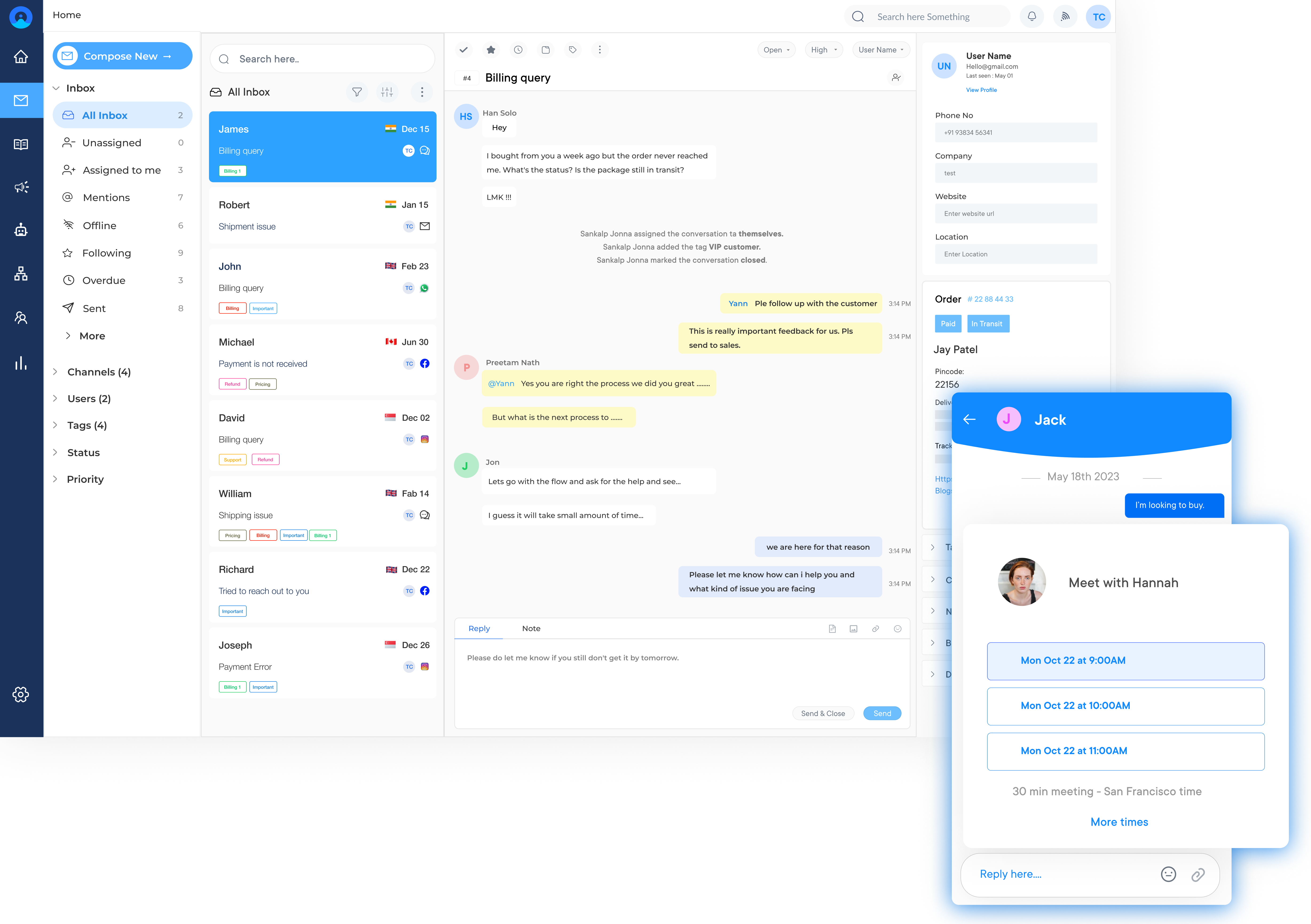
Provide real time engagement to assist customers and prospects via best live chat apps while interacting directly via websites or mobile devices.
Deliver prompt responses with the best live chat application using voice chats, video calls and co-browsing.
Interact with customers in real time as they prefer instant help with minimal effort. Online chat apps let users interact with agents while delivering support across multiple channels like websites and social media.
Condense customer pain points by addressing queries to streamline workflows. Live chat app allows to gather customer queries and feedback while categorizing it to the right agents.
Convert website visitors into leads with instant engagement. A website with immediate support assistance boosts website conversions. Motivate first-time user decisions by providing accurate information about products.
Manage customer service by delivering instant solutions in real time. It helps website visitors land exactly where they need to save time and effort reducing customer effort while increasing efficiency.
Every minute a customer waits for a response is like earning their trust. Slow email queues and missed calls cost businesses revenue daily, and disconnected tools only make things worse. Live chat apps and real-time messaging platforms integrated on websites enable teams to meet customers at the moment their intent is highest.
Companies using live chat have higher revenue per chat and customer satisfaction rates. Walkthrough the definitive guide to understand the features, pricing and use cases to choose the right live chat app for your team.
A live chat app is defined as a messaging platform that allows businesses to communicate with their customers in real-time. These apps are commonly used on websites and mobile applications to provide instant customer support, answer questions or assist with any issues that may arise during the customer’s online journey.
Deploying the best live chat apps enhances the customer experience by offering immediate assistance and personalized interaction. Live chat reduces response times compared to email or phone support, making it a preferred channel for customers seeking quick resolutions.
The key objectives of live chat apps are:
Live chat apps are a vital tool for businesses to improve their customer service and allow businesses to communicate with their customers in real-time, providing instant support.
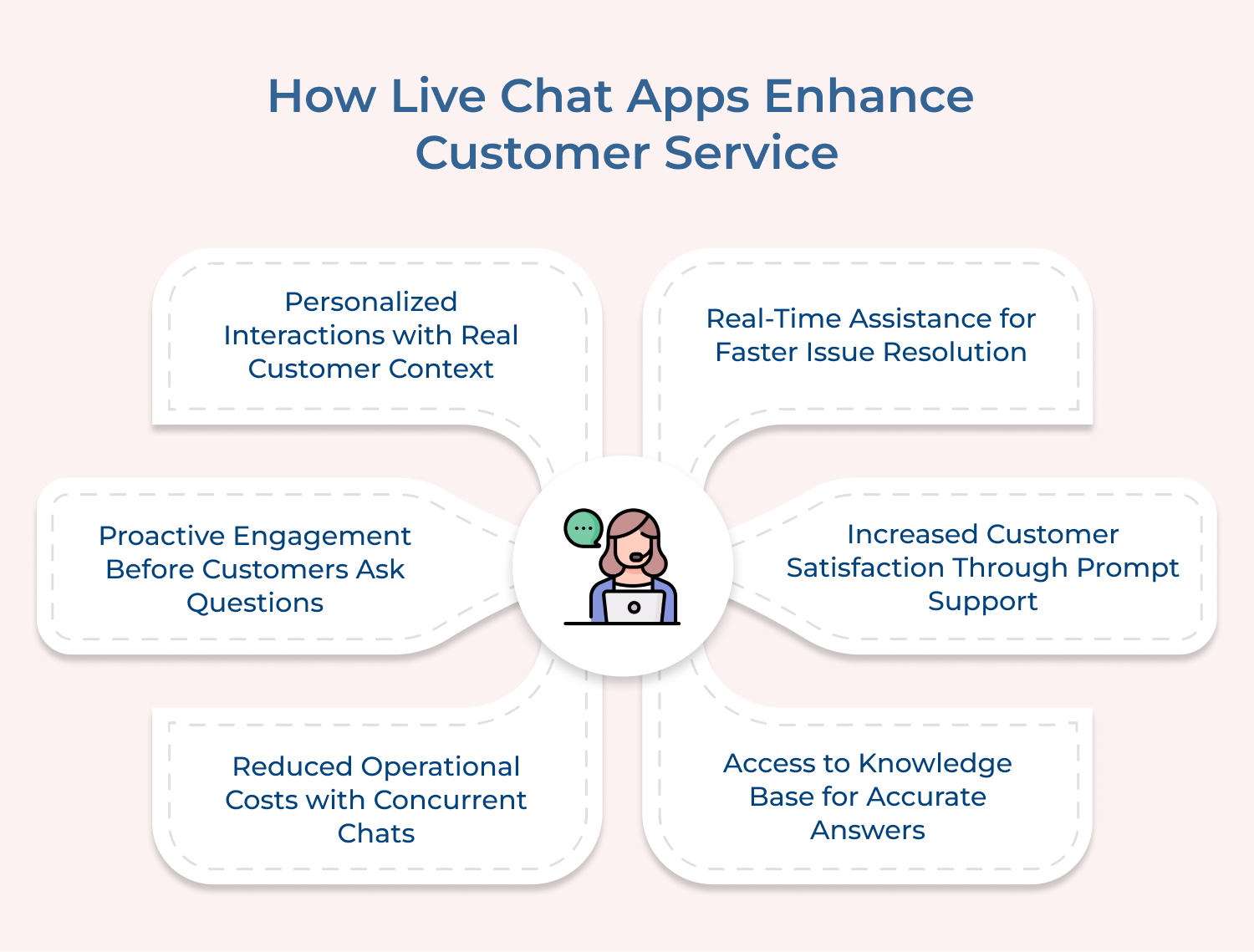
Live chat agents can pull up customer information the moment a conversation starts, such as purchase history, past tickets and browsing behavior. The context lets agents skip repetitive questions and jump straight into solving the actual problem, making customers feel recognized.
Personalization also extends beyond current conversation into long-term relationship building. Customers who are consistently receiving tailored responses instead of generic scripts are more likely to trust the brand, turning routine support interactions into a genuine driver of loyalty over time.
Emails leave customers waiting hours for a reply, whereas live chat delivers instant, real-time support the moment an issue arises. Agents can guide customers through complex technical issues live and immediately clarify confusion before it turns into frustration.
This is valuable during high-stakes moments such as checkout errors or account access issues, where delays directly move to lost revenue. Businesses that resolve problems in real time see fewer escalations and significantly shorter overall resolution times.
Live chat allows businesses to proactively reach out based on browsing behavior or page or cart abandonment signals. The shifts support from reactive to preventive to help catch confusion before it turns into a frustrated customer.
Proactive engagement feels helpful instead of intrusive when timed around genuine hesitation instead of triggered immediately on page load. It signals attentiveness, which many customers associate with stronger overall brand trust.
Personalized and efficient support through live chat directly shapes how customers perceive a brand’s reliability compared to being on hold during a phone call or waiting days for an email reply. This consistency builds stronger loyalty and higher retention. Satisfied customers are also likely to leave positive reviews and recommend the business to others.
Live chat support is generally more cost-effective than traditional phone support because agents handle multiple conversations. This directly reduces the number of agents needed to manage the same support volume, reducing staffing costs meaningfully.
Proper integration with centralized knowledge base allows agents to quickly pull up relevant documentation instead of relying on asking colleagues for help. This ensures customers receive accurate answers regardless of which agent happens to be handling chat session.
Training time is also reduced for new agents, since they can depend on documented answers while building product knowledge. It also eliminates misinformation and keeps support quality steady even as teams grow or turnover happens.
When choosing a live chat app for your business, it’s essential to consider a range of features that can enhance the customer experience and improve operational efficiency.
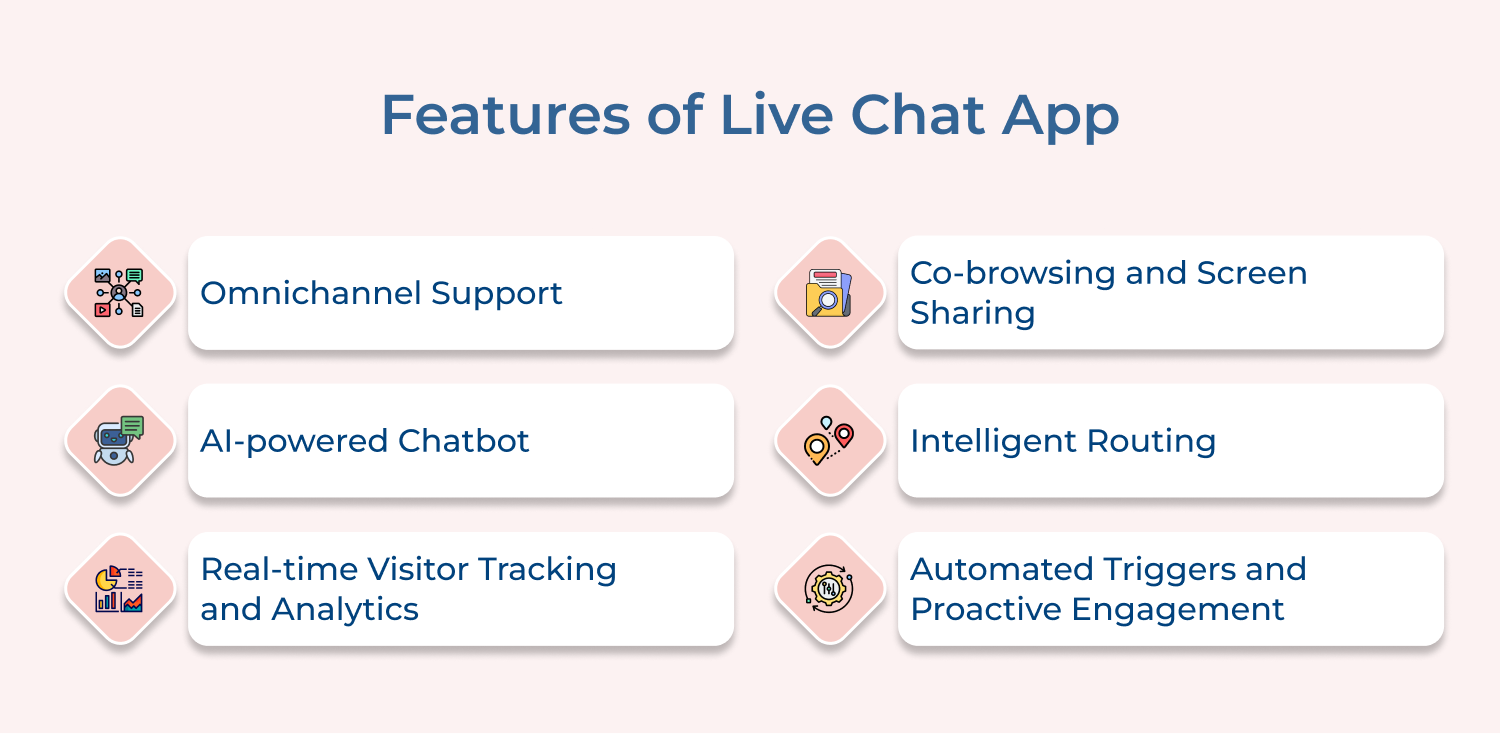
Connect communication channels, such as social media, messaging apps, and email, into one shared inbox, providing a cohesive omnichannel experience. It ensures that customers can initiate and continue conversations across multiple touchpoints without disruption.
Advanced capabilities such as co-browsing and screen-sharing enable agents to view and navigate a customer’s browser or screen in real-time. Provides personalized assistance, walking customers through complex processes or troubleshooting technical issues more effectively.
Chatbots can complement live chat agents by handling routine inquiries, providing 24/7 support, and automating repetitive tasks. Look for a live chat app that allows you to integrate customizable chatbots, enabling you to tailor them to your business needs and provide a seamless handoff to human agents when necessary.
Intelligent routing ensures that incoming chat requests are automatically routed to the most suitable agent based on predefined rules. Such rules include language, skill set, or product expertise, resulting in personalized support.
Provide valuable insights into customer behavior, website performance, and chat metrics. The data can help you identify areas for improvement, optimize your support processes and make data-driven decisions to enhance the overall customer experience.
Online chat applications offer automated triggers and proactive engagement features. These capabilities allow you to initiate chat conversations based on predefined rules, such as visitor behavior, time spent on specific pages or cart abandonment, providing timely assistance and improving conversion rates.
Live chat apps have become an essential tool for businesses looking to provide real-time customer support and engage with their website visitors.
Best live chat app for customer engagement
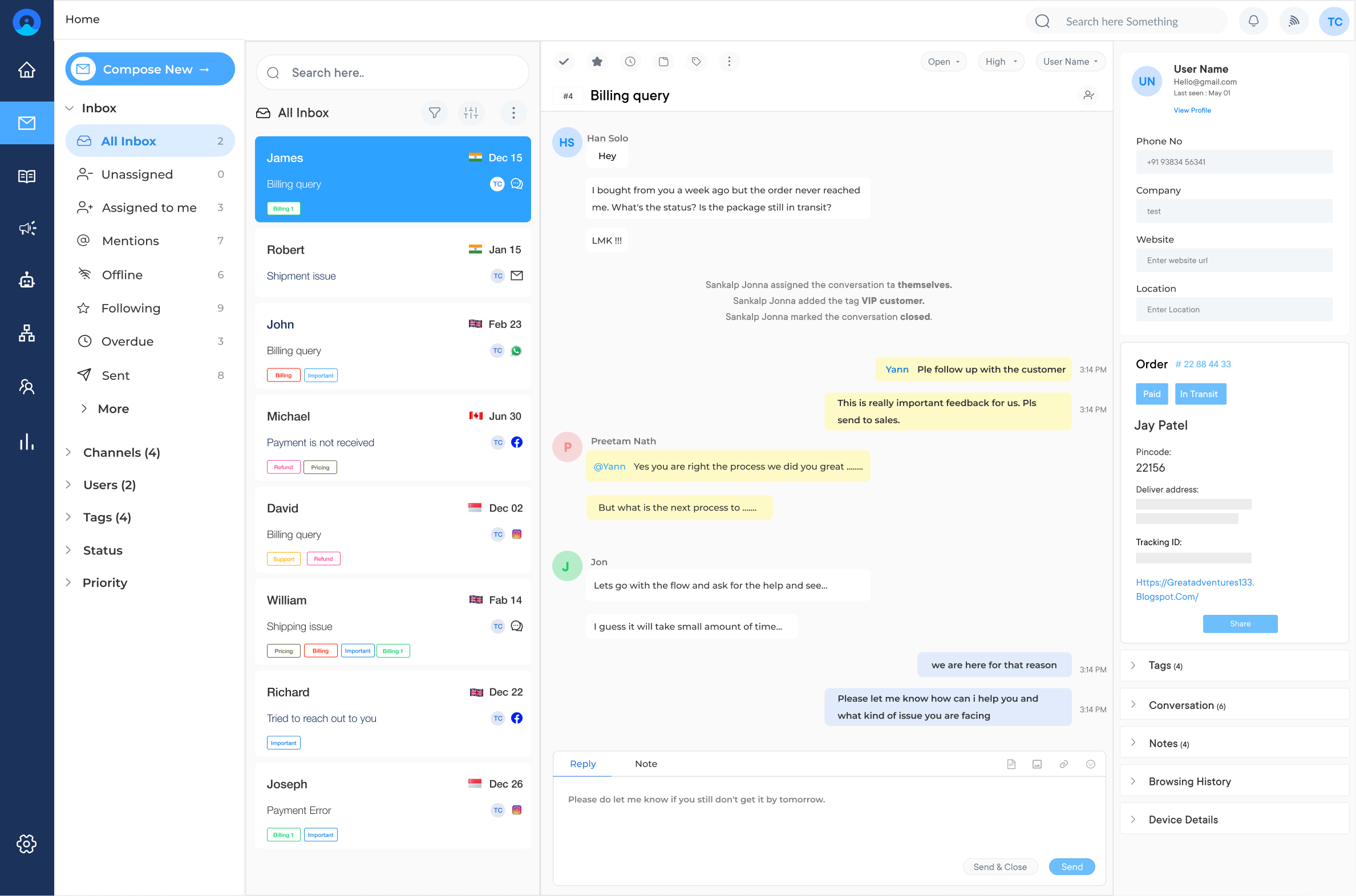
Omni24 is a customer experience software that offers live chat, email automation and a knowledge base to support businesses in providing excellent customer service. The platform allows for seamless integration with various e-commerce platforms and boasts of powerful features for easy customization as well as management, unlike LiveChat features that aren’t user-friendly.
Key features:
Pricing: The pricing starts from $29/user/month with one inbox feature to unlimited inbox for $149/user/month. The pricing depends on factors like the number of users, the level of features required, and the scale of customer support operations. Omni24 also offers a 14-day free trial for businesses to explore its features. Check out their pricing for more detailed comparison.
Excellent platform for conversational marketing and sales
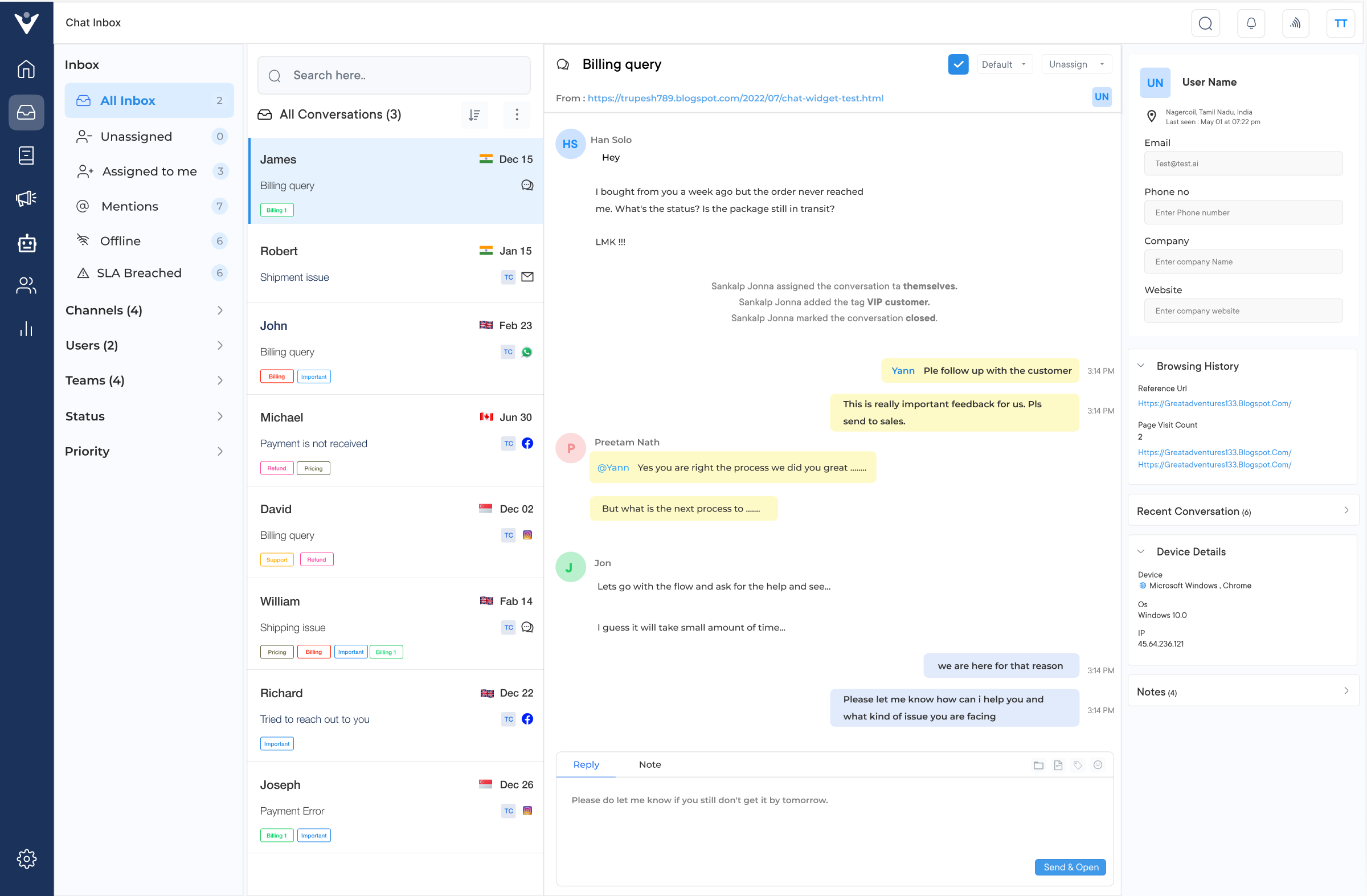
Veemo Chat is a business messaging platform that helps businesses communicate with their customers in real-time, providing a seamless customer support experience. Live chat lets agents engage website visitors in real time while accessing shared customer data, so conversations stay contextual every time. Businesses engage with potential customers and guide them towards making a purchase.
Key features:
Pricing: Veemo’s pricing plans start from $29/user/month and go up to $129/user/month based on the features and add-ons.
Powerful customer service platform
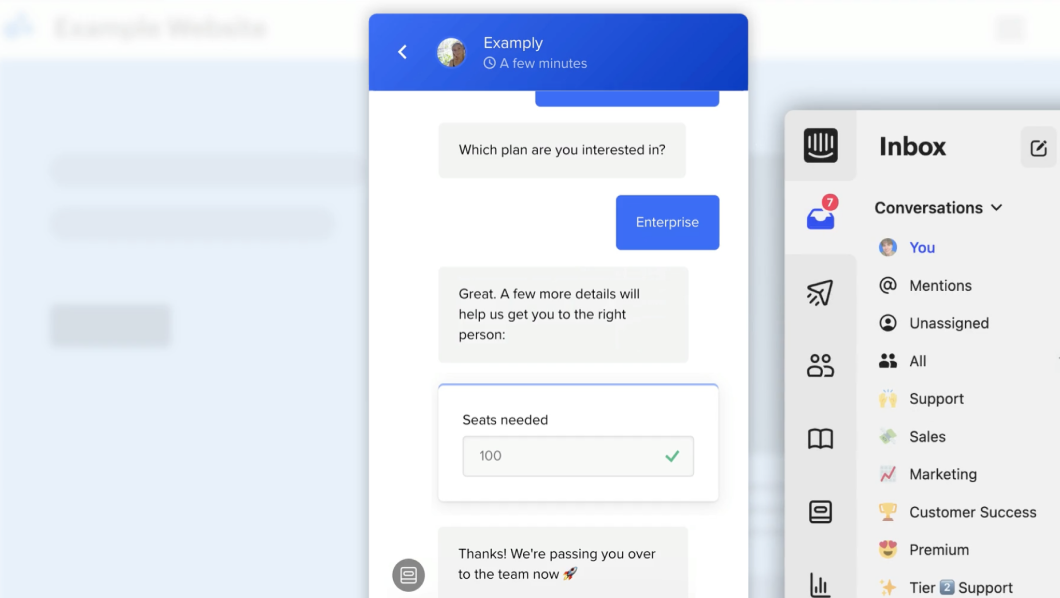
Intercom is a customer communication platform that offers live chat, email, and in-product messaging capabilities. It is designed to help businesses provide personalized and contextual support to their customers.
Why businesses should use Intercom: Intercom enables businesses to communicate with customers in real-time, improving customer satisfaction and reducing churn. It provides a unified view of customer data, allowing businesses to personalize their interactions and deliver a seamless experience.
Key features: Conversational support through live chat and in-product messaging. Automated lead qualification and routing based on predefined rules. Customizable chat widget and in-product messaging interfaces.
Pricing: Intercom offers a range of pricing plans, starting from $67 per month for the Starter plan, and scaling up based on the number of users and additional features required.
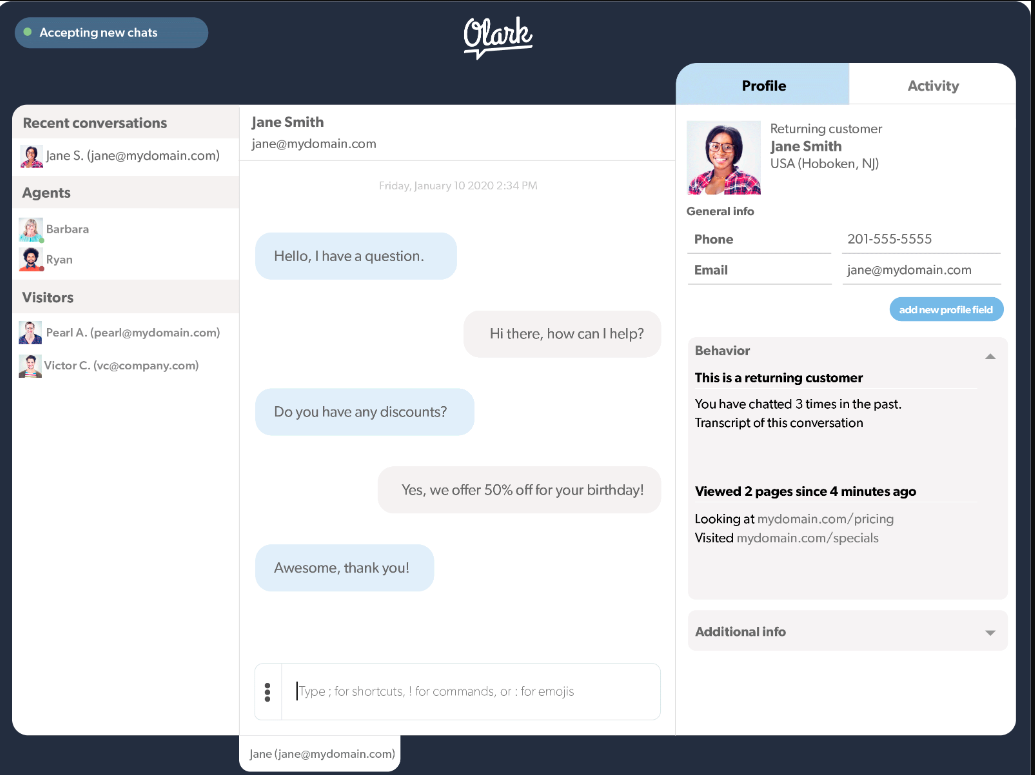
Olark is a live chat software designed specifically for small businesses and e-commerce websites. It offers a range of features to facilitate real-time customer support and sales assistance.
Why businesses should use Olark:
Olark provides a user-friendly interface that is easy to set up and customize for small businesses. It offers robust chat management tools, including chat transcripts, visitor tracking, and team collaboration features.
Key features: Customizable chat widget with branding and language options. Visitor tracking and behavior monitoring for proactive engagement. Integration with popular e-commerce platforms and CRM systems.
Pricing: Olark offers a range of pricing plans, starting from $17 per month for the Basic plan, with higher-tier plans offering additional features and customization options.
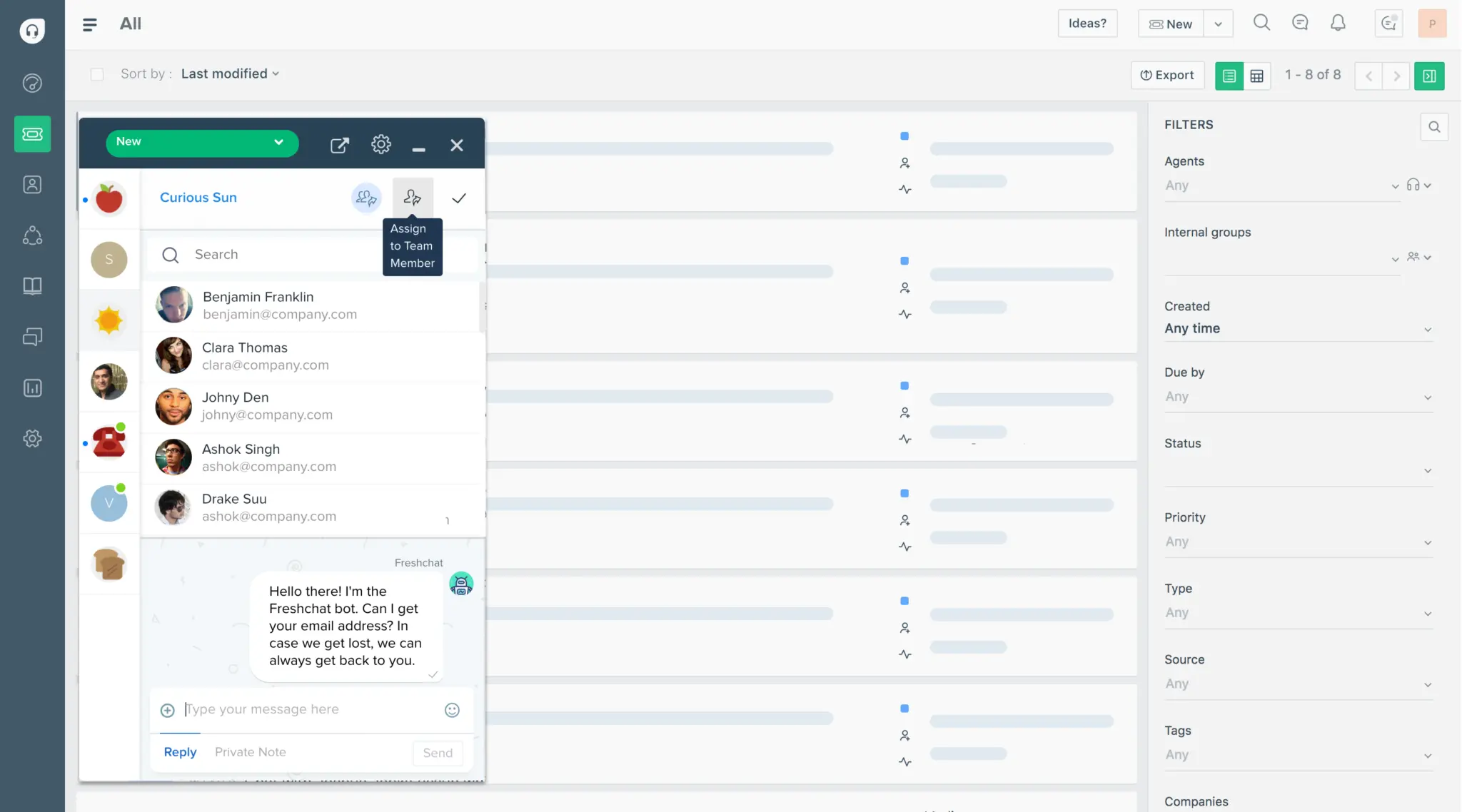
Freshchat is a part of the Freshworks suite of customer engagement tools, offering a comprehensive live chat solution for businesses.
Why businesses should use Freshchat:
Freshchat provides a unified platform for customer support, sales, and marketing, enabling seamless collaboration across teams. It offers advanced automation and AI-powered capabilities, such as chatbots and intent recognition, to streamline customer interactions.
Key features: Omnichannel support through live chat, email, and messaging apps. AI-powered chatbots and intent recognition for automated responses. Detailed customer journey tracking and analytics for optimization.
Pricing: Freshchat offers a range of pricing plans, starting from $19 per month for the Sprout plan, with higher-tier plans offering additional features and user seats.
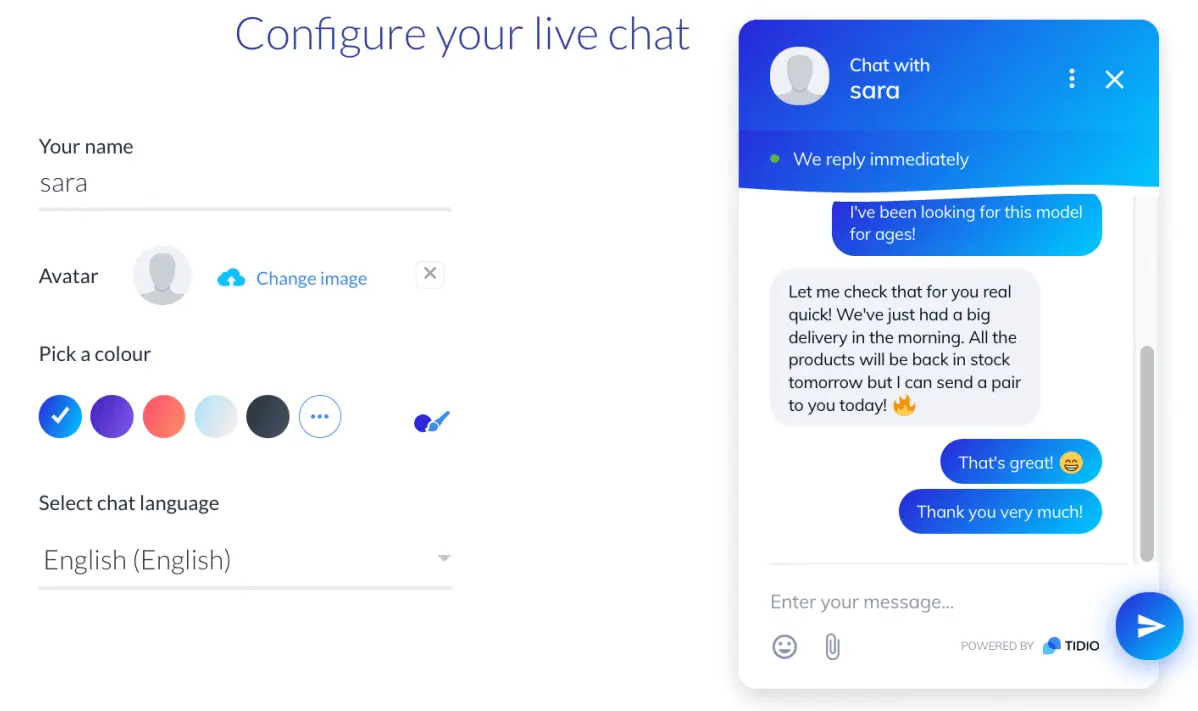
Tidio is a user-friendly live chat solution designed for small businesses and e-commerce websites. It offers a range of features to facilitate real-time customer support and engagement.
Why businesses should use Tidio:
Tidio provides a simple and intuitive interface that is easy to set up and use, even for non-technical users. It offers a range of customization options, allowing businesses to match the chat widget with their branding and design.
Key features: Customizable chat widget with branding and language options. Built-in chatbots and automated responses for 24/7 support. Integration with popular e-commerce platforms and marketing tools.
Pricing: Tidio offers a freemium plan with basic features, and paid plans starting from $19 per month for the Communicator plan, with higher-tier plans offering additional features and user seats.
Great live chat app for better customer service
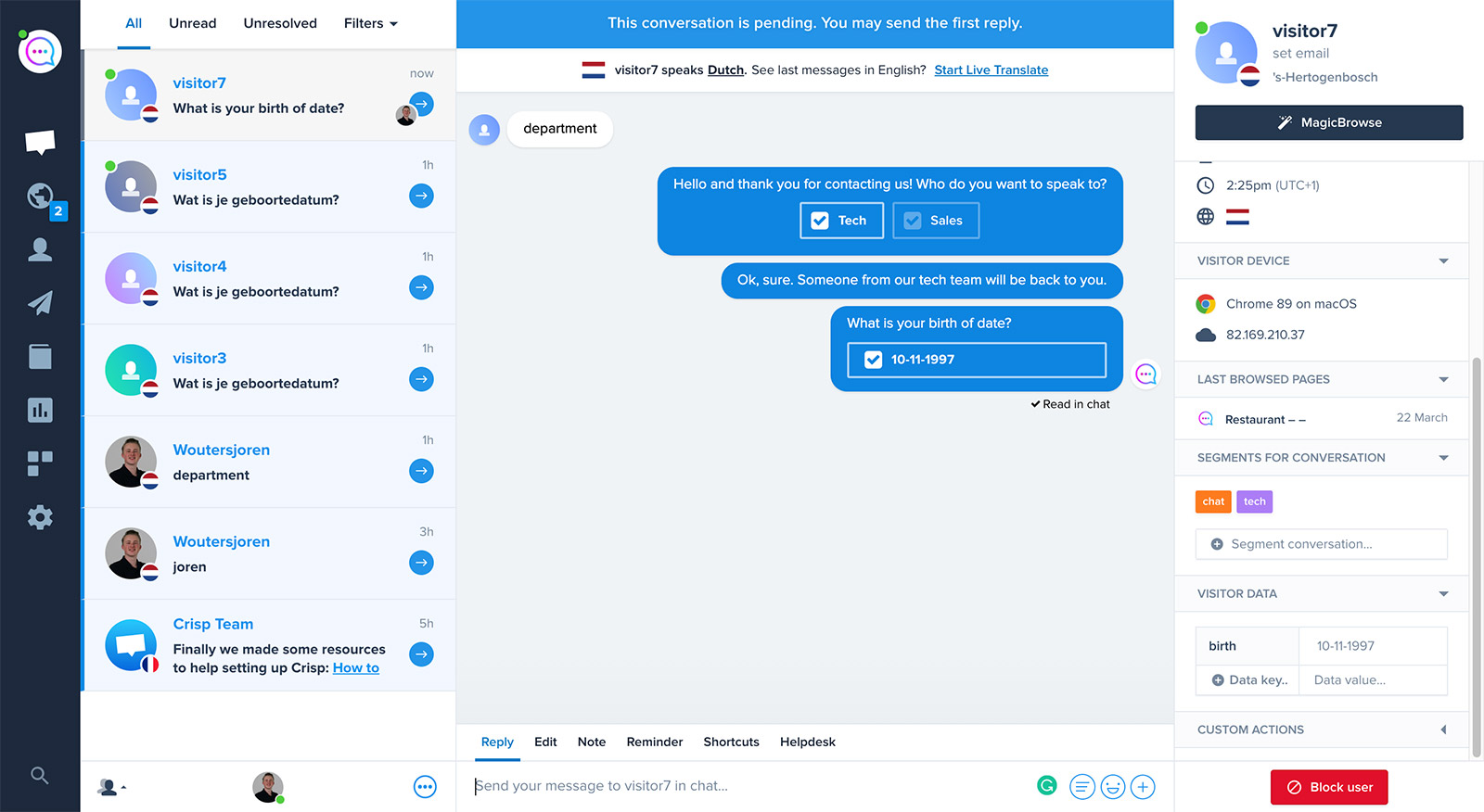
Crisp is a live chat and conversational marketing platform designed for businesses of all sizes. It offers a range of features to facilitate real-time customer support and lead generation.
Why businesses should use Crisp:
Crisp provides a unified platform for live chat, email, and messaging apps, enabling omnichannel customer support. It offers advanced targeting and segmentation features, allowing businesses to deliver personalized experiences based on customer behavior.
Key features: Omnichannel support through live chat, email, and messaging apps. Advanced targeting and segmentation for personalized engagement. Detailed customer journey tracking and analytics for optimization.
Pricing: Crisp offers a range of pricing plans, starting from $25 per month for the Unlimited plan, with higher-tier plans offering additional features and user seats.
A powerful omnichannel customer service platform that seamlessly integrates live chat with email, social media, and phone support. It offers AI-powered automated responses, customizable chat widgets and detailed analytics. Teams can leverage features like chat routing, visitor tracking and trigger-based messaging. The platform also provides robust reporting tools to measure agent performance and customer satisfaction.
Key features: It includes co-browsing for real-time issue resolution, canned responses to speed up interactions, and smart routing to efficiently direct customer inquiries.
Pricing: Zendesk Chat has 4 pricing edition(s), from $0 to $55. A free trial of Zendesk Chat is also available.
A comprehensive customer experience platform featuring a modern live chat solution that helps businesses engage visitors in real-time. It stands out with its multi-location management capabilities, mobile-first design, and intelligent chatbot integration. The platform excels in converting website visitors through instant responses and automated lead qualification, while offering seamless integration with other Birdeye tools like reviews and surveys.
Key features: Birdeye is a comprehensive reputation management platform that offers live chat as one of its key features apart from live chat, it empowers businesses to monitor online reviews, collect customer feedback.
Pricing: Birdeye has 3 pricing edition(s), from $299 to $399. A free trial of Birdeye is also available.
Read more: Want to compare Birdeye with other tools? Read more about the top Birdeye alternatives.
The best online chat app is one that provides an efficient communication experience for users while offering a robust set of capabilities. Let’s explore key factors to consider:
Team Adoption & Learning Curve
A feature-rich live chat app fails if your team resists. Consider how quickly your staff can get comfortable with the interface, since a steep learning curve slows down daily work. Low adoption often means teams quietly revert to email or scattered personal messaging apps.
Security & Data Privacy
Team conversations often include sensitive business information, so end-to-end encryption genuinely matters. Evaluate how the app handles data storage, message retention and access permissions before rollout. This becomes important if you operate in a regulated industry.
Vendor Reliability & Uptime History
A live chat app that frequently goes down disrupts real work. Check the vendor’s public uptime record and past incident history before long-term commitment. Teams that depend on the communication tool your team uses should not experience unpredictable outages during critical business hours.
Integration Ecosystem
A chat app that connects with your existing tools saves teams from constantly switching between apps. Strong native integrations or open APIs make the tool more useful as your tech stack scales over time. Poor integration support creates isolation instead of a connected workflow.
Total Cost as You Scale
Most platforms price attractively for small teams but grow expensive fast per additional agent added. Look for pricing at your projected team size, not just headcount; this helps you avoid an unpleasant surprise at renewal time.
Cross-Platform Reliability
The app should work consistently across desktop, mobile and web without sync. Teams with remote or hybrid members require reliable cross-device performance to stay connected. Inconsistent software performance often leads to missed messages and frustrated employees.
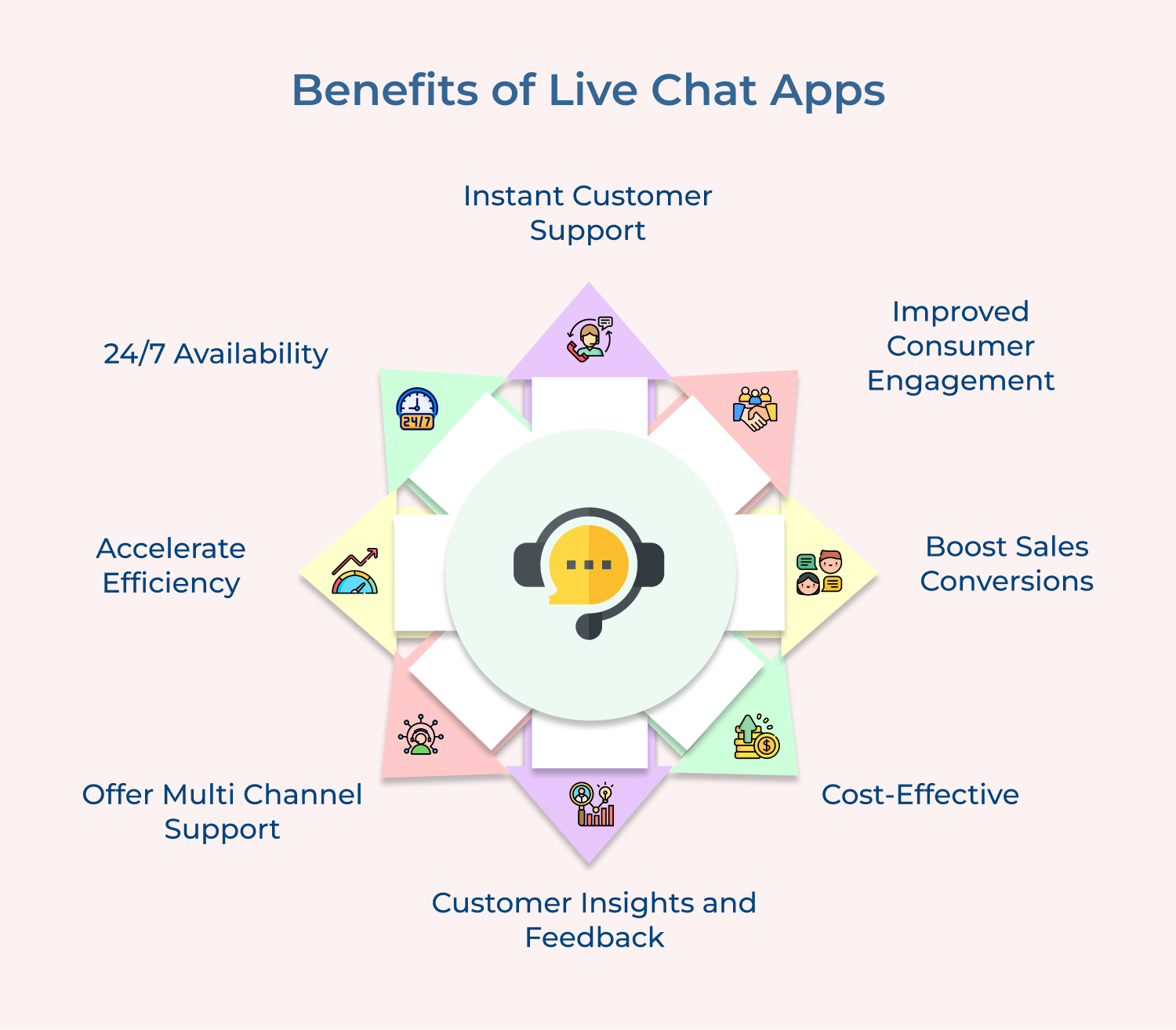
Live chat apps have become increasingly popular as they offer numerous benefits for both businesses and consumers.
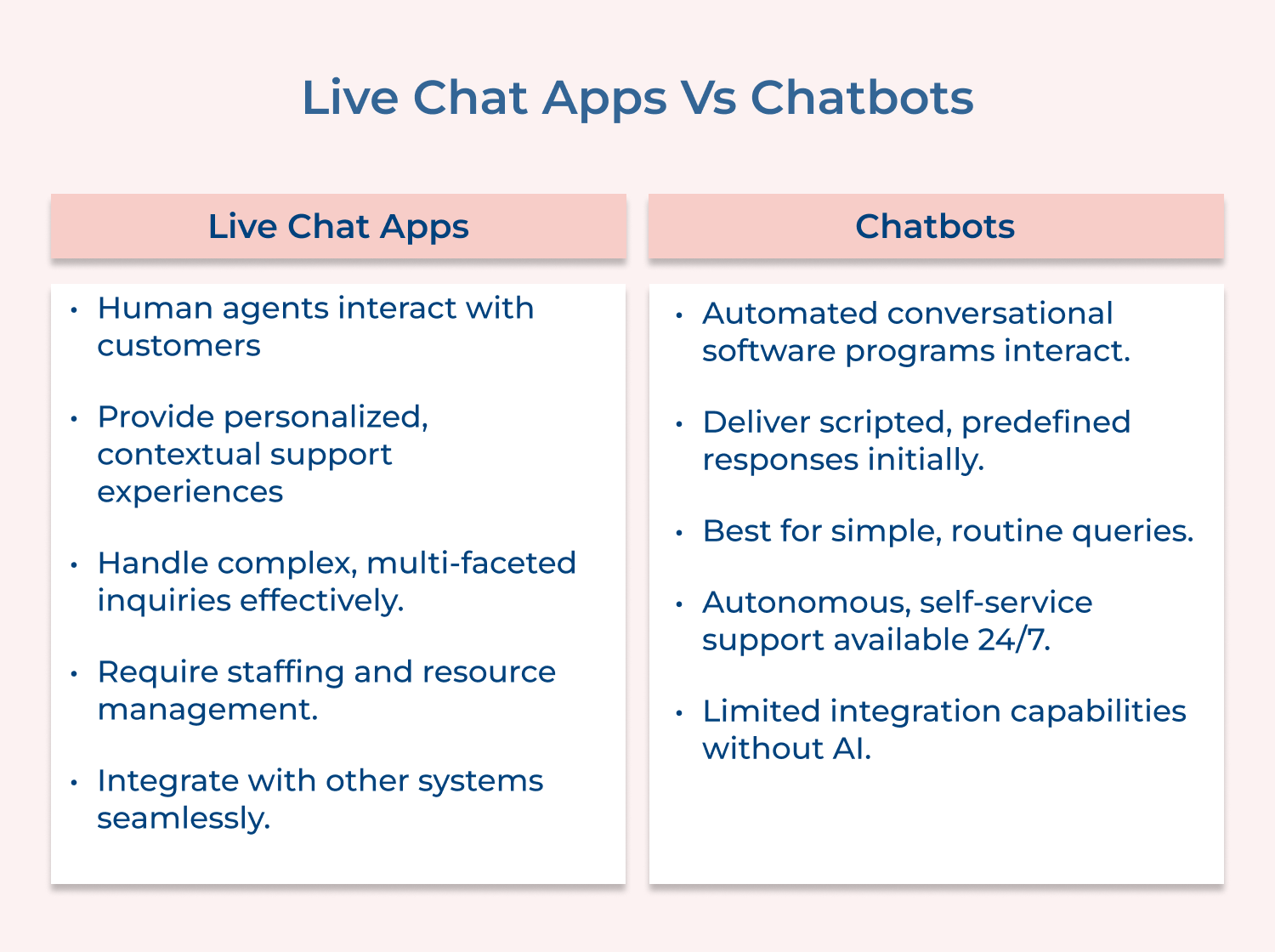
Live chat apps and chatbots are both designed to provide customer support and engagement, but they differ in several key ways.
1. Human Involvement
Live chat apps involve real human agents who interact with customers in real-time, providing personalized and contextual support. Chatbots in comparison, use artificial intelligence (AI) and natural language processing (NLP) to simulate conversations without human intervention.
2. Conversational Complexity
Human agents can handle complex conversations by understanding context or emotions to provide tailored solutions to unique situations. While chatbots are improving with advancements in AI. They still have limitations in handling ambiguity and providing fully contextual responses.
3. Availability and Scalability
Availability of live chat support is limited by the number of human agents and their working hours. AI bots on other hand can operate around the clock, handling an unlimited number of concurrent conversations, making them highly scalable and available 24/7.
4. Personalization and Empathy
Human agents through live chat can provide a highly personalized and empathetic experience by adapting their communication style or approach based on customers’ needs. While chatbots lack the genuine empathy or emotional intelligence of human agents.
5. Integration and Functionality
Online chat apps often integrate with other systems like CRM, helpdesk software and knowledge bases, enabling agents to access customer data as well as relevant information for effective support. Chatbots is more limited and focused on specific tasks, such as answering FAQs or guiding users through predefined workflows.
Utilizing live chat apps can bring significant benefits to businesses, such as improved customer engagement, increased sales and enhanced customer satisfaction.
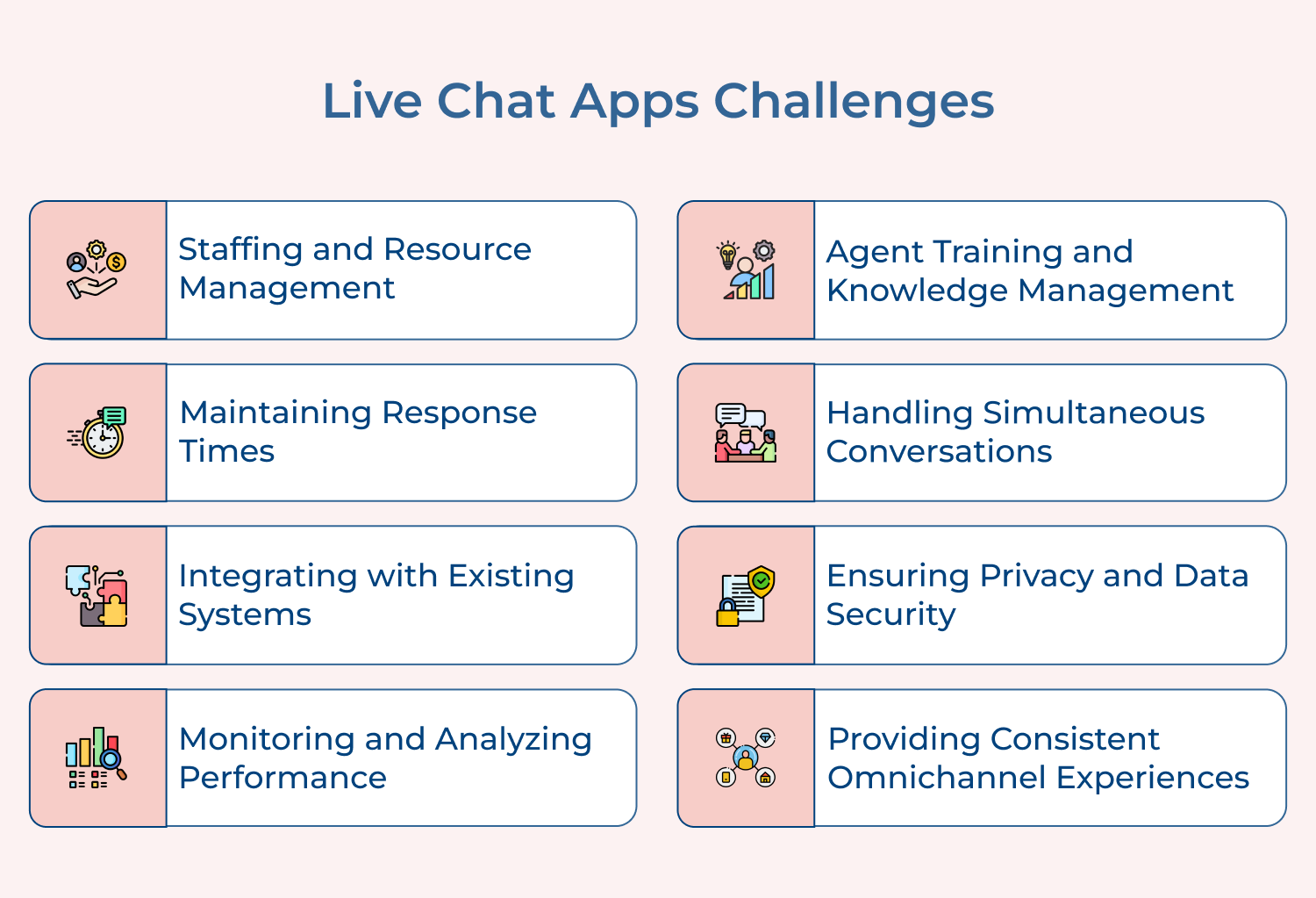
1. Staffing and Resource Management
Ensuring adequate staffing and resource allocation to handle live chat inquiries can be challenging, especially during peak hours or periods of high demand.
Solution: Implement workforce management strategies, such as forecasting demand, scheduling agents effectively and utilizing chatbots or self-service options to supplement human agents during high-volume periods.
2. Agent Training and Knowledge Management
Providing consistent and accurate responses to customer queries requires well-trained agents with access to up-to-date knowledge bases.
Solution: Invest in comprehensive agent training programs, maintain a robust and regularly updated knowledge base. Provide agents with access to relevant product or service information to ensure they can deliver informed and reliable support.
3. Maintaining Response Times
Meeting customer expectations for prompt responses can be difficult, especially during periods of high chat volume or when handling complex inquiries.
Solution: Implement service level agreements (SLAs) and response time targets to monitor live chat metrics. Leverage features like intelligent routing, prioritization, and escalation protocols to ensure timely responses.
4. Handling Simultaneous Conversations
Agents may struggle to effectively manage multiple chat sessions simultaneously, leading to decreased efficiency and potentially compromised customer experience.
Solution: Provide agents with training on multitasking as well as chat management best practices, implement features like conversation threading or tabbed interfaces, and consider setting reasonable limits on the number of concurrent chats an agent can handle.
5. Integrating with Existing Systems
Seamlessly integrating live chat apps with existing customer relationship management (CRM), helpdesk, or other business systems can be complex and time-consuming.
Solution: Choose a live chat app that offers robust integration capabilities and API. Work closely with the vendor or internal IT teams to ensure proper integration and data synchronization.
6. Ensuring Privacy and Data Security
Live chat apps may handle sensitive customer data, raising concerns about data privacy and security.
Solution: Select a live chat app that adheres to industry-standard security protocols, such as encryption, secure data storage and compliance with relevant regulations (e.g., GDPR, PCI-DSS). Implement strict access controls. Regularly review and update security measures.
The right live chat app can transform your customer support experience with real-time conversations that drive satisfaction and conversions. A good platform must align with your team size, budget and integration needs.
Ready to boost your customer conversations? Book a demo of Omni24 to explore all features and use cases.
Omni24’s customer engagement platform harnesses automation and AI to deliver unified customer experiences across digital channels, while keeping human touch
Adding a live chat app to your website is typically a simple process. Most live chat apps provide you with a code snippet that you can easily add to your website’s HTML. Once the code is added, the live chat widget will appear on your website, allowing visitors to initiate a conversation with your customer support team.
The best live chat app is one that offers seamless integration with your website, provides multiple customization options, supports real-time messaging, offers chatbots for automated responses and provides analytics to track performance.
When choosing a live chat app for your website, consider factors such as ease of use, customization options, chatbot capabilities, reporting or analytics features, integration with other tools, security measures and pricing. It’s also important to choose a live chat app that aligns with your business’s specific needs and goals.
Live chat apps let e-commerce businesses answer product questions and address concerns in real time, right when a customer is deciding whether to buy. This immediate support enables shoppers to walk through the checkout process, reduces hesitation and builds trust with buyers.
Reputable live chat apps use encryption to protect conversations between customers and support agents from interception. Most platforms layer on additional safeguards to keep customer data protected across the conversation lifecycle.
Live chat apps let agents manage several conversations at once through a unified dashboard, whereas phone support ties up one agent per caller. This concurrency makes chat significantly more efficient at scale.
Live chat apps can be customized for different industries by incorporating industry-specific features, branding elements and messaging strategies. For example, a live chat app for a healthcare website may include features for scheduling appointments, discussing health concerns and maintaining patient privacy.
Similarly, a live chat app for an e-commerce website may include features for product recommendations, order tracking and customer feedback. By tailoring live chat apps to specific industries, businesses can better meet the needs of their customers and improve their online presence.
 https://omni24.io/wp-content/uploads/2026/09/Social-commerce-scaled.png
1340
2560
Webvision Solution
https://omni24.io/wp-content/uploads/2023/04/Omni-Logo-1.svg
Webvision Solution2026-10-23 12:18:272026-10-23 12:18:27What is Social Commerce and Why Does It Matter?
https://omni24.io/wp-content/uploads/2026/09/Social-commerce-scaled.png
1340
2560
Webvision Solution
https://omni24.io/wp-content/uploads/2023/04/Omni-Logo-1.svg
Webvision Solution2026-10-23 12:18:272026-10-23 12:18:27What is Social Commerce and Why Does It Matter? https://omni24.io/wp-content/uploads/2026/08/AI-Customer-Service-Agents.png
1256
2400
Webvision Solution
https://omni24.io/wp-content/uploads/2023/04/Omni-Logo-1.svg
Webvision Solution2026-09-21 04:48:512026-09-21 04:48:51How to Build an AI Customer Service Agents: 8 Key Steps
https://omni24.io/wp-content/uploads/2026/08/AI-Customer-Service-Agents.png
1256
2400
Webvision Solution
https://omni24.io/wp-content/uploads/2023/04/Omni-Logo-1.svg
Webvision Solution2026-09-21 04:48:512026-09-21 04:48:51How to Build an AI Customer Service Agents: 8 Key Steps https://omni24.io/wp-content/uploads/2026/08/Omnichannel-Conversational-AI.png
1256
2400
Tushar Joshi
https://omni24.io/wp-content/uploads/2023/04/Omni-Logo-1.svg
Tushar Joshi2026-09-16 03:51:072026-09-16 03:51:07How to Build Omnichannel Conversational AI Strategy
https://omni24.io/wp-content/uploads/2026/08/Omnichannel-Conversational-AI.png
1256
2400
Tushar Joshi
https://omni24.io/wp-content/uploads/2023/04/Omni-Logo-1.svg
Tushar Joshi2026-09-16 03:51:072026-09-16 03:51:07How to Build Omnichannel Conversational AI Strategy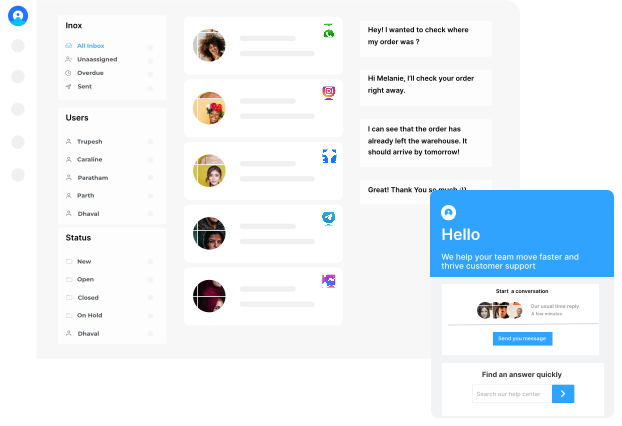
Whether it’s about acquire, engage or support – Omni24 covers all your customer engagement needs in one complete platform.

Copyright ©2026 Veemo All rights reserved.
CA, Los Angeles, Hall Ave, 19011