Integrations > Facebook

Project Management & Issue Tracking
Manage Facebook comments, ad comments, messages and mentions, right from Gorgias.
Integrations > Facebook
Project Management & Issue Tracking
Manage Facebook comments, ad comments, messages and mentions, right from Gorgias.
Conversational sales software offers a suite of tools designed to streamline prospect engagement and accelerate deal velocity. These features that enable faster, smarter selling.
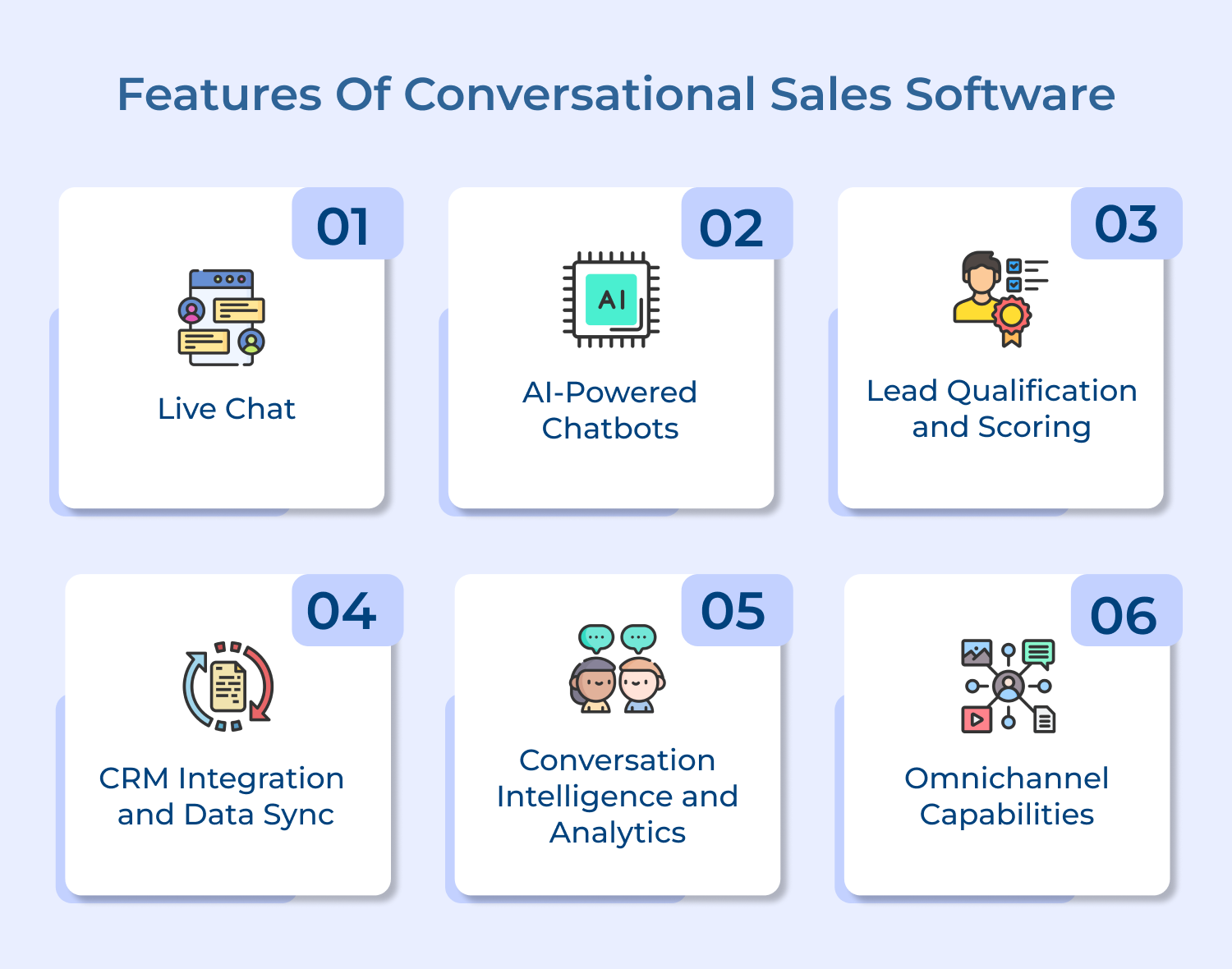
Live chat enables instant engagement with prospects directly through websites and mobile apps, addressing inquiries before potential leads disengage. It acts as the frontline of sales interaction, eliminating the wait times that commonly lead to drop-offs.
Modern platforms integrate live chat with channels like email and social media, allowing for seamless communication across touchpoints. Intelligent routing ensures conversations are assigned to the most qualified sales representatives based on availability and subject-matter expertise.
AI chatbots manage initial prospect interactions with speed and consistency, using natural language to simulate human conversation. They qualify leads by asking context-relevant questions and escalating promising contacts to human agents when necessary.
With machine learning, these bots refine their responses over time by analyzing previous interactions and adapting to evolving customer behavior. Natural language processing ensures clarity and relevance, even when customer queries are unstructured or informal.
Automated lead qualification tools assess prospect actions and responses to determine purchase intent with precision. These systems help reduce time spent on low-quality leads by flagging high-potential opportunities early.
Lead scoring algorithms analyze engagement signals such as time on site, conversation topics, and content interaction. Scores update in real time, helping sales teams focus on the most promising leads at each stage of the funnel.
Tight integration with CRM systems ensures that all sales conversations and prospect details are automatically captured, minimizing manual data entry. This keeps records current and accessible across departments.
Two-way data sync empowers sales teams with instant context during live engagements and supports workflow automation based on conversation outcomes. Advanced integrations also allow custom mapping of fields and triggers tailored to sales processes.
Conversation intelligence tools extract actionable insights from sales interactions by identifying common objections, tone shifts and effective messaging techniques. These learnings support sales coaching and strategy refinement.
Analytics dashboards present key metrics such as average response times, lead conversion rates and rep performance. Built-in sentiment analysis highlights emotional cues in conversations, helping teams tailor follow-ups more effectively.
Omnichannel functionality allows prospects to move fluidly across channels (live chat, SMS, email, or phone) without losing context or conversation history. This ensures a consistent, convenient experience.
A unified inbox consolidates all communications into a single thread, simplifying response management. Synchronization across platforms and teams eliminates gaps, so no inquiry is missed, regardless of the channel or device used.
 https://omni24.io/wp-content/uploads/2026/09/Social-commerce-scaled.png
1340
2560
Webvision Solution
https://omni24.io/wp-content/uploads/2023/04/Omni-Logo-1.svg
Webvision Solution2026-10-23 12:18:272026-10-23 12:18:27What is Social Commerce and Why Does It Matter?
https://omni24.io/wp-content/uploads/2026/09/Social-commerce-scaled.png
1340
2560
Webvision Solution
https://omni24.io/wp-content/uploads/2023/04/Omni-Logo-1.svg
Webvision Solution2026-10-23 12:18:272026-10-23 12:18:27What is Social Commerce and Why Does It Matter? https://omni24.io/wp-content/uploads/2026/08/AI-Customer-Service-Agents.png
1256
2400
Webvision Solution
https://omni24.io/wp-content/uploads/2023/04/Omni-Logo-1.svg
Webvision Solution2026-09-21 04:48:512026-09-21 04:48:51How to Build an AI Customer Service Agents: 8 Key Steps
https://omni24.io/wp-content/uploads/2026/08/AI-Customer-Service-Agents.png
1256
2400
Webvision Solution
https://omni24.io/wp-content/uploads/2023/04/Omni-Logo-1.svg
Webvision Solution2026-09-21 04:48:512026-09-21 04:48:51How to Build an AI Customer Service Agents: 8 Key Steps https://omni24.io/wp-content/uploads/2026/08/Omnichannel-Conversational-AI.png
1256
2400
Tushar Joshi
https://omni24.io/wp-content/uploads/2023/04/Omni-Logo-1.svg
Tushar Joshi2026-09-16 03:51:072026-09-16 03:51:07How to Build Omnichannel Conversational AI Strategy
https://omni24.io/wp-content/uploads/2026/08/Omnichannel-Conversational-AI.png
1256
2400
Tushar Joshi
https://omni24.io/wp-content/uploads/2023/04/Omni-Logo-1.svg
Tushar Joshi2026-09-16 03:51:072026-09-16 03:51:07How to Build Omnichannel Conversational AI Strategy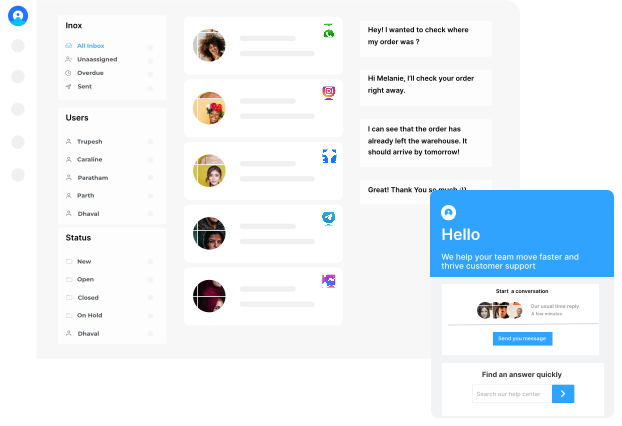
Whether it’s about acquire, engage or support – Omni24 covers all your customer engagement needs in one complete platform.

Copyright ©2026 Veemo All rights reserved.
CA, Los Angeles, Hall Ave, 19011