How to Implement Customer Knowledge Management: 6 Key Steps
Customer Knowledge Management gathers and uses customer insights to anticipate needs, refine strategies and enhance experiences for a competitive edge.

Customer Knowledge Management gathers and uses customer insights to anticipate needs, refine strategies and enhance experiences for a competitive edge.
Many businesses struggle to understand their customer’s needs and preferences. The lack of insights can lead to decreased customer satisfaction. Effective Customer Knowledge Management (CKM) addresses this challenge by analyzing customer data into actionable insights.
A study by Aberdeen Group revealed that organizations with strong knowledge management practices achieve a 15% -30% improvement in productivity, translating to significant cost savings.
Implementing CKM allows organizations to enhance customer relationships and drive business growth. Leveraging customer knowledge empowers companies to deliver personalized experiences that resonate with their audience and cultivates loyalty.
Let us dive into the key components and how to implement customer knowledge management.
Customer Knowledge Management (CKM) refers to the systematic process of collecting, analyzing and leveraging customer information to enhance business strategies as well as improve customer relationships. It involves gathering data from various sources, including customer feedback, interactions, their preferences and transforming it into actionable insights.
CKM plays a crucial role in creating a more customer-centric organization. Effectively managing customer knowledge allows businesses to better understand their audience’s needs and behaviors, leading to improved products/services. The understanding builds stronger relationships, boosts customer satisfaction and drives loyalty and profitability.
Key objectives:
Customer Knowledge Management consists of essential elements that enable organizations to effectively analyze customer insights for strategic advantage. Here are the key components.

Data collection is crucial in Customer Knowledge Management, including various methods like surveys, feedback forms and social media monitoring. These approaches gather both quantitative and qualitative insights, allowing businesses to understand customer preferences, behaviors and sentiments, which inform strategic decision-making.
Data analysis transforms raw customer information into actionable insights. Techniques such as statistical analysis, sentiment analysis and trend identification help businesses discern patterns as well as to understand customer emotions. Utilizing appropriate analytical tools, organizations can make informed decisions that enhance customer satisfaction and drive growth.
Effective knowledge sharing ensures that insights gathered from customer data are accessible to all relevant stakeholders. Creating a centralized knowledge base and facilitating regular training sessions empower employees to utilize customer insights in their interactions, leading to improved service delivery and enhanced customer experiences.
Customer engagement focuses on building strong relationships through effective communication and personalized interactions. By leveraging customer knowledge, businesses can tailor experiences, recommendations, and marketing strategies to meet individual preferences for encouraging repeat business that enhances overall customer satisfaction.
Continuous improvement in Customer Knowledge Management involves establishing feedback loops that incorporate customer insights into ongoing strategies. Regular assessments of CKM processes ensure that businesses remain adaptive to changing customer needs, enabling them to refine their approaches and maintain a competitive edge in the market.
Implementing Customer Knowledge Management requires a structured approach, focusing on data collection, analysis and knowledge sharing to drive meaningful business outcomes.
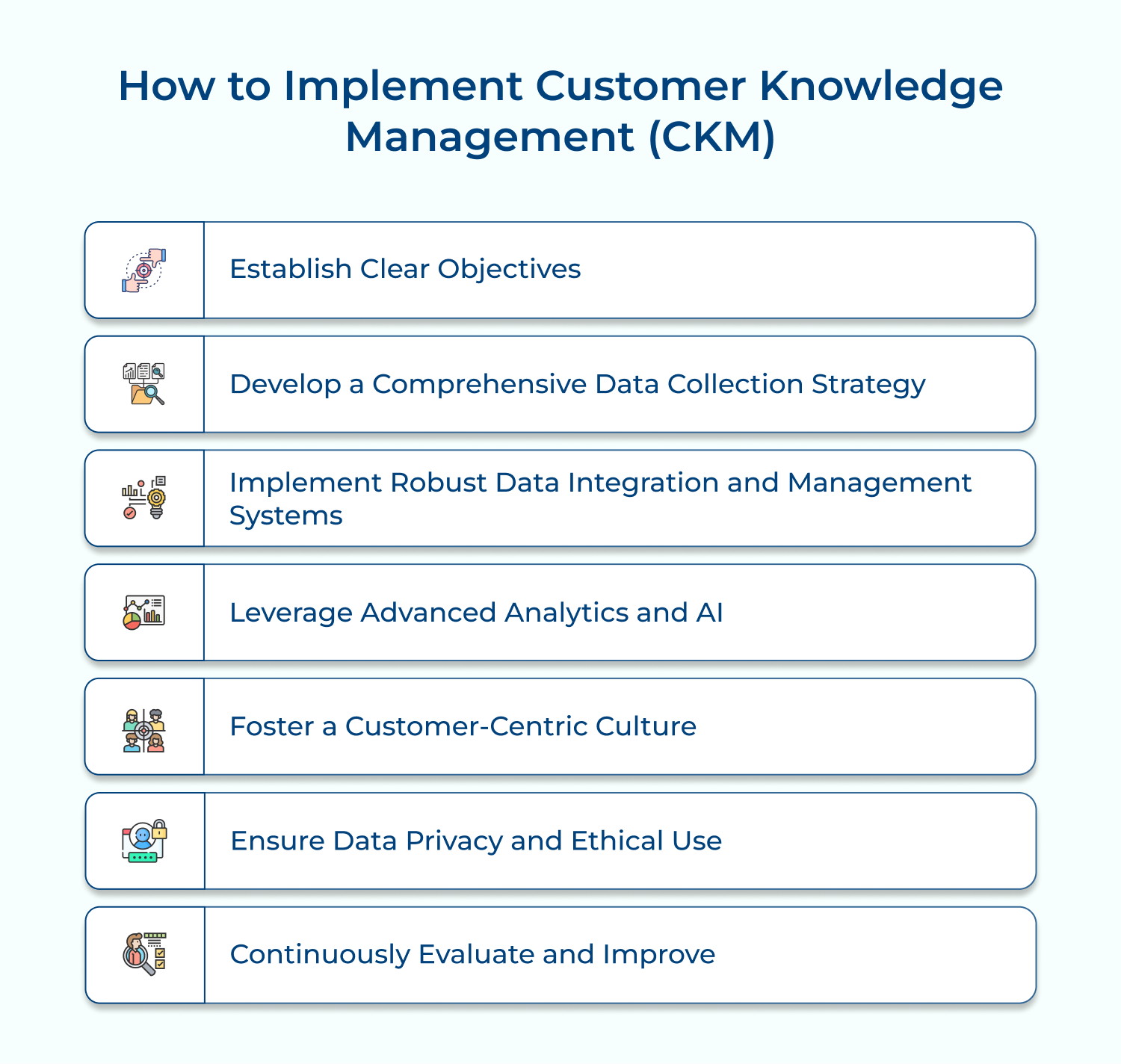
Defining clear objectives is crucial for CKM implementation as it provides direction as well as purpose. It ensures that all efforts are aligned with business goals and customer needs. Clear objectives help in measuring success, allocating resources effectively, and gaining buy-in from stakeholders across the organization.
Clear objectives guide the entire CKM process, from data collection to application. They help in prioritizing initiatives, selecting appropriate technologies, and designing customer-centric strategies. Objectives can be used to create key performance indicators (KPIs) for measuring the effectiveness of CKM efforts and driving continuous improvement.
Actionable tips:
A comprehensive data collection strategy is essential to gather accurate and relevant customer information. It ensures that all valuable data points are captured across various touchpoints.
The strategy helps in creating a holistic view of customers, avoiding data silos, and ensuring data quality plus consistency. It guides in the selection of data sources, collection methods, and tools. It also helps in designing customer surveys, implementing tracking mechanisms, and integrating data from various channels.
The data collection strategy also ensures that the right data is collected to support decision-making and personalization efforts.
Actionable tips:
Data integration and management systems consolidate data from various sources into a unified view. They ensure data consistency, accessibility, and security. These systems enable efficient data processing, reduce redundancies, and provide a single source of truth for customer information across the organization.
These systems can be used to create customer profiles, enable real-time data updates, and facilitate data sharing across departments. They support advanced analytics, personalization efforts, and enable a 360-degree view of the customer. Robust systems also ensure compliance with data protection regulations and maintain data integrity.
Actionable tips:
Advanced analytics and AI are essential as they enable businesses to uncover hidden patterns, predict customer behavior and automate decision-making processes. These technologies help in personalizing customer experiences, optimizing marketing efforts and identifying new business opportunities.
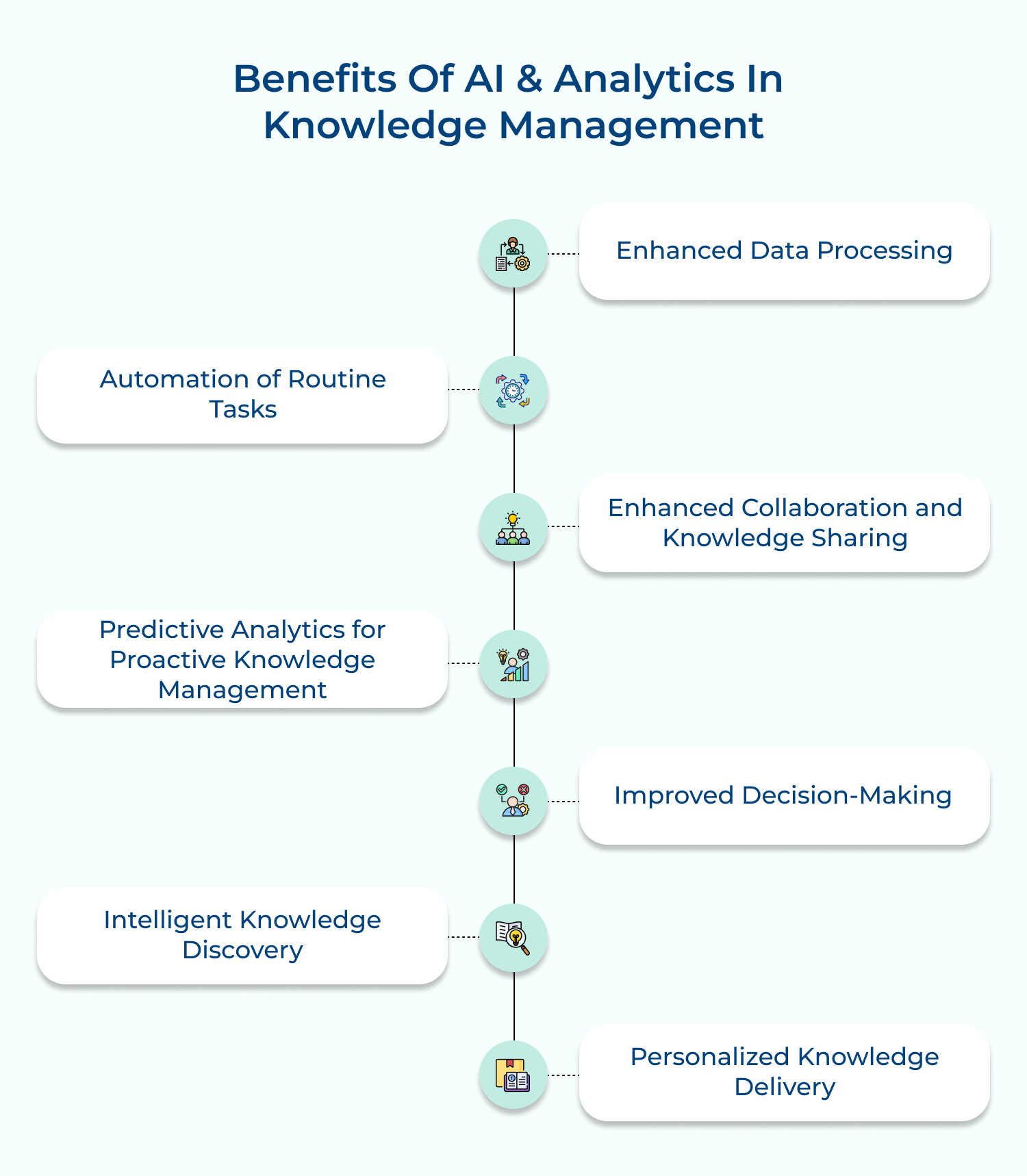
Advanced analytics and AI can be used for customer segmentation, churn prediction, sentiment analysis, and personalized recommendations. They can automate routine tasks, enhance chatbot interactions, and provide predictive insights for proactive customer service. These technologies enable businesses to make data-driven decisions and deliver hyper-personalized experiences at scale.
Actionable tips:
A customer-centric culture ensures that customer knowledge is valued, shared, and applied across the organization. The culture promotes employee engagement in CKM efforts, encourages customer-focused decision-making, and drives continuous improvement in customer experiences.
A customer-centric culture can be used to align all departments around customer needs. It promotes cross-functional collaboration, encourages employees to use customer insights in their daily work and drives innovation based on customer feedback. The culture helps in creating a consistent and superior customer experience across all touchpoints.
Actionable tips:
Continuous evaluation and improvement maintains the effectiveness of CKM initiatives. They ensure that CKM strategies remain aligned with changing customer needs and business objectives. Regular assessment helps in identifying areas for improvement, adapting to new technologies and maximizing the return on investment in CKM.
Evaluation regularly can measure the impact of CKM initiatives on key business metrics. It involves regularly reviewing KPIs, gathering feedback from users and customers, and benchmarking against industry best practices. The process informs strategy adjustments, technology upgrades and process refinements to enhance the overall CKM effectiveness.
Actionable tips:
Customer Knowledge Management plays a crucial role in driving business growth by enhancing customer relationships and informing data-driven strategic decisions. Here are the key impacts.

Targeted marketing strategies allow businesses to communicate more effectively with their audience, improving campaign performance and ROI. By tailoring messages to specific customer segments, companies can increase engagement, conversion rates, and customer acquisition while reducing marketing waste and improving cost-efficiency.
CKM enables targeted marketing by providing detailed customer profiles and segmentation data. This information can be used to create personalized marketing campaigns, select appropriate channels for different customer groups, and tailor messaging to resonate with specific audience segments. It allows for more precise targeting and timing of marketing efforts.
Optimizing loyalty programs is crucial for retaining customers and increasing their lifetime value. Well-designed loyalty programs can encourage repeat purchases, build emotional connections with the brand, and provide valuable data about customer preferences. They help businesses maintain a competitive edge by creating barriers to customer switching.
CKM can optimize loyalty programs by analyzing customer behavior, purchase history, and engagement patterns. This data can inform the design of rewards, personalize offers, and identify the most effective ways to engage different customer segments. It allows for dynamic adjustment of loyalty program elements to maximize their appeal and effectiveness.
Live analytics are essential for making timely, data-driven decisions in today’s fast-paced business environment. They provide real-time insights into customer behavior, sales performance, and operational efficiency, allowing businesses to quickly identify trends, address issues, and capitalize on opportunities as they arise.
CKM can power live analytics by continuously collecting and processing customer data from various touchpoints. The real-time information can be displayed on dashboards, triggering alerts for significant events or trends. It enables immediate response to customer needs, swift adaptation of marketing strategies, and proactive management of potential issues.
Optimizing resource allocation ensures that limited resources (time, money, personnel) are directed towards the most impactful activities and highest-value customers. Proper resource allocation helps businesses maintain competitiveness, improve customer satisfaction, and drive profitability in a resource-constrained environment.
CKM informs resource allocation by providing insights into customer value, behavior patterns, and service needs. The data can guide decisions on where to invest in product development, which customer segments to prioritize for marketing or service improvements, and how to distribute resources across different channels or departments.
Rapid adaptation allows companies to stay relevant, capitalize on new opportunities quickly, and mitigate risks associated with market shifts. The ability to adapt swiftly can be a significant competitive advantage, helping businesses maintain market share and customer loyalty.
CKM facilitates rapid adaptation by providing real-time insights into changing customer preferences, emerging trends, and shifts in market dynamics. The data can be used to quickly adjust product offerings, marketing strategies, and service approaches. It enables businesses to make informed decisions quickly and pivot their strategies in response to market changes.
Consistent brand experiences are essential for building strong brand identity and driving loyalty. They ensure that customers have a cohesive interaction with the brand across all touchpoints, reinforcing brand values and promises. Consistency in brand experience reduces customer confusion and strengthens the overall brand perception.
CKM enables consistent brand experiences by providing a unified view of customer interactions across all channels. The comprehensive data can be used to ensure messaging, service quality, and product offerings are consistent across all touchpoints. It allows for personalized yet brand-aligned experiences, tailoring interactions while maintaining core brand elements.
The benefits of Customer Knowledge Management include improved customer satisfaction, and enhanced decision-making processes that contribute to overall business success.

1. Improved communication: Effective CKM leads to more informed interactions, ensuring customers receive timely and accurate information. It reduces frustration and enhances satisfaction, as customers feel valued and understood.
2. Faster resolution of issues: The comprehensive understanding of customer history and needs, businesses can address inquiries and complaints more efficiently. Quick resolutions enhance customer trust and loyalty, making customers feel prioritized.
3. Greater engagement: CKM builds deeper relationships between businesses and customers, encouraging active participation. Customers are more likely to engage through feedback, surveys, and discussions when they see their input valued and acted upon.
4. Enhanced customer insights: CKM provides businesses with valuable data on customer preferences and behaviors. These insights help organizations tailor their offerings, improving market positioning and customer satisfaction.
5. Increased efficiency: Centralizing customer knowledge streamlines processes, allowing teams to access information quickly. This efficiency reduces response times and operational costs, enhancing overall productivity.
6. Improved customer retention: Understanding customer needs enables businesses to proactively address issues and enhance loyalty. CKM fosters long-term relationships, resulting in higher retention rates and reduced churn.
Real-world examples of Customer Knowledge Management illustrate how organizations effectively leverage customer insights to improve services and foster customer loyalty. Here are some notable examples.
Amazon leverages its vast customer data to create personalized product recommendations. By analyzing browsing history, purchase patterns, and customer preferences, Amazon’s CKM system suggests products tailored to each user. It not only enhances the shopping experience but also increases sales through targeted cross-selling and upselling.
Netflix uses CKM to analyze viewing habits, ratings, and user interactions to suggest content. Their sophisticated algorithm considers factors like genre preferences, viewing times, and even the devices used. This personalized approach keeps users engaged and reduces churn by consistently offering relevant content.
Spotify’s CKM system creates a personalized “Discover Weekly” playlist for each user. By analyzing listening history, liked songs, and user-created playlists, Spotify introduces users to new music aligned with their tastes. This feature enhances user experience and keeps customers engaged with the platform.
Starbucks uses CKM in its mobile app to offer personalized promotions and rewards. The app tracks purchase history, favorite drinks and frequently visited locations to tailor offers. This approach increases customer loyalty and drives repeat business through targeted marketing.
Implementing Customer Knowledge Management (CKM) significantly enhances business performance through deeper customer insights and data-driven decision-making. Effectively collecting, analyzing and sharing customer knowledge allows organizations to strengthen relationships. The proactive approach boosts customer satisfaction while driving innovation and operational efficiency.
As businesses adapt to evolving market dynamics, a robust CKM strategy becomes essential for maintaining a competitive edge. Investing in CKM empowers companies to respond effectively to customer needs, ultimately leading to sustained growth and long-term success.

How Is Customer Knowledge Management Different from Traditional Knowledge Management?
Customer Knowledge Management (CKM) focuses specifically on gathering information about customers, their behaviors, preferences and interactions with the company. Traditional Knowledge Management, on the other hand, encompasses a broader scope, including internal processes, best practices and organizational know-how. CKM is more customer-centric and directly tied to improving customer experiences.
How does CKM add value to brands?
CKM adds value to brands by providing deep insights into customer needs, preferences and behaviors. This knowledge enables brands to create more personalized experiences, develop targeted marketing strategies and innovate products or services that truly resonate with their audience. By leveraging CKM, brands can enhance customer satisfaction, increase loyalty and ultimately drive revenue growth through improved customer retention.
How does customer knowledge management help in improving customer relationships?
Customer Knowledge Management improves customer relationships by enabling businesses to understand and anticipate customer needs better. It allows for personalized interactions, tailored product recommendations and proactive customer service. By leveraging CKM, companies can create more relevant experiences across all touchpoints, address customer pain points efficiently and demonstrate that they value their customers.
What role does data analytics play in customer knowledge management?
Data analytics plays a crucial role in Customer Knowledge Management by transforming raw customer data into actionable insights. It involves processing large volumes of data from various sources to identify patterns, trends and correlations in customer behavior. Analytics tools enable businesses to segment customers, predict future behaviors, personalize experiences and measure the effectiveness of customer-focused initiatives. This data-driven approach enhances decision-making and strategy formulation in CKM.
 https://omni24.io/wp-content/uploads/2026/08/Omnichannel-Conversational-AI.png
1256
2400
Tushar Joshi
https://omni24.io/wp-content/uploads/2023/04/Omni-Logo-1.svg
Tushar Joshi2026-09-16 03:51:072026-09-16 03:51:07How to Build Omnichannel Conversational AI Strategy
https://omni24.io/wp-content/uploads/2026/08/Omnichannel-Conversational-AI.png
1256
2400
Tushar Joshi
https://omni24.io/wp-content/uploads/2023/04/Omni-Logo-1.svg
Tushar Joshi2026-09-16 03:51:072026-09-16 03:51:07How to Build Omnichannel Conversational AI Strategy https://omni24.io/wp-content/uploads/2026/08/Customer-Service-Teams.png
1256
2400
Tushar Joshi
https://omni24.io/wp-content/uploads/2023/04/Omni-Logo-1.svg
Tushar Joshi2026-09-15 04:01:522026-09-15 04:02:16How to Build Customer Service Teams: 6 Key Steps
https://omni24.io/wp-content/uploads/2026/08/Customer-Service-Teams.png
1256
2400
Tushar Joshi
https://omni24.io/wp-content/uploads/2023/04/Omni-Logo-1.svg
Tushar Joshi2026-09-15 04:01:522026-09-15 04:02:16How to Build Customer Service Teams: 6 Key Steps https://omni24.io/wp-content/uploads/2026/08/conversational-ai-ecommerce.png
1256
2400
Webvision Solution
https://omni24.io/wp-content/uploads/2023/04/Omni-Logo-1.svg
Webvision Solution2026-09-08 04:06:222026-09-08 04:06:22How Conversational AI for Ecommerce Boosts Sales in 2026
https://omni24.io/wp-content/uploads/2026/08/conversational-ai-ecommerce.png
1256
2400
Webvision Solution
https://omni24.io/wp-content/uploads/2023/04/Omni-Logo-1.svg
Webvision Solution2026-09-08 04:06:222026-09-08 04:06:22How Conversational AI for Ecommerce Boosts Sales in 2026
Whether it’s about acquire, engage or support – Omni24 covers all your customer engagement needs in one complete platform.

Copyright ©2026 Veemo All rights reserved.
CA, Los Angeles, Hall Ave, 19011