Top 8 NPS Best Practices For a Higher Response Rate
Implement these 8 research-backed NPS best practices to dramatically increase survey response rates and gather meaningful customer feedback.

Implement these 8 research-backed NPS best practices to dramatically increase survey response rates and gather meaningful customer feedback.
Your carefully crafted NPS surveys are going unanswered. Low response rates leave you with insufficient data to make meaningful improvements, while the customers who do respond may not represent your broader user base. Studies show that average survey response rates typically range between 5% to 30%, depending on industry and channel.
Every ignored survey represents a missed opportunity to prevent churn and strengthen customer relationships. Worse, the customers most likely to ignore surveys are often those in the middle whose feedback could reveal your greatest growth opportunities.
Implement these eight research-backed NPS best practices, you will dramatically increase response rates while gathering more meaningful feedback. These approaches transform your surveys into valuable conversation starters.
An NPS (Net Promoter Score) survey is a customer feedback tool designed to measure loyalty and satisfaction through a simple yet powerful question framework.
In the B2B SaaS context, it helps companies understand how likely their clients are to recommend their software to others. It serves as a key indicator of customer health, customer experience, retention potential and growth opportunities through referrals.
NPS Questions product or success manager ask to the users:
These two questions work together powerfully – the numerical rating provides quantifiable data for tracking trends while the open-ended follow-up captures specific pain points or highlights that explain the rating. Together they paint a complete picture of customer sentiment.
Let’s explore how NPS scores are calculated and what they reveal about your customer relationships. NPS categorizes respondents into three segments based on their numerical responses:
For example, if a B2B analytics platform surveys 100 customers and receives 60 promoters, 30 passives as well as 10 detractors, their NPS would be 50 (60% – 10% = 50). This positive score suggests strong customer satisfaction with growth potential.
Key Principles:
NPS surveys have become a cornerstone of customer experience measurement. Let’s explore six key benefits they offer companies seeking deeper insights into their customers’ experiences.
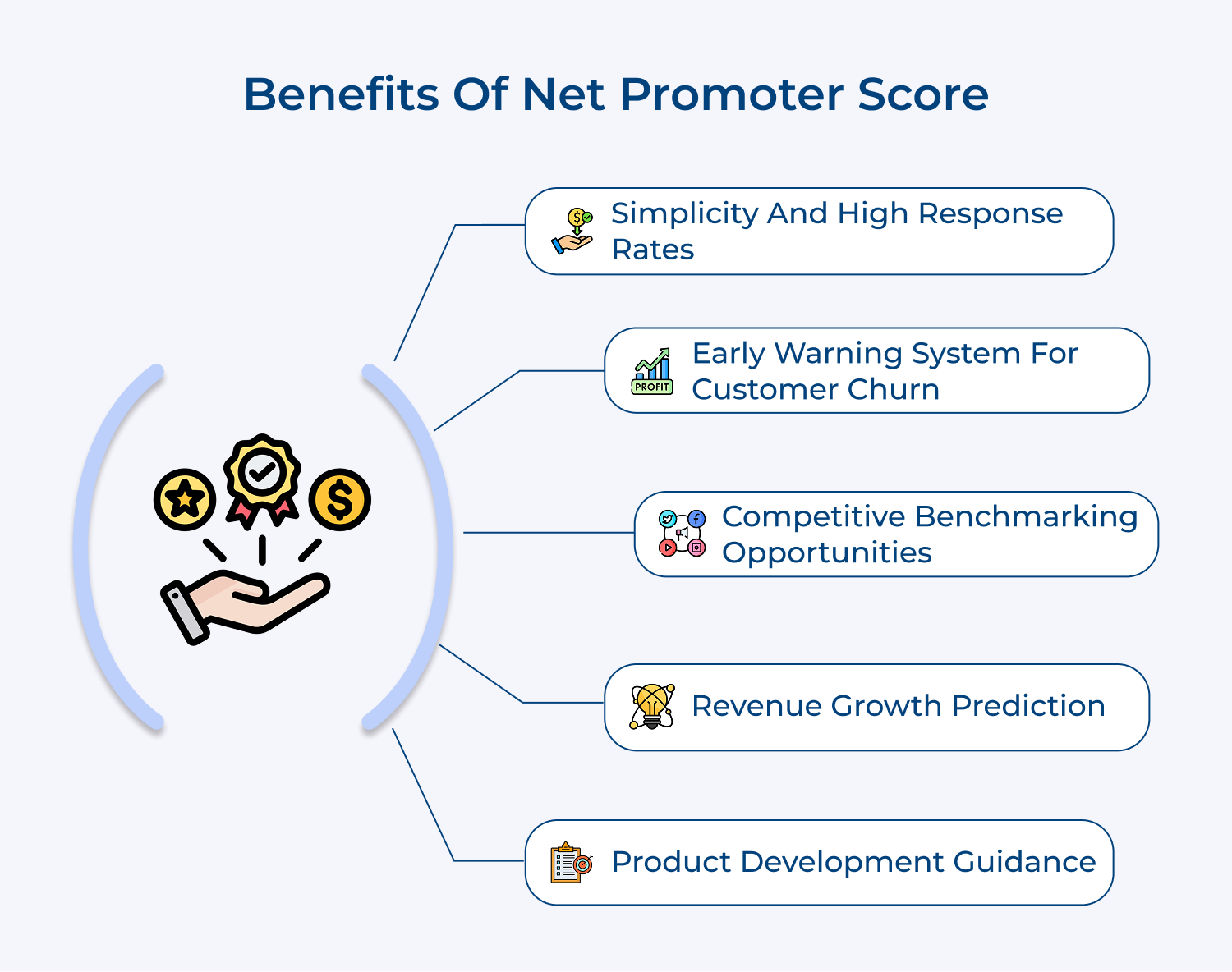
Simplicity that Drives High Response Rates
NPS surveys work because they’re short and easy. With just two survey questions, often including an open-ended question, busy professionals respond quickly. This simplicity leads to a higher average response rate compared to lengthy survey templates.
Early Warning System for Customer Churn
NPS surveys act as an early signal when customers are unhappy. Low scores highlight accounts at risk of churn before they leave silently. By combining scores with open-ended question feedback, customer success teams can step in proactively and prevent revenue loss in subscription-driven businesses.
Quantifiable Metric for Tracking CX Improvements
Unlike vague satisfaction ratings, NPS provides a measurable benchmark on a -100 to +100 scale. Tracking this score over time shows whether product updates, onboarding improvements, or support changes are making an impact. A quantifiable approach helps justify CX investments and proves business value.
Product Development Guidance
The open-ended feedback from NPS survey questions uncovers product gaps and unmet needs. When multiple users share similar pain points, teams can confidently prioritize fixes or new features. The customer-driven approach ensures product roadmaps focus on real issues and deliver meaningful improvements.
Cross-functional Alignment Around Customer Needs
NPS scores give every department a shared metric to rally around. Marketing, product and customer success teams work with the same survey templates and feedback to align on customer needs. The collaboration builds a stronger customer-centric culture and ensures consistent improvements across the business.
Let’s explore the top 7 NPS survey best practices that will help you achieve a higher response rate and unlock the full potential of customer feedback.
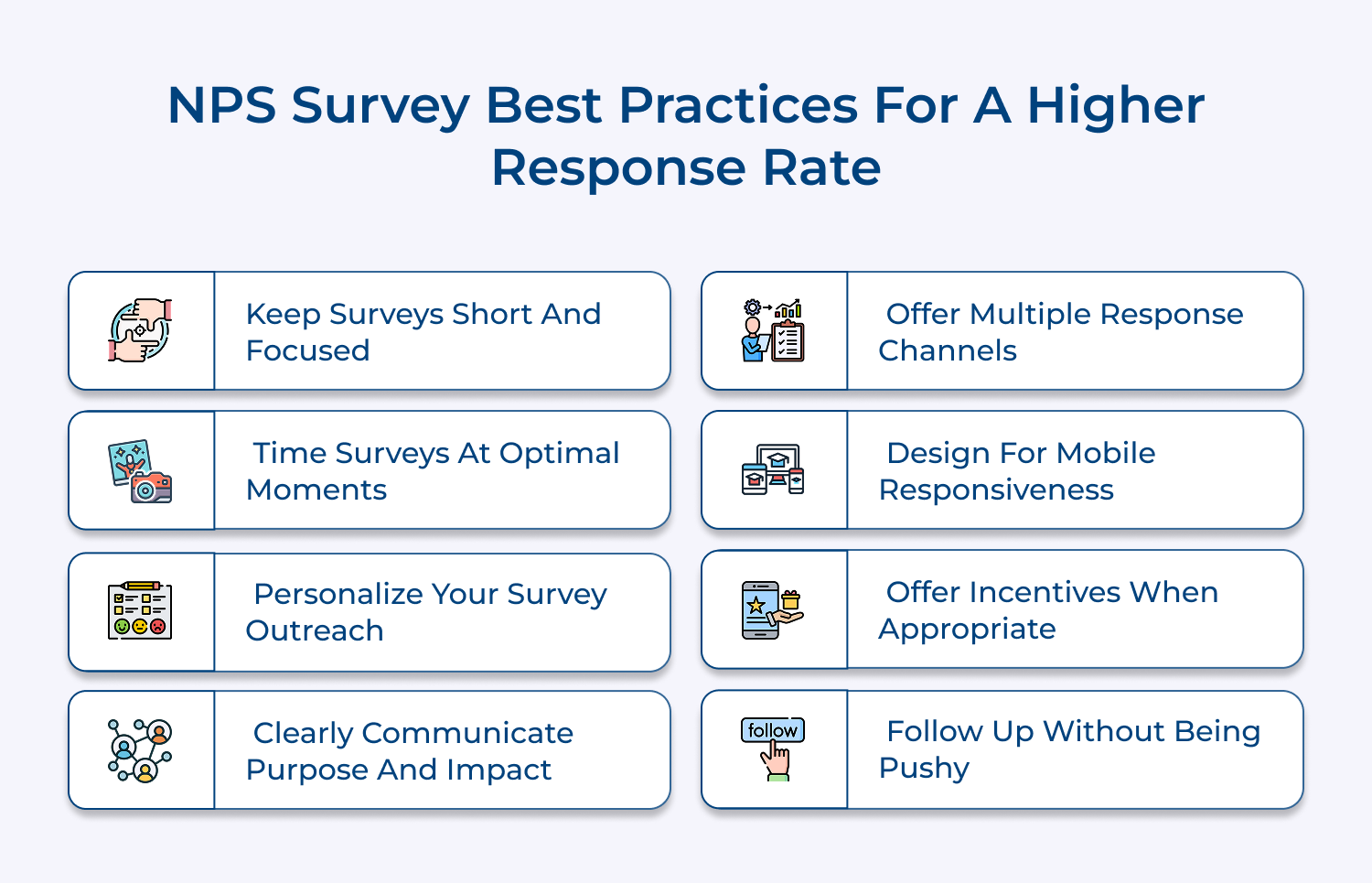
Clear, easy-to-read questions make NPS surveys more effective. Complicated wording or unclear phrasing often causes confusion, abandoned responses, or inaccurate feedback. When people understand a question right away, they give more thoughtful answers.
Use plain business language instead of jargon or technical terms. Break complex ideas into smaller survey questions, each focusing on one topic. For the main NPS question, explain what each number on the scale means. Before sending surveys, test your questions with colleagues from outside your team to ensure clarity.
For example, a SaaS company changed “How satisfied are you with the implementation of our solution’s capabilities?” to “How easy was it to set up our software?” The response rate improved instantly because customers understood the question without extra effort.
Pro tips: read survey questions aloud to spot awkward phrasing and add short context examples when needed.
The timing of NPS surveys has a major impact on response rates and feedback quality. If you send surveys at the wrong moment, customers will ignore them or respond without much thought. A smart strategy uses both relationship and transactional surveys for balance.
Relationship surveys are sent at fixed intervals, like quarterly or twice a year. They track overall satisfaction and long-term loyalty across the customer journey.
Transactional surveys are tied to specific events, such as onboarding completion, support resolution, or new feature use. Because they capture opinions immediately, the feedback reflects fresh experiences.
When used together, these surveys give a clear picture of customer loyalty and detailed insights into touchpoints. This dual approach highlights systemic issues and quick wins without overwhelming customers with too many survey questions.
Map your customer journey to choose the best timing. Identify key milestones and emotional moments where feedback is most meaningful as well as likely to be shared.
Personalization makes NPS surveys feel like real conversations instead of generic forms. When surveys acknowledge a customer’s unique context, response rates increase. Customers feel valued as individuals, not just data points.
Key personalization elements that boost engagement include:
For example, a project management SaaS firm saw survey abandonment drop after adding usage context. Customers no longer had to recall past activities, making surveys easier to complete.
Being transparent about why you collect feedback and how you’ll use it makes NPS surveys meaningful. Customers participate more when they know their input leads to action. Without this clarity, surveys feel one-sided and unworthy of their time.
Explain Your Feedback Goals
Start every survey with a short note on what you want to learn. Be specific, avoid generic lines like “we value your input.” Instead, explain which part of the experience you’re improving. This focus helps customers give sharper, more useful answers.
Share Previous Implementation Examples
Show that feedback drives real change. Mention one or two product updates or service improvements that came directly from past NPS survey responses. It builds trust and motivates participation.
Set Realistic Action Timeframes
Tell customers when their input may shape changes – whether immediate fixes, quarterly updates, or long-term planning. Setting clear expectations avoids disappointment and shows respect for their effort as well as time.
Offering multiple ways to complete your NPS survey makes feedback accessible and convenient. Relying on a single channel excludes customers who don’t use that medium often. By giving options, you increase participation and ensure responses reflect your full customer base.
Common survey distribution channels include:
The benefit of a multi-channel approach is meeting customers where they already are. Some check email rarely but answer SMS instantly. Others respond better to in-app surveys tied to their activity.
Choose the right channels by studying engagement data such as open rates, session frequency, and support preferences. Test different options to see which delivers the highest response rates for your segments.
Mobile-responsive NPS surveys recognize the reality that most business professionals now check email and use SaaS products across multiple devices. When your survey struggles on mobile, you lose responses from busy professionals checking email between meetings or while commuting. A frustrating mobile experience signals that you don’t understand how your customers actually work.
Create mobile-friendly surveys by using responsive design templates that automatically adjust to different screen sizes. Keep questions on a single screen whenever possible and replace radio buttons with larger touch targets that accommodate finger tapping. Test your survey across various devices before sending to ensure the experience remains smooth regardless of how customers access it.
Pro tips:
Strategic follow-up reminds busy customers about your survey without creating annoyance that damages the relationship. In a crowded digital environment, your initial survey request can easily get overlooked.
A thoughtful reminder increases response rates substantially but requires careful timing and messaging to avoid feeling like pressure or harassment. Implement reminder sequences by scheduling a single follow-up 3-5 days after the initial request using a slightly different subject line and message.
Consider using a different channel for the reminder if appropriate, such as a brief in-app notification following an email. Always acknowledge it’s a reminder and provide an easy way to decline further requests to respect customer boundaries.
Pro tips:
Strategic incentives can lift NPS survey participation, especially when response rates are low or critical feedback is needed. Customers’ time has real value, so incentives should act as a genuine thank-you, not a payment that biases their responses.
Effective incentive ideas for B2B SaaS NPS surveys:
The best incentives respect feedback integrity while showing appreciation for customer time. Choose options that match your brand values and strengthen relationships, ensuring feedback remains honest as well as actionable.
Here are five proven approaches to transform raw NPS data into strategic direction for your SaaS business.
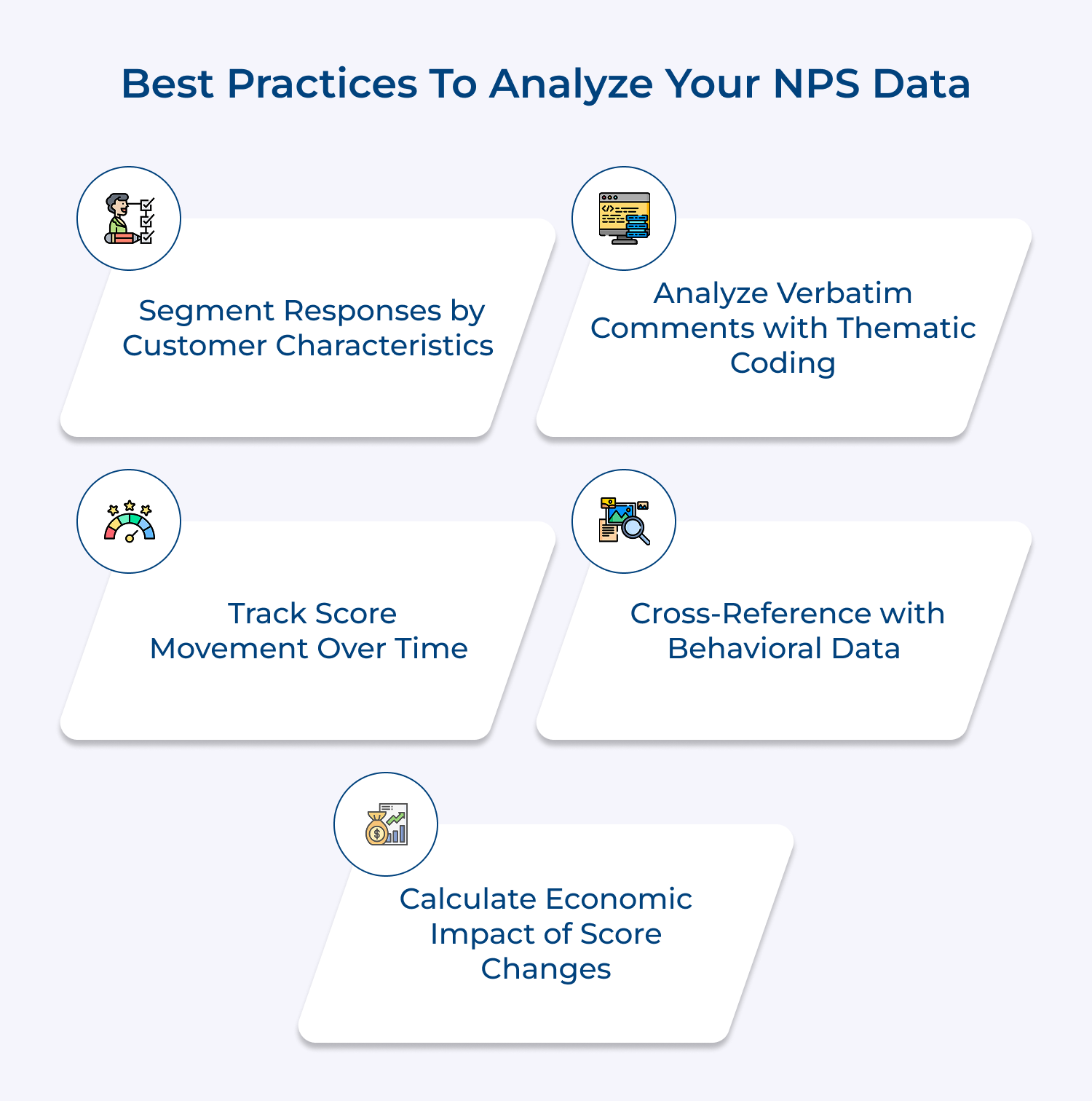
Break down your NPS results by customer segments such as company size, industry, subscription tier, or user role. This targeted analysis reveals how different types of customers experience your product differently. For example, enterprise clients might love your advanced security features while small businesses find them overwhelming. These distinct perspectives help prioritize improvements for specific segments.
The open-ended responses explaining why customers gave their scores contain your most valuable insights. Systematically categorize these comments into themes like “ease of use” or “missing features” to identify patterns. The qualitative analysis transforms scattered individual feedback into clear priority areas. Resist the temptation to cherry-pick dramatic comments and instead look for recurring themes across multiple responses.
Monitor how your NPS trends quarter-over-quarter rather than fixating on absolute numbers. This longitudinal analysis reveals whether your improvement efforts are working and highlights seasonal patterns in satisfaction. Pay special attention to customers who change categories – understanding why a Passive became a Promoter or a Promoter became a Detractor provides crucial insight into what drives loyalty in your product.
Combine NPS responses with product usage data to validate feedback and identify disconnects. High-scoring customers who barely use your product might not provide reliable feedback while detractors with intensive daily usage offer invaluable insights for improvement. The behavioral context helps separate perception issues from genuine product problems and reveals which features truly drive satisfaction.
Translate NPS improvements into business outcomes by connecting score changes to retention rates and expansion revenue. For example, track whether accounts with improving scores show higher renewal rates or increased spending. This financial lens helps prioritize which feedback-driven improvements will deliver the greatest return on investment and builds executive support for customer experience initiatives.
Implementing NPS surveys best practices effectively requires thoughtful design, strategic timing, and meaningful follow-through. By keeping questions clear and timing outreach appropriately, you create a feedback ecosystem that generates valuable insights without burdening customers. The right incentives and respectful follow-ups further enhance participation, ensuring you capture a representative view of customer sentiment.
The true power of NPS emerges when you analyze responses through multiple lenses – segmenting by customer characteristics, coding qualitative feedback, tracking trends over time, connecting scores to behavior and measuring business impact. This comprehensive approach transforms simple numerical ratings into strategic direction for your business. Remember that NPS is about creating meaningful dialogue with customers that drives continuous improvement and strengthens relationships.

1. How should we follow up with detractors in NPS surveys?
Respond to detractors within 24-48 hours with personal outreach from someone empowered to solve problems. Listen completely before defending or explaining. Document specific issues, create a resolution plan with clear timelines and follow up after implementation. Convert these challenging conversations into opportunities to demonstrate your commitment to improvement as well as potentially rescue at-risk accounts.
2. What is the best way to turn passives into promoters?
Start by understanding what’s holding passives back through targeted follow-up questions about specific product aspects. Identify patterns in their feedback to spot near-miss opportunities. Provide personalized education about underutilized features that address their pain points. Small improvements in their specific friction areas often matter more than major new features in moving passives into the promoter category.
3. What is the best frequency for sending NPS surveys?
For B2B SaaS, quarterly relationship surveys strike the right balance between gathering regular feedback and avoiding survey fatigue. Supplement these with targeted transactional surveys after significant interactions like onboarding or support resolution. Adjust frequency based on customer lifecycle – survey newer customers more frequently as they form opinions, while reducing frequency for long-term accounts.
4. How can we increase NPS survey response rates?
Keep surveys ultra-short with the NPS question first, followed by no more than 1-2 open-ended questions. Send from a real person’s email address rather than a generic account. Use subject lines that emphasize brevity like “2-minute question about your experience.” Consider timing surveys during mid-week mornings when professional attention spans are typically more available.
5. How do we effectively communicate NPS results internally?
Create a regular cadence of sharing NPS insights across departments with different detail levels for different audiences. Translate customer verbatims into specific action items for product, support as well as sales teams. Celebrate improvements by sharing customer success stories that resulted from addressing previous feedback. Make NPS visible in dashboards alongside business metrics to reinforce its connection to company performance.
 https://omni24.io/wp-content/uploads/2026/08/AI-Customer-Service-Agents.png
1256
2400
Webvision Solution
https://omni24.io/wp-content/uploads/2023/04/Omni-Logo-1.svg
Webvision Solution2026-09-21 04:48:512026-09-21 04:48:51How to Build an AI Customer Service Agents: 8 Key Steps
https://omni24.io/wp-content/uploads/2026/08/AI-Customer-Service-Agents.png
1256
2400
Webvision Solution
https://omni24.io/wp-content/uploads/2023/04/Omni-Logo-1.svg
Webvision Solution2026-09-21 04:48:512026-09-21 04:48:51How to Build an AI Customer Service Agents: 8 Key Steps https://omni24.io/wp-content/uploads/2026/08/Omnichannel-Conversational-AI.png
1256
2400
Tushar Joshi
https://omni24.io/wp-content/uploads/2023/04/Omni-Logo-1.svg
Tushar Joshi2026-09-16 03:51:072026-09-16 03:51:07How to Build Omnichannel Conversational AI Strategy
https://omni24.io/wp-content/uploads/2026/08/Omnichannel-Conversational-AI.png
1256
2400
Tushar Joshi
https://omni24.io/wp-content/uploads/2023/04/Omni-Logo-1.svg
Tushar Joshi2026-09-16 03:51:072026-09-16 03:51:07How to Build Omnichannel Conversational AI Strategy https://omni24.io/wp-content/uploads/2026/08/Customer-Service-Teams.png
1256
2400
Tushar Joshi
https://omni24.io/wp-content/uploads/2023/04/Omni-Logo-1.svg
Tushar Joshi2026-09-15 04:01:522026-09-15 04:02:16How to Build Customer Service Teams: 6 Key Steps
https://omni24.io/wp-content/uploads/2026/08/Customer-Service-Teams.png
1256
2400
Tushar Joshi
https://omni24.io/wp-content/uploads/2023/04/Omni-Logo-1.svg
Tushar Joshi2026-09-15 04:01:522026-09-15 04:02:16How to Build Customer Service Teams: 6 Key Steps
Whether it’s about acquire, engage or support – Omni24 covers all your customer engagement needs in one complete platform.

Copyright ©2026 Veemo All rights reserved.
CA, Los Angeles, Hall Ave, 19011