How to Scale Enterprise Customer Engagement Strategies
Unify data and AI to deliver personalized enterprise customer engagement, slashing churn and boosting loyalty across channels.

Unify data and AI to deliver personalized enterprise customer engagement, slashing churn and boosting loyalty across channels.
Your customers interact with many touchpoints, but because sales, support and marketing don’t share the same view of them, the experience feels inconsistent.
Without unified data, 70% of marketing leaders struggle to segment customers and only about a quarter of companies have a single trusted customer profile. That fragmentation erodes loyalty, boosts churn and slows growth.
By connecting systems and empowering teams with shared insights, you deliver the personalized, seamless experiences 80% of buyers now expect as well as turn one-off interactions into long-term partnerships.
Enterprise customer engagement is how large organizations build and maintain meaningful relationships with their customers across multiple touchpoints. It involves understanding customer needs and delivering personalized experiences that drive long-term business value.
Enterprise customer engagement operates through integrated systems that collect and analyze customer data from every interaction point. These systems help teams coordinate their responses and ensure customers receive consistent support whether they’re talking to sales or reaching out for help.
Key objectives:
Strong customer engagement transforms how enterprises operate and grow. Here’s what happens when you get it right.
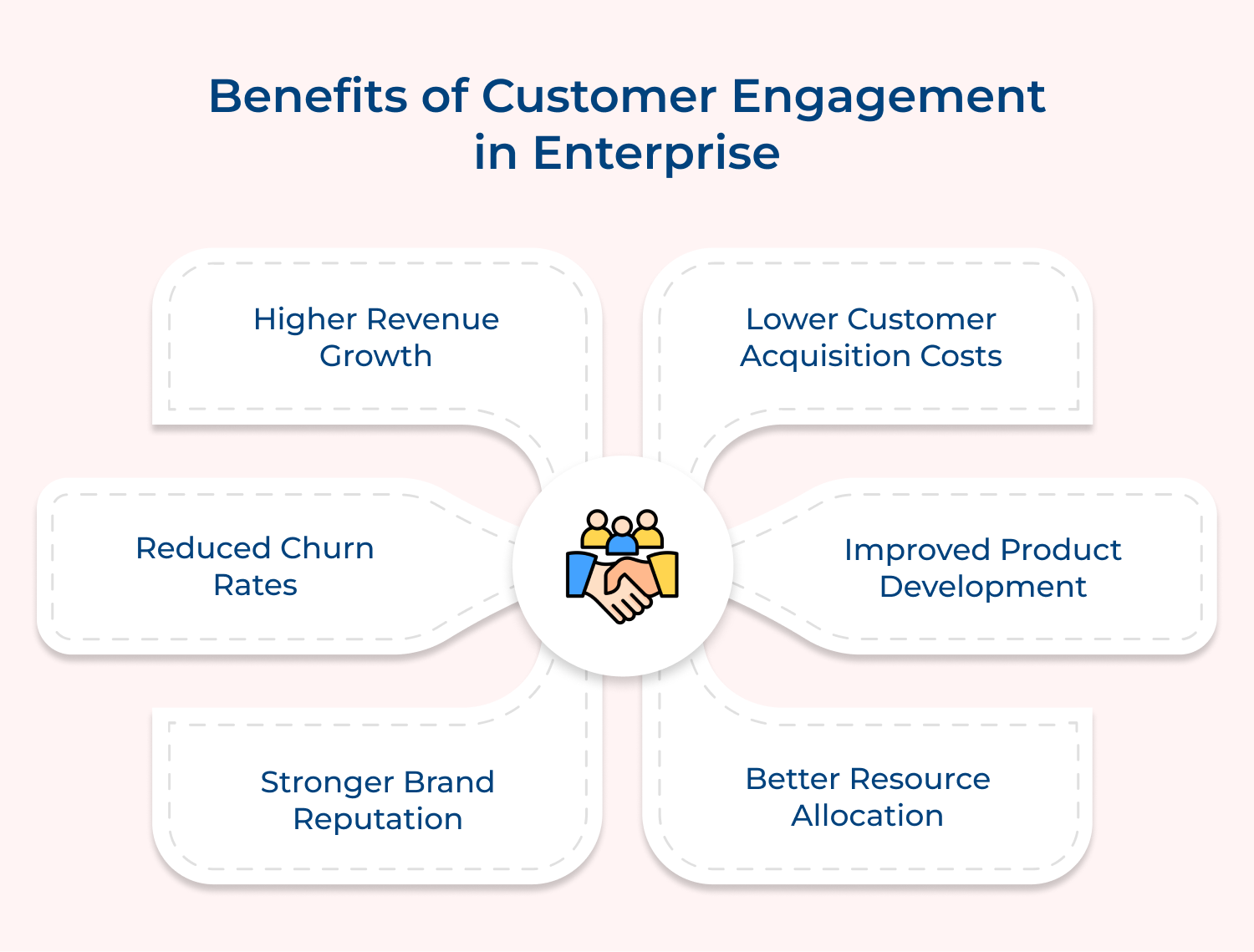
1. Higher Revenue Growth
Engaged customers spend more over time and buy additional products or services from you. They’re less sensitive to pricing because they value the relationship and trust you’ve built with them.
2. Lower Customer Acquisition Costs
Satisfied customers refer new business through word-of-mouth and positive reviews. This organic growth channel costs significantly less than traditional marketing campaigns and brings in higher-quality leads.
3. Reduced Churn Rates
Customers who feel heard and valued stick around longer instead of switching to competitors. Regular engagement helps you spot warning signs early and address issues before customers decide to leave.
4. Improved Product Development
Direct feedback from engaged customers reveals what features they actually need versus what you think they want. This insight helps you build products that solve real problems and gain market traction faster.
5. Stronger Brand Reputation
Engaged customers become vocal supporters who defend your brand during crises and amplify positive messages. Their authentic testimonials carry more weight than any advertising campaign you could run.
6. Better Resource Allocation
Understanding customer behavior helps you invest time and money where it matters most. You can focus support teams on high-value accounts and automate routine interactions for efficiency gains.
AI and automation are reshaping how enterprises interact with customers at scale. These technologies handle complexity that is impossible to manage manually.
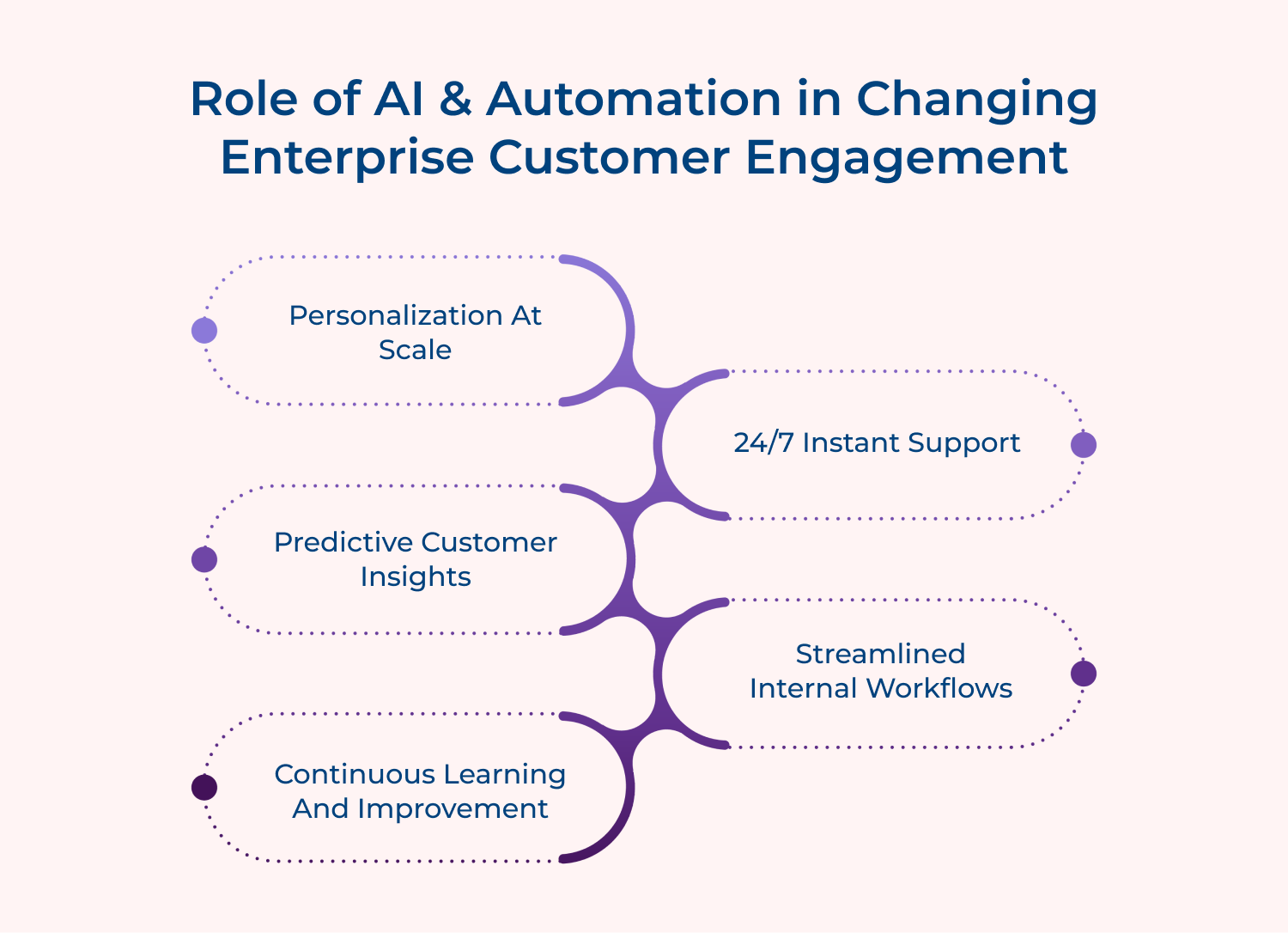
AI sifts through huge volumes of customer data to create tailored experiences for thousands of people at once. Instead of relying on manual lists or rigid segments, it adapts recommendations, messaging and content to match individual preferences in real time. Every customer feels understood without your team having to customize each interaction manually.
AI-powered chatbots and automated systems manage common questions around the clock. Customers get accurate answers anytime they need them, without waiting in queues. Meanwhile, your support team can focus on high-impact issues that truly require human empathy, context and decision-making.
Machine learning identifies patterns in customer behavior to forecast which accounts might churn or which customers are ready to upgrade. These predictions let teams intervene proactively instead of reacting to problems after they occur.
Automation handles repetitive tasks like data entry and ticket routing so employees spend time on strategic work. This efficiency means faster response times and more bandwidth for building genuine customer relationships.
AI doesn’t stay static, it learns from every interaction. By analyzing what works and what falls flat, it steadily improves recommendations as well as workflows. Over time, the system becomes more accurate and effective, all without constant manual tweaks from your team.
Let’s explore the eight best customer engagement strategies that can elevate your enterprise to new heights of customer satisfaction and business success.
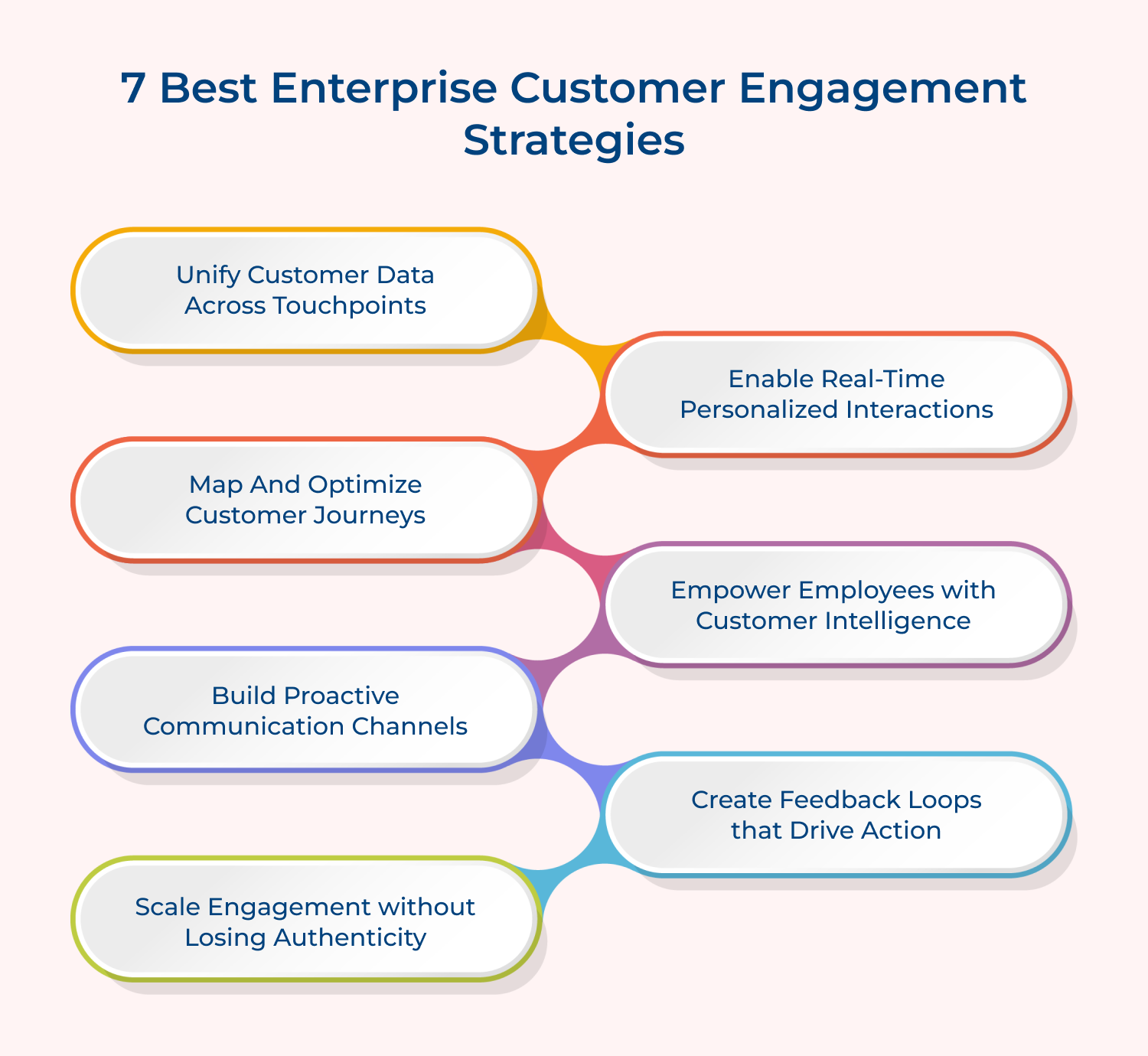
Unified customer data means every team sees the same complete profile, no matter where the information originated. Without it, decisions are based on fragments and customers repeat themselves. Hence, hurting the overall customer experience and weakening customer loyalty.
Here’s how to bring your data together:
For example, a telecom company combined billing and service data as well as found customers with three outages churned within 60 days. Now, they trigger retention offers after the second outage – reducing churn before it starts.
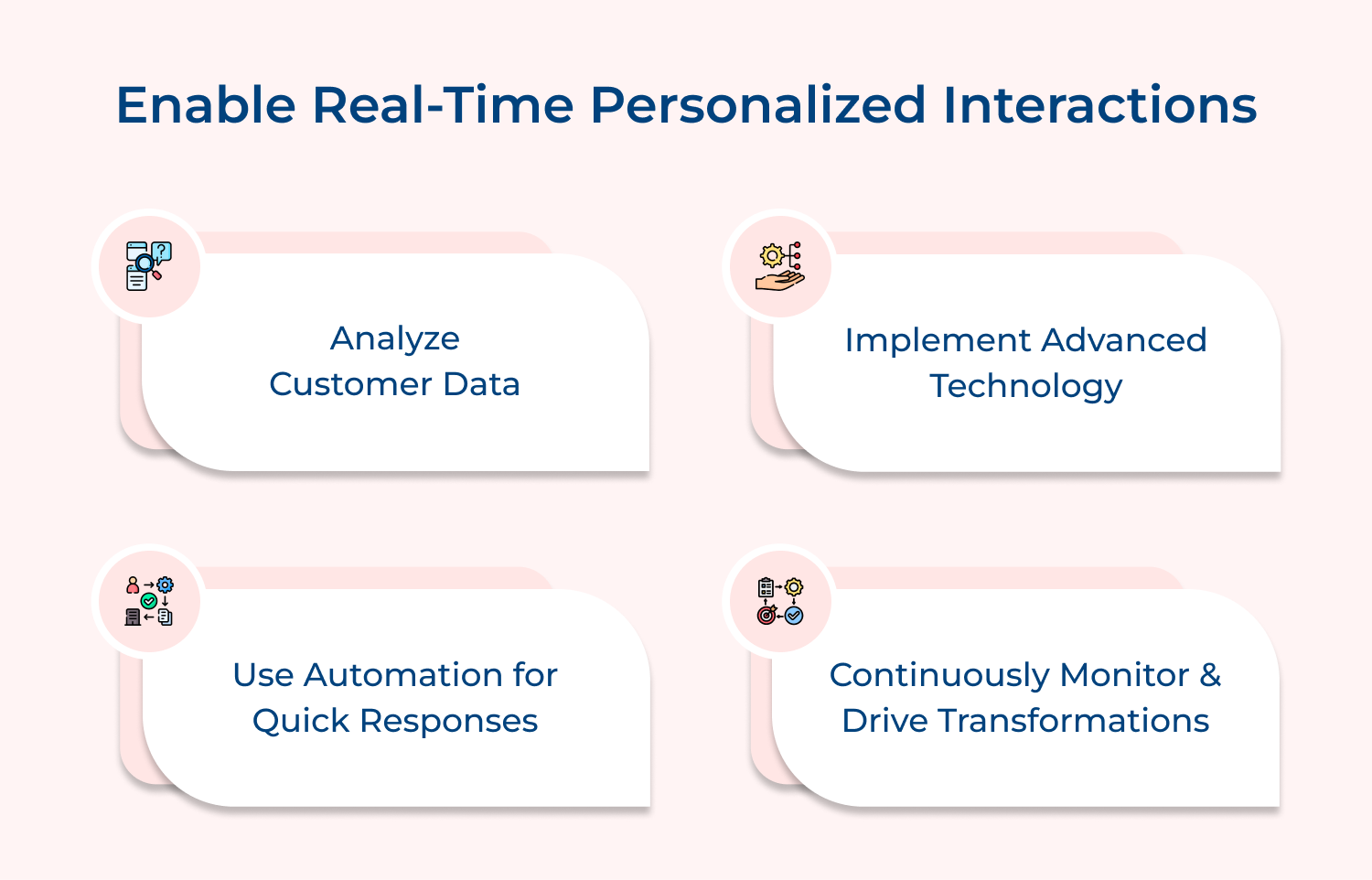
Real-time personalization adjusts what customers see and hear based on their current behavior instead of last month’s activity. This approach recognizes that customer needs shift constantly and yesterday’s preferences might not apply to today’s situation.
The strategy works by monitoring customer actions as they happen and immediately triggering relevant responses through automated workflows. Your systems detect signals like abandoned carts or repeated page views and respond with targeted messages within minutes instead of days.
Pro tips:
Journey mapping visualizes every step customers take from initial awareness through purchase and beyond to identify where they struggle. Understanding these paths helps you remove obstacles that cause frustration and abandonment before they cost you revenue.
Mapping customer journeys delivers these specific improvements for engagement:
What about journeys that vary wildly between customer segments? You’re right to wonder about this because not everyone follows the same path. Create separate journey maps for your major customer types and look for common pain points that appear across all of them.
Start by selecting one high-value journey like onboarding or renewal and instrument it with tracking before trying to map everything. Focus your initial efforts where improvements will deliver measurable revenue impact and expand from there.
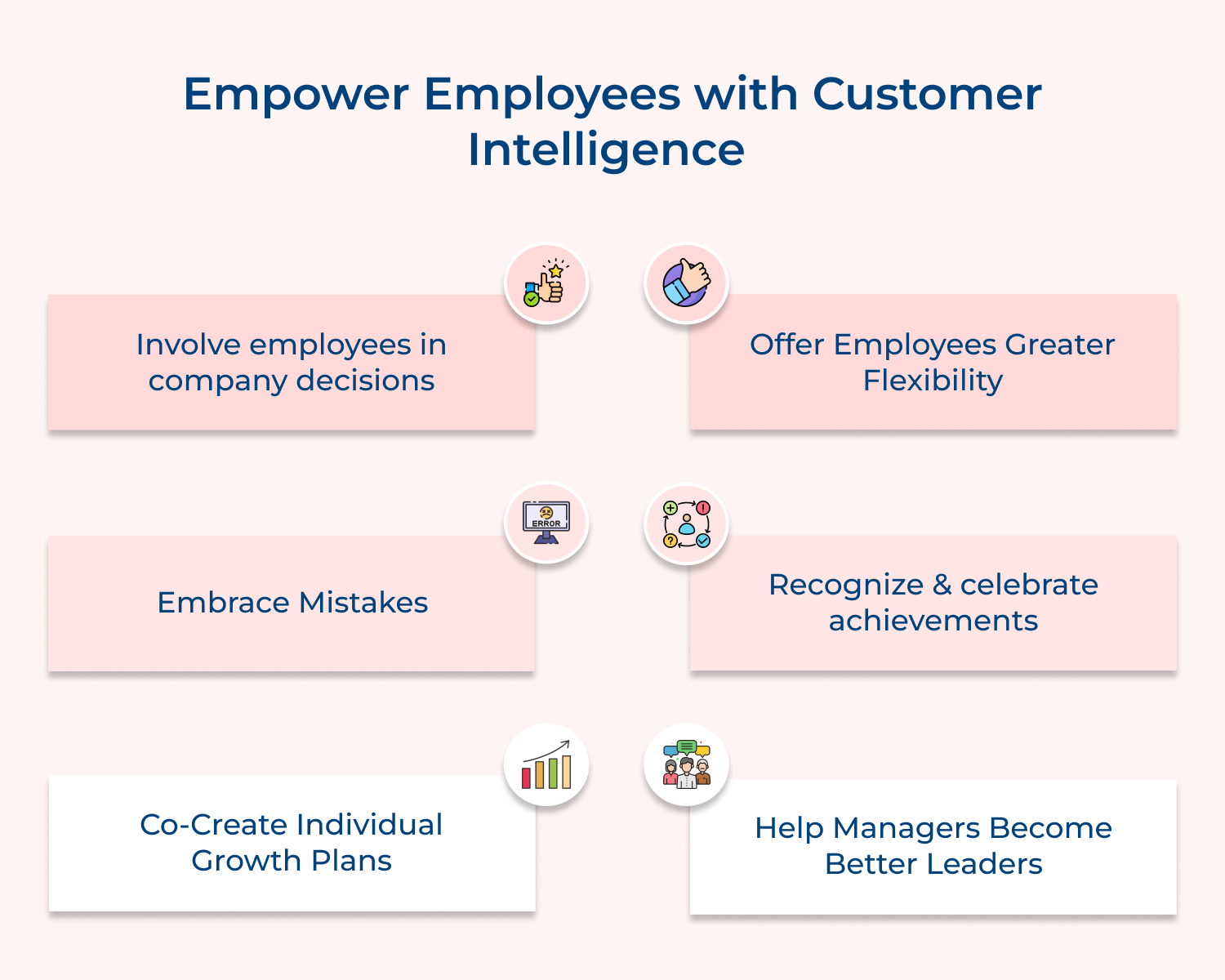
When your teams don’t have access to customer intelligence, they’re essentially flying blind. They make educated guesses about what a customer needs, which leads to inconsistent answers and frustrating experiences.
Customers end up repeating their story to every new person they speak with and that quickly impacts trust as well as your Customer Satisfaction Score.
Give every customer-facing employee access to simple dashboards that highlight key signals like health scores, recent interactions and engagement trends.
Embed customer timelines directly into the tools teams already use. Sales should see support history and support should see purchase data – without switching tabs or logging into multiple systems.
Use AI-driven recommendations to suggest clear next steps, helping every employee act confidently and consistently.
Proactive communication is all about reaching out before your customers feel the need to chase you. Instead of waiting for complaints or confusion, you step in early with relevant updates and guidance. That simple shift builds trust.
It starts with anticipation. Customer data reveals patterns – what questions typically come up at certain stages, where users get stuck and when they’re likely to need support. When you use those insights to share helpful resources ahead of time, you remove friction before it escalates.
Next comes timely updates. Whether it’s system maintenance, pricing changes, or feature updates, proactive teams inform customers before issues disrupt their experience.
Focus on key lifecycle moments like renewals, upgrades, or milestones. These are high-impact touchpoints where thoughtful, well-timed outreach shows customers they truly matter.
Here are critical moments that deserve your proactive attention:
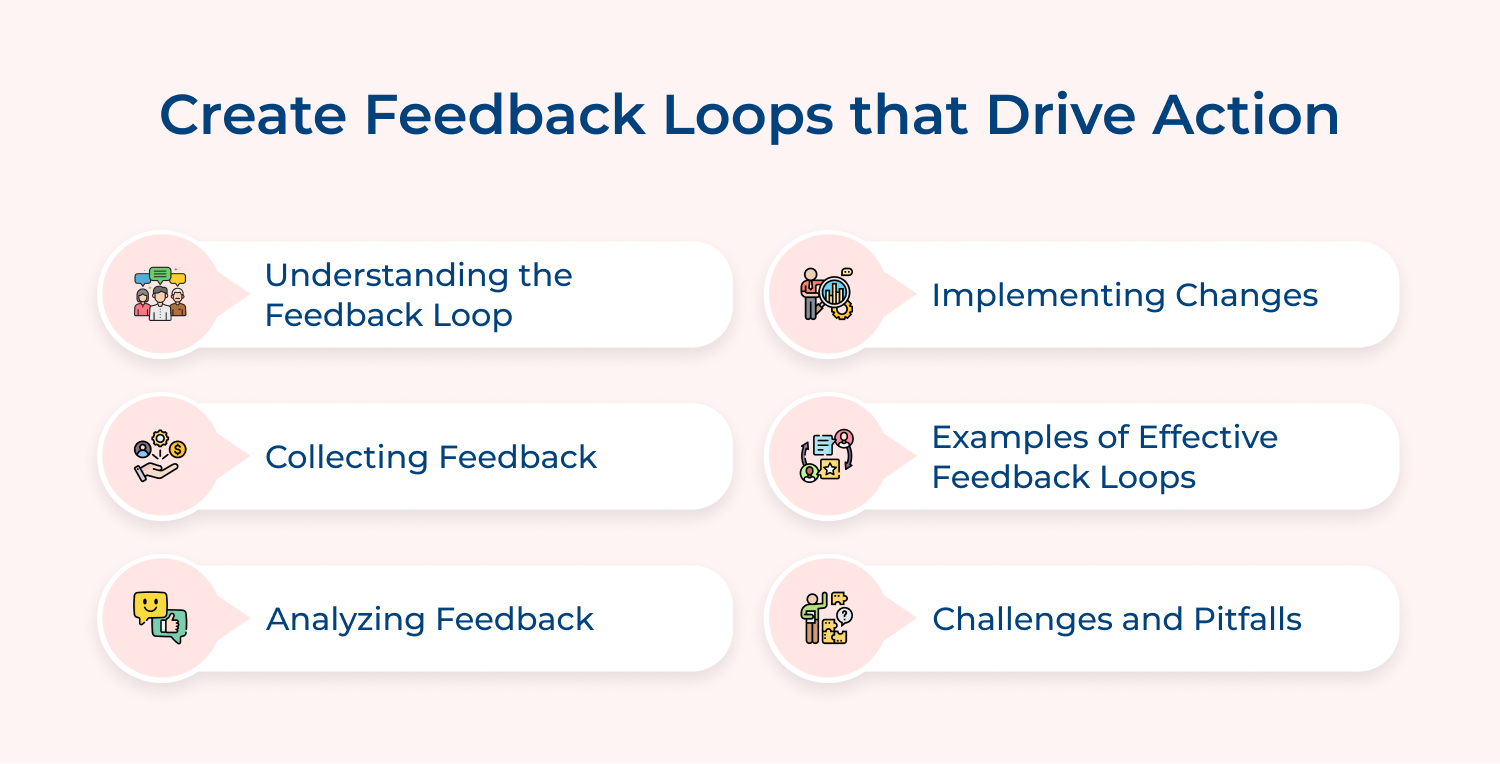
Feedback loops collect customer input and then implement changes based on what you learned. This strategy matters because customers disengage when they share opinions that disappear without any visible response or improvement.
Deploy surveys at key moments and monitor social media mentions while tracking support ticket themes to capture feedback from multiple sources. Combine quantitative data with qualitative insights from customer calls to understand what’s broken and why it matters.
Scaling engagement means serving more customers effectively without sacrificing the personal touch that makes relationships meaningful. The challenge is that automation often feels robotic while purely human approaches don’t scale beyond certain customer volumes.
Here’s how to grow your engagement capacity authentically:
Won’t customers feel deceived when they realize they’re talking to a bot? Only if you try to hide it or use automation inappropriately. Be transparent about when automation is handling requests and give easy ways to reach a human.
Managing customer engagement at enterprise scale introduces complexities that smaller organizations never face. Here are the obstacles that consistently trip up large companies.
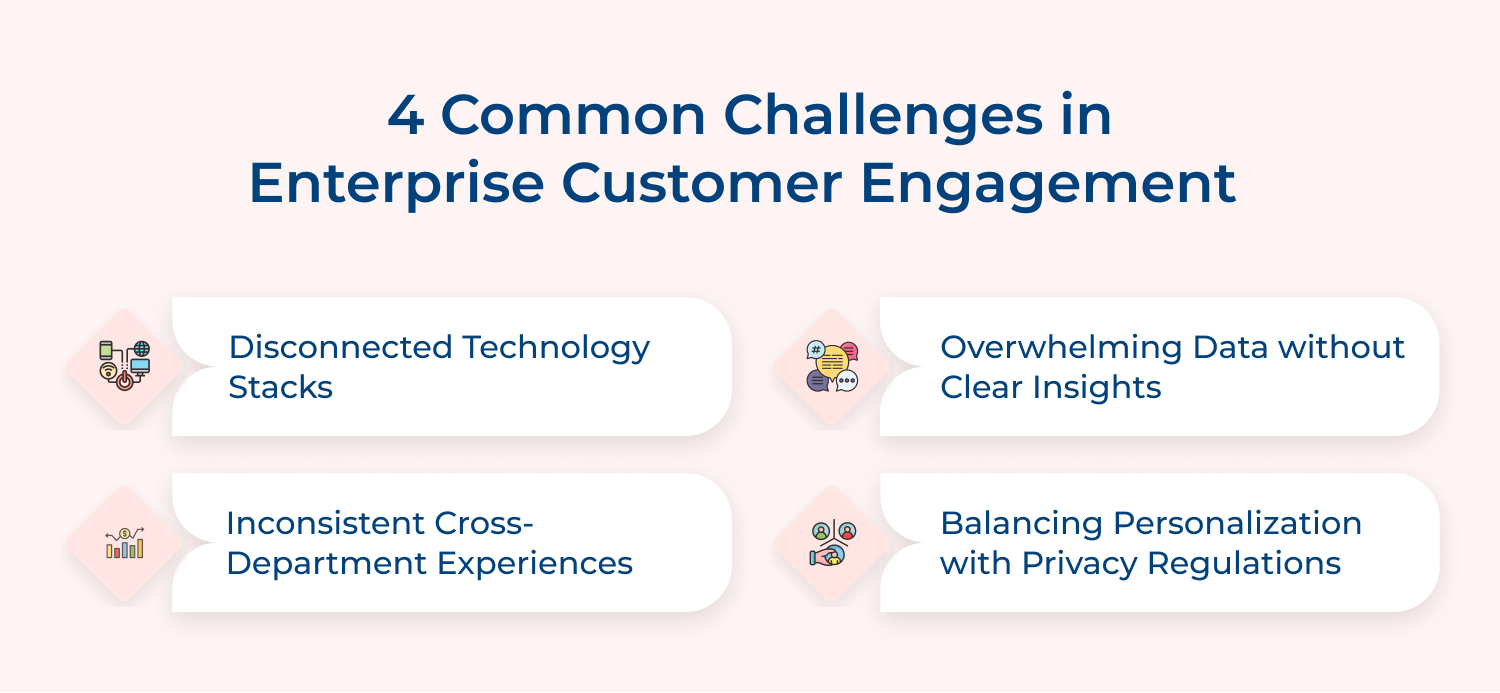
1. Disconnected Technology Stacks
Enterprise companies often run dozens of different systems that don’t communicate with each other effectively. Customer data lives in separate databases across departments and creates fragmented experiences where no one has the complete picture.
2. Inconsistent Cross-Department Experiences
Sales promises one thing while support delivers another because teams operate independently with different priorities and information. Customers get confused when marketing messages contradict what their account manager told them last week about product capabilities.
3. Overwhelming Data Without Clear Insights
Enterprises collect massive amounts of customer data but struggle to turn it into actionable intelligence quickly enough. Teams drown in reports and dashboards without knowing which metrics actually matter or what actions to take next.
4. Balancing Personalization with Privacy Regulations
Global enterprises must navigate different privacy laws across regions while still delivering personalized experiences customers expect. The fear of compliance violations often leads companies to under-utilize customer data and provide generic interactions instead.
These challenges aren’t insurmountable when you approach them strategically. Here’s how leading enterprises tackle each obstacle.
Enterprise customer engagement isn’t optional anymore because customers expect personalized experiences regardless of company size. The right combination of strategy and technology helps you meet these expectations while scaling efficiently.
Start by unifying your data and empowering teams with actionable insights that drive meaningful interactions. Choose platforms that align with your specific needs and remember that authentic relationships matter more than perfect automation.

How does Enterprise Customer Engagement differ from SMB engagement?
Enterprise engagement handles vastly more customers across global markets with complex organizational structures and longer sales cycles. It requires sophisticated technology stacks and dedicated teams while SMBs often manage engagement through simpler tools as well as direct relationships.
What channels are used in Enterprise Customer Engagement?
Enterprises engage customers through email, phone, live chat, social media, mobile apps and self-service portals. Many also use account-based marketing and in-person events as well as community forums to create multiple touchpoints that suit different customer preferences.
How does Enterprise Customer Engagement improve customer loyalty?
Consistent personalized interactions make customers feel valued and understood which reduces their likelihood of switching to competitors. Proactive communication and quick problem resolution build trust that transforms transactional relationships into long-term partnerships.
What technologies support Enterprise Customer Engagement?
CRM platforms, customer data platforms, marketing automation tools and AI chatbots form the foundation of enterprise engagement systems. Analytics software and journey mapping tools as well as integration platforms connect these technologies to enable coordinated customer experiences.
How can enterprises personalize engagement at scale?
AI analyzes customer data to automatically segment audiences and trigger relevant messages based on individual behaviors as well as preferences. Dynamic content systems adjust what each customer sees while maintaining efficiency that manual personalization could never achieve.
 https://omni24.io/wp-content/uploads/2026/08/AI-Customer-Service-Agents.png
1256
2400
Webvision Solution
https://omni24.io/wp-content/uploads/2023/04/Omni-Logo-1.svg
Webvision Solution2026-09-21 04:48:512026-09-21 04:48:51How to Build an AI Customer Service Agents: 8 Key Steps
https://omni24.io/wp-content/uploads/2026/08/AI-Customer-Service-Agents.png
1256
2400
Webvision Solution
https://omni24.io/wp-content/uploads/2023/04/Omni-Logo-1.svg
Webvision Solution2026-09-21 04:48:512026-09-21 04:48:51How to Build an AI Customer Service Agents: 8 Key Steps https://omni24.io/wp-content/uploads/2026/08/Omnichannel-Conversational-AI.png
1256
2400
Tushar Joshi
https://omni24.io/wp-content/uploads/2023/04/Omni-Logo-1.svg
Tushar Joshi2026-09-16 03:51:072026-09-16 03:51:07How to Build Omnichannel Conversational AI Strategy
https://omni24.io/wp-content/uploads/2026/08/Omnichannel-Conversational-AI.png
1256
2400
Tushar Joshi
https://omni24.io/wp-content/uploads/2023/04/Omni-Logo-1.svg
Tushar Joshi2026-09-16 03:51:072026-09-16 03:51:07How to Build Omnichannel Conversational AI Strategy https://omni24.io/wp-content/uploads/2026/08/Customer-Service-Teams.png
1256
2400
Tushar Joshi
https://omni24.io/wp-content/uploads/2023/04/Omni-Logo-1.svg
Tushar Joshi2026-09-15 04:01:522026-09-15 04:02:16How to Build Customer Service Teams: 6 Key Steps
https://omni24.io/wp-content/uploads/2026/08/Customer-Service-Teams.png
1256
2400
Tushar Joshi
https://omni24.io/wp-content/uploads/2023/04/Omni-Logo-1.svg
Tushar Joshi2026-09-15 04:01:522026-09-15 04:02:16How to Build Customer Service Teams: 6 Key Steps
Whether it’s about acquire, engage or support – Omni24 covers all your customer engagement needs in one complete platform.

Copyright ©2026 Veemo All rights reserved.
CA, Los Angeles, Hall Ave, 19011