How Conversational AI for Ecommerce Boosts Sales in 2026
Conversational AI ecommerce boosts engagement, automates support, cuts abandonment and lifts conversions via personalized real-time interactions.

Conversational AI ecommerce boosts engagement, automates support, cuts abandonment and lifts conversions via personalized real-time interactions.
Online shoppers abandon carts, miss products and leave without answers – not because the store failed them, but because no one was there to help. In fact, 65% will switch brands after a poor service experience.
Conversational AI ecommerce is the use of AI-powered chat interfaces to guide customers through discovery, purchase, and support in real time. It transforms static storefronts into dynamic, two-way experiences.
90% of customers expect an immediate response when they reach out to a brand. This guide covers how the technology works, its core use cases, implementation strategies and how to measure ROI — giving you a complete foundation in conversational AI ecommerce.
Conversational AI uses natural language processing to let shoppers interact with online stores through chat. It understands questions and responds like a human assistant would. The technology powers chatbots and virtual assistants that help customers browse, buy and get support.
The system processes customer messages to understand intent and context. It pulls from product databases and past interactions to generate relevant responses. Machine learning helps it improve over time by recognizing patterns in conversations. The AI can handle multiple chats simultaneously and route complex issues to human agents when needed.
key objectives:
Conversational AI transforms how online stores interact with customers. Here’s how it elevates the shopping and customer experience CX
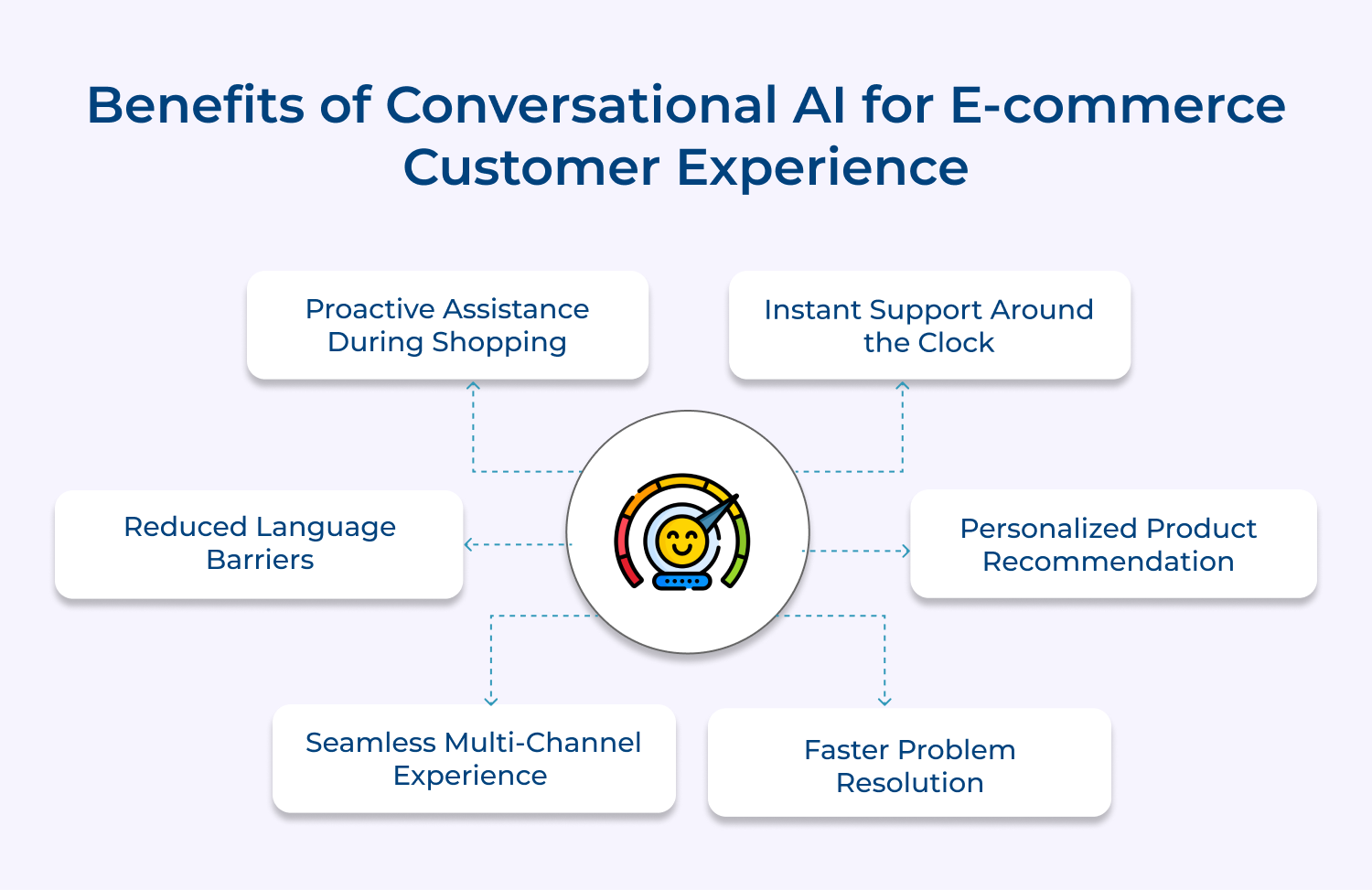
1. Instant Support Around The Clock
Customers get immediate answers at any time without waiting for business hours. The AI handles questions about sizing, shipping and availability instantly. It eliminates frustration and keeps shoppers engaged when they’re ready to buy.
2. Personalized Product Recommendation
The system learns from browsing history and purchase patterns to suggest relevant items. It asks the right questions to understand preferences and budget. Shoppers discover products they actually want instead of scrolling endlessly.
3. Faster Problem Resolution
Simple issues like tracking orders or processing returns get solved in seconds. The AI accesses account information and completes tasks without transferring between departments. Customers spend less time troubleshooting as well as more time shopping.
4. Seamless Multi-Channel Experience
Conversations continue across websites, mobile apps and social media platforms. Customers can start chatting on Instagram and finish purchasing on the website. The AI remembers context so shoppers don’t repeat themselves.
5. Reduced Language Barriers
The technology communicates in multiple languages to serve global customers. It translates queries and responses in real-time with natural phrasing. International shoppers feel welcomed and understood regardless of their location.
6. Proactive Assistance During Shopping
The AI notices when customers spend time on product pages or hesitate at checkout. It offers help before frustration builds or cart abandonment happens. This gentle guidance increases completion rates without feeling pushy.
Now, we will explore key strategies for leveraging conversational AI effectively to boost your e-commerce platform and ensure superior customer engagement.
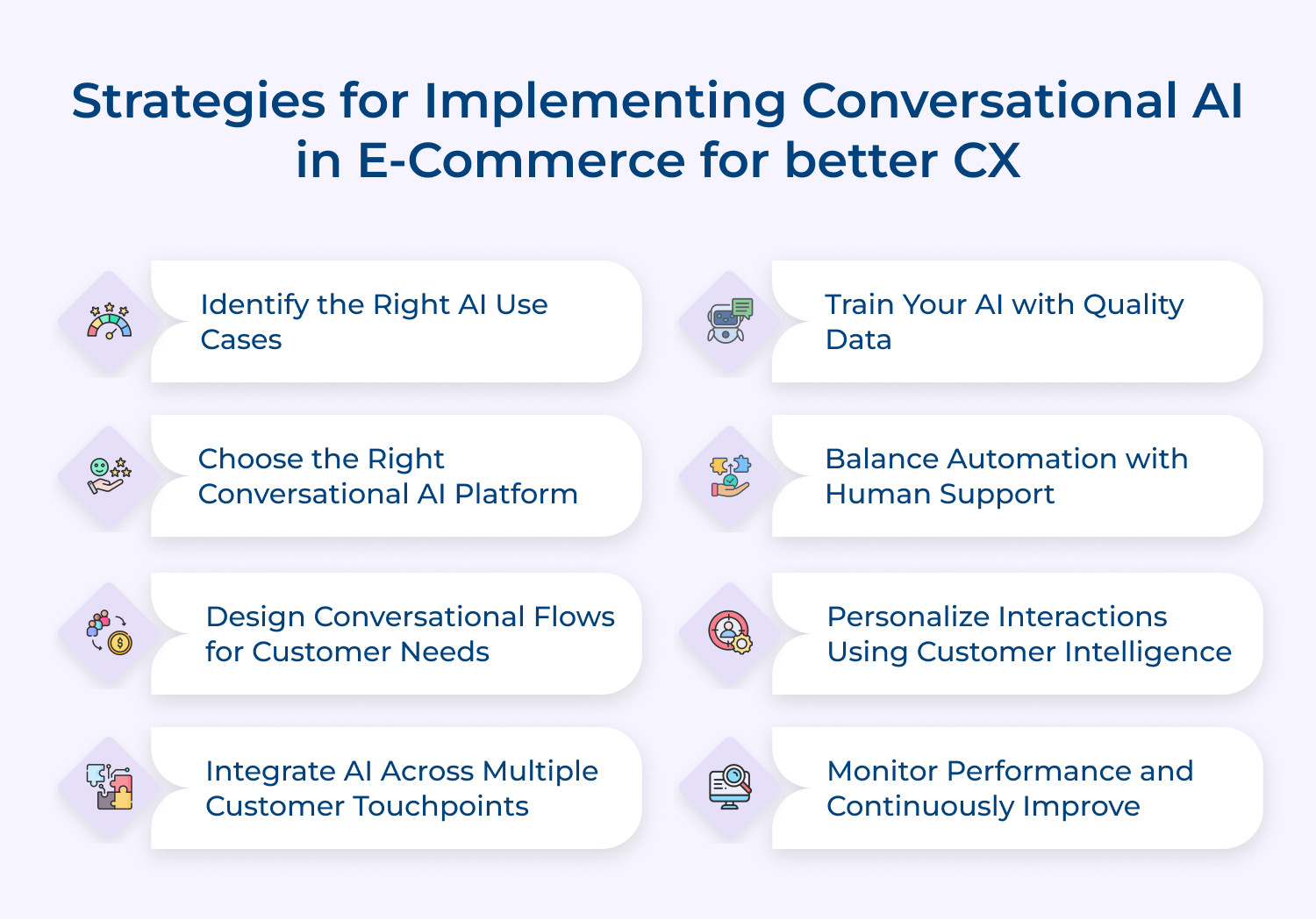
Not every customer interaction needs AI automation. Start by finding where conversational AI delivers the most value for your shoppers and business. Focus on pain points that frustrate customers and drain your support team’s time.
Here’s how to pinpoint the best opportunities for AI:
A fashion retailer noticed 40% of support tickets asked about fabric care instructions. They built an AI assistant that answered material questions and suggested matching items. Customer satisfaction jumped while support costs dropped significantly.
Why not automate everything at once? You’ll overwhelm your team and create a clunky experience. Start small with proven use cases and expand as you learn what works.
The platform you select determines how well your AI understands customers and integrates with your store. A strong foundation makes the difference between helpful conversations and frustrating loops. The right choice scales with your business without constant rebuilding.
Consider these crucial factors when evaluating platforms:
What if you’re not technical enough to evaluate these factors? Most vendors offer demos where you can test real scenarios. Ask them to show how the platform handles your specific products and customer questions.
Popular conversational AI tools serve different e-commerce needs:
Conversation design maps how your AI guides customers from question to resolution naturally. Poor flows confuse shoppers and send them running to competitors. Well-designed paths anticipate needs and make finding answers feel effortless.
How do you know if your flows work? Test them with real customers before launch. Watch where they get confused or frustrated and redesign those branches accordingly.
Here are conversation flows that work for e-commerce businesses:
Omnichannel integration connects your conversational AI everywhere customers interact with your brand. Shoppers start conversations on Instagram and finish purchasing on your website without repeating themselves. This continuity builds trust as well as removes friction from the buying journey.
Your AI becomes truly helpful when it recognizes customers across platforms. Someone asking about a product on Facebook Messenger shouldn’t explain everything again on your website chat. The context carries over and the conversation continues naturally.
Pro tips:
Quality training data determines how accurately your AI understands and responds to customer questions. Poor data creates confused conversations that send shoppers elsewhere. Rich datasets help your AI learn nuances in product queries and customer intent.
Feed your AI historical chat logs and support tickets to recognize patterns. Include complete product information with specifications and common questions. Update seasonal content like holiday shipping deadlines to keep responses current and accurate.
Best practices:
Smart automation handles routine tasks while humans tackle complex emotional situations. Over-automation frustrates customers when they can’t reach real people for nuanced problems. The right balance keeps costs down without sacrificing the personal touch that builds loyalty.
How do you know when to hand it off to humans? Set triggers based on conversation complexity and customer sentiment. If the AI detects frustration or can’t resolve an issue in three exchanges then escalate immediately.
Here’s where human-AI collaboration works best in e-commerce:
Won’t customers get annoyed by handoffs? Not if transitions are smooth and context carries over. The human agent should see the entire AI conversation and continue from where it left off.
Personalization uses customer data to make every conversation feel tailored and relevant. Generic responses make shoppers feel like ticket numbers instead of valued individuals. Smart personalization increases conversion by showing customers exactly what they want when they want it.
Ask yourself these questions before personalizing AI interactions:
These questions reveal how deep you can personalize without creeping customers out. They help you use data ethically while creating better experiences. The answers guide what information your AI should reference during conversations.
Your AI should greet returning customers by name and reference their last purchase. It recommends products based on browsing patterns and past orders. Adjust conversation tone for budget shoppers versus luxury buyers automatically.
Ongoing monitoring shows where your AI succeeds and where it confuses customers. Without tracking you’re flying blind and missing opportunities to enhance performance. Regular analysis turns good implementations into exceptional ones that keep improving over time.
Review conversation logs weekly to spot patterns in failed interactions or escalations. Track metrics like resolution rate and customer satisfaction scores consistently. Use feedback surveys after AI chats to understand what works and what frustrates shoppers.
Pro tips:
Conversational AI solves real business problems while delighting customers. Here’s how leading e-commerce brands put this technology to work every day.
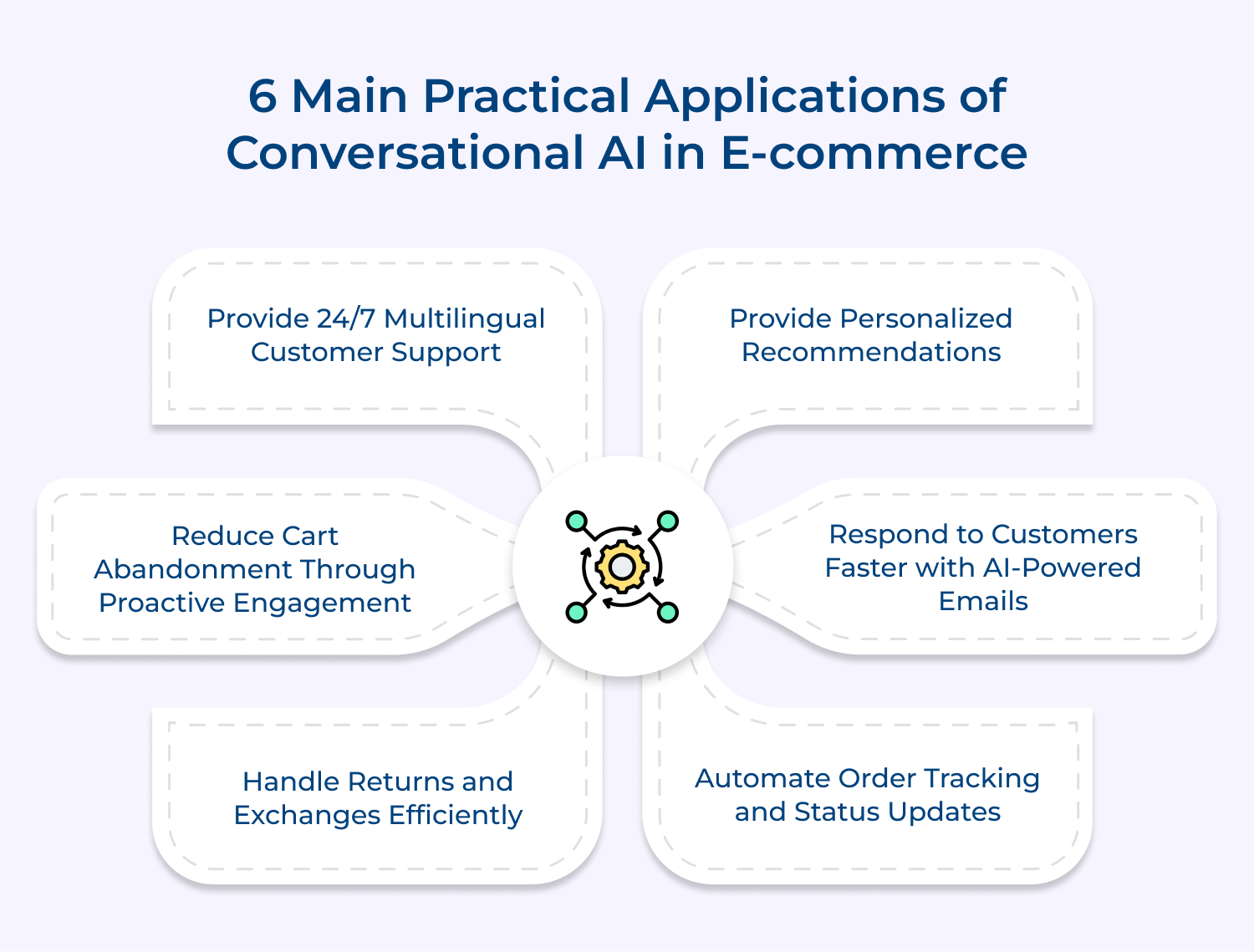
AI analyzes browsing history and past purchases to suggest products customers actually want. It asks smart questions about preferences and budget to narrow down options. This beats generic “you might also like” suggestions that miss the mark completely.
Key ways AI personalizes shopping experiences:
The recommendations feel natural because AI understands context from the entire conversation. A customer asking about running shoes gets follow-up questions about terrain and distance. The AI then suggests appropriate cushioning levels and durability ratings without overwhelming them.
AI drafts personalized email responses to common inquiries in seconds instead of hours. It pulls information from order databases and knowledge bases automatically. Support teams review while sending these drafts rather than writing each response from scratch.
Smart email automation handles these scenarios effectively:
The AI maintains your brand voice while adapting tone based on customer sentiment. Frustrated customers get empathetic language and immediate solutions. Happy customers receive friendly confirmation with cross-sell opportunities that feel helpful rather than pushy.
Customers get instant answers about where their packages are without contacting support. The AI connects to shipping carriers and pulls real-time location data. It proactively notifies shoppers about delays or delivery changes before they ask.
This eliminates the most common reason people contact customer service teams. The AI handles questions about estimated delivery dates and carrier information effortlessly. Shoppers can change delivery instructions or reschedule through the conversation without phone calls or forms.
AI guides customers through return eligibility and generates shipping labels in minutes. It checks purchase dates and returns windows automatically without human verification. The process becomes so simple that customers don’t dread returning ill-fitting items.
Return automation streamlines these tedious tasks:
The system saves partial returns when possible by understanding customer objections. Someone returning shoes because they’re tight gets offered a half-size up. The AI processes the exchange immediately rather than completing a return and hoping they reorder.
Global customers get help in their native language at any hour. The AI translates questions and responds naturally without robotic phrasing. This opens new markets without hiring support staff in every timezone and language.
Late-night shoppers and international customers no longer wait until business hours for answers. The AI handles basic troubleshooting and account questions regardless of time or location. Complex issues get queued for human agents with full context and translation included.
AI detects when shoppers hesitate and offers help at critical decision moments. It notices extended time on checkout pages or multiple visits without purchasing. The assistant jumps in with targeted questions rather than generic “need help?” messages.
Strategic interventions that recover abandoned sales:
The timing makes all the difference between helpful and annoying. AI waits for genuine struggle signals rather than pestering every visitor immediately. Someone comparing prices across tabs gets a best-price guarantee offer right when they need it.
Implementing conversational AI comes with obstacles. Understanding these challenges helps you build better solutions from the start.
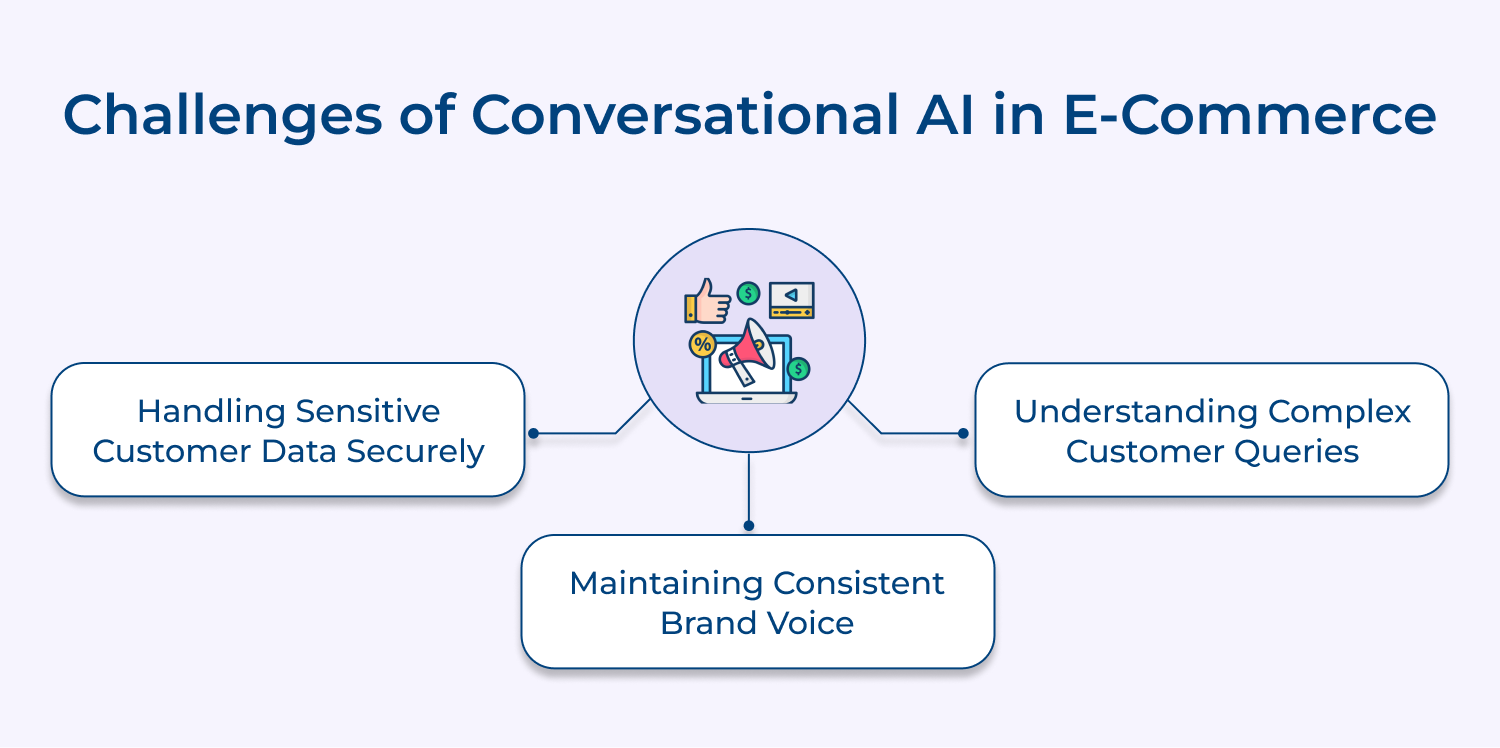
1. Understanding Complex Customer Queries
AI struggles with nuanced questions involving multiple products or vague descriptions. Customers asking “something for my sister who likes vintage stuff” need human interpretation. The technology misses context clues that people grasp instantly.
2. Maintaining Consistent Brand Voice
Generic AI responses sound robotic and damage your brand personality. The assistant might be too formal for casual brands or too casual for luxury retailers. Inconsistent tone confuses customers and erodes trust.
3. Handling Sensitive Customer Data Securely
AI systems process payment information and personal details that hackers target constantly. Data breaches destroy customer trust and trigger legal consequences. Compliance with privacy regulations across countries adds complexity.
Smart strategies help you navigate conversational AI obstacles effectively.
Conversational AI transforms online shopping from transactional to personal. It handles support tasks while freeing your team for complex problems. Smart implementation requires choosing right use cases and balancing automation with human touch.
Start small with high-impact areas like order tracking and product recommendations. Monitor performance closely while improving based on real customer feedback. The technology evolves constantly so your strategy should too. Done right, conversational AI boosts satisfaction while reducing costs significantly.

Can Conversational AI Ecommerce personalize shopping experiences?
Yes. AI analyzes browsing history and past purchases to recommend relevant products. It asks questions about preferences and adapts suggestions based on customer responses. This creates tailored experiences that match individual shopping needs better than generic product lists.
How does Conversational AI Ecommerce handle customer queries?
AI processes questions using natural language understanding to grasp intent. It searches knowledge bases and product catalogs for accurate answers. Complex queries get escalated to human agents while simple questions receive instant automated responses.
Does Conversational AI Ecommerce work with chat and messaging apps?
Absolutely. AI integrates with website chat widgets and popular messaging platforms like WhatsApp. It maintains conversation context across different channels so customers can switch devices. This omnichannel approach lets shoppers engage wherever they feel most comfortable.
How does Conversational AI Ecommerce increase conversions?
AI reduces cart abandonment by addressing concerns during checkout in real-time. It guides hesitant shoppers toward products that match their needs through strategic questions. Instant support eliminates friction points that typically cause customers to leave without purchasing.
Is Conversational AI Ecommerce suitable for small online stores?
Yes. Many platforms offer affordable plans that scale with business growth. Small stores benefit most from automating repetitive tasks like order tracking. Start with basic chatbot features and expand capabilities as your customer base grows.
https://omni24.io/wp-content/uploads/2026/08/conversational-ai-ecommerce.png
1256
2400
Webvision Solution
https://omni24.io/wp-content/uploads/2023/04/Omni-Logo-1.svg
Webvision Solution2026-09-08 04:06:222026-09-08 04:06:22How Conversational AI for Ecommerce Boosts Sales in 2026 https://omni24.io/wp-content/uploads/2026/08/Ecommerce-Customer-Segmentation.png
1256
2400
Tushar Joshi
https://omni24.io/wp-content/uploads/2023/04/Omni-Logo-1.svg
Tushar Joshi2026-09-07 04:53:302026-09-07 04:53:30How Ecommerce Customer Segmentation Drives Higher Conversions
https://omni24.io/wp-content/uploads/2026/08/Ecommerce-Customer-Segmentation.png
1256
2400
Tushar Joshi
https://omni24.io/wp-content/uploads/2023/04/Omni-Logo-1.svg
Tushar Joshi2026-09-07 04:53:302026-09-07 04:53:30How Ecommerce Customer Segmentation Drives Higher Conversions https://omni24.io/wp-content/uploads/2026/08/Enterprise-Customer-Engagement.png
1256
2400
Tushar Joshi
https://omni24.io/wp-content/uploads/2023/04/Omni-Logo-1.svg
Tushar Joshi2026-09-02 05:29:412026-09-02 05:29:41How to Scale Enterprise Customer Engagement Strategies
https://omni24.io/wp-content/uploads/2026/08/Enterprise-Customer-Engagement.png
1256
2400
Tushar Joshi
https://omni24.io/wp-content/uploads/2023/04/Omni-Logo-1.svg
Tushar Joshi2026-09-02 05:29:412026-09-02 05:29:41How to Scale Enterprise Customer Engagement Strategies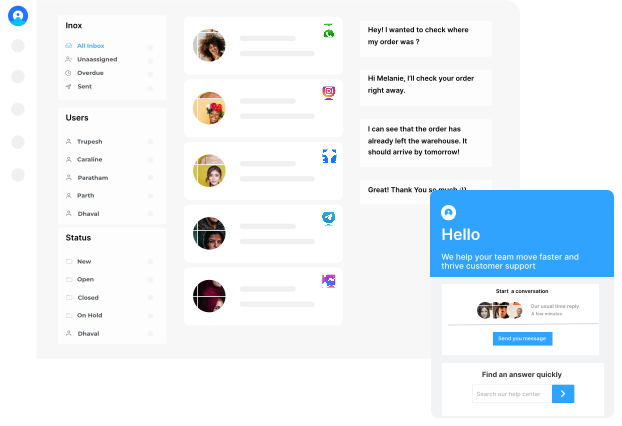
Whether it’s about acquire, engage or support – Omni24 covers all your customer engagement needs in one complete platform.

Copyright ©2026 Veemo All rights reserved.
CA, Los Angeles, Hall Ave, 19011