How to Build Omnichannel Conversational AI Strategy
Omnichannel conversational AI delivers seamless, faster customer experiences across channels, boosting engagement.
Omnichannel conversational AI delivers seamless, faster customer experiences across channels, boosting engagement.
Customers expect instant responses across multiple channels. Most businesses force people to repeat themselves when switching channels. Such disconnected experience frustrates customers and drives them toward competitors.
More than 71% of businesses have invested in bots for CX support, planning increased budgets for conversational AI chatbots across channels.
Traditional systems treat each channel separately without sharing conversation history. Omnichannel conversational AI maintains seamless conversations across every platform your customers use.
The technology remembers context when people switch channels and delivers consistent answers everywhere. This guide shows you how to bridge your customer experience gap.
Omnichannel conversational AI enables customers to interact with businesses through multiple channels like chat, voice, email and social media while maintaining context throughout their journey. The AI remembers previous interactions regardless of which platform the customer uses. It creates a seamless experience where conversations flow naturally across different touchpoints without customers repeating themselves.
Companies using omnichannel conversational AI see reduced operational costs and improved customer satisfaction scores. Support teams handle higher volumes efficiently because the AI resolves routine queries independently. Businesses gain valuable insights from unified customer data across all channels to make better decisions and personalize experiences.
Key Objectives
Omnichannel conversational AI transforms how businesses interact with customers. Here are six concrete advantages that directly impact your bottom line and customer relationships.
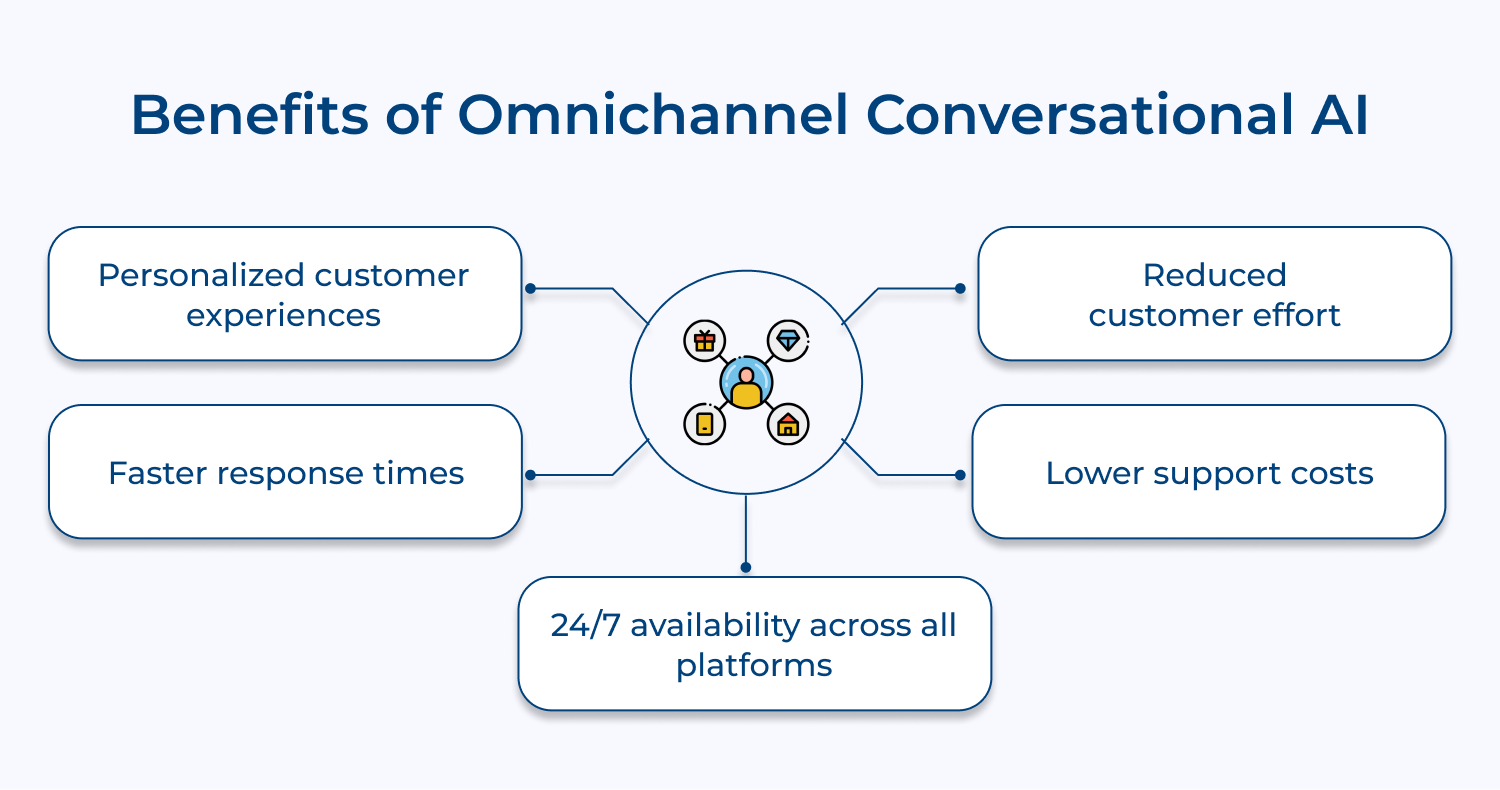
1. Reduced customer effort: Customers don’t need to repeat information when moving between channels. The AI retrieves previous conversation details automatically. This reduces frustration and speeds up resolution times.
2. 24/7 availability across all platforms: Your business never closes because AI handles inquiries round the clock on every channel. Customers get instant responses at midnight or during holidays. This availability increases customer satisfaction.
3. Lower support costs: AI resolves up to 80% of routine questions without human intervention. Your team focuses on complex issues that need personal attention. This efficiency dramatically reduces operational expenses.
4. Faster response times: AI answers customer questions in seconds rather than hours or days. No more waiting in the queue across any communication channel. Quick responses lead to happier customers and higher conversion rates.
5. Personalized customer experiences: The system tracks preferences and purchase history across all touchpoints. AI tailors recommendations and responses based on individual customer behavior. Personalization builds loyalty and increases repeat purchases.
This article outlines seven transformative steps to help you construct a robust conversational AI strategy that meets today’s business demands and tomorrow’s challenges.
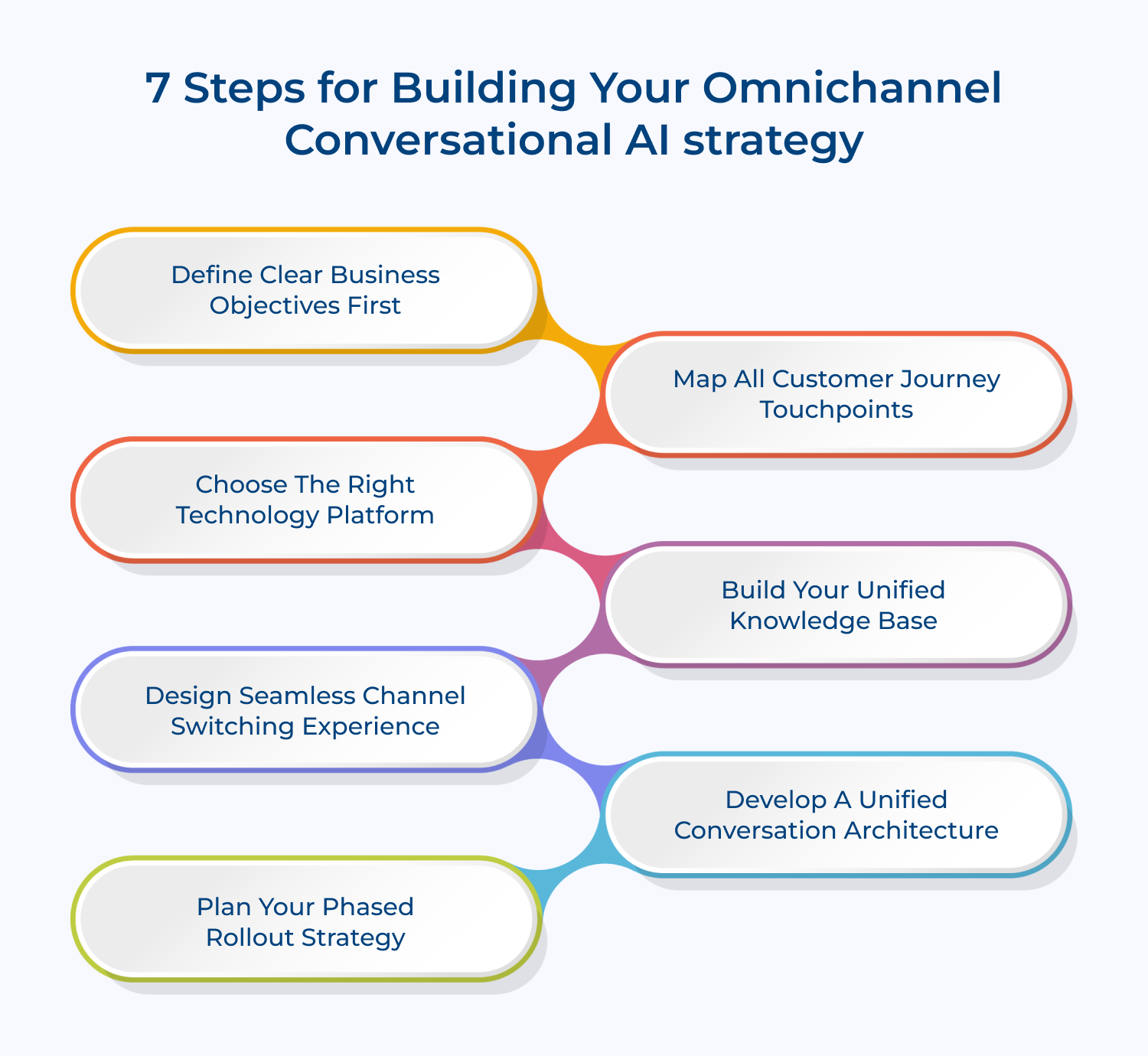
Starting without clear goals leads to wasted resources and disappointing results. Your omnichannel conversational AI needs specific targets to justify investment and guide development decisions throughout the implementation process.
Business objectives give your team direction and help measure success accurately. They determine which features matter most and which channels deserve priority attention from your development resources.
Here’s what your omnichannel conversational AI objectives might focus on:
How do you actually set these objectives? Start by examining your current support metrics and identifying your biggest pain points. Then define what success looks like in concrete numbers within a realistic timeframe.
Understanding where and how customers interact with your business shapes your entire strategy. Omnichannel conversational AI works best when deployed at the exact moments customers need help across their journey.
Here are three effective ways to map customer touchpoints comprehensively:
Consider a retail company that discovered customers frequently abandoned carts after visiting the shipping policy page. They deployed omnichannel conversational AI at that exact touchpoint to answer delivery questions instantly.
Your technology platform determines what your omnichannel conversational AI can actually accomplish. The wrong choice limits functionality and creates technical debt that becomes expensive to fix later.
Selecting the right platform ensures smooth integration with existing systems. It affects response quality and determines whether your AI can truly maintain context as customers switch between channels.
Consider these four critical factors when evaluating technology platforms:
What if you’re unsure which features you’ll need long-term? Choose platforms with modular architectures that let you add capabilities gradually. Such an approach prevents overpaying upfront while keeping future options open.
A unified knowledge base ensures your omnichannel conversational AI provides consistent accurate answers everywhere. Without it your AI gives different responses across channels which confuses customers and damages trust.
The centralized repository powers all AI responses regardless of platform. It eliminates contradictions and ensures updates instantly reflect across every customer touchpoint simultaneously.
Pro tips:
Channel switching lets customers move between platforms without losing conversation context or repeating information. This capability defines true omnichannel conversational AI and separates it from basic multi-channel support.
Why does seamless switching matter so much for customer experience? Because 67% of customers get frustrated when forced to repeat themselves. When your AI remembers context across channels customers feel heard and valued.
Here are five channel switching experiences businesses can design effectively:
Unified conversation architecture creates consistent dialogue patterns that work identically across all platforms. This structure ensures customers receive the same quality experience whether they use chat or voice for their omnichannel conversational AI interactions.
Your architecture defines how conversations flow and how the AI recognizes what customers want. It establishes reusable components that speed up development and maintain consistency as you expand channels.
Pro tips:
Launching omnichannel conversational AI everywhere simultaneously creates overwhelming complexity and increases failure risk. A phased approach lets you learn from early channels and refine before expanding coverage.
Before planning your phased roll out consider these four critical questions:
These questions prevent premature expansion and ensure each phase builds confidence. They help you identify realistic timelines and resource requirements before committing to full deployment.
Start with your most straightforward channel like web chat for three months. Gather feedback and optimize responses before adding email, then gradually expand to voice or social platforms.
These elements form the foundation of a system that truly understands and serves customers.
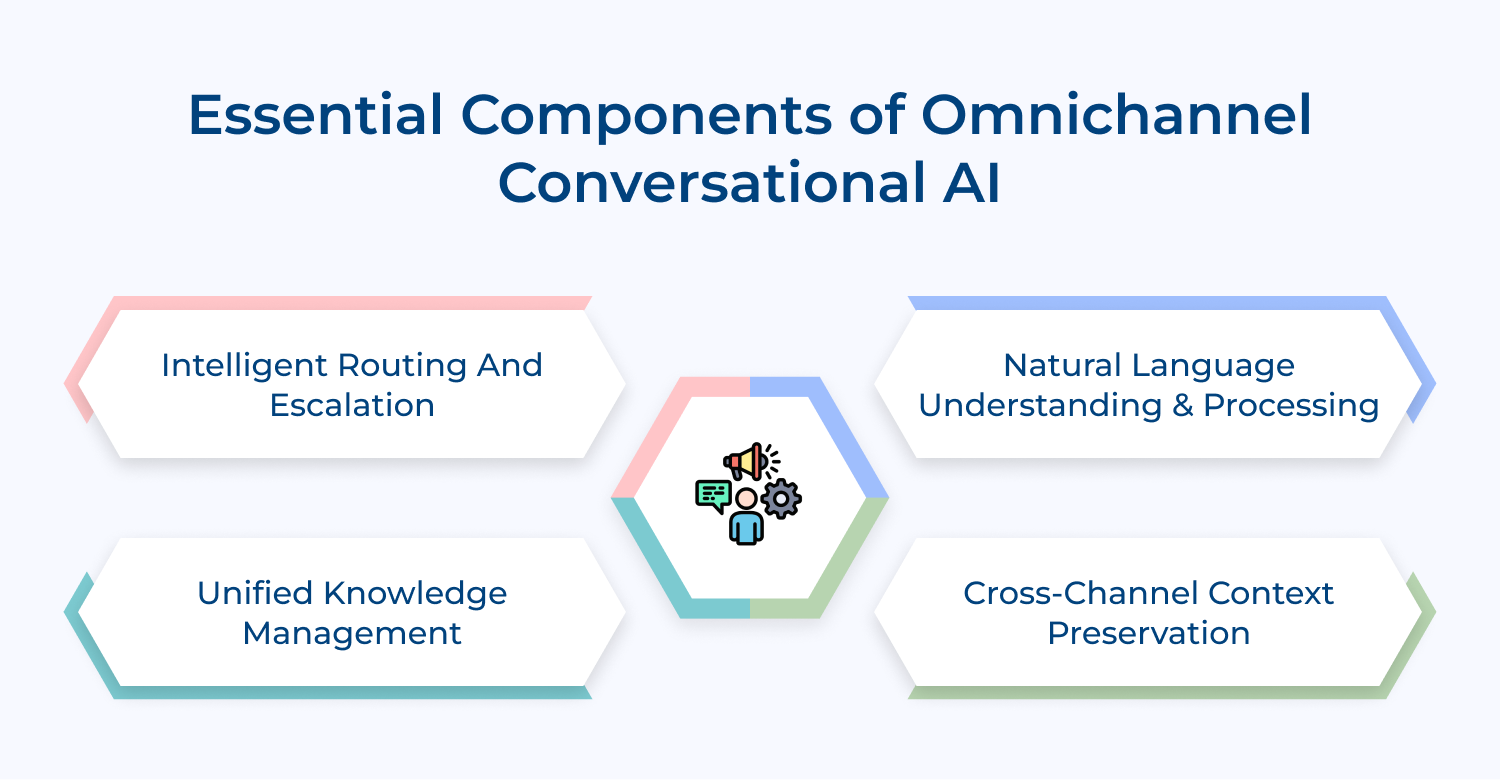
1. Natural Language Understanding and Processing
The AI must comprehend customer intent regardless of how they phrase questions. It interprets slang, typos and different languages accurately. This capability ensures customers communicate naturally without learning specific commands.
2. Cross-Channel Context Preservation
The system maintains conversation history when customers switch from chat to phone or email. Context flows seamlessly so customers never repeat themselves. This continuity creates a frustration-free experience across touchpoints.
3. Unified Knowledge Management
A central knowledge base powers AI responses across all channels consistently. Updates to information automatically reflect everywhere the AI operates. This ensures customers receive accurate answers regardless of their chosen platform.
4. Intelligent Routing and Escalation
The AI recognizes when conversations need human expertise and transfers smoothly to appropriate agents. It passes along the full context so agents start to be informed. This prevents customers from explaining their issues multiple times during handoffs.
Traditional customer service methods can’t match the efficiency and consistency of modern AI systems. Here’s how omnichannel conversational AI fundamentally differs from conventional support approaches.
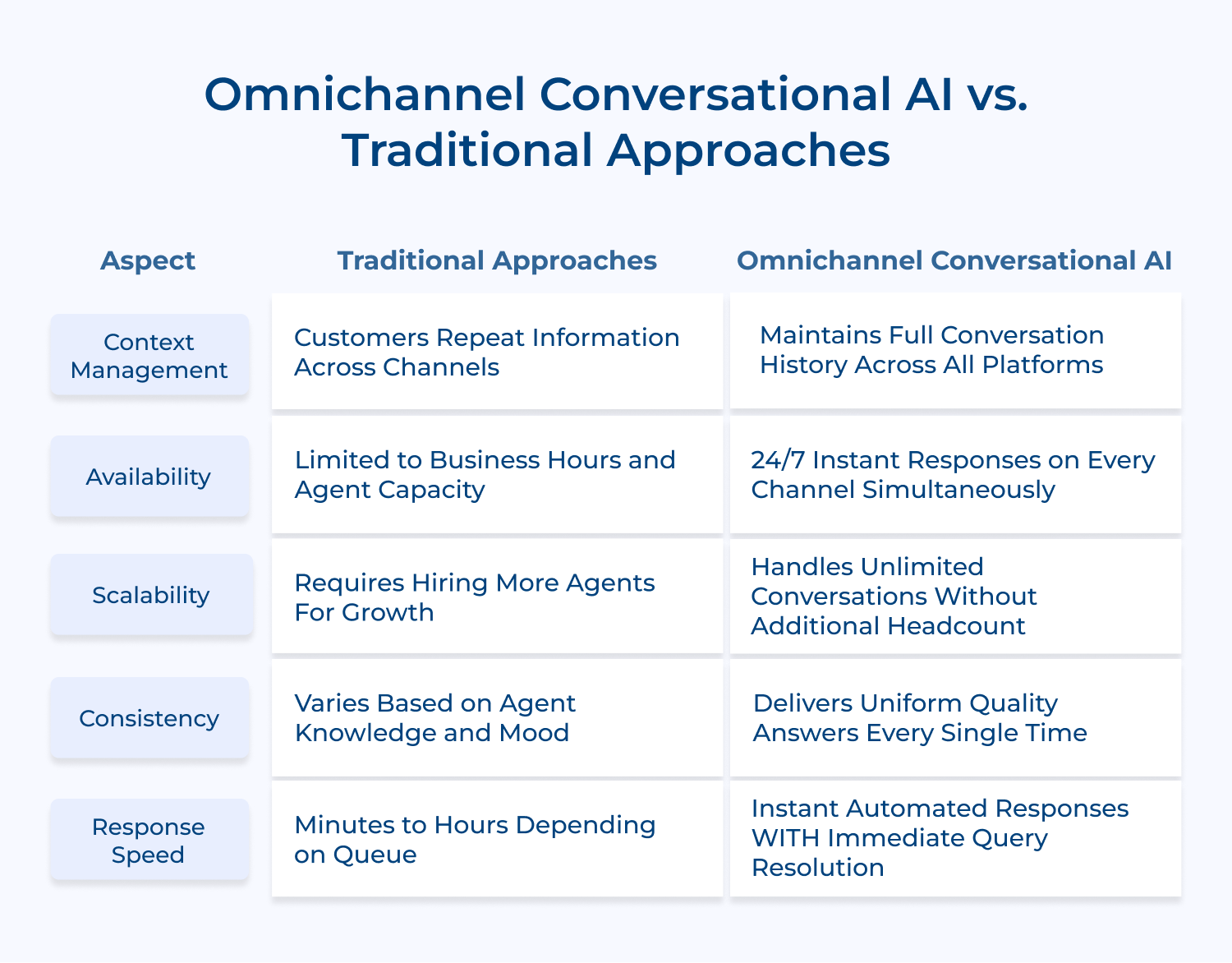
1. Context Management
Traditional systems treat each channel as separate. When customers switch from email to phone they must restart their entire explanation. Agents lack visibility into previous interactions across different platforms.
Omnichannel conversational AI creates a unified customer profile accessible everywhere. The system recalls conversation details regardless of channel changes. Customers pick up exactly where they left off without repeating themselves.
2. Availability
Traditional support operates during specific hours with limited agent availability. Customers wait in queues or receive delayed responses outside business hours. Night and weekend inquiries go unanswered until the next working day.
Omnichannel conversational AI provides instant responses around the clock every day. Multiple customers get simultaneous attention across all channels without waiting. Holiday periods and peak times don’t affect service availability or quality.
3. Scalability
Traditional models require hiring and training more agents to handle growth. Increasing support capacity means higher salary costs and management complexity. Seasonal spikes demand temporary staff or result in longer wait times.
Omnichannel conversational AI scales instantly without proportional cost increases or quality degradation. Handling ten thousand conversations costs nearly the same as handling one thousand. Businesses grow their customer base without expanding their support team linearly.
4. Consistency
Traditional support quality depends on individual agent knowledge and experience. Different agents provide varying answers to identical questions across channels. Tired or frustrated agents may deliver subpar service during difficult shifts.
Omnichannel conversational AI delivers standardized accurate responses based on approved knowledge sources. Every customer receives the same high-quality information regardless of timing. The system never has bad days or provides inconsistent guidance.
5. Response Speed
Traditional methods involve wait times while agents handle other customers sequentially. Email responses take hours or days depending on ticket volume. Phone support means holding in queue during busy periods.
Omnichannel conversational AI responds within seconds to all inquiries simultaneously across channels. Customers receive immediate acknowledgment and resolution for straightforward questions. Complex issues get routed to humans faster because the AI handles routine queries.
Different industries deploy omnichannel conversational AI to solve unique challenges and improve customer experiences. Here’s how five sectors use this technology effectively.
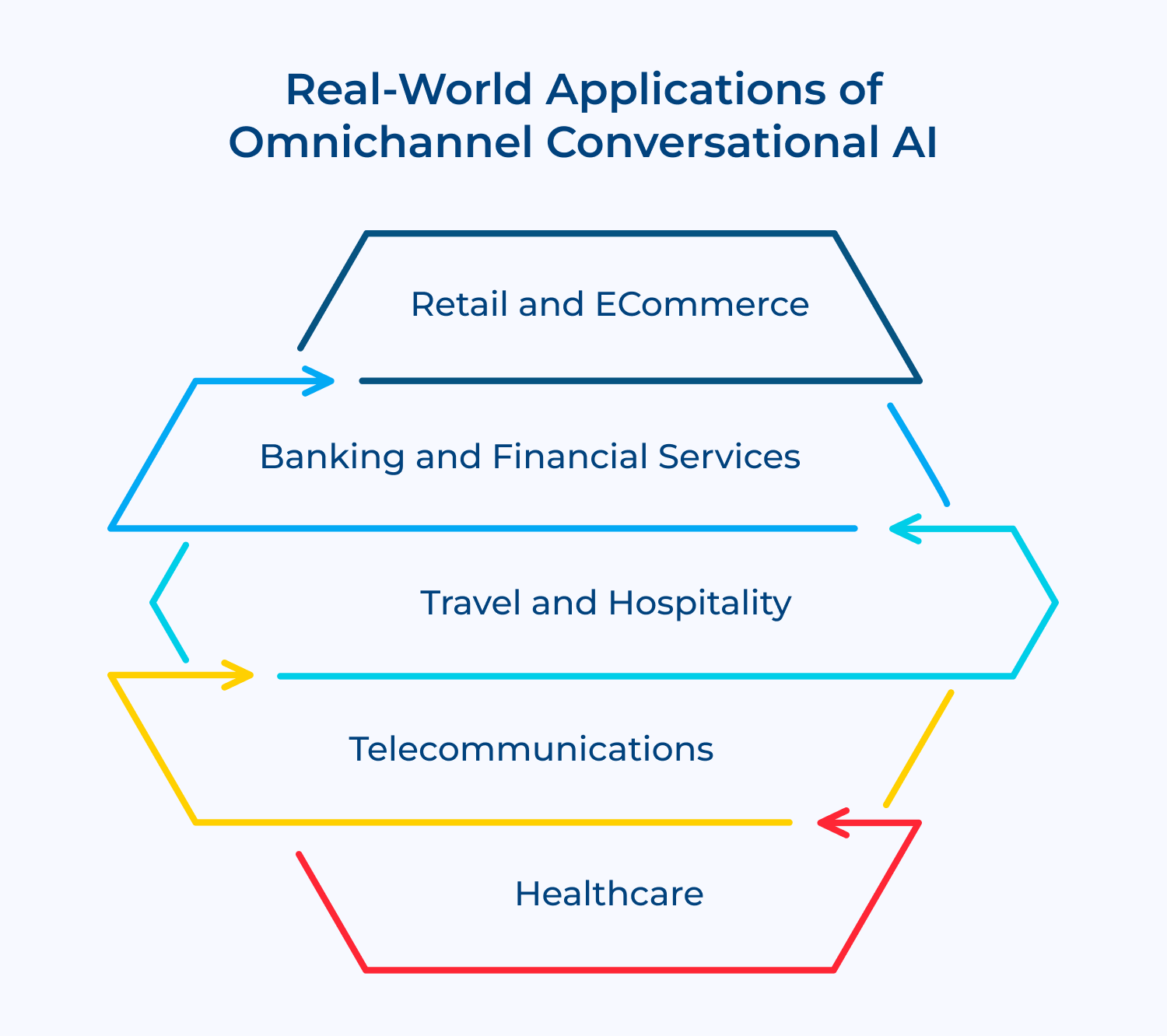
Retail businesses use omnichannel conversational AI to guide shoppers from browsing to purchase across platforms. Customers ask product questions via chat then complete purchases through voice assistants seamlessly. The AI tracks preferences regardless of channel switching.
Healthcare providers deploy omnichannel conversational AI for appointment scheduling and patient inquiries across channels. Patients book appointments via chat then receive voice reminders with previous conversation context. The system securely accesses records while maintaining HIPAA compliance.
Banks use omnichannel conversational AI to handle account inquiries, transactions across apps and phones. Customers check balances via chat then resolve fraud alerts through voice without re-authentication. The AI maintains security while providing instant account access.
Travel companies leverage omnichannel conversational AI to manage bookings and provide trip support throughout journeys. Customers research via chat then modify reservations through voice with full context. The AI sends proactive flight updates across preferred channels.
Telecom providers use omnichannel conversational AI to handle technical support and billing across touchpoints. Subscribers troubleshoot via chat then escalate to phone with full diagnostic history. The AI resolves outages while maintaining conversation context.
Omnichannel conversational AI continues advancing rapidly with emerging technologies reshaping client interactions. Here are five transformative developments that will define the next generation of customer service.
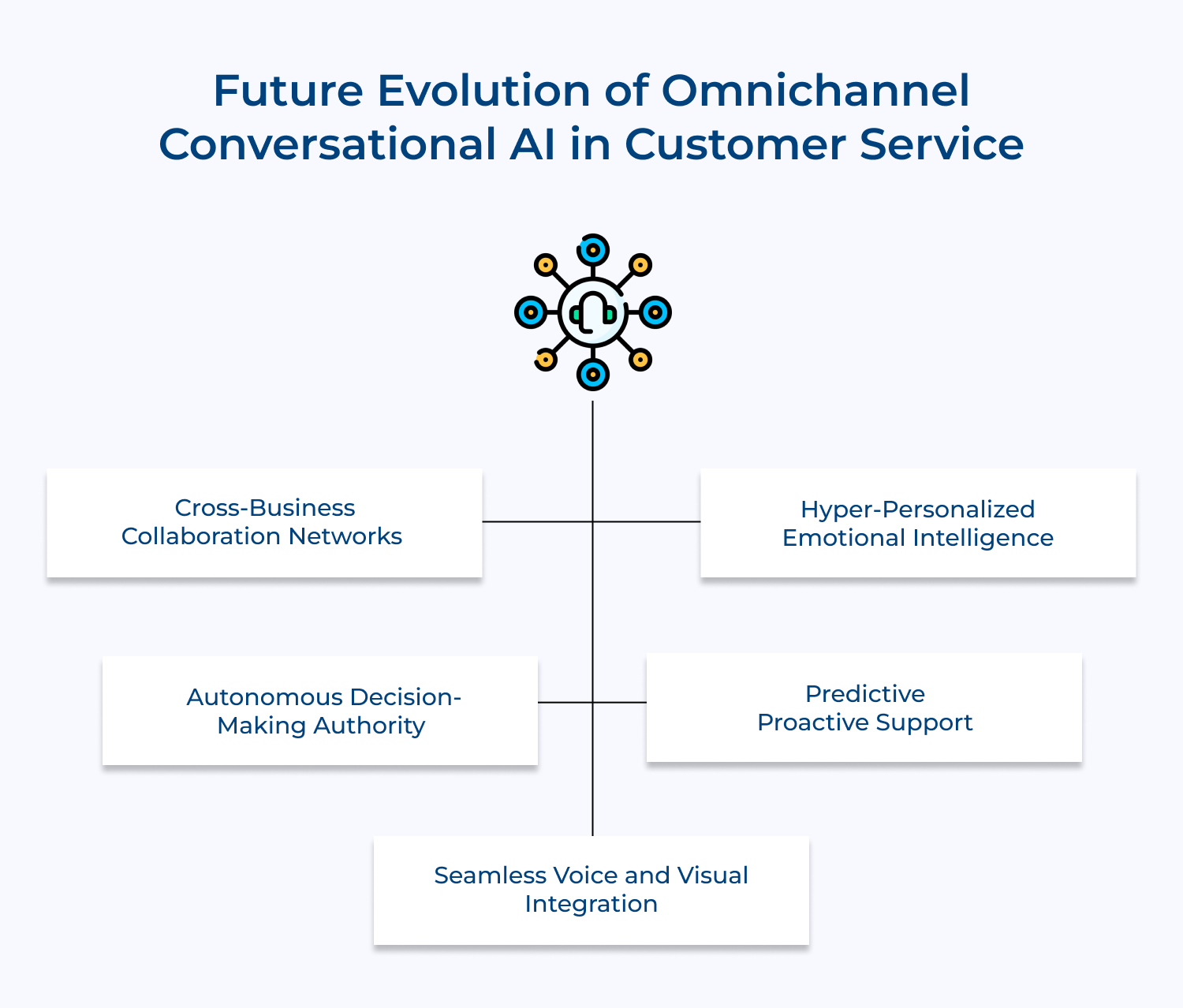
1. Hyper-Personalized Emotional Intelligence
Future AI will detect customer emotions through voice tone and text patterns to adjust responses accordingly. Systems will recognize frustration or confusion and adapt communication style in real-time. This emotional awareness creates more empathetic interactions that feel genuinely human.
2. Predictive Proactive Support
AI will anticipate customer needs before they ask by analyzing behavior patterns and usage data. Systems will reach out proactively across preferred channels with solutions to problems customers haven’t noticed yet. This shift from reactive to predictive support prevents issues entirely.
3. Seamless Voice and Visual Integration
Conversational AI will combine voice interactions with visual elements like augmented reality and screen sharing simultaneously. Customers will describe problems verbally while AI shows visual guides or overlays instructions on their device. This multimodal approach solves complex issues faster than text alone.
4. Autonomous Decision-Making Authority
Advanced AI will handle complex transactions like refunds and account changes without human approval requirements. Systems will make judgment calls on exceptions and edge cases using learned business policies. This autonomy reduces resolution times from hours to seconds.
5. Cross-Business Collaboration Networks
Omnichannel conversational AI systems will share context across different companies within customer journeys seamlessly. Your airline AI will communicate with hotel and rental car AI to coordinate travel changes. This interconnected ecosystem eliminates repetitive explanations across service providers.
Omnichannel conversational AI transforms how businesses connect with customers across every touchpoint imaginable. It eliminates friction and creates experiences where conversations flow naturally regardless of channel switching or time.
The technology keeps evolving to meet rising customer expectations for instant personalized support everywhere. Businesses that implement these systems now position themselves ahead of competitors still using traditional fragmented approaches to customer service.

How does Omnichannel Conversational AI work across channels?
The system maintains a centralized customer profile that updates with each interaction across platforms. When customers switch channels the AI retrieves previous conversation history instantly. This unified architecture ensures seamless continuity regardless of where customers reach out.
Which channels support Omnichannel Conversational AI?
Most platforms support web chat, mobile apps, email, SMS, voice calls and social media like Facebook Messenger. WhatsApp, Telegram, Slack and Microsoft Teams integration is also common. The exact channels depend on your chosen technology provider and business needs.
How does Omnichannel Conversational AI improve customer experience?
Customers never repeat information when switching channels because context transfers automatically between platforms. Wait times decrease dramatically since AI handles multiple conversations simultaneously. Consistent answers across every touchpoint build trust and reduce frustration significantly.
Can Omnichannel Conversational AI provide 24/7 support?
Yes, AI operates continuously without breaks or holidays across all connected channels simultaneously. Customers receive instant responses at midnight or weekends when human agents are unavailable. Complex issues get queued for human follow-up during business hours.
How does Omnichannel Conversational AI personalize conversations?
The AI accesses customer purchase history, preferences and past interactions from integrated databases instantly. It tailors recommendations based on individual behavior patterns and stated needs. Personalization improves as the system learns from each conversation over time.
Is Omnichannel Conversational AI secure for customer data?
Reputable platforms use encryption for data transmission and storage with compliance to regulations like GDPR. Access controls limit which information AI can retrieve based on conversation context. Regular security audits and authentication protocols protect sensitive customer information.
https://omni24.io/wp-content/uploads/2026/08/Omnichannel-Conversational-AI.png
1256
2400
Tushar Joshi
https://omni24.io/wp-content/uploads/2023/04/Omni-Logo-1.svg
Tushar Joshi2026-09-16 03:51:072026-09-16 03:51:07How to Build Omnichannel Conversational AI Strategy https://omni24.io/wp-content/uploads/2026/08/Customer-Service-Teams.png
1256
2400
Tushar Joshi
https://omni24.io/wp-content/uploads/2023/04/Omni-Logo-1.svg
Tushar Joshi2026-09-15 04:01:522026-09-15 04:02:16How to Build Customer Service Teams: 6 Key Steps
https://omni24.io/wp-content/uploads/2026/08/Customer-Service-Teams.png
1256
2400
Tushar Joshi
https://omni24.io/wp-content/uploads/2023/04/Omni-Logo-1.svg
Tushar Joshi2026-09-15 04:01:522026-09-15 04:02:16How to Build Customer Service Teams: 6 Key Steps https://omni24.io/wp-content/uploads/2026/08/conversational-ai-ecommerce.png
1256
2400
Webvision Solution
https://omni24.io/wp-content/uploads/2023/04/Omni-Logo-1.svg
Webvision Solution2026-09-08 04:06:222026-09-08 04:06:22How Conversational AI for Ecommerce Boosts Sales in 2026
https://omni24.io/wp-content/uploads/2026/08/conversational-ai-ecommerce.png
1256
2400
Webvision Solution
https://omni24.io/wp-content/uploads/2023/04/Omni-Logo-1.svg
Webvision Solution2026-09-08 04:06:222026-09-08 04:06:22How Conversational AI for Ecommerce Boosts Sales in 2026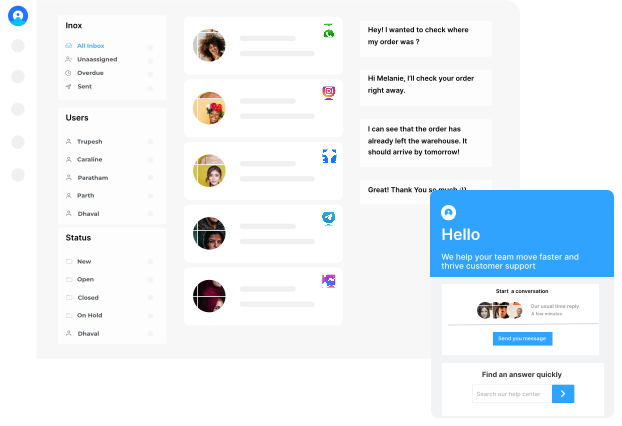
Whether it’s about acquire, engage or support – Omni24 covers all your customer engagement needs in one complete platform.

Copyright ©2026 Veemo All rights reserved.
CA, Los Angeles, Hall Ave, 19011