How Proactive Messaging Drives Engagement & Loyalty?
Proactive messaging anticipates customer needs, reduces friction, boosts satisfaction, builds trust and drives stronger engagement.
Proactive messaging anticipates customer needs, reduces friction, boosts satisfaction, builds trust and drives stronger engagement.
Most businesses wait for customers to reach out and that waiting is quietly costing them retention. The gap between what customers need and what businesses communicate is where churn actually begins.
Such silence creates uncertainty in the customer’s mind and uncertainty almost always moves them closer to leaving. Proactive messaging closes that gap by putting the right information in front of the customer before they feel the need to ask.
Proactive chat triggers 20-40% conversion lifts, turning passive data into active opportunities via timely, predictive outreach.
Businesses that implement it correctly see fewer support tickets, stronger retention and customers who genuinely trust the brand they are paying for.
Proactive messaging is when a business reaches out to a customer first before the customer feels the need to ask. It is about delivering the right information at the right moment to keep customers informed and confident.
Investing in proactive messaging across digital channels directly shapes how customers perceive and experience your brand. When customers receive timely and relevant updates, they feel valued rather than ignored.
Businesses that build proactive messaging into their digital strategy consistently outperform those that wait for customers to raise concerns. It shifts the entire customer relationship from reactive damage control to intentional experience building.
Key objectives:
Understanding the two core types of proactive messaging helps businesses deploy the right message at the right moment.
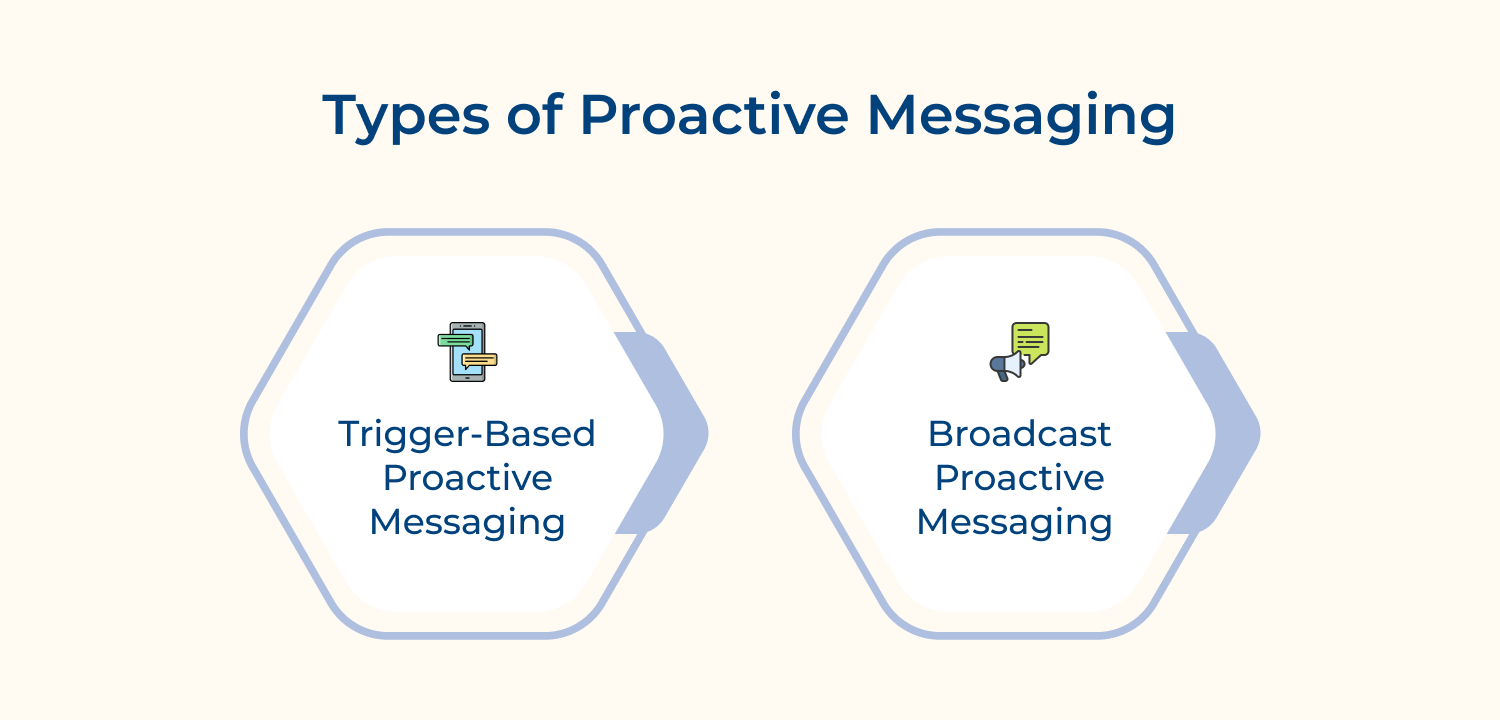
Trigger-based messaging fires automatically when a customer takes a specific action or hits a defined condition in your system. It is the most precise form of proactive communication because the message is directly tied to real customer behaviour.
Examples of trigger-based proactive messaging in action:
This type of messaging removes the guesswork because the system responds to what the customer actually did. Businesses using trigger-based flows see measurably higher engagement because the message always arrives with context.
Broadcast messaging is when a business sends a planned message to a defined segment of customers at a scheduled time. It works best when you have an important update or offer that is relevant to a group rather than an individual action.
Examples of broadcast proactive messaging in action:
Done right, broadcast messaging feels less like a blast and more like a well-timed heads-up from a brand that knows its audience. The key is tight segmentation because a poorly targeted broadcast does more damage to trust than silence ever would.
Knowing when to send a proactive message is just as important as knowing what to say in it.
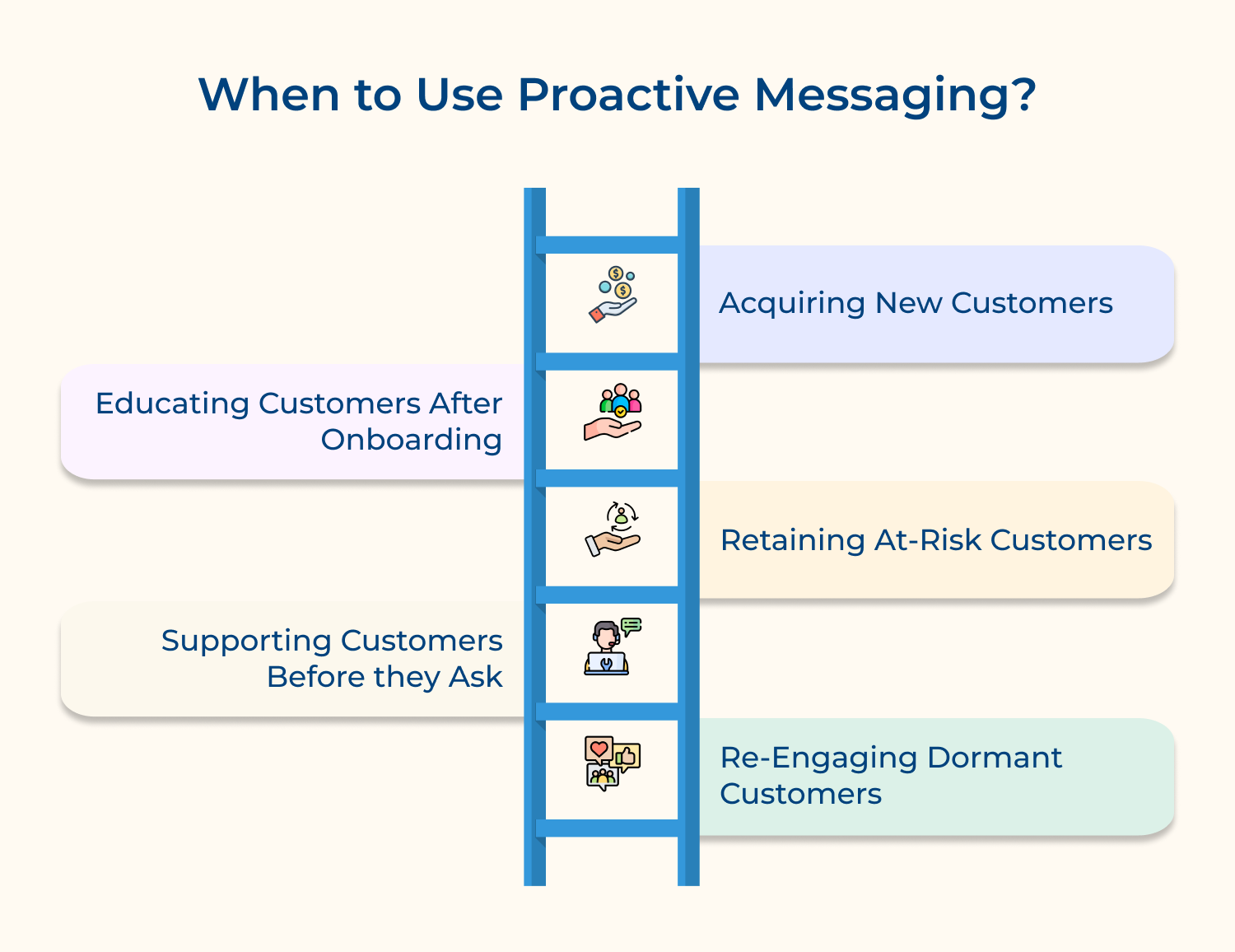
Proactive messaging during the acquisition stage works best when a prospect has shown clear intent but has not yet converted. A well-timed message at that moment — say, after a pricing page visit — can be the deciding factor between a sign-up and a drop-off.
Ask yourself these questions before sending acquisition messages:
Businesses that map their proactive triggers to high-intent prospect behaviour consistently see better conversion rates than those running generic outreach. The message does not need to be aggressive; it just needs to arrive when the prospect is already thinking about you.
The onboarding window is one of the most underused opportunities in proactive messaging for most businesses. Customers who do not understand your product quickly lose confidence in it and that directly increases early churn.
A strong onboarding message sequence should cover these core areas:
Sending structured educational messages in the first 7 to 14 days covering key features and common use cases builds product familiarity faster. A customer who knows how to use what they paid for is far more likely to stick around and expand their usage over time.
The most expensive support interaction is the one that could have been prevented with one timely message. When your system detects a potential issue like a failed payment or an unusual usage drop, reaching out first completely changes the customer’s perception of your brand.
These questions can sharpen your proactive support strategy significantly:
Proactive support messaging reduces inbound ticket volume while simultaneously improving satisfaction scores. Customers do not remember that there was a problem; they remember that you caught it before they had to.
Churn rarely happens without warning signals and your data almost always shows them before the customer cancels. A sudden drop in login frequency or a skipped renewal are clear behavioural signals that warrant an immediate proactive outreach.
The message at this stage should not feel like a desperate save; it should feel like a genuine check-in from a brand that is paying attention. Businesses that build churn-prediction triggers into their messaging workflows retain significantly more customers than those who only react after a cancellation.
A customer going quiet does not always mean they are gone and that distinction matters enormously for revenue recovery. Proactive re-engagement messaging targeted at dormant segments based on last activity date and past behaviour can bring back customers who simply drifted away.
Here is what an effective re-engagement message strategy should include:
The most effective re-engagement messages acknowledge the gap and lead with something genuinely useful like a new feature or a relevant use case. Pushing a discount as the first move leaves revenue on the table because many dormant customers will return for value not just a price cut.
Here are the eight essential steps to successfully integrating proactive messaging into your communication practices, ensuring you not only meet customer expectations but consistently exceed them
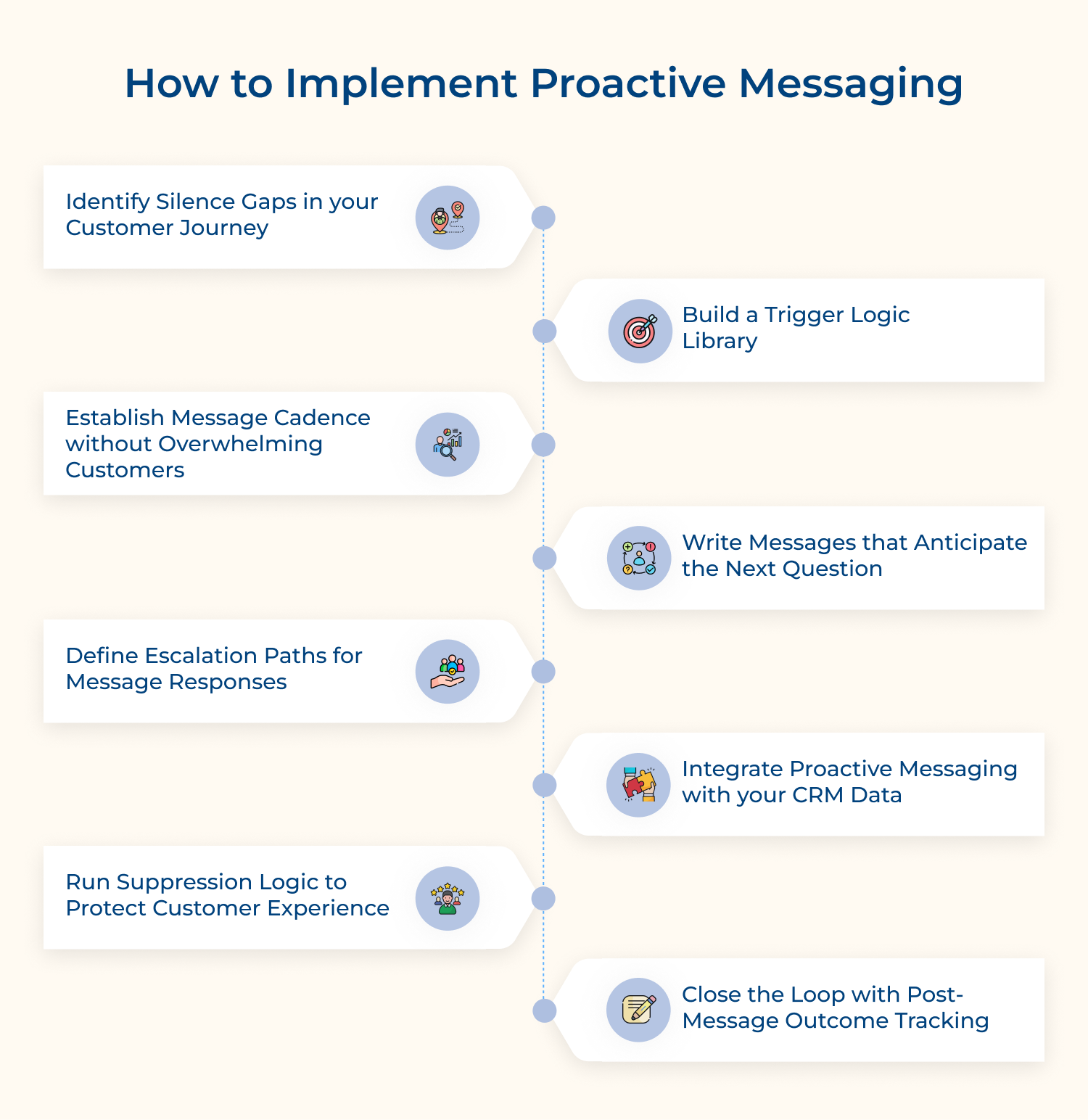
Most businesses invest heavily in acquisition messaging but leave critical post-conversion moments completely silent. Those unaddressed gaps are where customer trust slowly breaks down without any visible warning sign.
Here are four silence gaps every business must identify and address:
The core challenge with silence gaps is that they are invisible until you deliberately map your communication against the full customer journey. Most teams only discover these gaps after seeing a spike in churn or inbound support volume from a specific stage.
So how do you practically locate these gaps in your own business? Pull your inbound support tickets and group them by customer journey stage because every recurring query cluster points directly to a silence gap that proactive messaging can close.
A trigger logic library is the operational backbone of any proactive messaging strategy that scales without becoming chaotic. It defines exactly when a message fires, for whom and toward what specific customer outcome.
Without documented trigger logic, teams end up making individual decisions on the fly that create inconsistent and often contradictory customer experiences. The library brings discipline to what would otherwise be a fragmented and reactive process.
Here is a 5-step process to build a trigger logic library for proactive messaging:
So why must event-driven triggers be kept separate from scheduled broadcast triggers once your library is built? Because mixing them without clear separation causes your personalised real-time messages to get delayed or suppressed by lower-priority scheduled sends which defeats the purpose entirely.
Pro Tip: Store every trigger rule with its condition logic, message objective and team owner in a shared document so any new team member can build on the library without accidentally breaking existing customer flows.
Even the most relevant proactive message loses its impact when customers are receiving too many messages too close together. Cadence is not a scheduling preference — it is a core part of how customers experience your brand’s respect for their attention.
Getting cadence right requires you to think about the cumulative message experience rather than evaluating each message in isolation. A customer who receives three well-intentioned messages in two days will begin treating all of them as noise regardless of individual relevance.
Setting Frequency Caps to Protect Message Value Per Customer
Frequency caps work best when they are set at the customer level rather than the campaign level. A customer in an active support situation should automatically receive fewer promotional triggers because volume at the wrong moment destroys perceived care.
Defining Cooling-Off Periods Between Consecutive Proactive Messages
A cooling-off period is a mandatory gap between two proactive messages sent to the same customer. Without it, even perfectly timed individual messages start blending into a pattern that feels more like pressure than guidance.
Balancing Message Urgency Against the Customer’s Attention Bandwidth
High-urgency triggers like a failed payment must fire immediately regardless of recent message history. Lower-urgency messages like feature tips or educational nudges should be held back if the customer has already received a message within the last 48 hours.
A proactive message that addresses the current situation but ignores the obvious follow-up question has only completed half its job. The best proactive messages are written to make the customer’s next action completely obvious without them having to think.
Every word in a proactive message should be working toward one outcome — eliminating the customer’s need to seek further clarification. When a message achieves that, it does not just inform the customer; it actively reduces friction from their experience.
Here are examples of proactive messages that successfully anticipate the next question:
Businesses that consistently write self-sufficient proactive messages see a measurable reduction in reply rates and follow-up support contacts. That metric alone tells you whether your message truly anticipated the next question or simply created a new one.
Best practices for writing messages that anticipate the next question:
A proactive message that triggers a customer reply but leads nowhere actively damages the trust it was designed to build. Every response needs a pre-defined path that moves the conversation forward without hesitation.
When a customer replies to a proactive message, the response carries a specific intent your system must immediately recognise. Identifying that intent upfront is what determines whether the experience continues smoothly or collapses into a dead end.
Here is what a customer response to a proactive message can look like:
Once response types are defined, routing each one correctly becomes a structured decision rather than a reactive scramble. Misrouted replies are where most businesses accidentally convert a positive proactive moment into a frustrating dead-end experience.
Here are 3 key routing criteria based on customer responses to proactive messages:
Once routing is defined, handoff protocols become the final execution layer that determines whether the escalation lands well. For example — a reply saying “this charge looks wrong” must immediately suspend automation and create a prioritised live agent task with the full message thread attached.
CRM integration gives your proactive messaging system the live intelligence it needs to send messages with genuine contextual accuracy. Without real-time CRM data feeding your triggers, your entire proactive strategy runs on outdated customer information.
Before building the integration, run through this 4-question readiness checklist:
This checklist prevents you from deploying a system that fires messages on stale data creating disconnected customer experiences. One misfire caused by outdated CRM data can undermine the credibility of every proactive message that follows.
With a properly integrated CRM, your system triggers messages based on what a customer did 30 minutes ago. That shift from profile-based to behaviour-based triggering is the difference between messaging that feels automated and messaging that feels attentive.
best practices:
Suppression logic is the decision layer that tells your system when holding back a message is more valuable than sending one. Most businesses optimize their proactive systems to send — very few build equally strong logic to stop.
Here are 3 effective suppression methods every proactive messaging system must have:
So what actually happens when suppression logic is missing from your proactive messaging system? A customer managing a billing dispute who simultaneously receives an upsell message will treat it as proof that your business has no awareness of their situation.
Consider this — a customer raises a delayed order complaint on Monday and receives an automated satisfaction survey on Tuesday. That single misfire tells the customer your systems are operating in complete isolation and reversing that perception takes significant effort.
Sending a proactive message without tracking its outcome is operationally equivalent to making a business decision without reviewing the results. Outcome tracking transforms your proactive messaging programme into a continuously improving customer experience system.
Here is what outcome tracking in proactive messaging is designed to measure:
These four metrics show whether your proactive messaging is genuinely changing customer behaviour or simply adding to notification volume. That distinction separates a strategy that reduces churn from one that merely appears proactive on the surface.
Here are 4 core metrics for closing the loop on proactive message outcomes:
When outcome data shows consistent underperformance against a specific trigger, the problem is almost never the message copy. Refining trigger logic based on real behavioural outcome data is what keeps your proactive messaging precise as your customer base scales.
Most businesses launch proactive messaging with the right intent but undermine it through execution mistakes that quietly erode customer trust. Knowing what to avoid is just as strategically important as knowing what to do.
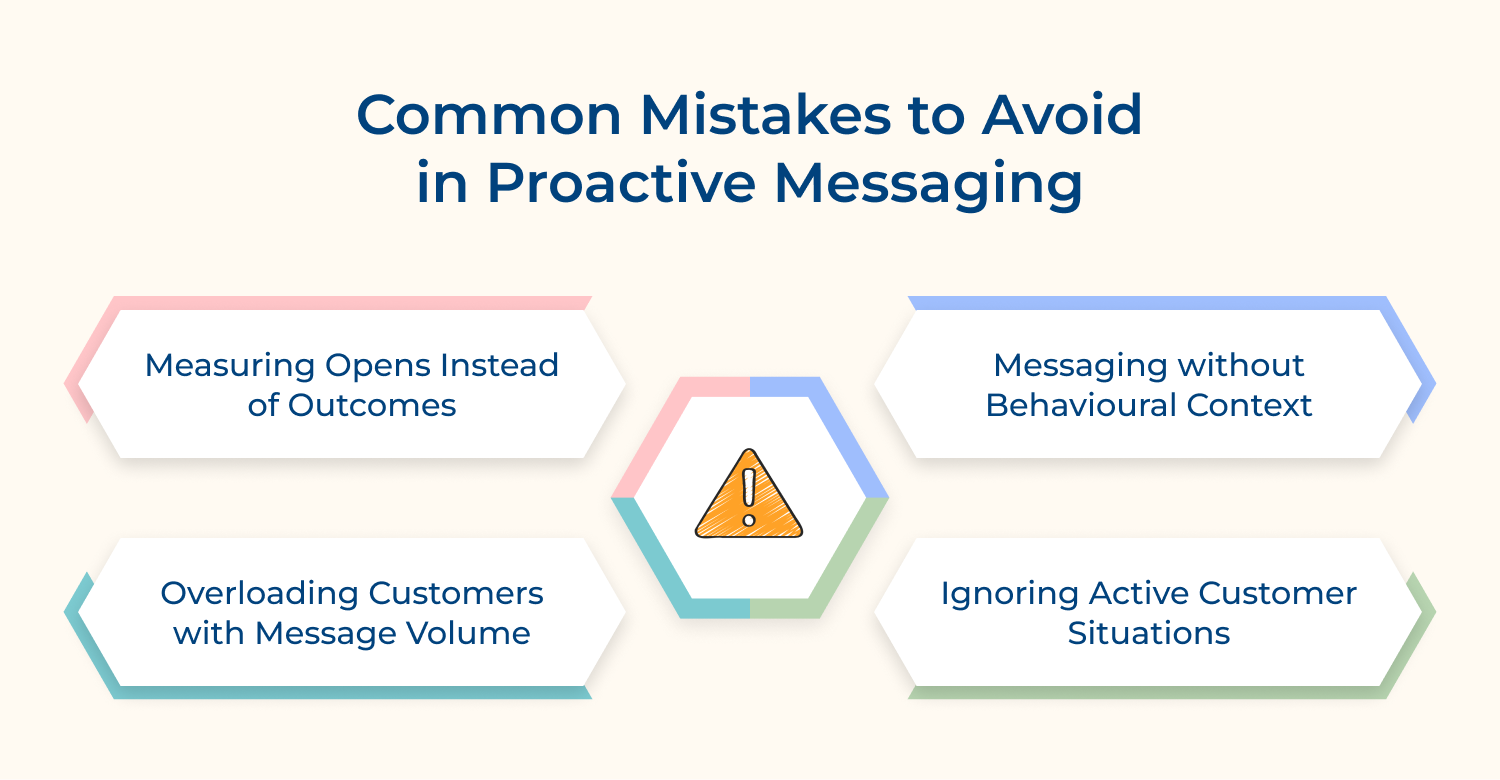
1. Messaging Without Behavioural Context
Sending a proactive message based on who a customer is rather than what they just did produces messages that feel generic and poorly timed. A message disconnected from real customer behaviour signals that your system is not actually paying attention.
2. Ignoring Active Customer Situations
Triggering a promotional or educational message while a customer has an open complaint or an unresolved ticket is one of the most damaging execution failures in proactive messaging. It tells the customer that your communication systems operate in complete isolation from each other.
3. Overloading Customers With Message Volume
Sending too many proactive messages in a short window trains customers to ignore all of them regardless of relevance or urgency. Volume without discipline turns a trust-building tool into a source of friction.
4. Measuring Opens Instead of Outcomes
Optimising your proactive messaging strategy around open rates and click rates gives you engagement data but tells you nothing about whether the message actually solved the problem it was sent to address. A message with a high open rate that still generates a support ticket has fundamentally failed its purpose.
Here is how to fix each of these mistakes effectively:
Proactive messaging is not a communication upgrade — it is a fundamental shift in how businesses build lasting customer relationships. The businesses that win long-term are the ones that speak first with context and purpose.
Every silent gap you close with a well-timed message is a churn risk you eliminate before it ever surfaces. Start aiming the right triggers, protect the experience with suppression logic and let outcome data sharpen your strategy over time.

How can businesses optimize their approach to Proactive Messaging?
Optimisation starts with replacing assumption-based triggers the real behavioural signals pulled directly from live customer data. Every underperforming message should lead you back to refining the trigger condition rather than rewriting the message copy.
What are the common challenges in implementing Proactive Messaging?
The biggest implementation challenge is not the technology — it is the absence of clean and real-time customer data to power accurate triggers. Without suppression logic and defined escalation paths, even a well-built proactive system will create more friction than it resolves.
How does Proactive Messaging improve customer engagement?
Proactive messaging improves engagement because it reaches customers at moments of genuine relevance rather than at a scheduled broadcast time. A message tied to a real customer action always outperforms a message tied to a calendar date.
Can Proactive Messaging be automated?
Proactive messaging can and should be automated but automation without behavioural logic produces messages that feel robotic rather than responsive. The goal is to build automation that reacts to what customers actually do rather than simply running on a preset schedule.
Is Proactive Messaging suitable for small businesses?
Small businesses arguably benefit more from proactive messaging because every customer relationship carries a higher individual revenue weight. Even a simple trigger — like a follow-up message after a first purchase — can meaningfully improve retention without requiring enterprise-level infrastructure.
 https://omni24.io/wp-content/uploads/2026/08/AI-Customer-Service-Agents.png
1256
2400
Webvision Solution
https://omni24.io/wp-content/uploads/2023/04/Omni-Logo-1.svg
Webvision Solution2026-09-21 04:48:512026-09-21 04:48:51How to Build an AI Customer Service Agents: 8 Key Steps
https://omni24.io/wp-content/uploads/2026/08/AI-Customer-Service-Agents.png
1256
2400
Webvision Solution
https://omni24.io/wp-content/uploads/2023/04/Omni-Logo-1.svg
Webvision Solution2026-09-21 04:48:512026-09-21 04:48:51How to Build an AI Customer Service Agents: 8 Key Steps https://omni24.io/wp-content/uploads/2026/08/Omnichannel-Conversational-AI.png
1256
2400
Tushar Joshi
https://omni24.io/wp-content/uploads/2023/04/Omni-Logo-1.svg
Tushar Joshi2026-09-16 03:51:072026-09-16 03:51:07How to Build Omnichannel Conversational AI Strategy
https://omni24.io/wp-content/uploads/2026/08/Omnichannel-Conversational-AI.png
1256
2400
Tushar Joshi
https://omni24.io/wp-content/uploads/2023/04/Omni-Logo-1.svg
Tushar Joshi2026-09-16 03:51:072026-09-16 03:51:07How to Build Omnichannel Conversational AI Strategy https://omni24.io/wp-content/uploads/2026/08/Customer-Service-Teams.png
1256
2400
Tushar Joshi
https://omni24.io/wp-content/uploads/2023/04/Omni-Logo-1.svg
Tushar Joshi2026-09-15 04:01:522026-09-15 04:02:16How to Build Customer Service Teams: 6 Key Steps
https://omni24.io/wp-content/uploads/2026/08/Customer-Service-Teams.png
1256
2400
Tushar Joshi
https://omni24.io/wp-content/uploads/2023/04/Omni-Logo-1.svg
Tushar Joshi2026-09-15 04:01:522026-09-15 04:02:16How to Build Customer Service Teams: 6 Key Steps
Whether it’s about acquire, engage or support – Omni24 covers all your customer engagement needs in one complete platform.

Copyright ©2026 Veemo All rights reserved.
CA, Los Angeles, Hall Ave, 19011