Customer Centric Marketing: What it is & How to Succeed
Customer-centric marketing boosts loyalty and sales by meeting needs. Though challenging, simple strategies can lead to lasting customer retention.

Customer-centric marketing boosts loyalty and sales by meeting needs. Though challenging, simple strategies can lead to lasting customer retention.
Businesses are constantly vying for the attention of consumers. With the rise of digital marketing and social media, companies have more opportunities than ever to engage their target audience.
However, only 9% of the companies operate in a truly customer centric manner! Why is that? What aspects make customer-centric culture difficult for the companies to execute?
Every business knows that understanding customer expectations and offering products with high-value is the only way to stay relevant in the competition. Implementing customer-centric strategy is always an added advantage. Let’s explore why focusing on the customer is essential for a thriving marketing strategy.
Customer-centric marketing focuses on putting the customer at the center of all marketing strategies and activities. It aims to create a personalized as well as engaging experience for the customer.
The approach involves understanding the needs and preferences of individual customers while tailoring marketing efforts to meet those needs. The goals of customer-centric marketing are to build strong relationships with customers, increase customer loyalty, while also driving sales and revenue.
key objectives:
Customer-centric companies reap 60% higher profits compared to the ones that haven’t prioritized CX. Let’s explore the importance of customer centric marketing.
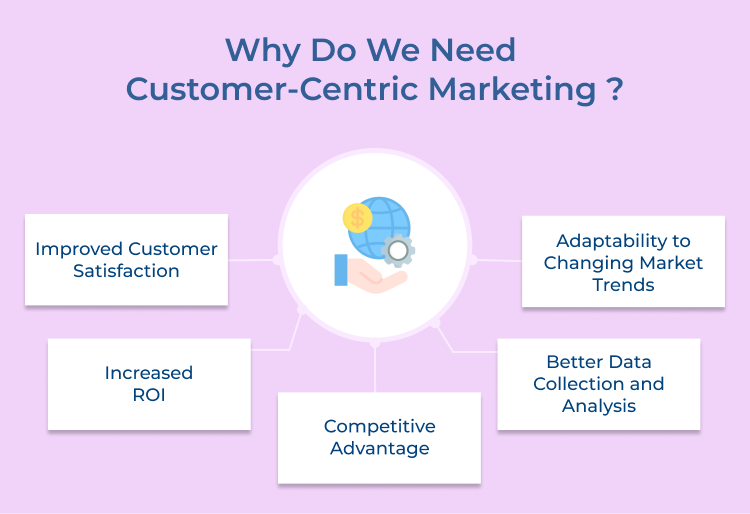
Although customer-centric marketing benefits the companies, what exactly does it mean to be customer-centric? Here are some practical steps to execute a fool-proof strategy:
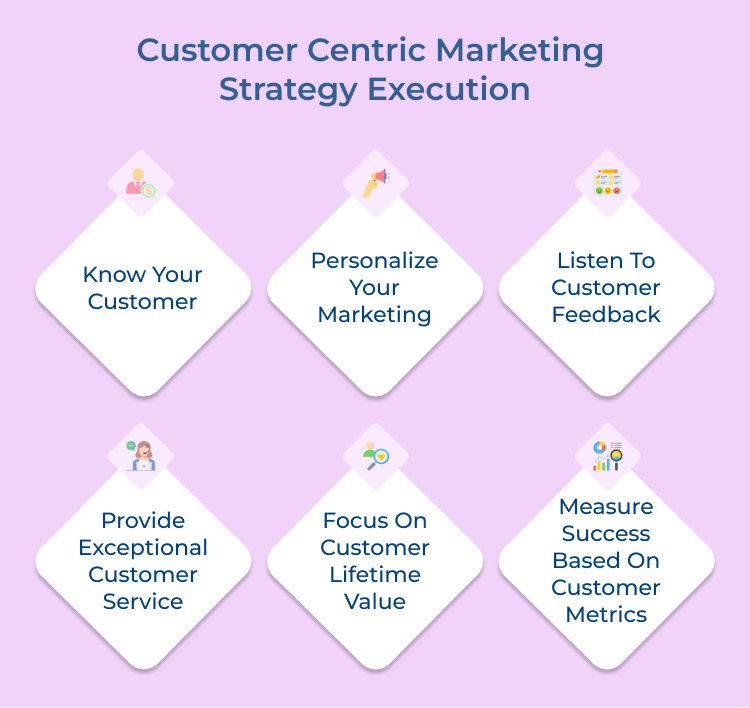
The first step in building a customer-centric marketing strategy is to truly understand who your target audience is. Conduct market research, analyze data and create customer personas to get a clear picture of your ideal customer.
Consider following tips:
Once you have a clear knowledge of your customer, tailor your marketing efforts to meet their specific preferences. Personalization can be as simple as addressing customers by name in emails or as complex as creating customized product recommendations based on their browsing history.
Pro tips:
Customer feedback is a goldmine of information for improving your products and services. Actively seek out feedback through surveys, reviews, social media interactions, etc. to use this information to make necessary adjustments to your marketing strategy.
Tips to consider:
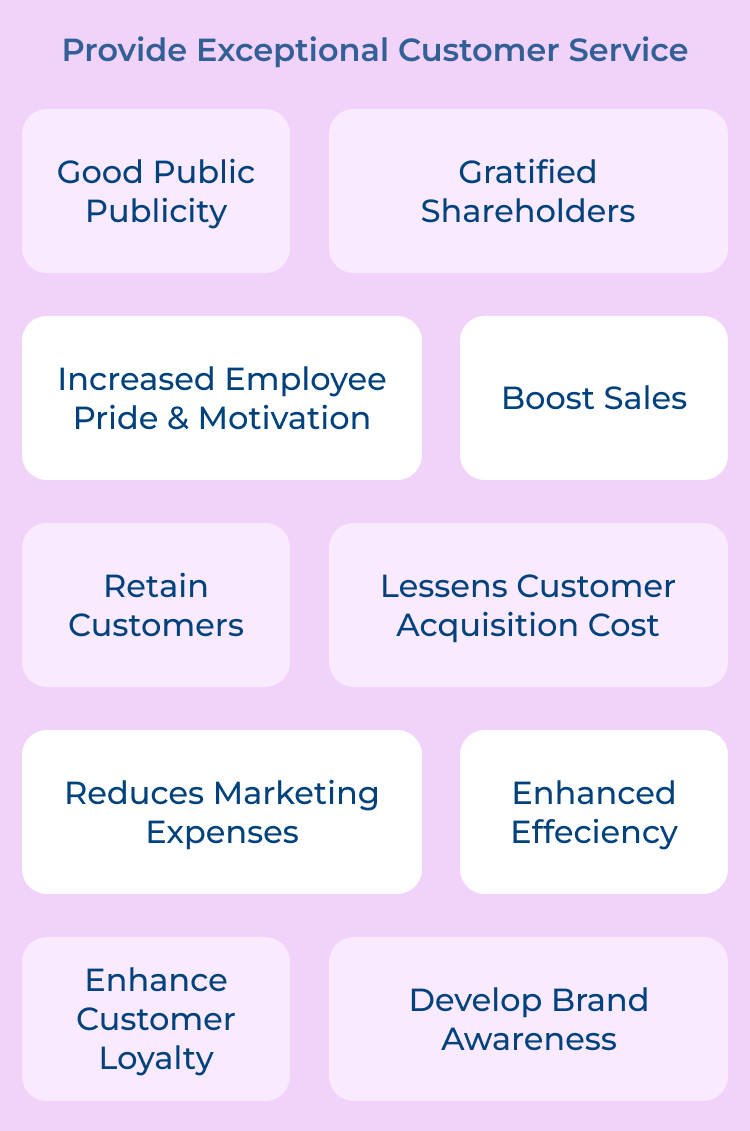
Excellent customer service is a key component of a customer-centric marketing strategy. Make sure your customers feel valued and supported in every customer journey, whether it’s through live chat, email support, or social media interactions.
Pro tips:
Instead of focusing solely on acquiring new customers, prioritize building long-term relationships with existing customers. Loyal customers make repeat purchases and recommend your brand to others which eventually increases customer lifetime value along with customer retention.
Here are few tips:
In order to evaluate the success of your customer-centric marketing efforts, track key customer metrics such as customer satisfaction, retention rate and Net Promoter Score (NPS). Use these metrics to make data-driven decisions while continuously improving your marketing strategies.
Tips:
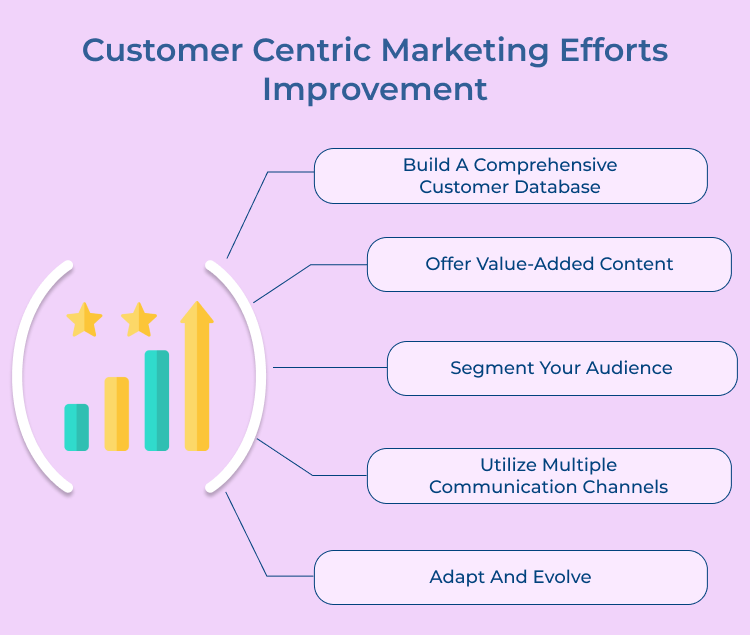
The success rate of selling a product to your existing customer is 60-70% compared to the new ones which is only 5-20%! Here are tips to help improve customer-centric marketing efforts:
In my opinion, a little effort fetches far better results than none at all. So, here’s the list of challenges you might face. Knowing these will help you create a fool-proof action plan.
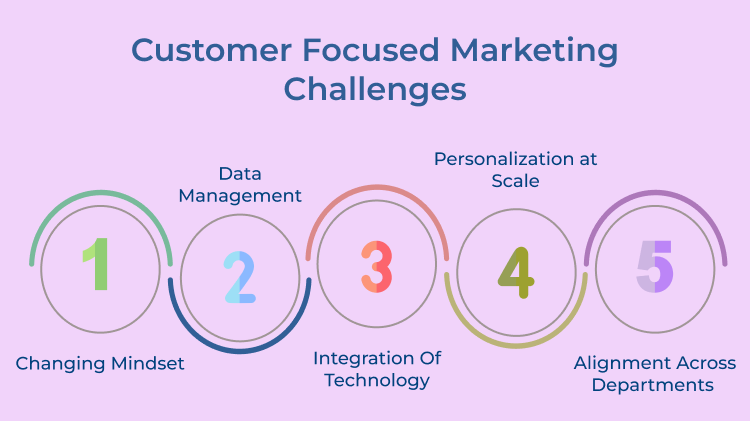
Changing Mindset
Shifting from a product-centric to a customer-centric mindset can be a challenge for many organizations. It requires a fundamental change in the way that employees think about and approach marketing, which can be a difficult as well as time-consuming process.
What you can do: Consistent communication of the effectiveness of these strategies helps the bottom-line to slowly warm up to the idea.
Data Management
Customer-focused marketing relies heavily on data and analytics to learn customer behavior, preferences etc. Analyzing large amounts of data can be overwhelming and require significant resources along with the help of expertise.
What you can do: Use tools and software to divide the data strategically. Segmenting data into digestible sections makes it easier to understand the trends as well as patterns.
Integration of Technology
Implementing a customer-focused marketing strategy often involves the use of various technologies, such as customer relationship management (CRM) systems, marketing automation platforms and analytics software. Integrating these technologies can be complex and require careful planning as well as execution.
What you can do: Find automation platforms that fit your goals and budget. It should be able to manage multiple tasks while also having a scalability option, if need be.
Personalization at Scale
Personalization is a key aspect of customer-focused marketing, but personalizing marketing messages and experiences for each individual customer at scale can be challenging. It requires a deep understanding of customer data and advanced targeting as well segmentation capabilities.
What you can do: Learn how your customers would like to be communicated. Try A/B testing on your audience to study the personalization style that is most appreciated by your audience.
Alignment Across Departments
Implementing a customer-focused marketing strategy requires alignment and collaboration across various departments, including marketing, sales, customer service and product development. Ensuring that all departments are working towards the same customer-centric goals can be difficult.
What you can do: Encourage inter-department collaboration for better communication. Break the ice with fun activities first, then proceed implementing strategies for an improved function between the departments.
Customer centric marketing is a strategy that focuses on putting the customer at the center of all marketing efforts. Here are the live examples to help you grasp things better:
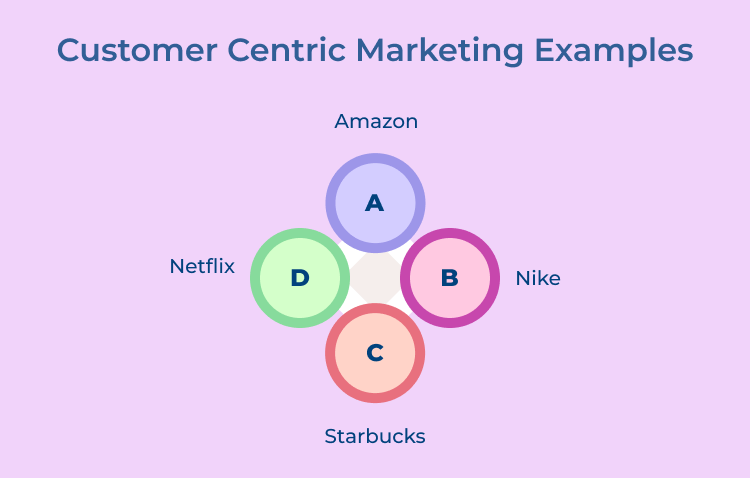
Amazon is a prime example of a company that has mastered customer-centric marketing. By analyzing customer data, Amazon is able to recommend personalized products to customers, based on their previous purchases and browsing history. The personalized approach not only enhances the customer experience but also drives sales and customer loyalty.
Nike is another company that has excelled in customer-centric marketing. Through its NikeID platform, customers can personalize their own shoes, choosing colors, materials and designs to suit their individual style. This level of customization not only appeals to customers’ preferences but also creates a sense of exclusivity and uniqueness, driving customer loyalty.
Starbucks is known for its customer-centric approach to marketing. Through its mobile app and loyalty program, Starbucks offers personalized offers, rewards, recommendations, etc to customers based on their purchase history and preferences. The personalized experience creates a sense of appreciation among customers, leading to repeat business and increased customer lifetime value.
Netflix uses customer data and behavior to personalize recommendations as well as content for its users. Analyzing viewing patterns enables the platform to suggest personalized shows and movies to users, increasing engagement / retention. The customer-centric approach has been instrumental in Netflix’s success and dominance in the streaming industry.
In conclusion, adopting a customer-focused approach in marketing is key to reaping the rewards of a successful business. By putting the needs and desires of the customer at the forefront of all marketing strategies, businesses can build strong relationships, increase brand loyalty which ultimately drive sales.
In my opinion, understanding the customer, their behavior and their preferences is crucial in creating effective marketing campaigns. When you truly listen to the customer and deliver value through personalized experiences, you differentiate yourself from the crowded marketplace. In essence, focusing on the customer is the foundation of a thriving marketing strategy.

What are the benefits of customer-centric marketing?
Customer-centric marketing has many benefits for businesses. By focusing on the needs and preferences of the customer, businesses can create more personalized marketing campaigns. This can lead to higher conversion rates, increased customer loyalty and improved customer satisfaction. Customer-centric marketing can also help businesses differentiate themselves from competitors and build a strong brand reputation.
How can you create a customer-centric marketing strategy?
To create a customer-centric marketing strategy, businesses need to start by knowing their customers. This involves conducting market research, analyzing customer data and identifying key customer segments. Once businesses have a clear understanding of their customers, they can create personalized marketing campaigns that resonate with their target audience. It may involve using customer data to personalize emails, create targeted social media ads, or develop tailored content for different customer segments.
How customer-centric marketing can help your business?
Customer-centric marketing can help businesses in a number of ways. By focusing on the needs and preferences of the customer, businesses can create more effective marketing campaigns that drive results. This can lead to increased revenue, improved customer loyalty and a stronger brand reputation. Customer-centric marketing can also help businesses stand out from competitors as well as build long-term relationships with their customers.
Why is customer-centric marketing important?
Customer-centric marketing is important because it allows businesses to build strong relationships with their customers. By focusing on the needs and preferences of the customer, businesses can create personalized marketing campaigns that resonate with their target audience. This can lead to higher conversion rates, increased customer loyalty and improved customer satisfaction.
 https://omni24.io/wp-content/uploads/2026/08/AI-Customer-Service-Agents.png
1256
2400
Webvision Solution
https://omni24.io/wp-content/uploads/2023/04/Omni-Logo-1.svg
Webvision Solution2026-09-21 04:48:512026-09-21 04:48:51How to Build an AI Customer Service Agents: 8 Key Steps
https://omni24.io/wp-content/uploads/2026/08/AI-Customer-Service-Agents.png
1256
2400
Webvision Solution
https://omni24.io/wp-content/uploads/2023/04/Omni-Logo-1.svg
Webvision Solution2026-09-21 04:48:512026-09-21 04:48:51How to Build an AI Customer Service Agents: 8 Key Steps https://omni24.io/wp-content/uploads/2026/08/Omnichannel-Conversational-AI.png
1256
2400
Tushar Joshi
https://omni24.io/wp-content/uploads/2023/04/Omni-Logo-1.svg
Tushar Joshi2026-09-16 03:51:072026-09-16 03:51:07How to Build Omnichannel Conversational AI Strategy
https://omni24.io/wp-content/uploads/2026/08/Omnichannel-Conversational-AI.png
1256
2400
Tushar Joshi
https://omni24.io/wp-content/uploads/2023/04/Omni-Logo-1.svg
Tushar Joshi2026-09-16 03:51:072026-09-16 03:51:07How to Build Omnichannel Conversational AI Strategy https://omni24.io/wp-content/uploads/2026/08/Customer-Service-Teams.png
1256
2400
Tushar Joshi
https://omni24.io/wp-content/uploads/2023/04/Omni-Logo-1.svg
Tushar Joshi2026-09-15 04:01:522026-09-15 04:02:16How to Build Customer Service Teams: 6 Key Steps
https://omni24.io/wp-content/uploads/2026/08/Customer-Service-Teams.png
1256
2400
Tushar Joshi
https://omni24.io/wp-content/uploads/2023/04/Omni-Logo-1.svg
Tushar Joshi2026-09-15 04:01:522026-09-15 04:02:16How to Build Customer Service Teams: 6 Key Steps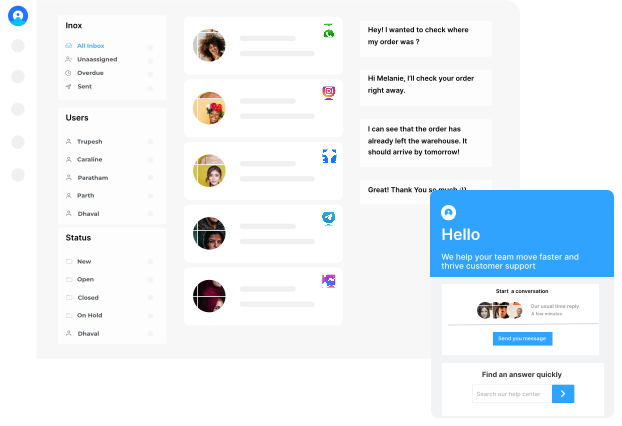
Whether it’s about acquire, engage or support – Omni24 covers all your customer engagement needs in one complete platform.

Copyright ©2026 Veemo All rights reserved.
CA, Los Angeles, Hall Ave, 19011