How CRM Marketing Transforms Customer Relationships?
CRM marketing matters because it uses data to understand customers, enabling personalized engagement, stronger relationships and better marketing results.
CRM marketing matters because it uses data to understand customers, enabling personalized engagement, stronger relationships and better marketing results.
Most businesses collect customer data but never truly use it to build relationships that last. That gap between data and action is exactly where revenue quietly walks out the door.
CRM users see 35% increase in sales, a productivity boost and 8x ROI, leading marketers to prioritize CRM for personalization.
CRM marketing closes that gap by turning raw customer information into targeted campaigns, timely outreach and experiences that actually resonate.
Explore the guide for clear definitions, real benefits and eight actionable strategies to help you build a CRM marketing approach that turns one-time buyers into long-term loyal customers.
CRM marketing is how smart businesses stop treating every customer the same. It uses CRM software & data-driven techniques to track behavior, understand preferences and deliver communication that actually matters. When done right, it transforms your marketing from broadcast to conversation.
Every time a customer emails you, buys something, or visits your site that data lives in your CRM. You use that information to segment your audience, time your outreach and personalize every touchpoint. The result is marketing that feels less like advertising and more like the business genuinely knows them.
Key Objectives:
A CRM marketing strategy is a deliberate plan that defines how you will use customer data to guide every marketing decision you make. It is not just about sending emails or running campaigns, it is about building a system that keeps customers engaged over time. Think of it as the blueprint behind every personalized interaction your business delivers.
A CRM marketing strategy tells you who to target, when to reach them and what to say based on where they are in their journey. It connects your customer data directly to business outcomes retention, revenue and loyalty.
A strong strategy also defines how your teams work together. Your marketing, sales & support teams all touch the customer and your CRM strategy ensures they are all working from the same playbook. That alignment is what turns scattered touchpoints into a seamless customer experience.
Key Factors to Consider:
CRM marketing does more than organize customer data; it directly impacts how your business grows and retains customers. Here are six benefits that make it worth investing in.
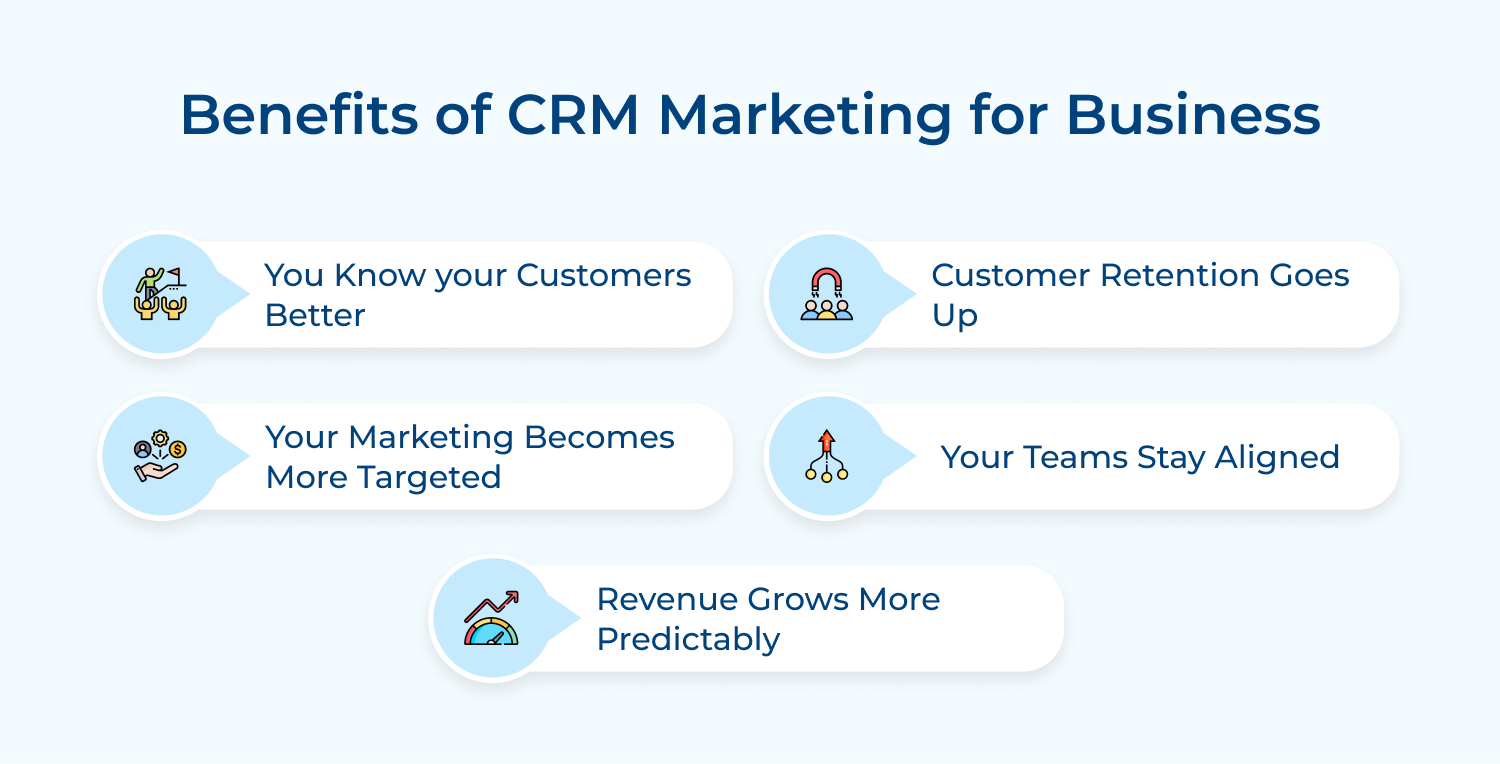
1. You know your customers better: CRM marketing gives you a clear picture of who your customers are and what they actually want. You stop guessing and start making decisions backed by real behavior.
2. Your marketing becomes more targeted: Instead of sending the same message to everyone, you reach the right customer with the right offer at the right time. That precision reduces wasted spend and improves campaign performance.
3. Customer retention goes up: When customers feel understood and valued, they stay longer. CRM marketing helps you identify at-risk customers early and act before they decide to leave.
4. Your teams stay aligned: Marketing, sales and support all work from the same customer data. That shared view eliminates confusion and ensures every team delivers a consistent experience.
5. Revenue grows more predictably: CRM marketing helps you identify upsell and cross-sell opportunities within your existing customer base. Growing revenue from customers you already have is faster and cheaper than acquiring new ones.
CRM marketing is not a single tactic it is a system that touches every part of how you manage and grow customer relationships. Here is where it creates real impact across industries.
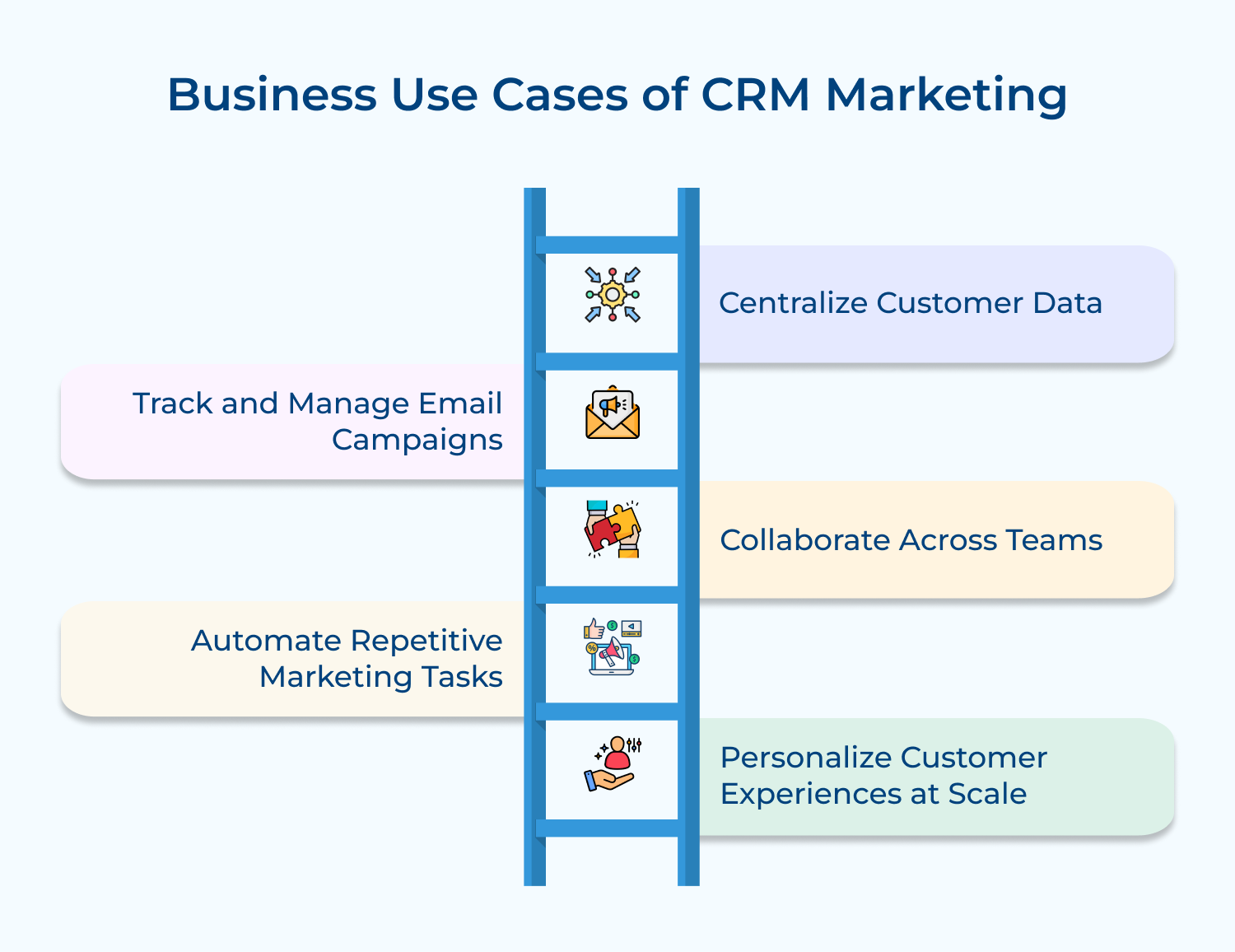
Scattered data is one of the biggest reasons marketing fails. Your CRM fixes that by pulling everything into one place. Whether you are in retail, healthcare or SaaS, having a single source of truth changes how you make decisions.
When your data is centralized, your campaigns become sharper and your customer conversations become more meaningful. A hospital system using CRM, for example, can track patient history and send timely follow-up care reminders all from one platform.
Email without tracking is just sending messages into the void. CRM marketing lets you monitor open rates, click behavior and conversions tied to actual customer profiles.
An e-commerce brand can use this to see which customers opened a discount email but did not purchase, then trigger a follow-up automatically. That level of visibility turns email from a broadcast channel into a precision tool.
Manual follow-ups & campaign scheduling drain your team’s time introduce human error. CRM automation handles the repeatable work so your team focuses on strategy.
A financial services firm, for example, can automate onboarding sequences for new clients ensuring every client gets the same quality experience without relying on a team member to remember each step.
CRM marketing breaks the wall between marketing, sales and support by giving every team visibility into the same customer journey. No more “I didn’t know that was already handled” moments.
When a sales rep can see that a customer just raised a support ticket, they know not to push an upsell right now. That kind of real-time collaboration protects the customer relationship and makes your business feel more coordinated.
Personalization is not just a nice-to-have customers now expect it. CRM marketing lets you deliver tailored experiences to thousands of customers without losing the human touch.
A travel brand can use CRM data to send destination recommendations based on past bookings and browsing behavior. That kind of relevance builds loyalty far faster than any generic promotional email ever could.
Knowing how to use the CRM tool strategically is what separates businesses that grow from those that plateau. These eight strategies are built for real execution and real results.
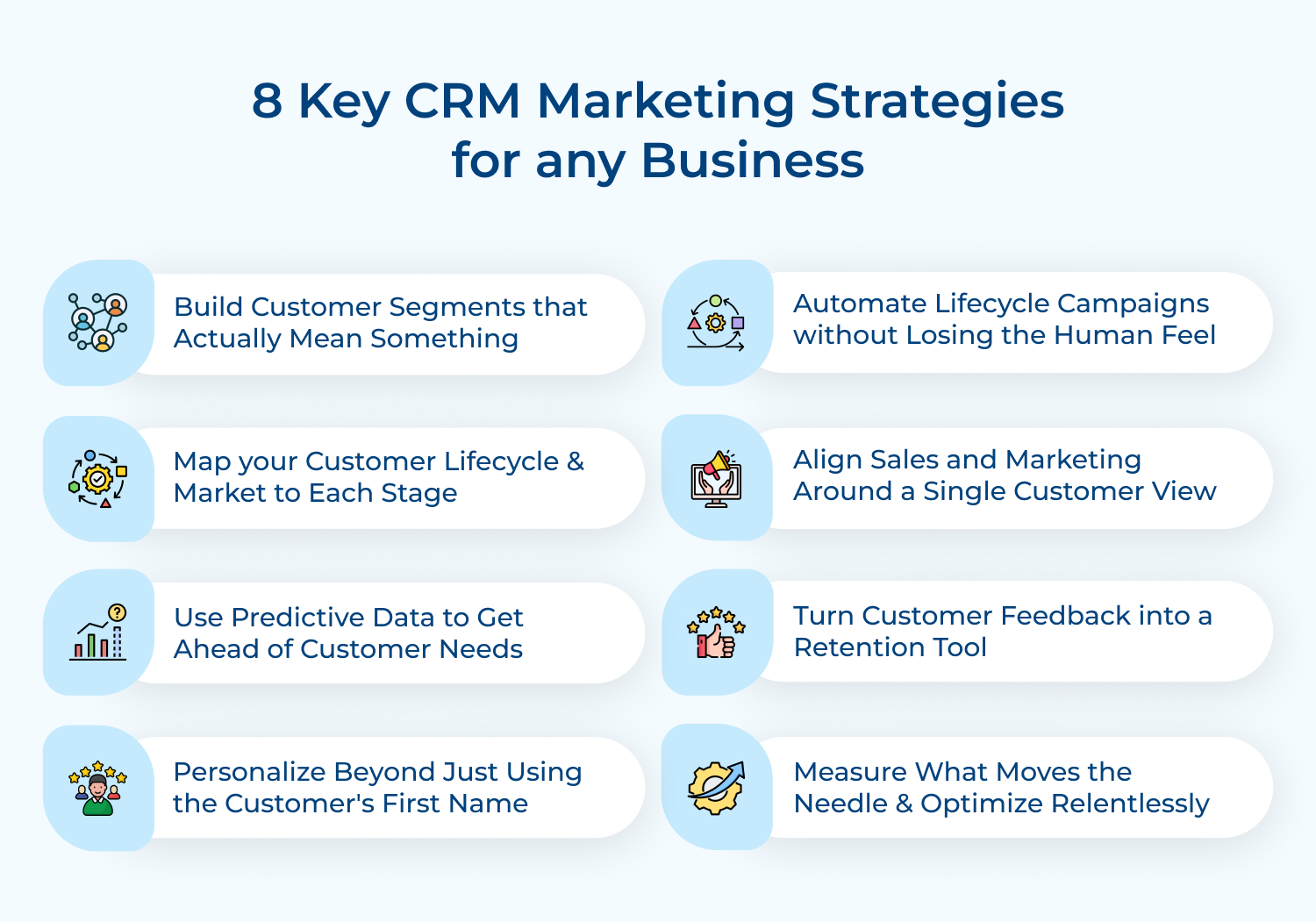
Stop segmenting by basic demographics alone. A strong CRM marketing strategy uses behavioral data purchase frequency, product usage and support history to reflect where customers truly are right now.
When your segments are built on real behavior, your messaging lands differently. A customer who bought twice in 90 days needs a very different conversation than one who has been completely silent for six months.
Here is what meaningful segmentation actually looks like in practice:
For example, a SaaS company segments its users by login frequency and feature usage. Customers who rarely use core features get an education sequence while power users receive an upsell campaign with the same product, two very different conversations that drive very different outcomes.
Every customer moves through stages of awareness, first purchase, repeat buying and loyalty. Most businesses market the same way to everyone and then wonder why retention keeps suffering quarter after quarter.
So what does lifecycle marketing actually require? It requires your CRM to tell you exactly where each customer is and your team to have a specific plan ready for each stage they move through.
Key lifecycle stages to map and market to:
Without a clear CRM marketing strategy that accounts for every lifecycle stage, you will always be marketing to the average customer. The problem is the average customer does not exist and your results will reflect that gap every single time.
Reactive marketing waits for a customer to act before you respond. Predictive CRM marketing uses historical patterns to anticipate what a customer needs before they even realize it themselves.
This is where CRM stops being a communication tool and starts becoming a genuine growth engine for your business. Businesses winning at retention are not responding to churn; they are actively preventing it before it ever happens.
For example, a subscription business notices that customers who log in fewer than three times monthly are twice as likely to cancel. Their CRM automatically triggers a personalized re-engagement campaign on day 25 saving revenue that reactive strategies would have lost entirely.
Best practices:
True personalization means your customer receives content, offers and timing that reflect their actual history with your brand. First name tags are table stakes that are not personalization at all and most customers see right through it.
What does real personalization actually feel like to a customer? It feels like your business genuinely remembers them, understands their preferences and reaches out at exactly the right moment without feeling forced.
Ask yourself these questions to evaluate your current personalization depth:
Build personalization in layers start with behavioral triggers and add complexity as your data matures over time. A well-executed CRM marketing strategy treats personalization not as a feature but as a core principle that runs through every single customer interaction you deliver.
Automation is not about removing the human touch it is about delivering it consistently at scale across every customer interaction. The biggest mistake businesses make is automating purely for efficiency and completely forgetting about the experience on the other end.
Every automated message your CRM sends is still a direct interaction with a real customer who is paying attention. They form an opinion about your brand with every single touchpoint whether a human sent it or a workflow did.
Key lifecycle moments worth automating:
Write automation copy in a tone that sounds like it came from a person not a system that is running sequences in the background. Always include a clear path for customers to reach a real human whenever they need one because not every situation can or should be handled by automation.
When sales and marketing work from different data, the customer pays the price every single time. Your CRM must ensure both teams see the same history, communication log and journey stage at all times without exception.
This is not just an operational fix it is a direct customer experience improvement that impacts revenue. Misalignment between teams creates visible gaps that customers notice and eventually leave because of over time.
Ask your team these questions to assess your current alignment:
Imagine a sales rep calling a customer to pitch an upgrade completely unaware they filed a support complaint two days ago. That call damages trust instantly and no amount of a good offer will recover the relationship at that moment. A shared CRM view would have flagged it and protected the relationship entirely.
Most businesses collect feedback and file it away without any follow-through. A smart CRM marketing strategy turns that feedback into immediate action and then closes the loop to show the customer it actually mattered to you.
That closing of the loop is exactly what most businesses skip entirely. It is also what separates brands that customers stay loyal to from brands they quietly move away from without ever explaining.
How to build feedback into your CRM strategy:
Do not send feedback requests too frequently. Survey fatigue is real, while it damages both response quality and overall customer sentiment over time. Space your requests around meaningful moments in the journey rather than pushing them out on a fixed calendar schedule.
Best practices:
Vanity metrics will give you a false sense of progress while the real numbers quietly tell a different story. The metrics that matter are customer retention rate, lifetime value, churn rate, and campaign-attributed revenue; everything else is just supporting context around those core figures.
Can you draw a straight line from your CRM activity to a real business outcome right now? If the answer is no you are measuring the wrong things and making optimization decisions based on fundamentally incomplete information.
What to track and why it matters:
Build your measurement framework before launching any campaigns, not after you are already three months in. A CRM marketing strategy that lacks a strong measurement foundation is essentially running blind and no amount of great content or smart automation can fix decisions made without reliable data to back them up.
CRM marketing shows up in more ways than most businesses realize. Here are four real examples of how it works across different customer touchpoints.
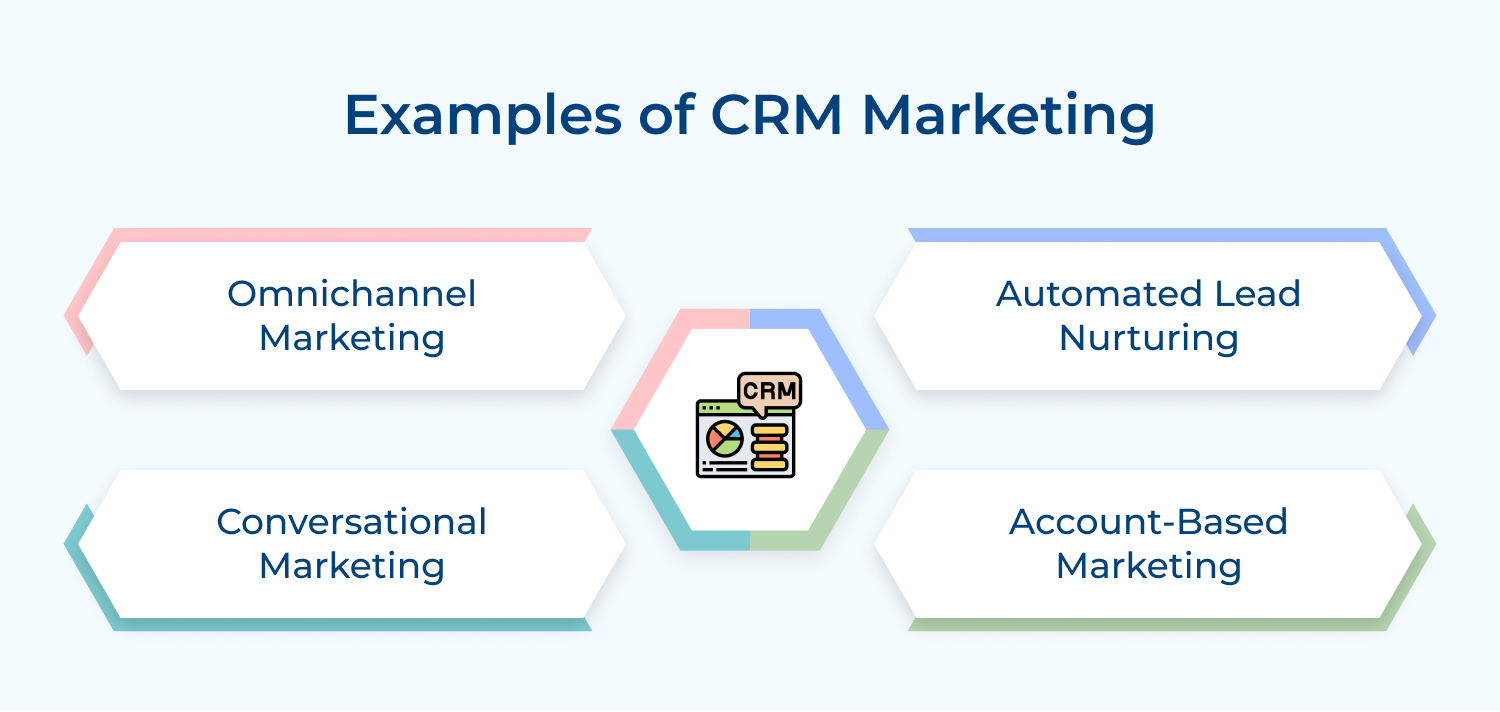
Omnichannel marketing uses your CRM to deliver a consistent experience across every channel email, SMS, social and in-store. The customer picks up exactly where they left off regardless of which channel they switch to.
Not every lead is ready to buy the moment they discover you and automated lead nurturing respects that. Your CRM tracks where each lead is and automatically delivers the right content at the right stage keeping your pipeline warm without manual effort.
Account-based marketing flips the traditional funnel instead of casting wide, you focus entirely on high-value accounts. Your CRM tells you who the key decision-makers are and when to engage them, turning marketing into precision rather than volume.
Conversational marketing uses real-time interactions, live chat, chatbots and messaging apps to move customers through the journey faster. Your CRM connects every conversation to the customer’s full history so each interaction feels like a continuation not a cold start.
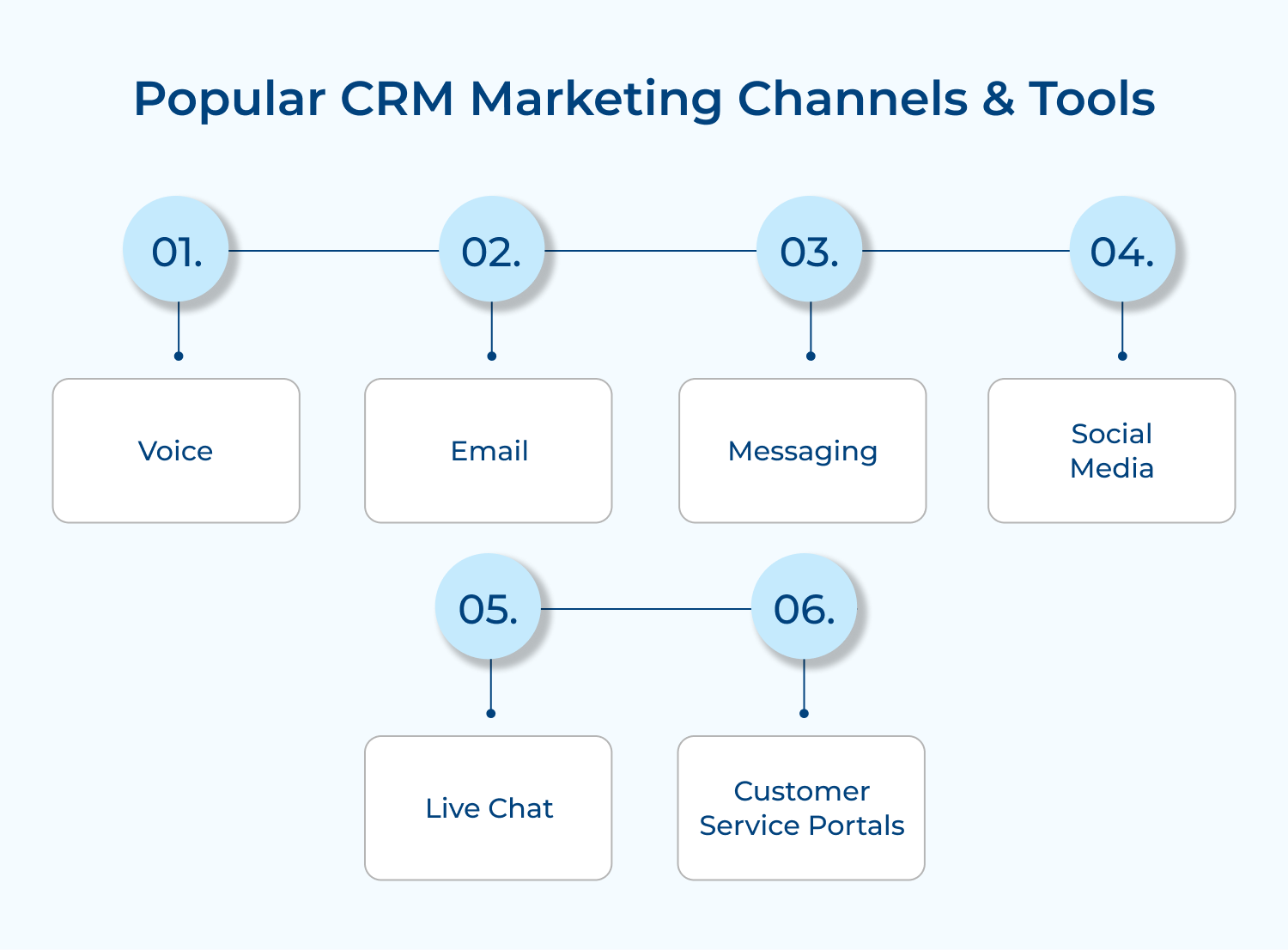
Your CRM strategy is only as effective as the channels you use to execute it. Here are six channels that deliver the most impact when backed by solid CRM data.
The right CRM software can make or break your marketing strategy. Here are three platforms that consistently deliver strong results for marketing teams.
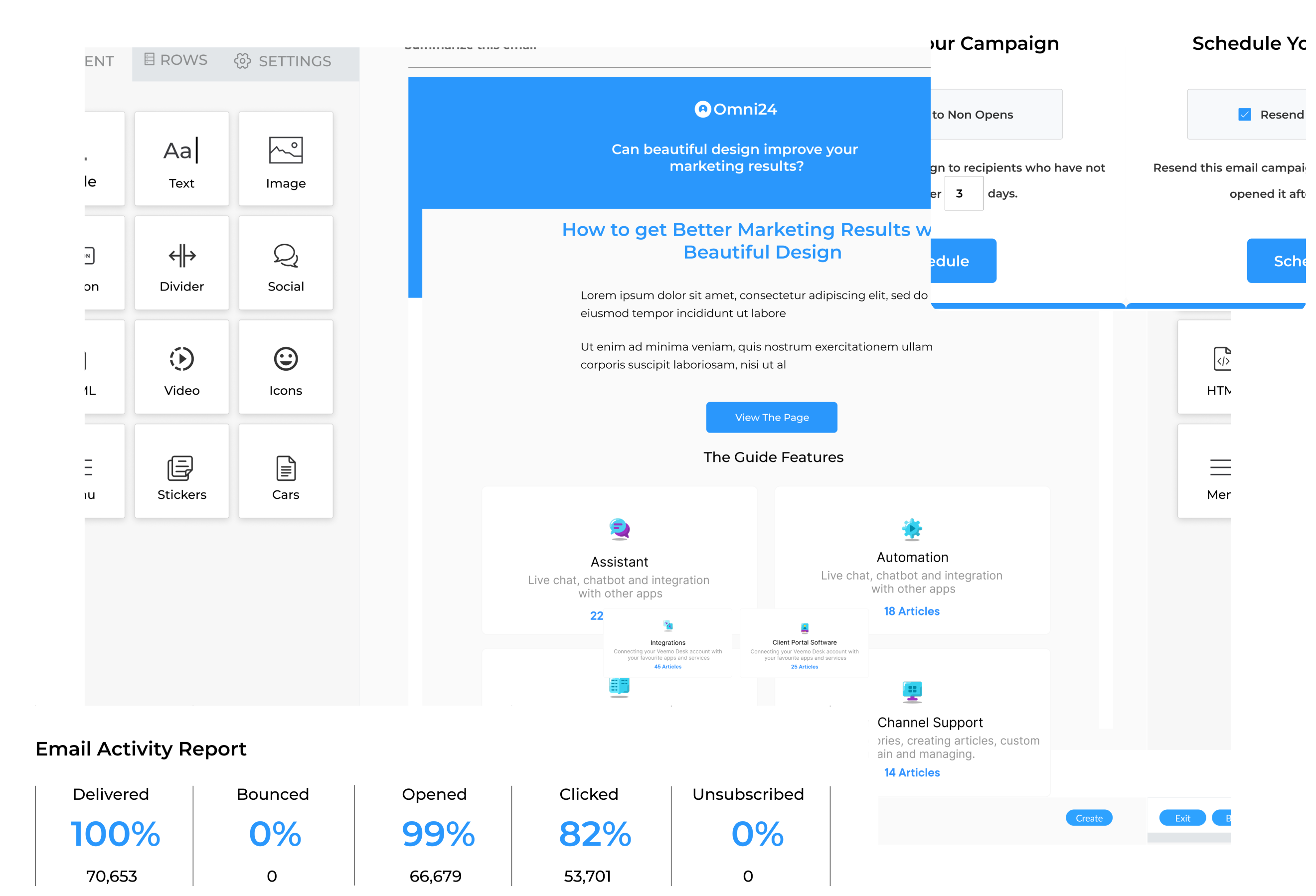
Omni24 is a customer experience platform that brings together marketing, support & engagement tools to help businesses build stronger and more profitable customer relationships from a single connected workspace.
Key Features:
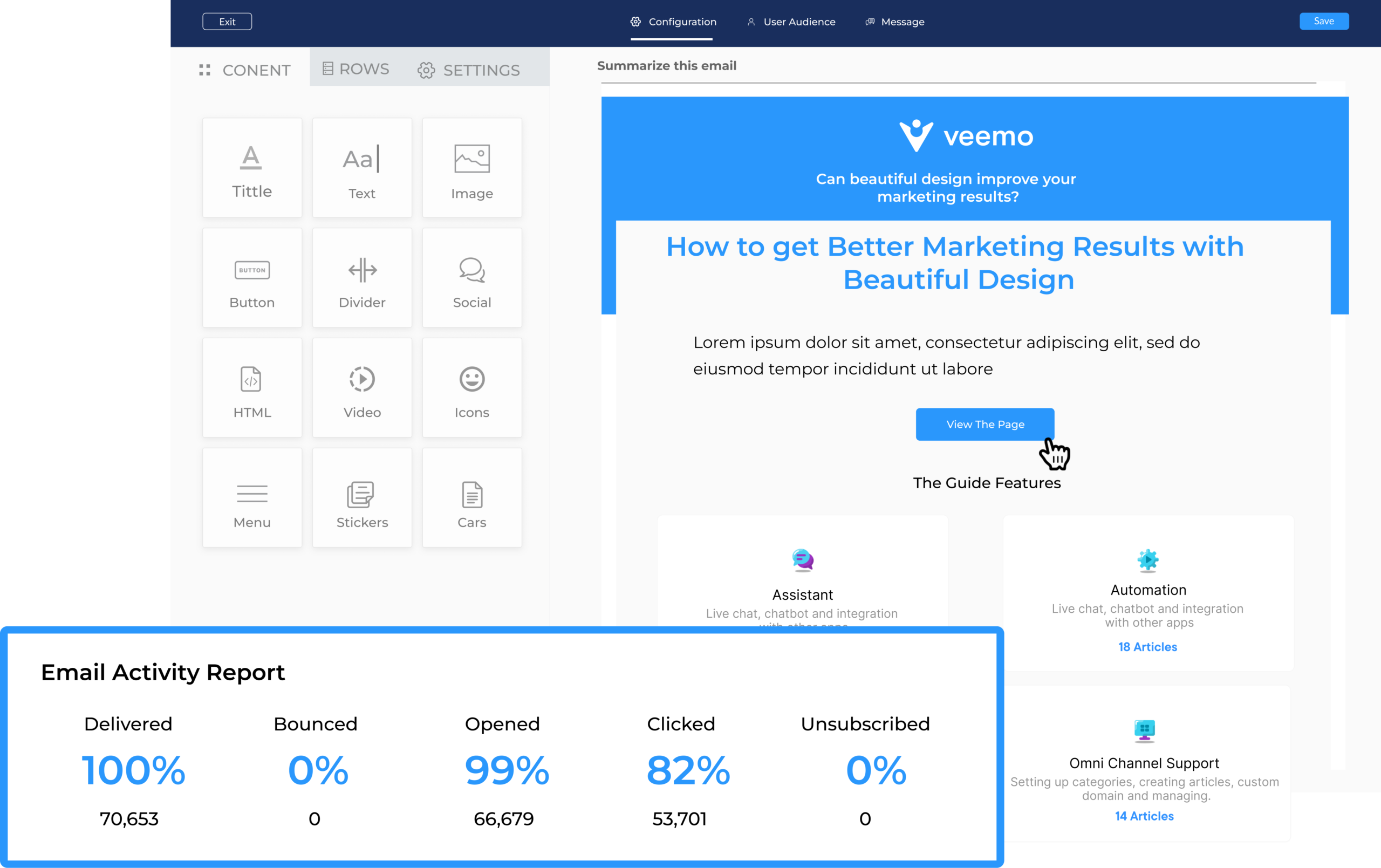
Veemo is a customer engagement suite that unifies support, sales and marketing teams around a single customer view. It helps businesses build consistent and meaningful relationships at every stage of the journey.
Key Features:
HubSpot gives marketing teams a complete view of every contact from first touch to closed deal. It combines email marketing, automation and pipeline tracking in one connected platform that is easy to adopt.
Zoho is a strong choice for growing businesses that need powerful CRM marketing features without the enterprise price tag. It covers email campaigns, lead scoring, and customer segmentation all connected to a central customer database your entire team can work from.
CRM marketing is not a one-time campaign it is a long-term commitment to understanding your customers and acting on that understanding consistently. The businesses that do this well do not just grow faster, they retain better.
Every strategy, channel and tool covered in this guide points to one outcome: a business that treats customers like relationships worth investing in. Start where you are and build from there.

How does CRM help marketing goals?
CRM gives your marketing team accurate customer data to build targeted campaigns that drive retention, increase revenue and reduce wasted spend on the wrong audiences.
How does CRM marketing support customer lifecycle management?
CRM marketing tracks where every customer is in their journey and triggers the right message at the right stage, keeping them moving forward rather than dropping off.
How can CRM marketing help in identifying and targeting high-value customers?
Your CRM scores and segments customers based on purchase history or engagement levels making it easy to identify your most valuable customers and build campaigns specifically around them.
What are common marketing CRM metrics?
The metrics that matter most are customer retention rate, lifetime value, churn rate, email engagement by segment and revenue directly attributed to your CRM campaigns.
 https://omni24.io/wp-content/uploads/2026/08/AI-Customer-Service-Agents.png
1256
2400
Webvision Solution
https://omni24.io/wp-content/uploads/2023/04/Omni-Logo-1.svg
Webvision Solution2026-09-21 04:48:512026-09-21 04:48:51How to Build an AI Customer Service Agents: 8 Key Steps
https://omni24.io/wp-content/uploads/2026/08/AI-Customer-Service-Agents.png
1256
2400
Webvision Solution
https://omni24.io/wp-content/uploads/2023/04/Omni-Logo-1.svg
Webvision Solution2026-09-21 04:48:512026-09-21 04:48:51How to Build an AI Customer Service Agents: 8 Key Steps https://omni24.io/wp-content/uploads/2026/08/Omnichannel-Conversational-AI.png
1256
2400
Tushar Joshi
https://omni24.io/wp-content/uploads/2023/04/Omni-Logo-1.svg
Tushar Joshi2026-09-16 03:51:072026-09-16 03:51:07How to Build Omnichannel Conversational AI Strategy
https://omni24.io/wp-content/uploads/2026/08/Omnichannel-Conversational-AI.png
1256
2400
Tushar Joshi
https://omni24.io/wp-content/uploads/2023/04/Omni-Logo-1.svg
Tushar Joshi2026-09-16 03:51:072026-09-16 03:51:07How to Build Omnichannel Conversational AI Strategy https://omni24.io/wp-content/uploads/2026/08/Customer-Service-Teams.png
1256
2400
Tushar Joshi
https://omni24.io/wp-content/uploads/2023/04/Omni-Logo-1.svg
Tushar Joshi2026-09-15 04:01:522026-09-15 04:02:16How to Build Customer Service Teams: 6 Key Steps
https://omni24.io/wp-content/uploads/2026/08/Customer-Service-Teams.png
1256
2400
Tushar Joshi
https://omni24.io/wp-content/uploads/2023/04/Omni-Logo-1.svg
Tushar Joshi2026-09-15 04:01:522026-09-15 04:02:16How to Build Customer Service Teams: 6 Key Steps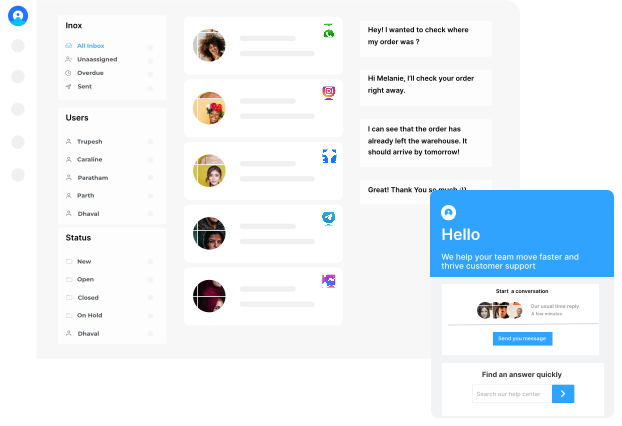
Whether it’s about acquire, engage or support – Omni24 covers all your customer engagement needs in one complete platform.

Copyright ©2026 Veemo All rights reserved.
CA, Los Angeles, Hall Ave, 19011