Customer Satisfaction vs Customer Loyalty: Is there a difference?
Learn the difference between customer satisfaction and loyalty. Discover how to measure them and build emotional connections for long-term growth.

Learn the difference between customer satisfaction and loyalty. Discover how to measure them and build emotional connections for long-term growth.
You’ve invested countless hours perfecting your product and training your team, yet despite high satisfaction scores, customers continue disappearing to competitors. This puzzling disconnect leaves you wondering why seemingly happy customers aren’t sticking around.
The answer lies in understanding the critical distinction between customer satisfaction and customer loyalty. While satisfaction addresses whether you’ve met expectations in specific interactions, loyalty reveals whether you’ve created the emotional connection necessary for customers to choose you repeatedly.
Understanding these crucial differences will transform casual customers into committed advocates who drive sustainable growth through higher spending, referrals and resistance to competitive pressures.
Customer satisfaction is the measure of how products and services supplied by a company meet or exceed customer expectations. It reflects the overall feeling of contentment that comes when a customer’s needs are fulfilled. Customer satisfaction emerges from the entire experience a person has with your organization from their first interaction to post-purchase support.
Customer satisfaction directly influences loyalty and retention rates. Satisfied customers become repeat buyers and advocates who share positive experiences with others. This organic word-of-mouth marketing reduces acquisition costs while increasing revenue stability.
Key Objectives:
Understanding why customer satisfaction matters goes beyond just making people happy. Let’s explore the tangible advantages that come from prioritizing customer experiences.
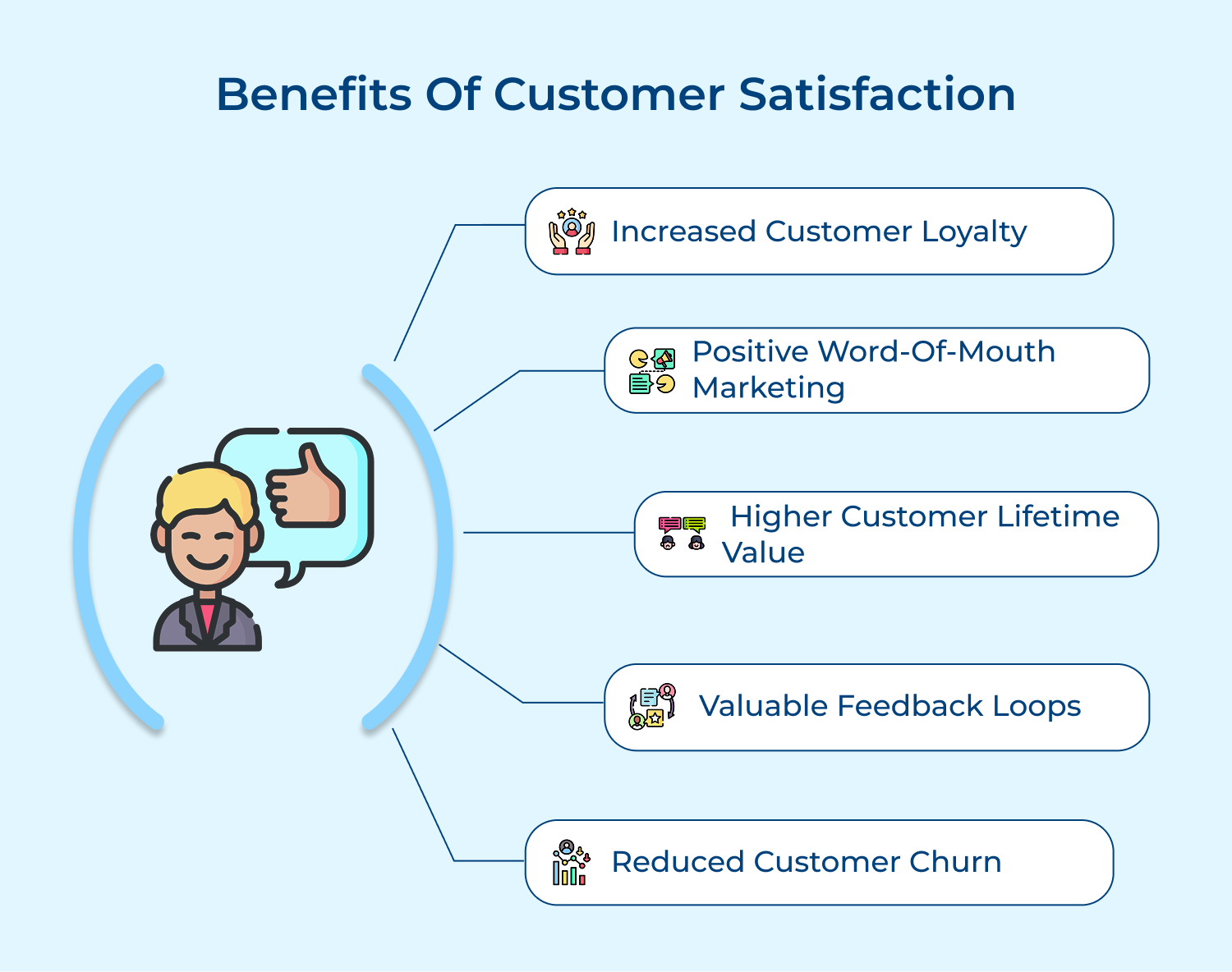
1. Increased Customer Loyalty
When customers feel genuinely satisfied with your products, they’re much more likely to stick around for the long haul. This loyalty translates into repeat business that costs significantly less than acquiring new customers.
2. Positive Word-of-Mouth Marketing
Satisfied customers naturally become advocates for your brand without being prompted. They share their positive experiences with friends and family through conversations as well as social media posts.
3. Higher Customer Lifetime Value
Customers who remain satisfied tend to spend more money with your business over time. They’re more willing to try new offerings and often make larger purchases because they trust your brand. This increased spending compounds over the customer relationship, making each satisfied customer substantially more valuable to your business.
5. Valuable Feedback Loops
Satisfied customers provide honest feedback that helps you improve your offerings. They feel invested in your success and want to help you get better. This continuous stream of insights helps you spot trends and address issues before they become widespread problems.
6. Reduced Customer Churn
When satisfaction levels remain high, fewer customers leave for competitors. This stability creates predictable revenue streams and reduces the constant pressure to find new customers.
Customer loyalty represents a deep-seated commitment that drives consumers to consistently choose a specific brand over alternatives, despite situational influences or competing marketing efforts. It goes beyond mere repeat purchases to encompass emotional attachment, preference and advocacy.
Customer loyalty develops when people feel a meaningful connection to your brand based on consistently positive experiences that align with their values. Thus, creating a relationship that withstands price fluctuations and market changes.
Customer loyalty directly fuels business scalability by creating a stable revenue foundation. Loyal customers require less marketing investment while generating higher average purchases, enabling businesses to allocate resources toward growth initiatives. This predictable customer base provides the confidence needed to expand operations and enter additional markets.
While often used interchangeably, customer loyalty and retention represent different concepts. Retention simply measures whether customers continue purchasing from you and can be achieved through barriers like contracts or lack of alternatives. True loyalty emerges from emotional connection and preference that drives voluntary engagement even when customers have other options.
Key Principles
When customers develop a genuine allegiance to your brand, the advantages extend far beyond repeat sales. Let’s explore how customer loyalty creates meaningful value to your business.
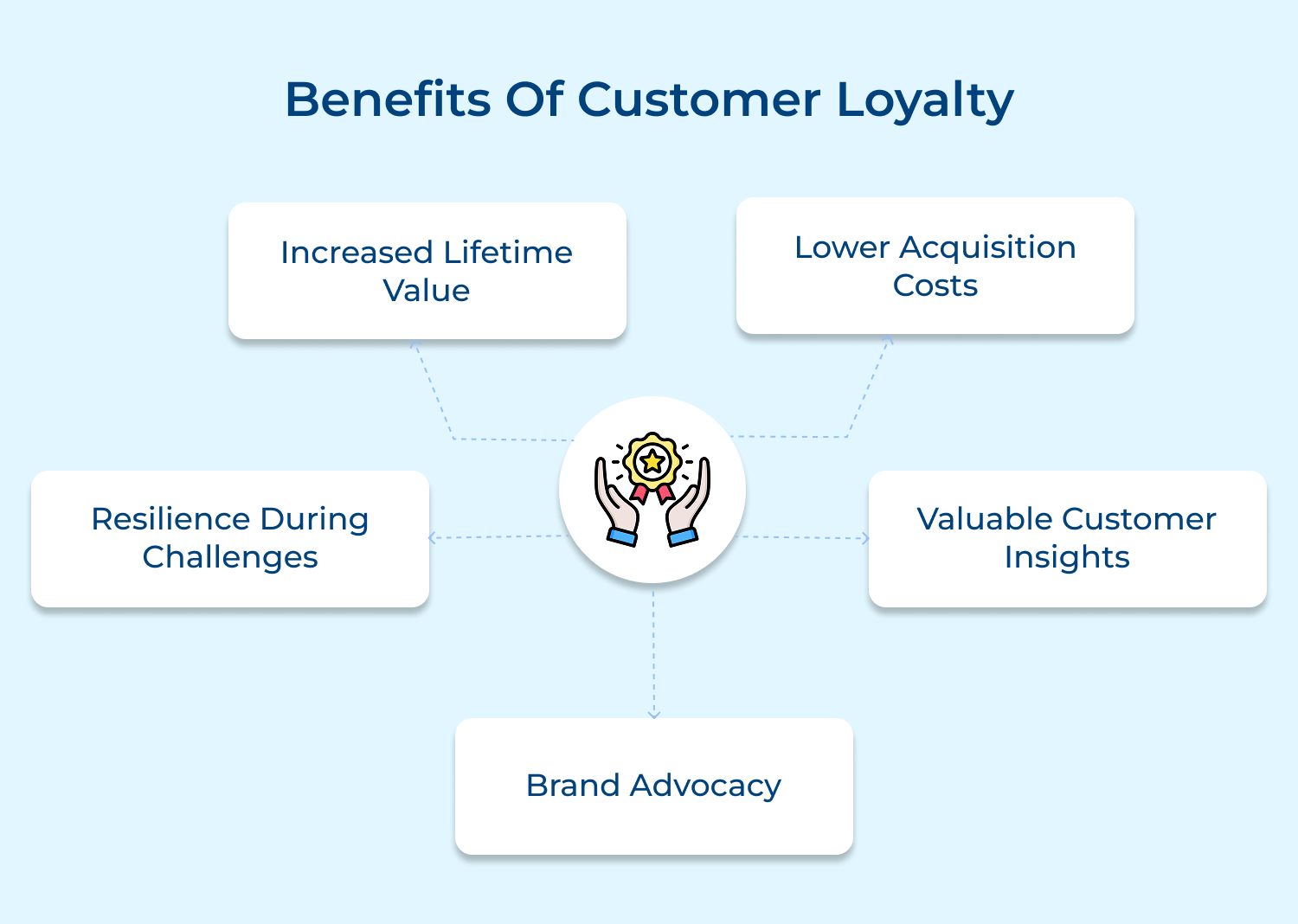
1. Increased Lifetime Value
Loyal customers spend more over time than one-time buyers. They buy more often, try more products, and generate higher revenue without extra acquisition costs.
2. Lower Acquisition Costs
Keeping loyal customers is cheaper than finding new ones. Acquiring a new customer costs five to seven times more than retention, saving money for innovation and improvement.
3. Valuable Customer Insights
Loyal customers give honest, detailed feedback. Their insights help you spot improvement opportunities and new needs before competitors notice or they affect your wider customer base.
4. Brand Advocacy
Loyal customers recommend your brand to others. Their word-of-mouth is highly trusted and can bring in many new customers without any advertising costs.
5. Resilience During Challenges
Loyal customers are more forgiving during mistakes or service issues. This trust gives you time to fix problems before losing them and facing bigger revenue losses.
While both relate to how customers feel, they represent fundamentally different concepts with distinct implications for your success. Let’s explore these critical differences.
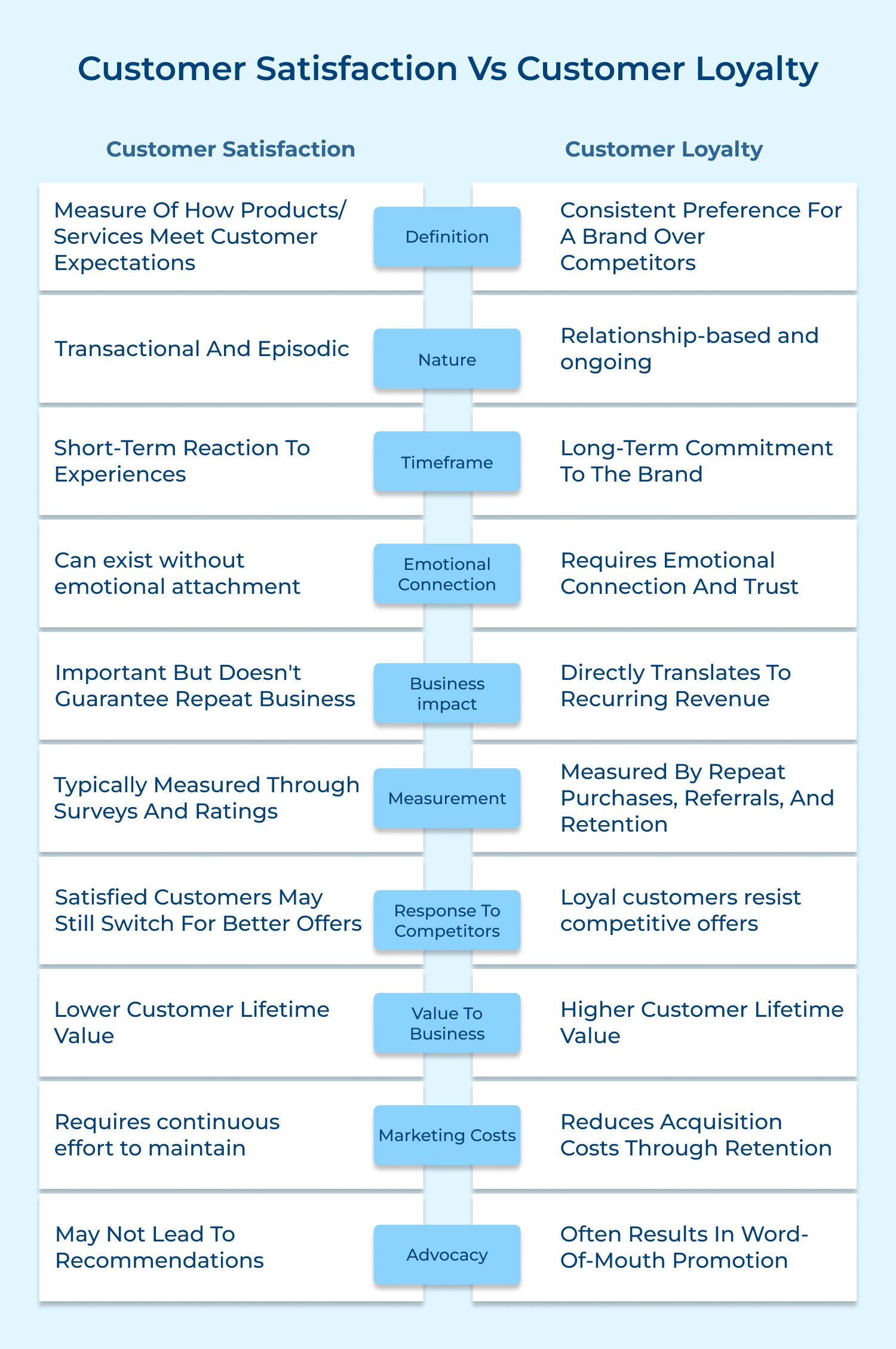
Customer satisfaction measures how well a product or interaction meets expectations in the present moment. It’s an immediate reaction that can change with each new experience. Satisfaction is a snapshot of customer feelings, not a guarantee of future loyalty.
Customer loyalty grows over time through consistent positive experiences that build emotional connections. It’s the result of many interactions, moving customers from short-term satisfaction to long-term commitment that shapes their buying decisions.
Consider a coffee shop where a customer enjoys a perfectly made latte and leaves satisfied with that day’s experience. However, true loyalty emerges when that same customer deliberately bypasses three other coffee shops on their route to work specifically to visit yours every morning for months or years.
Key takeaways:
Customer satisfaction is transactional and rational, focusing on whether a product or service met functional expectations. It’s based on practical factors like performance, delivery time, or problem-solving and can exist without emotional connection.
Customer loyalty is emotional, built on trust, shared values and a sense of belonging. It makes customers choose your brand over others, even when competitors offer similar or better options.
Key takeaways:
Customer satisfaction shows if needs were met in a single transaction. A satisfied customer may still try other brands if convenience, price, or other factors make them appealing. It leaves the door open for future purchases but doesn’t ensure repeat business.
Customer loyalty is shown through repeated purchases and clear brand preference, even when other options exist. Loyal customers often spend more over time, try new products, and prove their commitment through consistent actions.
Key takeaways:
Customer satisfaction alone rarely leads to proactive recommendations. Satisfied customers usually keep their positive feelings to themselves unless directly asked, limiting their impact on others’ perceptions of your brand.
Customer loyalty naturally fuels word-of-mouth marketing. Loyal customers actively share positive experiences with friends, family and online audiences, promoting your brand without prompting as part of their personal connection to it.
Key consideration:
Customer satisfaction can be easily lost after one bad experience. When issues arise, satisfied customers often switch to competitors instead of giving you a chance to fix the problem. The relationship is fragile because it’s based mainly on flawless service, not deeper connection.
Customer loyalty offers protection against occasional mistakes. Loyal customers usually give you time to address problems before considering alternatives. They value the relationship enough to work through challenges instead of leaving at the first sign of trouble.
Key takeaways:
Customer satisfaction mainly drives repeat purchases of the same products or services. For example, a satisfied laptop buyer may return for another laptop but not explore other product categories. This creates limited growth potential and requires constant acquisition of new customers for other offerings.
Customer loyalty enables cross-selling and upselling across your whole business. Loyal customers trust your brand and are open to trying new products or services, even in completely different categories.
insight for businesses:
Customer satisfaction is like a meter that resets with every interaction. One bad experience can erase previous goodwill and rebuilding trust often takes multiple positive interactions. This constant reset keeps satisfaction-focused businesses on edge, as every touchpoint risks undoing past progress.
Customer loyalty works like a relationship bank account. Positive experiences act as deposits, creating a buffer during tough times. Loyal customers rely on this accumulated trust, seeing issues as rare exceptions rather than deal-breakers.
When Southwest Airlines faced massive flight cancellations during holiday travel in 2022, their most loyal customers—who had years of positive experiences—returned to flying with them much faster than merely satisfied occasional travelers who had no emotional investment to draw upon during the crisis.
Crisis management implications:
In this article, we will delve into five essential metrics that can effectively measure customer satisfaction, ensuring you’re on the right path to fostering loyal and happy clients.
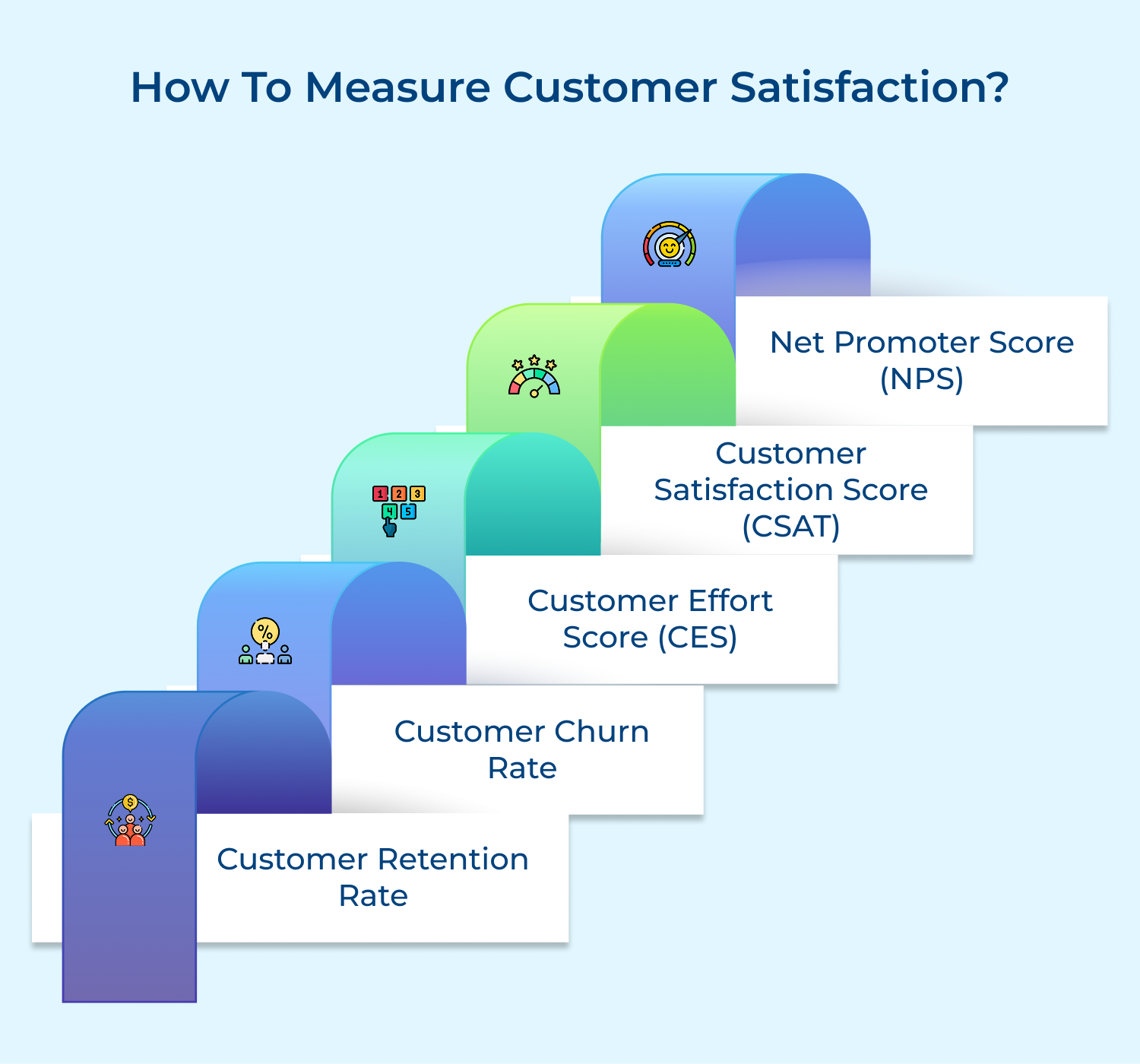
Net Promoter Score measures customer loyalty by asking one question: “How likely are you to recommend our company to a friend or colleague?” Customers answer on a scale from 0–10. Their scores place them into three groups:
NPS is valuable because it’s simple, predicts growth potential and allows companies to track loyalty trends while comparing results with industry standards.
Customer Satisfaction Score measures how happy customers are after a specific interaction or purchase. Customers are asked to rate their experience and the score is calculated as:
CSAT = (Number of satisfied responses ÷ Total responses) × 100
This metric helps identify what’s working well and where improvements are needed. It’s powerful because feedback is collected right after the experience, making it easier to fix issues before they affect the overall relationship.
Customer Effort Score measures how easy it is for customers to get what they need – whether it’s buying a product, resolving a problem, or getting support. Lower scores mean smoother, hassle-free experiences. CES is important because reducing effort often builds more loyalty than trying to “wow” customers. It focuses on removing obstacles, which strongly predicts repeat purchases and loyalty.
Customer Retention Rate measures the percentage of customers who stay with you over a certain period. It’s calculated as:
Retention Rate = ((Customers at End − New Customers) ÷ Customers at Start) × 100
Retention shows how well you keep customers after their first purchase. It reflects the overall value and satisfaction you deliver over time. Even a small improvement in retention — for example, 5% — can increase profits by 25–95%.
These metrics help you assess whether customers are truly committed to your brand or simply satisfied with their most recent transaction.
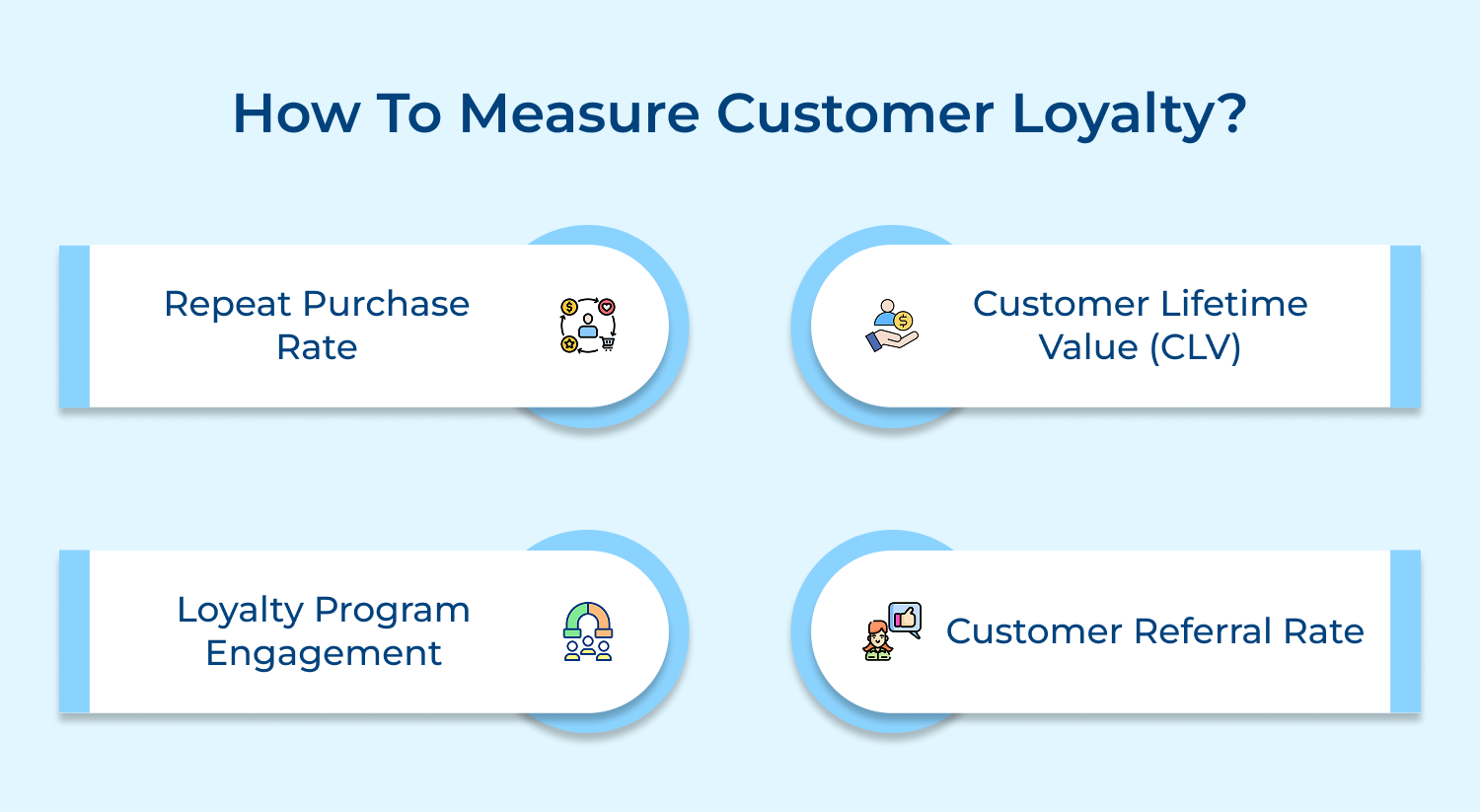
Repeat Purchase Rate tracks how frequently customers return to make additional purchases over time. It measures actual buying behavior rather than stated intentions, revealing which customers consistently choose your brand despite having other options.
Repeat Purchase Rate = Number of Repeat Customers ÷ Total Number of Customers
This behavioral metric provides concrete evidence of loyalty by showing who puts their money where their mouth is through sustained purchasing patterns.
Customer Lifetime Value calculates the total revenue a business can reasonably expect from a customer throughout their relationship. It combines purchase frequency, average order value, and relationship duration to quantify loyalty in financial terms. By revealing which customer segments generate the most long-term value, CLV helps businesses prioritize loyalty-building efforts where they’ll create the greatest return on investment.
Loyalty Program Engagement assesses how actively customers participate in your formal loyalty initiatives through metrics like redemption rates, point accumulation and tier advancement.
Loyalty Program Engagement Rate = Number of Active Program Members ÷ Total Program Members
It reveals which customers are deliberately investing in their relationship with your brand rather than making disconnected purchases. Strong engagement indicates customers who see long-term value in maintaining their relationship with you.
Customer Referral Rate tracks how often existing customers actively recommend your brand to others, either through formal referral programs or informal word-of-mouth. It captures the ultimate loyalty behavior, putting personal reputation on the line to advocate for your business. High referral rates indicate customers who feel so strongly about your brand that they become an extension of your marketing team.
Building true customer loyalty requires strategic approaches that go beyond basic satisfaction to create emotional connections and lasting relationships. Here’s how you improve these:
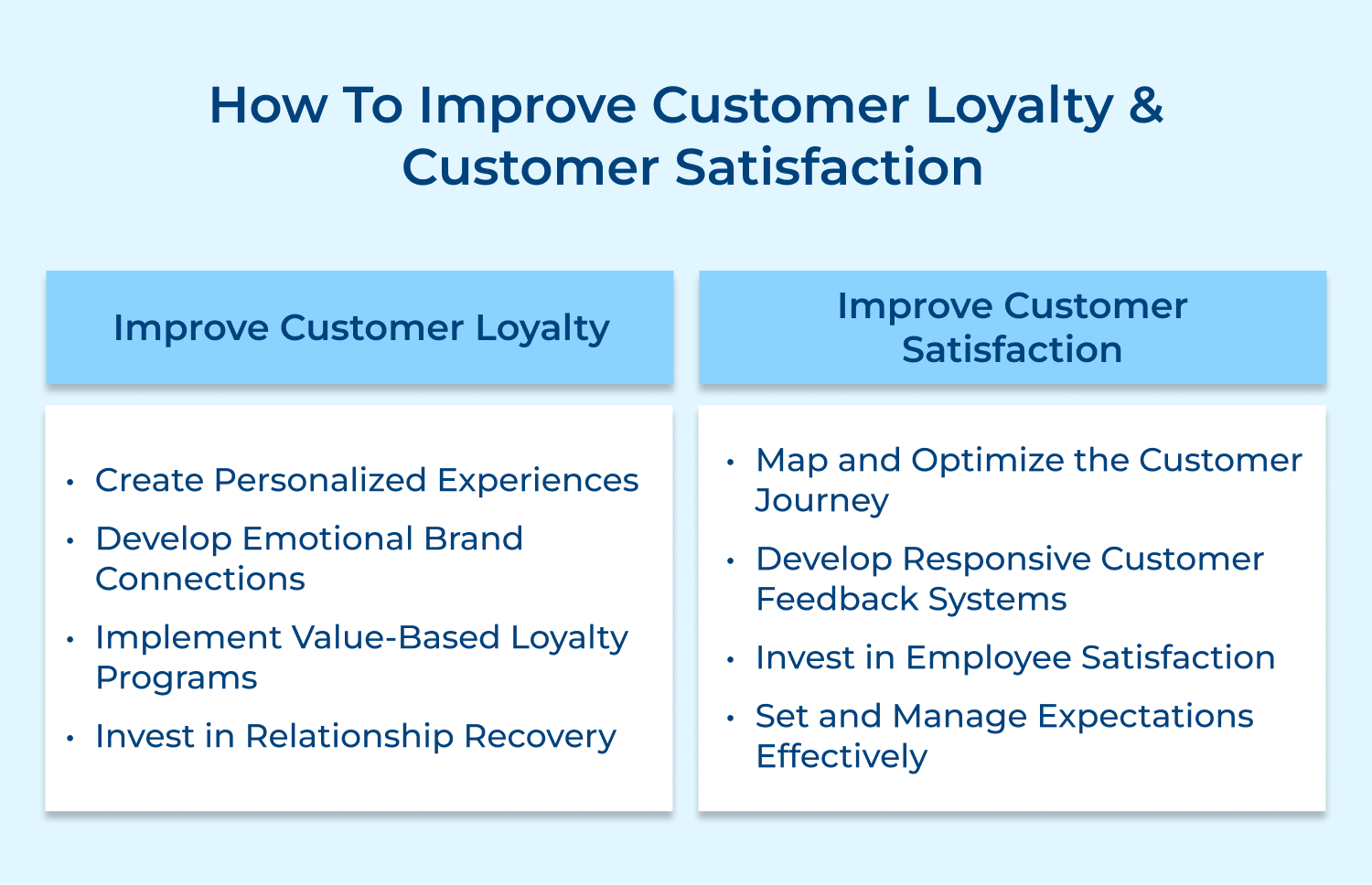
While customer satisfaction and loyalty are closely related, they respond very differently to setbacks. Satisfaction can vanish instantly, while loyalty offers resilience built over time.
1. Create Personalized Experiences
Use customer data to tailor experiences, communication and offers to individual needs. This makes customers feel understood and valued, creating deeper connections than generic approaches. Anticipate needs before customers even express them.
Key ideas:
Go beyond transactions and build relationships rooted in shared values, identity as well as belonging. Emotional connections make customers less likely to switch, even when competitors offer similar or better deals.
Key ideas:
Create loyalty programs that offer more than just discounts. Reward behaviors that show genuine engagement and give customers exclusive experiences they can’t get elsewhere.
Key ideas:
Handle service failures in ways that strengthen trust. A well-managed recovery can turn a bad experience into a loyalty-building moment.
Key ideas:
These practices help ensure you’re consistently meeting or exceeding customer expectations to create the positive experiences necessary for deeper relationships to form.
1. Map and Optimize the Customer Journey
Look at every step a customer takes with your business and make each one as smooth as possible. This stops problems in one area from undoing good work in another. Review the journey often so you can keep up with customer needs and fix issues quickly.
Satisfaction-building ideas:
2. Develop Responsive Customer Feedback Systems
Give customers many ways to share feedback and act on it quickly. This shows you care about their opinions. Let customers see how their feedback led to real changes.
Ideas to try:
3. Invest in Employee Satisfaction
Happy employees give better service and solve problems more effectively. Train them well and give them the tools to help customers without always needing a manager.
Pro tips:
4. Set and Manage Expectations Effectively
Be honest about what you can deliver. Don’t promise more than you can give. This builds trust and makes it a pleasant surprise when you go above expectations.
Ideas to try:
Customer satisfaction measures immediate happiness with specific experiences while customer loyalty reflects deeper emotional commitment developed over time. While satisfaction creates a foundation for potential future business, it remains vulnerable to competitive offers and isolated negative experiences. True loyalty transcends rational evaluation to create resilience against both competitive pressures and occasional service failures.
Ultimately, satisfaction operates as a necessary starting point, but loyalty represents the destination that creates sustainable business value. Organizations excelling at both understand that satisfaction without loyalty creates constant vulnerability, while attempting to build loyalty without consistent satisfaction is fundamentally impossible. The businesses that thrive focus on satisfaction as their minimum standard while intentionally building the emotional connections that transform satisfied customers into loyal advocates.

What is the relationship between customer satisfaction and customer loyalty?
Customer satisfaction serves as the foundation upon which loyalty can develop, but doesn’t automatically create it. Satisfaction represents meeting expectations in individual interactions, while loyalty emerges from consistent satisfaction plus emotional connection over time.
Does customer satisfaction really lead to customer loyalty?
Satisfaction alone doesn’t reliably predict loyalty. Research shows that 60-80% of customers who switch brands reported being “satisfied” or “very satisfied” before leaving. True loyalty requires more than just meeting expectations—it needs emotional connections, shared values, exceptional experiences and trust built over multiple positive interactions. Satisfaction creates opportunity for loyalty but requires intentional cultivation to actually develop.
Why is loyalty more important than satisfaction?
Loyalty delivers substantially higher business value than satisfaction because loyal customers spend more (15-25% higher lifetime value), cost less to serve (reduced acquisition costs), provide invaluable feedback, refer others (creating free acquisition) and forgive occasional mistakes. While satisfaction prevents immediate defection, only loyalty creates the sustainable competitive advantage and predictable revenue growth that businesses need for long-term stability as well as profitability.
What practical steps create loyalty beyond satisfaction?
Turn satisfaction into loyalty by personalizing interactions based on customer preferences and past purchases. Create emotional connections through shared values and community. Develop loyalty programs that reward meaningful engagement. Empower employees to go beyond expectations. Design memorable moments in the customer journey. Set up feedback systems that show you value customer input. Each step strengthens the relationship beyond just transactions.
 https://omni24.io/wp-content/uploads/2026/09/Social-commerce-scaled.png
1340
2560
Webvision Solution
https://omni24.io/wp-content/uploads/2023/04/Omni-Logo-1.svg
Webvision Solution2026-10-23 12:18:272026-10-23 12:18:27What is Social Commerce and Why Does It Matter?
https://omni24.io/wp-content/uploads/2026/09/Social-commerce-scaled.png
1340
2560
Webvision Solution
https://omni24.io/wp-content/uploads/2023/04/Omni-Logo-1.svg
Webvision Solution2026-10-23 12:18:272026-10-23 12:18:27What is Social Commerce and Why Does It Matter? https://omni24.io/wp-content/uploads/2026/08/AI-Customer-Service-Agents.png
1256
2400
Webvision Solution
https://omni24.io/wp-content/uploads/2023/04/Omni-Logo-1.svg
Webvision Solution2026-09-21 04:48:512026-09-21 04:48:51How to Build an AI Customer Service Agents: 8 Key Steps
https://omni24.io/wp-content/uploads/2026/08/AI-Customer-Service-Agents.png
1256
2400
Webvision Solution
https://omni24.io/wp-content/uploads/2023/04/Omni-Logo-1.svg
Webvision Solution2026-09-21 04:48:512026-09-21 04:48:51How to Build an AI Customer Service Agents: 8 Key Steps https://omni24.io/wp-content/uploads/2026/08/Omnichannel-Conversational-AI.png
1256
2400
Tushar Joshi
https://omni24.io/wp-content/uploads/2023/04/Omni-Logo-1.svg
Tushar Joshi2026-09-16 03:51:072026-09-16 03:51:07How to Build Omnichannel Conversational AI Strategy
https://omni24.io/wp-content/uploads/2026/08/Omnichannel-Conversational-AI.png
1256
2400
Tushar Joshi
https://omni24.io/wp-content/uploads/2023/04/Omni-Logo-1.svg
Tushar Joshi2026-09-16 03:51:072026-09-16 03:51:07How to Build Omnichannel Conversational AI Strategy
Whether it’s about acquire, engage or support – Omni24 covers all your customer engagement needs in one complete platform.

Copyright ©2026 Veemo All rights reserved.
CA, Los Angeles, Hall Ave, 19011