Ecommerce Chatbots: What are They and Their Use Cases
Ecommerce chatbots deliver instant support, guide buyers, boost conversions, improve experience and streamline operations efficiently.

Ecommerce chatbots deliver instant support, guide buyers, boost conversions, improve experience and streamline operations efficiently.
Every e-commerce business faces the same painful reality: customers expect instant answers and a delayed response costs sales. The gap between customer expectations and actual support capacity is widening every day.
Most businesses respond by hiring more agents to keep up with demand. But the real problem is not headcount; it is the inability to deliver consistent support at scale.
An ecommerce chatbot closes that gap by handling real customer interactions intelligently across every touchpoint. Almost 47% of customers use chatbots for help placing orders, for issue reporting or returns and for tech support in ecommerce.
Brands deploying chatbots strategically are building a support experience that customers genuinely trust and return to.
An e-commerce chatbot is an automated conversational tool that handles customer interactions on shopping platforms. It helps in answering queries, guiding purchases and resolving issues without human intervention. It works round the clock to keep the customer experience smooth and consistent at every touchpoint.
A chatbot follows predefined rules and scripted flows to respond to common customer questions like order status or return policies. It works best for repetitive, high-volume interactions where speed and consistency matter more than deep reasoning.
An AI agent, on the other hand, understands context and makes decisions dynamically based on the customer’s behavior. It can handle complex multi-step tasks like comparing products, adjusting orders and personalizing recommendations in real time.
Key Objectives:
Choosing the right type of chatbot impacts how a brand serves its customers. They are built for a specific purpose and deliver measurable value across different stages of their journey.
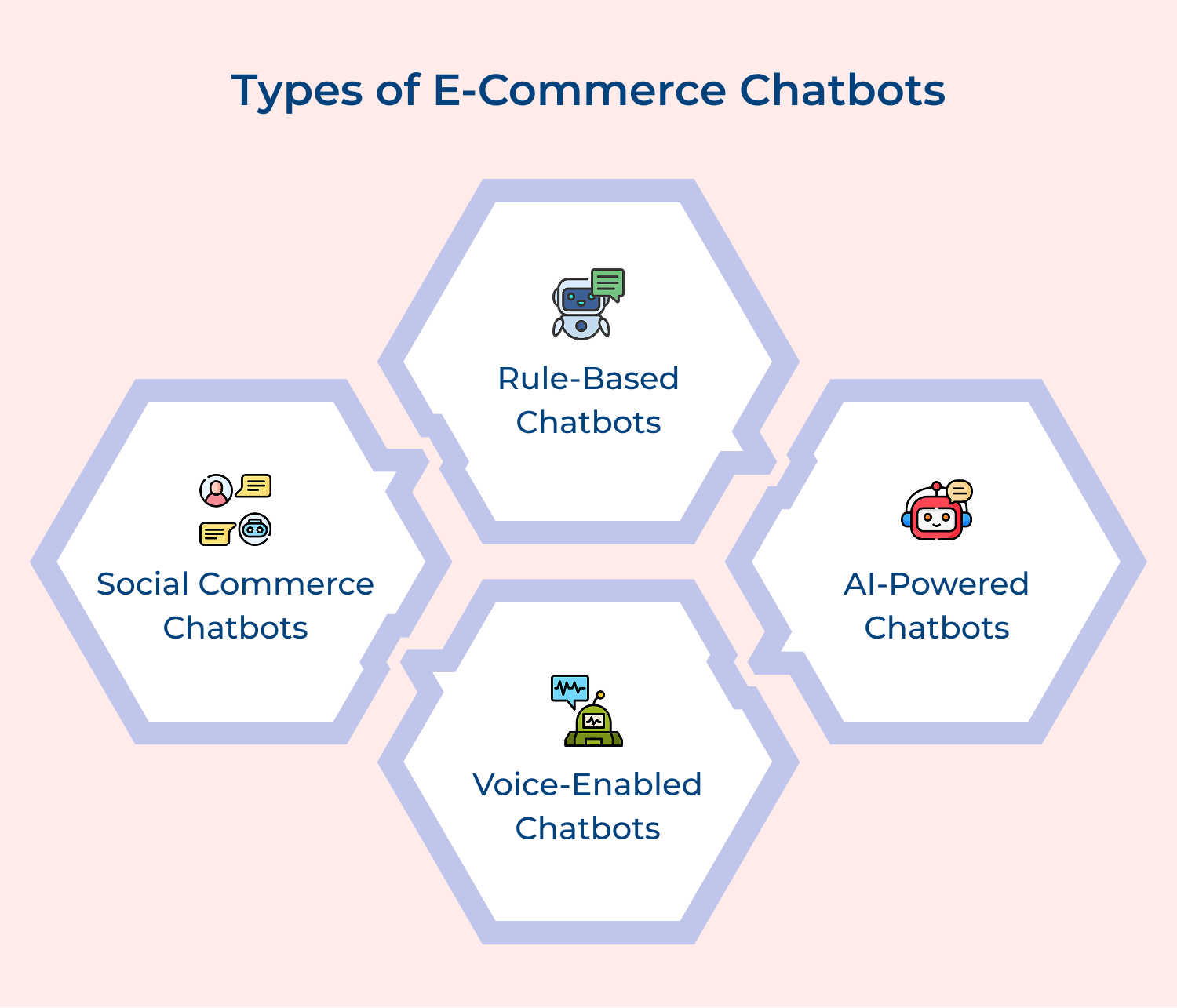
Rule-based chatbots operate on decision-tree logic and handle predictable customer queries like store hours or shipping policies. They are the most reliable choice for businesses that need consistent and fast responses to high-volume repetitive interactions.
AI-powered chatbots use natural language processing to understand customer intent beyond just keywords or scripted triggers. They adapt to varied customer inputs and deliver contextually accurate responses that feel far more natural.
Voice-enabled chatbots allow customers to interact through spoken language making the shopping experience more accessible and hands-free. Retail brands integrating voice chatbots on apps and smart devices see stronger engagement from customers who prefer speaking over typing.
Social commerce chatbots operate directly within platforms like WhatsApp, Instagram and Facebook Messenger to engage customers where they already spend time. They handle product discovery, order updates and support queries without requiring customers to leave their preferred platform.
Chatbots are no longer just a support tool — they are a strategic layer that directly shapes how customers perceive and interact with a brand. Understanding their real benefits starts with asking the right questions first.
Before diving into the benefits, ask yourself these four questions:
These questions reveal the exact gaps that e-commerce chatbots are built to close and the measurable value they bring to customer service operations.
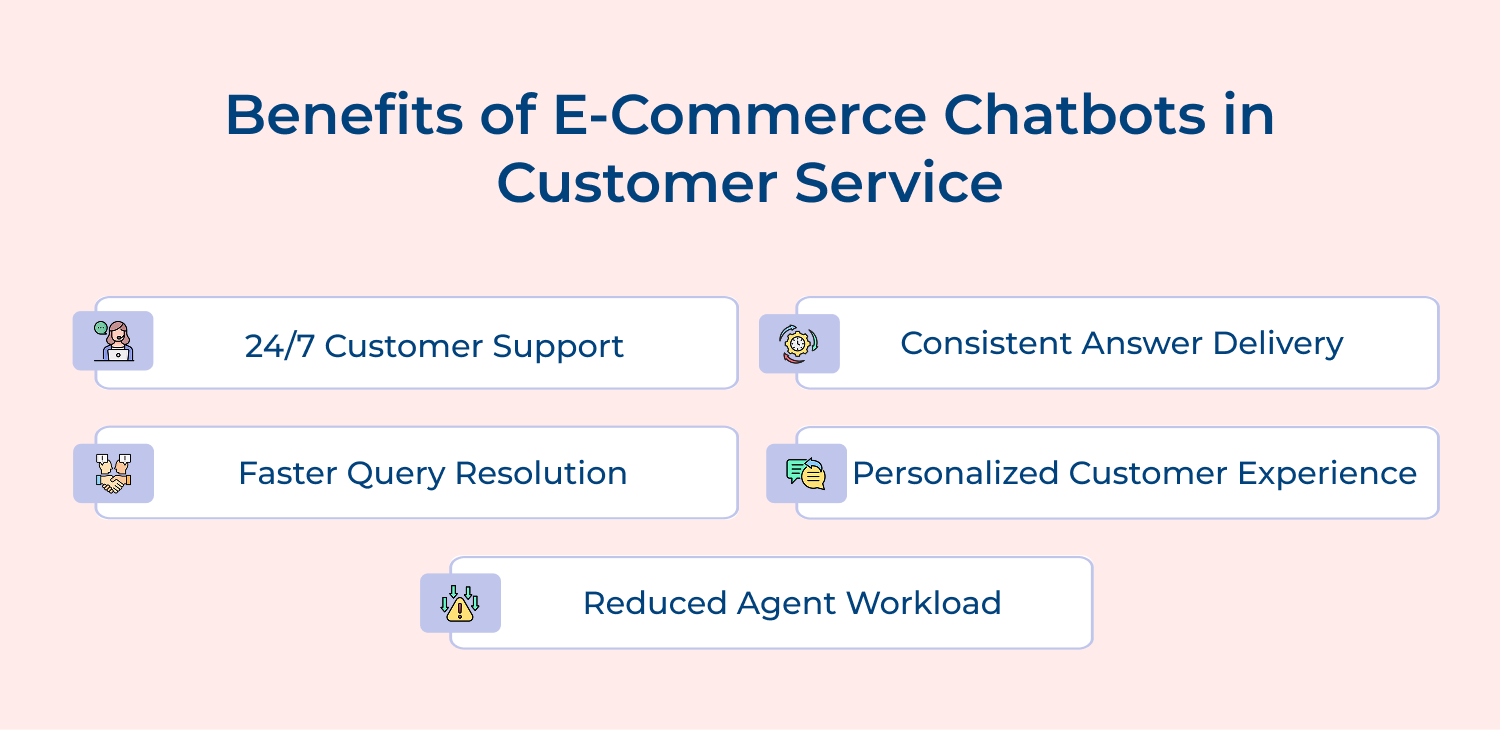
1. 24/7 Customer Support
Customers shop at all hours and expect support to be available whenever a question arises. Chatbots eliminate response delays by staying active round the clock without any additional staffing cost.
2. Consistent Answer Delivery
One of the biggest hidden problems in customer service is inconsistency where two agents give two different answers to the same question. Chatbots solve this by delivering the same accurate response every single time across every channel.
3. Faster Query Resolution
Customers lose trust when they have to wait minutes or hours for a simple order update or refund status. Chatbots resolve these high-frequency queries within seconds and keep the customer experience frictionless.
4. Personalized Customer Experience
A well-configured chatbot tracks customer behavior and purchase history to deliver recommendations & responses that feel relevant. This level of personalization at scale is nearly impossible to achieve through human agents alone.
5. Reduced Agent Workload
When chatbots handle repetitive tier-one queries, human agents get the bandwidth to focus on complex and high-value customer issues. This improves both agent productivity and the overall quality of customer experience across the board.
These use cases cover the highest-value areas where chatbots deliver consistent and measurable results.
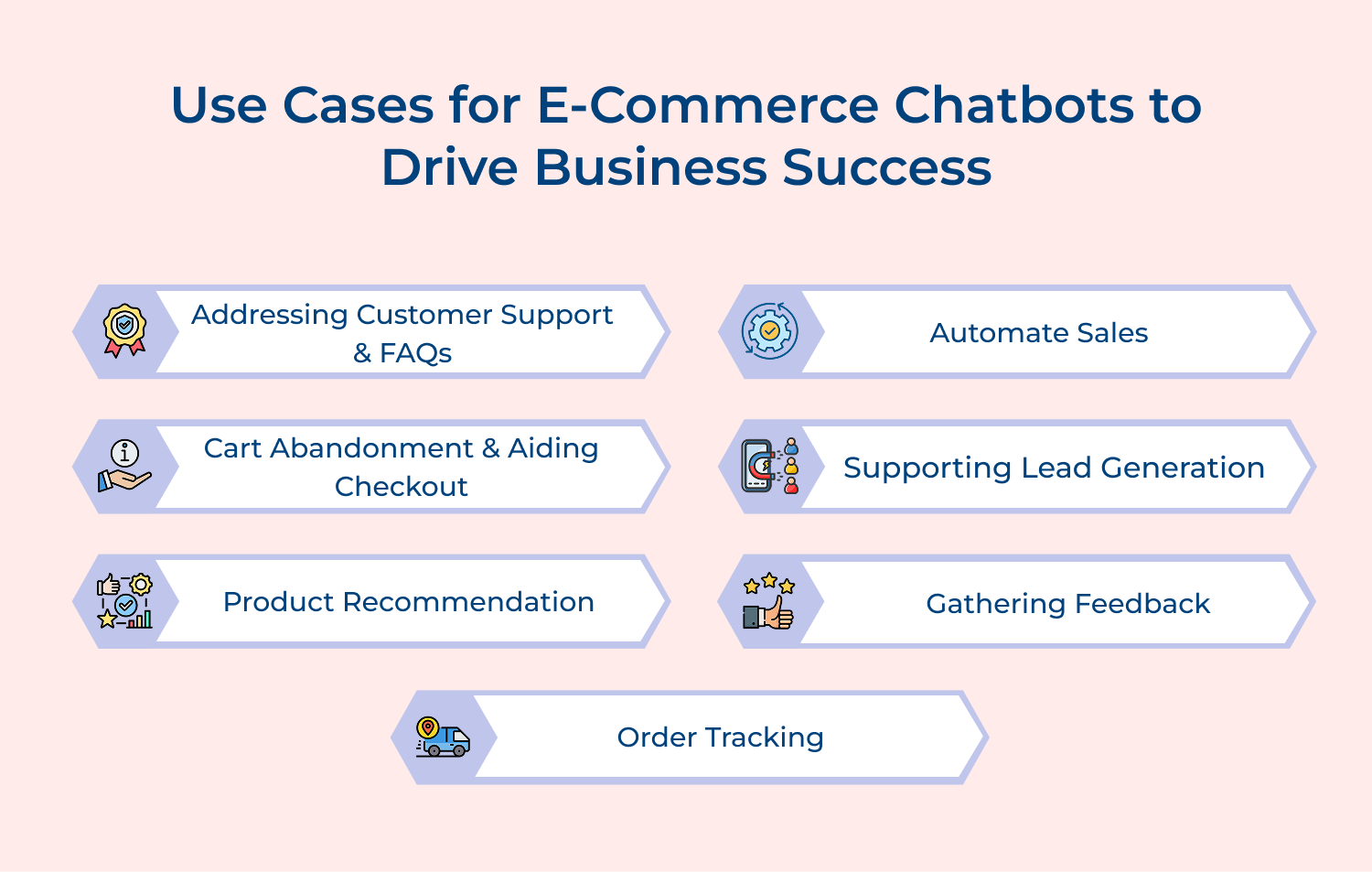
Repetitive queries consume enormous agent bandwidth and slow down the entire support operation daily. Chatbots handle these instantly as the first line of defense without any human involvement needed.
So what kind of questions are customers actually asking every day? Order status, return windows and payment failures dominate the support queue across every e-commerce brand. These high-frequency queries get resolved in seconds without ever reaching a live agent.
For example a leading fashion retailer deployed a support chatbot and saw a 60% reduction in live agent tickets within the first quarter. The chatbot was handling size guide queries, return initiations and delivery status updates all without a single human touchpoint.
Before scaling your support team, run through this checklist:
When FAQs are handled with speed and accuracy, customer trust builds naturally over time. Consistent resolutions directly reduce support costs and improve overall customer satisfaction scores.
Cart abandonment mostly happens when customers hit an unexpected friction point right before completing a purchase. A well-placed chatbot identifies that hesitation and steps in before the customer exits the page.
Why do customers abandon carts even after spending time selecting products? Unanswered questions around shipping costs and payment security are the biggest culprits at checkout. A chatbot addressing these concerns in real time removes the barrier standing between intent and purchase.
Smart ways chatbots recover abandoned carts at the right moment: These triggers work best when deployed based on real-time customer behavior signals.
Brands using chatbots at checkout consistently report higher completion rates and lower drop-offs. Every recovered cart represents a customer who almost left but stayed because friction was removed in time.
Customers today expect brands to understand their preferences rather than showing the same generic suggestions. A behavior-driven chatbot surfaces the right product at the right moment without the customer searching manually.
Can a chatbot really replace the intuition of a skilled sales associate? Not entirely — but it replicates that outcome at a scale no human team could match. Real-time behavioral data allows the chatbot to recommend products that feel personally curated every time.
For example a customer visits a home decor store looking for a sofa, the chatbot asks a few quick questions about room size, budget and preferred style. Within seconds it surfaces three shortlisted options with a comparison exactly what a skilled store associate would do in person.
Before assuming your recommendation engine is truly personalized, check these questions:
When recommendations feel relevant, customers spend more and return more often. Personalized suggestions delivered at the right moment directly increase average order value and purchase frequency.
Sales automation is about removing the friction that slows purchase decisions down at critical moments. A chatbot can guide a customer from product discovery to payment confirmation without any agent involvement.
For example an electronics brand deployed a chatbot that guided customers through a budget-based product selector and the average purchase completion time dropped by 35%. The chatbot filtered options, highlighted key specs and initiated the checkout flow all within a single conversation window.
Key automation touchpoints that keep the sales engine running around the clock to ensure no buying intent goes unaddressed, regardless of the hour.
Automating sales through chatbots keeps the revenue engine running even when the team is offline. Every unattended buying intent that gets captured translates directly into incremental revenue for the business.
Lead generation is a critical growth lever especially for high-consideration purchases in e-commerce. Chatbots engage first-time visitors and capture intent data in a way that feels conversational rather than transactional.
How is chatbot-driven lead generation different from a standard contact form? A contact form is passive and simply waits for a customer to fill it or submit. A chatbot actively qualifies the lead through conversation before any human effort is invested.
Before building lead generation flows, verify these critical checkpoints first. Skipping these steps results in low-quality leads reaching the sales team unprepared:
A well-structured lead chatbot shortens the sales cycle and delivers only conversion-ready leads. This means the sales team spends time closing deals rather than chasing unqualified or cold prospects.
Traditional surveys feel like extra work and customers simply ignore them after a purchase. A chatbot asking one focused question right after an interaction captures honest and timely responses.
What makes chatbot-driven feedback more reliable than email surveys? In-conversation prompts catch the customer at peak sentiment right inside the experience. An email survey sent days later rarely reflects the true in-the-moment feeling accurately.
Three high-impact ways chatbots collect feedback without disrupting the experience:
Chatbot-driven feedback delivers higher response rates and more actionable data than traditional methods. Brands that act on this real-time input consistently improve their CX faster than competitors relying on delayed feedback.
Order tracking is the most common post-purchase query and it drains significant support bandwidth every day. A chatbot handling this end-to-end frees agents for complex issues while customers get instant clarity.
For example, a mid-sized apparel brand integrated a chatbot with their logistics API and proactive delay notifications dropped inbound “where is my order” tickets by 45%. Customers were informed before they even had a reason to worry and that shift alone improved their post-purchase CSAT significantly.
Before going live, ensure your post-purchase chatbot covers these essentials:
When customers always know where their order is, trust grows and repeat purchases follow naturally. A reliable post-purchase experience is one of the strongest drivers of long-term customer loyalty.
In this guide, we’ll walk you through the six essential steps to implementing an AI chatbot, enabling your business to thrive in the digital age and stand out in the crowded marketplace.
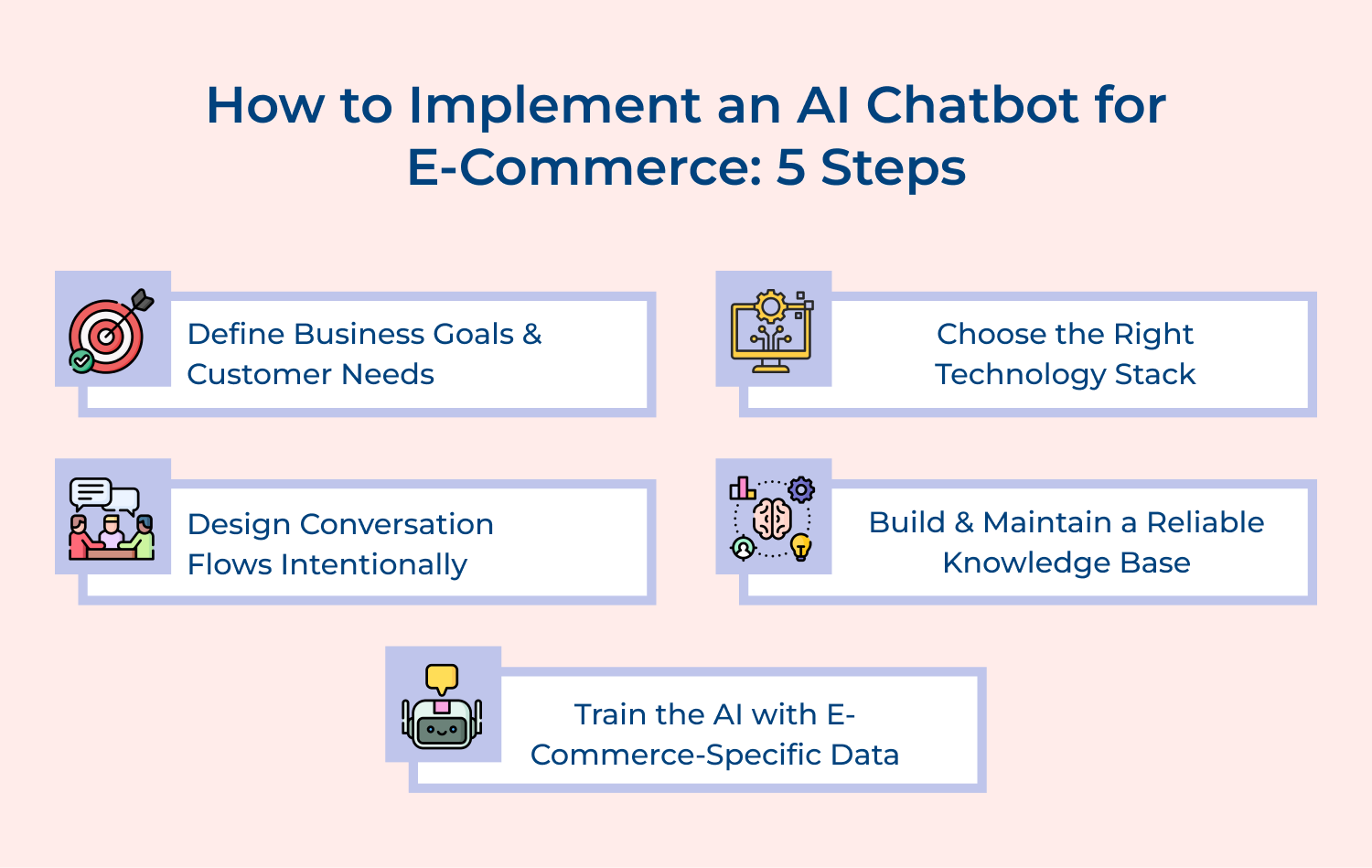
Clear business goals determine whether a chatbot delivers real CX value or just adds operational noise. Without this step, even advanced chatbot technology will consistently fail to solve the right customer problems.
Not sure how to define goals and customer needs? Start by asking:
Answering these questions removes assumptions and grounds every chatbot decision in actual customer behavior. This foundation directly shapes what the chatbot is built to do and how success is measured.
Based on these answers, the next move is translating insights into specific and measurable chatbot objectives. Every goal should have a clear CX metric attached resolution rate, CSAT score, or response time.
Four examples of business goals e-commerce brands define before implementing a chatbot:
The technology stack chosen directly determines how well the chatbot performs across all customer touchpoints. A mismatched stack creates integration gaps that quietly damage the customer experience from day one.
Four key factors to evaluate when choosing the right technology stack:
So what happens when brands choose a technology stack based on cost alone? They end up with a chatbot that cannot pull real order data and customers feel that gap immediately. The right stack must be capable enough to support the CX outcomes the business is working toward.
Four core tools that form a strong technology stack for e-commerce chatbot implementation:
Conversation flow design is where chatbot strategy either translates into smooth CX or breaks into frustrating dead ends. A poorly designed flow confuses customers and erodes the trust the chatbot was built to create.
Three effective ways to design conversation flows for an e-commerce AI chatbot:
What is the biggest challenge brands face when designing conversation flows? Most brands design flows based on what the business wants to say rather than what customers actually need. Using real support chat logs and journey data to map flows around genuine behavior solves this effectively.
A reliable knowledge base is the core engine that powers accurate and consistent chatbot responses across every customer interaction. Without well-structured and regularly updated information, even the best-designed chatbot will deliver wrong or outdated answers.
A strong knowledge base allows the chatbot to pull precise answers on product details, return policies and shipping information without any agent dependency. This directly reduces escalations and keeps the customer experience trustworthy at every touchpoint.
Pro tips:
Training an e-commerce chatbot on generic data produces generic results that fail to meet real customer expectations. The chatbot must be trained on data that reflects actual e-commerce conversations, behaviors and query patterns to perform effectively.
Once trained, the chatbot needs continuous exposure to new interaction data to stay accurate and relevant over time. Retraining should not be a one-time event — it should be a scheduled and ongoing part of the chatbot management process.
Pro tips:
Knowing these challenges upfront helps teams build smarter and set realistic expectations around chatbot capabilities.
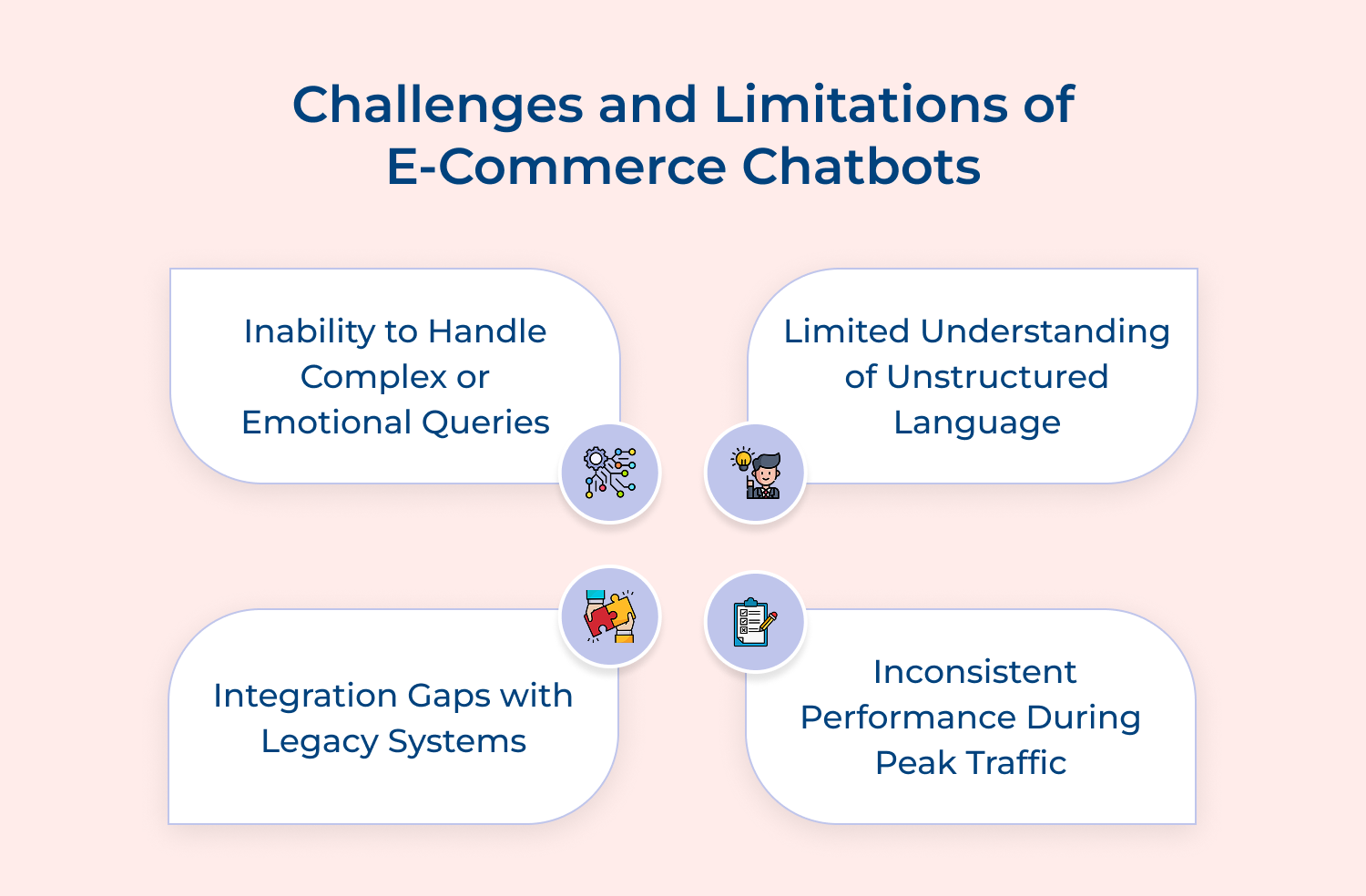
1. Inability to Handle Complex or Emotional Queries
Chatbots handle structured queries well but struggle when a customer is frustrated or dealing with a nuanced issue. Emotional intelligence and contextual judgment are still uniquely human strengths that no chatbot can fully replicate.
2. Limited Understanding of Unstructured Language
Customers rarely type in clean sentences — they use slang, abbreviations and mixed languages that confuse NLP models. When the chatbot misreads intent, it delivers irrelevant responses and the customer experience breaks down immediately.
3. Integration Gaps with Legacy Systems
Many e-commerce businesses run on older backend systems that were never built with chatbot integration in mind. These gaps prevent the chatbot from accessing real-time order data and customer history which directly limits response quality.
4. Inconsistent Performance During Peak Traffic
High-traffic periods like flash sales put enormous pressure on chatbot infrastructure that was not scaled for demand spikes. Performance degradation during these critical moments damages customer trust precisely when the experience needs to be strongest.
These four solutions directly map to the limitations above and provide a clear path forward for e-commerce teams.
These four platforms stand out for delivering measurable CX and conversion outcomes across e-commerce environments.
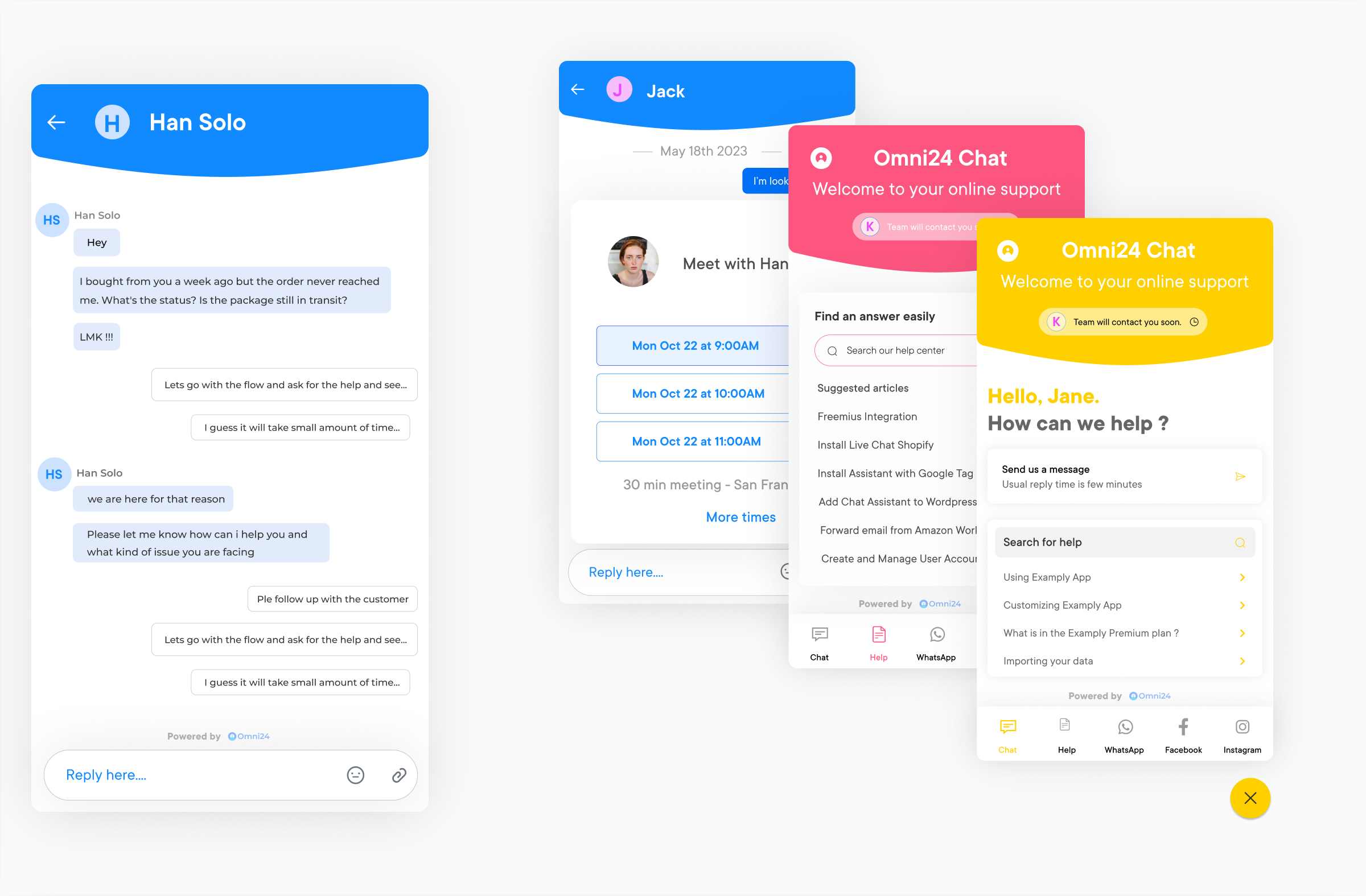
Omni24 is an AI-powered customer service platform that unifies chatbot automation and live support across every customer touchpoint in one interface. It is purpose-built for e-commerce businesses that need to deliver consistent and superior customer experience at scale without compromising on personalization.
Key features:
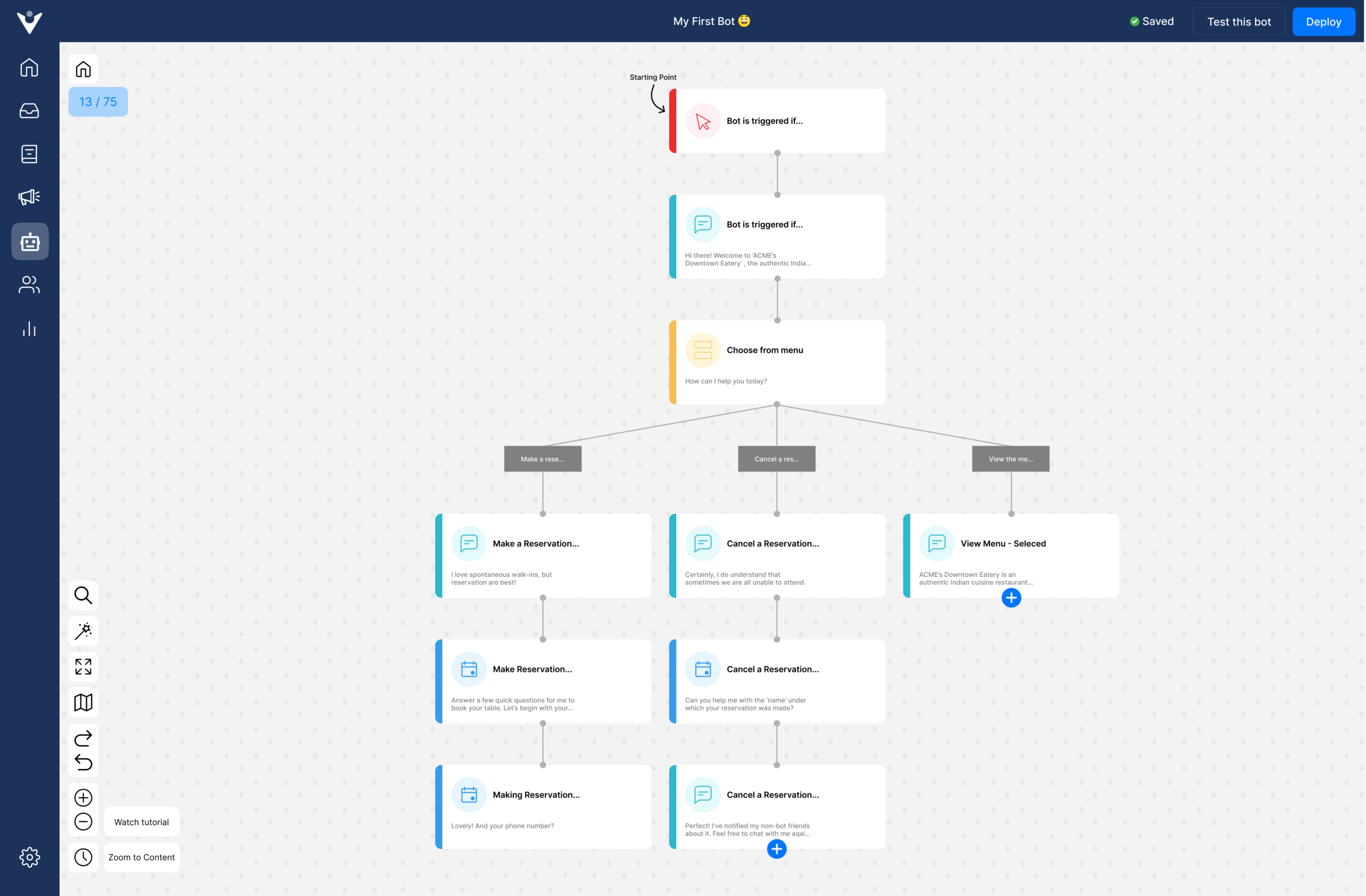
Veemo Chat is a customer engagement and communication platform that combines chatbot automation with real-time live chat to drive meaningful interactions. It is built for e-commerce businesses that want to turn every customer conversation into a high-quality engagement opportunity across multiple channels.
Key features:
Chatfuel is a no-code chatbot builder that deploys AI-powered bots across Facebook Messenger and Instagram without any developer dependency. It excels at automating product discovery, abandoned cart recovery and customer engagement directly inside platforms where buyers already spend time.
Intercom combines AI-powered automation with a robust live support infrastructure inside one unified platform. It enables e-commerce businesses to deliver personalized conversations at scale from first visit through post-purchase support without losing the human touch.
Elevating the online shopping experience is no longer about adding more support staff, it is about deploying the right conversational intelligence at the right customer moment. An e-commerce chatbot bridges the gap between customer expectations and what a business can realistically deliver at scale.
The brands winning at customer experience today are not just automating responses they are using chatbots to build faster, more consistent and deeply personalized journeys. Getting this right starts with a clear strategy and a commitment to continuous improvement beyond just the initial deployment.

How do e-commerce chatbots improve online shopping?
E-commerce chatbots improve online shopping by delivering instant assistance at every stage of the customer journey. They reduce friction, answer product questions and guide customers toward purchase decisions without any wait time involved.
Can e-commerce chatbots increase sales conversions?
E-commerce chatbots increase conversions by engaging customers at high-intent moments and removing barriers that typically cause drop-offs. They qualify buyer intent, surface relevant products and guide customers through checkout — directly impacting the bottom line.
How do e-commerce chatbots reduce cart abandonment?
Chatbots detect cart proactively re-engage customers with timely messages, answers and incentives before they exit. This real-time intervention addresses the exact friction points that cause customers to leave without completing their purchase.
Do e-commerce chatbots support personalized product recommendations?
Yes — chatbots analyze browsing behavior, purchase history and real-time intent signals to deliver highly relevant product suggestions. This level of personalization at scale drives higher average order values and stronger repeat purchase rates.
How do e-commerce chatbots handle customer queries 24/7?
Chatbots operate on automated conversation flows that respond to customer queries instantly regardless of the time or day. This round-the-clock availability ensures no customer question goes unanswered and no support opportunity is ever missed.
 https://omni24.io/wp-content/uploads/2026/08/AI-Customer-Service-Agents.png
1256
2400
Webvision Solution
https://omni24.io/wp-content/uploads/2023/04/Omni-Logo-1.svg
Webvision Solution2026-09-21 04:48:512026-09-21 04:48:51How to Build an AI Customer Service Agents: 8 Key Steps
https://omni24.io/wp-content/uploads/2026/08/AI-Customer-Service-Agents.png
1256
2400
Webvision Solution
https://omni24.io/wp-content/uploads/2023/04/Omni-Logo-1.svg
Webvision Solution2026-09-21 04:48:512026-09-21 04:48:51How to Build an AI Customer Service Agents: 8 Key Steps https://omni24.io/wp-content/uploads/2026/08/Omnichannel-Conversational-AI.png
1256
2400
Tushar Joshi
https://omni24.io/wp-content/uploads/2023/04/Omni-Logo-1.svg
Tushar Joshi2026-09-16 03:51:072026-09-16 03:51:07How to Build Omnichannel Conversational AI Strategy
https://omni24.io/wp-content/uploads/2026/08/Omnichannel-Conversational-AI.png
1256
2400
Tushar Joshi
https://omni24.io/wp-content/uploads/2023/04/Omni-Logo-1.svg
Tushar Joshi2026-09-16 03:51:072026-09-16 03:51:07How to Build Omnichannel Conversational AI Strategy https://omni24.io/wp-content/uploads/2026/08/Customer-Service-Teams.png
1256
2400
Tushar Joshi
https://omni24.io/wp-content/uploads/2023/04/Omni-Logo-1.svg
Tushar Joshi2026-09-15 04:01:522026-09-15 04:02:16How to Build Customer Service Teams: 6 Key Steps
https://omni24.io/wp-content/uploads/2026/08/Customer-Service-Teams.png
1256
2400
Tushar Joshi
https://omni24.io/wp-content/uploads/2023/04/Omni-Logo-1.svg
Tushar Joshi2026-09-15 04:01:522026-09-15 04:02:16How to Build Customer Service Teams: 6 Key Steps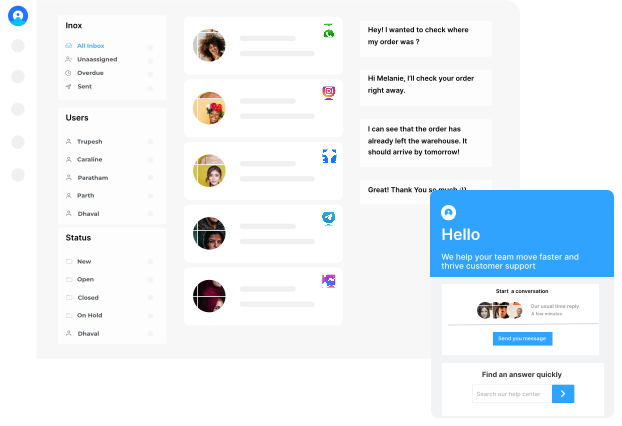
Whether it’s about acquire, engage or support – Omni24 covers all your customer engagement needs in one complete platform.

Copyright ©2026 Veemo All rights reserved.
CA, Los Angeles, Hall Ave, 19011