How Omnichannel Chatbots Improve Your Customer Experience
Omnichannel chatbots are vital for delivering consistent support across all customer touchpoints. They help improve responsiveness and enhance overall customer experience.
Omnichannel chatbots are vital for delivering consistent support across all customer touchpoints. They help improve responsiveness and enhance overall customer experience.
Every time a customer repeats their issue to a new agent or starts over on a different channel, trust erodes and most businesses don’t even realize how often this is happening.
The root cause is disconnected support infrastructure. Without a unified system behind every channel, your team works harder and your customers still leave frustrated with unresolved issues. 73.8% of web chats begin with AI first responders, highlighting omnichannel chatbots’ role in initial engagement.
Omnichannel chatbots fix this at the foundation. They connect every channel, carry full customer context and resolve issues faster cutting operational costs while delivering an experience customers actually appreciate.
An omnichannel chatbot is an AI-powered conversational system that maintains a continuous and context-aware dialogue with customers across every channel they use website, WhatsApp, SMS or social media treating every interaction as part of one ongoing relationship rather than isolated conversations.
Most businesses run channel-specific bots that work in silos. A bot on your website knows nothing about what a customer asked on WhatsApp last Tuesday. That gap creates friction and forces customers to repeat themselves which according to research is one of the top reasons customers abandon a brand entirely.
Omnichannel chatbots fix this at the infrastructure level. They sit on top of a unified customer data layer that syncs intent, history and preferences in real time. So when a customer moves from Instagram DM to your website chat, the bot already knows who they are and where they left off.
Here’s how they work at a functional level:
A well-implemented omnichannel chatbot doesn’t just reduce ticket volume it reshapes how customers experience your brand and how efficiently your team operates behind the scenes.
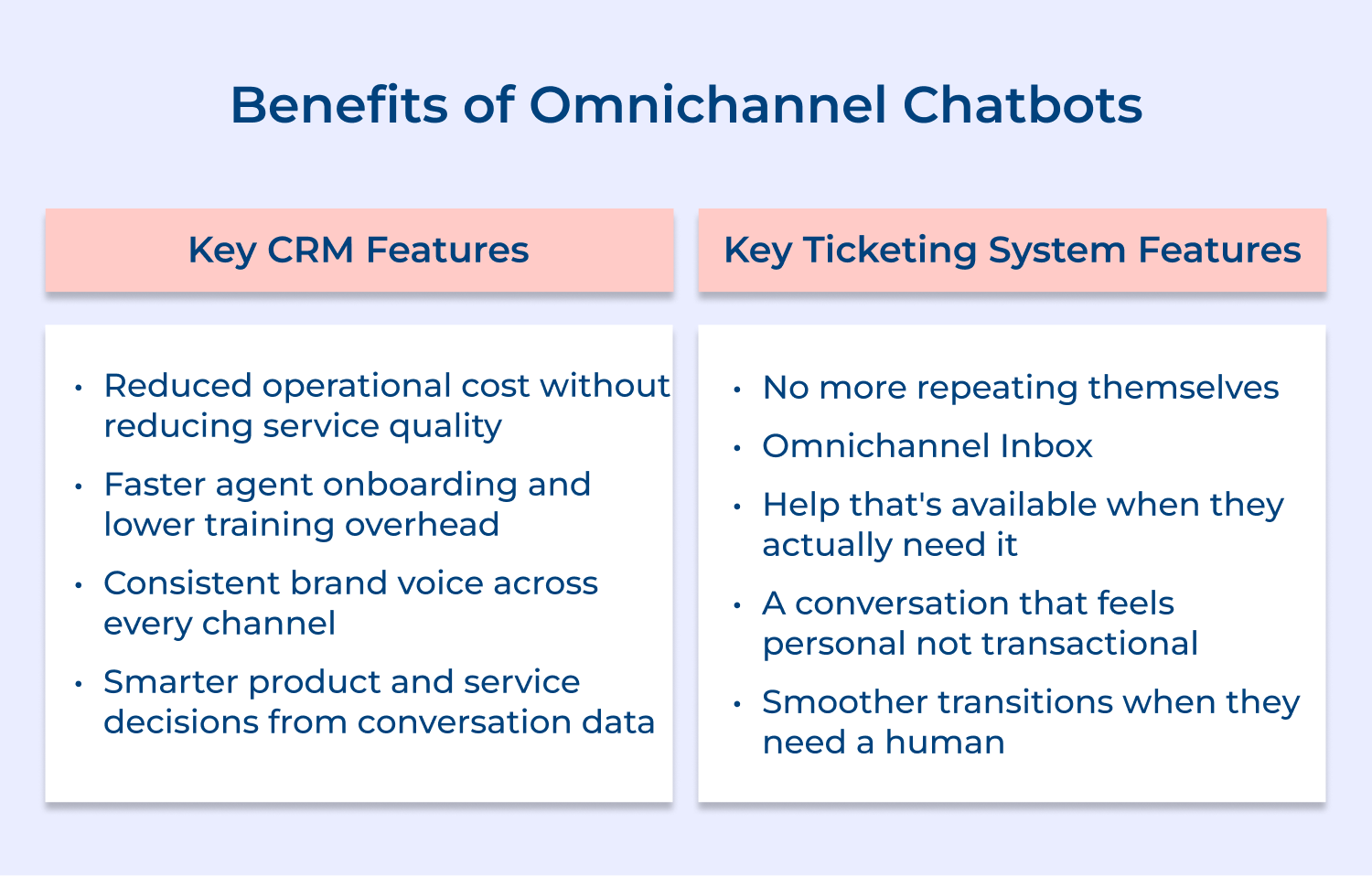
Reduced Operational Cost Without Reducing Service Quality
Most support costs sit in repetitive, low-complexity queries. Omnichannel chatbots handle these consistently across channels so your human agents focus on conversations that actually need judgment and empathy.
Faster Agent Onboarding and Lower Training Overhead
When bots handle tier-one queries and pass clean conversation summaries to agents, new team members ramp up faster. They’re resolving issues instead of gathering context from frustrated customers.
Consistent Brand Voice Across Every Channel
A human team across 10 channels will inevitably drift in tone and accuracy. A centralized bot ensures every customer gets the same answer, the same way whether they’re on chat or WhatsApp at 2am.
Smarter Product and Service Decisions from Conversation Data
Every customer interaction is a signal. Omnichannel chatbots aggregate these signals into patterns that reveal where your product confuses users, where your process breaks down and where customers silently churn.
No More Repeating Themselves
Customers carry their context from one channel to the next without re-explaining their issue. That single shift removes one of the most universally frustrating parts of any support experience.
Help that’s Available When They Actually Need It
Customers don’t have problems during business hours. An omnichannel chatbot provides consistent support at midnight on a Sunday without making them wait or feel like a lower priority.
A Conversation That Feels Personal Not Transactional
Because the bot knows their history and preferences, responses feel tailored rather than generic. Customers feel recognized and that recognition builds trust faster than any loyalty program.
Smoother Transitions When They Need a Human
When a bot hands off to an agent, customers don’t hit a wall. The agent already has the full picture so the conversation continues naturally instead of restarting from scratch.
Dive into these eight strategies that will transform how your business engages with its customers, ensuring satisfaction and loyalty like never before.
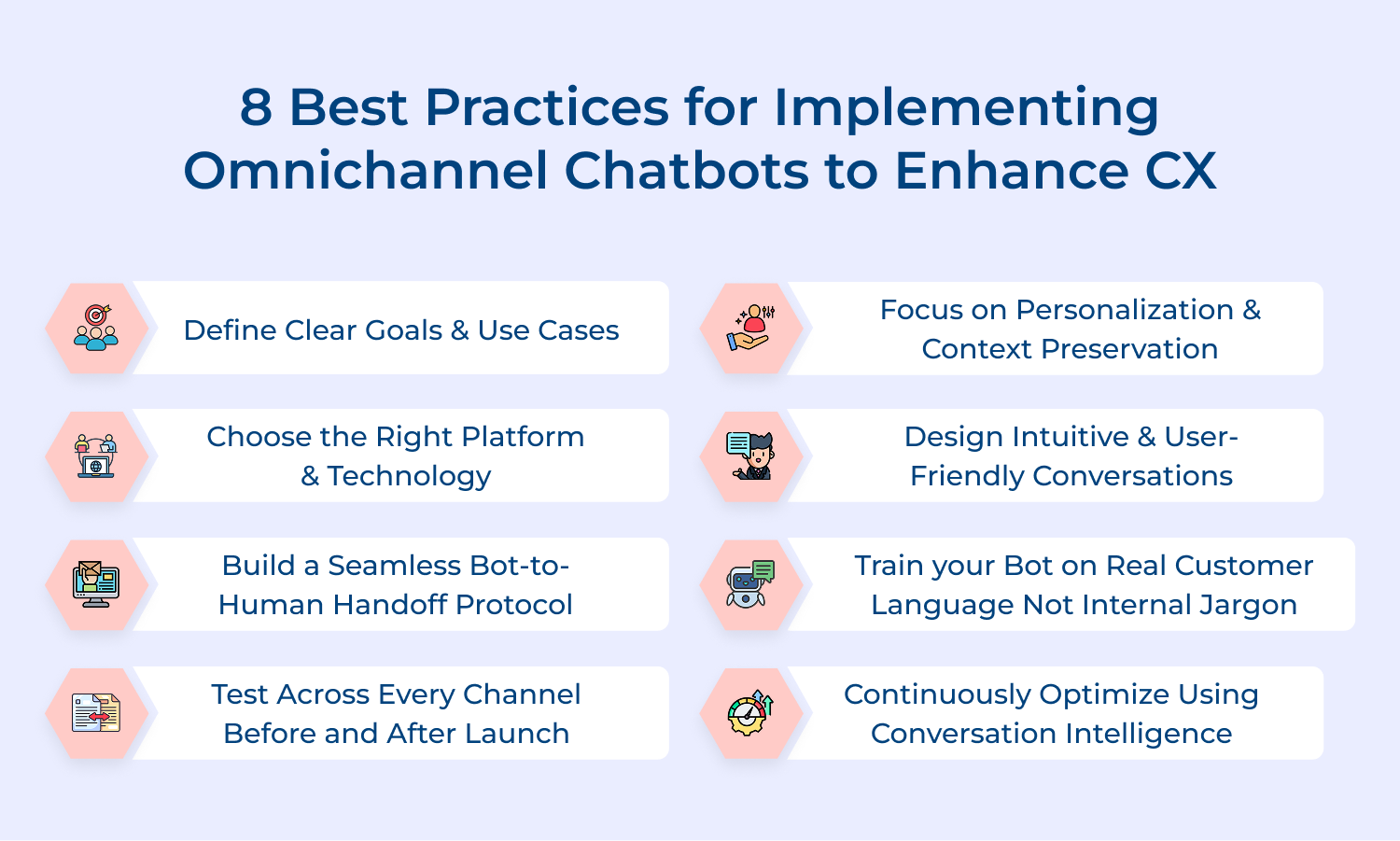
Before building anything, get specific about what success looks like. A chatbot without a defined purpose becomes a catch-all tool that frustrates customers and overwhelms your team with unresolved escalations.
Start by auditing your support data ticket volume by category, average handle time and your most repeated queries. These numbers tell you exactly where a bot creates the most immediate impact without guessing.
Before you build, answer these foundational questions:
Take an e-commerce brand as an example. Their highest-volume queries were order tracking, return requests & delivery updates all repetitive, data-driven, and resolvable without a human. Within 90 days their bot was handling 60% of total support volume before they touched complex use cases.
So what happens if you skip this and build for everything at once? You end up with a bot that half-resolves dozens of use cases instead of fully owning the five that matter most.
The platform decision is more of an infrastructure decision than a software one. What sits underneath the bot your CRM, helpdesk and data warehouse determines how contextual the experience can actually be.
Evaluate platforms on integration depth first and feature set second. A bot with advanced NLP that can’t pull live order data from your backend will still deliver a disconnected experience regardless of how polished the interface looks.
Three platform capabilities that will make or break your omnichannel experience:
Also consider how the platform handles channel-specific formatting. WhatsApp, web chat and SMS render content differently. Your platform should manage these differences automatically rather than requiring manual customization per channel.
Personalization at scale is only possible when your bot has live access to customer data. Without a real-time connection to your CRM, every conversation starts cold regardless of how long that customer has been with you.
Context preservation goes beyond remembering the last message. It means carrying the customer’s unresolved intent, emotional state, and interaction history across sessions.
Questions to pressure-test your personalization architecture:
The biggest personalization mistake is treating it as a layer added after the bot is built. It needs to be architected into your data structure from day one retrofitting it later becomes a significant technical and operational problem.
What your personalization layer must be connected to in order to work:
Conversation design sits between UX writing and behavioral psychology. The goal isn’t a bot that sounds smart, it’s one that gets customers to their answer in the fewest possible steps without friction.
Most poorly performing bots suffer from over-engineered flows. Teams design for edge cases first and forget that 80% of customers ask a handful of the same questions. Nail the common paths before building for exceptions.
Conversation design principles to follow:
Every flow should be tested by someone with zero internal context. If a first-time user can’t navigate it without confusion, it isn’t ready, customer language not product language should drive every prompt and menu label.
The handoff moment is where most omnichannel implementations quietly fail. Customers who explain their issue to a bot and then repeat everything to an agent don’t just feel frustrated they feel disrespected.
A strong handoff protocol runs on three things: the right trigger, the right context transfer and the right agent routing all working together in real time without manual steps in between.
Escalation triggers should be dynamic rather than purely rule-based. Combining sentiment analysis, complexity scoring and customer tier gives you a far more accurate picture of when a human is genuinely needed.
Signs your handoff protocol needs immediate redesign:
The biggest gap between a bot that works in testing and one that fails in production is language. Internal teams describe problems one way customers describe them in dozens of other ways and the bot needs to understand all of them.
Pull training data from actual customer interactions support tickets, chat transcripts, app store reviews and social comments. This is where real customer language lives and it’s far more valuable than any internally written FAQ.
Three training practices with the most immediate impact on bot accuracy:
Language evolves with your product. Every new feature, pricing change or policy update creates vocabulary customers will use in conversations. Your training needs a continuous update cycle to stay relevant.
Omnichannel testing is not the same as testing a single deployment. Each channel has its own rendering rules, character limits and interaction patterns. What works on web chat can completely break on WhatsApp or SMS.
Pre-launch testing should cover both functional accuracy and experiential flow. Functional testing confirms correct answers. Experiential testing confirms a real customer can navigate those answers without confusion or dead ends.
A practical omnichannel testing checklist:
Post-launch testing is equally important and often neglected. Real customer behavior in production rarely matches staging genuine usage patterns that expose gaps that no pre-launch testing could have fully predicted.
Launching a chatbot is the beginning of an ongoing product, not the completion of a project. The teams that get the most from their bots treat optimization as a standing weekly ritual rather than a quarterly review.
Conversation intelligence means going beyond deflection rate. It means reading actual transcripts, identifying where customers drop off, where they express frustration and where the bot confidently gives the wrong answer without knowing it.
Metrics that should drive your optimization cadence:
The most valuable insights don’t come from dashboards, they come from the conversations themselves. Build a regular review process where CX leaders, bot trainers & product managers read failed and escalated conversations together.
Questions that should drive your monthly optimization review:
Implementing omnichannel chatbots is not a plug-and-play exercise. The teams that struggle most underestimate what happens beneath the surface before a single customer conversation goes live.
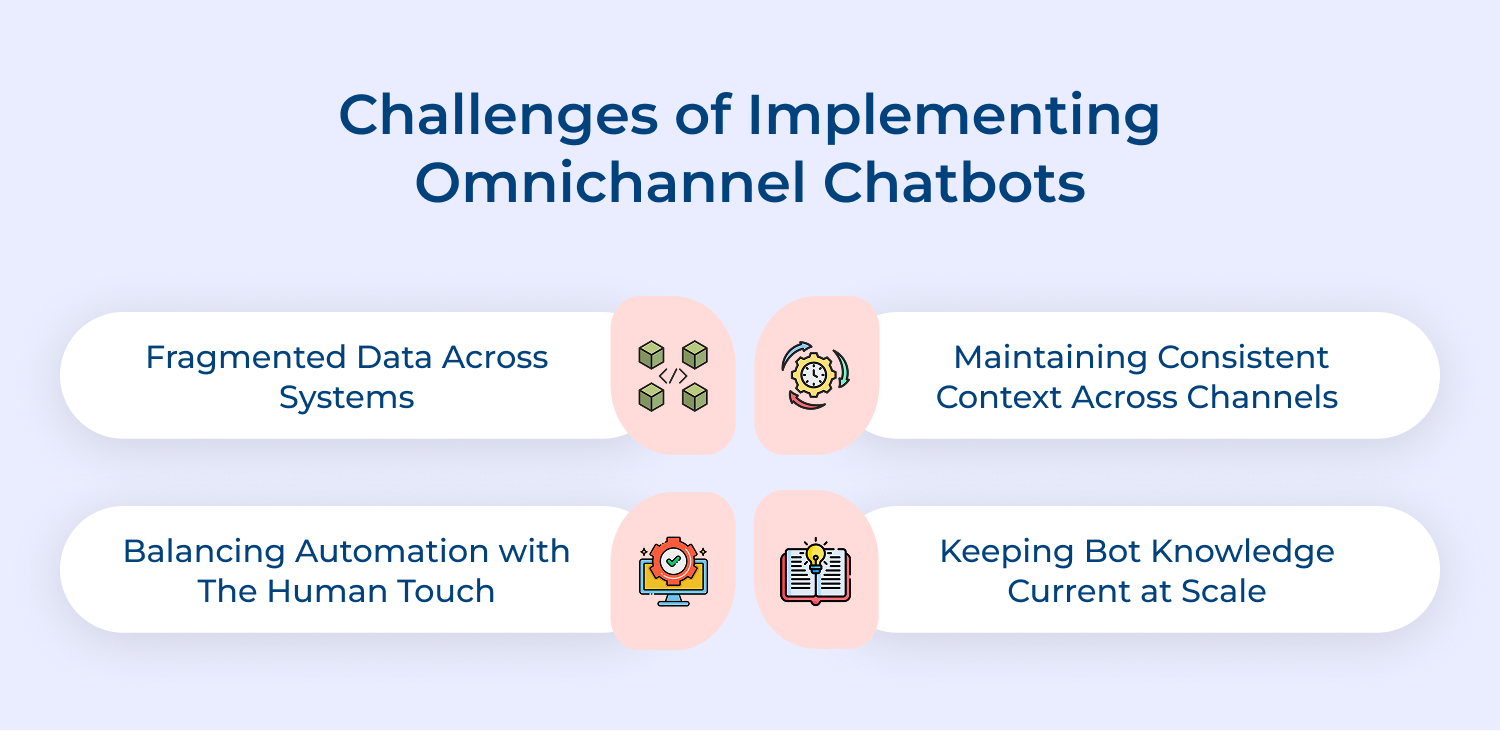
1. Fragmented Data Across Systems
Most businesses run their CRM, helpdesk and e-commerce platform as separate systems that rarely talk to each other. When your bot can’t access unified customer data in real time, it delivers responses that feel generic and disconnected — even when the answer exists somewhere in your stack.
This is a solvable integration problem, not a fundamental limitation.
2. Maintaining Consistent Context Across Channels
Customers think in conversations, not channels. Most chatbot architectures are built channel by channel which means context gets siloed at the platform level. A customer moving from web chat to WhatsApp shouldn’t have to reintroduce themselves — but without deliberate architecture, that’s exactly what happens.
This requires building context persistence from the start — not patching it in later.
3. Balancing Automation With the Human Touch
Pressure to maximize containment rate pushes teams to over-automate — keeping conversations with the bot longer than they should. Customers with complex or emotional issues don’t want efficiency, they want to feel heard. A bot that holds on too long doesn’t just fail to resolve — it damages the relationship.
The solution is escalation intelligence that knows when to step back and hand over gracefully.
4. Keeping Bot Knowledge Current at Scale
Your bot is only as accurate as the information it was last trained on. Every product update or policy change creates a gap between what the bot says and what is actually true. At scale these gaps compound quickly — and outdated information erodes customer confidence faster than almost any other service failure.
How to overcome it?
Omnichannel chatbots are not a one-size-fits-all solution but certain industries have found ways to deploy them that create measurable impact on both customer experience and operational efficiency.
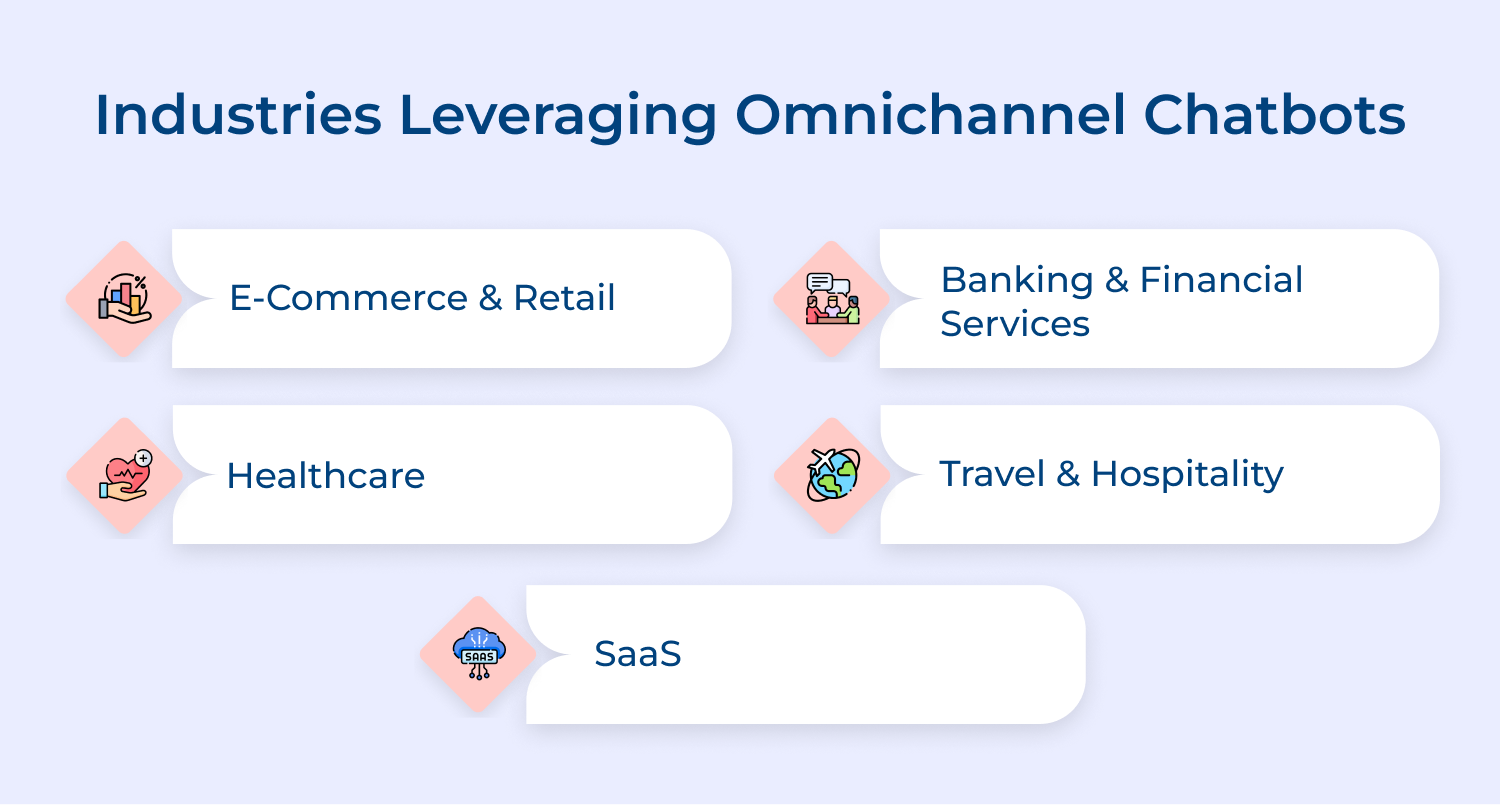
Omnichannel chatbots are not just about automating conversations, they’re about building a customer experience that feels connected, consistent and genuinely helpful regardless of where the interaction happens.
The businesses that get this right don’t treat chatbots as a cost-cutting tool. They treat them as a core part of their CX strategy and that mindset difference shows up clearly in every customer interaction.

How do omnichannel chatbots work across channels?
Omnichannel chatbots sit on a unified data layer that syncs conversation context in real time so when a customer moves from web chat to WhatsApp, the bot carries the full interaction history forward without missing a beat.
How do omnichannel chatbots improve customer experience?
They eliminate the most frustrating parts of customer service by repeating information, losing context and waiting for answers. Customers get consistent and connected support regardless of which channel they reach you on.
How do omnichannel chatbots personalize conversations?
By connecting to your CRM & customer data in real time, the bot recognizes who the customer is, what they’ve purchased and what they’ve previously asked & shapes every response around that specific context.
How do you measure omnichannel chatbot performance?
The metrics that matter most are containment rate, intent recognition accuracy, drop-off points by channel and post-interaction CSAT. Together these give you a clear picture of where the bot is delivering and where it needs work.
Can omnichannel chatbots provide 24/7 support?
Yes and this is one of their most immediate operational advantages. Customers get accurate and context-aware responses at any hour without wait times while your human team focuses on complex issues during business hours.
 https://omni24.io/wp-content/uploads/2026/08/AI-Customer-Service-Agents.png
1256
2400
Webvision Solution
https://omni24.io/wp-content/uploads/2023/04/Omni-Logo-1.svg
Webvision Solution2026-09-21 04:48:512026-09-21 04:48:51How to Build an AI Customer Service Agents: 8 Key Steps
https://omni24.io/wp-content/uploads/2026/08/AI-Customer-Service-Agents.png
1256
2400
Webvision Solution
https://omni24.io/wp-content/uploads/2023/04/Omni-Logo-1.svg
Webvision Solution2026-09-21 04:48:512026-09-21 04:48:51How to Build an AI Customer Service Agents: 8 Key Steps https://omni24.io/wp-content/uploads/2026/08/Omnichannel-Conversational-AI.png
1256
2400
Tushar Joshi
https://omni24.io/wp-content/uploads/2023/04/Omni-Logo-1.svg
Tushar Joshi2026-09-16 03:51:072026-09-16 03:51:07How to Build Omnichannel Conversational AI Strategy
https://omni24.io/wp-content/uploads/2026/08/Omnichannel-Conversational-AI.png
1256
2400
Tushar Joshi
https://omni24.io/wp-content/uploads/2023/04/Omni-Logo-1.svg
Tushar Joshi2026-09-16 03:51:072026-09-16 03:51:07How to Build Omnichannel Conversational AI Strategy https://omni24.io/wp-content/uploads/2026/08/Customer-Service-Teams.png
1256
2400
Tushar Joshi
https://omni24.io/wp-content/uploads/2023/04/Omni-Logo-1.svg
Tushar Joshi2026-09-15 04:01:522026-09-15 04:02:16How to Build Customer Service Teams: 6 Key Steps
https://omni24.io/wp-content/uploads/2026/08/Customer-Service-Teams.png
1256
2400
Tushar Joshi
https://omni24.io/wp-content/uploads/2023/04/Omni-Logo-1.svg
Tushar Joshi2026-09-15 04:01:522026-09-15 04:02:16How to Build Customer Service Teams: 6 Key Steps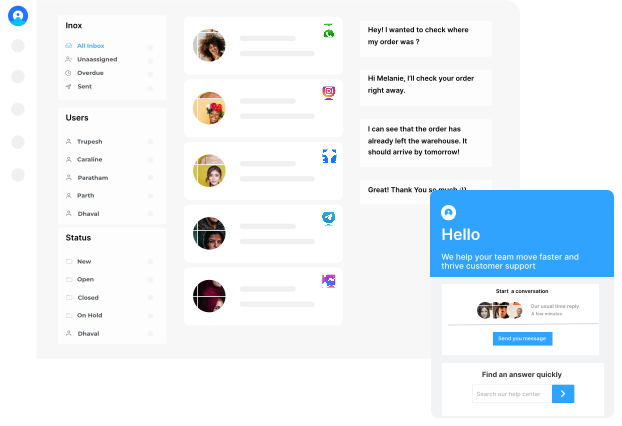
Whether it’s about acquire, engage or support – Omni24 covers all your customer engagement needs in one complete platform.

Copyright ©2026 Veemo All rights reserved.
CA, Los Angeles, Hall Ave, 19011