How to Create an Omnichannel Ecommerce Strategy: 7 Best Ways
Omnichannel ecommerce connects every channel - website, app, store, social into one seamless, data-driven customer experience that boosts retention.
Omnichannel ecommerce connects every channel - website, app, store, social into one seamless, data-driven customer experience that boosts retention.
Customers today do not shop in a straight line. They browse on mobile, research on desktop and walk into a store expecting staff to already know what they want.
Most businesses are still treating each of those touchpoints as separate problems to solve. 80% of companies still run on nonintegrated communication channels phone, email, chat and web self-service that don’t talk to each other. That gap between how customers actually shop and how brands are set up to serve them is exactly where revenue quietly disappears.
Omnichannel ecommerce closes that gap by connecting every channel into one continuous experience. This guide breaks down exactly how it works and how to build it in a way that actually sticks.
Omnichannel ecommerce is a retail approach where a customer’s shopping experience stays connected across every channel — your website, mobile app, physical store, and social media. No matter where they browse or buy, their journey feels like one continuous conversation with your brand.
Think of it this way — a customer spots a jacket on your Instagram, saves it to their wishlist on your app, and picks it up in-store the same evening. Every touchpoint they hit along the way is talking to the same system in the background.
That’s possible because omnichannel connects your inventory, customer data, and order management into a single source of truth. When a customer adds something to their cart on desktop, it’s still sitting there when they open your app on the subway.
The real engine behind it is real-time data sync. Your systems know what the customer browsed, what they bought last month, and even which store they prefer — so every interaction they have feels personal and frictionless.
Key Objectives:
Once your channels start working together instead of competing with each other, the business impact shows up fast — in revenue, loyalty and operational efficiency.
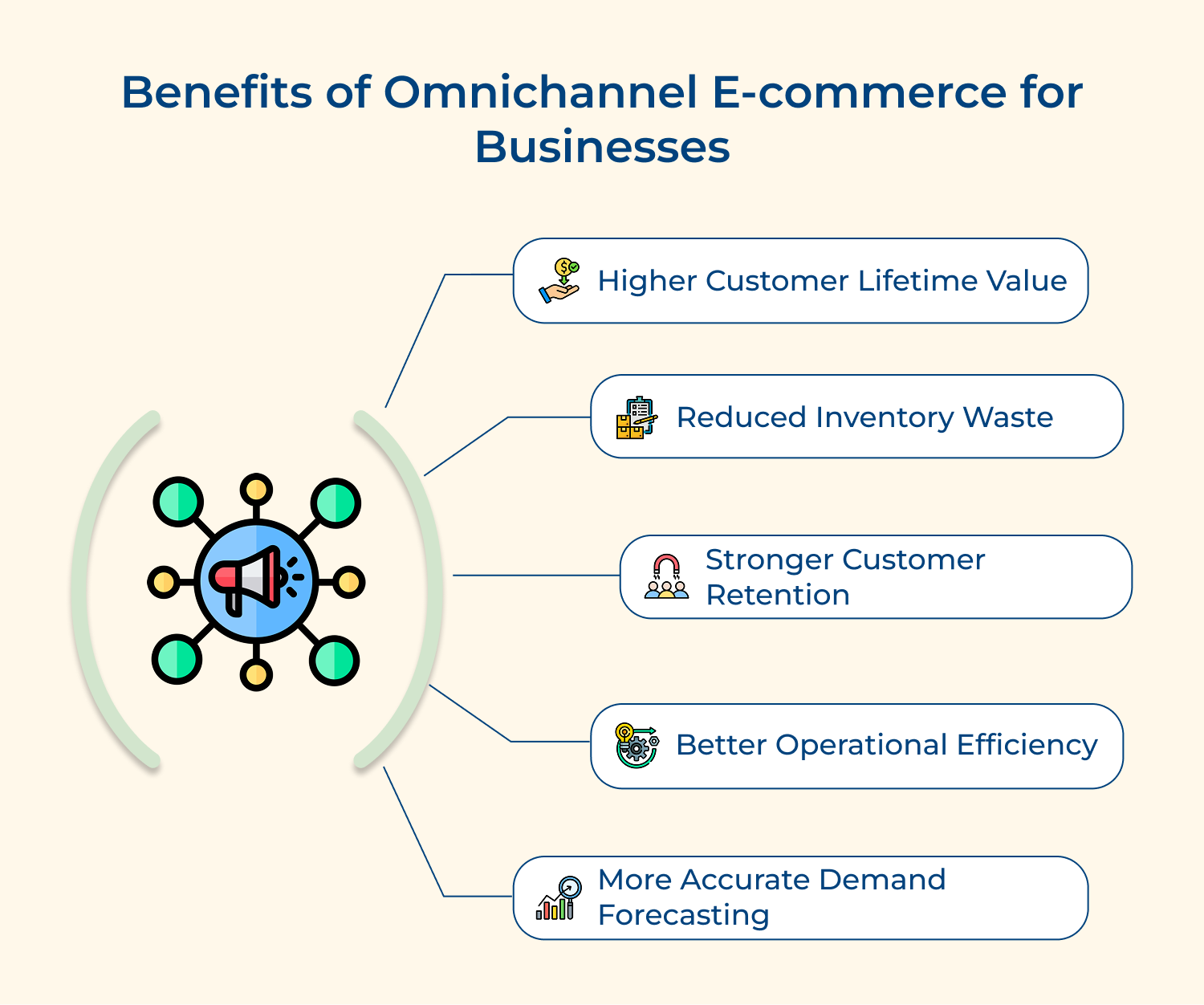
1. Higher Customer Lifetime Value
When customers can move between channels without friction, they naturally buy more often. A seamless experience removes every small reason someone might abandon a purchase halfway through.
2. Reduced Inventory Waste
With unified inventory visibility, you stop over-stocking in one location while running dry in another. Retailers, grocers and healthcare suppliers all save significantly when stock moves based on actual demand signals across every channel.
3. Stronger Customer Retention
Customers remember how easy or difficult it was to shop with you. When their preferences, order history and cart follow them everywhere, they have very little reason to go looking elsewhere.
4. Better Operational Efficiency
Disconnected systems force your team to manually reconcile data across platforms. A unified backend cuts that overhead and lets your operations, logistics and support teams focus on work that actually moves the business forward.
5. More Accurate Demand Forecasting
When all your channel data feeds into one place, your buying and planning teams can finally see real patterns. You stop guessing what to stock and start making decisions based on how customers actually behave across every touchpoint.
Both approaches use multiple channels to reach customers — but the way those channels communicate with each other is where everything changes.
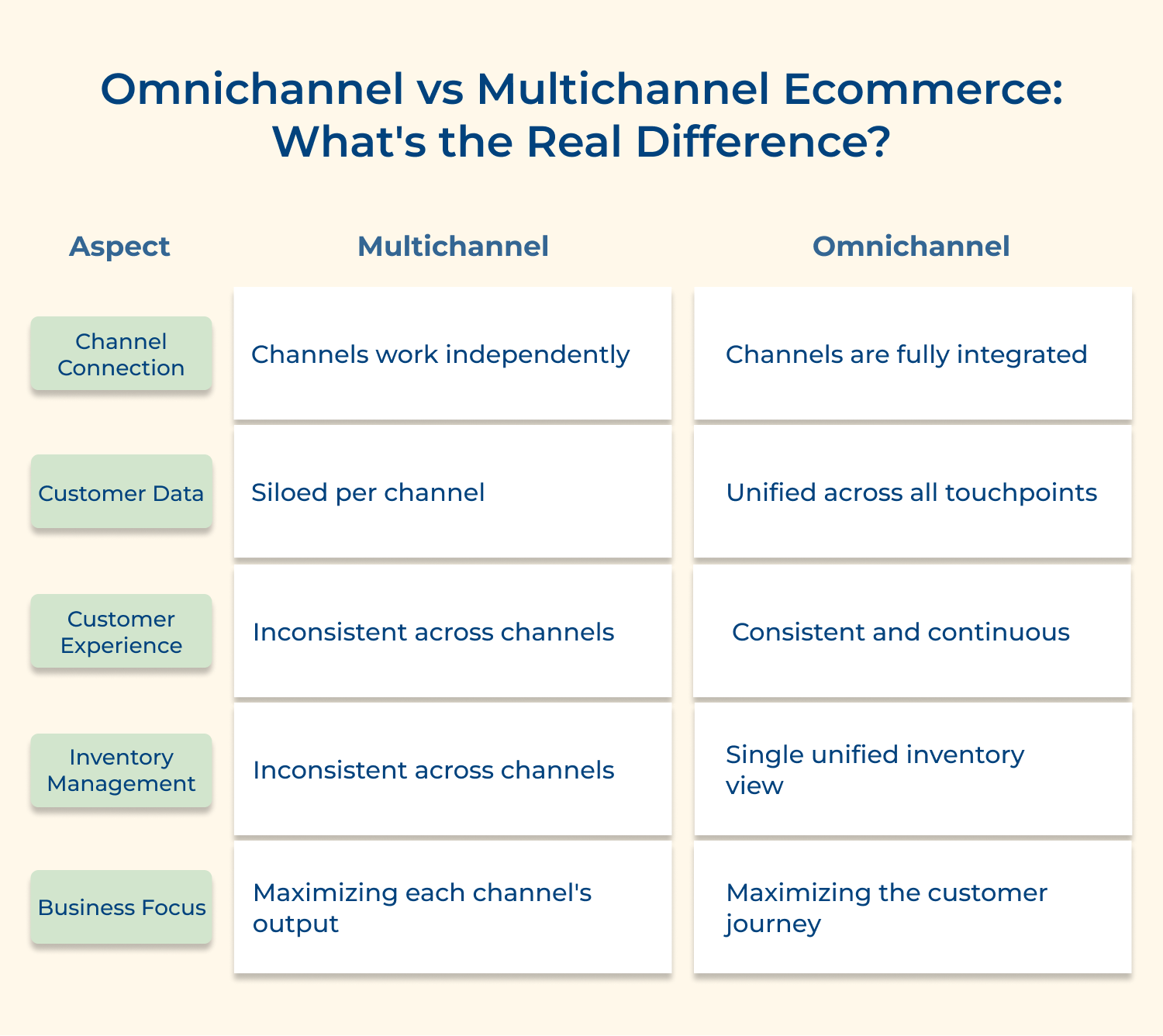
1. Channel Connection
In multichannel, your website, store and app are essentially running as separate businesses. Each one has its own data, its own logic and very little awareness of what’s happening on the others.
Omnichannel flips that entirely. Every channel is a node in one connected system so a return initiated on the app can be completed in-store without a single awkward conversation at the counter.
2. Customer Data
Multichannel captures data but keeps it trapped inside each platform. Your email tool knows one thing, your POS knows another and your ecommerce platform knows something else — and none of them are talking.
Omnichannel pulls all of that into a single customer profile. So when someone contacts support, your team already knows what they bought, where and when — without asking them to repeat themselves.
3. Customer Experience
With multichannel, the experience quality depends entirely on which channel a customer lands on. One channel might be polished and fast while another feels outdated and disconnected from everything else.
Omnichannel holds the experience to the same standard everywhere. The tone, the offers, the cart, the history — it all travels with the customer regardless of where they choose to engage next.
4. Inventory Management
Multichannel inventory is one of the most expensive operational problems in retail. Stock sits in silos and you end up overselling on one channel while product collects dust in a warehouse assigned to another.
Omnichannel treats all inventory as one shared pool. Every channel pulls from the same numbers in real time so fulfillment decisions become smarter and costly stock imbalances become far less common.
5. Business Focus
Multichannel thinking is channel-first. Teams are measured on how well each individual channel performs and optimization happens in isolation rather than across the full customer journey.
Omnichannel shifts that focus to the customer. The goal is not to make each channel hit its own number but to make the overall experience smooth enough that customers keep coming back regardless of which channel they use.
Let’s delve into seven ways you can craft an omnichannel strategy that truly resonates with your audience.
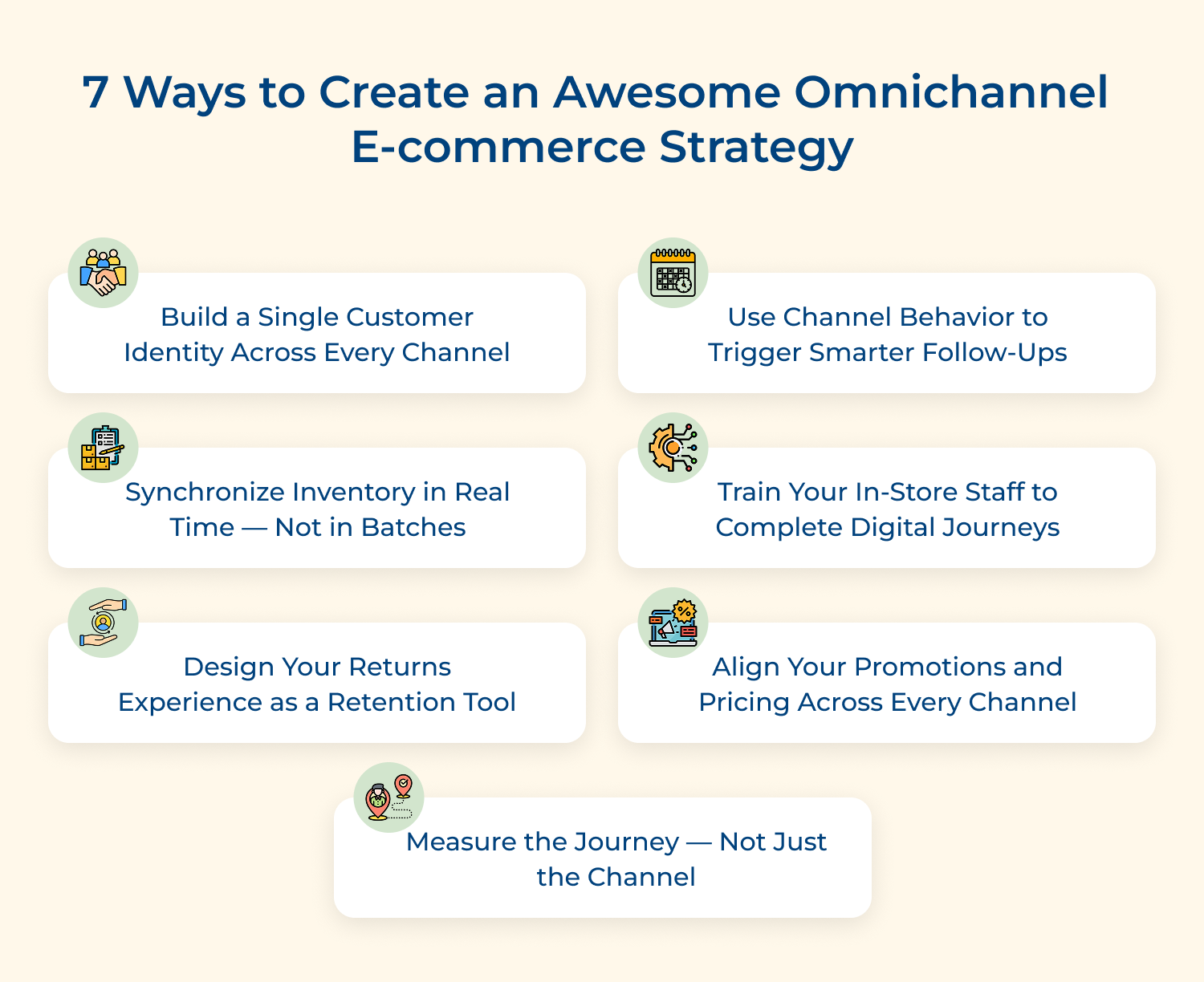
Before you optimize any channel, make sure you can recognize the same customer across all of them. A unified customer ID ties together browsing behavior, purchase history and support interactions into one profile.
Without this foundation, every personalization effort downstream is essentially guesswork. Teams across marketing, support and fulfillment end up working from different versions of the same customer — and the experience breaks down in ways customers notice immediately.
Ask yourself these questions before you start:
Once you have answers to those, the next step is making sure your unified identity actually covers every data source that matters. A strong single customer identity should connect all of these without any gaps:
Most businesses sync inventory on a schedule and that gap between updates is exactly where overselling and broken promises happen. Customers rarely give a second chance after a failed pickup or a cancelled order confirmation.
Move to real-time inventory sync across every channel and fulfillment node. When your website, app and store all reflect the same live number, you stop making commitments you cannot keep — and fulfillment decisions become significantly smarter across the board.
The operational benefits go beyond just avoiding stockouts. Real-time sync also means your store staff, warehouse team and customer support are all looking at the same numbers — so there are no internal disagreements when a customer asks about availability.
Here is what real-time sync should cover across your operations:
Returns are where most omnichannel strategies quietly fall apart. A customer who bought online should be able to return in-store without friction, paperwork or a staff member who has no visibility into the original order.
Most businesses treat returns as a cost center and design the experience accordingly — making it just difficult enough that some customers give up. That approach might save a return in the short term but it almost always costs you the customer permanently.
Run through this checklist before you redesign your returns flow:
A smooth cross-channel return tells the customer that your systems are genuinely connected. That single interaction often does more for long-term loyalty than any discount or rewards program — because it removes doubt about whether your brand can actually follow through on its promises.
If a customer browses a product three times on mobile but never buys, that signal should trigger something — a targeted email, a price drop alert or a personalized push notification. Most businesses collect this behavioral data and then do nothing meaningful with it.
The problem is not a lack of data. It is that behavioral signals from different channels never get connected into one place. Your email tool sees an open, your app sees a browse and your store sees a walk-in — but none of them know the others exist.
Map out the moments where customers stall or drop off across channels. Then build follow-ups that feel like helpful nudges because they are grounded in what that specific customer actually did — not what a generic segment is assumed to want.
The most common drop-off points worth building triggers around:
Once your triggers are live, segment them by where the customer actually is in their decision journey.
Your physical store is a powerful omnichannel touchpoint but only if your staff knows how to use it that way. A customer walking in with an abandoned cart or an online inquiry needs staff who can pick up exactly where the digital journey left off.
Before rolling out training, make sure these are already in place:
This is not just a technology problem — it is a training problem. You can give your staff the best POS system in the world but if they do not know how to use customer data in a live conversation, the experience still falls flat.
When store staff can see digital history at the point of sale, they stop treating every walk-in as a cold interaction. That shift dramatically changes how connected the in-store experience feels — and how confident the customer is about coming back next time.
Nothing erodes customer trust faster than finding a lower price for the same product on a different channel of yours. It signals that your business is not actually integrated — it just appears to be on the surface.
This happens more often than most businesses realize. A discount goes live on the website but the app is still showing full price. A loyalty reward applies online but the in-store system does not recognize it. Each of these moments plants a small seed of doubt that compounds over time.
Centralize your promotions engine so that every discount, loyalty reward and seasonal offer applies consistently everywhere. Customers should never feel like they need to shop around within your own brand to find the best deal on something they already decided to buy.
Audit your current promotions setup against these questions:
Beyond auditing the gaps, also make sure your promotions engine is built to scale without creating new inconsistencies. Here is what it should handle without any manual intervention:
Most analytics setups measure each channel in isolation — conversion rate here, bounce rate there. That view completely misses the customer who researched on mobile, compared on desktop and completed the purchase in-store.
The danger of channel-level measurement is that it leads to channel-level budget decisions. You end up pulling investment from channels that look underperforming on paper but are actually doing critical work earlier in the customer journey before the final conversion happens.
Shift your measurement to journey-level attribution. Understand which channel combinations actually drive conversion and long-term retention — so your budget decisions are based on how customers actually behave rather than how your dashboard is set up to report.
Start by identifying the journey data points you are currently missing:
Once you have that visibility, build your measurement framework around the full journey. These are the four metrics your framework should track consistently:
Getting the strategy right is one thing — executing it consistently across every channel is where most businesses actually struggle. These best practices close that gap.
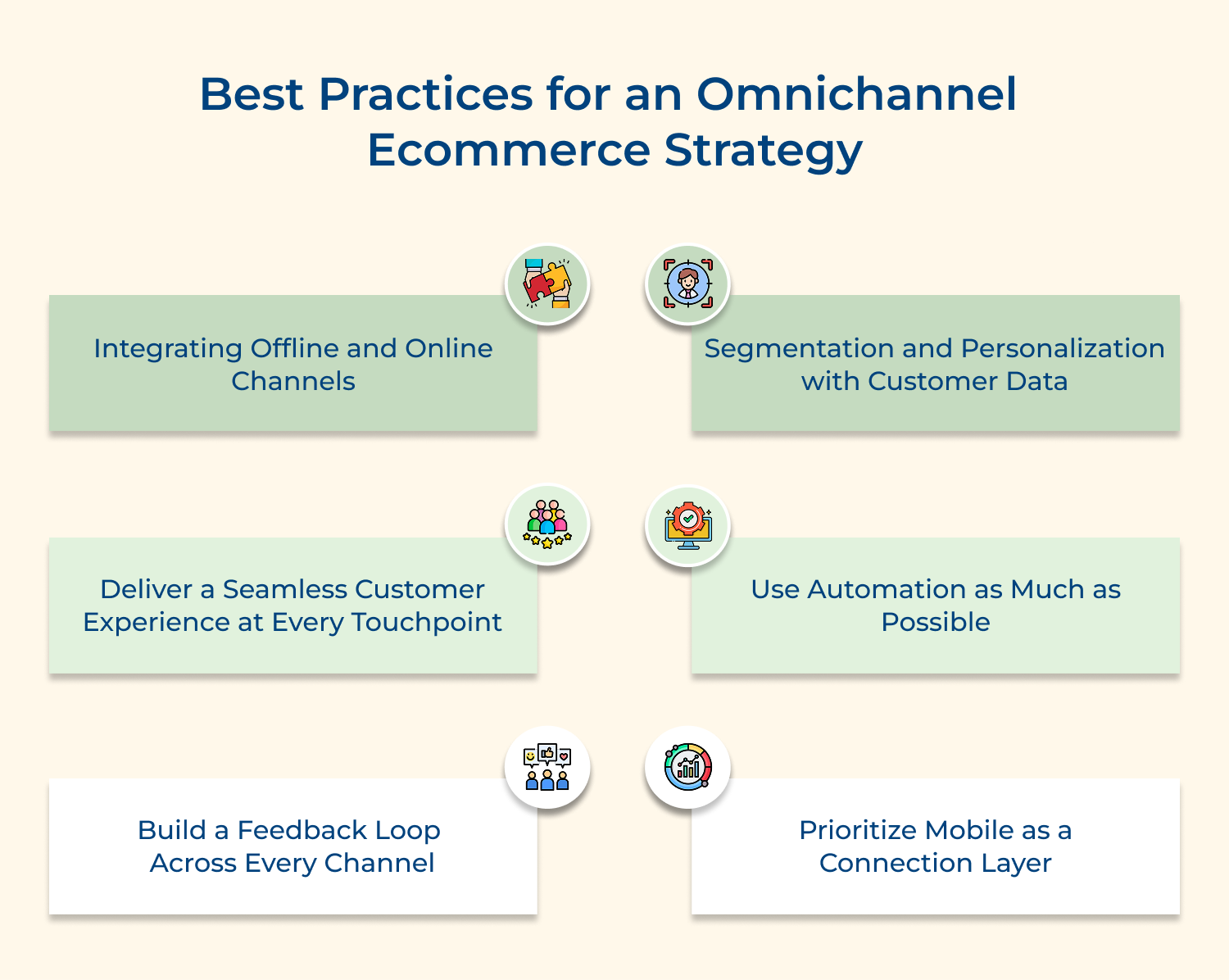
1. Integrating Offline and Online Channels
Your offline and online channels should share data continuously — not occasionally. A customer’s in-store visit should inform their next online interaction and vice versa, creating one uninterrupted experience.
2. Segmentation and Personalization with Customer Data
Stop treating all customers the same across every channel. Use purchase history, browsing behavior and channel preferences to serve each customer the right message at the right moment.
3. Deliver a Seamless Customer Experience at Every Touchpoint
Every channel your customer touches should feel like it belongs to the same brand. Inconsistency in tone, pricing or service quality across touchpoints quietly signals that your operations are still working in silos.
4. Use Automation as Much as Possible
Manual processes do not scale across multiple channels without breaking. Automate inventory updates, follow-up triggers, loyalty rewards and promotional syncs so your team focuses on decisions rather than repetitive execution.
5. Build a Feedback Loop Across Every Channel
Customer behavior is constantly telling you what is working and what is not. Collect feedback signals — returns, support tickets, drop-off points — from every channel and feed them back into your strategy regularly.
6. Prioritize Mobile as a Connection Layer
Mobile is rarely where the final purchase happens but it is almost always part of the journey. Treat your mobile experience as the thread that connects every other channel rather than just another storefront.
Building an omnichannel experience is worth it — but it comes with real operational and technical hurdles that businesses need to anticipate before they hit them.
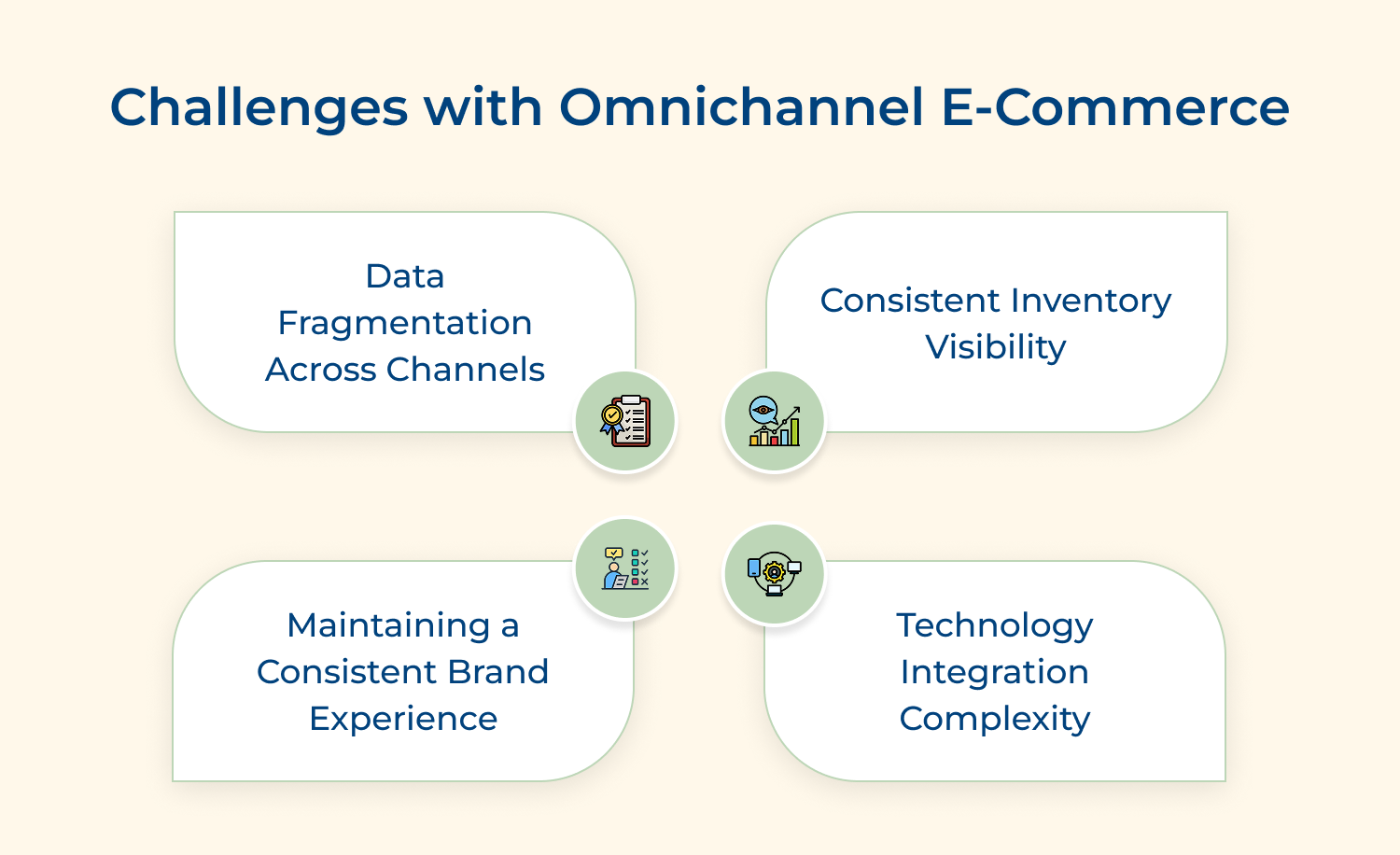
When every channel runs on a separate system, customer data gets trapped in silos. You end up with multiple incomplete pictures of the same customer instead of one accurate view.
Keeping stock levels accurate across every channel in real time is harder than it sounds. A single return, cancellation or flash sale can create discrepancies that ripple across your entire fulfillment operation almost instantly.
Every channel has its own team, its own tools and its own way of doing things. Without a shared standard, the experience a customer gets on your app can feel completely disconnected from what they get in-store.
Most businesses are running legacy systems that were never built to talk to each other. Connecting your POS, CRM, OMS and ecommerce platform into one coherent stack is a significant technical undertaking that takes time to get right.
The good news is that these challenges are not unique to your business — they are well-understood problems with proven solutions. Addressing them does not require rebuilding everything at once but it does require a clear and prioritized approach.
Here is where to focus your efforts:
The best way to understand omnichannel done right is to look at brands that have built it into the core of how they operate — not just as a feature but as a business model.
Amazon
Amazon connects every touchpoint — its website, app, Alexa, Prime and physical stores like Amazon Fresh — into one seamless customer journey. Your cart, preferences and delivery history follow you everywhere, making every interaction feel like a continuation rather than a fresh start.
Nike
Nike ties its app, website, physical stores and membership program into one connected experience through the Nike Membership ecosystem. A customer can reserve products on the app, try them in-store and have their purchase history inform every recommendation they see next — across every channel they use.
Zappos
Zappos builds its omnichannel strategy around customer service as the connective tissue. Every interaction a customer has — whether through the website, app or support — is informed by their full history with the brand, making every touchpoint feel personal and informed rather than transactional.
Sephora
Sephora’s Beauty Insider program is one of the strongest examples of omnichannel loyalty done right. A customer’s purchases, product preferences and rewards balance stay consistent whether they shop online, on the app or in-store — and their in-store associates can see the same profile to make personalized recommendations on the spot.
Omnichannel is not a trend you adopt — it is the new baseline customers expect. When your channels work together, every interaction builds trust rather than creating friction that quietly pushes customers away.
The businesses winning today are not the ones with the most channels. They are the ones where every channel knows what the others are doing — and uses that knowledge to serve the customer better.

How can small businesses implement omnichannel ecommerce?
Start small by connecting your two most active channels first. A unified customer profile and shared inventory view will give you more traction than trying to integrate everything at once.
What challenges come with omnichannel ecommerce?
Data fragmentation, inconsistent inventory visibility and technology integration are the three biggest hurdles. Most of them trace back to systems that were built independently and never designed to share information with each other.
What channels are included in omnichannel ecommerce?
Omnichannel covers your website, mobile app, physical stores, social commerce, email, SMS and marketplaces like Amazon. The channel itself matters less than whether it is connected to the same customer data and inventory as everything else.
Why is omnichannel ecommerce important for online retailers?
Customers no longer shop in a straight line — they jump between channels before every purchase decision. Retailers who cannot follow that journey lose the sale to someone who can meet the customer wherever they already are.
What metrics track omnichannel ecommerce performance?
Focus on cross-channel conversion rates, customer lifetime value and cart abandonment recovery across devices. Channel-level metrics only tell part of the story — journey-level attribution shows you what is actually driving revenue across your full operation.
 https://omni24.io/wp-content/uploads/2026/08/AI-Customer-Service-Agents.png
1256
2400
Webvision Solution
https://omni24.io/wp-content/uploads/2023/04/Omni-Logo-1.svg
Webvision Solution2026-09-21 04:48:512026-09-21 04:48:51How to Build an AI Customer Service Agents: 8 Key Steps
https://omni24.io/wp-content/uploads/2026/08/AI-Customer-Service-Agents.png
1256
2400
Webvision Solution
https://omni24.io/wp-content/uploads/2023/04/Omni-Logo-1.svg
Webvision Solution2026-09-21 04:48:512026-09-21 04:48:51How to Build an AI Customer Service Agents: 8 Key Steps https://omni24.io/wp-content/uploads/2026/08/Omnichannel-Conversational-AI.png
1256
2400
Tushar Joshi
https://omni24.io/wp-content/uploads/2023/04/Omni-Logo-1.svg
Tushar Joshi2026-09-16 03:51:072026-09-16 03:51:07How to Build Omnichannel Conversational AI Strategy
https://omni24.io/wp-content/uploads/2026/08/Omnichannel-Conversational-AI.png
1256
2400
Tushar Joshi
https://omni24.io/wp-content/uploads/2023/04/Omni-Logo-1.svg
Tushar Joshi2026-09-16 03:51:072026-09-16 03:51:07How to Build Omnichannel Conversational AI Strategy https://omni24.io/wp-content/uploads/2026/08/Customer-Service-Teams.png
1256
2400
Tushar Joshi
https://omni24.io/wp-content/uploads/2023/04/Omni-Logo-1.svg
Tushar Joshi2026-09-15 04:01:522026-09-15 04:02:16How to Build Customer Service Teams: 6 Key Steps
https://omni24.io/wp-content/uploads/2026/08/Customer-Service-Teams.png
1256
2400
Tushar Joshi
https://omni24.io/wp-content/uploads/2023/04/Omni-Logo-1.svg
Tushar Joshi2026-09-15 04:01:522026-09-15 04:02:16How to Build Customer Service Teams: 6 Key Steps
Whether it’s about acquire, engage or support – Omni24 covers all your customer engagement needs in one complete platform.

Copyright ©2026 Veemo All rights reserved.
CA, Los Angeles, Hall Ave, 19011