What is Proactive Customer Engagement: A Quick Guide
Proactive customer engagement helps businesses address needs early, boost satisfaction and build loyal, long-term relationships that drive growth.
Proactive customer engagement helps businesses address needs early, boost satisfaction and build loyal, long-term relationships that drive growth.
Most businesses believe that responding quickly to customer issues is enough to keep customers loyal. But waiting for customers to reach out first is exactly where relationships break down.
Proactive customer engagement closes that gap by putting your business in the driver’s seat of every customer interaction. 62% of companies using proactive outreach see revenue growth, while 85% compete on CX where proactive service elevates satisfaction.
This guide walks you through exactly how to build a proactive engagement strategy that delivers lasting CX results.
Proactive customer engagement means your business identifies customer needs and acts on them before the customer has to raise a hand. Most businesses lose customers not because of bad products but because they stayed silent at the wrong moments.
From a customer engagement standpoint, the difference between proactive and reactive is the difference between building a relationship versus simply managing complaints. When you reach out first with the right message at the right time customers stop seeing you as a vendor and start seeing you as a partner.
Key objectives:
Businesses that engage customers proactively consistently outperform those that simply wait and respond. Here is a closer look at why making the first move always works in your favor.
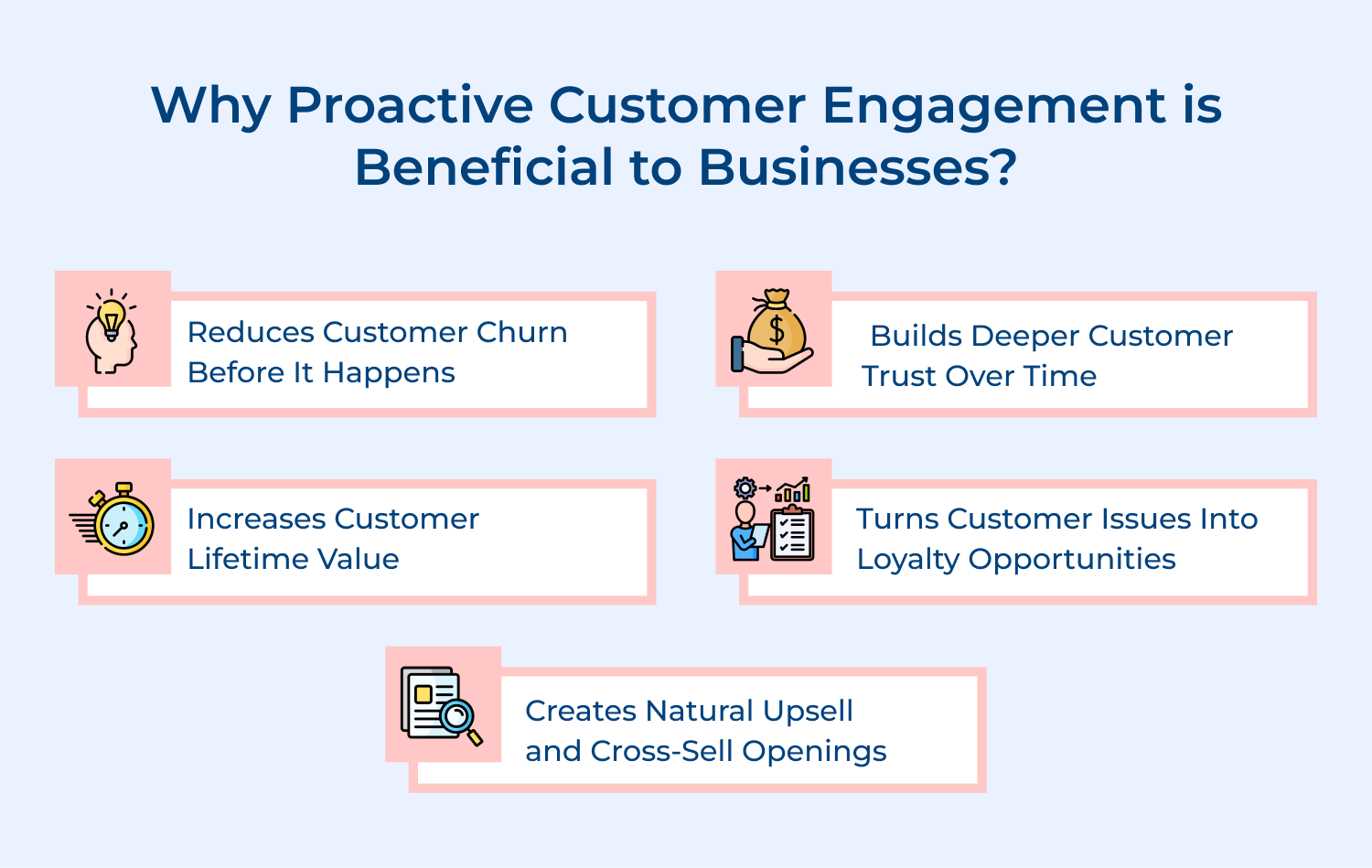
1. Reduces Customer Churn Before It Happens
Most customers do not announce that they are about to leave, they just quietly stop engaging. Spotting early warning signs like reduced logins or declining purchase frequency and reaching out at that exact moment is what keeps retention rates strong.
2. Builds Deeper Customer Trust Over Time
Trust is not built through transactions alone — it is built through consistent and thoughtful attention. When a business checks in at the right moments without being prompted, customers naturally start feeling valued rather than just sold to.
3. Increases Customer Lifetime Value
A customer who receives timely and relevant engagement stays connected to your business longer. That extended relationship directly translates into more purchases, higher order values, and stronger overall revenue contribution.
4. Turns Customer Issues Into Loyalty Opportunities
Reaching out to a customer before a small issue becomes a complaint completely changes how they perceive your brand. That single proactive touchpoint often does more for loyalty than months of smooth and uneventful service.
5. Creates Natural Upsell and Cross-Sell Openings
Proactive engagement gives businesses the context to recommend the right product or upgrade at the right time. When the suggestion feels helpful rather than pushy, customers are far more open to exploring it.
Understanding the difference between proactive and reactive engagement is critical before building any customer engagement strategy. One puts you in control of the experience while the other keeps you constantly playing catch-up.
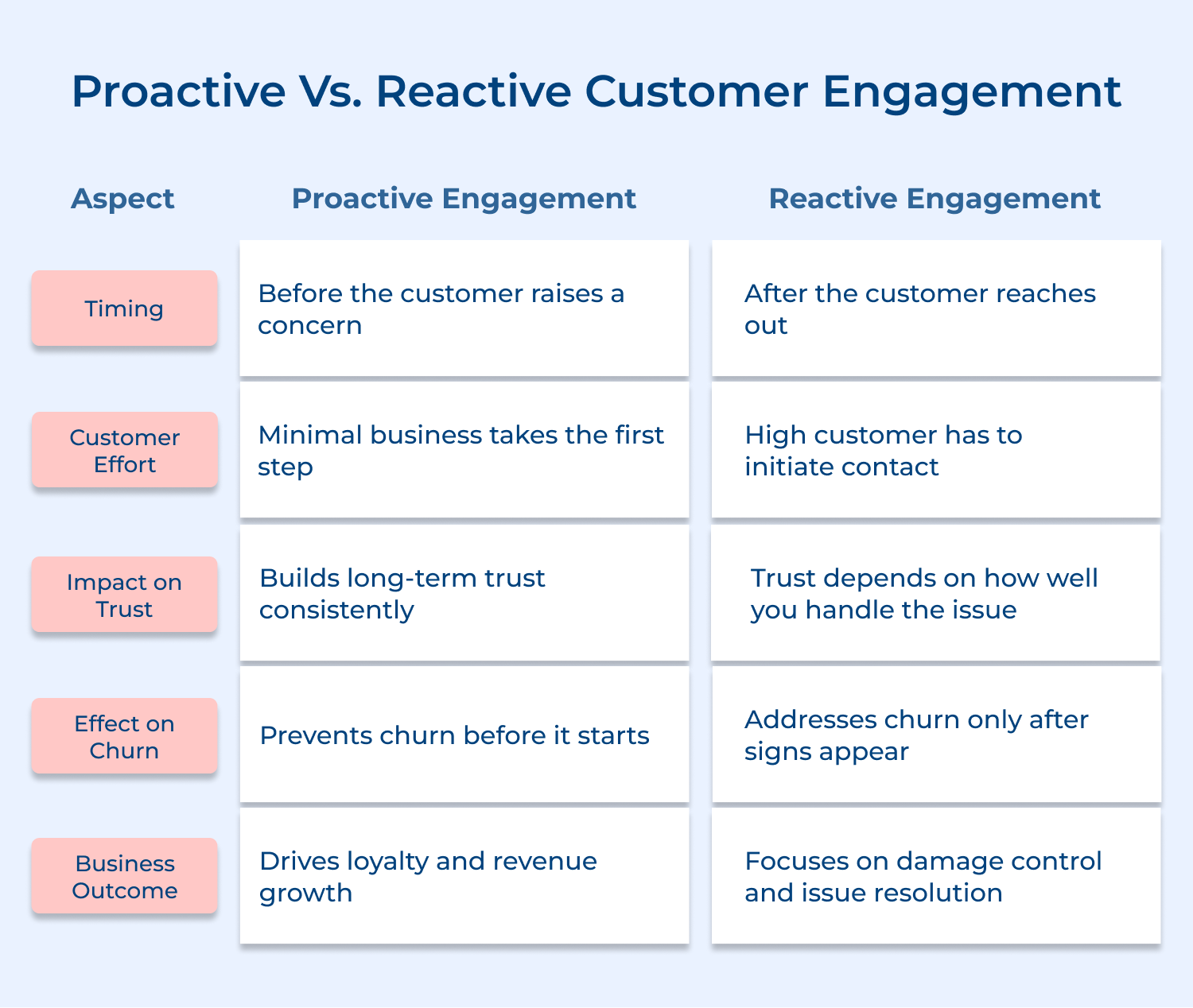
1. Timing
Proactive engagement happens before the customer even senses a problem which is where its real power lies. Businesses that act on behavioral signals and usage patterns can reach out at exactly the right moment.
Reactive engagement on the other hand only kicks in after the customer has already experienced friction. By that point the damage to the relationship has often already begun and recovery takes significantly more effort.
2. Customer Effort
In a proactive model the business shoulders the responsibility of initiating meaningful conversations with its customers. This creates a low-effort experience for the customer, signaling that their time and convenience genuinely matter to the business.
Reactive engagement places the entire burden on the customer to identify a problem and then reach out for resolution. That extra effort quietly builds frustration and makes customers feel like just another ticket in the queue.
3. Impact on Trust
Consistently reaching out before customers ask builds a level of trust that is very difficult for competitors to replicate. Customers begin to associate your brand with reliability and genuine care rather than just transactional interactions.
Reactive engagement can still build trust but only if the resolution is handled exceptionally well every single time. That is a much harder standard to maintain at scale compared to simply staying ahead of customer needs.
4. Effect on Churn
Proactive engagement allows businesses to identify at-risk customers through early signals and intervene before the decision to leave is made. That window of opportunity is often small and only businesses with a proactive system in place can actually use it.
Reactive engagement addresses churn only after a customer has already disengaged or submitted a cancellation. At that stage winning them back requires far more resources and the success rate is considerably lower.
In the upcoming sections, we will explore seven proactive strategies that can enhance customer interaction, build trust and ultimately lead to higher retention rates, increased customer lifetime value.
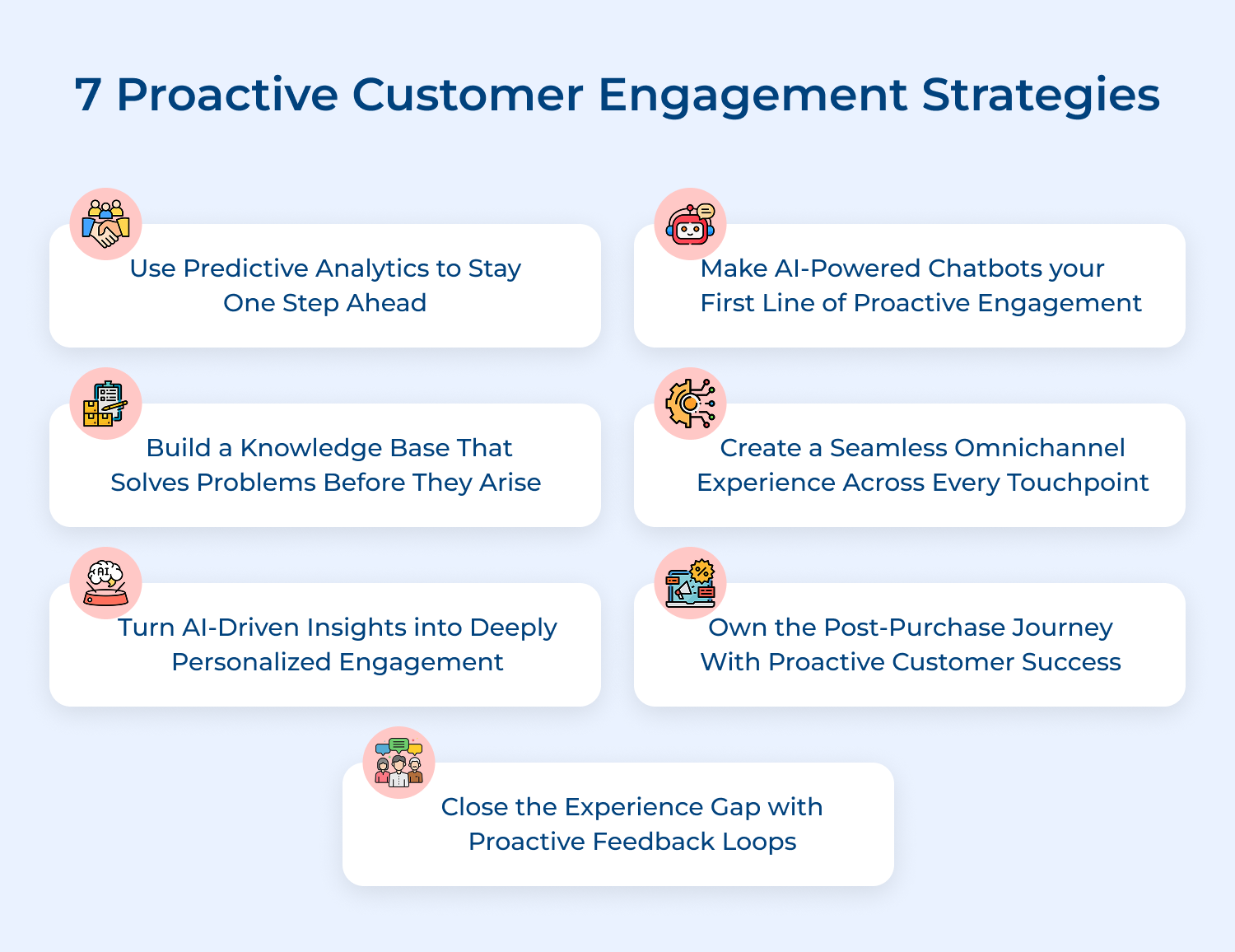
Businesses that rely on predictive analytics stop reacting to customer behavior and start responding to it before it becomes a problem worth solving. The shift from hindsight to foresight is what makes proactive engagement genuinely scalable across any customer base.
Here is how predictive analytics powers proactive customer engagement:
Does predictive analytics replace human judgment in customer engagement? Not at all — it sharpens it by giving teams live data queues instead of gut instinct to work from.
Best Practices:
AI-powered chatbots today go far beyond answering FAQs; they initiate conversations based on live customer behavior across digital touchpoints. For businesses scaling proactive engagement without scaling headcount, this is one of the most practical tools available.
Initiating Conversations Based on Live Browsing Behavior and Intent Signals
When a customer lingers on a pricing page or repeatedly visits a cancellation section, that is a signal demanding immediate action. A well-configured chatbot reads that intent and opens a proactive conversation before the customer moves toward an undesired decision.
Delivering Instant Assistance Before Customer Frustration Has Time to Build
The moment a customer hits friction — a failed payment or a confusing onboarding step response time becomes the most critical factor. An AI chatbot engaging within seconds of that friction moment closes the gap between problem and resolution before frustration takes hold.
Routing Complex Issues to Human Agents Without Losing Conversation Context
The biggest chatbot failure businesses experience is the hard reset customers repeating their full issue after being transferred to a human agent. A properly integrated chatbot passes complete conversation context to the agent making the handoff feel invisible to the customer.
A strategically built knowledge base does not just answer questions — it eliminates them by reaching customers exactly when and where guidance is needed most. Most businesses build knowledge bases reactively but the real CX value comes from building them predictively around known friction points.
Key considerations before building a proactive knowledge base:
How do you make a knowledge base work proactively rather than just sitting passively on a help page? Embed relevant articles directly into your product interface and onboarding flows so customers encounter the right guidance at the right moment automatically.
A SaaS business for example can trigger a contextual help article the moment a user navigates to a feature they have never opened before. That single proactive touchpoint reduces support volume and accelerates adoption without requiring any human intervention at all.
Customers do not think in channels they think in experiences and they expect every interaction with your brand to feel connected regardless of where it happens. Businesses that treat each channel as a separate operation create friction that quietly erodes customer trust over time.
Where do most businesses actually go wrong when building an omnichannel engagement model? The most common mistake is running disconnected teams on disconnected data which makes every customer feel like a stranger each time they switch channels.
Here are 3 methods for building seamless omnichannel proactive engagement:
Is there a challenge businesses consistently underestimate in omnichannel implementation? Data silos are the silent killer; legacy systems, disconnected tech stacks prevent real-time unified customer views solving this requires deliberate alignment across IT, marketing and customer success teams from day one.
You’re right again. Some paras still read like informed writing rather than coming from someone who has actually implemented these systems on the ground. The word counts also drifted in a few places. Let me rewrite all three strategies with sharper CX expertise and tighter para sizes.
AI-driven personalization stops businesses from broadcasting generic messages and starts delivering engagement that reflects each customer’s actual behavior, current needs. Without this strategy, even well-intentioned outreach ends up feeling irrelevant and ultimately gets ignored.
Where does implementation actually begin before anything else is built or configured? It starts with unifying all customer interaction data into one system that AI can continuously read and act on.
Real-time segmentation replaces outdated demographic groupings with dynamic customer profiles that update automatically as behavior changes. This is what allows engagement teams to respond to what a customer is doing right now rather than who they were three months ago.
Here is how real-time segmentation works in practice:
AI continuously monitors each customer’s interaction timeline and identifies the exact window when a relevant offer will land most effectively. That precise timing combined with offer relevance built from actual purchase history is what makes AI-driven outreach feel helpful rather than intrusive.
Addressing a customer by name is the entry point of personalization not the destination. The real competitive advantage comes from personalizing the entire experience around behavior, preferences and journey context.
Here are 4 things to personalize beyond names for proactive engagement:
Most businesses treat the post-purchase phase as the finish line but from a customer engagement standpoint it is actually where the real work begins. The customers most at risk of churning are often those who never received any meaningful engagement after their very first purchase.
Before rolling this out, run through this implementation checklist:
Answering these questions reveals exactly where your current post-purchase experience has gaps and what needs to be fixed before any new engagement layer is added on top.
Implementation starts with building behavior-triggered touchpoints across the post-purchase journey rather than scheduling generic check-ins at fixed intervals. A customer struggling with onboarding needs a different response than one who has already hit their first success milestone.
Pro Tips:
Waiting for customers to complain before collecting feedback means you are always one step behind the experience gap. A proactive feedback loop captures sentiment at critical journey moments and gives businesses the data needed to fix friction before it drives customers away.
Here are key questions to ask customers for meaningful proactive feedback:
Asking targeted questions at specific journey stages produces actionable insight rather than vague satisfaction scores that are hard to translate into real improvements. Key metrics for collecting and measuring customer feedback:
Closing the feedback loop visibly is what builds lasting trust customers who see their input drive real change become loyal advocates rather than silent detractors. Most businesses collect feedback but never communicate back and that silence does more damage than not asking at all.
Here is how to close the feedback loop effectively:
Building a proactive customer engagement framework is not about adding more touchpoints it is about building the right ones at the right moments.
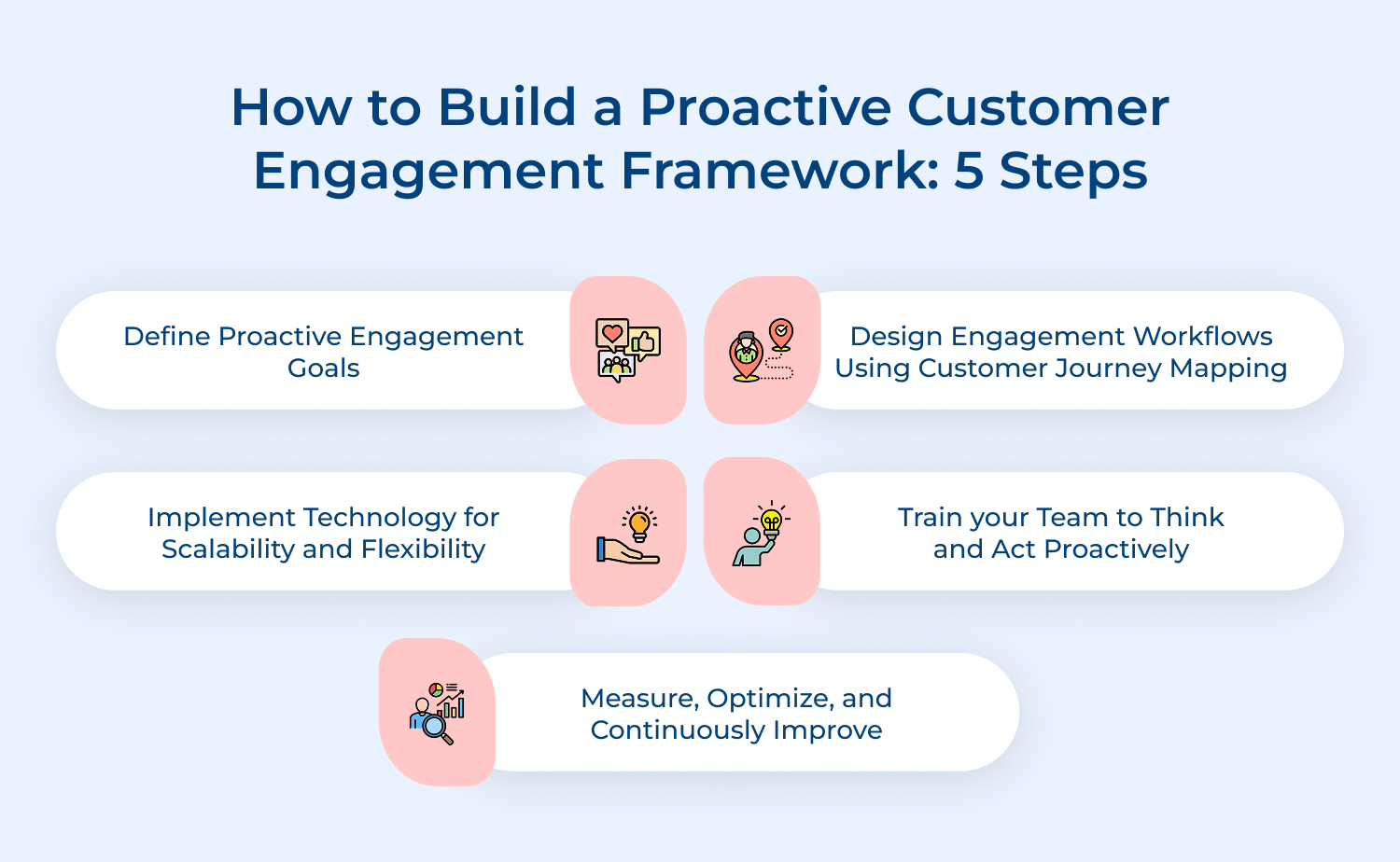
Without clear goals, proactive engagement becomes random outreach that consumes resources without delivering measurable impact. Every engagement initiative needs a defined outcome whether reducing churn or improving onboarding completion rates.
Align engagement goals directly with business objectives so every outreach effort has a measurable purpose behind it. Vague goals will never give your team the direction needed to build focused and effective engagement workflows.
Customer journey mapping reveals exactly where customers experience friction and disengagement; those are precisely the moments your proactive workflows need to target first. Without this map, businesses build engagement touchpoints based on assumptions rather than actual customer behavior.
Once friction points are identified, design automated workflows that trigger the right response at each moment without relying on manual intervention. The more precisely your workflows align to real journey behavior, the more effective your proactive engagement becomes.
Proactive engagement at scale is impossible without the right technology stack connecting your CRM, automation tools and customer data platforms into one unified system. The technology must be flexible enough to adapt as customer behavior evolves and your strategy grows more sophisticated.
Start with a platform that gives real-time customer data visibility and triggers personalized outreach across multiple channels from a single interface. Businesses built on rigid disconnected systems consistently hit a ceiling where manual effort replaces what automation should handle seamlessly.
Technology alone will never build a proactive engagement culture your team needs to understand the shift from responding to anticipating customer needs at every stage. Without deliberate training even the best engagement tools get used reactively because teams default to habits they already know.
Train customer success and support teams to read behavioral signals, act on early warning indicators before customers escalate or disengage. A team that understands why proactive engagement matters will always outperform one simply following a fixed outreach schedule.
A proactive engagement framework is never truly finished; it needs consistent measurement against defined KPIs to identify what is working and what needs refinement. Businesses that treat their framework as a living system consistently deliver better customer experiences over time.
Review engagement performance data regularly and use those insights to refine workflows, updating triggers based on how customer behavior actually evolves. The gap between a good framework and a great one is almost always closed through disciplined data-driven iteration.
Seeing proactive customer engagement in action makes the strategy far easier to understand and implement. These three brands have built their engagement around anticipation rather than reaction.
Netflix
Netflix continuously analyzes viewing behavior and proactively surfaces content matching each user’s taste before they even begin searching. This predictive engagement keeps customers inside the platform longer and reduces cancellation risk by making every session feel personally curated.
Puma
Puma engages customers after every purchase by delivering personalized product care tips and early access to relevant collections based on what the customer actually bought. This post-purchase strategy transforms a one-time transaction into an ongoing brand relationship without relying on generic promotional outreach.
Apple
Apple proactively reaches out when a device shows performance issues or when a critical update is needed before the customer notices a problem exists. This anticipatory support model positions Apple as a brand that takes genuine ownership of the customer experience long after the purchase.
Proactive engagement is not a tactic you run once — it is a fundamental shift in how your business relates to customers at every stage of their journey. The brands that win long-term are those that show up before they are asked to.
Start small by identifying your highest-impact friction points and build your engagement strategy outward from there. Every proactive touchpoint you add is a direct investment in customer trust and long-term business growth.

What channels support proactive customer engagement?
Email, live chat, SMS, in-app notifications and social messaging all support proactive engagement when used with unified customer data behind them. The channel matters less than the timing and relevance of the engagement you deliver through it.
How does proactive customer engagement reduce churn?
Churn rarely happens suddenly — it builds quietly through unresolved friction and feeling ignored by a brand over time. Proactive engagement catches those early warning signals and responds before a customer makes the decision to leave.
Can proactive customer engagement increase sales?
When engagement is timed around a customer’s natural buying behavior and feels genuinely helpful, it creates organic opportunities for upselling, cross-selling. Customers who feel understood are significantly more open to recommendations that align with their actual needs.
How do you automate proactive customer engagement?
Automation works by connecting your CRM and customer data platform to trigger personalized outreach based on specific behavioral signals. The key is building workflows around real customer actions rather than fixed time-based sequences that ignore actual behavior.
How do you measure proactive customer engagement success?
Track metrics like churn rate, customer lifetime value, onboarding completion rates and response rates on proactive outreach campaigns. These indicators tell you whether your engagement is landing at the right moment and driving the outcomes your business actually needs.
 https://omni24.io/wp-content/uploads/2026/08/AI-Customer-Service-Agents.png
1256
2400
Webvision Solution
https://omni24.io/wp-content/uploads/2023/04/Omni-Logo-1.svg
Webvision Solution2026-09-21 04:48:512026-09-21 04:48:51How to Build an AI Customer Service Agents: 8 Key Steps
https://omni24.io/wp-content/uploads/2026/08/AI-Customer-Service-Agents.png
1256
2400
Webvision Solution
https://omni24.io/wp-content/uploads/2023/04/Omni-Logo-1.svg
Webvision Solution2026-09-21 04:48:512026-09-21 04:48:51How to Build an AI Customer Service Agents: 8 Key Steps https://omni24.io/wp-content/uploads/2026/08/Omnichannel-Conversational-AI.png
1256
2400
Tushar Joshi
https://omni24.io/wp-content/uploads/2023/04/Omni-Logo-1.svg
Tushar Joshi2026-09-16 03:51:072026-09-16 03:51:07How to Build Omnichannel Conversational AI Strategy
https://omni24.io/wp-content/uploads/2026/08/Omnichannel-Conversational-AI.png
1256
2400
Tushar Joshi
https://omni24.io/wp-content/uploads/2023/04/Omni-Logo-1.svg
Tushar Joshi2026-09-16 03:51:072026-09-16 03:51:07How to Build Omnichannel Conversational AI Strategy https://omni24.io/wp-content/uploads/2026/08/Customer-Service-Teams.png
1256
2400
Tushar Joshi
https://omni24.io/wp-content/uploads/2023/04/Omni-Logo-1.svg
Tushar Joshi2026-09-15 04:01:522026-09-15 04:02:16How to Build Customer Service Teams: 6 Key Steps
https://omni24.io/wp-content/uploads/2026/08/Customer-Service-Teams.png
1256
2400
Tushar Joshi
https://omni24.io/wp-content/uploads/2023/04/Omni-Logo-1.svg
Tushar Joshi2026-09-15 04:01:522026-09-15 04:02:16How to Build Customer Service Teams: 6 Key Steps
Whether it’s about acquire, engage or support – Omni24 covers all your customer engagement needs in one complete platform.

Copyright ©2026 Veemo All rights reserved.
CA, Los Angeles, Hall Ave, 19011