Client vs Customer: What’s the Difference & Why Does it Matter?
Understanding client vs customer helps businesses tailor their approach to different relationship types. It enables better engagement strategies and improved customer experiences.

Understanding client vs customer helps businesses tailor their approach to different relationship types. It enables better engagement strategies and improved customer experiences.
Most businesses treat client vs customer as interchangeable terms, using them without a second thought. It’s a mistake that quietly damages service quality, weakens communication strategy and limits long-term revenue potential in ways most companies never even notice happening.
The real problem runs deeper than terminology: treating a long-term client like a one-time customer signals no special value beyond the transaction itself. Recognizing this difference lets businesses build the right service structures, communication and retention strategies for each one.
A client is someone who engages a business or professional for ongoing personalized services that require deep involvement and a long-term working relationship. The interaction goes far beyond a simple transaction and is built on trust.
Certain industries are structured entirely around managing client relationships rather than handling high-volume transactions with anonymous buyers. The work delivered in these industries is tailored specifically to each person’s needs and goals.
Law firm
Unlike transaction-based models, client-based services demand consistent communication and a thorough understanding of each individual’s situation. The service evolves over time as the professional learns more about what the client actually needs.
Key Characteristics of a Client:
A customer is someone who makes a one-time or repeated purchase of a product or service from a business. They do not necessarily share a long-term formal relationship with the business beyond that transaction.
Customer-based service models are found across almost every industry where a transaction takes place between a business and a buyer. These models are built around serving a large number of people efficiently rather than managing individual relationships.
Each of these businesses serves customers at different touchpoints but the core dynamic remains the same. A person exchanges money for a product or service and the business fulfills that need at that moment.
Key Characteristics of a Customer:
Understanding who is a client or who is a customer directly shapes how a business communicates, delivers and grows.
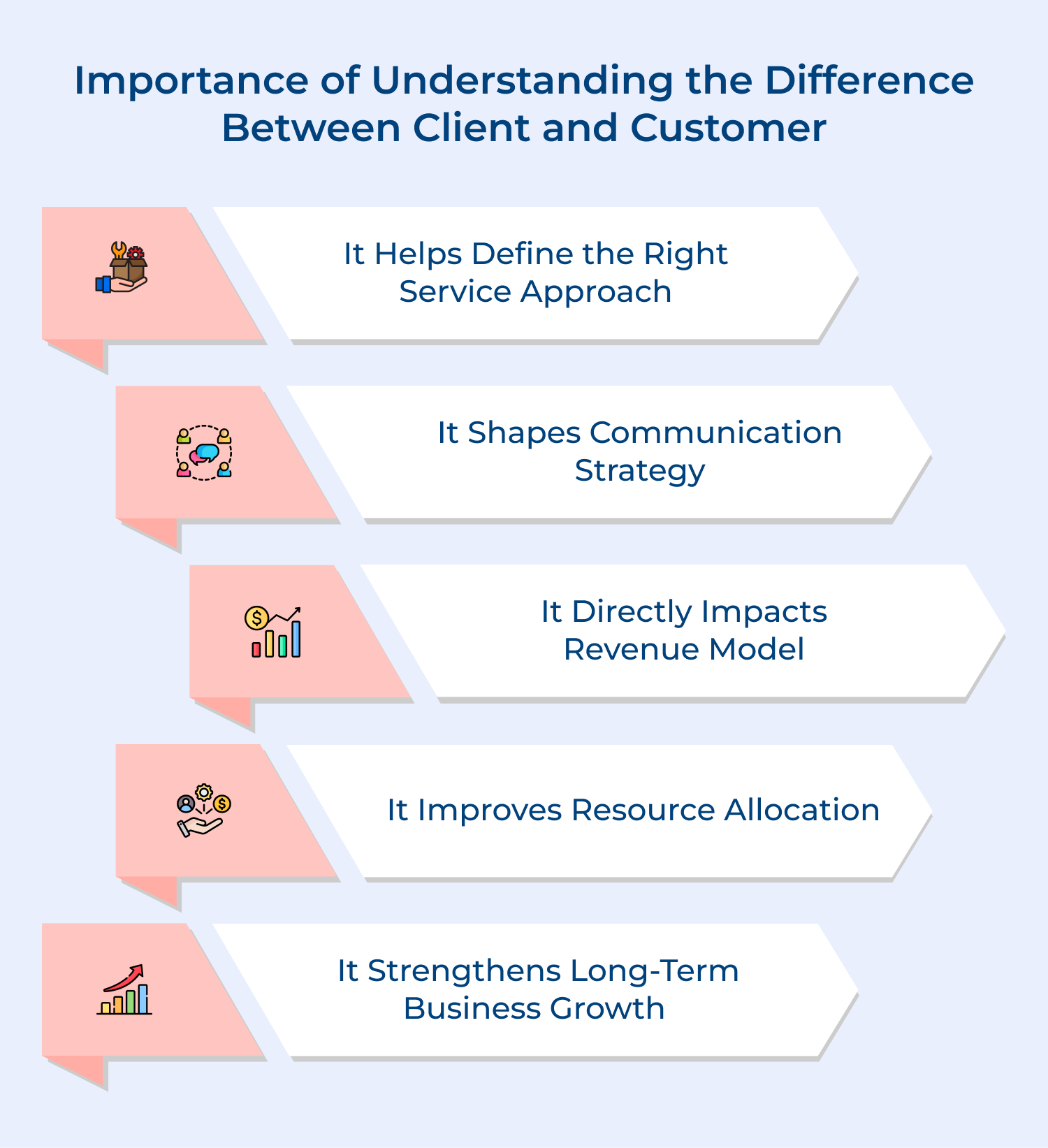
1. It Helps Define the Right Service Approach
A retail business serving thousands of customers daily cannot operate the same way a law firm handles its clients. The service structure, response time and level of personalization must match the nature of the relationship to actually deliver value.
2. It Shapes Communication Strategy
Sending a generic promotional email to a long-term client is a fast way to damage a professional relationship. Businesses that recognize this difference craft targeted and context-aware communication that reflects the depth of each relationship.
3. It Directly Impacts Revenue Model
Customer-based businesses focus on volume & repeat purchases while client-based businesses focus on retaining and growing individual accounts. Mixing up these models leads to misaligned pricing strategies and missed revenue opportunities.
4. It Improves Resource Allocation
A business that treats all interactions equally ends up over-serving low-value touchpoints and under-serving high-value relationships. Knowing the difference allows teams to distribute time, attention and budget where it actually drives results.
5. It Strengthens Long-Term Business Growth
Clients who feel understood and well-served become long-term partners who bring referrals or repeat business. Customers who receive frictionless service keep coming back and that consistency builds a loyal base over time.
Throughout this article, we will delve into the key distinctions between these two roles and explore how understanding them can enhance your overall strategy.
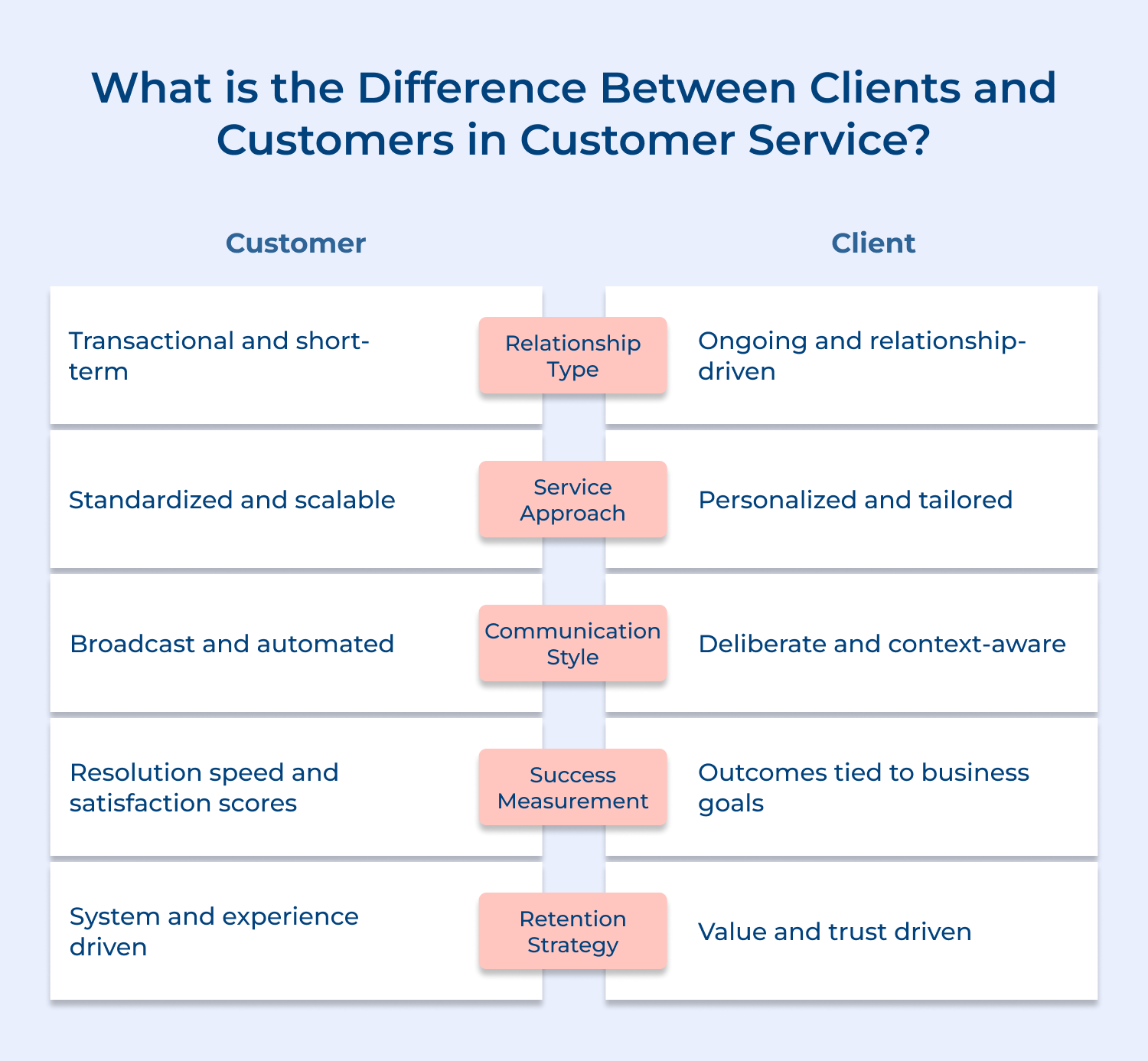
A customer shares a transactional relationship with a business where the interaction typically ends once the purchase is complete. The business rarely needs to know anything beyond what is required to fulfill that transaction.
Most businesses serving customers at scale are structured around speed and volume rather than individual understanding. The entire service model is optimized to fulfill needs quickly and reset for the next person in line.
A client shares a deeply involved relationship where the service provider must understand their goals, challenges and expectations over time. The relationship is the foundation on which the entire service is built.
So what does a strong client relationship actually look like in practice? It looks like a service provider who walks into every meeting already knowing what happened last time and what needs to happen next.
Key Takeaways:
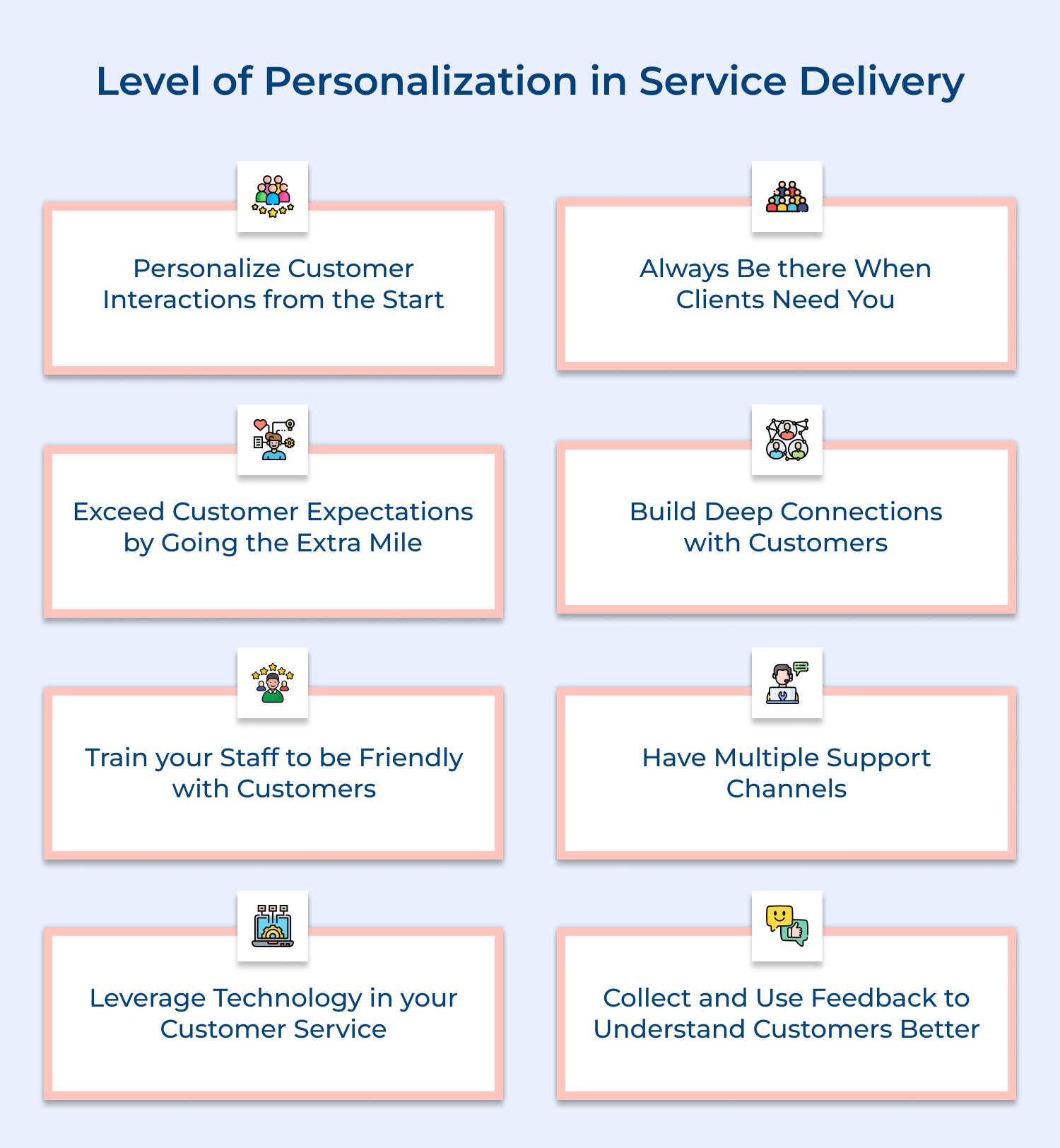
Customer service is designed to be consistent and scalable where the same quality of service is delivered to everyone regardless of who they are. Personalization exists but it is largely driven by data and automation.
Here is the real question — is your team personalizing based on actual human understanding or just behavior-triggered automation? Because those two things feel very different to the person on the receiving end.
Most customer-facing teams fall into these personalization gaps without realizing it:
A client receives service that is built entirely around their specific situation and no two clients receive the exact same approach. The service provider adjusts strategy, tone and delivery based on what they know about that particular client.
Client-level personalization is not about using someone’s first name in an email. It is about knowing their business well enough to flag a problem before they even realize it exists themselves.
Customers make independent decisions without much input or guidance from the business serving them. The business creates conditions for a good purchase experience but rarely steps into the decision process itself.
Think about how a well-designed self-checkout system works. It removes every possible friction point so the customer can complete their journey without needing a single human conversation. That is customer service working exactly as it should.
These are the core signs that customer decision-making support is working well:
Clients often make decisions collaboratively with the service provider since the outcome directly affects both parties. A wrong decision on either side can derail the entire engagement and damage the relationship.
Key Takeaways:
Customer interactions are often short and contained within a specific window of time around the purchase. Once the need is fulfilled the service cycle resets and begins fresh with the next interaction.
Most customer support teams are measured on resolution time and ticket closure rate. The entire performance framework is built around speed and completion rather than relationship depth or continuity.
A client relationship runs continuously over a defined or open-ended period where each interaction builds on the last. The service provider carries forward all previous context and uses it to deliver progressively better outcomes.
Why does continuity matter so much in client service? Because every conversation that starts from scratch wastes time and signals to the client that they are not truly known by the people serving them.
Key Takeaways:
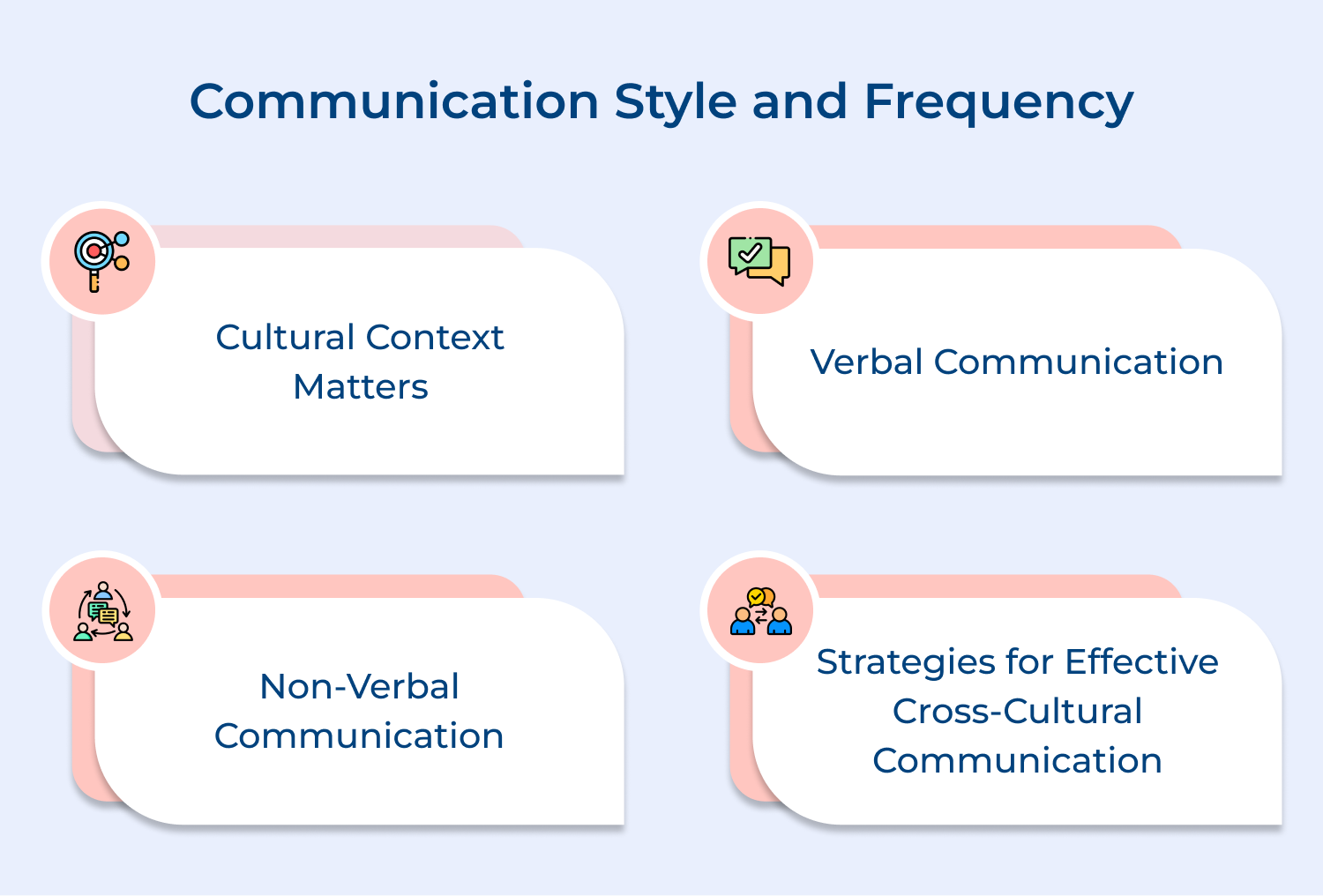
Customer communication is largely standardized where businesses use broadcast-style messaging to reach a large audience with the same information. The goal is to stay relevant without overwhelming the person on the other side.
Most businesses get this wrong by over-communicating through promotional messages and under-communicating when it actually matters. A customer who just had a bad experience needs a direct response and not a discount coupon.
Client communication is highly intentional where every touchpoint is planned around the client’s current situation and progress. Frequency is determined by the nature of the work and not by automated schedules.
The quality of client communication often reflects the quality of the entire service relationship. A service provider who communicates proactively before problems arise builds a level of trust that is very hard to replace.
Key Takeaways:
Customer service success is measured through volume-based metrics like resolution time, satisfaction scores and repeat purchase rates. These numbers give a broad picture of how well the service system is performing at scale.
Here is what most businesses miss though — a high satisfaction score does not always mean the customer actually got what they needed. It often just means the interaction was pleasant enough to not leave a bad impression.
Most customer service teams track these metrics to measure performance effectively:
Client service success is measured by outcomes that directly tie back to the client’s business goals and not just interaction quality. A client engagement is only truly successful when the delivered work moves the needle on what the client was actually trying to achieve.
A satisfied client is not one who enjoyed the meetings. A satisfied client is one whose business is in a better position because of the work done on their behalf.
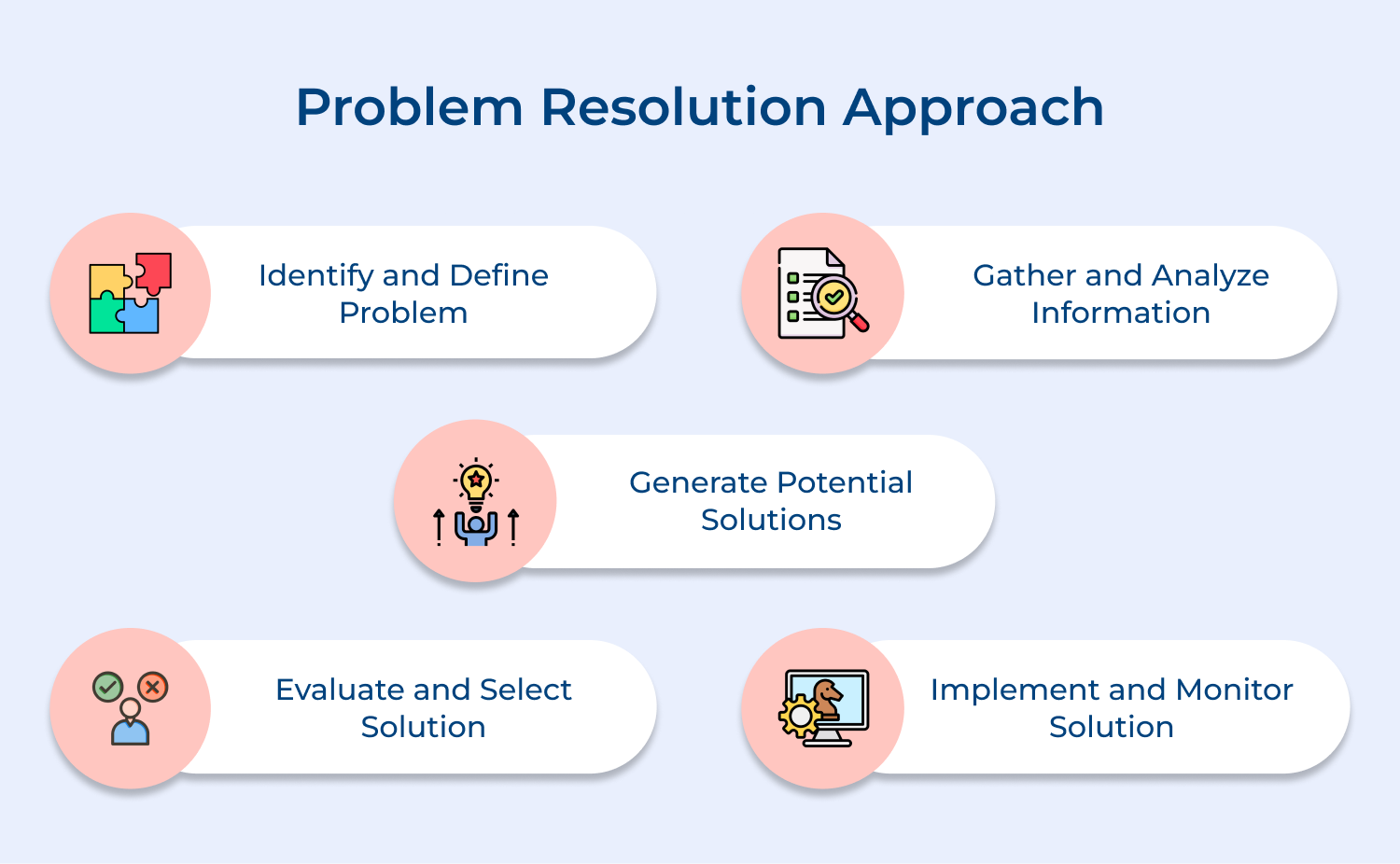
When a customer faces a problem the business responds by following a defined resolution process that is consistent across all similar cases. The focus is on solving the issue quickly and restoring the experience to its expected standard.
Speed is the currency of customer problem resolution. A customer who waited 48 hours for a response has already formed a negative opinion regardless of how good the final answer turns out to be.
These are the non-negotiables for effective customer problem resolution:
When a client faces a problem it triggers a deeper collaborative process where both sides work together to understand the root cause. The resolution is not just about fixing what broke but about making sure it does not affect the broader engagement.
So what separates average client problem resolution from genuinely great ones? It is the service provider’s ability to take ownership of the problem before the client has to escalate it themselves.
Customer loyalty is built through consistent positive experiences, well-timed incentives and a service quality that makes returning feel easier than switching. Retention at this level is largely a systems problem and the better the system the higher the retention.
Most businesses invest heavily in acquiring new customers but significantly underinvest in the experience that actually makes existing ones stay. Retention is not a loyalty program — it is the sum of every interaction a customer has had with the business.
Client retention is built on demonstrated value over time where the client stays because the outcomes justify the relationship. No retainer, contract or pricing incentive can replace the retention power of a service provider who consistently delivers results.
The moment a client starts questioning whether the relationship is worth continuing it means the value has not been communicated or delivered clearly enough. Strong client retention is about making that question never arise in the first place.
Key Takeaways:
These examples break down exactly how the same business function operates differently depending on who is being served.
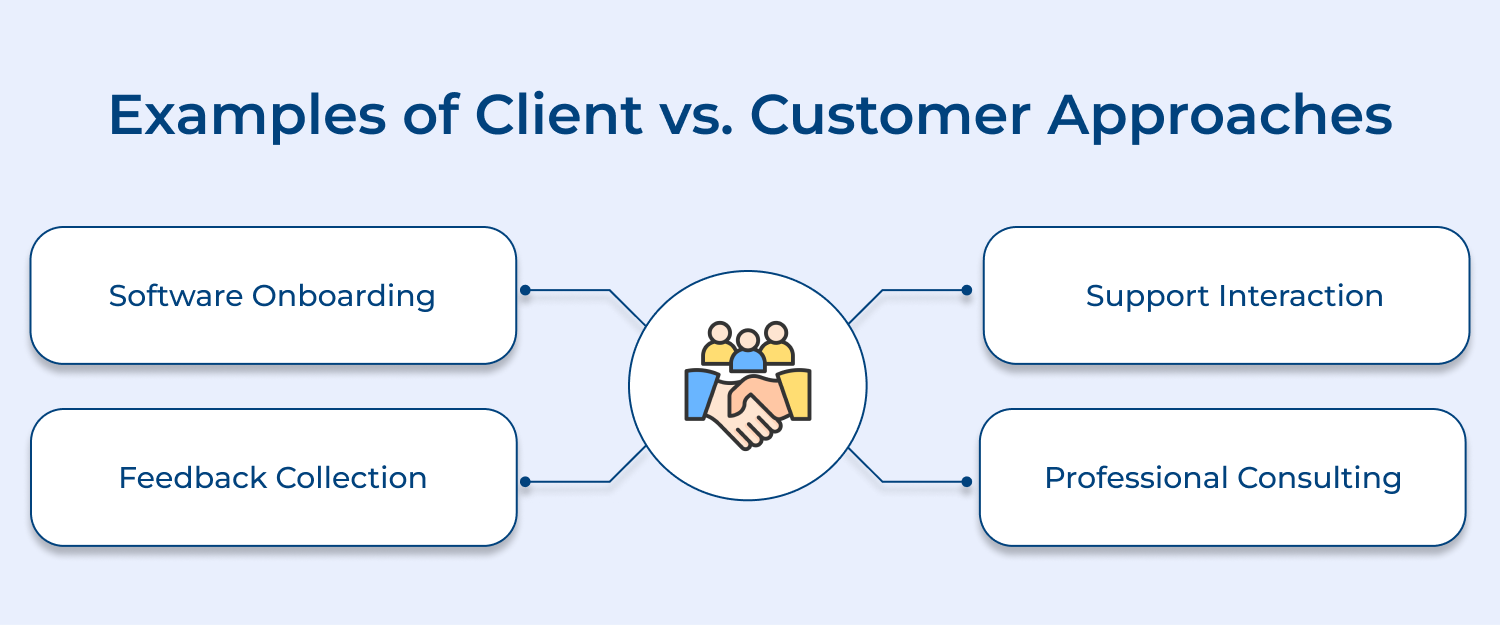
1. Software Onboarding
When a customer signs up for a software product the onboarding is self-guided where automated sequences and walkthrough videos handle the entire process. The system itself does the onboarding and no dedicated person is assigned.
When a client signs up for an enterprise software solution a dedicated implementation specialist maps the entire setup around the client’s existing workflows. Every configuration decision is made in direct conversation with the client’s team.
2. Support Interaction
Customer support runs on ticket-based systems where issues are categorized and resolved through a structured process by agents who may have no prior context. The measure of success is speed and resolution quality.
Client support starts from a place of existing knowledge where the handler already understands the client’s history and business environment. The response goes beyond fixing the issue and actively reinforces the trust built over the relationship.
3. Feedback Collection
Customer feedback is gathered through standardized surveys and NPS scores designed to capture sentiment patterns across a large audience. The goal is identifying trends and not deeply understanding any single person’s experience.
Client feedback is collected through direct structured conversations where the service provider asks specific questions tied to project outcomes. Every response is treated as critical input that directly shapes how the engagement moves forward.
4. Professional Consulting
A customer engaging a consulting firm for a one-time workshop receives a standardized curriculum that has been delivered to many businesses before them. The content is relevant but not rebuilt from scratch for their specific situation.
A client engaging the same firm for an ongoing strategy engagement receives a completely tailored approach built around their business challenges and internal dynamics. The consultant’s value grows with every session as deeper context is gained.
Serving clients and customers well requires a fundamentally different mindset for each. Businesses that understand this distinction consistently outperform those that treat everyone the same way.
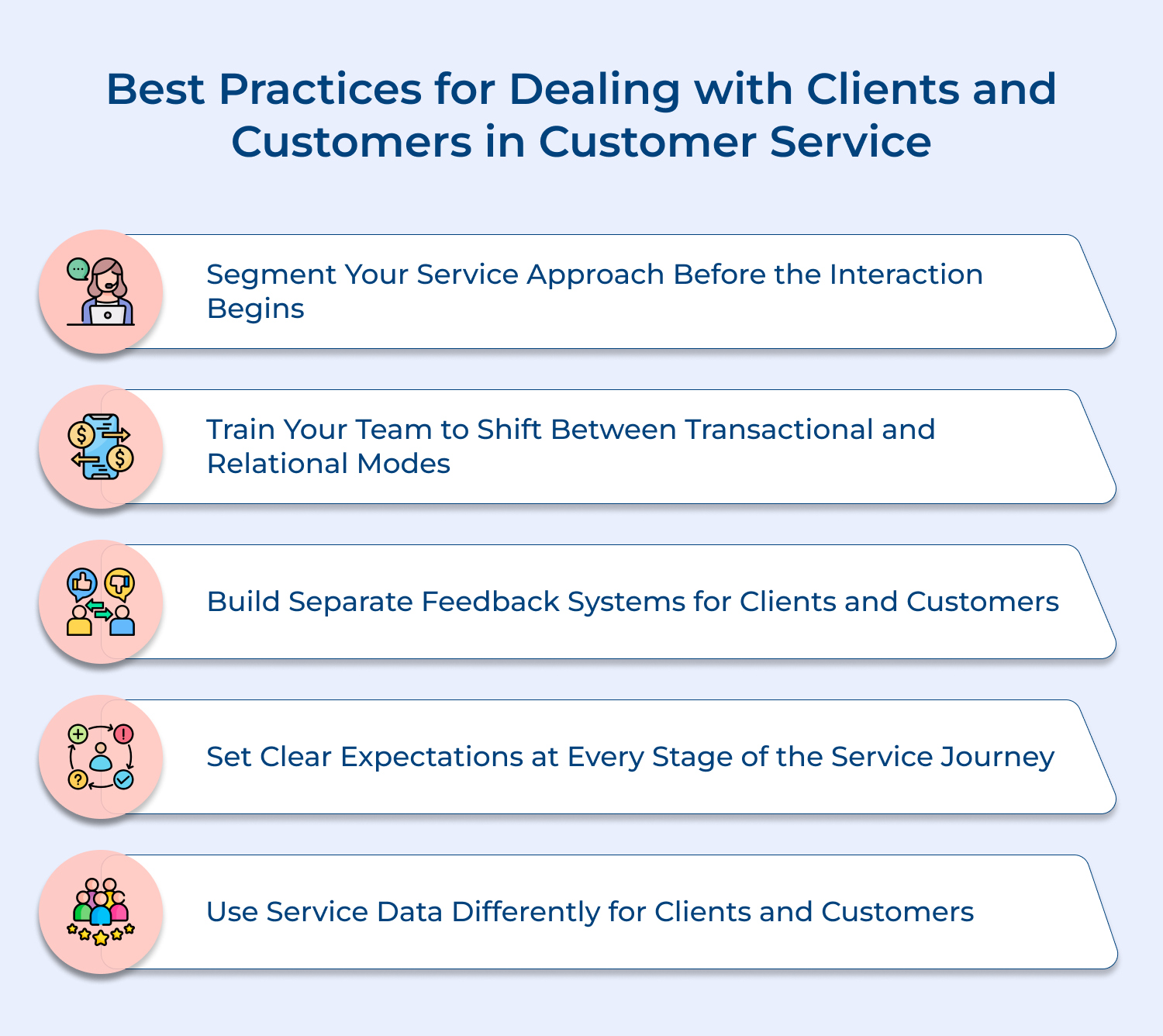
Walking into a service interaction without context is how mismatched experiences are created. Knowing who you are serving before the conversation starts changes everything about how you show up.
Before any interaction your team should be clear on these fundamentals:
Customers need a frictionless path to resolution while clients need a context-aware conversation. This segmentation must be built into the workflow before a single word is exchanged.
A rep excellent at closing tickets quickly will completely miss the mark with a long-term client needing strategic conversation. These are two different skills and both need deliberate training.
The ability to read the room and adjust communication style is not a personality trait. It is a trainable skill that improves significantly with the right coaching and real scenario practice.
Sending a five-star rating request to a long-term client after a strategy session is a missed opportunity. Generic feedback tools are built for volume and not for relationship depth.
Here is what strong client feedback actually uncovers in practice:
Customer feedback should focus on resolution quality across high-volume touchpoints. Client feedback must go deeper into outcomes and relationship health to be truly useful.
Customers who do not know what to expect after a purchase become anxious and that anxiety turns into avoidable support tickets. A well-designed post-purchase flow eliminates most questions before they are asked.
For clients the cost of misaligned expectations is far greater than a missed deadline. A client who feels uninformed starts questioning the reliability of the entire relationship, not just a single deliverable.
Customer service data is most valuable when analyzed at scale to identify friction points and recurring issues. That data tells you exactly where the system is breaking down across the entire user base.
Here is how strong teams use client data to stay ahead:
Client data is not about spotting trends, it is about understanding one relationship deeply enough. The businesses that use data this way build client relationships that are genuinely hard to walk away from.
Knowing the difference between a client and customer is not just terminology — it is the foundation of how great service is actually built. Businesses that apply this distinction make smarter decisions at every service touchpoint.
The way you serve people determines whether they return or leave for good. Treating every person through the right lens is what separates businesses that grow relationships from those that just process transactions.

How does Client vs Customer affect business relationships?
The distinction directly shapes how much time, attention and resources a business invests in each relationship. A customer relationship is optimized for efficiency while a client relationship is built around sustained trust and delivered outcomes.
Can a Client also be a Customer?
Yes and this happens more often than most businesses realize. A person can start as a customer through a one-time purchase and evolve into a client when the engagement deepens into an ongoing personalized service relationship.
How does communication differ in Client vs Customer interactions?
Customer communication is standardized and designed to reach many people with consistent messaging at the right moment. Client communication is deliberate and personalized where every touchpoint is tied to the specific context of that ongoing relationship.
Does revenue model impact Client vs Customer classification?
Absolutely — a transaction-based revenue model naturally produces customers while a retainer or project-based model produces clients. The way a business charges for its service directly reflects the depth of relationship it is built to maintain.
Are Client vs Customer used differently in B2B and B2C?
In B2C the term customer dominates because most interactions are transactional and volume-driven by nature. In B2B the term client is far more common because the engagements involve higher stakes, longer timelines and deeper professional accountability on both sides.
https://omni24.io/wp-content/uploads/2026/08/Client-vs-Customer.png
1256
2400
Tushar Joshi
https://omni24.io/wp-content/uploads/2023/04/Omni-Logo-1.svg
Tushar Joshi2026-09-01 03:57:222026-09-01 03:59:31Client vs Customer: What’s the Difference & Why Does it Matter? https://omni24.io/wp-content/uploads/2026/08/Benefits-of-Conversational-AI.png
1256
2400
Webvision Solution
https://omni24.io/wp-content/uploads/2023/04/Omni-Logo-1.svg
Webvision Solution2026-08-31 04:29:522026-08-31 04:29:52Benefits of Conversational AI: What You Should Know
https://omni24.io/wp-content/uploads/2026/08/Benefits-of-Conversational-AI.png
1256
2400
Webvision Solution
https://omni24.io/wp-content/uploads/2023/04/Omni-Logo-1.svg
Webvision Solution2026-08-31 04:29:522026-08-31 04:29:52Benefits of Conversational AI: What You Should Know https://omni24.io/wp-content/uploads/2026/08/Omnichannel-Chatbots.png
1256
2400
Tushar Joshi
https://omni24.io/wp-content/uploads/2023/04/Omni-Logo-1.svg
Tushar Joshi2026-08-13 04:43:302026-08-24 09:02:01How Omnichannel Chatbots Improve Your Customer Experience
https://omni24.io/wp-content/uploads/2026/08/Omnichannel-Chatbots.png
1256
2400
Tushar Joshi
https://omni24.io/wp-content/uploads/2023/04/Omni-Logo-1.svg
Tushar Joshi2026-08-13 04:43:302026-08-24 09:02:01How Omnichannel Chatbots Improve Your Customer Experience
Whether it’s about acquire, engage or support – Omni24 covers all your customer engagement needs in one complete platform.

Copyright ©2026 Veemo All rights reserved.
CA, Los Angeles, Hall Ave, 19011