How to Build a Powerful Customer Centric Strategy: Steps & Benefits
A customer-centric strategy is essential for engaging customers, generating value, improving operations and driving revenue.

A customer-centric strategy is essential for engaging customers, generating value, improving operations and driving revenue.
The success of any business ultimately relies on its ability to satisfy and retain customers. However, many struggle to implement effective strategies that truly put their customers at the heart of their operations.
A well-defined customer-centric strategy, it can be challenging to truly understand and connect with your target audience. Building a customer-centric strategy is a complex process that requires careful planning.
A McKinsey study found that 71% of consumers expect personalized services and 76% get frustrated when they don’t receive it.
However, by following a set of actionable steps, businesses can significantly improve customer satisfaction and loyalty. Let us discuss the steps that will help you to build a customer-centric strategy as well as drive success in today’s competitive market.
A customer centric strategy places customers at the core of all business decisions and operational processes. Such an approach goes beyond traditional customer service to create an organization-wide mindset that evaluates every action through the lens of customer impact.
Companies with this strategy deliberately design their products and experiences around solving real customer problems rather than focusing on internal goals. Customer centricity works by gathering deep insights about client needs and using them to inform everything from product development.
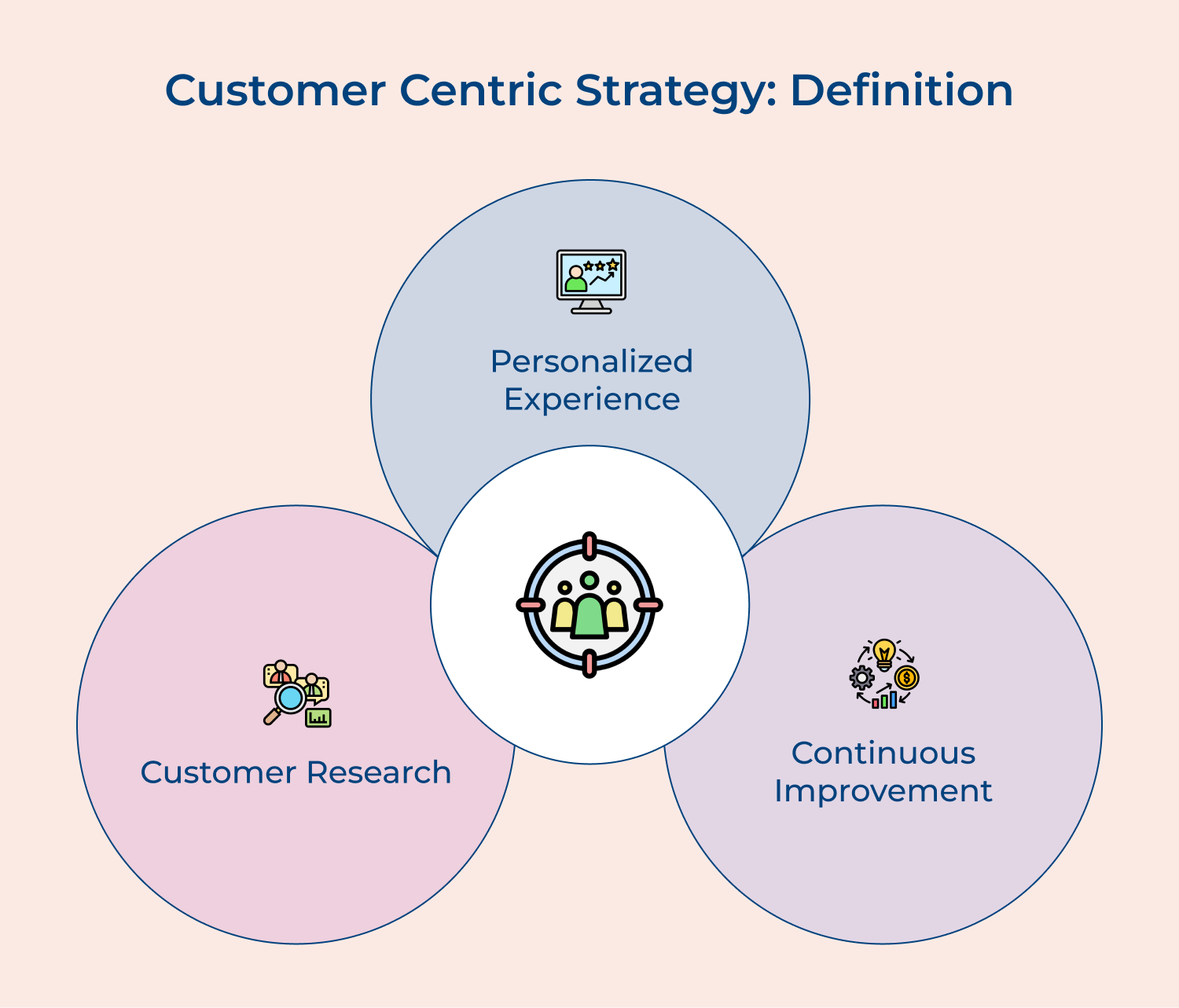
Companies build feedback loops that continuously capture customer data and experiences. Teams then use these insights to make improvements that address actual pain points and create meaningful value for customers.
Key Objectives:
Prioritizing CX is central to a customer-centric business model, driving satisfaction and loyalty. This strategy delivers significant benefits that directly contribute to long-term business success.
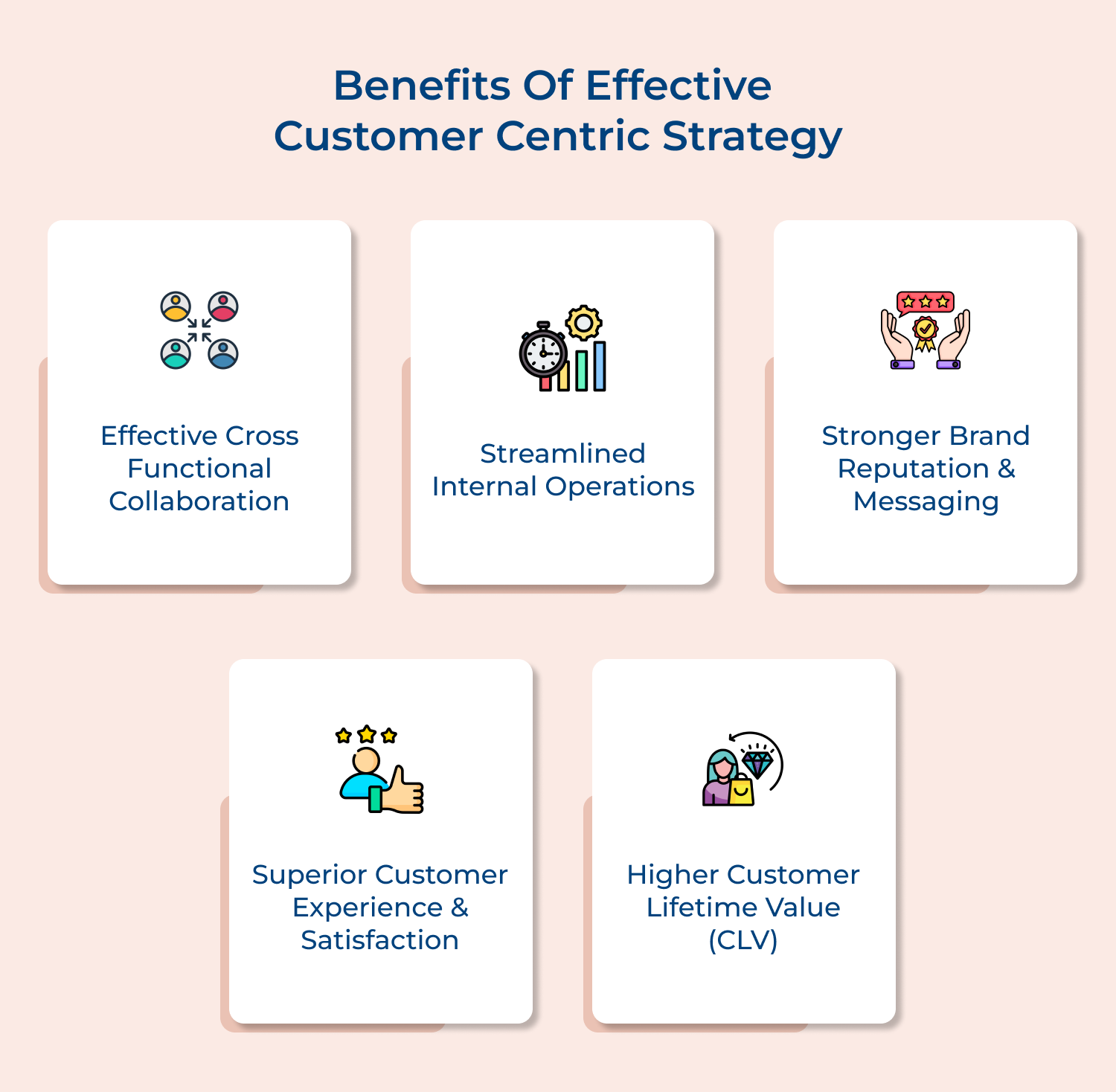
A customer-centric strategy emphasizes understanding customer needs to build lasting relationships. Here are seven key steps to help you design a strategy that sets your business apart.
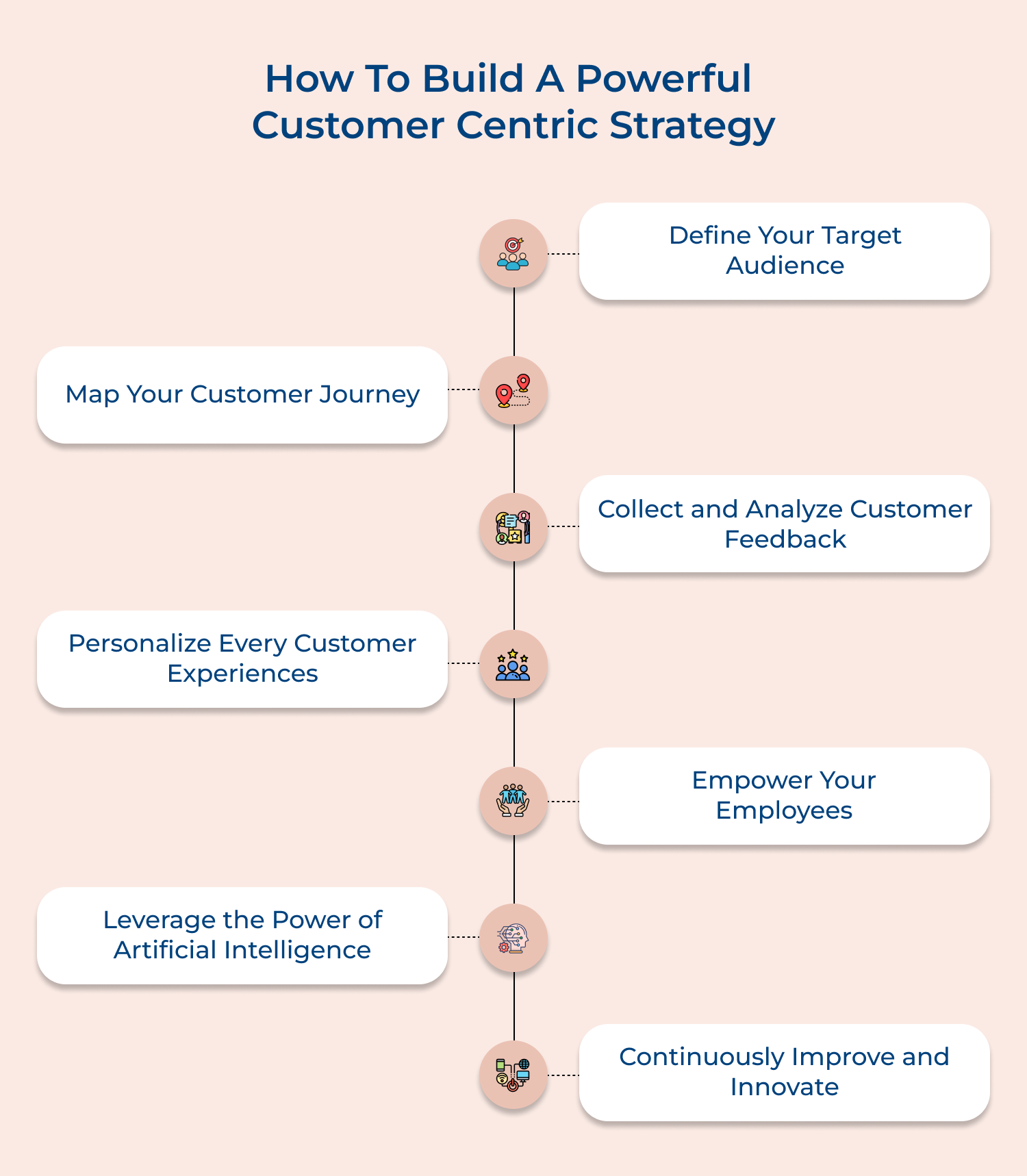
The first step in building a customer-centric strategy is to clearly define your Ideal Customer Profile (ICP). Identifying your target audience allows you to tailor your products, services, and marketing efforts to meet their specific needs and preferences.
Conduct market research, analyze data and create customer personas to gain a deep understanding of your ideal customers.
Best practices:
Understanding the customer journey is crucial for delivering a seamless and personalized experience.
Map out the different touchpoints and interactions customers have with your business throughout their journey, from initial awareness to post-purchase support. It will help you identify pain points and areas for improvement, allowing you to better meet customer expectations at every stage.
Best practices:
To truly become customer-centric, you need to actively seek feedback from your customers. Implement feedback mechanisms such as:
Analyze this data to identify trends and patterns as well as use it to inform decision-making to improve your products/services.
Best practices:
Customers today expect personalized experiences. Use the data collected from customer feedback and interactions to personalize your offerings.
Tailor your marketing messages, recommend products based on customer preferences, and customize the user experience on your website or app.
When customers feel like their needs are understood and catered to, they are more likely to become loyal advocates for your brand.
Best practices:
Building a customer-centric culture starts from within. Empower your employees to prioritize customer satisfaction and instill a customer-first mindset in your organization.
Provide training and support to help employees understand the importance of customer-centricity and equip them with the skills to deliver exceptional customer experiences.
Best Practices:
Technology plays a key role in delivering a customer-centric strategy. Businesses should invest in
The tools and technology will help to streamline processes, track customer interactions and gain insights into customer behavior. Utilize these technologies to personalize communications, automate repetitive tasks, and improve efficiency in serving your customers.
Best practices:
A customer-centric strategy is not a one-time effort, but an ongoing commitment. Continuously monitor customer satisfaction, gather feedback and measure the success of your customer-centric initiatives.
Use the information to make data-driven improvements that align with changing customer expectations. Stay up-to-date with industry trends and emerging technologies to proactively adapt your strategy as well as stay ahead of the competition.
Best practices:
With advancements in the field of artificial intelligence (AI) and automation, businesses now have powerful tools at their disposal to enhance their customer centric strategies.
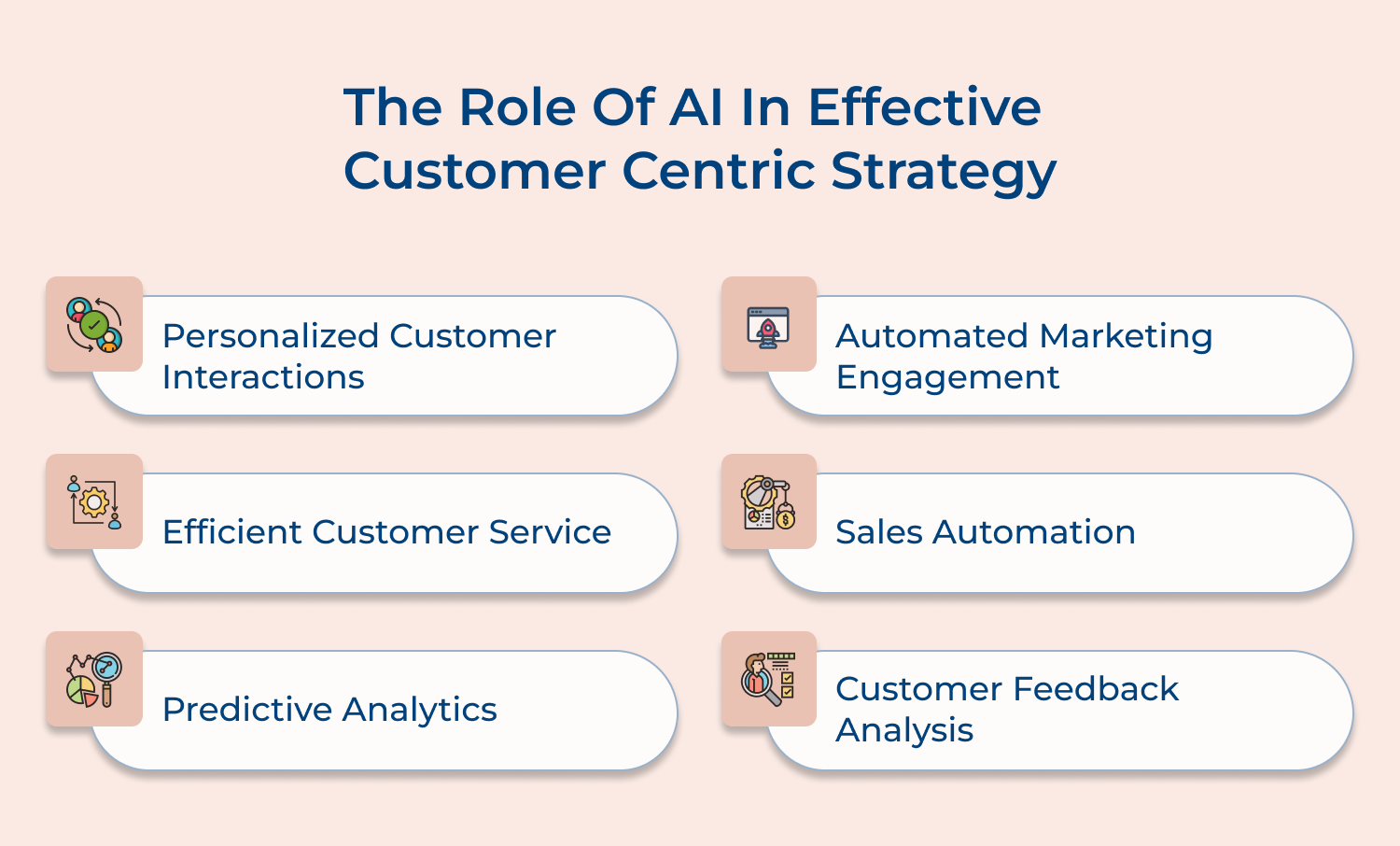
AI enables businesses to analyze vast amounts of customer insights into individual preferences and behaviors. It allows for the creation of personalized customer interactions through AI chatbots and virtual assistants as well as enhancing overall experience.
AI-powered automation can streamline customer service processes by handling routine inquiries and providing instant responses. Chatbots equipped with natural language processing can understand customer queries and provide accurate solutions.
Analyzing customer data using AI algorithms, businesses can gain valuable insights into customer preferences. Predictive analytics can anticipate customer needs, enabling businesses to proactively offer personalized recommendations, promotions, and offers.
Automation can revolutionize marketing strategies by automating various tasks such as email marketing, social media advertising, and content personalization. AI algorithms can analyze customer data to identify target demographics and deliver personalized content at the right time.
AI can streamline the sales process, from lead generation to conversion. Automation tools can qualify leads, optimize sales funnels. AI algorithms can assess customers’ buying behaviors to determine the best products to promote and the optimal timing for sales efforts.
Sentiment analysis tools can analyze customer feedback from various sources, such as social media platforms and online reviews, to understand customer sentiment accurately. The valuable data allows businesses to gauge customer satisfaction, identify areas for improvement.
Implementing a customer-centric strategy can bring great benefits to a business, but it also comes with its fair share of challenges.
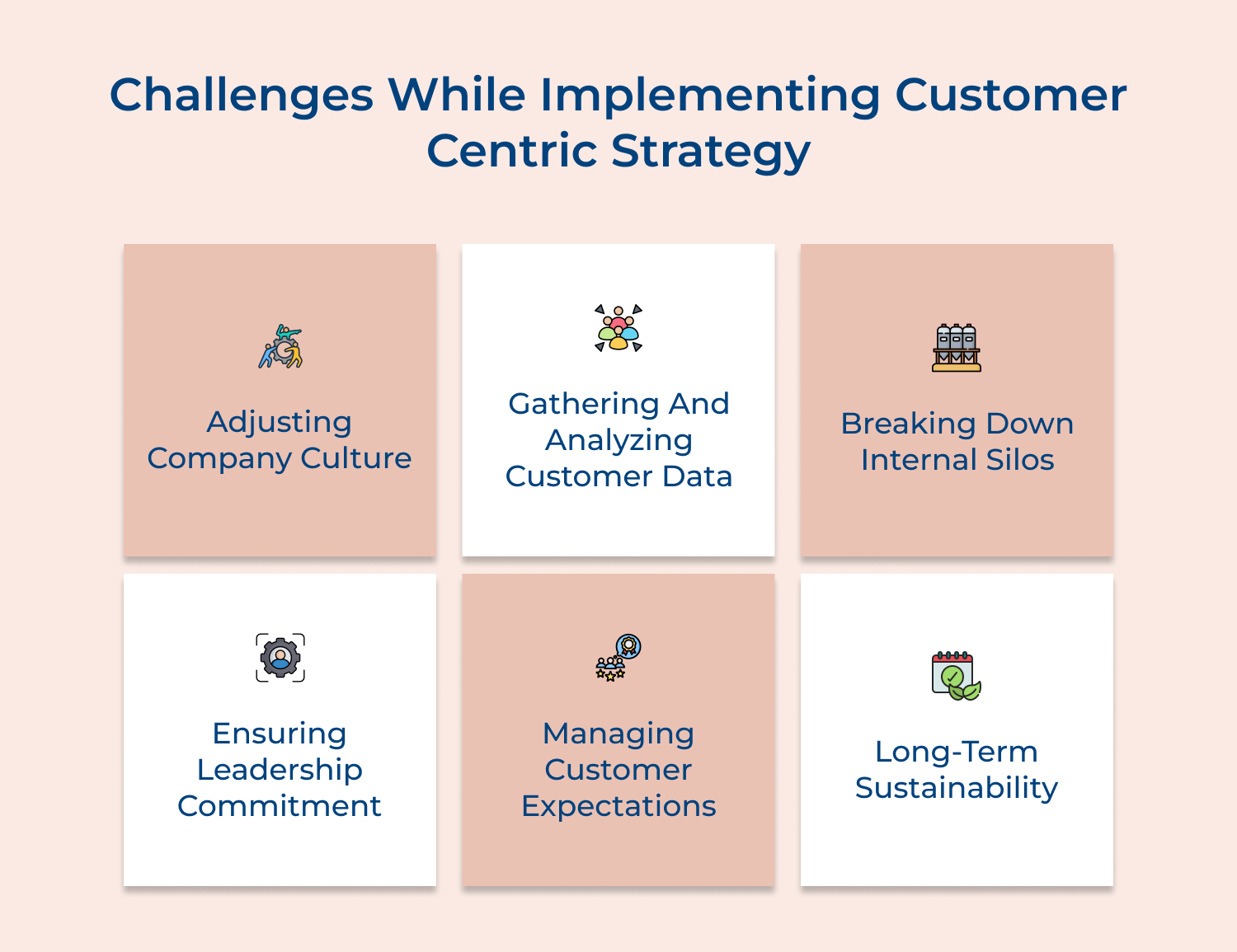
1. Adjusting company culture: Shifting towards a customer-centric strategy requires a cultural change within the organization. Employees may resist the changes or struggle to align their mindset and behaviors with the customer’s needs.
2. Gathering and analyzing customer data: To truly understand customers, businesses need to collect vast amounts of data. However, ensuring data accuracy, privacy, and finding the right tools as well as methodologies to analyze the data can be challenging.
3. Breaking down internal silos: Customer-centricity requires departments to work together seamlessly. Overcoming silos and fostering collaboration can be difficult, especially in larger organizations with well-established hierarchies.
4. Ensuring leadership commitment: Implementing a customer-centric strategy requires strong leadership commitment. Leaders need to consistently communicate the vision, provide resources and drive cultural change throughout the organization.
5. Managing customer expectations: When a company decides to prioritize customers’ needs, it can create a higher level of expectation among customers themselves. Meeting these expectations consistently can be a challenge which requires resources and operational changes.
6. Long-term sustainability: Maintaining a customer-centric approach is not a one-time effort. It requires ongoing dedication, as customer preferences and market dynamics evolve over time.
Many businesses have leveraged a powerful customer-centric strategy. They are able to deliver an excellent CX. Let us take a look at a few examples of businesses and their strategies.
Starbucks has built its brand around creating a personalized and welcoming experience for its customers. They focus on creating a cozy atmosphere, offering a wide range of customized beverages, and listening to customer feedback. Moreover, their loyalty program rewards customers, offering incentives as well as exclusive perks, ensuring a strong connection between the brand.
HDB, Singapore’s public housing authority, has successfully implemented customer-centric strategies to meet the diverse needs of its residents. The board actively seeks feedback and incorporates it into its policies as well as planning processes. Through initiatives like the “Remaking Our Heartland” program, which revitalizes older housing estates based on residents’ aspirations, HDB ensures that its developments align with the changing needs and preferences of its customers.
Ogilvy, a leading advertising and marketing agency, is dedicated to understanding their clients’ customers at a deep level. By conducting market research, trend analysis, as well as customer surveys, Ogilvy creates effective marketing campaigns that resonate with their target audience. They also provide personalized solutions and recommendations to help their clients address customer needs effectively.
Coca-Cola is a prime example of a brand that engages and connects with its customers through creative storytelling. They create emotionally-driven marketing campaigns that evoke feelings of happiness, togetherness, and celebration. Coca-Cola’s focus on building an emotional connection with its customers has been a key driver of their success.
Marriott International’s customer-centric approach focuses on anticipating guests’ needs and delivering personalized experiences. With their loyalty program, Marriott Bonvoy, guests receive tailored offers, exclusive benefits, and a seamless booking as well as check-in process. In addition, Marriott actively listens to customer feedback and uses it to continuously improve its services.
A customer-centric strategy places clients at the core of all business decisions, transforming how organizations create value and build lasting relationships. By deeply understanding customer needs, companies can drive sustainable growth through increased loyalty, higher retention rates, and valuable word-of-mouth recommendations.
This approach requires genuine organizational commitment, from leadership vision to frontline implementation. When executed effectively, customer centricity becomes a powerful competitive advantage, allowing businesses to adapt quickly to market changes while maintaining relevance in an increasingly crowded marketplace, driving both revenue growth and long-term profitability.

Why is a customer-centric strategy important?
A customer-centric strategy is important because it helps businesses build strong relationships with their customers, boost customer loyalty, and drive long-term success. By prioritizing the needs of customers, businesses can improve customer satisfaction, increase customer retention, and gain a competitive edge in the market.
How can a business transition to a customer-centric strategy?
Transitioning to a customer-centric strategy involves a shift in mindset and organizational culture. It requires businesses to invest in understanding their customers, collecting data and feedback, as well as aligning their products, services, and processes to meet customer needs. Training employees on customer-centric practices and incorporating customer feedback into decision-making is also crucial.
What are the benefits of implementing a customer-centric strategy?
Implementing a customer-centric strategy can lead to various benefits for businesses. These include increased customer loyalty, improved customer satisfaction, higher profitability, enhanced brand reputation, and a better understanding of customer needs. It also helps businesses stay relevant and adaptable in an ever-changing market.
How can data be used to support a customer-centric strategy?
Brands can gain valuable insights into customer behavior, purchasing patterns, and pain points by analyzing customer data , which can be used to personalize offerings, optimize marketing campaigns, improve customer service, and make data-driven decisions that align with customer needs.
How can a company measure the success of its customer-centric strategy?
Measuring the success of a customer-centric strategy can be done through various key performance indicators (KPIs), such as customer satisfaction scores, customer retention rates, repeat purchase rates, net promoter score (NPS), and customer lifetime value. Additionally, feedback through surveys, reviews, and social media interactions can provide valuable insights.
 https://omni24.io/wp-content/uploads/2026/09/Social-commerce-scaled.png
1340
2560
Webvision Solution
https://omni24.io/wp-content/uploads/2023/04/Omni-Logo-1.svg
Webvision Solution2026-10-23 12:18:272026-10-23 12:18:27What is Social Commerce and Why Does It Matter?
 https://omni24.io/wp-content/uploads/2026/08/AI-Customer-Service-Agents.png
1256
2400
Webvision Solution
https://omni24.io/wp-content/uploads/2023/04/Omni-Logo-1.svg
Webvision Solution2026-09-21 04:48:512026-09-21 04:48:51How to Build an AI Customer Service Agents: 8 Key Steps
 https://omni24.io/wp-content/uploads/2026/08/Omnichannel-Conversational-AI.png
1256
2400
Tushar Joshi
https://omni24.io/wp-content/uploads/2023/04/Omni-Logo-1.svg
Tushar Joshi2026-09-16 03:51:072026-09-16 03:51:07How to Build Omnichannel Conversational AI Strategy
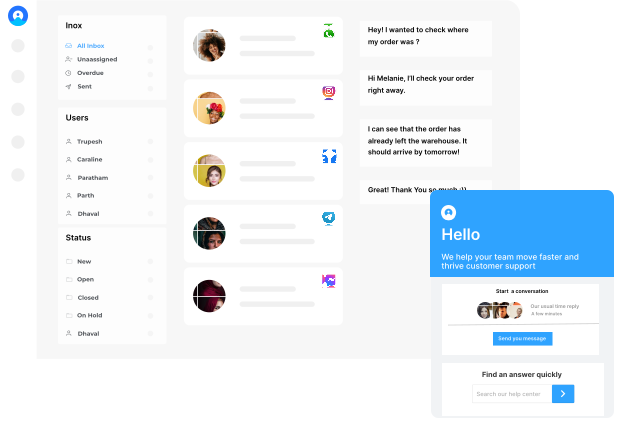
Whether it’s about acquire, engage or support – Omni24 covers all your customer engagement needs in one complete platform.

Copyright ©2026 Veemo All rights reserved.
CA, Los Angeles, Hall Ave, 19011