Customer Service Standards to Implement: Checklist & Templates
Setting up high customer service standards along with having the right technology in place can empower your team to deliver an excellent experience.

Setting up high customer service standards along with having the right technology in place can empower your team to deliver an excellent experience.
Customer service plays a crucial role in ensuring the success of any company.
But how do you know if your customer service is up to the mark? Are you meeting the expectations of your customers and providing them with an exceptional experience?
Forbes’s study states that 62% of customers said they would spend more money on a company that provides excellent customer service. To excel in customer service, businesses need to establish and follow a set of customer service standards.
The support standards act as a guide to ensure that every interaction with customers is efficient, effective, and exceeds their expectations. We will discuss the importance of having customer service standards and provide tips on how to implement them successfully.
A customer service standard is a formal set of guidelines and benchmarks that define the specific level of service customers should expect to receive from a business. It establishes clear, measurable targets for response times, interaction quality, and problem resolution procedures, creating consistency across all customer touchpoints.
When companies implement clear service standards, it transforms unpredictable customer experiences into reliable ones. Organizations see reduced complaints, higher customer retention rates, and improved staff performance because everyone knows exactly what’s expected. Teams work more efficiently when they have specific goals to meet, leading to happier customers and increased revenue.
key objectives:
The way you interact with your customers can greatly impact their satisfaction and loyalty. It is important to follow a set of principles that guide your interactions.
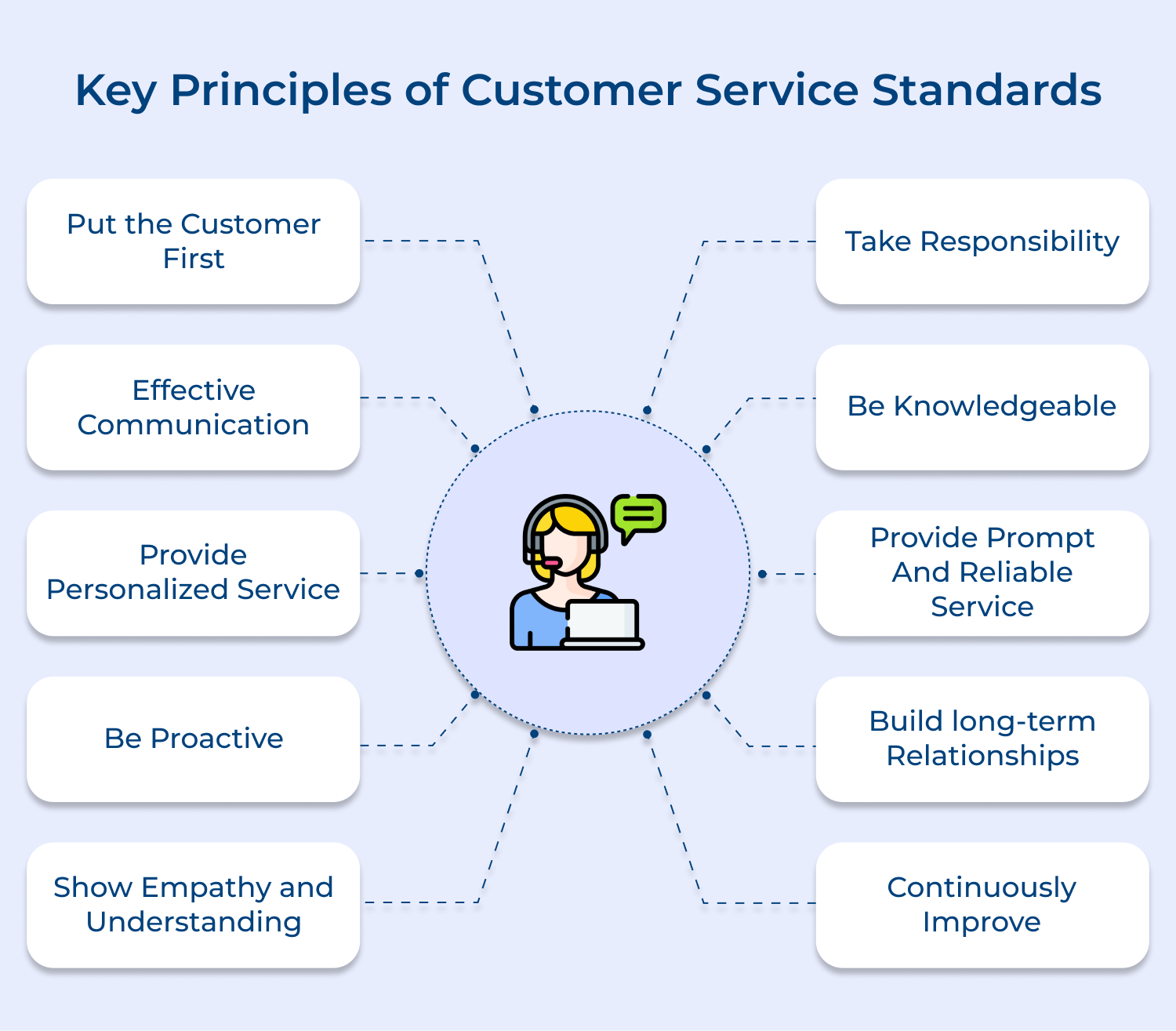
Customer service that is consistent, reliable, and professional, enhances customer retention and satisfaction with your products or services.
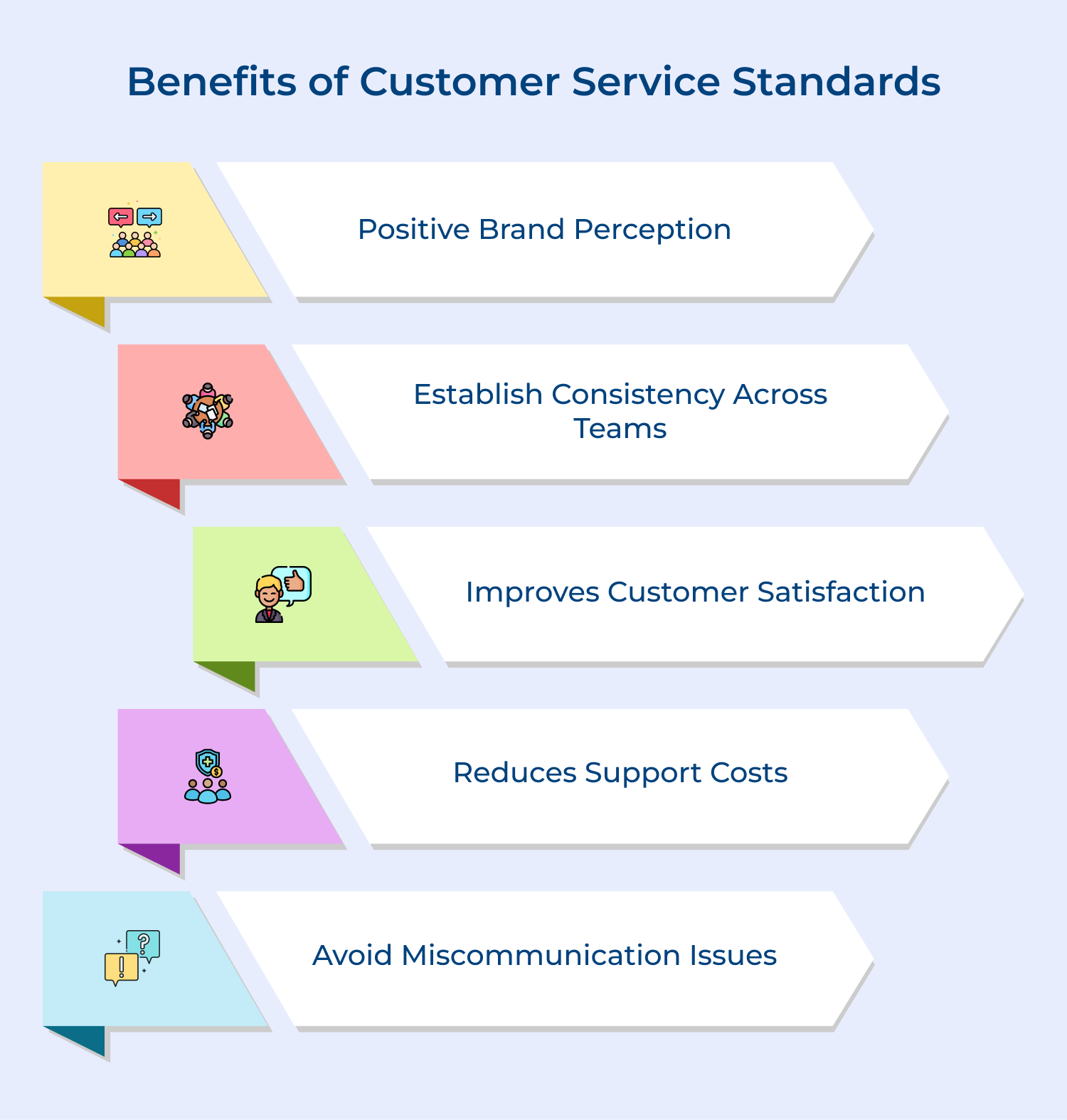
Having clear customer service standards can influence consumer perceptions more than you think. Having an excellent level of customer service shows potential customers that you prioritize them above all else which will potentially result in increased sales over time.
Example: Imagine a customer who receives prompt and friendly support from a company’s customer service team. The positive interaction leaves a lasting impression and enhances the brand’s reputation.
Every team member should have access to the same set of standards when it comes to handling customers so everybody follows prescribed practices consistently regardless of which team they’re part of or even if they’re working in different departments.
Example: If a customer contacts a customer service rep and receives prompt polite assistance, they will have a positive experience. If another customer contacts a different rep and receives slow service, it creates a negative impression that can lead to customer dissatisfaction.
Having well-defined customer service standards will ensure that your staff provides excellent customer experience throughout each interaction. It will ultimately ensure higher levels of satisfaction and increase their likelihood to remain loyal to your brand.
Example: A retail store may have a standard of responding to customer queries within 24 hours to ensure their satisfaction. When customers feel heard and have their concerns addressed promptly, their overall satisfaction improves significantly.
Establishing a clear customer service standard checklist helps cut down costs by helping minimize incidents that require additional resources such as complaint resolutions or returning merchandise for refunds or exchanges when areas around delivery have been clearly outlined within shipping policies beforehand.
Example: If a business implements self-service tools or a comprehensive knowledge base, customers can find answers to common questions themselves, reducing the reliance on support representatives and saving the company resources.
Defined standards help reduce communication issues since customers and staff members alike have clear expectations going into conversations then nothing is left up for debate as everything has been laid out properly ahead of time in writing.
Example: If a company has a policy of responding to customer emails within 24 hours, it eliminates confusion and ensures that customers receive consistent responses. It prevents customers from feeling ignored or unheard, which can lead to frustration and potential loss of business.
Businesses need to maintain a high standard of customer service and stay ahead of customer needs. Here are the key best practices and tips to take your standards of customer service.
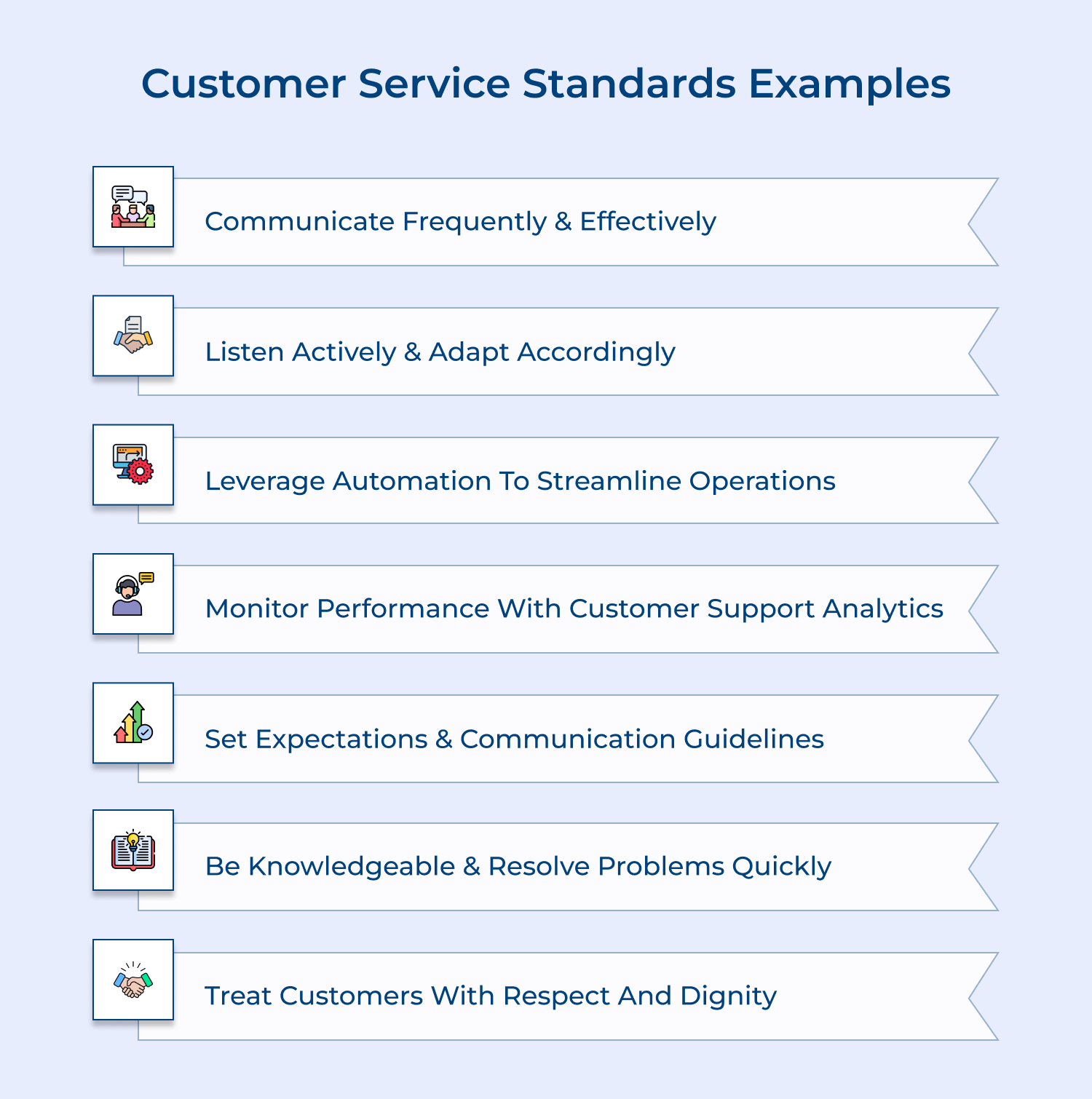
Encourage your staff members to update their clients regularly on progress throughout any process or course of action the company takes.
Avoid over-promising or under-delivering by setting reasonable expectations upfront. It will build trust between both parties and strengthen ties over time, leading to better relationships with current users as well as those considering using your services.
How to Implement?
Here is a template to help you communicate with your customers promptly and effectively:
Provide clear and concise information: When responding to customers, ensure your message is easy to understand. Use simple language and avoid jargon or technical terms that might confuse them.
“Dear [Customer Name],
I apologize for the inconvenience you have experienced with [specific issue]. Our team is currently investigating the matter and we will provide you with a detailed update by [specific date/time].
Thank you for your understanding, and if you have any additional questions, please feel free to ask.
Sincerely,
[Your Name]”
Too often we get caught up in our plans instead of listening attentively to what our clients have told us. It can lead to misunderstandings or miscommunication among the parties involved.
Being an active listener means understanding exactly what we hear from them so we can tailor the solution accordingly.
How to Implement?
The below template can help you listen to your customers actively:
Engage actively: When a customer reaches out with a concern, actively engage in the conversation. Encourage them to share details about their issue or feedback and demonstrate genuine interest.
“Dear [Customer Name],
Thank you for reaching out to us.
We appreciate you taking the time to share your concerns regarding [specific issue]. It is essential for us to better understand your experience and we would be grateful if you could provide us with more details. It will enable us to properly address your concerns and find a suitable solution.
Please feel free to share any additional information or provide examples that can help us fully grasp the situation. Your feedback is valuable to us and we are committed to resolving this matter to your satisfaction.
Regards,
[Your Name]”
Implement automation techniques/tools such as chatbots or automated emails whenever possible to streamline operations and offer 24/7 support without having human resources engaged constantly.
Using such tools frees up time for other support activities while still delivering high levels of customer satisfaction through prompt responses, accurate advice, and interesting content.
How to Implement?
Analytics can provide deep insights into customer behavior which can improve decision-making.
From understanding revenue cycle efficiency (RCE), calculating KPI trends over time, or monitoring churn rates – performances monitored with analytics drive more meaningful impact. Adopting analytics allows businesses to make intelligent decisions swiftly while improving workflows efficiently thereby increasing customer satisfaction overall.
How to Implement?
Customers expect clear expectations from companies with whom they interact. If these needs aren’t met consistently, it sets up misunderstandings that could cost you long-term loyalty from your customers.
Set realistic timelines that allow sufficient time for feedback-gathering steps like surveys or interviews before delivering solutions to ensure the timely execution of requests made by customers.
Creating an established communications protocol is essential for providing exceptional customer service experiences because it clearly outlines how communications happen between teams and clients.
How to Implement?
One of the keys to excellent customer service is having staff members who are knowledgeable about products and services.
Not only the key features but also how they can be used best while resolving customers’ issues quickly through virtual spaces or face-to-face interactions. Deploy AI chatbots that help instantly resolve some basic inquiries without human intervention and also ensure personalized responses when needed.
How to Implement?
Did you know – If customers don’t feel respected during interactions, they’ll likely take their business elsewhere?
Make sure customers understand they’re dealing with knowledgeable employees who will listen to their concerns without judgment. Consider offering rewards or discounts as a token of appreciation for being patient – It can help make frustrated customers happier.
How to Implement?
Implementing and managing customer support standards can be challenging, as it requires a shift in the way an organization operates.
One of the biggest challenges in implementing customer service standards is the lack of proper training for employees. It is crucial to provide comprehensive training programs that equip employees with the necessary skills and knowledge to address customer needs effectively.
Regular training sessions should be conducted to update employees on new industry trends and best practices.
Solution:
Maintaining consistent service quality across all customer touchpoints can be challenging, especially in businesses with multiple locations or departments. Customers expect the same level of service, regardless of whom they interact with.
Solution:
Customers demand multiple communication channels to reach out to businesses. Some companies may struggle to offer a diverse range of channels, limiting their ability to meet customer preferences.
Solution:
Dealing with difficult customers can be emotionally draining for employees, and if not handled correctly, it can impact the overall customer experience. Some employees may lack the skills to handle challenging situations, leading to frustration and potential loss of business.
Solution:
Without proper feedback mechanisms, it becomes challenging to gauge customer satisfaction and identify areas for improvement. Without feedback, businesses may continue to make the same mistakes or fail to meet evolving customer expectations.
Solution:
Providing personalized customer service can be time-consuming and requires a significant investment of resources. Balancing personalization with efficiency is a challenge that businesses often face.
Solution:
Empowering employees to make decisions and resolve customer issues on their own is crucial for delivering exceptional customer service. Some companies struggle with empowering employees, leading to delays in issue resolution and a negative customer experience.
Solution:
A well-defined customer service policy is crucial in ensuring customer satisfaction and loyalty. Here are 6 key elements to include in your customer service policy:
1. Response time commitments: Specify exact timeframes for acknowledging customer inquiries across all channels. For example, emails must receive an automated acknowledgment within 2 hours and a human response within 24 hours, while live chats require immediate greeting and phone calls answered within 3 rings.
2. Communication guidelines: Define clear protocols for professional language, tone, and style in customer interactions. This includes templates for common scenarios, rules for addressing customers (using their preferred names), and standards for written communication clarity and correctness.
3. Problem resolution procedures: Outline step-by-step processes for handling complaints, returns, and escalations. These procedures should include authority levels for different resolution types, when to involve supervisors, and maximum resolution timeframes for various issue categories.
4. Service quality metrics: Establish measurable benchmarks for evaluating service performance, such as customer satisfaction scores, first-contact resolution rates, and accuracy requirements. These metrics provide objective ways to assess whether standards are being met consistently.
5. Training requirements: Detail mandatory training programs and ongoing education requirements for customer service staff. This includes initial onboarding modules, product knowledge updates, soft skills development, and regular refresher courses to maintain high service standards.
6. Accessibility standards: Define how services accommodate diverse customer needs, including language support, disability accessibility, and multiple contact channel options. This ensures all customers can access quality service regardless of their preferred communication method or special requirements.
Customer service defines a brand’s reputation. Many businesses have come to rely on customer service as a key part of their branding efforts. One way to ensure your business stands out in the landscape of customer service is by defining and implementing customer service standards. Read on to learn more about how customer service standards define your brand image.
Customer service standards provide an outline of the core philosophies and expectations that you want all employees to adhere to when providing customer support. Setting clear standards helps to ensure everyone knows what they should be doing, how they should be working with customers and the attitude each should carry when communicating with those customers.

What are some customer service standards?
Customer service standards are guidelines that businesses establish to ensure that customers receive consistent and high-quality service. Some common customer service standards include:
What are customer service standards important?
Customer service standards are essential for several reasons:
How can businesses measure the effectiveness of their customer service standards?
Measuring the effectiveness of customer service standards is crucial for continuous improvement and identifying areas of strength or weakness. Some common methods include:
What are the consequences of not meeting customer service standards?
Failing to meet customer service standards can have detrimental effects on a business. Some consequences include:
 https://omni24.io/wp-content/uploads/2026/09/Social-commerce-scaled.png
1340
2560
Webvision Solution
https://omni24.io/wp-content/uploads/2023/04/Omni-Logo-1.svg
Webvision Solution2026-10-23 12:18:272026-10-23 12:18:27What is Social Commerce and Why Does It Matter?
https://omni24.io/wp-content/uploads/2026/09/Social-commerce-scaled.png
1340
2560
Webvision Solution
https://omni24.io/wp-content/uploads/2023/04/Omni-Logo-1.svg
Webvision Solution2026-10-23 12:18:272026-10-23 12:18:27What is Social Commerce and Why Does It Matter? https://omni24.io/wp-content/uploads/2026/08/AI-Customer-Service-Agents.png
1256
2400
Webvision Solution
https://omni24.io/wp-content/uploads/2023/04/Omni-Logo-1.svg
Webvision Solution2026-09-21 04:48:512026-09-21 04:48:51How to Build an AI Customer Service Agents: 8 Key Steps
https://omni24.io/wp-content/uploads/2026/08/AI-Customer-Service-Agents.png
1256
2400
Webvision Solution
https://omni24.io/wp-content/uploads/2023/04/Omni-Logo-1.svg
Webvision Solution2026-09-21 04:48:512026-09-21 04:48:51How to Build an AI Customer Service Agents: 8 Key Steps https://omni24.io/wp-content/uploads/2026/08/Omnichannel-Conversational-AI.png
1256
2400
Tushar Joshi
https://omni24.io/wp-content/uploads/2023/04/Omni-Logo-1.svg
Tushar Joshi2026-09-16 03:51:072026-09-16 03:51:07How to Build Omnichannel Conversational AI Strategy
https://omni24.io/wp-content/uploads/2026/08/Omnichannel-Conversational-AI.png
1256
2400
Tushar Joshi
https://omni24.io/wp-content/uploads/2023/04/Omni-Logo-1.svg
Tushar Joshi2026-09-16 03:51:072026-09-16 03:51:07How to Build Omnichannel Conversational AI Strategy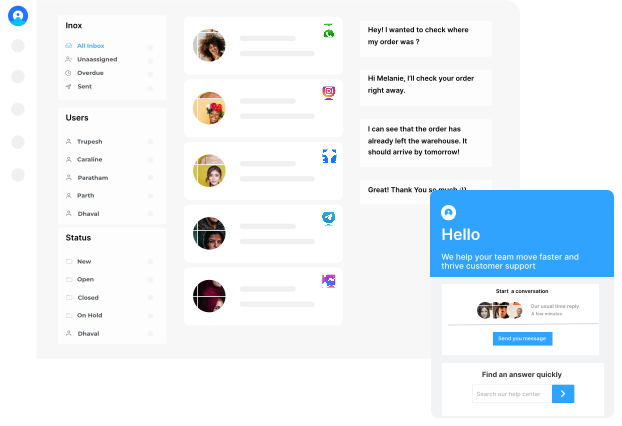
Whether it’s about acquire, engage or support – Omni24 covers all your customer engagement needs in one complete platform.

Copyright ©2026 Veemo All rights reserved.
CA, Los Angeles, Hall Ave, 19011