What is Unified Customer Experience? (Why It’s Important)
Creating a unified customer experience is critical for staying competitive and retaining as well as building a loyal customer base.
Creating a unified customer experience is critical for staying competitive and retaining as well as building a loyal customer base.
Customers expect a seamless, effortless experience when interacting with a brand, regardless of the channel they choose to use. Companies that fail to provide a unified customer experience, lead to dissatisfied customers.
Brands need to understand that every interaction a customer has with their brand contributes to their overall perception and satisfaction. Hence, it is crucial to ensure a unified customer experience across all online and offline channels.
By establishing a standard for customer interaction, companies can unify a brand that customers recognize across different channels and come to rely on. Loyal customers are more than five times more likely to purchase again and four times more likely to refer a friend.
Let us explore the key elements of a unified customer experience.
Unified Customer Experience, or Unified CX, refers to creating a seamless and consistent experience for customers across all channels/touchpoints. The main goal of a unified customer experience is to enhance customer satisfaction by providing an effortless, personalized and engaging journey.
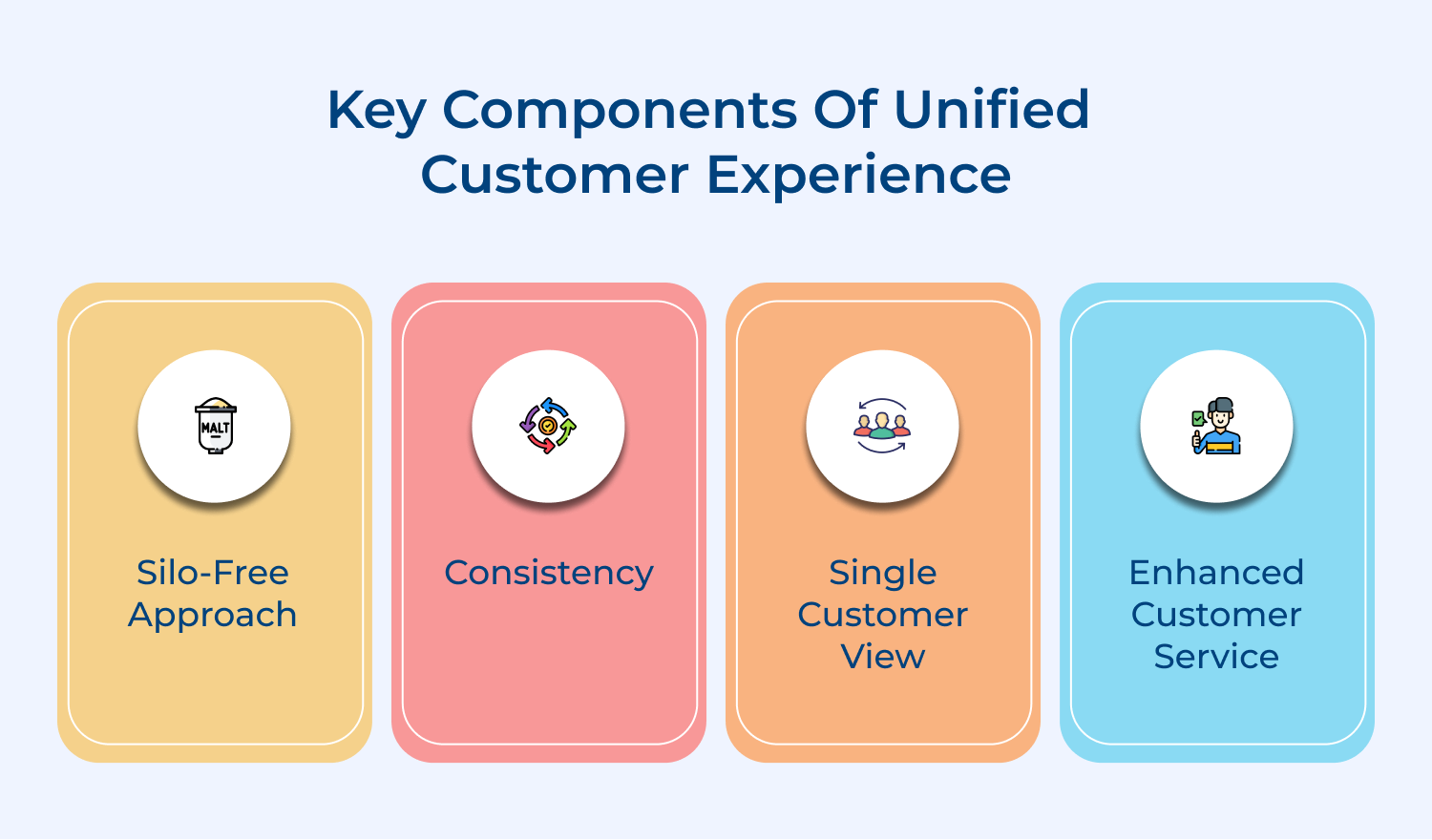
Key components of unified customer experience:
Different departments work together to provide a unified customer experience to clients. It means that there is no siloed approach where the customer has to interact with multiple departments for the same issue.
A unified CX program delivers a single customer view, which allows the business to provide personalized experiences based on the customer’s past behavior and preferences.
A unified customer experience program ensures all service reps have access to the same customer information, which enables them to provide a faster resolution to any issues the customer might have.
A well-designed unified customer experience strategy provides a consistent experience across all client touchpoints. Customers expect a uniform experience, whether they are interacting with the business on social media, mobile apps, contact centers, or in person.
The following are the touchpoints that make up a Unified Customer Experience:
Having a unified customer experience (CX) strategy in place is essential for businesses to sustain in the long run. Creating a seamless and consistent experience for customers across all possible touchpoints can bring numerous benefits to a company.
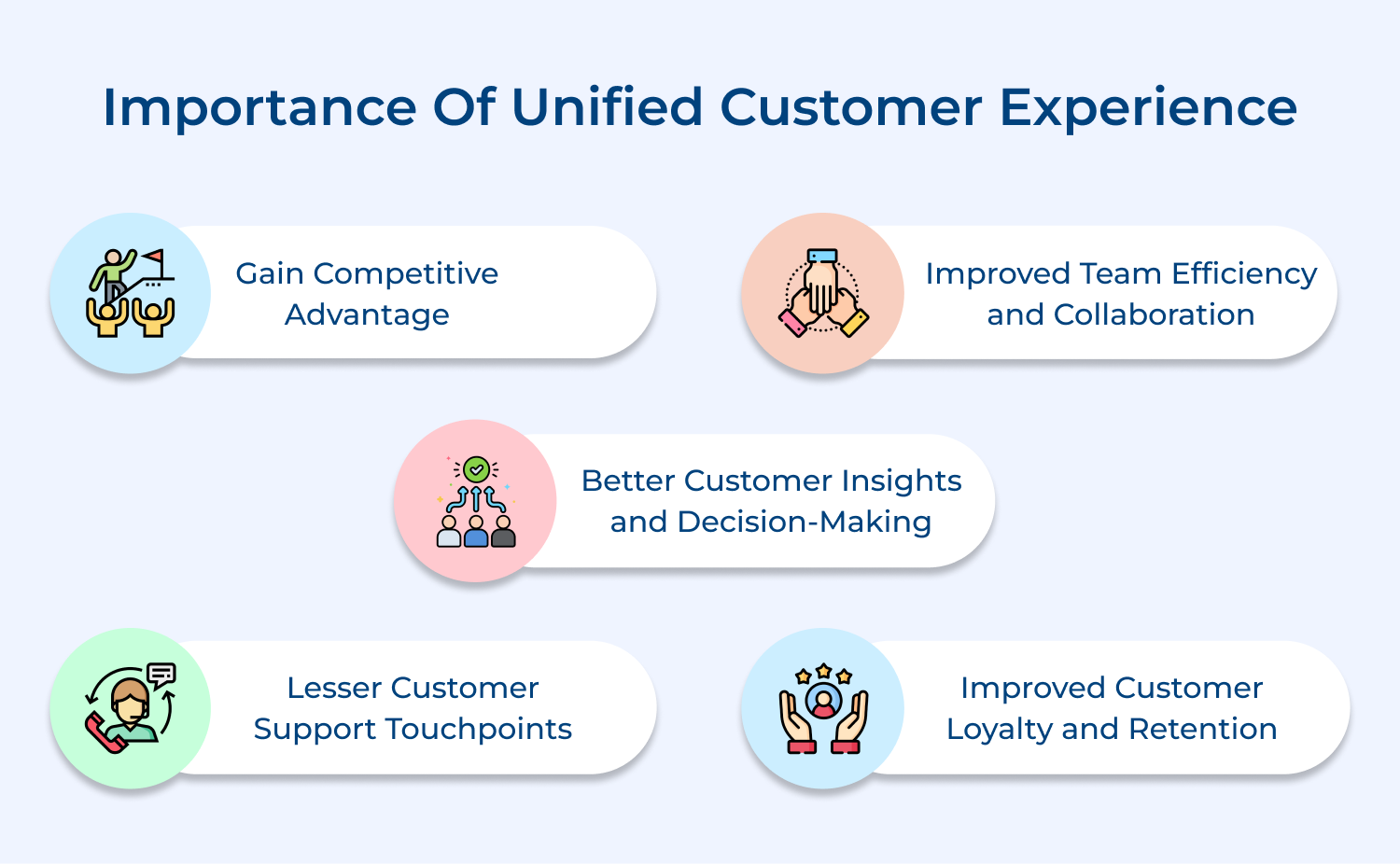
A unified CX strategy can help companies differentiate themselves from their competitors. Providing personalized experiences can enhance customer satisfaction, loyalty, and retention. It could give an edge over competitors who do not focus on creating such experiences.
Following unified customer experience management can break down silos across departments and help internal teams work cohesively towards the common goal of providing a seamless experience. It can lead to better team efficiency & collaboration, saving time and resources.
The unified CX approach allows businesses to collect customer data from various channels and create unified customer profiles. By analyzing the data, businesses can gain better customer insights, enabling them to make informed decisions.
A good unified CX strategy could result in fewer customer support touchpoints, as customers can now seamlessly interact with businesses across various touchpoints and have their issues resolved quicker. Customers expect businesses to be omnichannel in their approach.
Businesses that provide a seamless experience at every customer touchpoint, can enhance customer satisfaction, retention, and loyalty. Satisfied customers are likely to become brand advocates and promote the business through word of mouth, social media, or other platforms.
Creating a unified customer experience can seem like a daunting task, but there are several steps that businesses can take to achieve the goal. A well-executed unified CX strategy can lead to higher levels of customer satisfaction, customer loyalty and retention.
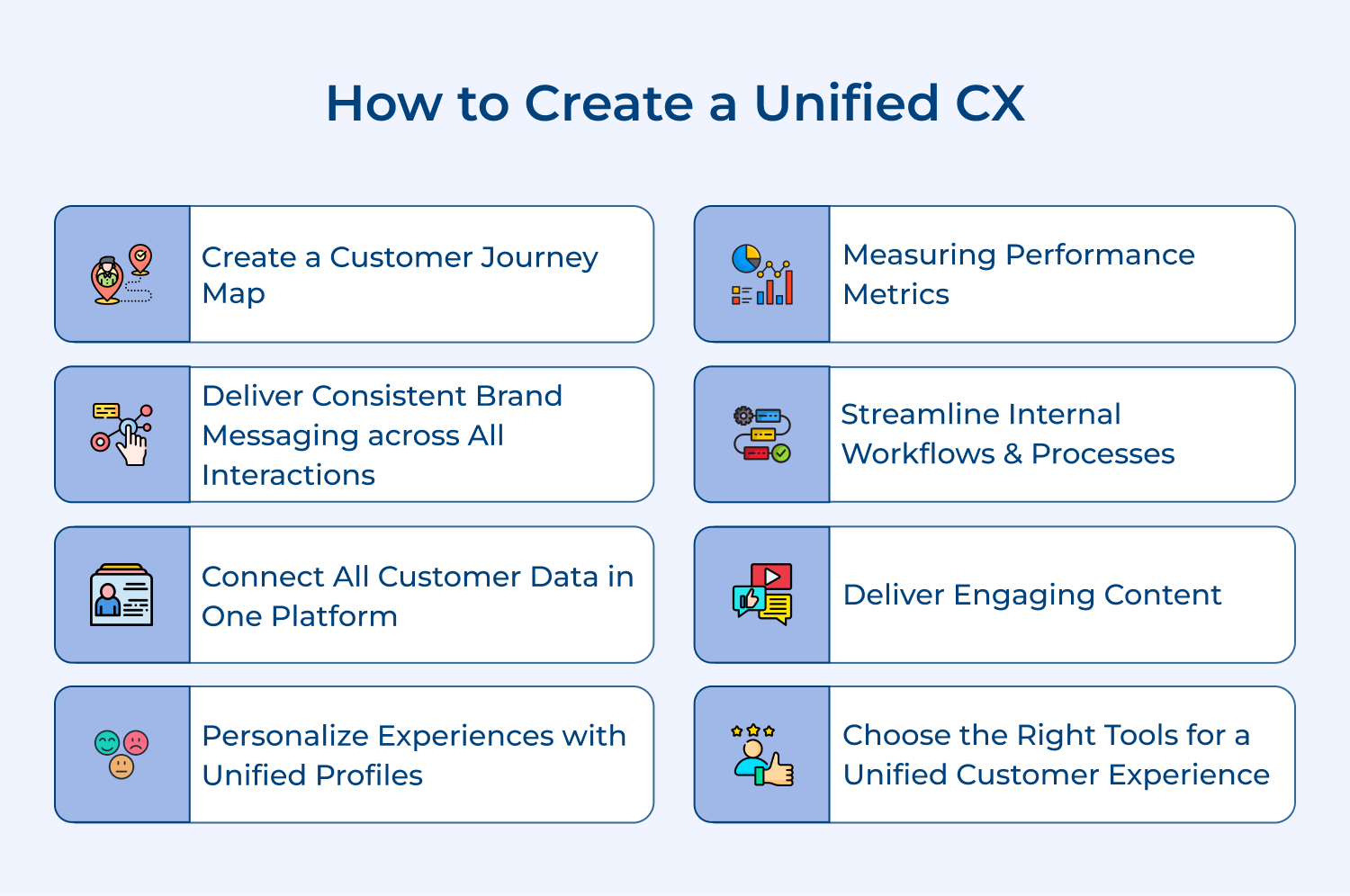
Creating a successful unified customer experience requires a deep understanding of the different stages of the client journey.
A customer journey map can help businesses recognize various touchpoints that can impact customer interactions and inform the right approach to enhancing customer experiences.
Here is how to implement a customer journey map effectively:
Create a seamless Unified Customer Experience by delivering consistent brand messaging across all interactions to reinforce your brand image. By doing so, your marketing team will have a clear vision of what your brand should represent across channels to ensure a coherent customer experience.
Tips to implement consistent branding messaging across your marketing channels:
A Single Customer View (SCV) enables brands to use critical customer data efficiently. Businesses have started to realize the importance of a customer’s lifecycle and have started collecting data from various sources such as CRM, e-commerce platforms, web analytics, mobile analytics, and POS solutions.
The data is often scattered across different departments, leading to inefficiencies and a lack of complete customer understanding. Connecting all data to one platform is necessary to resolve the issue.
Know how to implement the strategy:
Personalization is one of the keys to delivering a great customer experience.
Leveraging customer data to gain insights into their behaviors, businesses can tailor their products/services to create a more individualized experience. It leads to increased customer satisfaction as well as revenue.
Businesses can follow the below steps to implement personalization through unified profiles and insights:
Tracking the success of your unified customer experience program is critical to its long-term success. But with so much data at your fingertips, it can be challenging to know which performance metrics are the most important to track.
Utilizing performance metrics is the best way to ensure that you’re providing your customers with excellent service, identifying friction points, and optimizing your workflow to improve your overall CX strategy.
Ways to implement the strategy:
Businesses need to streamline internal workflows and processes to deliver a unified customer experience. It allows businesses to achieve greater efficiency, accuracy and consistency across their operations. By doing so, they can enhance their customer interactions, reduce errors and cut costs.
Know how to streamline internal workflows and processes:
Creating engaging content at every step of the customer lifecycle is crucial for delivering a unified customer experience. It is important to understand your target audience and what type of content they engage with to ensure your efforts align with their preferences.
Here are ways to deliver engaging content throughout the customer lifecycle:
Choosing the right tools for a unified customer experience is crucial in providing exceptional service. These tools help maintain a consistent, comprehensive customer view across multiple touchpoints and provide your service agents with the necessary data to offer satisfactory interactions.
Ways to choose the right tools to deliver unified CX:
Implementing a unified customer experience strategy is the backbone of any business that wants to bolster customer satisfaction and increase customer loyalty.
Here are 5 companies from different industries that have successfully implemented a unified CX program.
The coffee giant has been a trailblazer in implementing a unified CX strategy, connecting all of its touchpoints through its mobile app.
Starbucks rewards program, availability of mobile ordering, and loyalty program have all been linked to the app. It enhances customer engagement and offers personalized promotions across channels while maintaining a cohesive brand identity.
Airbnb has redefined customer experiences, linking up all of its customer data to deliver a consistent experience across all touchpoints by implementing a unified CX program. Its guests can communicate with hosts using the app, access local areas of interest, rent apartments, and book experiences, all in one place.
Airbnb also uses machine learning to provide personalized recommendations based on customer data, resulting in increased guest satisfaction during their stays.
Sephora has implemented a unified CX strategy by linking up all of its customer profiles across touchpoints. Sephora’s Beauty Insider program collects information customer’s skincare preferences/ shopping history/ behaviors, which helps to deliver personalized recommendations and experiences to customers across all channels of interaction. It also uses its mobile app to enhance customer experience by allowing customers to virtually try on makeup and get helpful beauty tips.
Walmart’s investment in a unified CX program has helped it stay relevant in the fiercely competitive retail industry. It implemented a unified data platform that links up the company’s online and offline interactions, helping to deliver personalized recommendations and promotions to customers both in-store and online. Its success with its online grocery delivery service has also contributed to enhanced customer satisfaction and increased loyalty.
Amtrak implemented a unified CX program that combined multiple booking channels, allowing passengers to purchase, reserve, and access their ticket information in one place. By linking up all customer data on one platform, Its reservation system provides passengers with personalized recommendations and experiences while helpfully guiding them through their journey. It has also set up a rewards program for frequent riders, which only helped to increase customer loyalty.
Selecting the appropriate CX platform is critical in delivering a consistent and unified customer experience. A unified CX management platform brings together all customer data, provides insights, and offers a single source of truth, allowing for more personalized interactions with customers. The system can also help businesses identify experience inconsistencies, gather customer insights, and measure performance metrics.
There is an array of CX platforms available in the market. Adobe Experience Cloud is a popular platform that offers an AI-powered tool for personalization. As customer expectations continue to evolve, it becomes increasingly important to invest in a CX platform that centralizes all CX initiatives, connects customer data, and enables insights, to maintain loyal customers in the long-term.

What is a unified customer profile?
A unified customer profile is a single source of truth that contains all of the information a business has about a customer. It includes data from past purchases, interactions with customer service and demographic information. A unified customer profile is essential for providing a personalized and seamless experience across all touchpoints.
What size businesses would benefit most from a unified customer experience?
Businesses of all sizes can benefit from a unified customer experience. Larger businesses with multiple touchpoints and a large customer base can benefit the most. A unified customer experience allows these businesses to streamline their processes, improve customer satisfaction and increase customer loyalty.
Why is governance essential to propelling innovation in customer experience?
Governance is essential for propelling innovation in customer experience because it provides the necessary structure, accountability and strategic direction. Governance ensures that CX initiatives are aligned with the organization’s overall strategy and goals. Effective governance ensures that individuals or teams are accountable for the success of CX initiatives. Governance helps allocate resources effectively, ensuring that innovation is supported with the necessary budget, technology and human capital.
Why is it important to address customer inquiries and provide relevant answers?
Providing relevant answers to customer inquiries shows that a business values its customers and is invested in their satisfaction. In addition, addressing customer inquiries efficiently can help prevent negative reviews and increase customer loyalty.
How does a unified customer experience benefit businesses?
A unified customer experience can help businesses improve customer satisfaction, increase customer loyalty and drive sales. By delivering a seamless and personalized experience across all touchpoints, businesses can create loyal customers who will continue to do business with the company in the long run. In addition, a unified customer experience can help businesses streamline their processes and improve overall efficiency.
 https://omni24.io/wp-content/uploads/2026/09/Social-commerce-scaled.png
1340
2560
Webvision Solution
https://omni24.io/wp-content/uploads/2023/04/Omni-Logo-1.svg
Webvision Solution2026-10-23 12:18:272026-10-23 12:18:27What is Social Commerce and Why Does It Matter?
https://omni24.io/wp-content/uploads/2026/09/Social-commerce-scaled.png
1340
2560
Webvision Solution
https://omni24.io/wp-content/uploads/2023/04/Omni-Logo-1.svg
Webvision Solution2026-10-23 12:18:272026-10-23 12:18:27What is Social Commerce and Why Does It Matter? https://omni24.io/wp-content/uploads/2026/08/AI-Customer-Service-Agents.png
1256
2400
Webvision Solution
https://omni24.io/wp-content/uploads/2023/04/Omni-Logo-1.svg
Webvision Solution2026-09-21 04:48:512026-09-21 04:48:51How to Build an AI Customer Service Agents: 8 Key Steps
https://omni24.io/wp-content/uploads/2026/08/AI-Customer-Service-Agents.png
1256
2400
Webvision Solution
https://omni24.io/wp-content/uploads/2023/04/Omni-Logo-1.svg
Webvision Solution2026-09-21 04:48:512026-09-21 04:48:51How to Build an AI Customer Service Agents: 8 Key Steps https://omni24.io/wp-content/uploads/2026/08/Omnichannel-Conversational-AI.png
1256
2400
Tushar Joshi
https://omni24.io/wp-content/uploads/2023/04/Omni-Logo-1.svg
Tushar Joshi2026-09-16 03:51:072026-09-16 03:51:07How to Build Omnichannel Conversational AI Strategy
https://omni24.io/wp-content/uploads/2026/08/Omnichannel-Conversational-AI.png
1256
2400
Tushar Joshi
https://omni24.io/wp-content/uploads/2023/04/Omni-Logo-1.svg
Tushar Joshi2026-09-16 03:51:072026-09-16 03:51:07How to Build Omnichannel Conversational AI Strategy
Whether it’s about acquire, engage or support – Omni24 covers all your customer engagement needs in one complete platform.

Copyright ©2026 Veemo All rights reserved.
CA, Los Angeles, Hall Ave, 19011