How to Increase Customer Loyalty and Retention?
Understand customer loyalty versus retention and how to measure their impact. Apply strategies to repeat purchases and long-term business growth.

Understand customer loyalty versus retention and how to measure their impact. Apply strategies to repeat purchases and long-term business growth.
Customer loyalty and customer retention are often used interchangeably, but they mean different things, while both are crucial for business success. Customer loyalty is the emotional connection a customer has with a brand, influencing repeat purchases and advocacy. Customer retention focuses on the strategies a company uses to keep existing customers from leaving.
This distinction matters because existing customers are significantly more valuable—they’re 67% more likely to spend than new customers and contribute to 65% of a company’s revenue, according to Bain & Company research on customer lifetime value
Understanding the difference between customer retention and loyalty helps businesses improve strategies, enhance experiences and drive growth.
Customer retention refers to the ability of a company to keep its customers over time, preventing them from switching to competitors or stopping the use of products or services. It involves strategies and actions aimed at maintaining long-term relationships with existing customers, encouraging repeat purchases, as well as building loyalty.
Generally more cost-effective to retain existing customers than to acquire new ones. Loyal customers tend to spend more, provide valuable feedback and often become brand advocates, recommending the company to others. High retention rates also indicate customer satisfaction and can lead to increased market share along with profitability.
Key objectives:
Customer loyalty refers to a consumer’s willingness to repeatedly purchase from or engage with a brand over an extended period. It goes beyond mere satisfaction, encompassing emotional attachment and a preference for a particular company or product. Loyal customers not only make repeat purchases but also recommend the brand to others, becoming advocates in the process.
Customer loyalty drives sustainable growth by ensuring a steady stream of repeat business and reducing customer acquisition costs. Loyal customers tend to spend more, are less price-sensitive and provide valuable feedback for improvement. They also act as brand ambassadors, generating positive word-of-mouth marketing that attracts new customers.
Key objectives:
Understanding the distinction between customer loyalty and retention is crucial for businesses. Here are the key differences to consider:
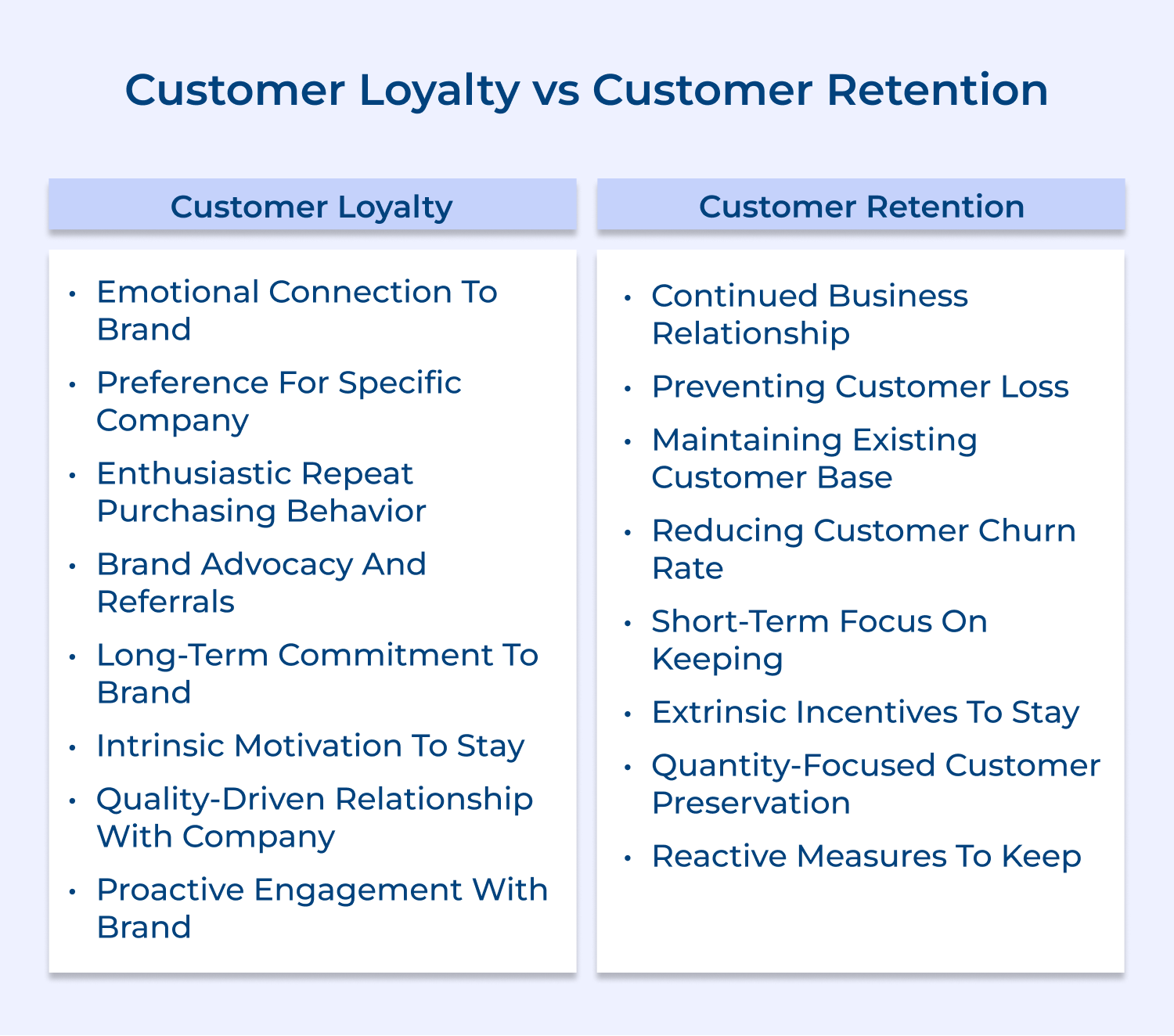
Loyal Customers:
Retained Customers:
Loyalty:
Retention:
Loyalty Strategies:
Retention Strategies:
Loyal Customers:
Retained Customers:
Measuring customer loyalty and retention is essential for business growth. Here are key methods to effectively assess these metrics:
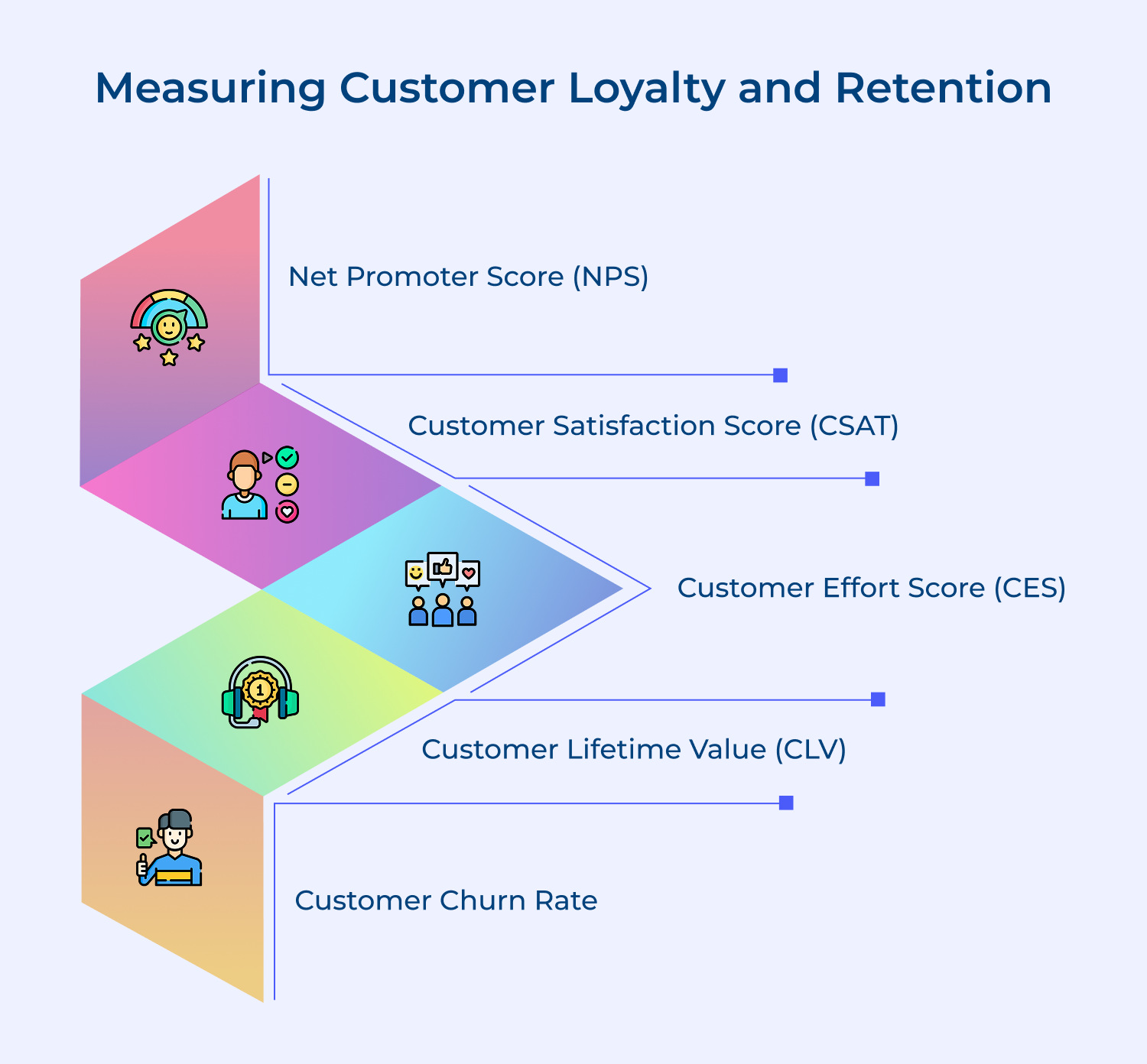
Understanding customer loyalty requires specific metrics. Here are the essential indicators to evaluate and enhance loyalty effectively:
Net Promoter Score (NPS)
NPS is a widely used metric to measure customer loyalty and satisfaction. It’s based on a single question: “How likely are you to recommend our company/product/service to a friend or colleague?” Customers respond on a scale from 0 to 10.
The NPS is calculated by subtracting the percentage of Detractors from the percentage of Promoters.
A high NPS indicates strong customer loyalty and a likelihood of positive word-of-mouth marketing.
Customer Satisfaction Score (CSAT)
CSAT measures how satisfied a customer is with a specific interaction, purchase, or overall experience. It typically involves asking customers to rate their satisfaction on a scale (e.g., 1-5 or 1-10).
The CSAT score is usually calculated as the percentage of satisfied customers (those who selected 4 or 5 on a 5-point scale) out of the total respondents. CSAT provides immediate feedback on specific aspects of the customer experience and can help identify areas for improvement.
Customer Effort Score (CES)
CES measures how much effort a customer has to exert to get an issue resolved, a request fulfilled, or a product purchased. The question typically asked is, “On a scale from ‘very easy’ to ‘very difficult,’ how easy was it to interact with our company?”
A low effort score indicates that customers find it easy to do business with the company, which often correlates to higher loyalty. CES is particularly useful for assessing the efficiency of customer service processes and identifying pain points in the customer journey.
Measuring customer retention is vital for sustained growth. Here are crucial metrics to track and improve retention rates effectively:
Customer Lifetime Value (CLV)
CLV is a prediction of the net profit attributed to the entire future relationship with a customer. It considers a customer’s revenue value and compares that number to the company’s predicted customer lifespan.
CLV = (Customer Value * Average Customer Lifespan)
Where Customer Value = Average Purchase Value * Average Number of Purchases
CLV helps businesses understand the long-term value of retaining customers and can guide decisions on how much to invest in acquiring while retaining different customer segments.
Customer Retention Rate (CRR): CRR measures the percentage of customers a company has retained over a specific period. The formula is:
CRR = ((E-N)/S) * 100
Where: E = Number of customers at the end of the period N = Number of new customers acquired during the period S = Number of customers at the start of the period
A high retention rate indicates that a company is successful in keeping its customers over time, which is often more cost-effective than acquiring new ones.
Customer Churn Rate
Churn rate is the percentage of customers who stop using a company’s products or services during a given time period. It’s essentially the opposite of the retention rate.
Churn Rate = (Customers lost during the period / Customers at the start of the period) * 100
A low churn rate is desirable as it indicates that customers are staying with the company. High churn rates can signal problems with product quality, customer service, or competitive pressures.
Customer retention and loyalty are crucial elements for sustainable business growth as well as long-term success. Their importance can be understood through several key aspects:
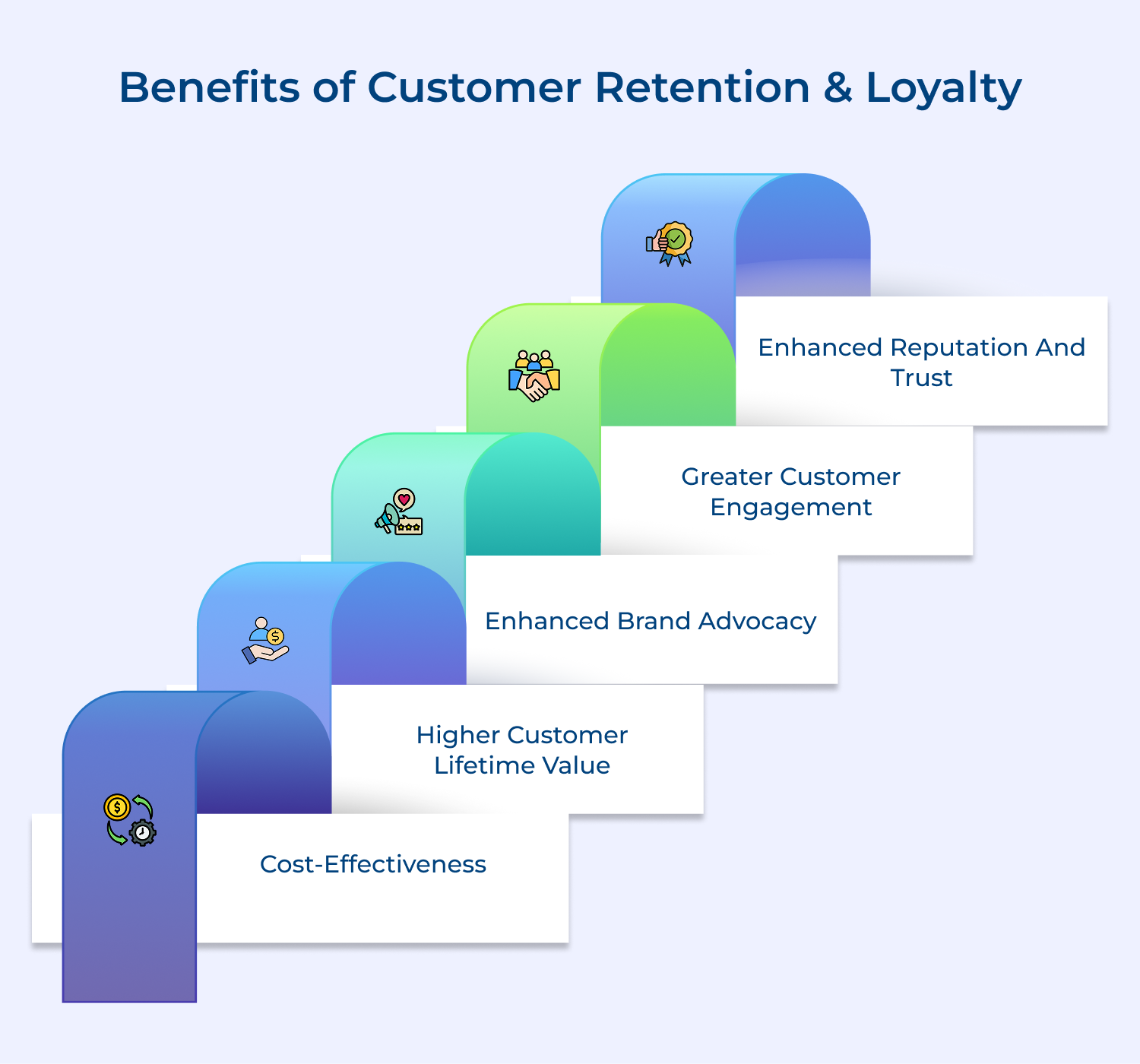
Cost-effectiveness
Retaining existing customers is significantly more cost-effective than acquiring new ones. Marketing and sales efforts to attract new customers often require substantial investments. In contrast, maintaining relationships with current customers typically involves lower costs.
Loyal customers are already familiar with the brand, reducing the need for extensive marketing campaigns. This cost efficiency allows businesses to allocate resources more effectively, potentially increasing profitability.
Higher Customer Lifetime Value
Loyal customers tend to have a higher lifetime value. They are more likely to make repeat purchases, try new products or services and potentially increase their spending over time.
As customers develop a deeper relationship with a brand, they may also be less price-sensitive, allowing for potentially higher profit margins. This increased value per customer contributes significantly to a company’s long-term financial health.
Enhanced Brand Advocacy
Satisfied, loyal customers often become brand advocates. They are more likely to recommend the company’s products or services to friends, family and colleagues.
This word-of-mouth marketing is incredibly valuable, as personal recommendations are often more trusted and influential than traditional advertising. Brand advocates can significantly extend a company’s reach and credibility, potentially attracting new customers at a lower acquisition cost.
Greater Customer Engagement
Loyal customers are typically more engaged with a brand. They are more likely to provide feedback, participate in surveys and interact with the company on various platforms.
The increased engagement provides valuable insights into customer preferences, needs and pain points. Companies can leverage this information to improve their products, services and overall customer experience, further strengthening customer relationships.
Enhanced Reputation and Trust
A loyal customer base contributes to a positive brand reputation. High customer retention rates often signal quality products or services and excellent customer experiences.
The enhanced reputation can attract new customers and potentially lead to partnerships or business opportunities. Loyal customers are more likely to give a brand the benefit of the doubt if issues arise, providing a buffer against potential reputation damage.
Customer retention is vital for sustainable business growth and profitability. Building strong relationships, providing exceptional customer service and continuously engaging with clients can help businesses to enhance loyalty as well as encourage repeat purchases.
Effective retention strategies, such as personalized communication and rewards programs, create a sense of value for customers, making them more likely to stay loyal.
Gathering feedback and addressing concerns promptly can further strengthen trust as well as satisfaction. Ultimately, prioritizing customer retention not only reduces acquisition costs but also turns satisfied customers into brand advocates, driving long-term success and a positive brand reputation in the marketplace.

How to Calculate Customer Retention Rate?
To calculate Customer Retention Rate (CRR), use the formula: CRR = ((E-N)/S) x 100, where E is the number of customers at the end of the period, N is the number of new customers acquired during the period and S is the number of customers at the start of the period. The percentage shows how well a company retains its customers over a specific timeframe.
What is the link between customer retention and customer loyalty?
Customer retention and loyalty are closely related but distinct concepts. Retention focuses on keeping customers engaged with a brand over time, while loyalty involves emotional attachment and preference. Effective retention strategies often lead to increased loyalty as customers develop positive experiences and trust with the brand. Loyalty, in turn, contributes to higher retention rates through repeat purchases and brand advocacy.
Why is customer loyalty and retention important?
Customer loyalty and retention are crucial for business success. They lead to increased customer lifetime value, reduced acquisition costs and stable revenue streams. Loyal customers often become brand advocates, providing valuable word-of-mouth marketing. High retention rates indicate customer satisfaction and can provide insights for product improvements. Together, loyalty and retention contribute to long-term profitability as well as competitive advantage.
How do you build customer loyalty and retention?
Provide exceptional customer service, personalize experiences, offer loyalty programs and consistently deliver value. Regularly engage customers through various channels, seek and act on feedback, while continuously improving products or services. Create emotional connections through brand storytelling and community building. Address issues promptly, exceed expectations and show appreciation for customer loyalty through exclusive offers or recognition.
 https://omni24.io/wp-content/uploads/2026/09/Social-commerce-scaled.png
1340
2560
Webvision Solution
https://omni24.io/wp-content/uploads/2023/04/Omni-Logo-1.svg
Webvision Solution2026-10-23 12:18:272026-10-23 12:18:27What is Social Commerce and Why Does It Matter?
https://omni24.io/wp-content/uploads/2026/09/Social-commerce-scaled.png
1340
2560
Webvision Solution
https://omni24.io/wp-content/uploads/2023/04/Omni-Logo-1.svg
Webvision Solution2026-10-23 12:18:272026-10-23 12:18:27What is Social Commerce and Why Does It Matter? https://omni24.io/wp-content/uploads/2026/08/AI-Customer-Service-Agents.png
1256
2400
Webvision Solution
https://omni24.io/wp-content/uploads/2023/04/Omni-Logo-1.svg
Webvision Solution2026-09-21 04:48:512026-09-21 04:48:51How to Build an AI Customer Service Agents: 8 Key Steps
https://omni24.io/wp-content/uploads/2026/08/AI-Customer-Service-Agents.png
1256
2400
Webvision Solution
https://omni24.io/wp-content/uploads/2023/04/Omni-Logo-1.svg
Webvision Solution2026-09-21 04:48:512026-09-21 04:48:51How to Build an AI Customer Service Agents: 8 Key Steps https://omni24.io/wp-content/uploads/2026/08/Omnichannel-Conversational-AI.png
1256
2400
Tushar Joshi
https://omni24.io/wp-content/uploads/2023/04/Omni-Logo-1.svg
Tushar Joshi2026-09-16 03:51:072026-09-16 03:51:07How to Build Omnichannel Conversational AI Strategy
https://omni24.io/wp-content/uploads/2026/08/Omnichannel-Conversational-AI.png
1256
2400
Tushar Joshi
https://omni24.io/wp-content/uploads/2023/04/Omni-Logo-1.svg
Tushar Joshi2026-09-16 03:51:072026-09-16 03:51:07How to Build Omnichannel Conversational AI Strategy
Whether it’s about acquire, engage or support – Omni24 covers all your customer engagement needs in one complete platform.

Copyright ©2026 Veemo All rights reserved.
CA, Los Angeles, Hall Ave, 19011