31 Incredible Customer Loyalty Statistics in 2026
Customer loyalty statistics reveal behavior and retention trends, helping brands strengthen ties, prevent chatbot failures, or boost growth.

Customer loyalty statistics reveal behavior and retention trends, helping brands strengthen ties, prevent chatbot failures, or boost growth.
Most businesses struggle with declining customer retention rates, watching loyal customers slip away to competitors despite significant investments in acquisition campaigns. Traditional marketing approaches fail to create lasting emotional connections that drive sustainable growth.
91% of companies worldwide now have loyalty programs, a major increase that underscores their strategic value in retaining customers.
These 40 powerful customer loyalty statistics reveal the hidden patterns behind successful retention strategies, providing actionable insights that transform how you build relationships.
Discover the data-driven secrets that industry leaders use to create unbreakable customer bonds and accelerate revenue growth.
Customer loyalty statistics are measurable data points that track how customers behave, feel and engage with brands over time. These numbers reveal patterns in customer retention, spending habits, program participation and emotional connections that businesses use to assess the health of their relationships.
Customer loyalty directly impacts your bottom line through increased spending, reduced acquisition costs and organic growth driven by referrals. Loyal customers spend 43% more at businesses they are loyal to, while companies leading in loyalty experience approximately 2.5 times faster revenue growth than others in their industries.
Key Objectives:
Building customer loyalty goes beyond keeping customers happy—it’s about creating measurable business advantages that boost your bottom line and long-term growth.
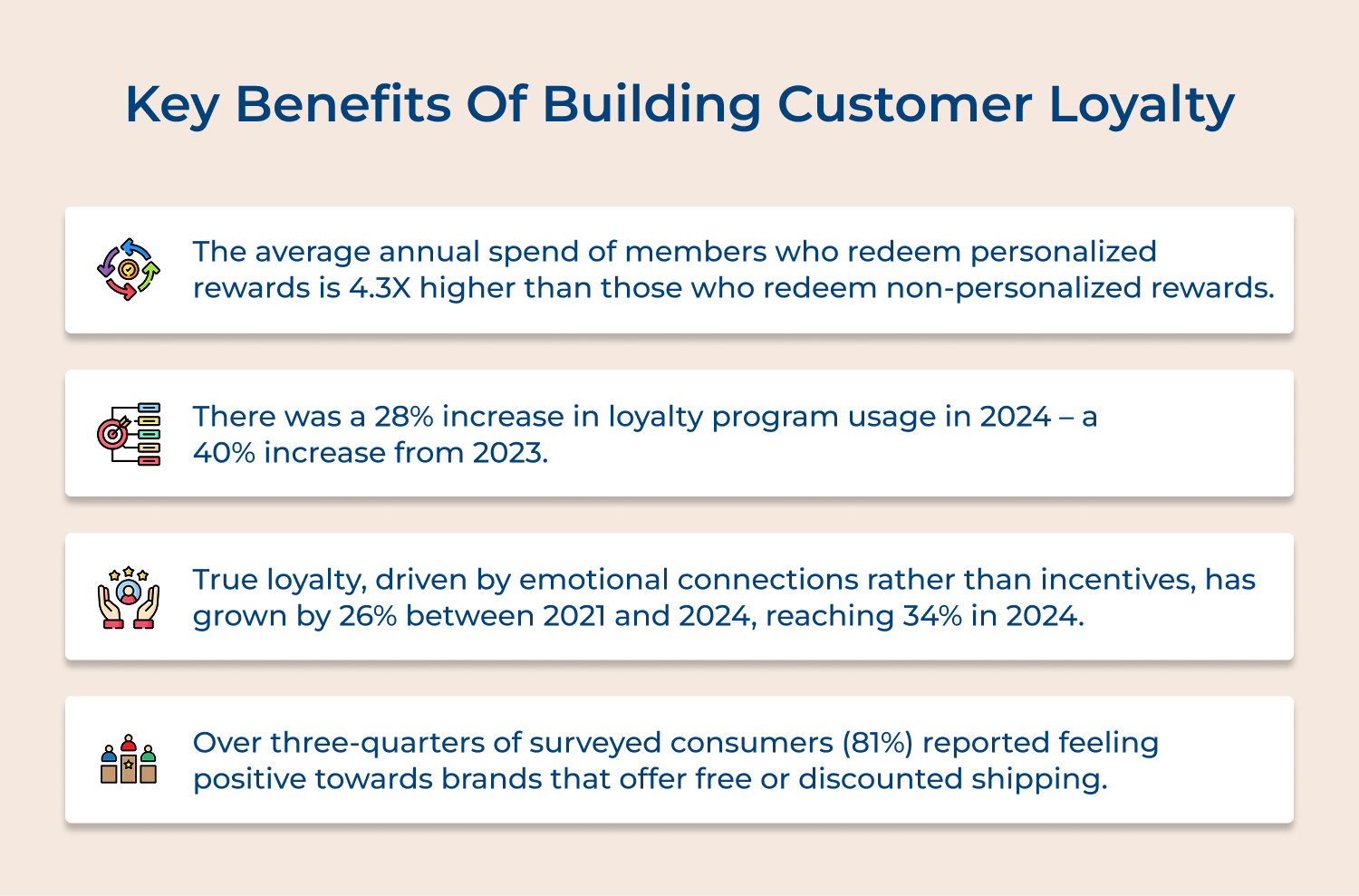
1. The average annual spend of members who redeem personalized rewards is 4.3X higher than those who redeem non-personalized rewards.
Such a remarkable multiplier effect demonstrates how personalized loyalty approaches transform average customers into high-value participants. When businesses understand individual preferences and deliver tailored experiences, they unlock dramatically higher spending patterns that compound annually, creating substantial revenue streams from engaged customers.
2. There was a 28% increase in loyalty program usage in 2024 – a 40% increase from 2023.
Such explosive year-over-year growth reveals that consumers increasingly embrace loyalty initiatives, creating expanding opportunities for businesses to capture market share. Companies establishing effective programs now position themselves advantageously as more customers actively seek brands offering meaningful loyalty experiences and rewards.
3. 64% of loyalty program members are willing to spend more money to maximize points earnings.
The behavior transformation shows how well-designed programs convert regular customers into value-maximizing participants who actively increase spending to unlock greater benefits. Rather than maintaining existing purchase levels, these customers deliberately expand their relationship with your brand through strategic purchasing decisions.
4. True loyalty, driven by emotional connections rather than incentives, has grown by 26% between 2021 and 2024, reaching 34% in 2024.
The trend indicates that businesses successfully creating emotional bonds with customers achieve deeper, more sustainable relationships beyond transactional benefits. Emotional loyalty proves more resilient during economic uncertainty and competitive challenges, providing a stable customer base that withstands market fluctuations.
5. Over three-quarters of surveyed consumers (81%) reported feeling positive towards brands that offer free or discounted shipping.
The positive sentiment translates into organic marketing as satisfied customers become brand advocates who recommend your business to their networks. Positive loyalty experiences create authentic testimonials and referrals that cost nothing but generate new customer acquisition through trusted personal recommendations from existing customers.
From my research on 2024-2026 customer loyalty data, here are 30 key stats in six categories showing how loyalty drives business success.
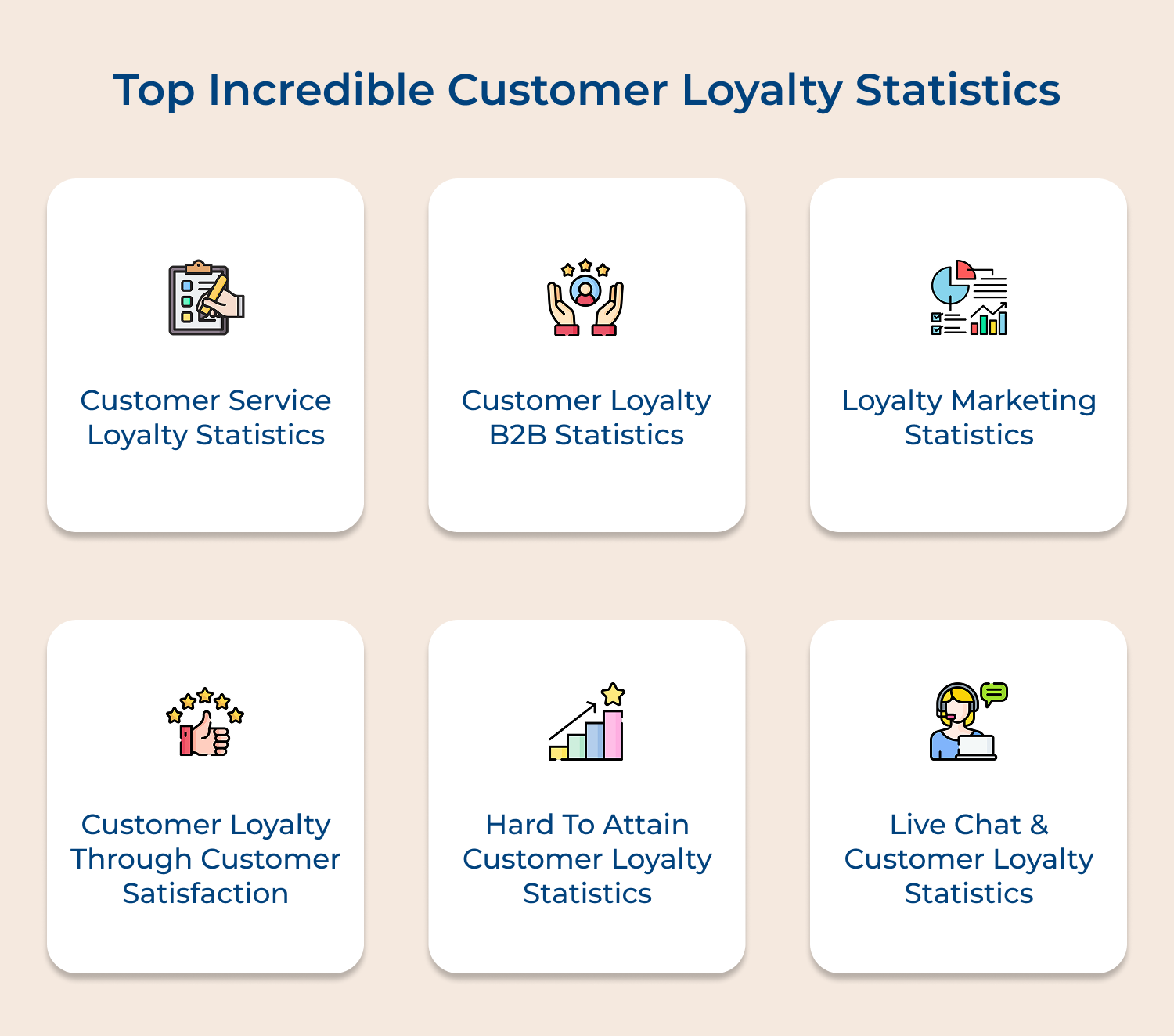
Customer service acts as the foundation of loyalty, where each interaction either builds or breaks the trust that keeps customers coming back for more.
1. 89% of customers who have a positive customer service experience are likely to return, demonstrating how service impacts loyalty.
The above statistic reveals how a single positive service interaction creates a psychological bond that transforms one-time buyers into repeat customers. When customers feel valued and heard during service encounters, they develop emotional attachment to the brand that transcends transactional relationships and drives long-term loyalty.
2. 45% of respondents in 2024 switched brands due to poor customer service, up from 42% in 2023.
The year-over-year increase shows that customer tolerance for poor service continues declining as expectations rise. This trend creates both risk and opportunity—brands that maintain service excellence can capture customers abandoning competitors, while those with declining service face accelerating customer defection.
3. 75% of customers expect a consistent experience across multiple channels (online, in-store, mobile), with inconsistency leading to dissatisfaction and higher churn.
Modern customers interact with brands through multiple touchpoints and expect seamless transitions between channels. When service quality varies dramatically between phone, chat, email, or in-person interactions, customers feel frustrated and question the brand’s competence, leading to loyalty erosion.
4. 96% of customers say customer service is important in their choice of loyalty to a brand.
This near-universal agreement confirms that service quality isn’t just one factor among many—it’s become the primary determinant of brand loyalty. Companies that treat customer service as secondary to product development or marketing miss the most direct path to customer retention and advocacy.
Business-to-business relationships operate on different loyalty dynamics, where long-term partnerships and trust carry greater weight than consumer impulse purchases.
5. B2B customer retention rates typically range from 76% to 81%.
These higher retention rates compared to B2C markets reflect the complexity and switching costs involved in business relationships. B2B purchases often require significant evaluation periods, implementation efforts and integration with existing systems, creating natural barriers to customer churn that businesses can leverage.
6. The annual loss incurred by US corporations from avoidable B2B customer switching is 136.8 billion dollars.
This staggering figure represents the collective cost of businesses losing clients they could have retained through better service, relationship management, or value delivery. The scale demonstrates why B2B companies increasingly prioritize customer success teams and retention strategies over pure acquisition efforts.
7. Only 48% were investing heavily in customer retention strategies.
Despite the high costs of customer switching, less than half of B2B companies make significant retention investments. This gap creates opportunities for forward-thinking businesses to differentiate themselves through superior customer relationship management while competitors focus primarily on new client acquisition.
8. 82% of enterprise organizations, their client onboarding strategy is a critical value driver.
Successful B2B onboarding sets the foundation for long-term loyalty by ensuring customers quickly realize value from their purchase. When businesses invest in comprehensive onboarding processes, they reduce early churn risk and accelerate the path to customer success.
Marketing strategies specifically designed to nurture loyalty require different approaches and metrics than traditional acquisition campaigns.
9. 27% of a loyalty program’s marketing budget, on average, is dedicated to customer loyalty and CRM.
This significant budget allocation reflects the strategic importance of retention marketing in driving program success. Companies that invest substantial resources in loyalty marketing understand that member engagement requires ongoing communication, personalization and value demonstration to maintain active participation.
10. 9 out of 10 companies have reported a positive ROI. For those with a positive ROI, the average ROI is 4.8X.
The near-universal positive returns and impressive 4.8X average ROI demonstrate that well-executed loyalty marketing generates substantial business value. This high success rate occurs because loyalty marketing targets already-engaged customers who cost less to retain than new customers cost to acquire.
11. Email marketing is the most effective channel for customer retention, with a 56% effectiveness rate.
Email’s dominance in retention marketing stems from its personal nature, cost-effectiveness and ability to deliver personalized content at scale. Unlike social media or advertising, email enables direct communication with customers who have explicitly opted in to receive brand messages.
12. 39% of consumers are likely to engage in a loyalty program this year compared to last and 43% relying more on loyalty program benefits.
Growing consumer engagement with loyalty programs reflects changing economic conditions and increased value consciousness. As consumers seek ways to maximize purchasing power, loyalty programs become essential rather than optional, creating greater opportunities for effective loyalty marketing strategies.
Satisfaction serves as the emotional bridge between service delivery and genuine loyalty, transforming pleased customers into passionate advocates.
14. Consumer satisfaction decreased by 0.6 percentage points since last year.
The measurable decline in global satisfaction suggests that rising customer expectations outpace service improvements across industries. Companies must continuously evolve their satisfaction strategies to maintain loyalty levels as consumers become more demanding and comparison shopping becomes easier.
15. Consumer loyalty is down as we head into 2026. Compared to last year, consumers are less likely to trust (-1.2 pts) and purchase more (-1.3 pts) from organizations.
Declining loyalty metrics across trust, advocacy and repurchase intent signal that businesses face increasing challenges in maintaining customer relationships. Economic uncertainty, abundant choice and rising expectations create headwinds that require more sophisticated satisfaction and loyalty strategies to overcome.
Some loyalty challenges prove particularly difficult to overcome, revealing the complexity of building lasting customer relationships in competitive markets.
16. 69% of respondents report loyalty to specific retailers, brands and stores in 2024, a drop from 77% in 2022.
The 8% decline in just two years reflects how AI-powered comparison tools and abundant choice make brand switching easier than ever. Customers can quickly evaluate alternatives, compare prices and discover new options, reducing the friction that once created natural loyalty barriers.
17. 77% of consumers now retract their loyalty more quickly than they did three years ago.
Accelerating loyalty erosion means businesses have shorter windows to address customer concerns and rebuild relationships after negative experiences. The compression of forgiveness periods requires companies to implement rapid response systems and proactive relationship management to prevent small issues from becoming loyalty losses.
18. 61% of consumers switched some or all of their business from one brand or provider to another in the last year.
The high switching rate demonstrates that customer loyalty has become increasingly fragile across industries. Even satisfied customers explore alternatives, making retention efforts essential for maintaining market share and requiring businesses to continuously prove their value proposition.
19. 60% of consumers switched from a brand they were loyal to because of cost considerations in 2024, slightly up from 58% in 2023.
Rising price sensitivity overwhelms even established loyalty relationships when economic pressures mount. This trend forces businesses to balance pricing competitiveness with loyalty program value, often requiring creative approaches to maintain relationships without sacrificing margins.
20. 30% of consumers reported that irresponsible data usage negatively impacts their brand loyalty.
Growing privacy concerns create new loyalty vulnerabilities that didn’t exist in previous decades. Businesses must balance personalization benefits with trust maintenance, as data misuse can instantly destroy years of relationship building and create loyalty defection to more privacy-conscious competitors.
Real-time communication through live chat creates immediate satisfaction opportunities that can strengthen or weaken customer loyalty based on execution quality.
21. 79% of businesses claimed that implementing live chat increased their customer loyalty, revenue and sales.
Live chat’s triple impact on loyalty, revenue and sales demonstrates how immediate problem resolution creates positive cascading effects throughout the customer relationship. When customers receive instant help, they develop confidence in the brand’s commitment to their success, strengthening emotional bonds.
22. Customers who use live chat are 63% more likely to return to a website than those who don’t.
The significant return rate difference shows how live chat removes friction from the customer journey while creating positive interaction memories. Customers who successfully resolve issues through chat develop trust in the support system, making them more comfortable engaging with the brand again.
23. A significant 79% of businesses acknowledge that providing live chat features has positively affected their sales, revenue and customer loyalty.
The widespread acknowledgment of live chat benefits reflects measurable improvements in key business metrics rather than just customer satisfaction scores. Companies that implement live chat properly see concrete returns through increased transaction completion rates and enhanced customer relationship quality.
24. Visitors who engage with a brand through proactive chat are 6.3 times more likely to make a purchase than those who don’t chat.
Proactive chat engagement creates a dramatic purchase probability increase by addressing concerns before they become barriers to conversion. When businesses anticipate customer needs and offer assistance at critical moments, they transform browsing behavior into buying behavior while building loyalty through helpful experiences.
25. 63% of customers say they are likely to revisit a website that offers live chat support.
The promise of immediate assistance creates a safety net that encourages repeat visits and exploration. Customers feel more confident engaging with brands that provide instant help options, knowing they can quickly resolve any questions or problems that arise during their interaction.
The retail landscape reveals fascinating patterns in how shoppers develop and maintain brand loyalty, with unique opportunities that distinguish retail from other industries.
26. 85% of US online adults belong to at least one retail loyalty program, with grocery, credit card and pharmacy programs the most popular.
The exceptionally high participation rate demonstrates how deeply loyalty programs have penetrated retail consumer behavior, becoming an expected rather than optional feature. Retail environments naturally lend themselves to loyalty programs because frequent, repeat purchases create numerous opportunities for reward accumulation and redemption cycles.
27. 63% of retail customers stay loyal to brands that consistently meet their expectations and offer a seamless shopping experience.
Retail loyalty hinges on operational excellence and consistency across touchpoints, from in-store service to online ordering as well as returns processing. Unlike service industries where loyalty might depend on personal relationships, retail loyalty develops through reliable, friction-free experiences that make shopping convenient and predictable for busy consumers.
28. Repeat customers spend 67% more in their third year than they did in their first six months with an online apparel brand or business.
The substantial spending increase over time illustrates how retail loyalty compounds through deeper product discovery and trust development. As customers become familiar with a retailer’s sizing, quality and return policies, they gain confidence to make larger purchases as well as explore new product categories within the same brand ecosystem.
Loyalty programs structure customer relationships, using rewards and exclusive benefits to boost measurable engagement and repeat purchases.
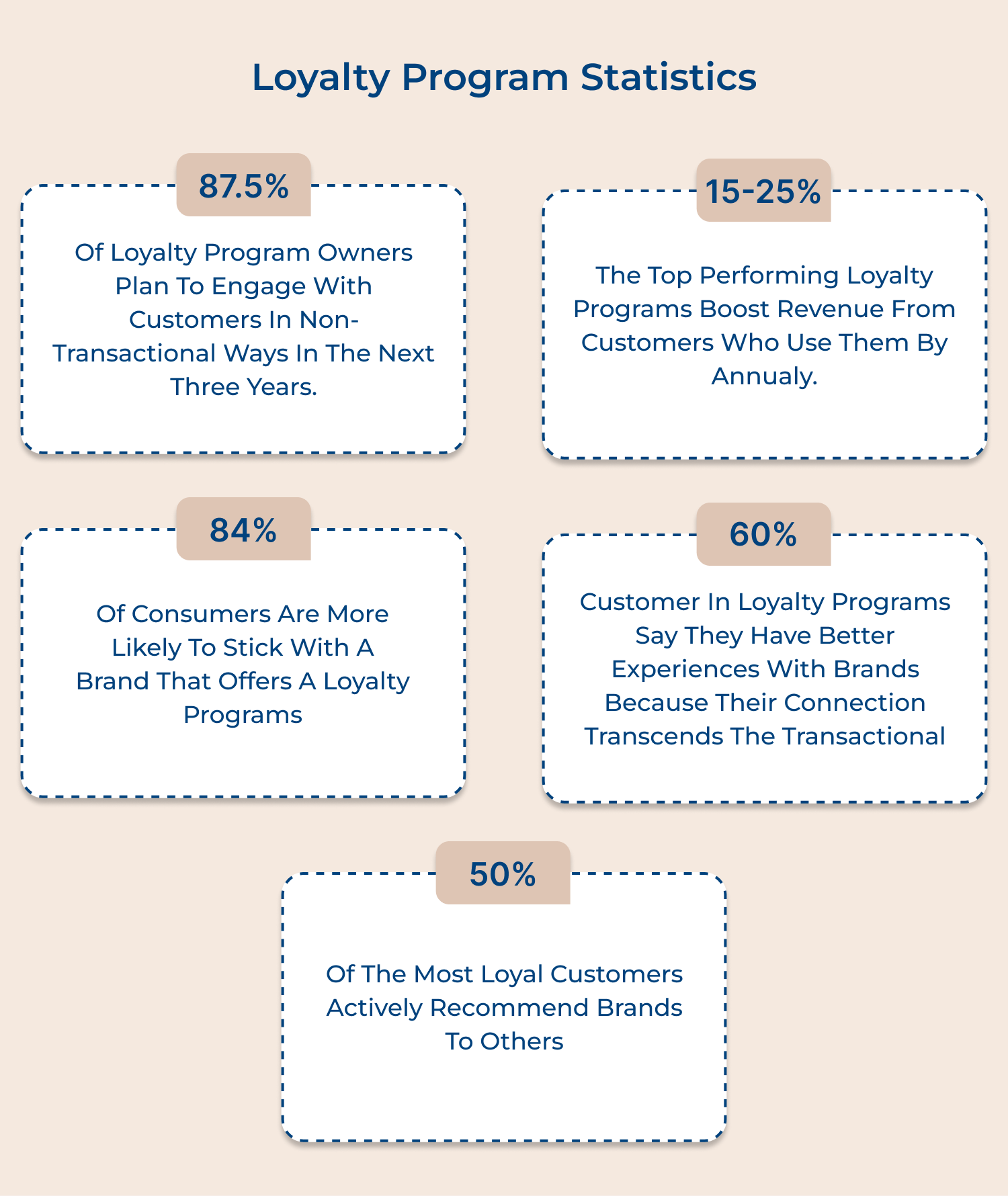
29. The redemption rate of loyalty program rewards amounted to 49.8 percent across the globe in 2023.
The fundamental engagement metric reveals that nearly half of all earned rewards actually get used by customers, indicating moderate program effectiveness. When customers actively redeem rewards, they demonstrate genuine value perception and ongoing relationship investment with the brand.
30. The average annual activity rate across loyalty programs is 59%.
The above statistic shows that more than half of loyalty program members actively engage with their programs each year through earning or redeeming activities. Active participation indicates successful program design that creates meaningful touchpoints between customers and brands beyond basic transactions.
31. Engagement is down 10% among US consumers since our initial study in 2022. Loyalty dropped by twice as much—20% lower than two years ago.
The concerning trend reveals how program saturation affects customer attention and commitment, as consumers spread their loyalty across multiple competing programs. The accelerating decline suggests businesses must innovate rapidly to maintain meaningful customer connections in increasingly crowded loyalty landscapes.
Studying how top brands build fierce loyalty uncovers the key strategies and benchmarks that set market leaders apart in forging enduring customer bonds.
32. Apple has a 92 percent retention rate among iPhone users, while Samsung has a 77 percent retention rate.
Apple’s remarkable retention advantage demonstrates how ecosystem integration and premium positioning create switching barriers that keep customers within the brand family. When customers invest in Apple’s interconnected devices practical, making alternative brands less attractive despite competitive offerings.
33. Starbucks has a higher customer retention rate of 44% than the industry average of 25%.
This substantial outperformance showcases how experiential brands can achieve loyalty rates nearly double their industry peers through consistent experience delivery and emotional connection. Starbucks transforms routine coffee purchases into lifestyle choices, creating habitual loyalty that transcends simple product preferences and price considerations.
34. Nike achieved 86% loyalty among existing sportswear owners, with 54% likely to purchase again.
Nike’s exceptional loyalty metrics reflect how brand identity and aspirational marketing create emotional bonds beyond functional product benefits. The company’s success demonstrates that when brands successfully align with customer self-image and values, loyalty becomes part of personal identity rather than mere purchasing convenience.
35. Starbucks Rewards members drove 55% of the Seattle-based company’s U.S. operating revenue for its third quarter that ended in October 2022.
This revenue concentration reveals how effective loyalty programs can fundamentally transform business models, making program members the primary profit drivers rather than occasional contributors. When loyalty programs achieve this level of business impact, they become strategic assets that directly influence company valuation and growth potential.
Modern technology transforms how businesses create and maintain customer relationships, moving beyond simple transactions to build intelligent, personalized experiences that adapt to individual preferences and behaviors in real-time.
36. 39.6% of consumers would be more likely to join a loyalty program if it had AI.
The above statistic reveals how artificial intelligence has become a compelling feature that attracts customers to loyalty programs rather than being perceived as impersonal technology. When consumers understand that AI can deliver more relevant rewards and experiences, they actively seek out these enhanced programs.
37. 95% of loyalty program members want to engage with their brand’s program through new and emerging technologies.
The overwhelming desire for technological innovation demonstrates that customers expect continuous evolution in how they interact with brands. Traditional loyalty approaches no longer satisfy digitally-savvy consumers who demand cutting-edge features that simplify and enhance their engagement experiences across multiple touchpoints.
38. 59% of consumers believe generative AI will change how they interact with companies in the next two years.
This forward-looking expectation shows that customers anticipate fundamental shifts in business relationships driven by AI capabilities. Companies that prepare for these changes now will gain competitive advantages in customer communication, support and personalization as AI becomes the standard interface.
39. More than 60% of agents say they could perform their jobs better if they had access to more data to personalize interactions.
Technology empowers customer service teams to deliver individualized experiences by providing comprehensive customer insights during every interaction. When agents have access to behavioral data, purchase history and preferences, they can create more meaningful conversations that strengthen loyalty bonds.
Customer loyalty statistics serve as your strategic compass, revealing the hidden patterns that separate thriving businesses from struggling competitors. These data-driven insights transform assumptions into actionable strategies, enabling you to build deeper relationships that drive sustainable growth.
Understanding these metrics empowers you to anticipate customer needs, optimize program effectiveness and create experiences that foster genuine emotional connections. By leveraging loyalty statistics, you transform raw data into competitive advantages that increase retention, boost revenue and build lasting brand advocacy.

What brand loyalty strategies make loyalty programs succeed?
Successful loyalty programs combine personalized rewards with emotional engagement, utilizing data analytics to deliver relevant experiences. Key strategies include tiered benefits, omnichannel integration, gamification elements and consistent value delivery that aligns with customer preferences and behaviors for maximum retention impact.
Why is customer loyalty important statistics?
Customer loyalty statistics reveal that loyal customers spend 67% more than new customers and cost five times less to retain than acquire. These metrics demonstrate measurable business impact through increased lifetime value, reduced churn rates and organic growth through referrals.
What are the statistics for customer satisfaction and loyalty?
Customer satisfaction directly correlates with loyalty, as 89% of customers return after positive service experiences while 96% leave after poor service. Additionally, 73% of customers report that service quality significantly influences their loyalty decisions, making satisfaction a critical loyalty driver for sustainable business growth.
What are the customer loyalty statistics: Facts & Trends for 2024?
Key 2024 trends show 69% of consumers report brand loyalty declining from 77% in 2022, while AI-powered loyalty programs attract 39.6% more interest. Additionally, 95% of loyalty members want emerging technology integration and emotional loyalty has grown 26% since 2021, reaching 34% currently.
 https://omni24.io/wp-content/uploads/2026/09/Social-commerce-scaled.png
1340
2560
Webvision Solution
https://omni24.io/wp-content/uploads/2023/04/Omni-Logo-1.svg
Webvision Solution2026-10-23 12:18:272026-10-23 12:18:27What is Social Commerce and Why Does It Matter?
https://omni24.io/wp-content/uploads/2026/09/Social-commerce-scaled.png
1340
2560
Webvision Solution
https://omni24.io/wp-content/uploads/2023/04/Omni-Logo-1.svg
Webvision Solution2026-10-23 12:18:272026-10-23 12:18:27What is Social Commerce and Why Does It Matter? https://omni24.io/wp-content/uploads/2026/08/AI-Customer-Service-Agents.png
1256
2400
Webvision Solution
https://omni24.io/wp-content/uploads/2023/04/Omni-Logo-1.svg
Webvision Solution2026-09-21 04:48:512026-09-21 04:48:51How to Build an AI Customer Service Agents: 8 Key Steps
https://omni24.io/wp-content/uploads/2026/08/AI-Customer-Service-Agents.png
1256
2400
Webvision Solution
https://omni24.io/wp-content/uploads/2023/04/Omni-Logo-1.svg
Webvision Solution2026-09-21 04:48:512026-09-21 04:48:51How to Build an AI Customer Service Agents: 8 Key Steps https://omni24.io/wp-content/uploads/2026/08/Omnichannel-Conversational-AI.png
1256
2400
Tushar Joshi
https://omni24.io/wp-content/uploads/2023/04/Omni-Logo-1.svg
Tushar Joshi2026-09-16 03:51:072026-09-16 03:51:07How to Build Omnichannel Conversational AI Strategy
https://omni24.io/wp-content/uploads/2026/08/Omnichannel-Conversational-AI.png
1256
2400
Tushar Joshi
https://omni24.io/wp-content/uploads/2023/04/Omni-Logo-1.svg
Tushar Joshi2026-09-16 03:51:072026-09-16 03:51:07How to Build Omnichannel Conversational AI Strategy
Whether it’s about acquire, engage or support – Omni24 covers all your customer engagement needs in one complete platform.

Copyright ©2026 Veemo All rights reserved.
CA, Los Angeles, Hall Ave, 19011