What is Customer Success Automation & How to Automate it?
Automation in customer success simplifies operations and provides clearer visibility into customer behavior. It helps teams act faster and support accounts.
Automation in customer success simplifies operations and provides clearer visibility into customer behavior. It helps teams act faster and support accounts.
Your customer-success team is drowning in repetitive tasks — and as a result, some struggling customers slip through the cracks. Manual workflows lead to inconsistent experiences, wasted time and lost revenue when unhappy customers quietly churn.
Customer-success automation changes that. Studies show 70 % of teams now use automation tools and companies leveraging such tools see up to a 22 % increase in customer lifetime value while improving onboarding efficiency by as much as 50 %.
By automatically handling routine tasks automation frees your team to focus on building meaningful relationships. The results are happier customers, consistent experiences and real growth.
Customer success automation uses technology to streamline and scale how businesses help customers achieve their goals. Instead of relying solely on manual outreach and support, companies deploy software tools that automatically track customer health scores, trigger personalized communications and identify at-risk accounts.
The system continuously monitors customer data like product usage patterns and engagement metrics to build comprehensive health profiles. When specific triggers occur automated workflows spring into action. These might send targeted emails, schedule check-in calls, or alert team members to intervene personally when human touch becomes essential.
Key objectives:
Customer success automation transforms how businesses nurture relationships by delivering consistent value at scale. Let’s explore the benefits one step at a time:
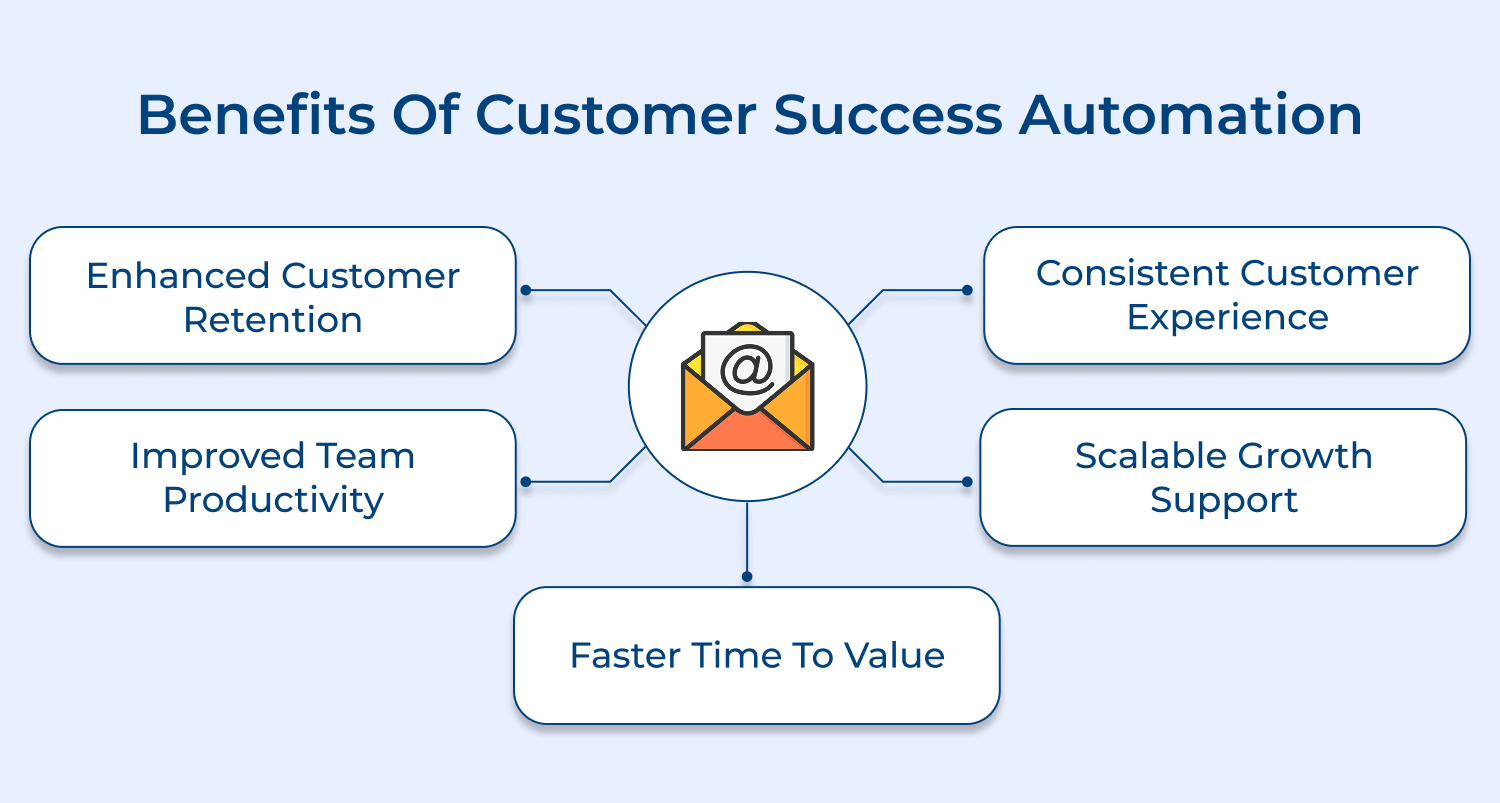
Enhanced customer retention: Automation helps you catch issues before they turn into churn. When usage drops or payments are delayed, the system instantly flags it and triggers the right action. This proactive approach lets you step in early, long before customers think about leaving.
Improved team productivity: Your team no longer has to chase follow-ups or manually monitor renewals. Automation handles the repetitive work so your customer success reps can focus on deeper conversations and solving bigger challenges.
Consistent customer experience: Every customer gets the same smooth onboarding and timely check-ins, no matter who manages their account. Automated workflows remove the guesswork and prevent gaps that happen with manual processes.
Scalable growth support: As your customer base grows, automation helps you manage hundreds or thousands of accounts without sacrificing quality. You can scale confidently, knowing the experience stays consistent.
Faster time to value: Automated onboarding flows and guided product tours help customers see value faster. They reach key milestones sooner, lowering early-stage churn and boosting initial satisfaction.
Here are seven critical steps to automate customer success, ensuring that your team can focus on what they do best – building meaningful relationships with your customers.
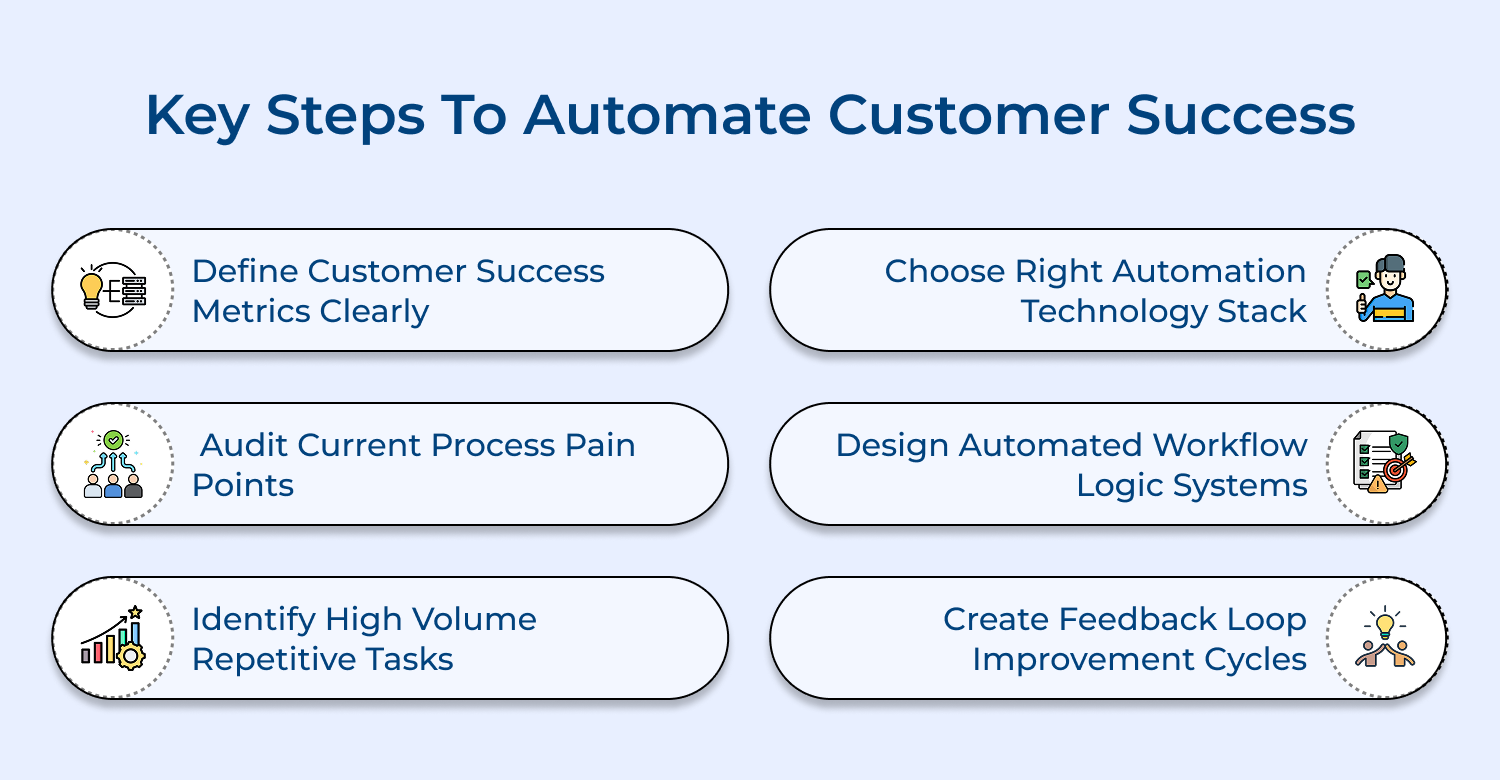
Customer success metrics serve as your North Star for understanding what meaningful outcomes look like from your customers’ perspective. Without clear definitions you cannot measure progress or identify when automation should intervene to guide customers toward their goals.
You can implement this by conducting customer interviews to understand their desired outcomes then translating those qualitative goals into quantitative measurements. Track metrics like time-to-value feature adoption rates and business impact scores that directly correlate with customer satisfaction as well as retention.
Pro tips:
Start by taking a clear, honest look at how your customer success operations actually run. The goal isn’t just to digitize what’s already broken — it’s to find friction, fix it and then automate the right steps.
Here are three simple ways to uncover real automation opportunities:
For example, a B2B project management platform found most users dropped off during integration setup. Their audit revealed a 48-hour wait for manual support, the perfect area for automation.
High volume repetitive tasks represent the sweet spot for customer success automation because they consume significant team resources while often providing inconsistent customer experiences. Automating these activities frees your human experts to focus on complex problem-solving and relationship building that truly requires emotional intelligence.
Answer these five strategic questions to systematically identify which repetitive tasks deserve automation priority:
What customer communications do we send weekly that follow similar templates? This helps identify email sequences, welcome messages and check-in communications that could be automated while maintaining personalization.
Which data entry tasks does our team perform multiple times daily? This reveals opportunities to automate customer health scoring account updates and activity logging that currently waste valuable human time.
What customer questions do we answer repeatedly through support channels? This identifies knowledge base content and chatbot opportunities that could provide instant answers for common customer inquiries.
Which customer onboarding steps require the same explanation for every new client? This highlights tutorial sequences, product walkthroughs and setup processes that could be standardized through automated guidance systems.
Choosing the right automation stack is the backbone of your customer success strategy. If your tools don’t integrate well, you’ll end up with data silos, broken workflows and frustrated customers.
Here are four things to evaluate when choosing your tech stack:
Once you know your criteria, here are the four most common automation stacks businesses rely on:
Choose a stack that fits your team size, budget and long-term customer success goals.
Automated workflow logic acts as the “brain” of your customer success automation. It decides when to respond, how to respond and what action to take based on customer behavior — all without your team manually tracking every detail. When designed well, these workflows deliver timely, consistent support that keeps customers on track.
The first step is building trigger-based rules that fire when certain behaviors occur. Common examples include:
Once a trigger fires, the system follows decision trees that factor in segment, account value and context to choose the right action — whether that’s an educational email, a guided resource, a check-in call, or a CSM alert.
But automation shouldn’t replace human judgment. That’s why clear escalation pathways matter. When situations are complex or sensitive, workflows should route customers to a real person who can handle the nuance.
Creating strong feedback loops is all about building a simple, repeatable process to keep your automation systems improving over time. As customer needs shift and your business grows, these continuous updates make sure your workflows stay relevant.
A practical way to do this is by scheduling regular review sessions. During these check-ins, your team can look at performance metrics, customer satisfaction scores and efficiency gains to understand what’s working. Pair this data with real feedback from customers and your internal team. Together, these insights make it easy to spot gaps, refine workflows and keep your automation running smoothly.
Pro tips:
Smart automation transforms routine customer success activities into seamless experiences while freeing your team for strategic relationship building.
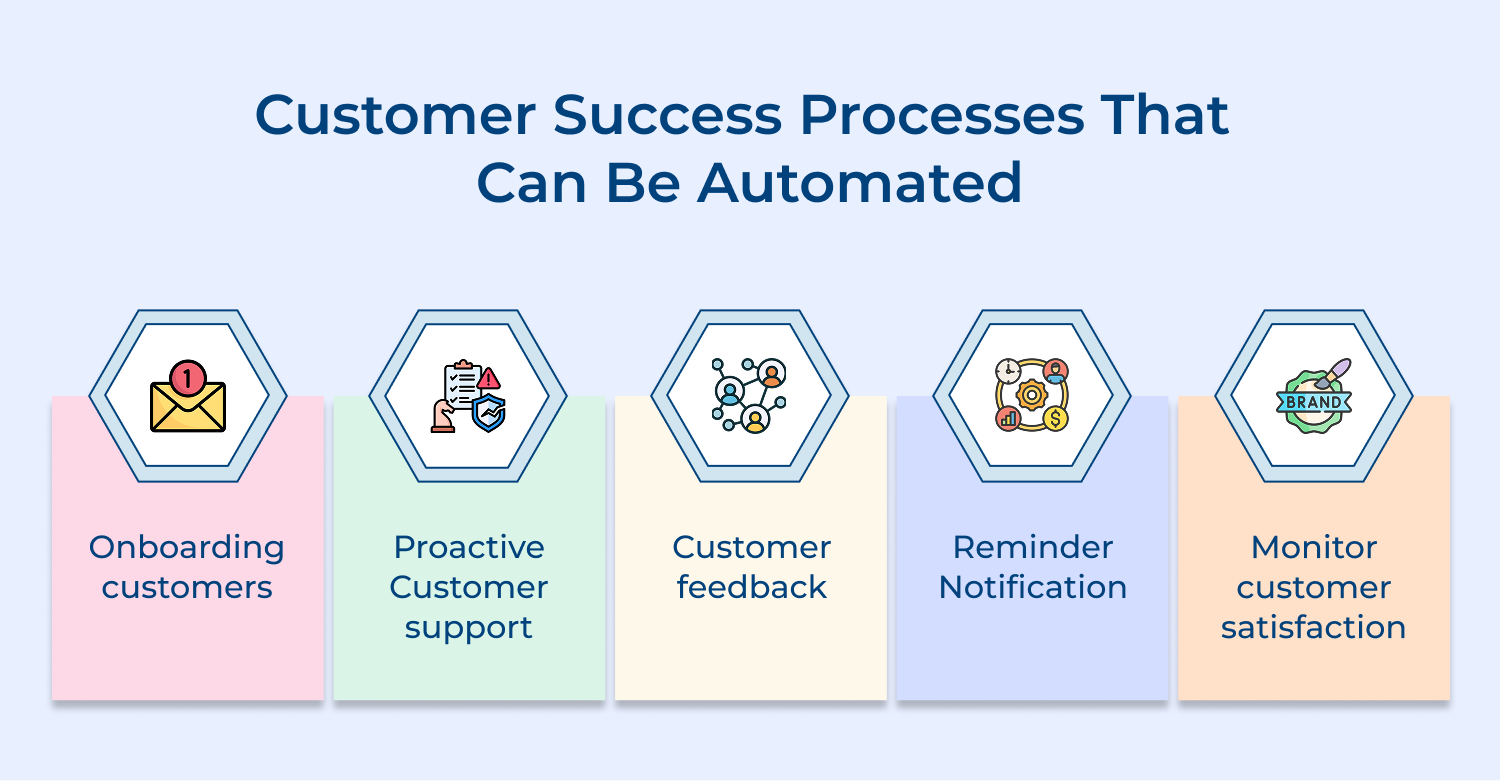
Customer onboarding automation creates structured journeys that guide new users from signup to first value achievement. These systems deliver personalized welcome sequences based on customer segments while tracking completion rates to identify where users get stuck.
Key automation components worth considering for effective onboarding include:
Automated onboarding includes intelligent content delivery that presents tutorials exactly when customers need them most. Advanced systems detect when users struggle with specific features then automatically provide targeted help through in-app messages.
Proactive support automation identifies potential issues before customers experience frustration by monitoring usage patterns continuously. These systems detect declining engagement or technical problems then automatically trigger appropriate interventions like helpful resources or direct outreach.
Essential elements that make proactive support automation genuinely effective:
Smart proactive support delivers contextual assistance that feels helpful rather than intrusive. These systems learn from customer behavior patterns to predict what type of support each user needs at different journey stages.
Automated feedback systems capture customer insights at optimal moments without creating survey fatigue or interrupting workflows. These platforms trigger different feedback requests based on customer actions like completing onboarding or reaching usage milestones.
Sophisticated feedback automation includes intelligent follow-up sequences that respond differently based on customer responses. Happy customers might receive requests for testimonials while dissatisfied users get immediate attention from customer success managers.
Automated reminder systems ensure customers never miss important deadlines or opportunities that could impact their success. These notifications include contextual information about why each reminder matters and what actions customers should take next.
Effective reminder automation personalizes timing as well as messaging based on individual customer preferences. Some customers prefer email notifications while others respond better to in-app messages at different times of day.
Automated health monitoring creates comprehensive dashboards that combine multiple data sources to provide early warning systems for potential churn or expansion opportunities. These systems track engagement levels and support interactions to generate actionable insights about customer trajectory.
Consider these essential questions when building automated health monitoring:
Advanced health monitoring automation identifies positive signals indicating expansion opportunities like increased team size or feature usage patterns suggesting readiness for plan upgrades.
Automated celebration systems recognize customer achievements to reinforce positive behaviors while building emotional connections with your brand. These programs detect when customers reach milestones then trigger personalized congratulatory messages or reward delivery.
Modern customer success automation platforms provide essential capabilities that transform how businesses nurture relationships. Here are its key features:
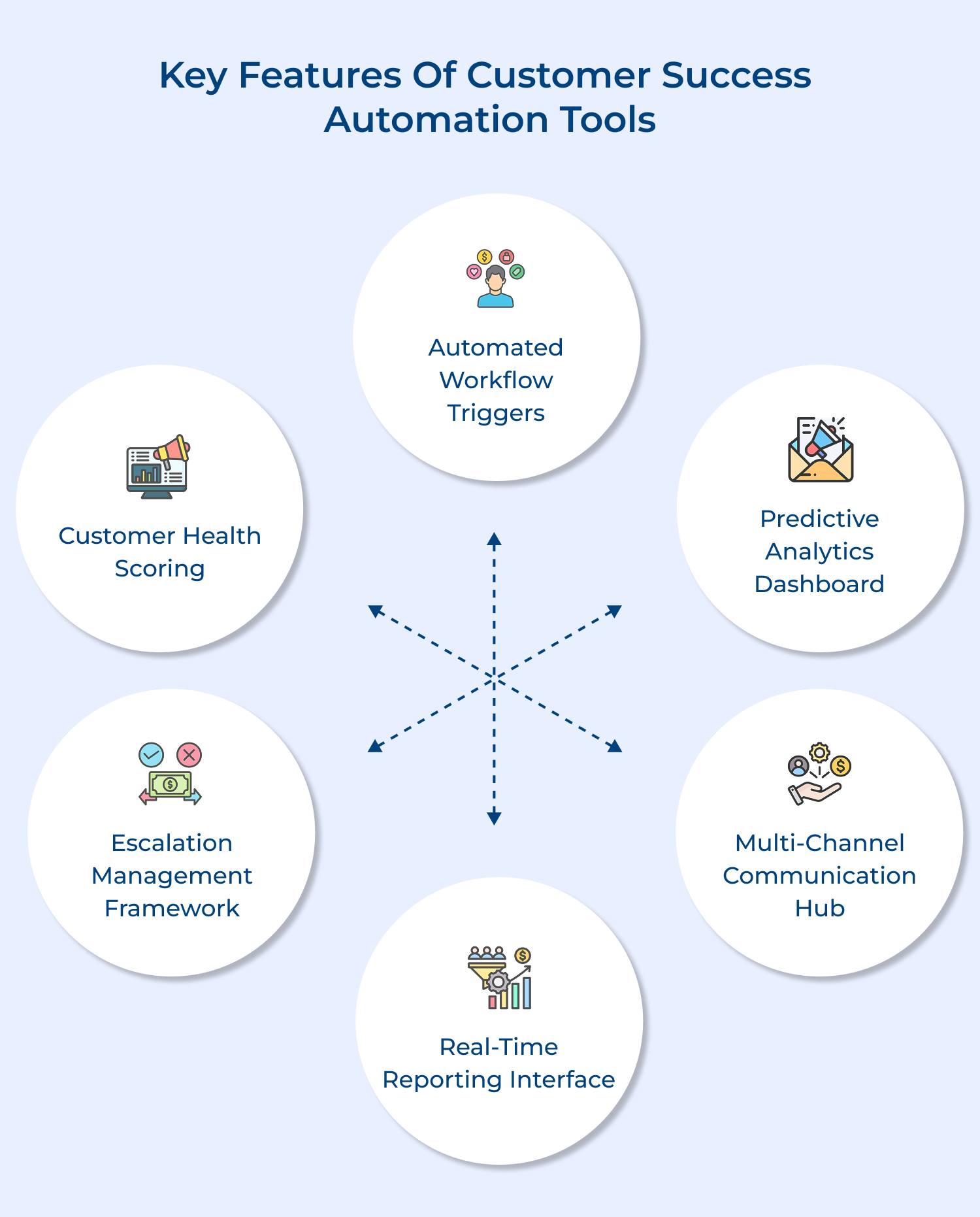
Measuring automation effectiveness requires tracking specific indicators that reveal whether your systems truly improve customer outcomes and operational efficiency.
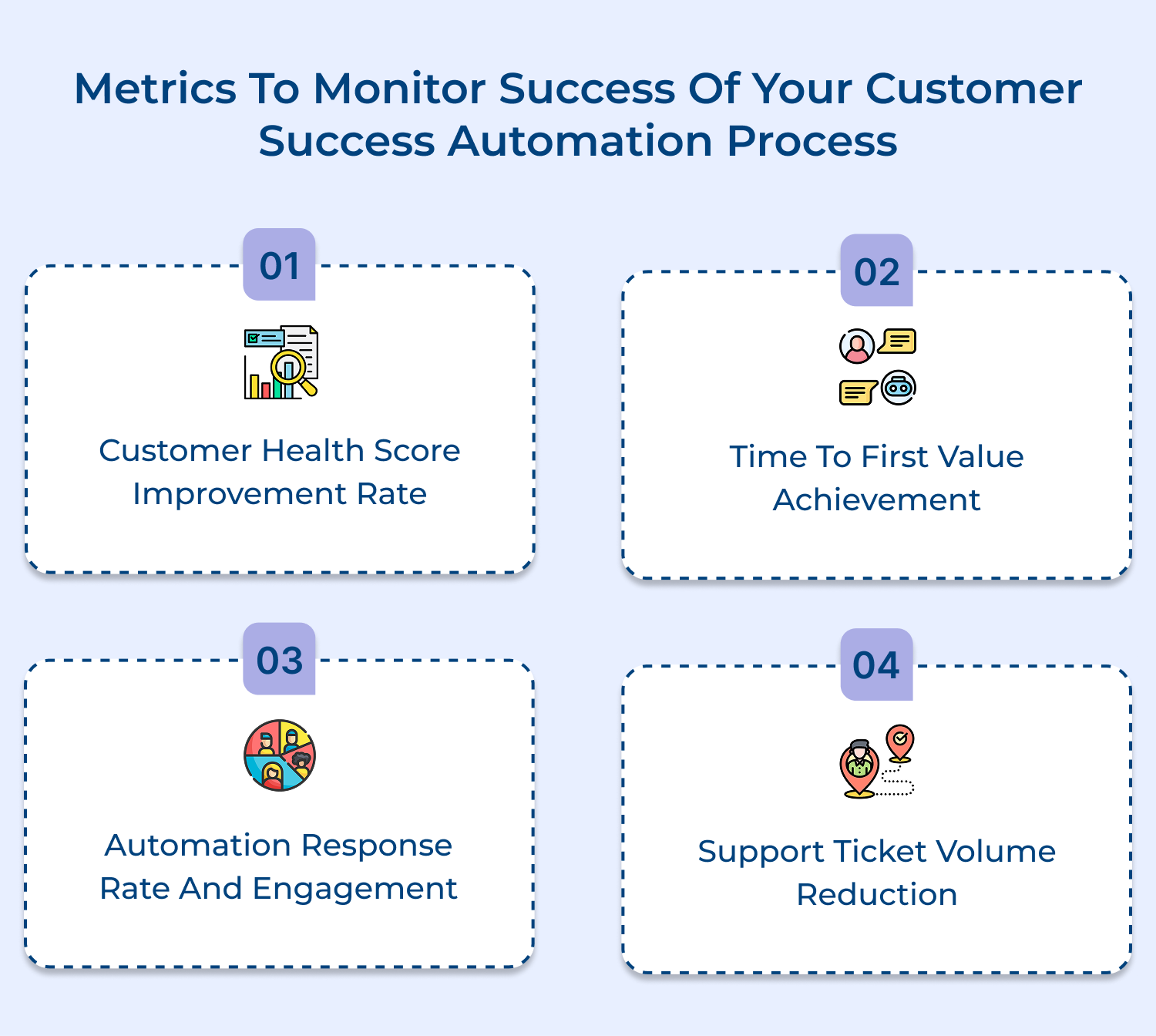
Track how quickly customers move from lower health scores to higher wellness ratings after automated interventions activate. This metric reveals whether your automation actually helps struggling customers recover rather than simply flagging problems without solving them.
Measure the average duration between customer signup and their first meaningful success milestone through automated onboarding sequences. Shorter timeframes indicate that automation effectively guides new customers toward quick wins and reduces early churn risk.
Monitor how frequently customers engage with automated emails, complete suggested actions and respond positively to triggered communications. High engagement rates demonstrate that automated messages feel relevant and valuable rather than intrusive to recipients.
Calculate the decrease in reactive support requests after implementing proactive automation that addresses common customer questions before they escalate. This metric shows whether automation prevents problems rather than simply managing them after they occur.
Customer success automation transforms reactive support into proactive relationship building by systematically guiding customers toward their goals. Think of it as creating a reliable framework that ensures every customer receives consistent attention and support throughout their journey.
When you implement these automated systems thoughtfully, you establish predictable pathways to customer satisfaction and business growth. This standardized approach means success becomes the expected outcome rather than a happy accident that depends on individual team member availability.

How can customer success automation improve client retention rates?
Customer success automation improves retention by continuously monitoring customer health signals and automatically triggering interventions when warning signs appear. The system proactively addresses issues before they escalate into cancellations. It ensures consistent touchpoints reinforce value as well as maintain strong relationships throughout the customer lifecycle.
How does customer success automation integrate with CRM and support platforms?
Customer success automation integrates through APIs that create seamless data flow between your CRM, support tickets and product usage analytics. This connectivity builds unified customer profiles that automatically update across all systems, ensuring your team has complete visibility while eliminating manual data entry while reducing information silos.
How does customer success automation personalize customer communications?
Customer success automation personalizes communications by analyzing individual behavior patterns, preferences and engagement history to craft targeted messages for each customer segment. The system dynamically adjusts content timing and delivery channels based on what resonates best with specific customers, making automated outreach feel genuinely personal rather than generic.
How does customer success automation help in proactive outreach to customers?
Customer success automation enables proactive outreach by setting intelligent triggers that detect when customers need assistance before they ask for help. The system automatically initiates appropriate communications like educational content or check-in calls when usage drops or milestones approach, preventing problems from becoming frustrations that damage relationships.
What are the challenges of customer success automation?
Customer success automation faces challenges including over-automation that feels impersonal, complex setup requirements and the risk of losing human touch in critical relationship moments. Organizations must balance efficiency gains with authentic customer connections while ensuring automated systems complement rather than replace meaningful human interactions as well as strategic relationship building.
 https://omni24.io/wp-content/uploads/2026/08/AI-Customer-Service-Agents.png
1256
2400
Webvision Solution
https://omni24.io/wp-content/uploads/2023/04/Omni-Logo-1.svg
Webvision Solution2026-09-21 04:48:512026-09-21 04:48:51How to Build an AI Customer Service Agents: 8 Key Steps
https://omni24.io/wp-content/uploads/2026/08/AI-Customer-Service-Agents.png
1256
2400
Webvision Solution
https://omni24.io/wp-content/uploads/2023/04/Omni-Logo-1.svg
Webvision Solution2026-09-21 04:48:512026-09-21 04:48:51How to Build an AI Customer Service Agents: 8 Key Steps https://omni24.io/wp-content/uploads/2026/08/Omnichannel-Conversational-AI.png
1256
2400
Tushar Joshi
https://omni24.io/wp-content/uploads/2023/04/Omni-Logo-1.svg
Tushar Joshi2026-09-16 03:51:072026-09-16 03:51:07How to Build Omnichannel Conversational AI Strategy
https://omni24.io/wp-content/uploads/2026/08/Omnichannel-Conversational-AI.png
1256
2400
Tushar Joshi
https://omni24.io/wp-content/uploads/2023/04/Omni-Logo-1.svg
Tushar Joshi2026-09-16 03:51:072026-09-16 03:51:07How to Build Omnichannel Conversational AI Strategy https://omni24.io/wp-content/uploads/2026/08/Customer-Service-Teams.png
1256
2400
Tushar Joshi
https://omni24.io/wp-content/uploads/2023/04/Omni-Logo-1.svg
Tushar Joshi2026-09-15 04:01:522026-09-15 04:02:16How to Build Customer Service Teams: 6 Key Steps
https://omni24.io/wp-content/uploads/2026/08/Customer-Service-Teams.png
1256
2400
Tushar Joshi
https://omni24.io/wp-content/uploads/2023/04/Omni-Logo-1.svg
Tushar Joshi2026-09-15 04:01:522026-09-15 04:02:16How to Build Customer Service Teams: 6 Key Steps
Whether it’s about acquire, engage or support – Omni24 covers all your customer engagement needs in one complete platform.

Copyright ©2026 Veemo All rights reserved.
CA, Los Angeles, Hall Ave, 19011