How to Achieve a 360-Degree Customer View: 7 Key Steps
A 360 degree customer view delivers complete customer insight, enabling personalized experiences and stronger relationships.

A 360 degree customer view delivers complete customer insight, enabling personalized experiences and stronger relationships.
Most businesses think they know their customers but a name and purchase history don’t equal true understanding. Fragmented data across disconnected systems creates experience gaps that cost businesses revenue and loyalty.
Companies with 360-degree views see 20-30% higher customer retention and improved LTV through deeper insights into behavior, preferences, interactions.
The real problem runs deeper than bad technology, it is the absence of a unified customer view that leaves every team working from an incomplete picture. A 360-degree customer view fixes this by connecting every data point into an actionable customer profile.
Following this guide breaks down exactly what it takes to build the components, strategies and tangible business outcomes.
A 360-degree customer view is a unified profile of every customer built by pulling together data from every touchpoint they have with your business. It gives you the full picture not just of who they are but how they behave, what they need and where they are in their journey with you.
Traditional CRM systems do a decent job of storing basic customer information like names, contact details and purchase history. But that alone doesn’t tell you why a customer churned or what they were feeling when they last reached out to your support team.
A true 360-degree view connects behavioral signals, service interaction and real-time engagement patterns to give your team the context they need to act meaningfully. When your sales, marketing and support teams all work from the same complete picture, the experience you deliver becomes consistent and relevant.
A complete 360-degree customer view typically includes:
In today’s competitive landscape, businesses that truly know their customers hold a decisive edge and a 360-degree customer view is exactly what makes that possible across every industry.
Here are 4 recent stats that reflect just how critical a unified customer view has become:
In this article, we’ll explore the myriad benefits of leveraging a 360-degree customer view and how it can transform your business operations.
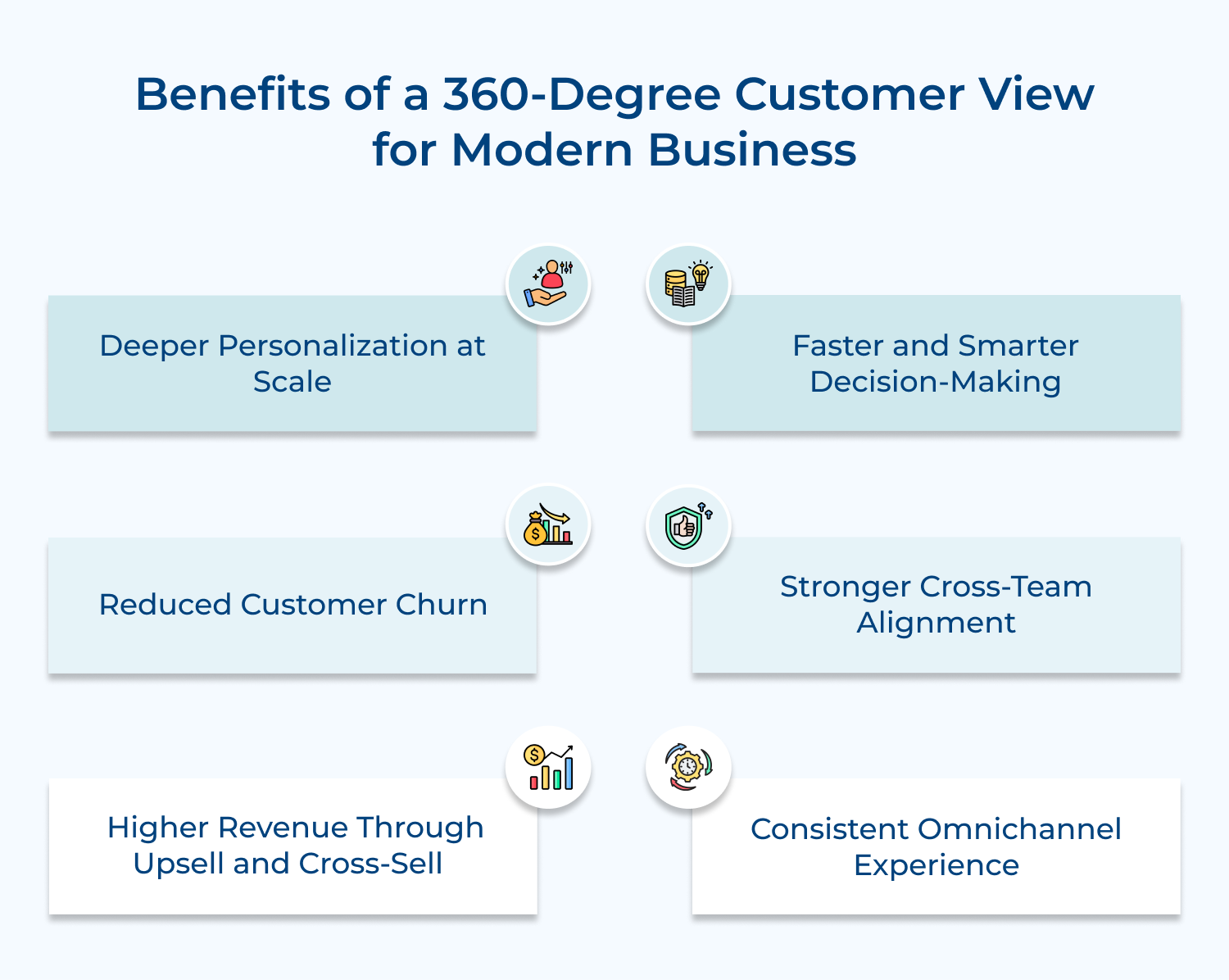
1. Deeper Personalization at Scale
When you have a complete view of each customer—their history, preferences and behavior—personalizing at scale stops being a challenge, starts being a competitive advantage. Teams that stop guessing and start acting on unified data consistently deliver more relevant experiences that convert, retain.
2. Faster and Smarter Decision-Making
A 360-degree view puts real-time customer context in front of the right people at the right time whether that’s a sales rep preparing for a call or a support agent handling a complaint. Decisions made with complete information are almost always sharper and faster than those made from fragmented data.
3. Reduced Customer Churn
One of the clearest patterns in CRM practice is that churn rarely happens without warning the data is usually there but sitting in silos. A unified customer view helps teams spot disengagement signals early and act before the relationship breaks down completely.
4. Stronger Cross-Team Alignment
Sales, marketing and service teams often operate from different data sets which creates inconsistent customer experiences. When everyone works from the same 360-degree profile, the customer no longer has to repeat themselves and internal teams stop working against each other.
5. Higher Revenue Through Upsell and Cross-Sell
A complete customer profile reveals natural buying patterns and unmet needs that teams would otherwise miss entirely. When reps know what a customer already owns and what they have shown interest in, upselling feels like helpful guidance rather than a sales push.
6. Consistent Omnichannel Experience
Customers today move across channels email, chat, store, app and they expect the journey to feel seamless no matter where they engage. A 360-degree view ensures that every touchpoint feels connected, informed rather than disjointed and repetitive.
Understanding what actually builds a complete customer view helps businesses move from scattered data to deliberate and consistent customer experiences.
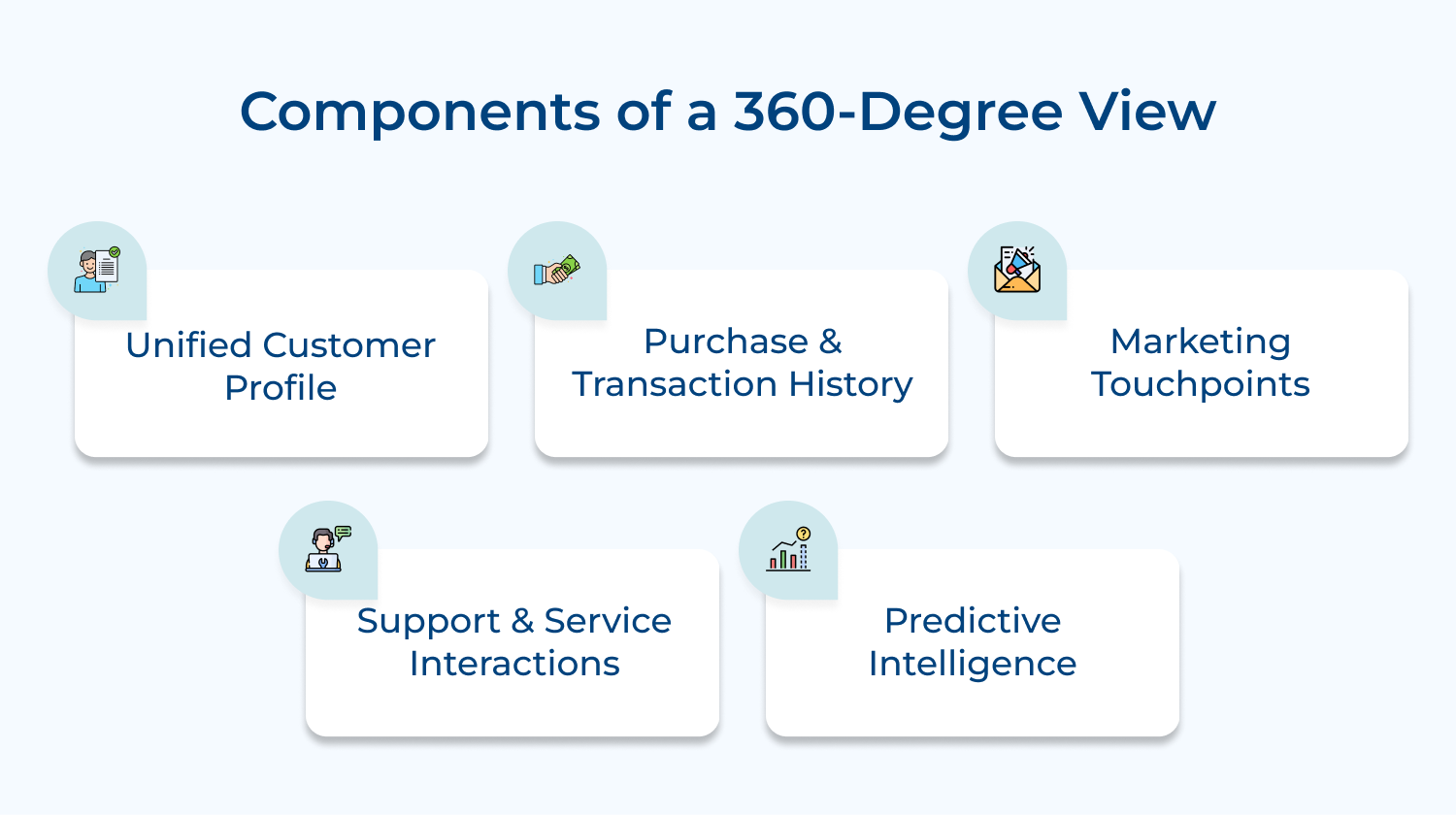
A unified profile is not just a data record it is the single source of truth that every customer-facing team operates from confidently. When this foundation is weak, every downstream decision about that customer becomes unreliable and inconsistent across teams.
A strong unified profile captures more than just basic contact details:
When a customer reaches out after engaging with a campaign, the team receiving that interaction should already have full context ready. That readiness is only possible when the unified profile is treated as a living document rather than a static database entry.
Transaction history is one of the most honest data sets available; it reflects real decisions a customer made rather than assumed intent. Patterns within this history reveal buying frequency, category loyalty and the moments when a customer’s needs begin to evolve naturally.
Beyond recording past purchases, this component helps teams identify where a customer is in their lifecycle and what they are likely to need next. Businesses that actively analyze transaction history consistently find revenue opportunities hiding inside relationships they already own.
Marketing touchpoint data connects campaign activity to real customer behavior showing exactly what influenced a decision before a purchase was made. Without this connection, teams end up optimizing campaigns based on vanity metrics rather than actual conversion evidence.
Tracking marketing touchpoints effectively means going beyond basic open rates:
Once touchpoint data is connected to the broader customer profile, messaging stops being broadcast and starts being a genuine response to demonstrated interest. The difference in conversion and retention outcomes between these two approaches is significant, consistently measurable.
Every service interaction is a direct signal of where the customer experience has a gap and that signal deserves the same strategic attention as any sales data point. Teams that mine service history for patterns will always understand their customers more completely than those who treat support as purely operational.
When service data is disconnected from the rest of the customer profile, businesses keep making the same mistakes because no one has the full picture. Connecting this history across teams ensures that the next interaction whether sales, marketing or service starts from an informed and empathetic position.
Predictive intelligence is what separates businesses that react to customer behavior from those that shape it through timely and relevant engagement. It uses clean historical data to surface forward-looking signals, churn risk, next purchase likelihood and lifetime value potential before they become visible through conventional reporting.
Predictive intelligence at its best works across multiple dimensions of the customer relationship:
When predictive models are built on clean and connected data from all other four components, the accuracy improves substantially. The real value is not in the prediction itself, it is in giving teams enough lead time to act with intention rather than urgency.
Most businesses don’t realize they need a 360-degree customer view until the gaps start costing them visibly here are five signs to watch for.
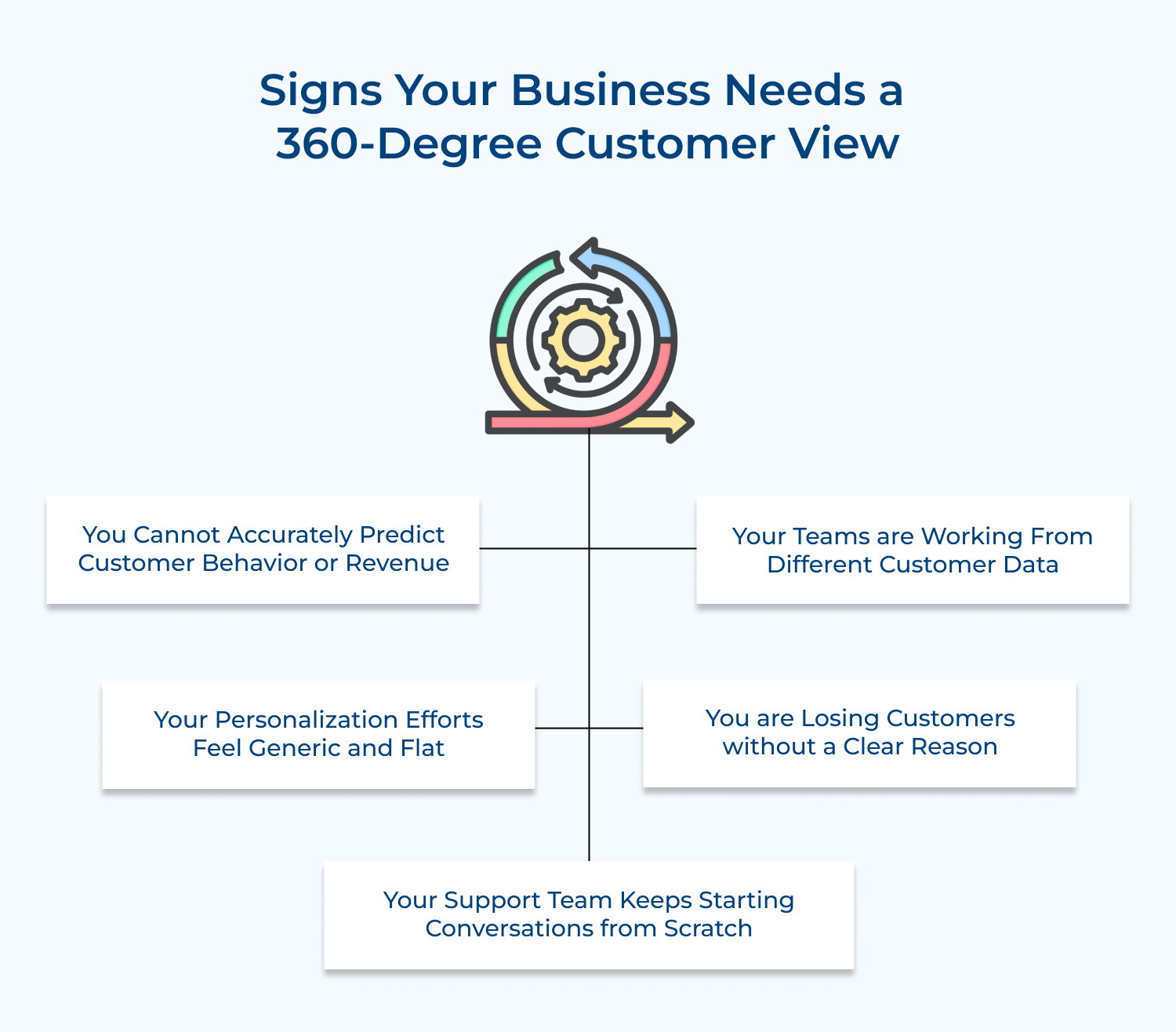
1. Your Teams Are Working From Different Customer Data
When sales, marketing and service teams each hold a different version of the same customer’s story, the experience delivered will always feel fragmented. Disconnected data is not just an internal inefficiency it is something customers notice and feel during every single interaction.
2. You Are Losing Customers Without a Clear Reason
Churn that cannot be explained is almost always a data visibility problem warning signs were present but buried across systems that never communicated. Businesses without a unified view are navigating retention blind and responding to losses they had every opportunity to prevent.
3. Your Personalization Efforts Feel Generic and Flat
When personalization is limited to a first name in an email, it signals that the underlying data is too shallow for meaningful engagement. Real personalization requires behavioral context, purchase history and service data all working together in one connected place.
4. Your Support Team Keeps Starting Conversations From Scratch
When customers repeat their history on every support interaction, it signals a serious gap in how data is shared across the business. This experience erodes trust quickly because it tells the customer their relationship with the brand is simply not remembered.
5. You Cannot Accurately Predict Customer Behavior or Revenue
When forecasting relies on gut feel rather than behavioral patterns and historical data, assumptions become increasingly expensive over time. A fragmented data environment makes reliable prediction nearly impossible because the inputs feeding those models are incomplete at the source.
In this article, we’ll explore strategies and tools to help you develop a holistic understanding of your customers, transforming data into powerful, actionable insights.
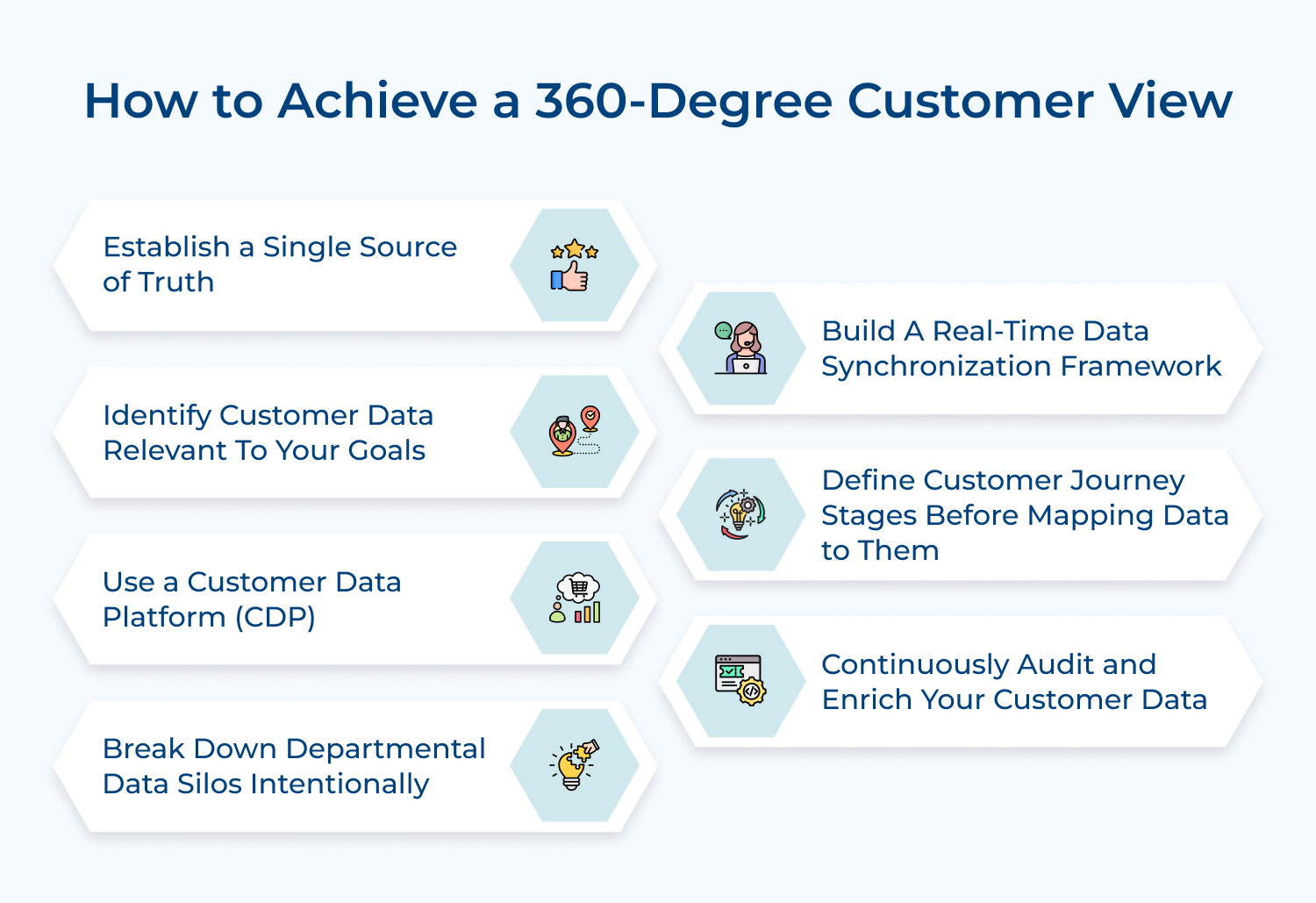
Most customer experience failures trace back to one root cause teams acting on different versions of the same customer’s data. Until that foundation is fixed, every personalization and retention strategy built on top will keep producing inconsistent results.
The audit comes before the technology businesses skipping directly to platform implementation without mapping existing data end up recreating fragmentation inside a newer system. Start by identifying every system holding customer data and understanding how those systems communicate.
Four core processes that make a single source of truth achievable:
Businesses that struggle most with this step treat it as a technology project rather than an organizational discipline. Technology enables the single source of truth but process ownership and accountability are what sustain it.
The golden record is the practical output of this entire step:
Businesses building the most reliable customer views collect the most relevant data, not the most data. Unfocused collection creates noise that makes it harder to act on what actually matters for the customer experience.
Not sure where to start? Consider this 5-question checklist first:
Running these questions cross-functionally immediately exposes which data points drive decisions and which ones are collected purely out of habit. That distinction alone saves businesses from building a bloated data environment no team actually uses effectively.
Four key actions to execute this step with precision:
Choosing the wrong CDP costs far more to undo than it did to make most businesses realize this only after a lengthy implementation. Before evaluating features, validate whether the CDP integrates cleanly with existing tools without demanding a complete infrastructure rebuild.
Three effective ways to use a CDP to build a 360-degree customer view:
Consider a mid-sized skincare ecommerce brand sending the same promotional email to their entire customer base weekly. Their support team had no purchase visibility and their website showed identical content to first-time visitors and loyal visitors alike.
After connecting their ecommerce platform, email tool and support system into a CDP, the experience shifted entirely. A repeat moisturizer buyer was automatically moved into a loyalty segment and shown relevant recommendations on their next visit.
Data silos have never dissolved on their own without deliberate leadership intervention and every day a silo remains intact is another day of fragmented customer experience. The word “intentionally” carries real weight because dismantling silos requires structural and cultural effort simultaneously.
Aligning Teams Around Shared Customer Data Ownership
The most damaging belief in any customer-facing organization is that customer data belongs to a specific department. When sales, marketing and service leaders jointly define how data is maintained, customer profile quality improves in ways no technology implementation alone can achieve.
Establishing Cross-Functional Accountability for Data Quality
Poor data quality is almost never a technology problem; it is an accountability problem that surfaces through technology. Assigning clear data stewardship roles within each department ensures the people closest to customer data are also responsible for keeping it accurate.
Creating Unified Dashboards Accessible Across All Departments
A unified dashboard removes the biggest friction point in cross-team customer management waiting on another department before making a decision. When every customer-facing team operates from the same live view, the experience delivered becomes consistent because the intelligence driving it is no longer fragmented.
A 360-degree customer view means nothing if the data feeding it is hours or days behind the customer’s actual behavior. Real-time synchronization is what keeps every team’s understanding of the customer current, accurate and actionable at the moment it matters most.
So how does syncing customer data instantly across all touchpoints actually work in practice? It works by establishing live data pipelines between every system ecommerce, support, email and web so that any customer action immediately updates the unified profile without manual intervention or batch processing delays.
Real-time sync across touchpoints depends on getting these foundations right:
When a customer behavior signal comes in a page visit, a support ticket, an abandoned cart the question is whether your systems are set up to act on it immediately or hours later. That gap between signal and action is where customer experience either wins or loses in real time.
Before setting up automated triggers, ask whether each trigger meets these conditions:
As a strong recommendation, reducing lag between customer action to response is not a technical nicety but a direct driver of customer satisfaction and conversion outcomes.
Mapping data without first defining journey stages is one of the most common reasons 360-degree customer view implementations lose their strategic value quickly. Data without journey context tells you what happened but not where it happened or why it matters to the experience being delivered.
So where does journey stage definition actually begin? It begins by bringing sales, marketing and service teams into the same room to agree on what the customer journey looks like from the customer’s perspective, not from each department’s internal process view.
Key elements to define before any data mapping begins:
Once the stages are defined, the next critical question is what data does the business actually need at each stage to make better decisions and deliver better experiences? Without answering that first, data mapping becomes a technical exercise disconnected from real customer experience outcomes.
Four key data mapping actions aligned to journey stages:
Journey stage mapping is not a one-time workshop output it needs to evolve as customer behavior and business priorities shift over time. The businesses that revisit their journey definitions regularly are the ones whose 360-degree customer view stays strategically relevant rather than becoming a static data exercise.
A 360-degree customer view is only as valuable as the quality and completeness of the data sustaining it and both degrade faster than most businesses anticipate without a structured audit process. Continuous enrichment is what separates a customer view that stays strategically useful from one that slowly becomes an expensive and unreliable data archive.
Regular audits surface the data quality issues that silently undermine personalization efforts, retention strategies and revenue forecasts long before they become visible as business problems. Businesses that schedule structured data audits quarterly find and fix inconsistencies before they compound into larger and more costly customer experience failures.
Pro tips:
A 360-degree customer view is not limited to one type of business here is how five distinct industries are using it to deliver measurably better customer experiences.
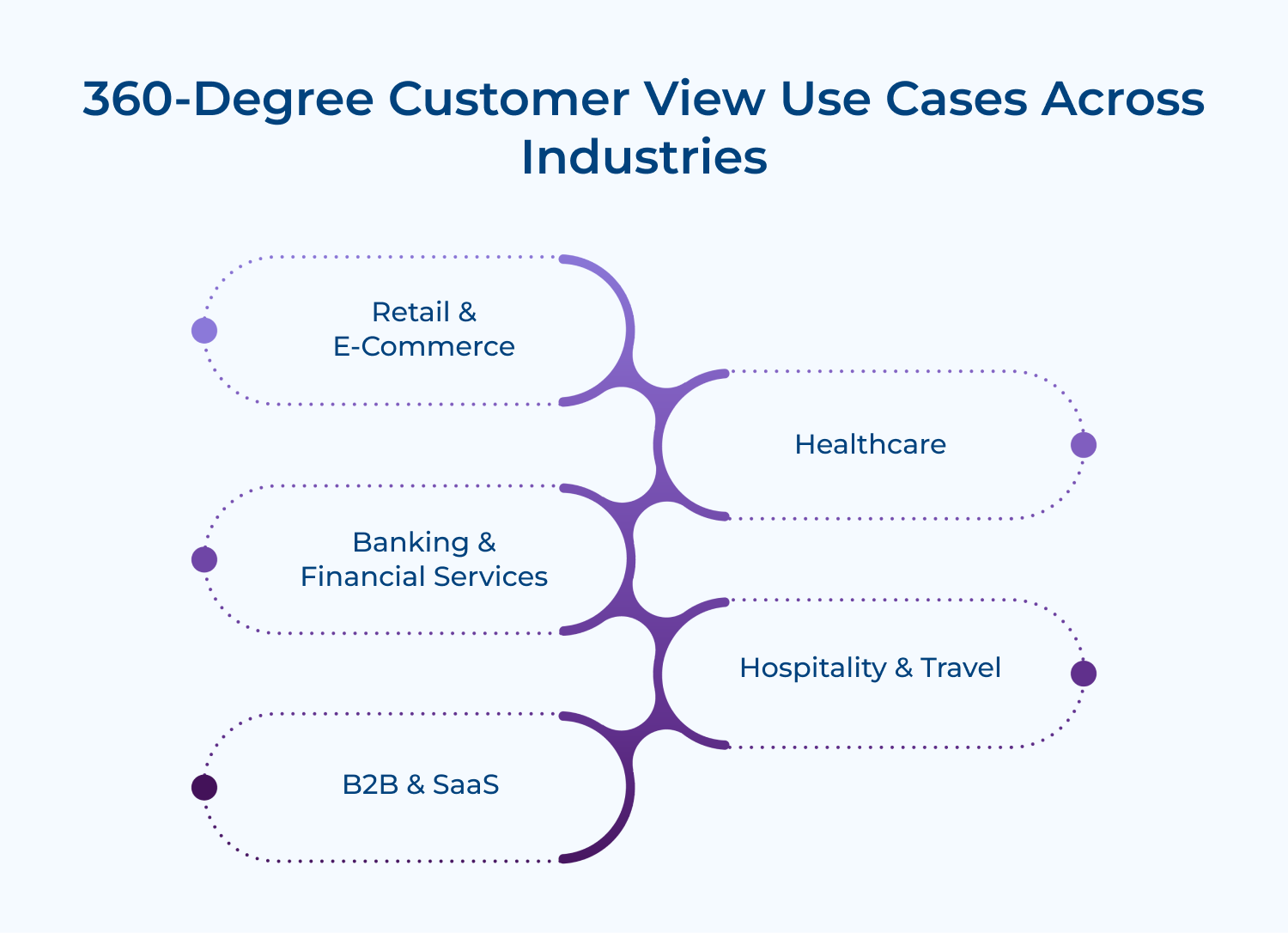
Retail teams unifying purchase history, browsing behavior, loyalty data stop guessing what a customer wants and start responding to what they have already demonstrated. A returning customer who browsed a category twice should never receive a generic promotional email and with a connected customer view, they never do.
In financial services, a 360-degree view means an advisor walking into a conversation already knowing the customer’s product holdings and recent service history. That preparation transforms a routine check-in into a genuinely consultative experience that builds long-term trust and wallet share simultaneously.
Fragmented patient data is not just an experience problem it directly impacts care quality and outcomes. When appointment history, treatment records are unified, care teams spend less time chasing records, more time delivering attentive, personalized patient care.
A frequent traveler who always requests the same preferences should never have to repeat them at check-in. Hospitality brands using a unified guest view turn preference data into effortless personalization that guests consistently notice and return for.
In B2B and SaaS, a unified view connects product usage data, support history and renewal timelines into one account profile. Customer success teams working from this view identify expansion and intervention moments with a precision that reactive account management simply cannot match.
Building a 360-degree customer view is a deliberate decision to understand customers deeply enough to serve them better at every touchpoint. Businesses that commit to this see the difference directly in their retention numbers and revenue growth.
A fragmented customer view will always produce a fragmented experience and customers today have little patience for businesses that do not remember them. Start with clean data and let unified customer intelligence drive every decision going forward.

How does a 360-Degree Customer View improve personalization?
Personalization built on unified data responds to demonstrated behavior rather than assumptions making every interaction feel relevant and timely. Teams stop broadcasting generic messages and start delivering experiences that reflect where each customer actually is in their journey.
What are the Common Mistakes Brands Make When Building a 360-Degree Customer View?
The most damaging mistake is prioritizing data volume over data quality; bloated profiles produce worse decisions than a smaller and cleaner data set. Skipping cross-functional alignment is the second failure because technology never compensates for teams still operating from conflicting customer information.
How does a 360-Degree Customer View support sales teams?
Sales teams working from a unified profile walk into every conversation with context that would otherwise take multiple interactions to establish. That advantage shortens the sales cycle and makes upsell conversations feel like genuine recommendations rather than scripted pitches.
Is a 360-Degree Customer View secure and compliant?
Security and compliance must be built into the architecture from day one not retrofitted after the data environment is already live. Businesses that establish clear governance policies, access controls early protect both their customers and operational integrity simultaneously.
How do you measure the success of a 360-Degree Customer View?
The most reliable indicators are improvements in customer retention and measurable increases in personalization-driven revenue. If the unified view is working effectively, teams make faster decisions, while customers respond with stronger engagement and longer relationships over time.
https://omni24.io/wp-content/uploads/2026/06/360-Degree-Customer-View.png
1256
2400
Tushar Joshi
https://omni24.io/wp-content/uploads/2023/04/Omni-Logo-1.svg
Tushar Joshi2026-07-09 03:33:152026-07-09 03:33:15How to Achieve a 360-Degree Customer View: 7 Key Steps https://omni24.io/wp-content/uploads/2026/07/Customer-Data-Platform.png
1256
2400
Tushar Joshi
https://omni24.io/wp-content/uploads/2023/04/Omni-Logo-1.svg
Tushar Joshi2026-07-08 03:58:592026-07-08 03:58:59How a Customer Data Platform Unlocks Unified Customer Insights
https://omni24.io/wp-content/uploads/2026/07/Customer-Data-Platform.png
1256
2400
Tushar Joshi
https://omni24.io/wp-content/uploads/2023/04/Omni-Logo-1.svg
Tushar Joshi2026-07-08 03:58:592026-07-08 03:58:59How a Customer Data Platform Unlocks Unified Customer Insights https://omni24.io/wp-content/uploads/2026/07/Unified-Customer-View.png
1256
2400
Tushar Joshi
https://omni24.io/wp-content/uploads/2023/04/Omni-Logo-1.svg
Tushar Joshi2026-07-07 03:37:342026-07-08 10:10:24How a Unified Customer View Transforms Customer Experience
https://omni24.io/wp-content/uploads/2026/07/Unified-Customer-View.png
1256
2400
Tushar Joshi
https://omni24.io/wp-content/uploads/2023/04/Omni-Logo-1.svg
Tushar Joshi2026-07-07 03:37:342026-07-08 10:10:24How a Unified Customer View Transforms Customer Experience
Whether it’s about acquire, engage or support – Omni24 covers all your customer engagement needs in one complete platform.

Copyright ©2026 Veemo All rights reserved.
CA, Los Angeles, Hall Ave, 19011