How to Deliver Compassionate Customer Service: Top 8 Strategies
Eight actionable compassionate customer service strategies to help service teams deliver empathy-first support that retains customers along with brand loyalty.

Eight actionable compassionate customer service strategies to help service teams deliver empathy-first support that retains customers along with brand loyalty.
Most businesses focus heavily on speed metrics while ignoring whether customers actually felt supported during the interaction. That oversight silently drives churn in ways no dashboard ever captures. In fact, only 34% of customers say they’re consistently treated with empathy during service interactions.
The gap between resolving an issue and making a customer feel genuinely valued is where most service teams struggle. That gap kills loyalty and damages brand reputation over time.
Compassionate customer service closes that gap by putting emotional intelligence at the center of every support interaction. This guide breaks down the strategies and best practices that deliver better CX.
Compassionate customer service means genuinely understanding a customer’s frustration and responding with empathy as well as real intent to resolve their problem. It goes beyond just solving issues, it’s about making the customer feel heard and valued at every step of the interaction.
When a customer reaches out with an issue, compassionate service starts by actively listening to what they are saying before jumping to solutions. A support rep who acknowledges the emotional state of the customer first creates a sense of trust that makes the entire interaction smoother.
Key Principles:
In business, how you make a customer feel during a support interaction directly shapes how they perceive your brand. Let’s explore how it is a core driver that impacts business.
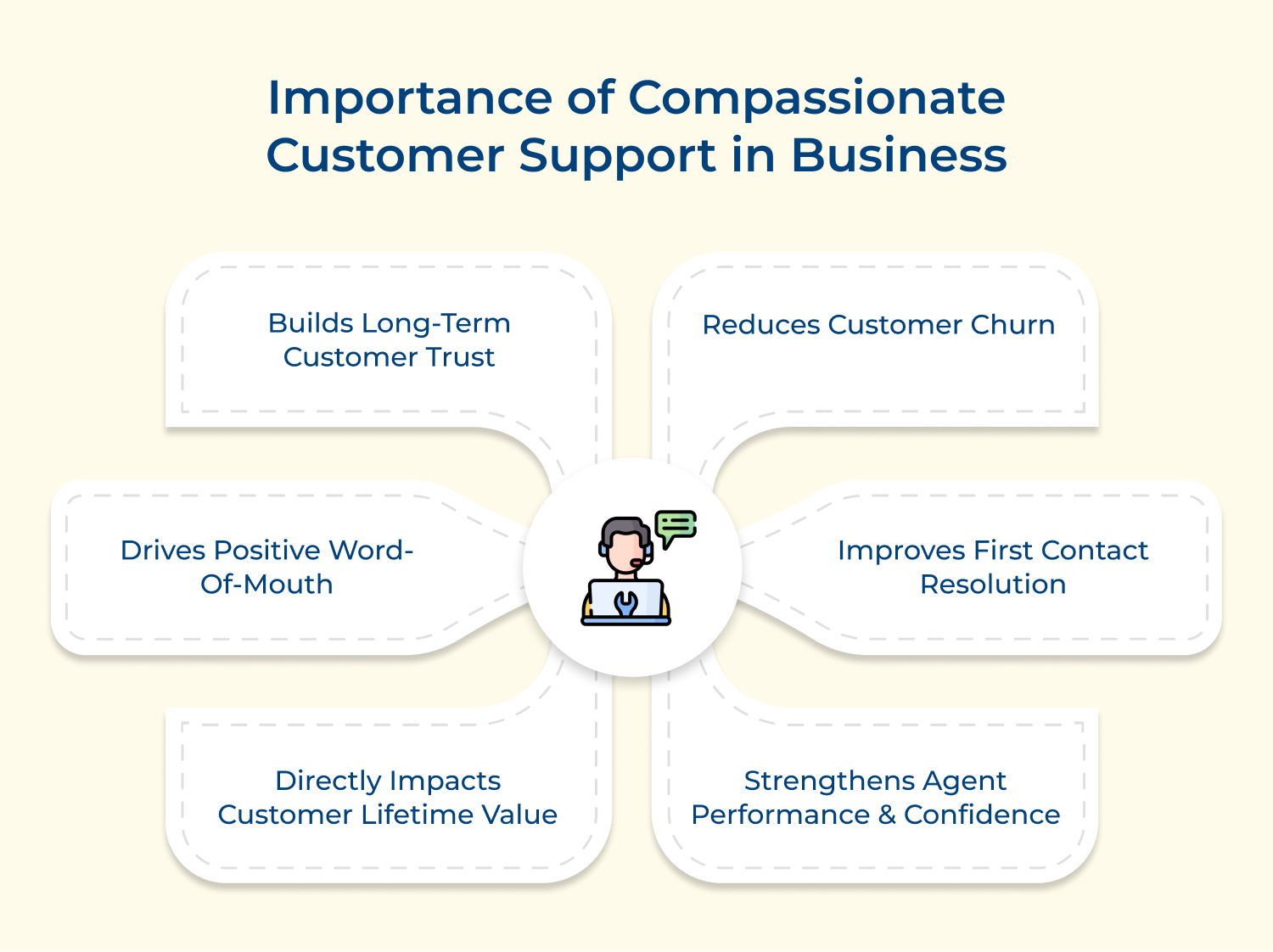
1. Builds Long-Term Customer Trust
Trust is built through consistent and emotionally aware support interactions that elevate the overall CX. When customers feel genuinely heard during a difficult situation, they develop a deeper confidence in your brand that keeps them coming back.
2. Reduces Customer Churn
A frustrated customer who receives a cold and scripted response is already halfway out the door. Compassionate support gives your team the ability to turn that frustration into a resolved experience, which directly reduces the chance of losing that customer permanently.
3. Drives Positive Word-of-Mouth
Customers rarely talk about average experiences, but they always talk about the ones that made them feel genuinely supported. A single compassionate interaction can generate referrals and reviews that no marketing budget can replicate.
4. Improves First Contact Resolution
When a support rep leads with empathy, the customer feels safe to explain the full problem without holding back. This gives the rep deeper context to resolve the issue in one interaction which improves FCR rates and strengthens the quality of CX your business delivers.
5. Strengthens Agent Performance and Confidence
Agents who are trained in compassionate service handle difficult conversations with far more control and clarity. They experience less burnout because they feel equipped to manage emotional situations rather than just deflecting them with scripts and that confidence directly reflects in the CX they deliver.
6. Directly Impacts Customer Lifetime Value
A customer who consistently receives compassionate support spends more and stays longer with your brand. From a business standpoint, investing in empathy-driven service training delivers measurable returns through higher retention and better CX outcomes across every touchpoint.
Customers remember how you made them feel long after they’ve forgotten what you said. These eight strategies help your team deliver just that!
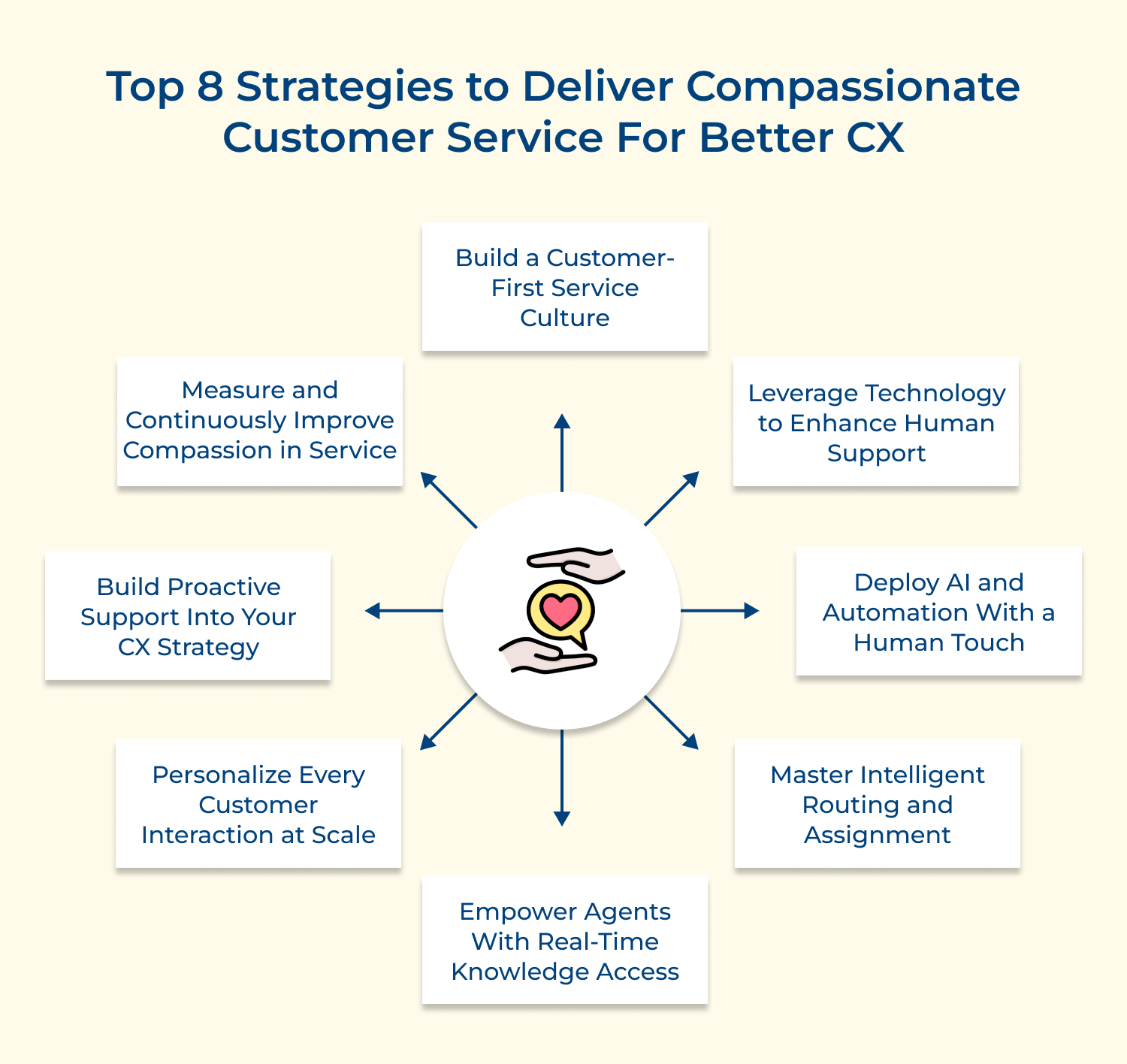
A customer-first culture means your team prioritizes the customer’s emotional experience as much as their resolution. Every interaction your agents handle should reflect genuine care and not just process compliance.
These 4 factors determine whether your service culture is truly built around the customer or just positioned that way:
A customer-first culture is built through daily leadership behavior and consistent agent empowerment. When doing right by the customer becomes the default instinct your CX transforms naturally from the inside out.
Here is how to actively build a Customer-First Culture in your business:
The culture you build internally is exactly the experience your customers will feel on the outside. Businesses that embed customer-first thinking into daily operations build loyalty that competitors simply cannot replicate.
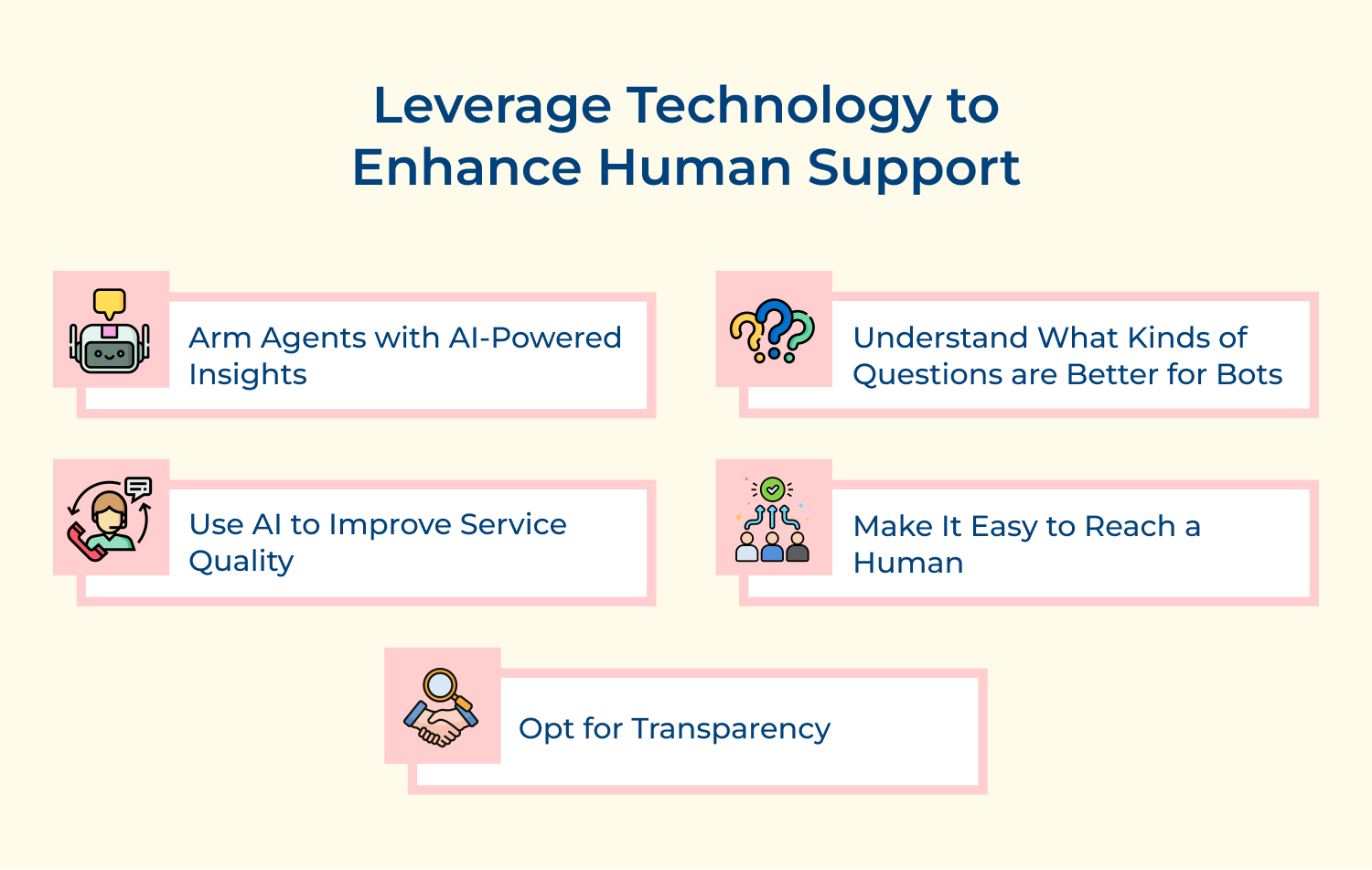
The right technology removes the barriers that prevent agents from delivering genuinely compassionate support to customers. When tools work seamlessly in the background, agents stay focused on the human conversation happening in front of them.
So what happens when agents lack the right technology during a live interaction? They lose context, toggle between systems and deliver a fragmented experience that feels cold as well as impersonal to the customer waiting for help.
The right technology stack for compassionate support must include these core capabilities:
So how do you implement technology that truly enhances human support without overwhelming your agents? Audit where agents lose the most time during live interactions and solve those friction points before adding anything new to the stack.
4 technology use cases that directly enhance human support for better CX:
Automation delivers real value only when they are designed to support empathy and not replace it in customer interactions. Businesses that get this right use automation for routine tasks while keeping humans at the center of every sensitive conversation.
Here is how AI and automation maintain a human touch for better CX:
So how do you implement AI without making your CX feel robotic and impersonal? Always design automation flows with a clear and easy exit to a human agent so customers never feel trapped in a loop that cannot understand their real problem.
Getting routing right is one of the most underrated decisions in delivering compassionate CX. Who picks up a customer’s issue and how quickly they do it sets the emotional tone before a single word is even spoken.
Intelligent routing uses data like customer history, issue type and agent skill sets to connect the right people at the right moment. When routing works well, customers feel understood immediately because the agent handling their case is already equipped to help them.
Pro Tips:
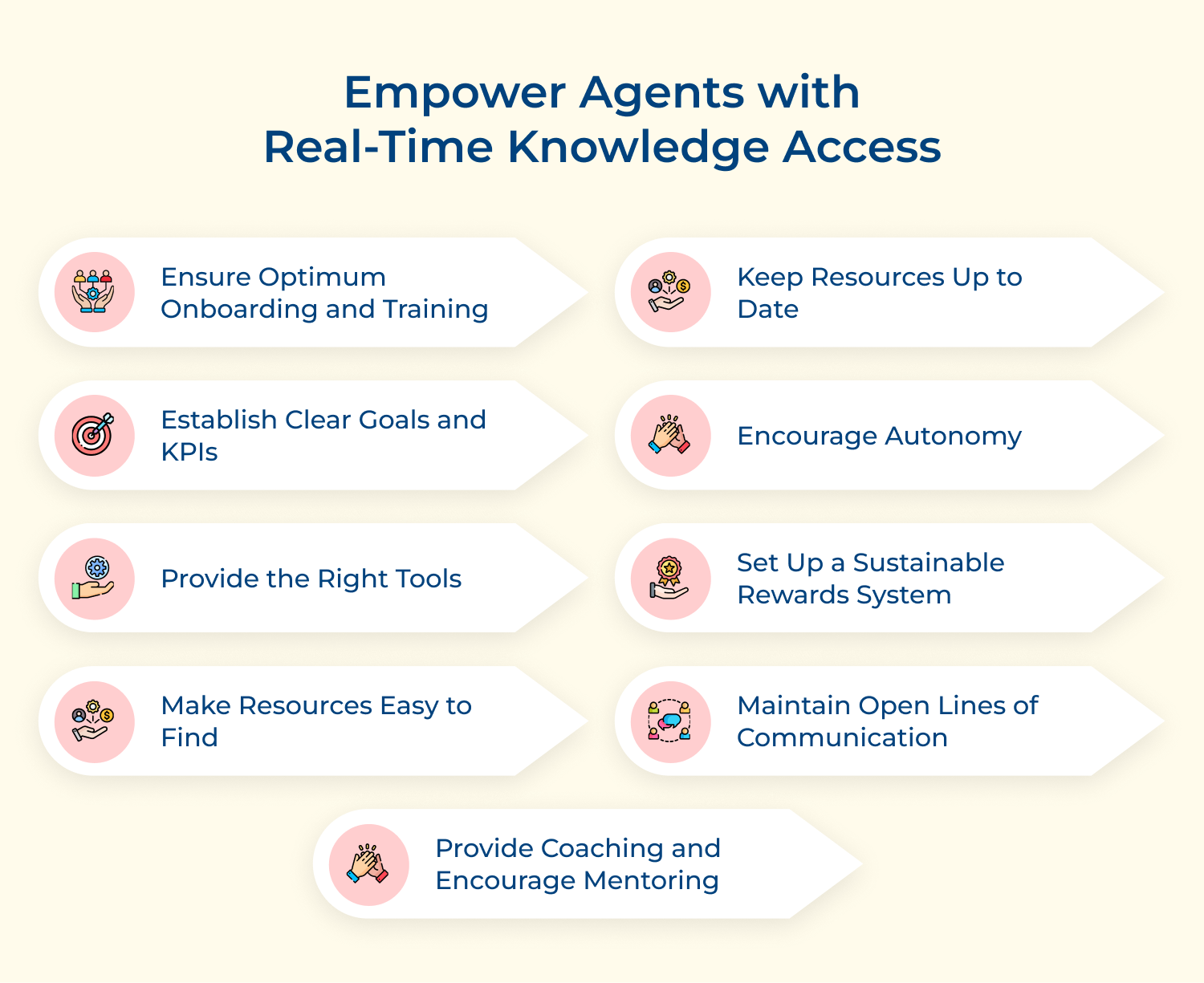
An agent who pauses a live conversation to search for answers has already broken the compassionate flow of that interaction. Real-time knowledge access keeps agents fully present because the right information appears instantly without disrupting the human connection.
A quick checklist to evaluate if your knowledge access truly empowers your agents:
A mid-sized e-commerce brand integrated an AI-powered knowledge assistant directly into their agent desktop and saw real results. Within 60 days handle time dropped and satisfaction scores rose because agents spent less time searching and more time genuinely helping customers solve their problems.
Personalization in customer service is about showing them that your business actually remembers and understands their history. When a customer feels recognized without having to re-explain themselves, the emotional quality of that CX improves instantly.
So how does personalization actually work at scale without losing the human element? The answer lies in building systems that feed agents with the right customer context before the conversation even begins so every interaction feels tailored and not templated.
Here is what true personalization in customer service looks like in practice:
Personalization at scale is only possible when your technology and your people work together with the same customer data. Businesses that invest in unified customer profiles consistently deliver a CX that feels personal and that is exactly what drives long-term loyalty.
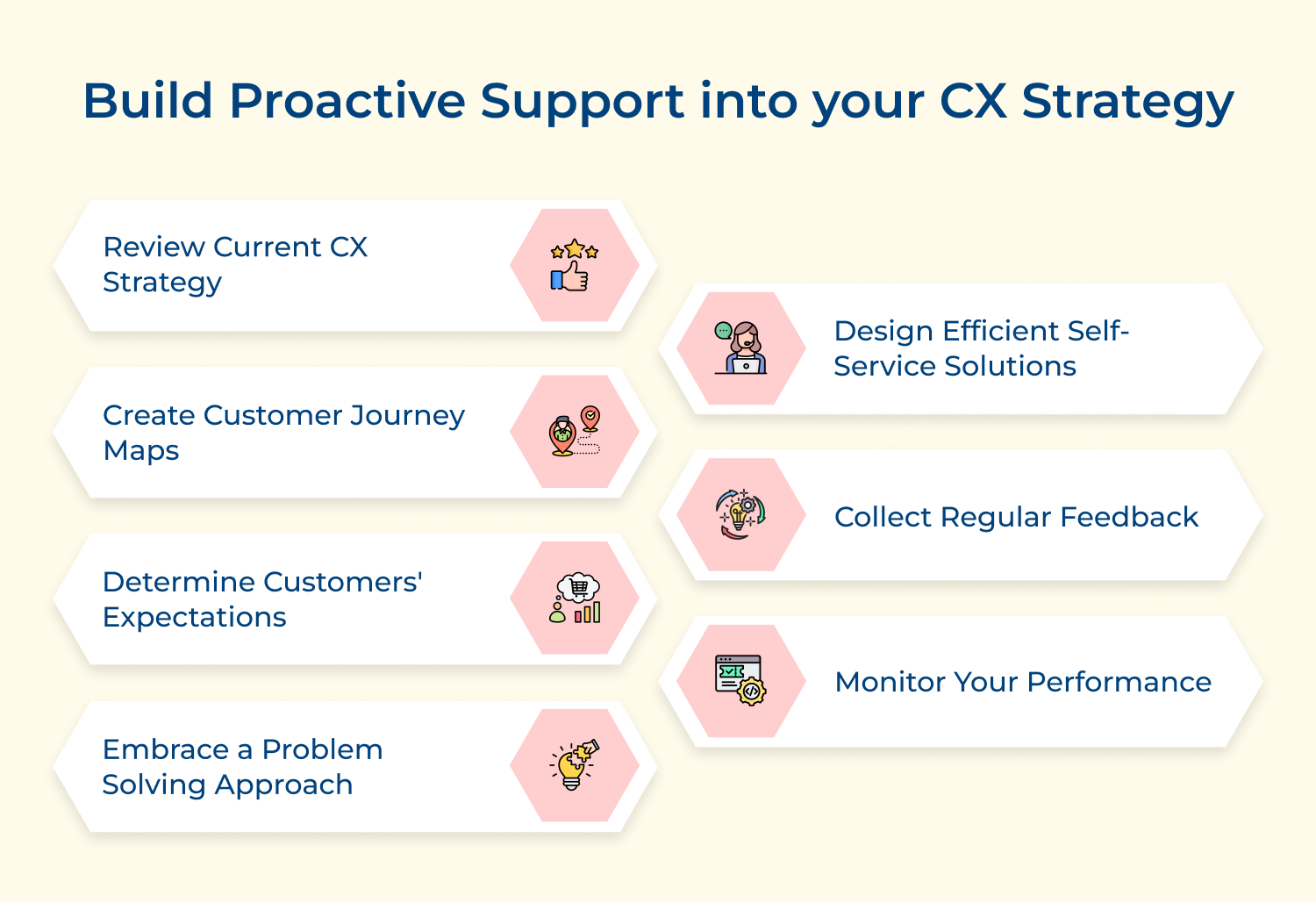
Reactive support means waiting for customers to come with problems. Meanwhile, proactive support means identifying and addressing those problems before the customer even realizes they exist. From a service leadership perspective, proactive outreach is one of the fastest ways to shift customer perception from frustration to genuine trust.
So why do most businesses still operate in reactive mode despite knowing proactive support drives better CX? Because building proactive systems requires upfront investment in data monitoring and early warning processes that most teams have not prioritized yet.
Here is how to build proactive support into your CX strategy effectively:
Proactive support transforms your CX from a cost center into a genuine relationship-building function within your business. Businesses that reach out first consistently earn more trust and retain more customers than those who only respond when problems are already escalating.
Most businesses measure customer service through metrics like AHT, FCR and CSAT — but very few measure whether their customers actually felt heard as well as supported during those interactions. Service teams can hit green on every dashboard while customers quietly churn because the emotional quality of support was never tracked or improved.
So what does measuring compassion in service actually look like beyond standard metrics? It means building feedback loops along with coaching frameworks that evaluate the emotional intelligence of every interaction and not just its speed or outcome.
Here is what a strong measurement framework for compassionate service should include:
Measurement without action is just data collection, what matters is building a continuous improvement loop that actually changes how agents show up for customers. When a team sees that compassion is measured and coached with the same seriousness as resolution time, the entire culture of your CX operation starts to shift in the right direction.
These six best practices give your support operations the consistency and emotional depth needed to deliver compassionate CX every single time.
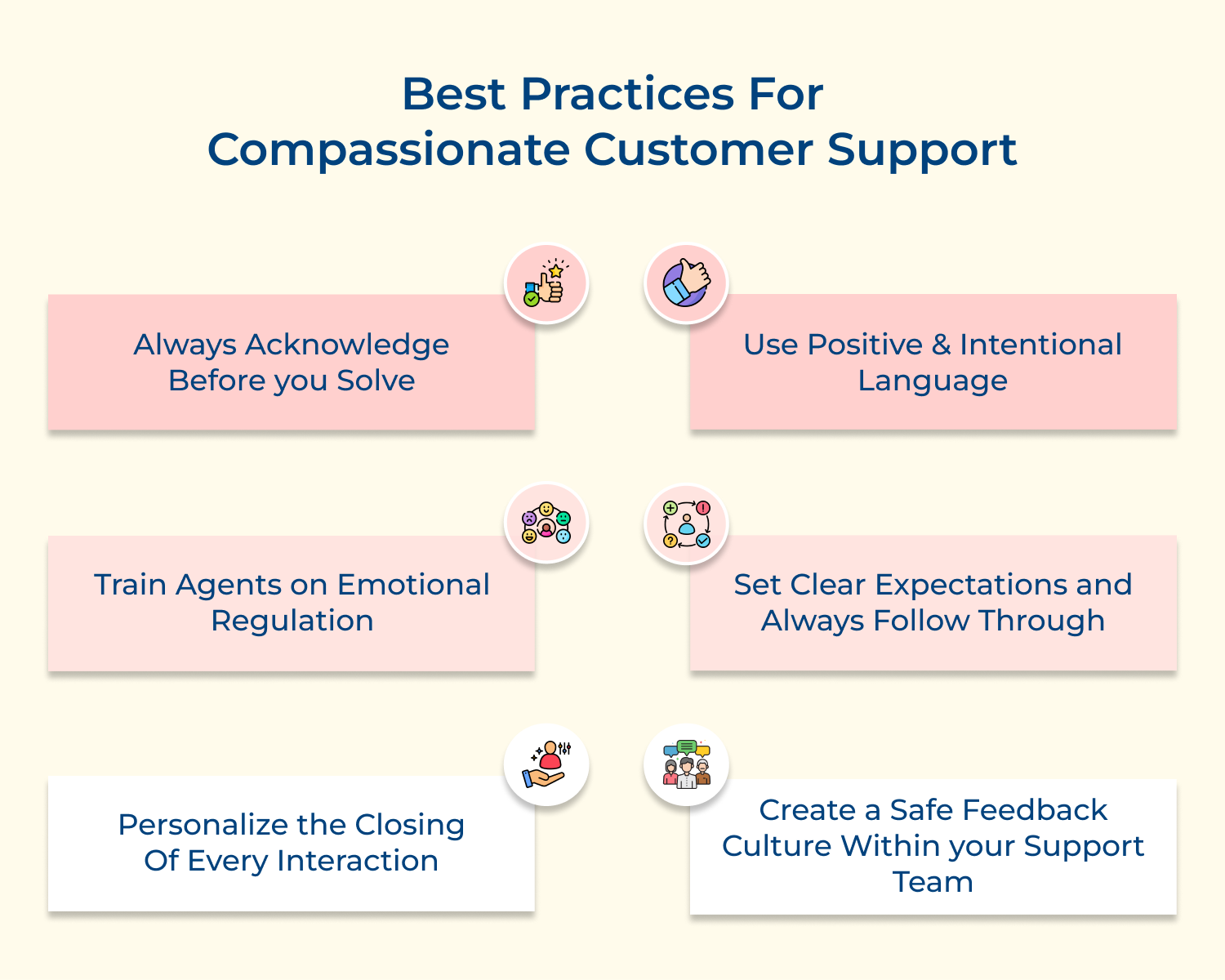
1. Always Acknowledge Before You Solve
Jumping straight into resolution without acknowledging how a customer feels is one of the most common mistakes support teams make. Customers need to feel heard first and then helped, that sequence makes every interaction feel genuinely compassionate rather than purely transactional.
2. Use Positive and Intentional Language
The words your agents choose during a support interaction carry more emotional weight than most service leaders realize. Replacing phrases like “I can’t do that” with “here is what we can do” shifts the entire tone from defensive to solution-oriented without changing the actual outcome.
3. Train Agents on Emotional Regulation
Compassionate support breaks down when agents absorb customer frustration and respond from a reactive emotional state. Training agents to stay calm and grounded during difficult interactions is a critical operational capability that directly protects your CX quality.
4. Set Clear Expectations and Always Follow Through
One of the fastest ways to destroy customer trust is to promise a callback or resolution timeline and then miss it without any update. Compassionate service means being honest about what you can deliver and then making absolutely sure your team delivers exactly that every time.
5. Personalize the Closing of Every Interaction
How an interaction ends is the last emotional impression a customer carries with them after the conversation is over. A personalized closing that references the specific issue and confirms the customer is satisfied leaves them feeling valued rather than processed through a support queue.
6. Create a Safe Feedback Culture Within Your Support Team
Agents who feel psychologically safe to share what is not working will always perform better than those who stay silent to avoid judgment. Building a culture where feedback flows openly between agents and leaders is what keeps your compassionate service standards improving consistently over time.
Every industry has its own way of showing empathy & compassion towards the customers. Here is how four distinct industries are putting that principle into real practice.
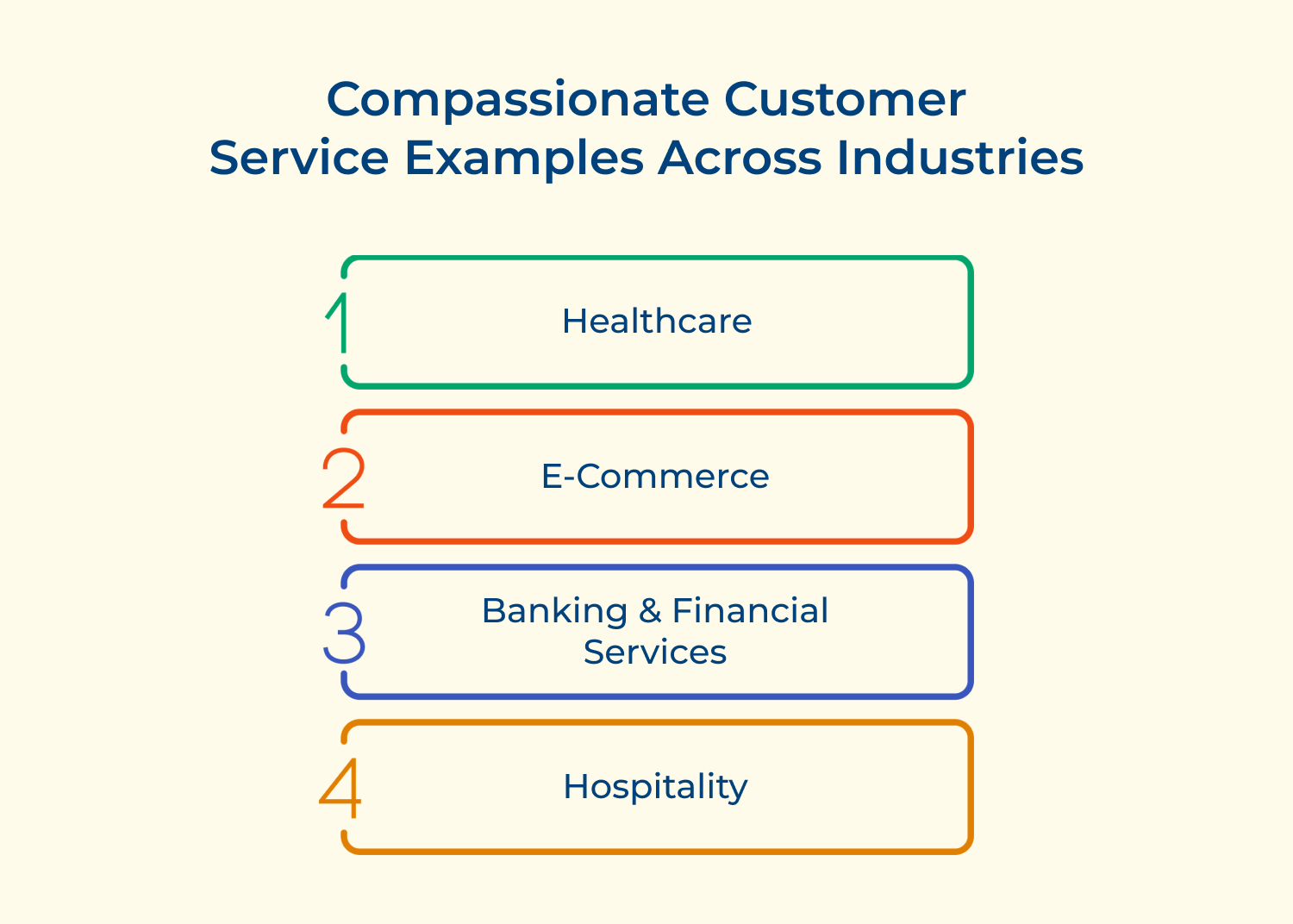
Patient interactions carry emotional weight that demands a higher standard of compassionate service than most industries. Healthcare providers that train staff to acknowledge patient anxiety before administrative processes consistently build stronger trust and deliver better CX.
High order volumes mean e-commerce support teams face frustrated customers daily and how they respond defines the entire brand experience. Strong operators empower agents to offer immediate resolutions without lengthy approvals because removing friction at the right moment converts an angry customer into a returning one.
Financial concerns are deeply personal and a customer calling their bank during a stressful situation needs emotional acknowledgment before policy details. Banks that train teams to validate concerns and deliver clear jargon-free guidance consistently outperform competitors on trust metrics as well as long-term CX satisfaction.
In hospitality the service itself is the product and guests measure their experience through how genuinely welcomed as well as cared for they feel. Properties that equip staff to anticipate needs and resolve complaints with full ownership consistently lead their competitive set on every major CX as well as loyalty benchmarks.
Compassionate customer service is not a one-time initiative, it is a continuous commitment to making every customer feel genuinely valued during each interaction. Businesses that embed empathy into their daily service operations build loyalty that no competitor can easily take away.
Getting the strategy right, training your teams consistently and measuring emotional outcomes alongside resolution metrics is what separates good support from truly exceptional CX. Start with one change and build from there because every compassionate interaction moves your business forward.

How does Compassionate Customer Service improve customer loyalty?
When customers feel genuinely heard during a difficult interaction, they develop an emotional connection with your brand that goes beyond the transaction. That connection drives repeat business because customers return to businesses that made them feel valued when it mattered most.
How does empathy support Compassionate Customer Service?
Empathy allows agents to understand what a customer is feeling before forming a response and that changes the entire quality of the interaction. Without empathy, even the fastest resolution can leave a customer feeling processed rather than genuinely cared for by your support team.
Can Compassionate Customer Service reduce customer churn?
Most customers do not leave because of the problem. They leave because of how that problem was handled by your team. Compassionate service turns frustrating moments into trust-building experiences and that directly reduces the likelihood of a customer walking away permanently.
What skills are needed for Compassionate Customer Service?
Active listening, emotional regulation and clear communication are the three core skills every compassionate support agent needs to deliver better CX consistently. The ability to take ownership without deflecting and follow through on every commitment made is what truly separates good agents from great ones.
How do you measure the impact of Compassionate Customer Service?
Measuring compassion in service goes beyond standard metrics like CSAT and FCR, it requires tracking whether customers actually felt supported during the interaction. Post-interaction sentiment surveys as well as conversation quality scoring give service leaders the clearest picture of where emotional service quality stands and where it needs to improve.
 https://omni24.io/wp-content/uploads/2026/08/Enterprise-Customer-Engagement.png
1256
2400
Tushar Joshi
https://omni24.io/wp-content/uploads/2023/04/Omni-Logo-1.svg
Tushar Joshi2026-09-02 05:29:412026-09-02 05:29:41How to Scale Enterprise Customer Engagement Strategies
https://omni24.io/wp-content/uploads/2026/08/Enterprise-Customer-Engagement.png
1256
2400
Tushar Joshi
https://omni24.io/wp-content/uploads/2023/04/Omni-Logo-1.svg
Tushar Joshi2026-09-02 05:29:412026-09-02 05:29:41How to Scale Enterprise Customer Engagement Strategies https://omni24.io/wp-content/uploads/2026/08/Client-vs-Customer.png
1256
2400
Tushar Joshi
https://omni24.io/wp-content/uploads/2023/04/Omni-Logo-1.svg
Tushar Joshi2026-09-01 03:57:222026-09-01 03:59:31Client vs Customer: What’s the Difference & Why Does it Matter?
https://omni24.io/wp-content/uploads/2026/08/Client-vs-Customer.png
1256
2400
Tushar Joshi
https://omni24.io/wp-content/uploads/2023/04/Omni-Logo-1.svg
Tushar Joshi2026-09-01 03:57:222026-09-01 03:59:31Client vs Customer: What’s the Difference & Why Does it Matter? https://omni24.io/wp-content/uploads/2026/08/Benefits-of-Conversational-AI.png
1256
2400
Webvision Solution
https://omni24.io/wp-content/uploads/2023/04/Omni-Logo-1.svg
Webvision Solution2026-08-31 04:29:522026-08-31 04:29:52Benefits of Conversational AI: What You Should Know
https://omni24.io/wp-content/uploads/2026/08/Benefits-of-Conversational-AI.png
1256
2400
Webvision Solution
https://omni24.io/wp-content/uploads/2023/04/Omni-Logo-1.svg
Webvision Solution2026-08-31 04:29:522026-08-31 04:29:52Benefits of Conversational AI: What You Should Know
Whether it’s about acquire, engage or support – Omni24 covers all your customer engagement needs in one complete platform.

Copyright ©2026 Veemo All rights reserved.
CA, Los Angeles, Hall Ave, 19011