What is the Difference between CXM vs CRM? Benefits & Use Cases
Sales and marketing teams constantly seek ways to enhance customer relationships. CRM and CXM both help manage customers, but their similar core functions often confuse.
Sales and marketing teams constantly seek ways to enhance customer relationships. CRM and CXM both help manage customers, but their similar core functions often confuse.
Do you know the difference between CRM and CXM and how they can help propel your business?
As a marketer, you probably hear the words CXM vs CRM around you a lot. These are terms that describe the strategies used for managing an organization’s customer interaction.
For example, focusing on marketing strategy, sales analysis, and technical support, businesses were able to comprehend who their customers were. This would help make the sales efforts directed toward those customers seem more relevant.
The first step is to create a platform for interaction using CRM for managing customer relationships. The next step is Customer Experience Management (CXM), which helps to understand as well as influence customer perceptions regarding a business and its products at the various touch points of the customer journey.
Let us discuss comprehensively the difference between CXM vs CRM, its meaning, and key use cases.
Customer relationship management (CRM) is defined as a strategy that focuses on building and strengthening relationships between businesses and their customers.
CRM software is used to track customer interactions, manage sales processes, and automate processes that improve the customer experience. CRM strategies aim to improve customer satisfaction, increase sales and retention rates, as well as reduce customer churn.
Key objective:
Customer experience management (CXM) refers to the practice of managing interactions between businesses and their customers in a way that creates a positive and satisfactory customer experience.
CXM takes a holistic approach to managing customer interactions, aiming to provide a seamless and consistent experience across all channels & touchpoints, from the first point of contact to post-purchase follow-up.
While CXM and CRM share similarities, their scopes and objectives differ. Using both together can boost customer experience, strengthen loyalty, and drive business success.
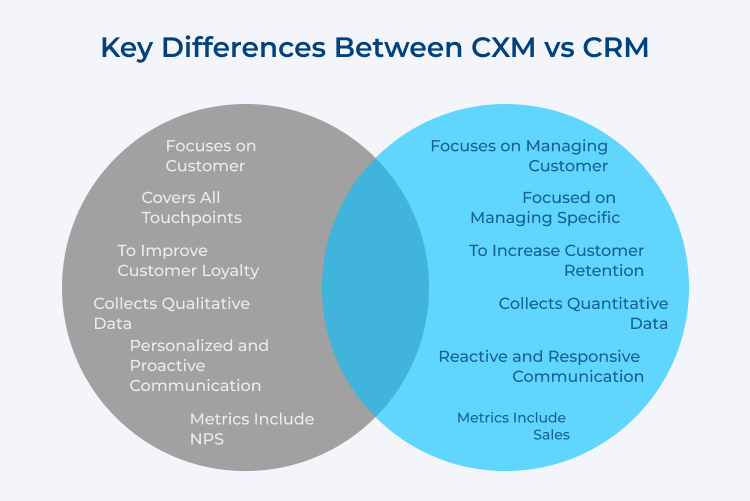
CXM (customer experience management) and CRM (customer relationship management) both focus on improving the customer experience, but CXM is overarching, while CRM is more focused. CXM is about understanding the customer journey and providing a tailored, personalized experience at every touchpoint, while CRM is focused on managing as well as organizing customer information.
CXM has wider & broader scope, which means that it involves every aspect of the customer experience, including marketing, sales and social media interactions. CRM is more focused on sales, marketing, and customer service, with customer data management being the central element.
The objective of CXM is to provide an engaging, personalized experience that addresses the customer’s needs, preferences and problems – no matter where they are in their journey. In contrast, the primary objective of CRM is to manage customer interactions and data to streamline business processes through automation.
For CXM, data collection involves gathering insights into customer behavior from various sources, such as surveys, social media, website analytics and online reviews to provide data-driven insights. On the other hand, CRM is focused on capturing and storing customer data related to purchases, interactions, and service requests for business analysis.
CXM aims to engage customers through personalized and relevant communications across various channels such as social media, email and mobile. It emphasizes building meaningful relationships with customers over the long term. Meanwhile, CRM focuses more on the transactional communication that occurs between the business and customers during the lifecycle of a purchase or service.
For CXM, the primary metrics are customer retention, engagement, satisfaction, and loyalty. On the other hand, the metrics for CRM are sales, revenue, customer acquisition and cost of customer acquisition.
CRM manages and analyzes customer interactions, while CXM designs them for a positive experience. Together, they strengthen relationships and fuel business growth.
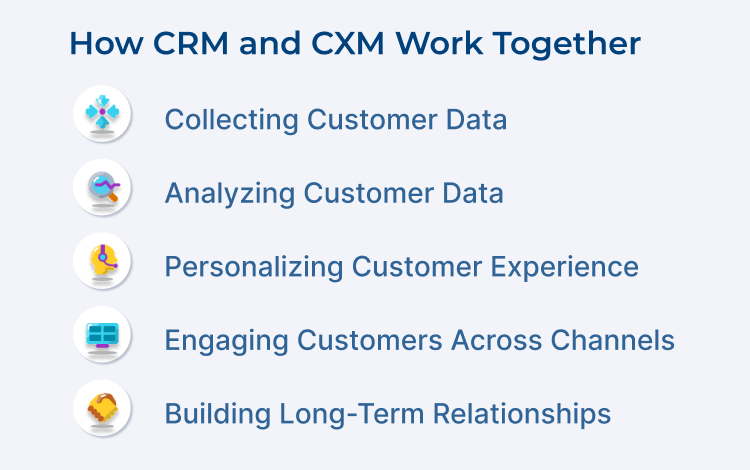
Both CRM and CXM solutions start with collecting customer data. A CRM system is responsible for collecting customer transactions, communication, and demographic data.
The collected data will be used to manage customer relationships and design effective marketing strategies.
CXM collects customer feedback, preferences and satisfaction data to improve customer engagement as well as satisfaction. Both sets of data are complementary and can be used together to create a more comprehensive picture of the customer.
Customer data analysis is a very crucial part as it directly impacts the success rate of the strategies designed for customer management.
After the data is collected, CRM and CXM analytics assess customer behavior, preferences and feedback. Analytics can help companies in the following areas:
Depending on the same customer data, CXM and CRM analytics can complement each other and work in sync to provide a holistic view of the customer.
Personalization is always in vogue when it comes to delivering an excellent customer experience.
By performing thorough data analysis, companies can personalize customer interactions, offering relevant content and services. CRM helps to personalize and automate targeted campaigns based on customer preferences.
CXM, on the other hand, brings a more contextualized approach to customization using customer feedback and touchpoints to offer a more personal, empathic customer experience.
It’s important for companies to balance their efforts in this area by using the data from CRM and CXM to provide a personalized customer journey.
Interaction consistently across all communication channels that your customers prefer to connect with your company is extremely crucial.
CRM platforms help businesses efficiently engage with customers via multiple channels such as email, phone, and social media. CXM offers a more immersive and seamless engagement experience by ensuring that customer’s journeys across channels are consistent and connected.
Working together, CRM and CXM can improve the quality of customer touchpoints, allowing for better communication and engagement.
The goal of both CRM and CXM is to build long-term, sustainable relationships with customers. CRM systems help companies manage the customer journey while CXM ensures that that journey is positive, memorable, and engaging.
As part of a unified strategy, businesses are more likely to build strong, loyal relationships with customers that benefit both the customer and the business alike.
Customer Experience Management (CXM) helps businesses improve interactions to boost satisfaction, build loyalty, and drive growth.
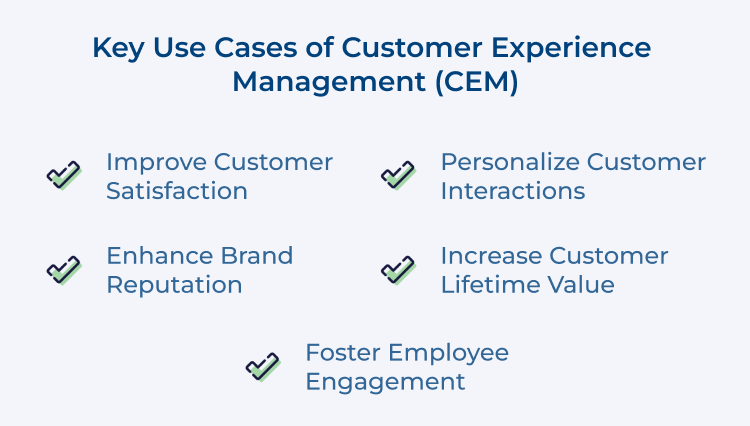
One of the primary goals of CEM is to understand and improve customer satisfaction levels. By gathering customer feedback, analyzing customer interactions and identifying pain points companies can take targeted actions to enhance the overall customer experience.
It leads to higher levels of customer satisfaction, which can translate into increased loyalty and repeat business.
The rise of digital technologies and social media, customers now expect a personalized experience from the brands they interact with.
CEM can help companies achieve this by collecting data on customer behavior, preferences, and past interactions, as well as using this information to personalize future interactions.
It could involve tailoring marketing messages, recommending relevant products and services, or providing customized support to each customer.
Positive customer experiences can go a long way in building a strong brand reputation. CEM can help companies monitor their online reputation across various platforms, track customer sentiment, and quickly respond to negative feedback.
Demonstrating a commitment to improving the customer experience and resolving issues promptly, companies can win over customers as well as enhance their brand image.
CEM can also help companies increase customer lifetime value (CLV) by identifying opportunities to upsell or cross-sell products and services to existing customers.
Analyzing customer data and behavior, companies can identify which customers are most likely to make additional purchases as well as target them with relevant offers. It not only drives additional revenue but also helps deepen the relationship between the customer and the brand.
CEM can also benefit employees by fostering a customer-centric culture within the organization.
By providing employees with the tools and training they need to deliver exceptional customer experiences, companies can improve employee engagement and retention. It eventually leads to a more motivated and productive workforce, which can further enhance the customer experience.
Customer Relationship Management (CRM) software is a vital component of any business. However, in the era of digital age, businesses need to consider upgrading to a CXM platform. Customer Experience Management is the next step in customer service, and it can provide your customers with an even better experience than ever before.
The aforementioned differences between CRM and CXM, along with their key use cases, highlight how they benefit your business. While adopting robust CRM tools is a great start to managing the early stages of customer relationships during acquisition, adoption is also imperative in improving customers’ experiences through their journeys with your business and greatly improving digital transformation initiatives.

Is CRM and CXM the same?
CXM differs from traditional CRM in the technology itself—with added benefits and capabilities for building customer relationships. While CRMs gather data through manual or batch entry, a true CXM will enable a real-time flow of data to offer deeper insights into customer preferences and behavior.
How does CXM differ from CRM in terms of customer experience management?
CXM takes the next step in managing customer relationships. Where CRM mostly deals with optimizing the internal processes of a business, CXM offers an even more customer-centric approach in several ways with new technologies as well as processes, strategies and customer-centric design.
Why should businesses consider implementing CXM instead of CRM?
Customer experience management (CXM) and customer relationship management (CRM) are important technologies that help organizations keep track of customer data.CXM and CRM systems help organizations boost customer satisfaction, but CXM focuses on how customers perceive a brand, while CRM helps employees understand their customers.
How does CXM enhance customer relationships compared to CRM?
Customer experience management (CXM) helps businesses to outline effective strategies by deeply analyzing the customer data collected. It helps to understand the pain points and their expectations. Based on it you can align your products/services and personalize them to deliver an excellent customer experience.
Why is it important for businesses to integrate CXM and CRM strategies?
CXM and CRM systems help organizations boost customer satisfaction, but CXM focuses on how customers perceive a brand, while CRM helps employees understand their customers. Organizations need to track a lot of customer information, but they also must know how to use it to create a great customer experience.
 https://omni24.io/wp-content/uploads/2026/05/customer-conversations.png
1256
2400
Tushar Joshi
https://omni24.io/wp-content/uploads/2023/04/Omni-Logo-1.svg
Tushar Joshi2026-06-01 04:54:272026-06-01 04:54:27What is Customer Conversations & How to Do it Effectively?
https://omni24.io/wp-content/uploads/2026/05/customer-conversations.png
1256
2400
Tushar Joshi
https://omni24.io/wp-content/uploads/2023/04/Omni-Logo-1.svg
Tushar Joshi2026-06-01 04:54:272026-06-01 04:54:27What is Customer Conversations & How to Do it Effectively? https://omni24.io/wp-content/uploads/2026/05/customer-follow-up.png
1257
2400
Tushar Joshi
https://omni24.io/wp-content/uploads/2023/04/Omni-Logo-1.svg
Tushar Joshi2026-05-28 03:45:392026-05-28 03:45:39Why Customer Follow-Up Is the Secret to Stronger Relationships?
https://omni24.io/wp-content/uploads/2026/05/customer-follow-up.png
1257
2400
Tushar Joshi
https://omni24.io/wp-content/uploads/2023/04/Omni-Logo-1.svg
Tushar Joshi2026-05-28 03:45:392026-05-28 03:45:39Why Customer Follow-Up Is the Secret to Stronger Relationships? https://omni24.io/wp-content/uploads/2026/03/Ecommerce-Customer-Retention.png
1256
2400
Tushar Joshi
https://omni24.io/wp-content/uploads/2023/04/Omni-Logo-1.svg
Tushar Joshi2026-05-27 03:38:082026-05-27 03:38:08What is Ecommerce Customer Retention & Why it Matters?
https://omni24.io/wp-content/uploads/2026/03/Ecommerce-Customer-Retention.png
1256
2400
Tushar Joshi
https://omni24.io/wp-content/uploads/2023/04/Omni-Logo-1.svg
Tushar Joshi2026-05-27 03:38:082026-05-27 03:38:08What is Ecommerce Customer Retention & Why it Matters?
Whether it’s about acquire, engage or support – Omni24 covers all your customer engagement needs in one complete platform.

Copyright ©2026 Veemo All rights reserved.
CA, Los Angeles, Hall Ave, 19011
