AI vs Human Customer Service: When to Use Each Approach
Learn how AI and human customer service work together to improve efficiency, handle complexity, boost satisfaction while creating balanced customer experiences.
Learn how AI and human customer service work together to improve efficiency, handle complexity, boost satisfaction while creating balanced customer experiences.
Your customers want instant replies at any hour, but they also expect real empathy when something goes wrong. That tension puts support teams in a tough spot, balancing speed with genuine human connection every single day.
Many businesses feel stuck choosing between AI automation and hiring more human agents. Yet studies show AI can boost customer-service productivity by about 14%, while most customers still prefer human help for complex or emotional issues.
The real answer isn’t picking one over the other. It’s learning when AI should handle routine requests and when humans should step in to build trust – creating a smarter, more satisfying support experience for everyone.
AI customer service uses artificial intelligence to handle customer questions, requests and routine support tasks. Instead of replacing human agents, it works alongside them to make support faster and more efficient while still maintaining a high standard of service.
Behind the scenes, AI reads customer messages using natural language processing to understand what the customer actually needs. It looks through knowledge bases, past conversations and stored data to find the most relevant answer. Then it delivers that response through chatbots, virtual assistants or automated emails in a way that feels genuinely helpful.
Key objectives:
Modern AI customer service agents come equipped with sophisticated capabilities that transform how businesses interact. These features work together to create seamless support.
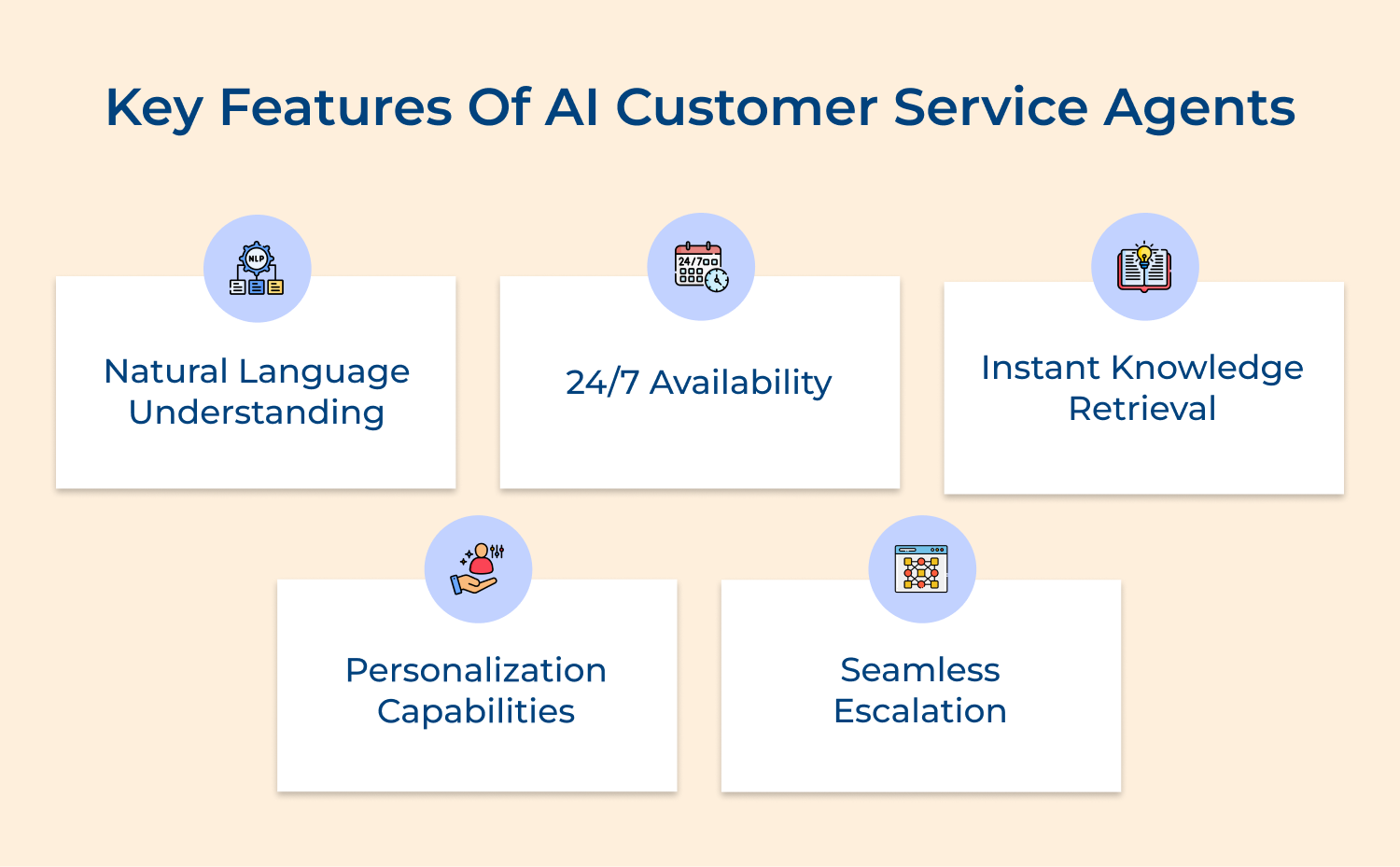
1. Natural Language Understanding
AI agents understand questions the way people actually speak – no special keywords needed. They pick up on intent, tone and context to respond appropriately. This deeper understanding of conversations, combined with insights from customer data, helps them deliver more accurate and relevant support.
2. 24/7 Availability
AI never needs breaks, which means customers get help anytime, across time zones and peak hours. These systems can manage multiple conversations at once while keeping responses consistent – something that directly supports higher customer satisfaction.
3. Instant Knowledge Retrieval
Instead of making customers wait in queues, AI pulls answers from product documentation, past interactions and support resources within seconds. Faster resolutions also generate useful customer feedback that teams can use to keep improving service quality.
4. Personalization Capabilities
AI recognizes returning customers while tailors responses based on their history, preferences and behavior. This familiarity creates smoother experiences and can positively influence loyalty metrics like Net Promoter Score.
5. Seamless Escalation
When a situation needs human expertise, AI transfers the conversation with full context included – so customers never have to repeat themselves.
AI customer service agents bring both significant benefits and notable limitations to the support experience. Understanding these trade-offs helps businesses deploy AI effectively.
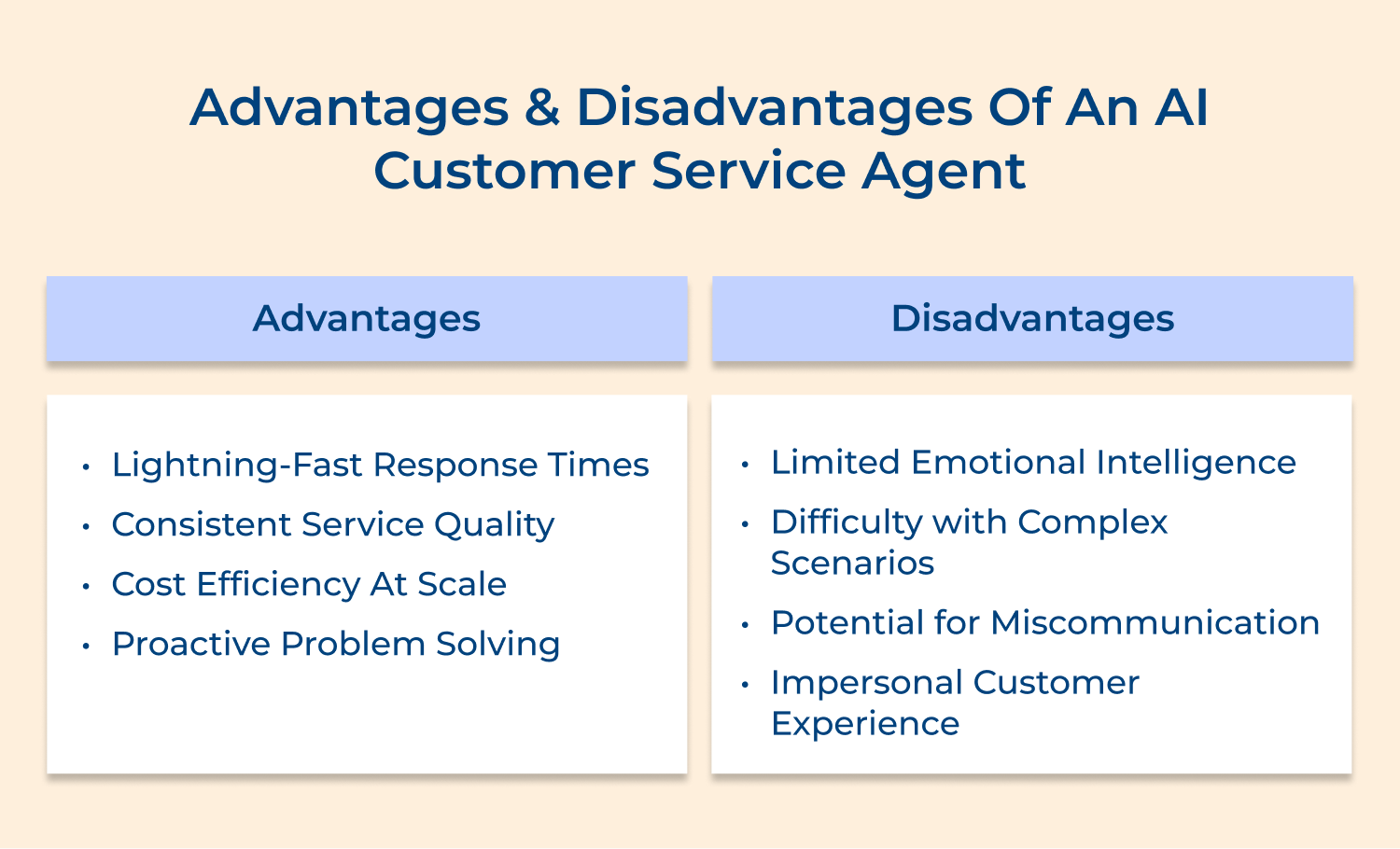
1. Lightning-Fast Response Times
AI agents eliminate wait queues by responding to customer inquiries within seconds of submission. This immediate engagement reduces frustration and keeps customers moving forward with their tasks instead of waiting on hold or for email replies.
2. Consistent Service Quality
Every customer receives the same level of attention and accuracy regardless of when they reach out. AI agents don’t have bad days or make errors due to fatigue, ensuring reliable information delivery across thousands of interactions.
3. Cost Efficiency At Scale
Businesses handle exponentially more customer requests without proportionally increasing headcount or training expenses. AI agents process routine inquiries automatically so companies can allocate human resources to growth initiatives rather than repetitive support tasks.
4. Proactive Problem Solving
AI agents identify patterns in customer behavior and reach out with solutions before issues escalate into complaints. They anticipate needs based on previous interactions and offer relevant help at exactly the right moment in the customer journey.
1. Limited Emotional Intelligence
AI agents struggle to recognize nuanced emotions or provide genuine empathy during sensitive situations. They may respond technically correctly but miss the human touch that upset or frustrated customers need to feel truly heard and valued.
2. Difficulty with Complex Scenarios
Unique problems that require creative thinking or judgment calls often confuse AI systems built on pattern recognition. These agents work best with straightforward questions but falter when customers present unusual combinations of issues or special circumstances.
3. Potential for Miscommunication
AI can misinterpret slang, sarcasm, or ambiguous phrasing and provide irrelevant answers that frustrate customers further. Cultural context and regional expressions sometimes bypass the system’s understanding, leading to confusing or inappropriate responses.
4. Impersonal Customer Experience
Some customers feel dismissed or undervalued when they can’t immediately speak with a real person. The automated nature of AI interactions can make service feel transactional rather than relationship-focused, potentially damaging brand loyalty over time.
Human customer service involves real people directly assisting customers with questions, problems and requests through various communication channels. These support agents use their judgment and empathy to understand situations while providing personalized solutions that address individual customer needs.
Trained customer service representatives receive inquiries through phone calls, emails, live chat, or in-person interactions. They listen to customer concerns and apply their knowledge/experience to resolve issues while building genuine connections that build trust as well as loyalty.
Key objectives:
Human customer service agents bring irreplaceable qualities to support interactions but also face inherent limitations. Recognizing both helps businesses optimize their service strategies.
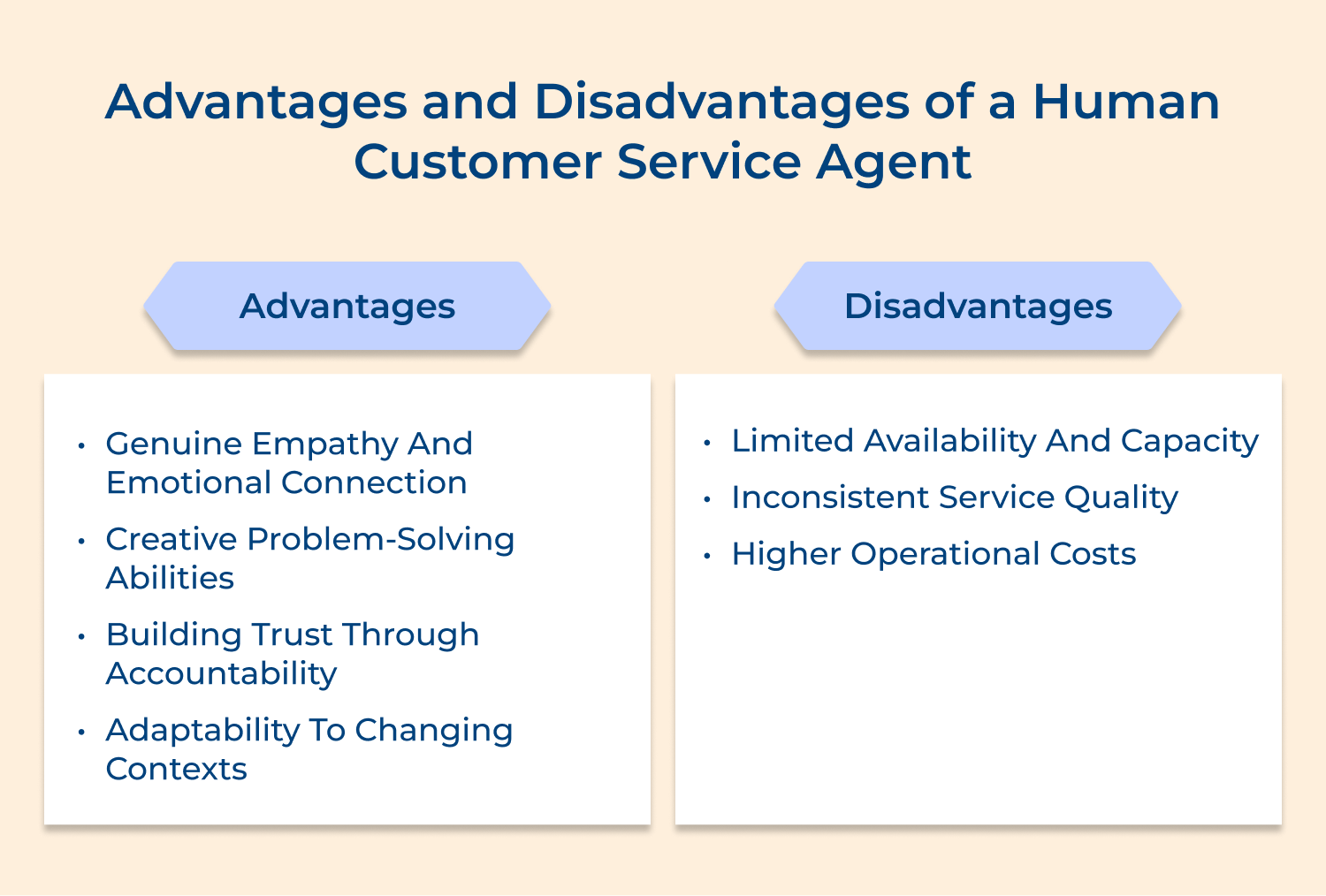
1. Genuine Empathy And Emotional Connection
Human agents read between the lines and respond to emotional subtext with authentic care. They adjust their tone based on how someone feels, providing comfort that makes customers feel genuinely understood.
2. Creative Problem-Solving Abilities
Agents think outside standard procedures to find solutions for unusual situations without predetermined answers. It combines resources and bend rules when appropriate to reach resolutions that satisfy customers while protecting company interests.
3. Building Trust Through Accountability
Customers feel confident speaking with real people who take ownership of their issue from start to finish. Human agents provide personal accountability that makes customers believe someone genuinely cares about resolving their problem.
4. Adaptability To Changing Contexts
Human agents pivot quickly when conversations take unexpected turns or customers share new information mid-interaction. They grasp nuanced situations and adjust strategy in real-time without needing reprogramming to handle emerging scenarios.
1. Limited Availability And Capacity
Human agents need breaks and work specific shifts while handling one conversation at a time without quality degradation. This creates wait times during busy periods and leaves customers without support during off-hours.
2. Inconsistent Service Quality
Agent performance varies based on experience level, training and personal strengths, leading to different outcomes for similar issues. One customer might receive exceptional help while another gets mediocre service depending on which agent they reach.
3. Higher Operational Costs
Employing human agents requires significant investment in salaries, benefits and training programs that scales with team size. These costs make it expensive to maintain adequate coverage across all channels and time zones.
These seven differences reveal how both approaches serve distinct purposes in creating exceptional customer experiences.
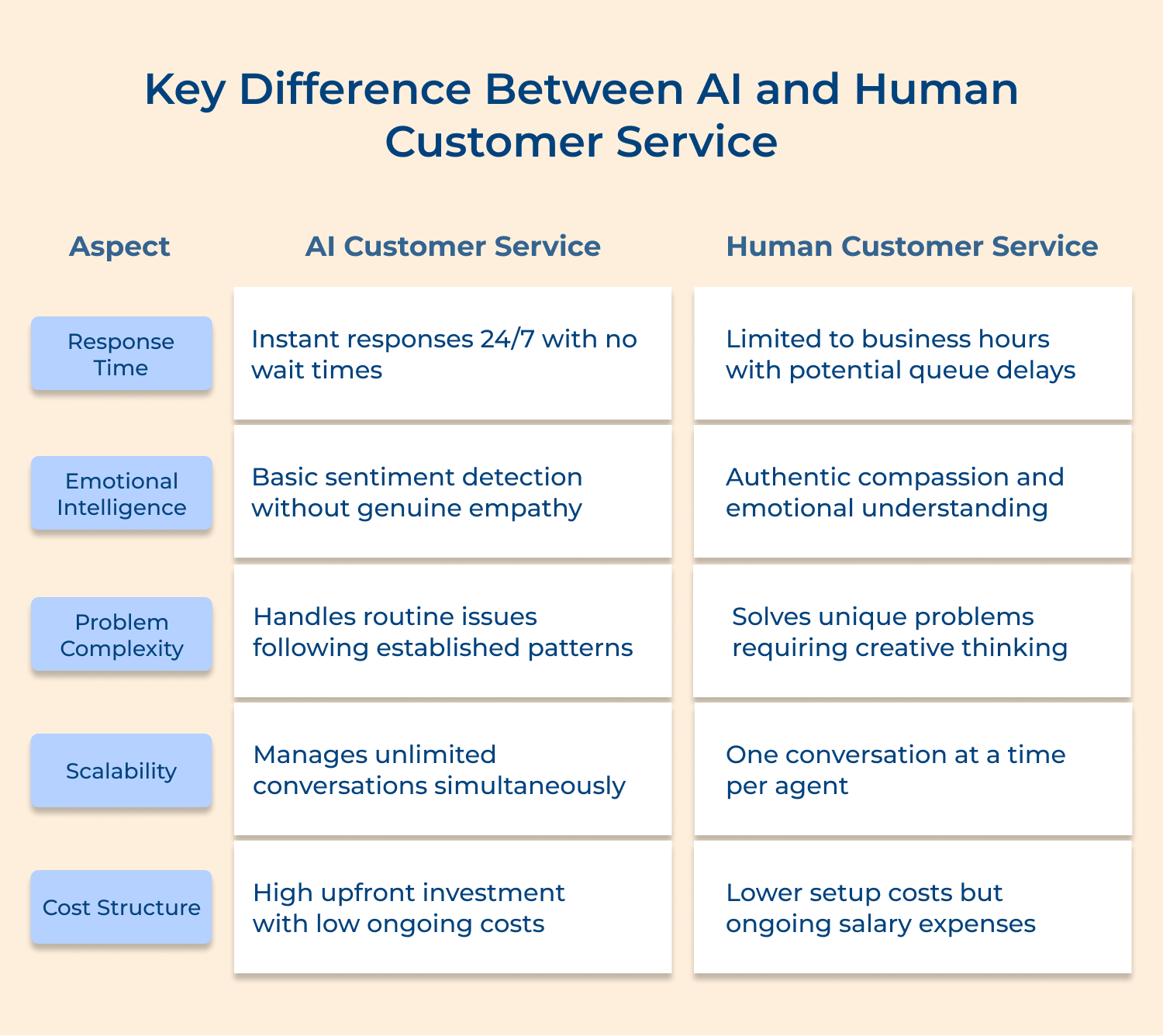
AI agents deliver instant responses around the clock without breaks while human agents work scheduled shifts with limited simultaneous conversations. This fundamental difference affects how quickly customers receive help and whether support exists when they need it most.
Example scenario: A customer in Tokyo needs help at 3 AM local time resetting their account password. An AI agent resolves this immediately while a human-only service would require waiting until business hours, potentially losing the customer to frustration.
Here’s what this means for different business needs:
Human agents handle one thoughtful conversation at a time but require staffing across time zones for continuous coverage. They provide deeper engagement per interaction but create bottlenecks during unexpected surges in customer inquiries or during holidays when staffing runs thin.
Key takeaways:
Human agents recognize emotional nuances and provide genuine compassion during difficult situations while AI struggles with sentiment beyond basic detection. This gap becomes critical when customers feel frustrated or need reassurance beyond factual problem-solving.
Consider these questions when evaluating your customer interactions:
AI agents detect keywords indicating frustration but cannot truly understand the emotional weight behind customer concerns or adjust responses with authentic empathy. They follow scripts for acknowledging feelings but lack the human warmth that transforms angry customers into loyal advocates.
Key takeaways:
Artificial intelligence customer service excels with straightforward issues matching known patterns, analyzing situations and developing customized solutions by combining knowledge with programmed responses.
Example scenario: A customer accidentally ordered products to an old address that’s now occupied by new tenants who refuse to return the package. This requires negotiation skills and creative problem-solving that AI cannot navigate without clear precedent.
Human agents assess context and make judgment calls about when to override policies or create exceptions for special circumstances. They understand the difference between what the rulebook says and what makes sense for retaining a valuable customer relationship.
Key takeaways:
AI delivers identical quality and accuracy across every interaction, following programmed guidelines while human performance varies based on individual skills as well as circumstances. This creates a tradeoff between reliable consistency and the personalized touch that makes customers feel special.
For example, an AI agent provides the same thorough explanation about return policies to every customer using identical language and structure. Meanwhile human agents might adjust their explanation based on whether they’re talking to a confused senior or a rushed professional.
Human agents remember previous conversations with repeat customers and tailor their approach based on individual preferences along with communication styles. However, service quality fluctuates based on training levels.
Key takeaways:
AI customer service requires upfront investment in technology and setup but handles unlimited conversations without additional per-interaction costs afterward. It scales proportionally with customer volume, making growth expensive but offering flexible management.
Consider how your business economics and growth trajectory align:
Human teams offer flexibility to temporarily increase or decrease staffing through part-time workers during predictable busy seasons. However, maintaining quality while scaling quickly remains challenging since new agents need weeks of training before reaching full productivity.
So based on it choose AI when experiencing rapid growth or highly variable demand that makes workforce planning difficult and expensive. Choose human agents when volume is stable and predictable, allowing you to maintain an optimized team size.
AI systems learn from aggregated data patterns and improve through programming updates that instantly apply across all interactions..
Ask yourself these questions about your support evolution needs:
Human agents offer deeper contextual understanding that comes from years of experience but struggle to share this institutional knowledge efficiently. So choose AI when you frequently update products or policies and need support knowledge to change instantly across all interactions.
When to choose Human Customer service? Choose human agents when deep product expertise develops slowly over time and you can retain experienced staff long-term.
Human agents create memorable personal connections through authentic conversations that transform transactions into relationships fostering long-term loyalty. AI provides efficient service but lacks the human touch that makes customers feel valued beyond their wallet, limiting emotional brand attachment.
The relationship-building advantage breaks down into specific elements:
AI interactions remain fundamentally transactional regardless of how sophisticated the technology becomes at mimicking conversational patterns. Customers recognize they’re talking to a machine, which prevents the authentic connection that inspires brand advocacy and positive word-of-mouth referrals.
The most effective customer service strategies don’t choose between AI and human agents but strategically deploy both. Creates seamless experiences that maximize efficiency with human touch.
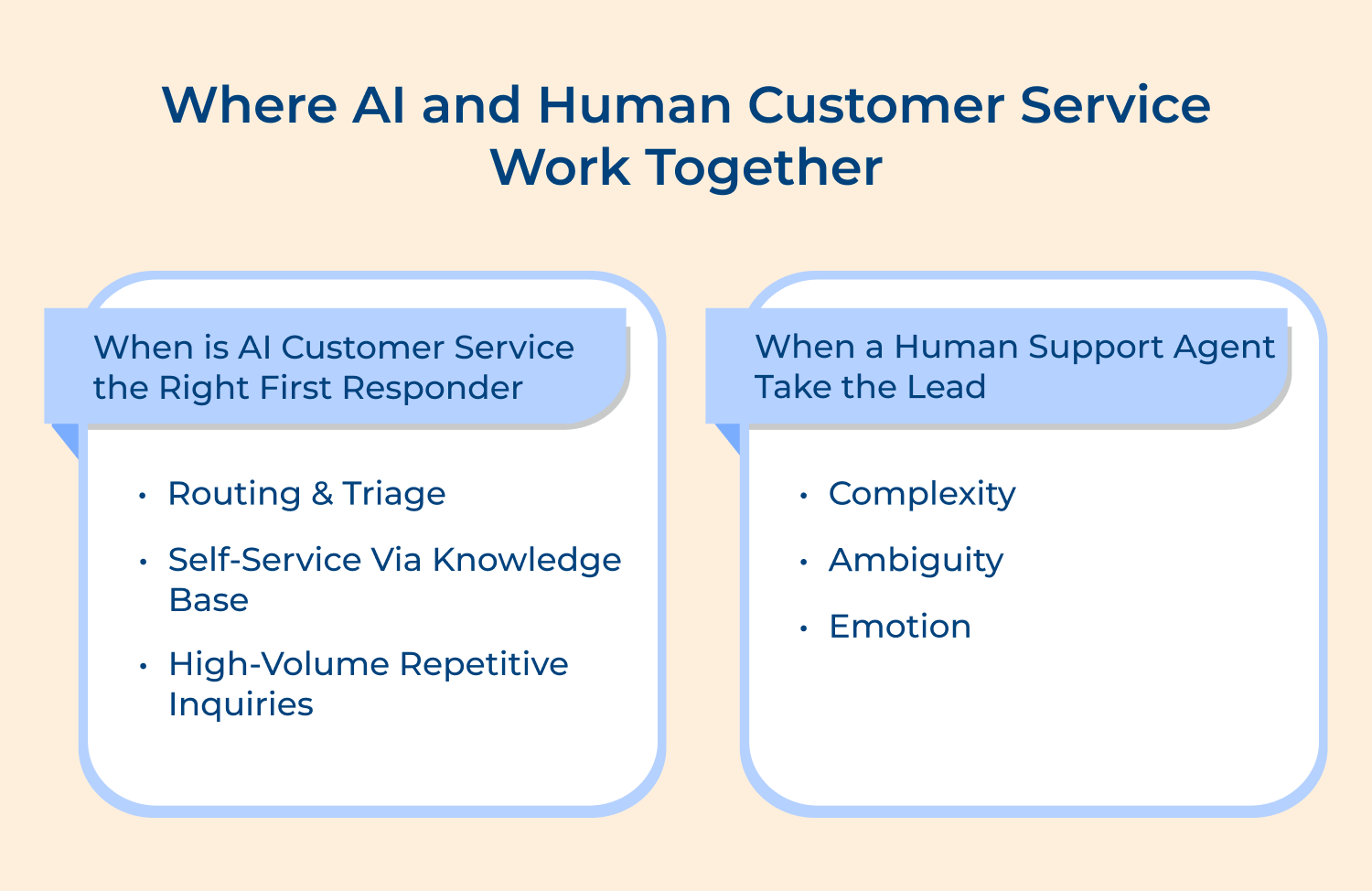
1. Routing and Triage
AI analyzes incoming requests and directs them to appropriate resources based on issue type as well as urgency instantly. This ensures customers reach the right solution path without navigating confusing menus or waiting for manual assignment.
Example: A customer submits a ticket about billing. AI instantly recognizes the account issue and routes it to the finance team while simultaneously suggesting relevant help articles for immediate self-service options.
2. Self-service via Knowledge Base
AI searches extensive documentation and delivers precise answers to common questions without human intervention required. Customers get immediate resolutions for straightforward issues like password resets or tracking information through conversational interfaces.
Example: A customer asks about return policies at midnight. The AI agent pulls the exact policy details and explains the step-by-step process, letting the customer initiate their return immediately without waiting.
3. High-Volume Repetitive Inquiries
AI handles thousands of identical questions simultaneously while maintaining consistent quality and freeing human capacity for complex work. This approach dramatically improves customer experience (CX) by eliminating wait times for routine matters.
Example: During a product launch, hundreds of customers ask about shipping timelines. AI provides accurate delivery estimates based on each customer’s location while human agents focus on technical setup questions.
1. Complexity Requiring Judgment
Human agents assess multifaceted problems involving multiple systems or requiring exceptions to standard policies and procedures. They navigate gray areas where predetermined rules don’t adequately address unique customer circumstances.
Example: A customer needs to modify an order that’s already shipped but hasn’t arrived yet. A human agent coordinates with logistics and offers creative solutions like rerouting or issuing a replacement.
2. Ambiguity in Customer Communication
Humans interpret vague descriptions and ask clarifying questions to understand what customers actually need versus what they initially request. They read between the lines when customers struggle to articulate their problems clearly.
Example: A customer says their product “isn’t working right” without details. A human agent asks targeted questions to discover the real issue is a missing cable rather than product malfunction.
3. Emotion and Relationship Repair
Human agents provide authentic empathy when customers feel frustrated or when service failures require apologies and relationship rebuilding. This personal touch transforms negative experiences into opportunities for strengthening customer loyalty while improving overall customer experience (CX).
For example a customer receives a damaged item for the third time and calls angry. A human agent listens to their frustration, apologizes sincerely and offers expedited replacement plus compensation for the inconvenience.
The future of customer support isn’t choosing between AI and human agents but orchestrating smooth transitions between both. Let AI handle speed and scale while humans provide empathy as well as complexity management for optimal results.
Smart businesses deploy AI as the first line of defense for routine inquiries and instant responses. When situations demand creativity or emotional intelligence, seamless handoffs to human agents ensure customers always receive the right type of support at exactly the right moment.

When should businesses use AI vs. Human Customer Service?
Use AI for high-volume repetitive questions, after-hours support and instant responses to straightforward issues like order tracking. Deploy human agents for complex problems requiring judgment, emotional situations needing empathy and high-value customers where personalized attention drives loyalty.
How does AI vs. Human Customer Service impact customer satisfaction?
AI improves satisfaction by eliminating wait times and providing instant answers for simple questions customers want resolved quickly. Human service increases satisfaction when customers face frustrating situations and need genuine empathy or someone who takes personal accountability for their problems.
Can AI replace human agents in customer service?
AI cannot fully replace human agents because it lacks emotional intelligence and creative problem-solving for ambiguous situations. The technology works best alongside humans by managing routine tasks while agents focus on complex cases where human qualities matter.
What are the limitations of AI vs. Human Customer Service?
AI struggles with emotional nuance, unprecedented situations and providing authentic empathy that builds genuine connections. Human limitations include inconsistent service quality, restricted availability requiring shift coverage and higher costs that make scaling expensive as volume grows.
How does AI vs. Human Customer Service handle complex issues?
AI handles complexity through pattern matching but fails when problems don’t fit established categories or require creative thinking. Human agents excel at complex issues by combining critical thinking with experience to develop customized solutions and make judgment calls.
 https://omni24.io/wp-content/uploads/2026/09/Social-commerce-scaled.png
1340
2560
Webvision Solution
https://omni24.io/wp-content/uploads/2023/04/Omni-Logo-1.svg
Webvision Solution2026-10-23 12:18:272026-10-23 12:18:27What is Social Commerce and Why Does It Matter?
https://omni24.io/wp-content/uploads/2026/09/Social-commerce-scaled.png
1340
2560
Webvision Solution
https://omni24.io/wp-content/uploads/2023/04/Omni-Logo-1.svg
Webvision Solution2026-10-23 12:18:272026-10-23 12:18:27What is Social Commerce and Why Does It Matter? https://omni24.io/wp-content/uploads/2026/08/AI-Customer-Service-Agents.png
1256
2400
Webvision Solution
https://omni24.io/wp-content/uploads/2023/04/Omni-Logo-1.svg
Webvision Solution2026-09-21 04:48:512026-09-21 04:48:51How to Build an AI Customer Service Agents: 8 Key Steps
https://omni24.io/wp-content/uploads/2026/08/AI-Customer-Service-Agents.png
1256
2400
Webvision Solution
https://omni24.io/wp-content/uploads/2023/04/Omni-Logo-1.svg
Webvision Solution2026-09-21 04:48:512026-09-21 04:48:51How to Build an AI Customer Service Agents: 8 Key Steps https://omni24.io/wp-content/uploads/2026/08/Omnichannel-Conversational-AI.png
1256
2400
Tushar Joshi
https://omni24.io/wp-content/uploads/2023/04/Omni-Logo-1.svg
Tushar Joshi2026-09-16 03:51:072026-09-16 03:51:07How to Build Omnichannel Conversational AI Strategy
https://omni24.io/wp-content/uploads/2026/08/Omnichannel-Conversational-AI.png
1256
2400
Tushar Joshi
https://omni24.io/wp-content/uploads/2023/04/Omni-Logo-1.svg
Tushar Joshi2026-09-16 03:51:072026-09-16 03:51:07How to Build Omnichannel Conversational AI Strategy
Whether it’s about acquire, engage or support – Omni24 covers all your customer engagement needs in one complete platform.

Copyright ©2026 Veemo All rights reserved.
CA, Los Angeles, Hall Ave, 19011