How to Track Knowledge Management Success: 5 Key Metrics & KPIs
Effective knowledge management helps organizations retain expertise, improve communication, drive innovation and ensure sustainable business growth.

Effective knowledge management helps organizations retain expertise, improve communication, drive innovation and ensure sustainable business growth.
Organizations often struggle to capture knowledge in this rapidly changing business landscape. It can lead to inefficiencies and a lack of innovation.
39% of organizations report improved business execution, including faster decisions and shorter time due to effective knowledge management systems.
Without a solid knowledge management strategy, valuable insights may go unused and decision-making can become sluggish. These challenges hinder business growth.
Knowledge management success is attainable through a strategic approach that includes setting clear objectives and leveraging technology. By implementing these strategies, businesses can enhance collaboration and streamline processes.
Explore how to unlock your organization’s potential through effective knowledge management.
Knowledge management success refers to the effective capture, distribution and utilization of knowledge within an organization to enhance performance. It involves creating systems and processes that allow information to flow freely among employees, ensuring that valuable insights are accessible when needed.
Achieving knowledge management success leads to improved decision-making and a culture of continuous learning. When businesses manage their knowledge resources effectively, they can reduce redundancy and make informed choices that drive strategic objectives, resulting in a competitive advantage in rapidly changing markets.
Key objectives:
Implementing effective knowledge management requires careful consideration of several factors. Here are the essential elements to ensure success:
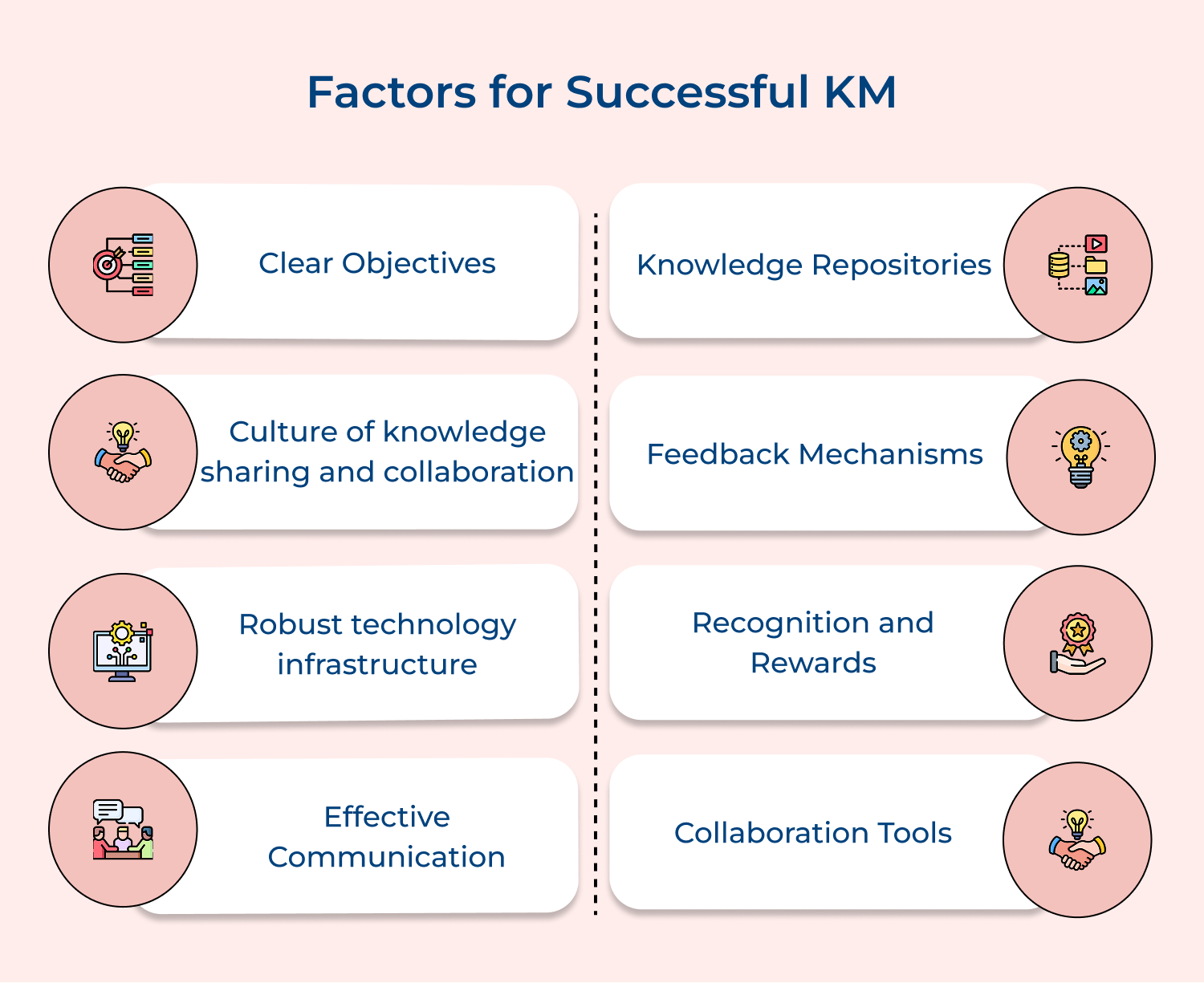
Clear objectives provide direction for knowledge management initiatives. They align efforts with organizational goals, ensuring resources are used effectively. Without clear objectives, knowledge management activities may lack focus leading to scattered efforts.
Clear objectives guide the development of knowledge management strategies and metrics. They help prioritize initiatives, allocate resources and measure success. Businesses can use objectives to communicate the importance of knowledge management to stakeholders, fostering buy-in and participation across all levels of the company.
Actionable tips:
A culture of knowledge sharing and collaboration is essential for effective knowledge management. It encourages employees to share their insights. Such culture breaks down silos and creates a learning organization where knowledge flows freely, leading to improved decision-making .
Organizations can cultivate culture through leadership examples, incentives and collaborative spaces. Encourage cross-functional teams, mentoring programs and communities of practice. Celebrate knowledge-sharing successes and integrate collaboration into performance evaluations.
Actionable tips:
Having a robust technology infrastructure supports efficient knowledge capture, storage, retrieval and sharing. It provides the backbone for knowledge management initiatives, enabling seamless access to information across the organization.
Implement a comprehensive knowledge management system that includes document management, collaboration tools and search capabilities. Use data analytics to identify knowledge trends and gaps. Leverage AI for knowledge discovery and recommendations.
Actionable tips:
Effective communication is crucial for knowledge transfer and understanding. It ensures that knowledge is accurately conveyed, interpreted and applied. Good communication practices help overcome barriers to knowledge sharing and facilitate the flow of information across different parts of the organization.
Develop clear communication channels for knowledge sharing, such as regular meetings, newsletters, or internal social media platforms. Try to use visual aids, storytelling and analogies to convey complex information. Encourage active listening and provide opportunities for questions.
Actionable tips:
Knowledge repositories centralize information, making it easily accessible. They prevent knowledge loss when employees leave and reduce time spent recreating existing solutions. Repositories serve as a single source of truth, ensuring consistency in information and practices across the organization.
Implement a structured repository with clear categories, tags and metadata. Include various types of knowledge assets. Use version control to maintain accuracy. Encourage regular contributions and updates from employees. Integrate the repository with daily workflows to increase usage and relevance.
Actionable tips:
Feedback mechanisms are essential and identify what’s working well or what needs improvement. Feedback ensures that knowledge management initiatives remain relevant, effective and aligned with user needs, leading to higher engagement.
Implement regular surveys, focus groups and user testing to gather feedback on knowledge management tools. Use analytics to track usage patterns and identify popular or underutilized resources. Create channels for users to suggest improvements or report issues. Act on feedback to demonstrate responsiveness and encourage ongoing participation.
Actionable tips:
Recognition and rewards motivate employees to actively participate in knowledge management initiatives. They reinforce the importance of knowledge sharing and collaboration, encouraging consistent engagement. A well-designed recognition system can make knowledge management a natural part of daily work routines.
Develop a formal recognition program that acknowledges significant contributions to knowledge management. You can incorporate knowledge sharing into performance evaluations and promotion criteria. Use a mix of intrinsic (public praise, increased responsibilities) and extrinsic (bonuses, awards) rewards. Celebrate team successes to encourage collaborative knowledge sharing.
Actionable tips:
Collaboration tools facilitate real-time knowledge sharing and co-creation in modern work environments. They break down geographical & departmental barriers, enabling diverse teams to work together efficiently. These tools capture informal knowledge exchanges and innovative organizational culture.
Implement a suite of collaboration tools including instant messaging, video conferencing and shared document editing platforms. Use virtual whiteboards for brainstorming sessions. Create digital workspaces for project teams and communities of practice. Integrate these tools with existing knowledge repositories to ensure seamless information flow and documentation.
Actionable tips:
Tracking key metrics and KPIs is essential for evaluating knowledge management effectiveness. Here are the critical indicators to consider:
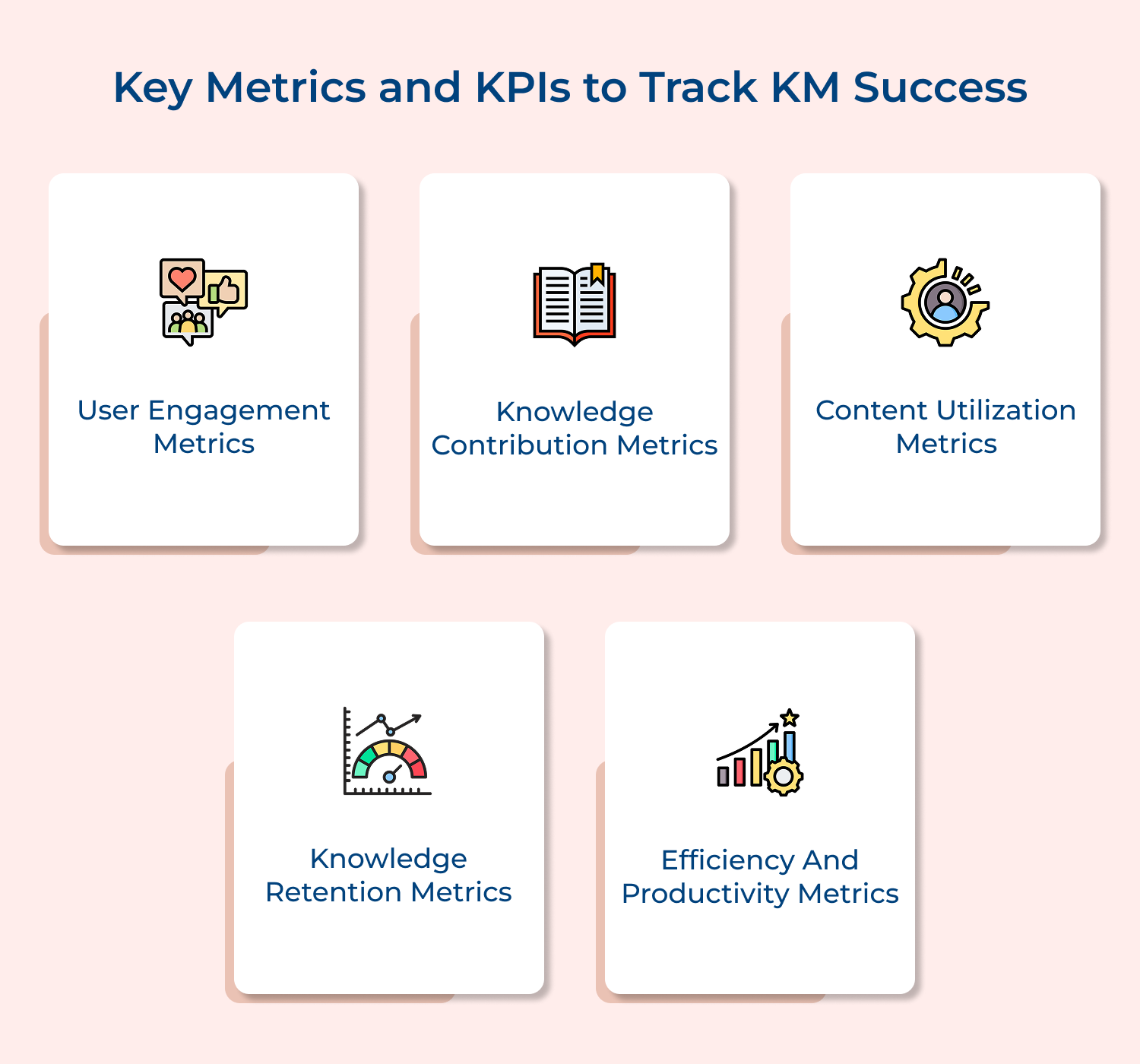
User engagement metrics are crucial for assessing how actively employees interact with the knowledge management system. These metrics indicate the system’s adoption rate and relevance to users’ daily work. High engagement suggests that the KM initiative is successfully meeting user needs and delivering value.
Use these metrics to identify popular content, peak usage times and user preferences. Such information can guide content creation, system improvements and targeted training efforts. Low engagement in certain areas may indicate a need for better promotion or revision of the KM strategy.
Knowledge contribution metrics measure how actively employees are sharing their expertise. These metrics assess the health of the knowledge-sharing culture within the organization. High contribution rates indicate a vibrant, collaborative environment where employees are willing to share their insights.
Use these metrics to identify top contributors and departments leading in knowledge sharing. The information can help in rewarding active contributors, identifying best practices for encouraging contributions and targeting areas where additional incentives may be needed to boost participation.
Content utilization metrics measure how frequently knowledge assets are being used. These metrics are crucial for understanding which types of content are most valuable to users and identifying underutilized resources. They help in assessing the overall usefulness of the knowledge base.
Use these metrics to guide content curation efforts, identifying which types of knowledge assets to prioritize. High-utilization content can be promoted as best practices, while low-utilization content may need revision or removal. This data helps in optimizing the knowledge base for maximum relevance and usefulness.
Knowledge retention metrics assess how effectively the organization preserves critical knowledge over time. These metrics are vital for ensuring that valuable insights and expertise are not lost due to employee turnover or time passage. They help in identifying potential knowledge gaps and areas at risk.
Use these metrics to develop targeted knowledge preservation strategies. Identify critical knowledge areas with low retention rates and implement measures such as mentoring programs, documentation initiatives, or training sessions. The data can also inform succession planning and risk management strategies related to knowledge loss.
These metrics measure the impact of knowledge management on operational performance. They are crucial for demonstrating the tangible benefits of KM initiatives to stakeholders. They help in quantifying how improved knowledge access and sharing translate into business value.
Use these metrics to calculate the ROI of KM initiatives. Track improvements in areas such as project completion times, problem resolution speed, or reduction in errors. The data can justify continued investment in KM and guide decisions on where to focus resources for maximum impact.
Implementing effective knowledge management practices is vital for organizational growth. Here are essential tips to enhance your KM strategy:
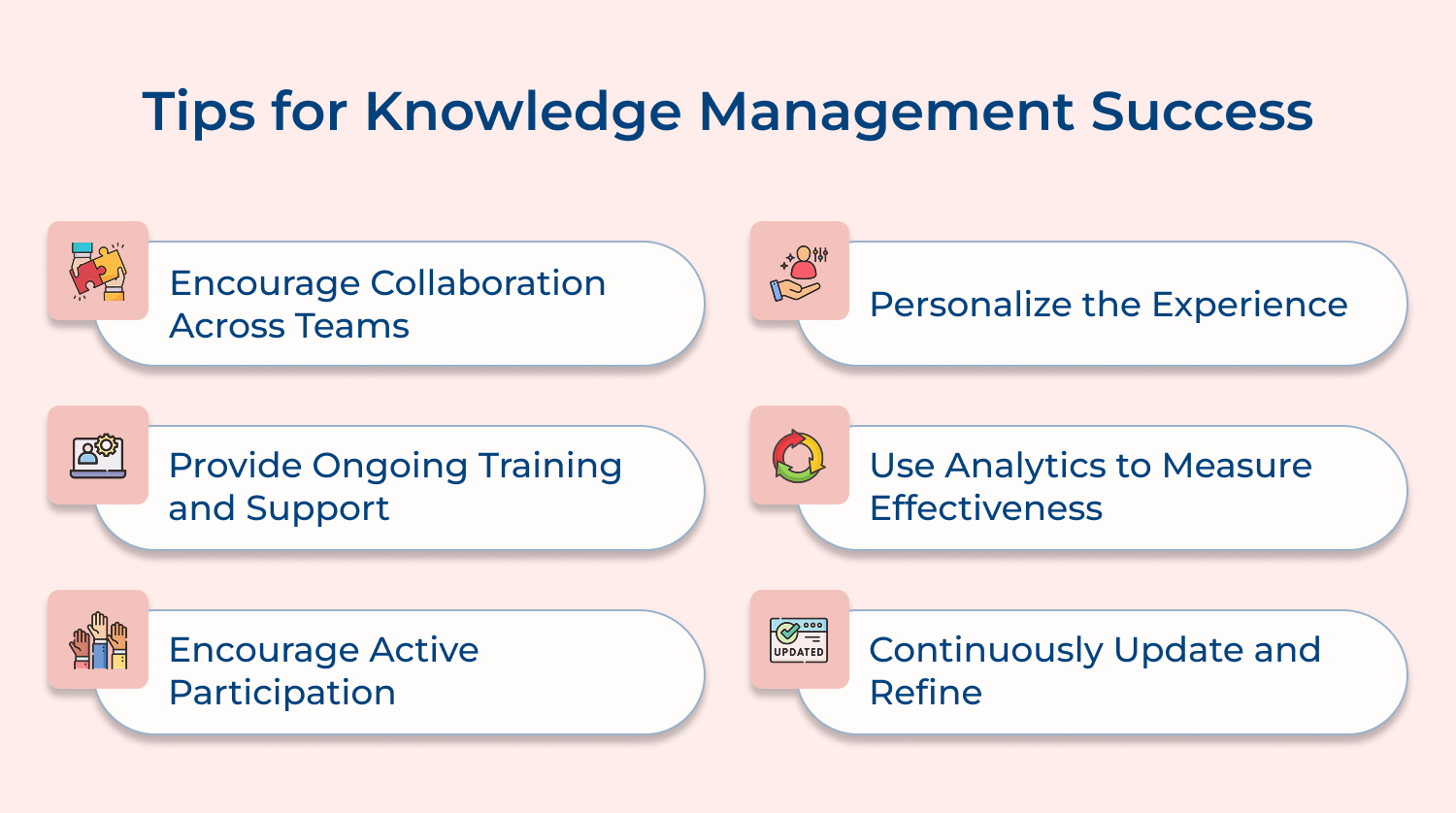
1. Encourage collaboration across teams: Promote cross-departmental collaboration to share diverse insights and best practices. Organizing workshops or joint projects can enhance knowledge and exchange a sense of unity within the organization.
2. Provide ongoing training and support: Provide resources such as user guides, FAQs and best practice documents. Designate knowledge champions within different departments to offer peer support. Continuous education ensures that employees can fully leverage the knowledge management tools and processes available to them.
3. Encourage active participation: Motivate employees to actively contribute to and use the knowledge management system. Gamify the process with leaderboards or badges for top contributors. Showcase success stories of how shared knowledge solved problems or improved processes.
4. Personalize the experience: Tailor the knowledge management experience to individual user needs and preferences. Implement AI-driven recommendations to suggest relevant content based on user roles and past interactions. Allow users to customize their dashboards and notification settings. It enhances engagement and makes knowledge more accessible.
5. Use analytics to measure effectiveness: Leverage analytics to track how knowledge is accessed and utilized. Understanding usage patterns allows for data-driven improvements to your knowledge management strategies and helps identify areas needing more focus.
6. Continuously update and refine: Implement a systematic process for reviewing content to ensure its relevance and accuracy. Encourage users to flag outdated information. Regularly solicit feedback on the usefulness and accessibility of the knowledge base. Use this input to refine your knowledge management strategy and enhance user experience over time.
Measuring knowledge management success can be complex and nuanced. Here are the common challenges organizations face in this process:

Challenge: One of the primary challenges in measuring KM success is the absence of clear, defined objectives. Without specific goals, it becomes difficult to gauge whether KM initiatives are effective or align with broader business objectives. Organizations may find themselves collecting data without understanding what to analyze or how to interpret it.
Solution: To overcome this challenge, organizations should start by establishing clear, measurable objectives for their KM initiatives. Involve key stakeholders in defining these goals to ensure alignment with the overall business strategy. Use the SMART criteria (Specific, Measurable, Achievable, Relevant, Time-bound) to create actionable objectives. Once objectives are set, organizations can implement metrics that directly correlate with these goals, making it easier to evaluate success.
Challenge: Quantifying the value of knowledge can be particularly challenging. Knowledge is often intangible because of its impact on productivity, innovation and decision-making may not be immediately visible. This can lead to skepticism regarding the ROI of KM initiatives.
Solution: To address this issue, organizations should develop qualitative and quantitative metrics that capture the value of knowledge. Conduct surveys and interviews to gather qualitative data on employee perceptions of KM effectiveness. For quantitative measures, consider tracking metrics such as time saved on projects, reduction in errors or the number of innovations stemming from knowledge sharing. Combining both types of data will provide a more comprehensive view of knowledge value.
Challenge: Resistance to change is a common barrier in organizations adopting KM practices. Employees may be reluctant to share knowledge due to fears of job security, lack of trust, or simply being accustomed to traditional workflows. This reluctance can hinder the implementation of effective KM systems and practices.
Solution: To combat resistance, organizations should foster a culture of collaboration and trust. Communicate the benefits of KM initiatives clearly to all employees, highlighting how knowledge sharing can lead to improved work processes and personal growth. Implement training programs that emphasize the importance of knowledge sharing and demonstrate how it can enhance team performance. Reward employees who actively participate in KM efforts, reinforcing positive behaviors and encouraging others to follow suit.
Challenge: An organization’s existing technology may not support effective KM practices, making it difficult to capture, store and retrieve knowledge. Inadequate tools can lead to frustration among employees, ultimately discouraging them from using KM systems.
Solution: Organizations should invest in modern KM tools that facilitate knowledge sharing and collaboration. Conduct a needs assessment to identify the specific requirements of your team and then select tools that meet those needs. Ensure that the technology is user-friendly and integrates seamlessly with existing systems to encourage adoption. Provide training and ongoing support to help employees navigate these tools effectively, ensuring they can leverage technology to enhance knowledge sharing.
Exploring real-life success stories can provide valuable insights. Here are five inspiring examples of effective knowledge management in action:
NASA’s Lessons Learned Information System (LLIS)
NASA’s LLIS is a comprehensive database of experiences, mishaps or best practices from various missions and projects.
What we can learn: Capturing lessons learned from both successes and failures is crucial for continuous improvement and avoiding repeated mistakes. This approach is especially valuable in high-stakes environments where errors can have significant consequences.
How to implement:
World Bank’s Knowledge Management Strategy
The World Bank implemented a knowledge management strategy that focuses on connecting staff across global offices and sharing expertise to support development projects worldwide.
What we can learn: Effective knowledge management can bridge geographical and cultural gaps, enabling global organizations to leverage their collective expertise more efficiently.
How to implement:
Siemens’ ShareNet
Siemens implemented ShareNet, a global knowledge sharing platform that allows employees to exchange ideas, best practices and solutions across different business units.
What we can learn: A well-designed knowledge sharing platform can significantly reduce duplication of efforts and accelerate problem-solving by connecting employees with relevant expertise across the organization.
How to implement:
Toyota’s Production System (TPS)
Toyota’s renowned production system is built on the principle of continuous improvement through knowledge sharing and standardization of best practices.
What we can learn: Integrating knowledge management into core business processes can lead to significant improvements in efficiency, quality and innovation.
How to implement:
Accenture’s Knowledge Exchange
Accenture’s Knowledge Exchange is a global repository of the company’s collective expertise, including methodologies, tools and best practices from various client engagements.
What we can learn: A well-organized knowledge base can be a powerful asset for consulting firms or any organization that needs to quickly leverage past experiences for new challenges.
How to implement:
Achieving knowledge management success impacts business performance significantly by enhancing collaboration, improving decision-making and driving innovation. By effectively capturing knowledge, organizations can streamline processes and reduce inefficiencies, leading to increased productivity. A strong KM strategy fosters a culture of continuous learning and engagement among employees, contributing to higher customer satisfaction.
As businesses navigate an ever-evolving landscape, prioritizing knowledge management not only empowers teams but also positions organizations for sustainable growth and success. Embracing these practices is essential for unlocking the full potential of your collective knowledge.

How to measure knowledge management success?
Measuring knowledge management success involves tracking various metrics such as user engagement, content quality and business impact. Key indicators include the frequency of knowledge access, time saved in problem-solving, reduction in repeated errors and improved decision-making processes. Employee surveys, productivity measurements and ROI calculations can also provide valuable insights into the effectiveness of your knowledge management initiatives.
What is a key success factor in knowledge management?
A key success factor in knowledge management is creating a culture that values and encourages knowledge sharing. This involves fostering an environment where employees feel comfortable sharing their expertise, rewarding contributions to the knowledge base and integrating knowledge sharing into daily workflows. Leadership support, user-friendly technology platforms and clear communication about the benefits of knowledge sharing are also crucial for success.
What makes knowledge management successful?
Successful knowledge management relies on a combination of factors. These include a clear strategy aligned with business objectives, robust technology infrastructure, active participation from employees at all levels and continuous improvement processes. Effective taxonomies, search capabilities and content curation also play vital roles. Successful knowledge management systems adapt to changing organizational needs and leverage data analytics.
How can leadership support Knowledge Management Success?
Leadership supports Knowledge Management success by fostering a culture of sharing and learning, allocating resources plus aligning KM initiatives with organizational goals. Effective leaders motivate teams, recognize contributions and remove barriers to collaboration. Their commitment ensures knowledge is captured, shared and used strategically to drive innovation, efficiency.
 https://omni24.io/wp-content/uploads/2026/08/AI-Customer-Service-Agents.png
1256
2400
Webvision Solution
https://omni24.io/wp-content/uploads/2023/04/Omni-Logo-1.svg
Webvision Solution2026-09-21 04:48:512026-09-21 04:48:51How to Build an AI Customer Service Agents: 8 Key Steps
https://omni24.io/wp-content/uploads/2026/08/AI-Customer-Service-Agents.png
1256
2400
Webvision Solution
https://omni24.io/wp-content/uploads/2023/04/Omni-Logo-1.svg
Webvision Solution2026-09-21 04:48:512026-09-21 04:48:51How to Build an AI Customer Service Agents: 8 Key Steps https://omni24.io/wp-content/uploads/2026/08/Omnichannel-Conversational-AI.png
1256
2400
Tushar Joshi
https://omni24.io/wp-content/uploads/2023/04/Omni-Logo-1.svg
Tushar Joshi2026-09-16 03:51:072026-09-16 03:51:07How to Build Omnichannel Conversational AI Strategy
https://omni24.io/wp-content/uploads/2026/08/Omnichannel-Conversational-AI.png
1256
2400
Tushar Joshi
https://omni24.io/wp-content/uploads/2023/04/Omni-Logo-1.svg
Tushar Joshi2026-09-16 03:51:072026-09-16 03:51:07How to Build Omnichannel Conversational AI Strategy https://omni24.io/wp-content/uploads/2026/08/Customer-Service-Teams.png
1256
2400
Tushar Joshi
https://omni24.io/wp-content/uploads/2023/04/Omni-Logo-1.svg
Tushar Joshi2026-09-15 04:01:522026-09-15 04:02:16How to Build Customer Service Teams: 6 Key Steps
https://omni24.io/wp-content/uploads/2026/08/Customer-Service-Teams.png
1256
2400
Tushar Joshi
https://omni24.io/wp-content/uploads/2023/04/Omni-Logo-1.svg
Tushar Joshi2026-09-15 04:01:522026-09-15 04:02:16How to Build Customer Service Teams: 6 Key Steps
Whether it’s about acquire, engage or support – Omni24 covers all your customer engagement needs in one complete platform.

Copyright ©2026 Veemo All rights reserved.
CA, Los Angeles, Hall Ave, 19011