How to Implement Knowledge Management in E-commerce?
Knowledge management in ecommerce enables businesses to transform data into actionable insights. It builds collaboration and agility in a competitive digital marketplace.

Knowledge management in ecommerce enables businesses to transform data into actionable insights. It builds collaboration and agility in a competitive digital marketplace.
Businesses often struggle with managing vast amounts of information effectively. It leads to inefficiencies, poor customer experiences, and lost opportunities. The pain of navigating unstructured data and disconnected teams can hinder growth.
70% of customers expect e-commerce sites to offer clear self-service and knowledge resources.
Implementing a robust knowledge management (KM) strategy can transform these challenges into opportunities. Systematically capturing knowledge enhances customer satisfaction and encourages collaboration.
Explore how effective KM can drive success in e-commerce, helping businesses not only survive but thrive in a competitive marketplace.
Knowledge management in e-commerce refers to the systematic process of capturing, distributing and effectively utilizing knowledge within online businesses. It includes strategies that organizations implement to gather insights and enhance customer experience.
KM plays a crucial role in leveraging data & information to improve operations and encourages innovation. Harnessing collective knowledge allows businesses to respond more rapidly to market changes and customer needs.
Key objectives:
Effective knowledge management is crucial for e-commerce success, driving efficiency and customer satisfaction. Here are the key reasons it matters.
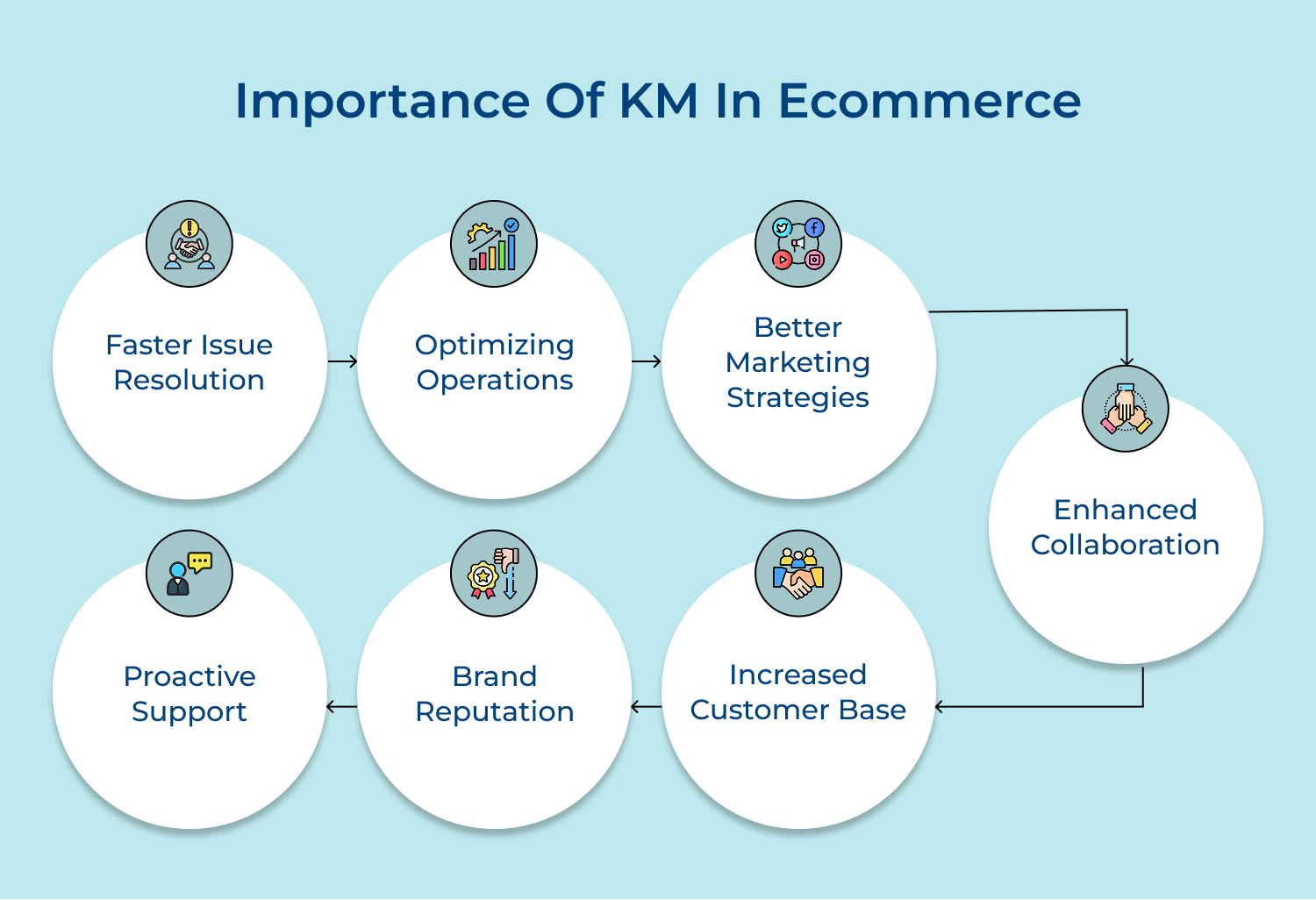
1. Faster issue resolution: The robust knowledge management systems, e-commerce businesses can significantly speed up issue resolution. Customer service representatives have immediate access to a wealth of information, enabling them to quickly address customer queries. This rapid response improves customer satisfaction and reduces the workload on support teams.
2. Optimizing operations: Knowledge management streamlines e-commerce operations by centralizing critical information. It enables quick access to best practices, inventory data and process guidelines. This centralization reduces errors and allows for faster decision-making. By sharing operational insights, businesses can continuously refine their processes, leading to cost savings and improved performance.
3. Enhanced collaboration: Knowledge management encourages collaboration across different departments in e-commerce organizations. It creates a shared repository of information, breaking down silos and encouraging knowledge sharing. Teams can easily access and contribute to collective wisdom. This collaborative environment promotes cross-functional synergies and enhanced overall business performance.
4. Increased customer base: By leveraging knowledge management, e-commerce businesses can better understand and cater to customer needs. Insights gathered from customer interactions, preferences and behaviors help in creating more appealing products or services. This customer-centric approach, combined with improved marketing strategies, attracts new customers while retaining existing ones, ultimately expanding the customer base and driving business growth.
5. Brand reputation: Knowledge management maintains brand reputation in e-commerce. By ensuring consistent information across all customer touchpoints, businesses can build trust and credibility. It also enables quick responses to market changes and customer feedback, allowing companies to maintain a positive brand image in the competitive online marketplace.
6. Proactive support: Knowledge management enables e-commerce businesses to offer proactive customer support. By analyzing past interactions, companies can anticipate potential problems and provide solutions before customers even encounter them. This proactive approach enhances the customer experience, reduces support tickets and demonstrates a commitment to customer satisfaction.
Implementing knowledge management in e-commerce requires strategic planning and execution. Here are essential steps to ensure successful implementation.

Assessing the current state helps identify gaps, inefficiencies and strengths in existing knowledge management practices. It provides a baseline for improvement and ensures that new initiatives are tailored to the specific needs of the e-commerce business.
The assessment can be used to create a roadmap for implementing knowledge management. It helps prioritize areas for improvement, allocate resources effectively and set realistic goals.
Tips:
1. Conduct a comprehensive audit of existing knowledge resources and processes, involving stakeholders from all departments.
2. Use surveys to gather insights from employees about current knowledge-sharing practices and pain points.
Clear objectives provide direction and purpose for knowledge management initiatives. They ensure that efforts are aligned with overall business goals and create a shared vision for all stakeholders.
Objectives can be used to guide the selection of knowledge management tools, shape policies and inform employee training programs. They serve as criteria for evaluating the success of knowledge management initiatives and help prioritize resources.
Tips:
1. Align knowledge management objectives with broader business goals, ensuring they contribute directly to the company’s success.
2. Use the SMART (Specific, Measurable, Achievable, Relevant, Time-bound) framework to create clear, actionable objectives.
Selecting appropriate tools and technologies is crucial for effective knowledge management in e-commerce. The right solutions streamline information capture, storage and retrieval, enhancing operational efficiency. Proper tools improve user adoption and the overall effectiveness of knowledge management initiatives.
The chosen tools can be integrated into existing workflows to automate knowledge capture and sharing. They can create centralized repositories for easy access to information, enable real-time collaboration and provide analytics for continuous improvement.
Tips:
1. Evaluate tools based on their compatibility with existing systems, ease of use and ability to meet specific e-commerce needs.
2. Prioritize scalable solutions that can grow with your business and integrate with emerging technologies.
A centralized knowledge base is essential for organizing and accessing information efficiently in an e-commerce environment. It reduces redundancy, ensures consistency in information and saves time in searching for data.
The centralized knowledge base can serve as a single source of truth for product information, customer data, operational procedures and best practices. It can be used to provide quick answers to customer queries and inform strategic decisions.
Tips:
1. Organize the knowledge base with a clear, intuitive structure and robust search functionality for easy navigation.
2. Implement a system for regular updates and version control to ensure the information remains accurate.
Systematic data collection and analysis are crucial for informed decision-making in e-commerce. They provide insights into customer behavior, market trends and operational performance. This process helps identify patterns, predict future outcomes and uncover hidden opportunities.
Data collection can be used to segment customers, personalize marketing campaigns and optimize product recommendations. It can inform inventory decisions, helping to balance stock levels with demand.
Tips:
1. Implement robust data collection methods across all customer touchpoints to ensure comprehensive insights.
2. Use advanced analytics tools to process large datasets and uncover actionable insights in real-time.
A knowledge-sharing culture is vital for maximizing the collective intelligence of an e-commerce organization. It promotes innovation, reduces duplication of efforts and accelerates problem-solving. This culture enhances collaboration, improves employee engagement and ensures that valuable insights & experiences are not lost when employees leave the company.
Regular team meetings, cross-departmental projects and mentoring programs can encourage a knowledge-sharing culture. It can be reinforced by recognizing and rewarding knowledge contributions.
Tips:
1. Implement a rewards system that recognizes and incentivizes knowledge sharing among employees.
2. Create dedicated spaces (physical and virtual) for informal knowledge exchange and collaborative problem-solving.
Monitoring and evaluating the effectiveness of knowledge management initiatives is crucial for ensuring their continued value and relevance. It helps identify what’s working and what needs improvement, justifies the investment in knowledge management.
Monitoring can be used to track key performance indicators (KPIs) related to knowledge management, such as time saved in information retrieval or improvement in customer satisfaction. Evaluation results can inform decisions about resource allocation, tool selection, and process improvements.
Tips:
1. Establish clear, measurable KPIs for knowledge management initiatives and regularly track progress against these metrics.
2. Conduct periodic surveys & interviews with employees and customers to gather qualitative feedback on knowledge management effectiveness.
Continuous improvement is essential in the rapidly evolving e-commerce landscape. It ensures that knowledge management practices remain effective and relevant over time. This approach helps businesses adapt to new technologies, changing customer expectations and emerging market trends.
Continuous improvement can be applied to refine knowledge management processes, update content in knowledge bases and enhance user interfaces of knowledge management tools. It can be used to address emerging gaps in knowledge and incorporate new best practices.
Tips:
1. Implement a formal process for regularly reviewing and updating knowledge management practices.
2. Encourage and act on feedback from users of knowledge management systems to drive improvements.
Knowledge management plays a pivotal role in enhancing customer experience in e-commerce. Here are ways it elevates customer interactions.
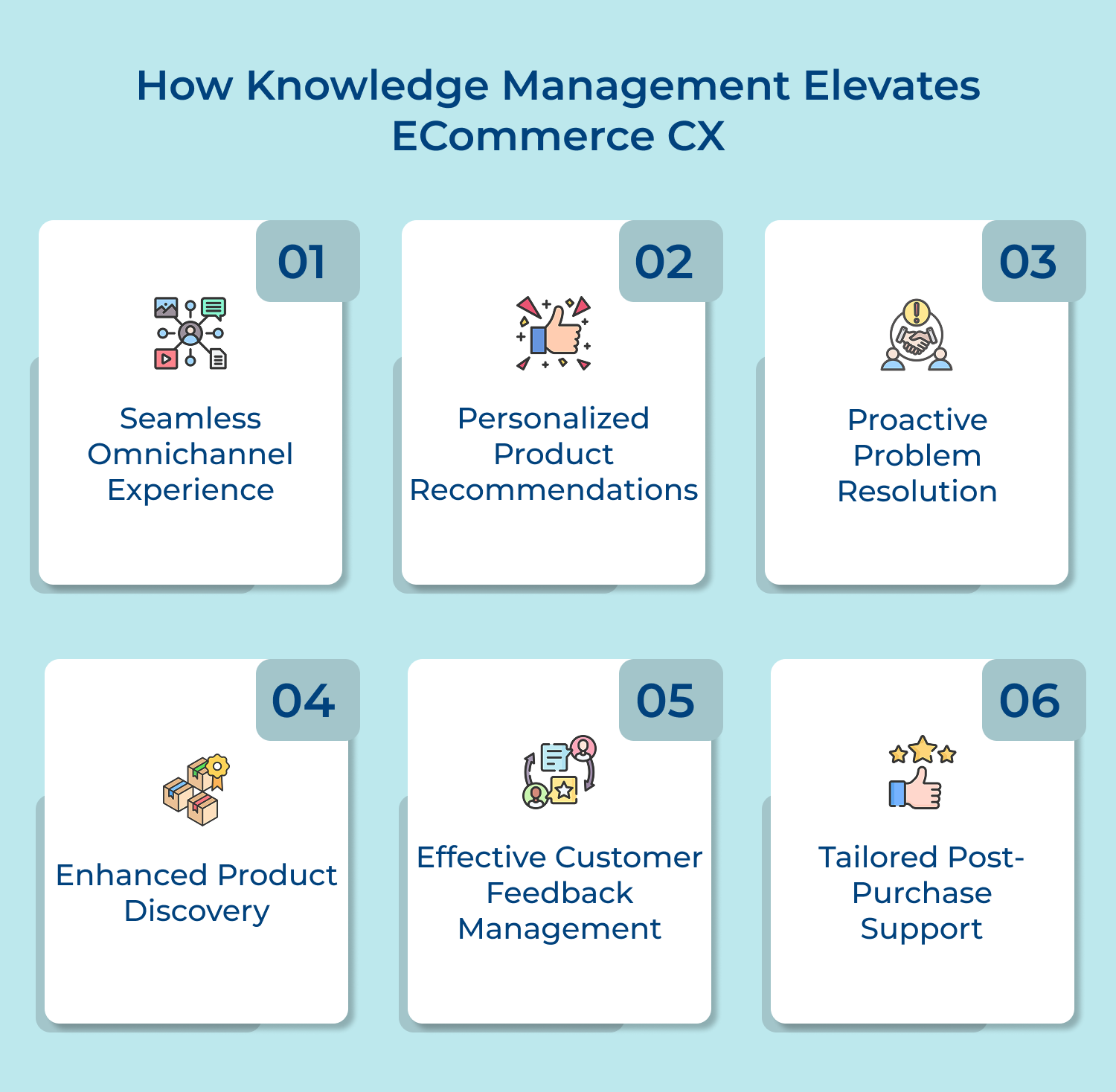
1. Seamless Omnichannel Experience
Knowledge management enables e-commerce businesses to provide a consistent and seamless experience across all channels. By centralizing customer data and interaction history, companies can ensure that customers receive personalized service whether they’re shopping online, using a mobile app, or contacting customer support.
2. Personalized Product Recommendations
Effective knowledge management allows e-commerce platforms to leverage customer data, purchase history and browsing behavior to offer highly personalized product recommendations. By analyzing this information, businesses can suggest items that align with individual preferences and needs.
3. Proactive Problem Resolution
Knowledge management systems enable e-commerce businesses to anticipate and address customer issues before they escalate. By analyzing patterns in customer queries, companies can develop proactive solutions and FAQs. This approach reduces customer frustration, minimizes the need for direct support interventions and demonstrates a commitment to customer care.
4. Enhanced Product Discovery
Knowledge management improves product discovery by organizing and presenting product information in user-friendly ways. By categorizing products effectively, providing detailed descriptions and utilizing customer-generated content like reviews, e-commerce platforms make it easier for customers to find what they’re looking for.
5. Effective Customer Feedback Management
Knowledge management systems facilitate the collection, analysis and application of customer feedback. By systematically gathering and organizing customer opinions, e-commerce businesses can identify trends, address common concerns and continuously improve their products.
6. Tailored Post-Purchase Support
Knowledge management enables e-commerce businesses to provide personalized post-purchase support. By maintaining comprehensive records of customer purchases, preferences and previous interactions, companies can offer tailored assistance for product troubleshooting.
Implementing knowledge management in e-commerce presents unique challenges that can hinder effectiveness. Here are the common obstacles faced by businesses.
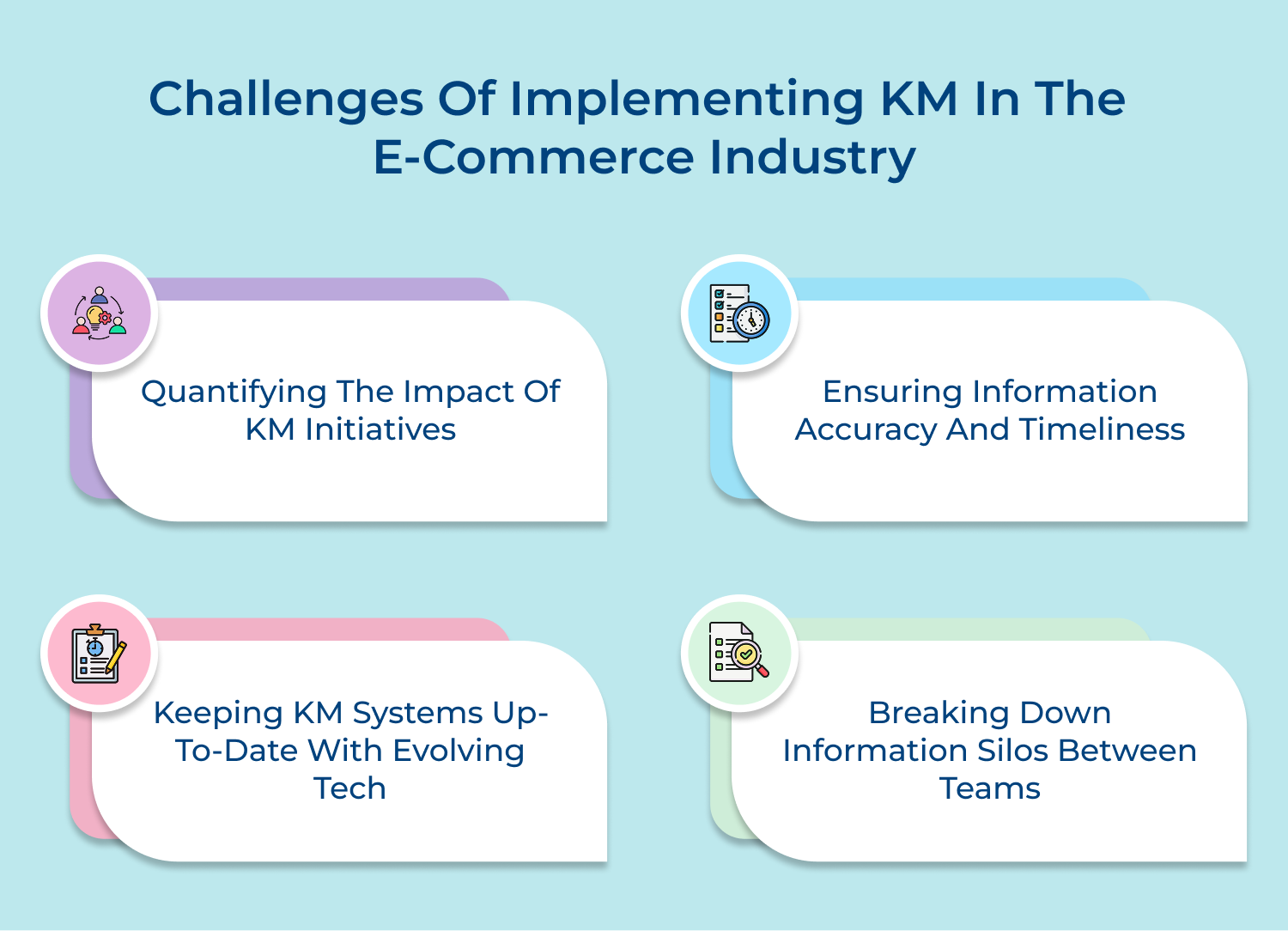
Measuring the direct impact of knowledge management (KM) initiatives in e-commerce can be challenging due to the intangible nature of knowledge and its indirect effects on business performance. Traditional metrics may not fully capture the value of improved decision-making, enhanced collaboration, or increased innovation resulting from KM efforts.
To tackle this challenge, e-commerce businesses can implement a balanced scorecard approach, combining quantitative metrics with qualitative assessments. Regular surveys &interviews with employees and customers can provide valuable insights into the perceived benefits of KM initiatives.
Maintaining the accuracy and timeliness of information is crucial yet challenging. Product details, pricing, inventory levels and market trends can change rapidly, making it difficult to keep knowledge bases current. Outdated or inaccurate information can lead to poor decision-making, customer dissatisfaction and potential revenue loss.
To address this challenge, e-commerce companies can implement automated data updating systems that sync information across various platforms in real-time. Establishing clear ownership and accountability for different knowledge areas, along with regular audit processes, can help maintain accuracy.
The rapid pace of technological advancement in e-commerce presents a significant challenge for knowledge management systems. New technologies, such as AI, blockchain, or advanced analytics, continuously emerge, potentially rendering existing KM systems obsolete. Integrating these new technologies into KM practices while ensuring compatibility with existing systems can be complex and resource-intensive.
To tackle this challenge, e-commerce businesses should adopt a flexible and modular approach to KM system architecture. This allows for easier integration of new technologies as they emerge. Regularly conducting technology audits and staying informed about industry trends can help in making informed decisions about technology adoption.
In many e-commerce organizations, information silos can develop between different departments such as marketing, sales, customer service and logistics. These silos can lead to duplication of efforts, inconsistent customer experiences and missed opportunities for cross-functional insights.
To address this challenge, e-commerce companies can implement cross-functional knowledge sharing platforms and collaborative tools that encourage interaction between different teams. Establishing regular cross-departmental meetings and projects can encourage a culture of knowledge sharing. Implementing a unified customer data platform that provides a single view of the customer across all touchpoints can help break down silos.
Knowledge management can be applied in various ways to improve e-commerce operations. Here are compelling use cases showcasing its effectiveness.
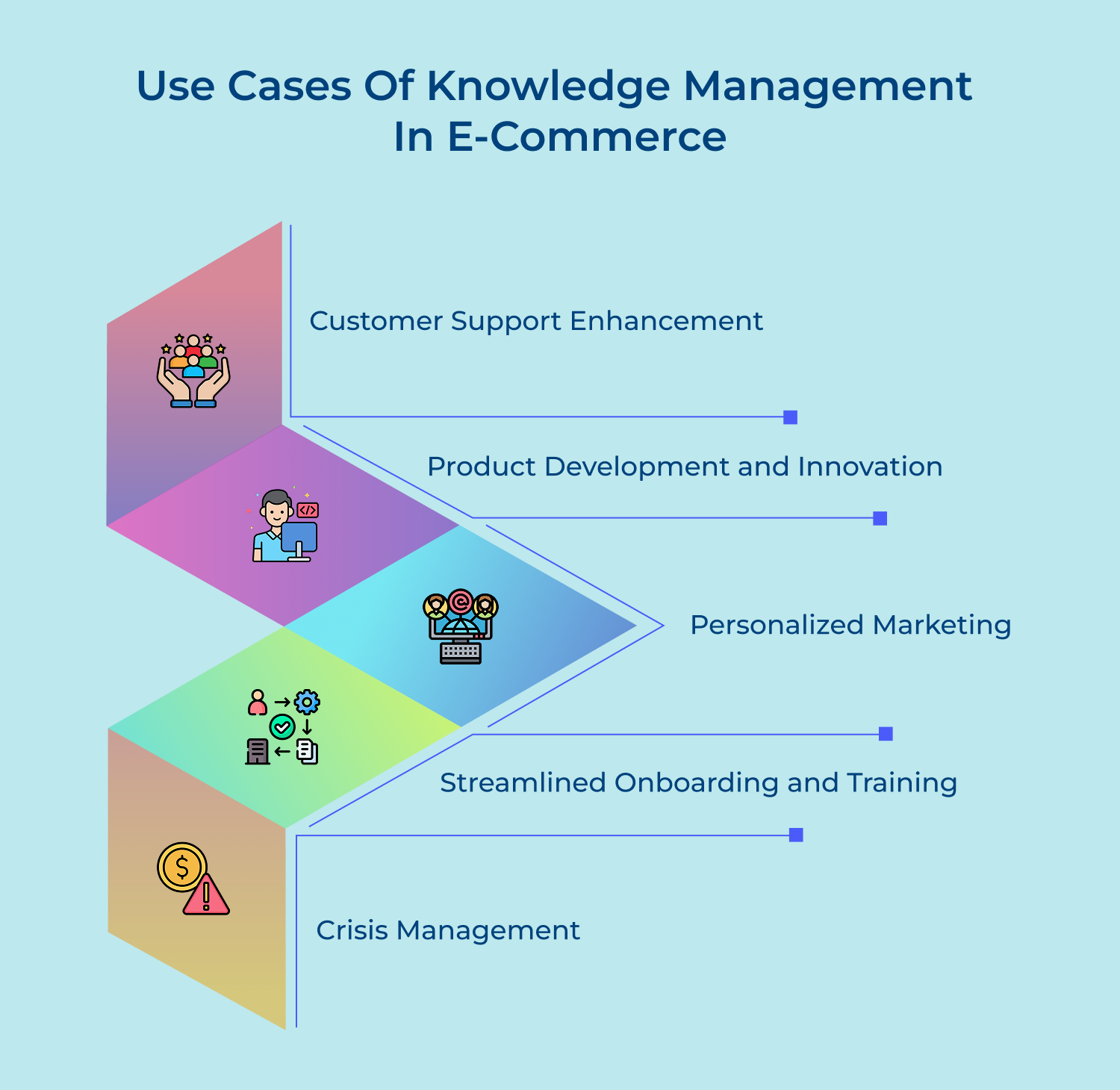
E-commerce customer support teams gain instant access to comprehensive product information, FAQs and resolution strategies through knowledge management. This access enables quicker, more accurate responses to customer queries across various channels.
Centralized knowledge allows support agents to provide consistent, high-quality assistance, reducing resolution times and improving customer satisfaction. The system facilitates the identification of common issues, allowing for proactive problem-solving and continuous improvement of support processes.
Knowledge management empowers e-commerce businesses to create highly targeted marketing campaigns. Aggregating customer data, purchase history, and browsing behavior allows companies to develop personalized product recommendations and tailored promotional offers.
This data-driven approach enables the creation of customer segments for more effective email marketing, retargeting ads and on-site personalization. The result is increased engagement, higher conversion rates and improved customer loyalty through relevant, timely marketing communications.
Knowledge management drives product innovation in e-commerce through systematic analysis of customer feedback, market trends and competitor data. Companies can identify gaps in the market and opportunities for new products using this information.
Existing products can be refined and new ones developed to better meet customer needs. Knowledge sharing across departments facilitates collaborative innovation, leading to more successful product launches and continuous improvement of the product lineup.
E-commerce companies streamline employee onboarding and ongoing training processes using knowledge management systems. A centralized repository of training materials, best practices, and operational procedures allows new hires to quickly access the information they need to become productive.
Such an approach ensures consistency in training across different departments and locations. Regular updates to the knowledge base keep all employees informed about the latest products, policies, and industry trends.
Knowledge management systems prove invaluable for e-commerce crisis management. Quick access to emergency protocols, communication templates and relevant data needed to address urgent situations such as security breaches, supply chain disruptions, or PR crises is provided.
Companies can respond swiftly and consistently across all channels with this centralized critical information. Post-crisis analysis is facilitated, allowing businesses to learn from incidents and improve their preparedness for future challenges.
Real-world examples illustrate how businesses leverage knowledge management to drive success in e-commerce. Here are notable instances worth exploring.
ASOS, a popular online fashion retailer, uses knowledge management to power its “Fit Assistant” feature. This tool combines customer data (such as previous purchases and returns) with product information and general sizing data to recommend the best size for each customer. By applying this knowledge effectively, ASOS helps customers make more informed decisions, reducing return rates and improving customer satisfaction.
eBay’s Seller Hub is an excellent example of knowledge management benefiting sellers in an e-commerce marketplace. This centralized platform aggregates and presents critical information for sellers, including market trends, competitor pricing & best practices for listing and promotion. By managing this knowledge effectively, eBay empowers its sellers to make data-driven decisions, optimize their listings and improve their sales performance.
Wayfair, a home goods e-commerce company, utilizes knowledge management in its visual search feature. The system manages a vast database of product images and their attributes. When a customer uploads a photo of a piece of furniture they like, the visual search tool analyzes the image, matches it with similar items in Wayfair’s inventory and presents these options to the customer. This application of knowledge management not only enhances the shopping experience but also helps customers find products that closely match their preferences, even if they don’t know the exact name or category of the item they’re seeking.
Implementing knowledge management in e-commerce profoundly impacts business operations and sales growth. Effectively harnessing information allows companies to enhance customer experiences through personalized service and faster support, increasing customer satisfaction.
Streamlined processes driven through KM improve operational efficiency, enabling businesses to respond swiftly to market changes and consumer demands. Ultimately, a robust KM strategy not only boosts sales through optimized marketing efforts and product development but also encourages a culture of continuous improvement, positioning e-commerce businesses for sustained success in a competitive landscape.

1. How to improve the efficiency of knowledge management in e-commerce?
To improve knowledge management efficiency in e-commerce, implement a centralized, user-friendly platform for storing and accessing information. Encourage a culture of knowledge sharing among employees. Utilize AI and machine learning for data analysis and insights. Regularly update and curate content to ensure relevance. Implement robust search functionality for quick information retrieval.
2. What are the types of knowledge management in e-commerce?
In e-commerce, knowledge management typically encompasses several types: Customer Knowledge Management, which involves leveraging customer data and preferences; Product Knowledge Management, focusing on organizing and disseminating product information; Process Knowledge Management, which streamlines operational procedures and best practices.
3. What is the process of knowledge management in e-commerce?
The knowledge management process in e-commerce typically involves five key steps: Knowledge Acquisition, where data is gathered from various sources like customer interactions, market research, and internal operations.
4. How can knowledge management help your e-commerce?
Knowledge management helps e-commerce businesses by enhancing customer support, improving product knowledge across teams, and reducing operational costs through efficient information use. It enables better customer targeting and retention, drives revenue growth, and streamlines operations, giving companies a competitive edge with more personalized, data-driven decision-making.
 https://omni24.io/wp-content/uploads/2026/08/AI-Customer-Service-Agents.png
1256
2400
Webvision Solution
https://omni24.io/wp-content/uploads/2023/04/Omni-Logo-1.svg
Webvision Solution2026-09-21 04:48:512026-09-21 04:48:51How to Build an AI Customer Service Agents: 8 Key Steps
https://omni24.io/wp-content/uploads/2026/08/AI-Customer-Service-Agents.png
1256
2400
Webvision Solution
https://omni24.io/wp-content/uploads/2023/04/Omni-Logo-1.svg
Webvision Solution2026-09-21 04:48:512026-09-21 04:48:51How to Build an AI Customer Service Agents: 8 Key Steps https://omni24.io/wp-content/uploads/2026/08/Omnichannel-Conversational-AI.png
1256
2400
Tushar Joshi
https://omni24.io/wp-content/uploads/2023/04/Omni-Logo-1.svg
Tushar Joshi2026-09-16 03:51:072026-09-16 03:51:07How to Build Omnichannel Conversational AI Strategy
https://omni24.io/wp-content/uploads/2026/08/Omnichannel-Conversational-AI.png
1256
2400
Tushar Joshi
https://omni24.io/wp-content/uploads/2023/04/Omni-Logo-1.svg
Tushar Joshi2026-09-16 03:51:072026-09-16 03:51:07How to Build Omnichannel Conversational AI Strategy https://omni24.io/wp-content/uploads/2026/08/Customer-Service-Teams.png
1256
2400
Tushar Joshi
https://omni24.io/wp-content/uploads/2023/04/Omni-Logo-1.svg
Tushar Joshi2026-09-15 04:01:522026-09-15 04:02:16How to Build Customer Service Teams: 6 Key Steps
https://omni24.io/wp-content/uploads/2026/08/Customer-Service-Teams.png
1256
2400
Tushar Joshi
https://omni24.io/wp-content/uploads/2023/04/Omni-Logo-1.svg
Tushar Joshi2026-09-15 04:01:522026-09-15 04:02:16How to Build Customer Service Teams: 6 Key Steps
Whether it’s about acquire, engage or support – Omni24 covers all your customer engagement needs in one complete platform.

Copyright ©2026 Veemo All rights reserved.
CA, Los Angeles, Hall Ave, 19011