How to Create Customer Experience (CX) Mapping: 9 Key Steps
Customer experience (CX) mapping is a strategic UX design tool that visualizes every stage of the customer journey for brands and design teams.

Customer experience (CX) mapping is a strategic UX design tool that visualizes every stage of the customer journey for brands and design teams.
Understanding customer interactions is crucial for business to deliver exceptional customer experience. More than 61% of consumers will pay at least 5% more if they know they’ll get a good customer experience.
Customer experience (CX) mapping represents every touchpoint of a client’s journey with your brand. These maps offer valuable insights, highlighting pain points and opportunities for enhancement.
CX mapping considers the entire experience, from initial contact to post-purchase support, helps uncover hidden issues, streamline processes, and deliver more personalized service. Explore how customer experience maps can transform your approach to customer satisfaction and loyalty.
Customer experience maps, also known as customer journey maps, are defined as visual representations of the entire client journey with a brand. These comprehensive diagrams illustrate every touchpoint and interaction a customer has with a company, from initial awareness through purchase and beyond. Businesses can gain a holistic view of their customers’ experiences by mapping out this journey.
CX maps typically include various stages of the customer journey, such as awareness, consideration, purchase, retention, and advocacy. They also incorporate emotional insights, highlighting how customers feel at each stage of their interaction with the brand
Key objectives:
Customer experience maps provide valuable insights into customer interactions, benefiting businesses to optimize their products/services and enhance customer satisfaction.
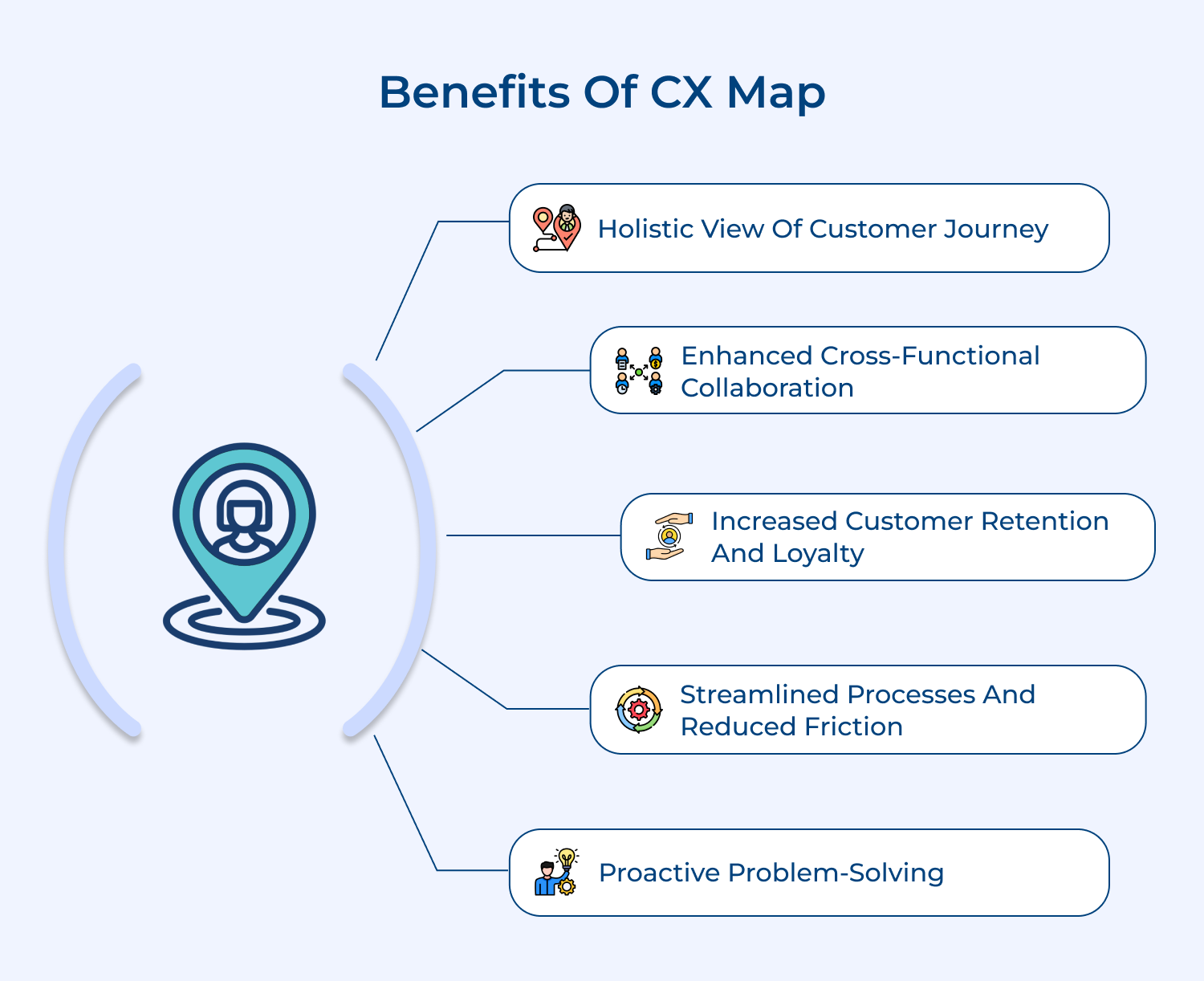
Holistic View of Customer Journey
Creating CX maps allows businesses to gain a comprehensive understanding of the entire customer journey. The holistic view helps identify touchpoints, pain points, and opportunities for improvement across all channels. By visualizing the complete journey, companies can better align their strategies to deliver a seamless experience.
Enhance Cross-Functional Collaboration
Customer experience maps encourage collaboration across different departments within an organization. By providing a shared visual representation of the customer journey, these maps encourage teams to work together towards a common goal of improving the overall customer experience. The cross-functional alignment leads to better-coordinated efforts.
Increase Customer Retention
Identifying pain points help businesses to significantly improve customer satisfaction, leading to increased retention and loyalty. Happy customers are more likely to make repeat purchases, recommend the company to others, and become brand advocates. It contributes to long-term business growth.
Streamline Business Processes
Mapping out the customer journey helps businesses to identify unnecessary steps in their processes. The streamlining results in smoother, more efficient interactions for customers, saving them time and effort. Reduced friction leads to a more enjoyable and stress-free experience overall.
Proactive Problem-Solving
As businesses gain insights from customer experience maps, they can anticipate potential issues before they become problems. The proactive approach means that customers are less likely to encounter difficulties or disruptions in their journey. When issues do arise, businesses are better prepared to resolve them quickly and efficiently.
Creating an effective customer experience map is a crucial process that helps businesses understand and optimize their customers’ journeys. Organizations can gain valuable insights by following these steps.
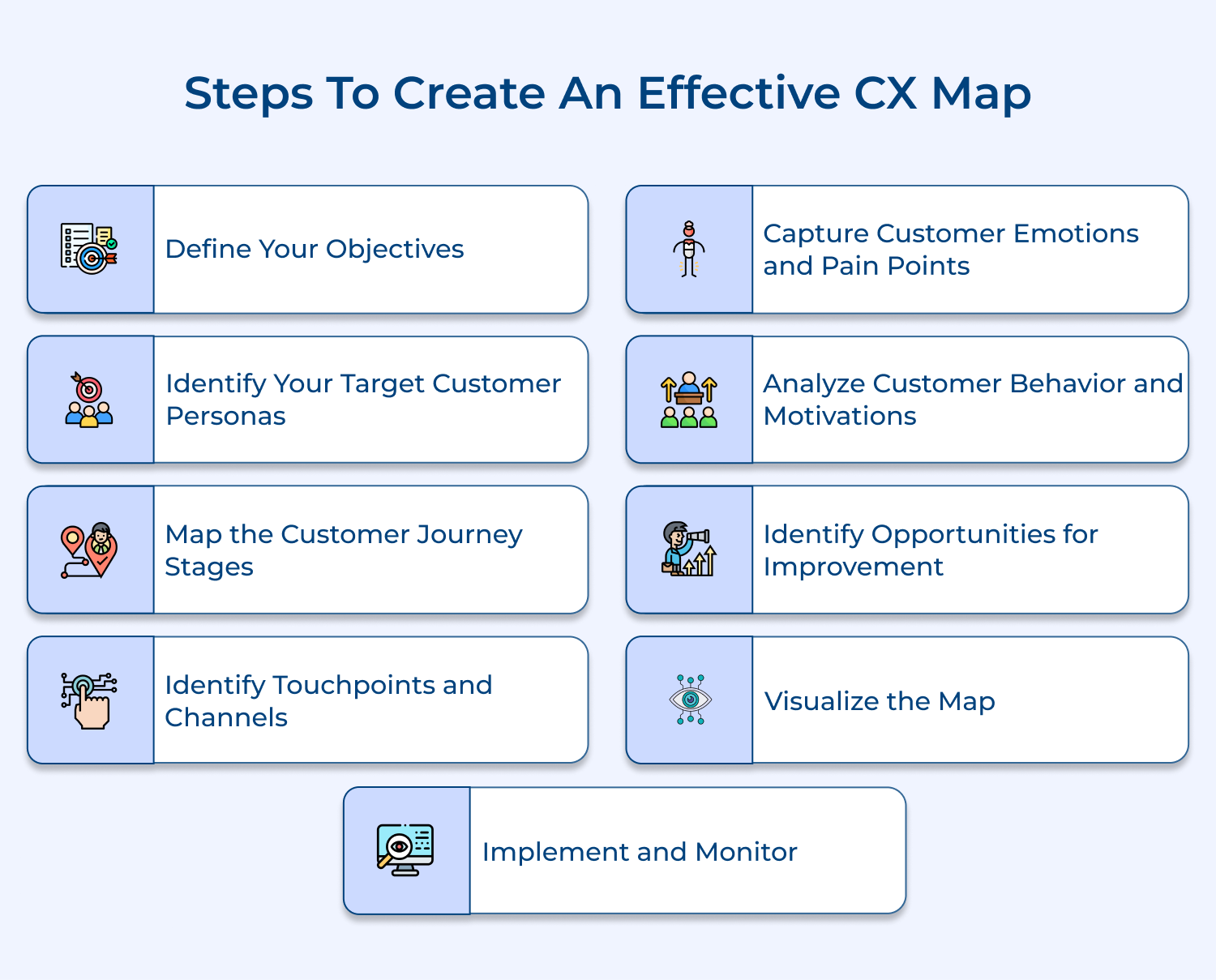
Outline objectives for your customer experience map ensures that the process remains focused with your business goals. It helps determine the scope of the mapping exercise and guides the entire process, ensuring that the final output is relevant plus actionable.
Use your objectives to guide data collection, analysis, and decision-making throughout the mapping process. They serve as a reference point for evaluating the effectiveness of your current customer experience and identifying areas for improvement that align with your business strategy.
Pro tips:
Understanding your target customer personas is essential for creating an accurate and meaningful experience map. It allows you to tailor the map to specific customer segments, ensuring that you address the unique needs, preferences, and pain points of each group.
Use persona information to inform the creation of customer journey stages, touchpoints, and emotional states within the map. The personalization helps in developing more targeted strategies for improving the customer experience for each segment.
Pro tips:
Identifying and mapping the key stages of the customer journey provides a clear structure for your experience map. It helps in organizing information and ensures that you capture the entire customer lifecycle, from initial awareness to post-purchase support.
Use the journey stages as the backbone of your experience map, organizing touchpoints, emotions, and opportunities for improvement within each stage. The structure helps in identifying patterns and trends across the entire customer journey.
Pro tips:
Mapping out all touchpoints and channels where customers interact with your business provides a comprehensive view of the customer experience. It helps identify gaps, redundancies, and opportunities for improvement across all customer interactions.
Use the touchpoint and channel information to analyze the effectiveness of each interaction, identify areas where customers may be experiencing frustration or confusion, and develop strategies for improving consistency across channels.
Pro tips:
Understanding customer emotions and pain points throughout their journey is crucial for creating empathy and identifying areas that need improvement. It helps businesses prioritize changes that will have the most significant impact on customer satisfaction.
Leverage emotional insights to guide decision-making about process improvements, communication strategies, and product development. Addressing pain points can lead to increased customer satisfaction, loyalty, and positive word-of-mouth.
Pro tips:
Understanding customer behavior and motivations provides context for their actions throughout the journey. The insight helps businesses anticipate customer needs and tailor their offerings and processes accordingly.
Use behavioral and motivational insights to inform product development, marketing strategies, and customer service improvements. The information can help in creating more personalized and effective customer experiences.
Pro tips:
Identifying opportunities for improvement is the main goal of creating a customer experience map. It helps businesses prioritize changes that will have the most significant impact on customer satisfaction and business performance.
Use the identified opportunities to develop action plans for improving the customer experience. These insights can inform strategic decisions about resource allocation, process improvements, and innovation initiatives.
Pro tips:
Visualizing the customer experience map makes complex information easily digestible and shareable across the organization. A well-designed visual representation helps stakeholders quickly understand the customer journey and identify key insights.
Use the visualized map as a communication tool to align teams, inform decision-making, and track progress on customer experience improvements. It serves as a central reference point for all customer experience initiatives.
Pro tips:
Implementing the insights gained from your customer experience map and monitoring the results is crucial for driving actual improvements in customer satisfaction as well as business performance. It turns the map from a theoretical tool into a practical driver of change.
Use the monitoring process to track the effectiveness of your customer experience improvements, measure ROI, and identify new opportunities for enhancement. The ongoing cycle of improvement helps maintain a competitive edge in customer experience.
Pro tips:
Creating a Customer Experience Map (CEM) requires the right tools and resources to effectively capture and analyze customer interactions. Here’s a guide to essential tools and their benefits.
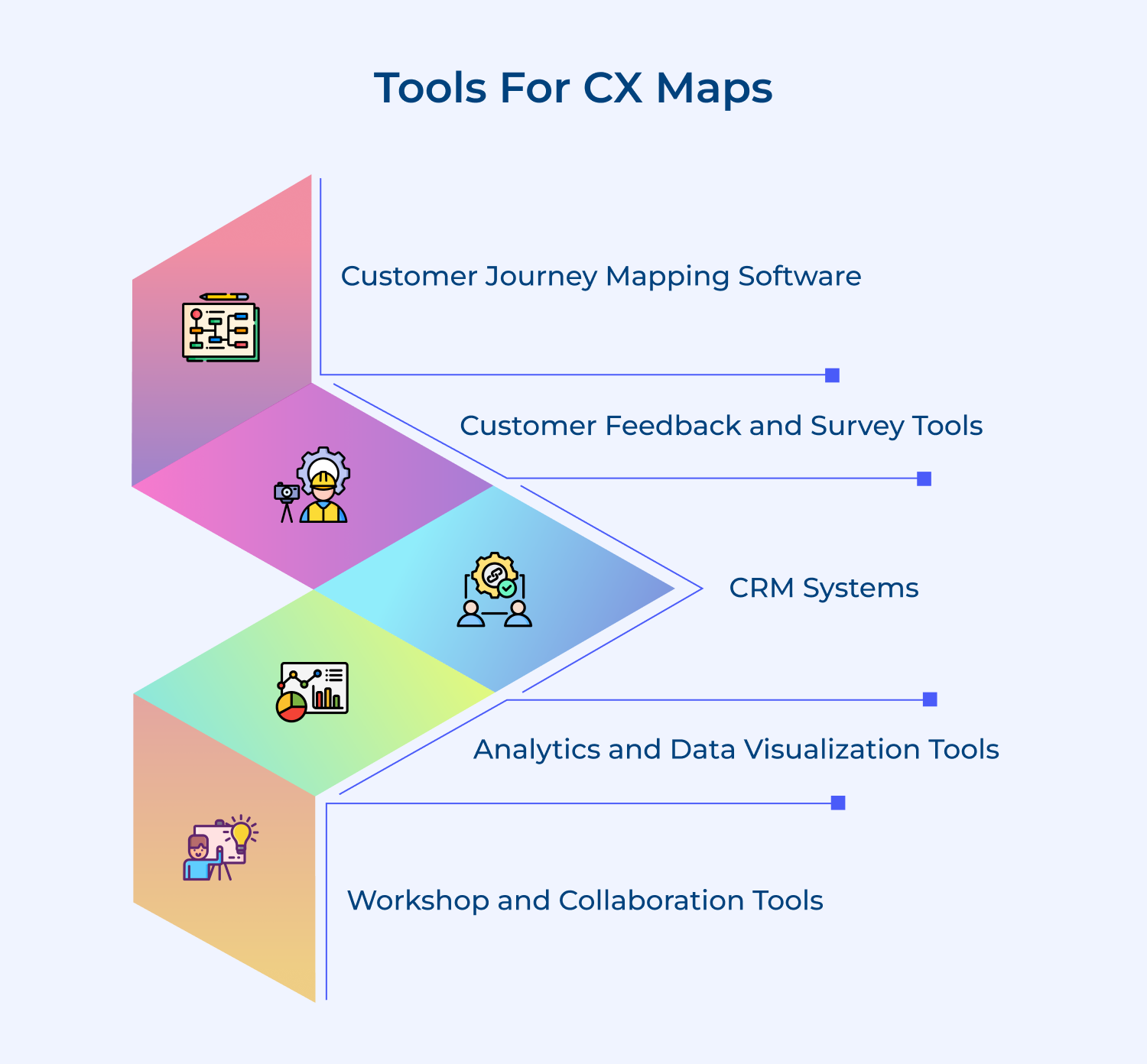
Customer journey mapping software provides a structured framework to visualize the entire customer journey, from initial contact to post-purchase. These tools help in organizing and detailing each stage, making it easier to identify and address gaps and opportunities for improvement.
Use journey mapping software to create interactive and customizable maps that depict each stage of the customer experience. These maps can incorporate various data points and feedback, helping to identify areas for enhancement and track the effectiveness of implemented changes.
Customer feedback and survey tools are essential for gathering direct insights from customers about their experiences and satisfaction levels. The feedback helps identify pain points, preferences, and areas needing improvement, providing a foundation for making data-driven enhancements.
Design and distribute surveys to collect feedback at various touch points along the customer journey. Analyze the feedback to identify trends and issues that can inform adjustments to the customer experience map and guide improvements.
Analytics and data visualization tools are crucial for interpreting customer behavior and interactions. They help in analyzing large volumes of data, presenting insights in a clear, visual format that highlights trends, and patterns..
Leverage analytics tools to track and measure customer interactions across various channels. Use data visualization tools to create dashboards and reports that make it easier to understand and present findings related to the customer journey.
Customer Relationship Management (CRM) systems manage and analyze customer interactions and data throughout the customer lifecycle. They provide valuable insights into customer behavior, preferences, and history, which are essential for creating a detailed and accurate customer experience map.
Utilize CRM systems to collect and track detailed customer data and interactions. The information helps in mapping customer journeys, identifying key touchpoints, and personalizing experiences based on customer history and preferences.
Workshop and collaboration tools facilitate team efforts in brainstorming, planning, and refining the customer experience map. They enable cross-functional teams to work together, share insights, and align on strategies, ensuring a holistic approach to mapping the customer journey.
Use collaboration tools to conduct workshops and brainstorming sessions with various departments. These tools support real-time feedback and discussions, helping teams to collaboratively develop and refine the customer experience map.
Creating an effective Customer Experience Map (CEM) requires implementing best practices to ensure accuracy and impact. Here’s a guide to these essential practices:
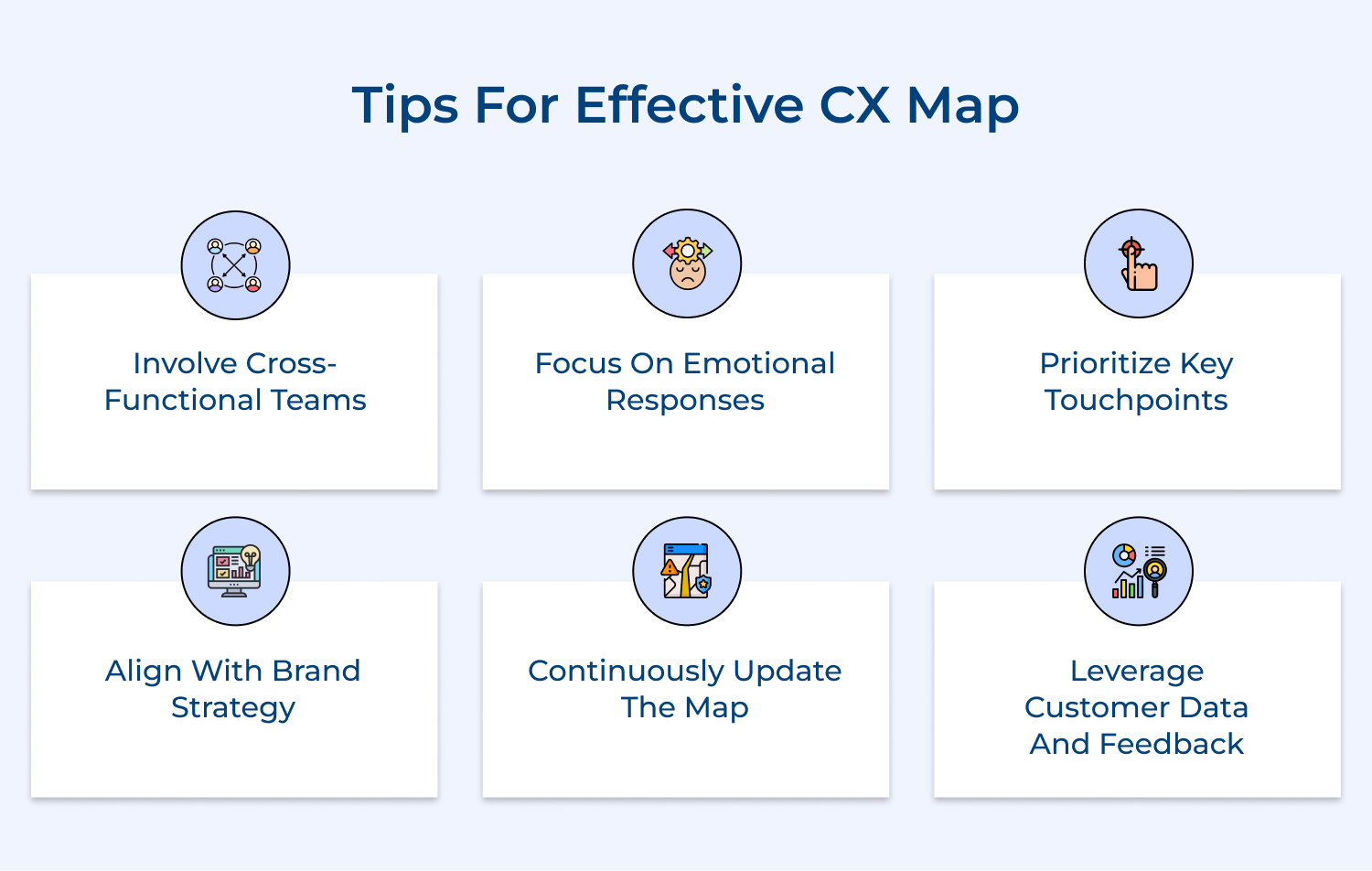
Involve Cross-Functional Teams
Engaging representatives from different departments provides diverse perspectives and a comprehensive view of the customer journey. The collaboration ensures that all aspects of the experience are captured, leading to a more accurate and holistic map.
Focus on Emotional Responses
Understanding customer emotions at various touchpoints helps identify critical pain points and areas of satisfaction. Mapping these emotional responses allows you to address negative experiences and enhance positive interactions, ultimately improving overall customer satisfaction.
Prioritize Key Touchpoints
Identifying and focusing on the most impactful touchpoints ensures that resources are allocated effectively. By prioritizing these key interactions, you can make targeted improvements that significantly enhance the customer experience and drive greater satisfaction.
Align with Brand Strategy
Ensure that the customer experience map reflects your brand’s values and strategic goals. Aligning the map with brand strategy helps maintain a consistent and coherent customer experience, reinforcing your brand promise and enhancing overall customer perception.
Continuously Update the Map
Regularly updating the customer experience map keeps it relevant and reflective of current customer behaviors. The ongoing process ensures that the map remains useful for identifying new opportunities and addressing emerging issues in the customer journey.
Leverage Customer Data and Feedback
Incorporate data from customer surveys, feedback forms, and interactions to gain valuable insights into customer preferences and pain points. Using this information helps validate touchpoints and refine the map, ensuring it accurately represents the customer experience.
Customer Experience Mapping (CEM) can transform how businesses understand customers. Here are the examples on how companies have successfully implemented CEM to drive meaningful improvements:
1. Starbucks: Personalization Through Digital Experience
Example: Starbucks uses Customer Experience Mapping to enhance their mobile app experience. By mapping out the customer journey from app launch to order fulfillment, Starbucks identified key touchpoints where personalization could be improved.
Insight: The mapping process revealed that personalized offers and easy reordering were critical touchpoints. This led to targeted promotions and a more seamless mobile experience, increasing customer loyalty and app engagement.
2. Amazon: Streamlining the Purchase Journey
Example: Amazon employs detailed customer journey maps to optimize their shopping experience. Mapping the entire purchasing process—from product search to checkout—helped Amazon identify friction points and streamline operations.
Insight: By analyzing this map, Amazon was able to reduce cart abandonment rates and improve the overall speed and efficiency of the checkout process, enhancing customer satisfaction.
3. Delta Airlines: Enhancing the Travel Experience
Example: Delta Airlines used CEM to map out the entire travel experience, from booking to post-flight. They focused on touchpoints such as check-in, security, and in-flight service.
Insight: The mapping process highlighted areas for improvement in communication and service delivery. Delta implemented changes like real-time flight updates and improved customer service protocols, leading to better passenger satisfaction.
4. Nike: Optimizing the In-Store Experience
Example: Nike utilized CEM to enhance the in-store experience at their flagship stores. By mapping out the customer journey from entry to purchase, they identified critical touchpoints that influenced buying decisions.
Insight: Insights from the mapping process led to store redesigns that improved product accessibility and interactive displays, resulting in a more engaging and personalized shopping experience.
5. Airbnb: Improving Host and Guest Interactions
Example: Airbnb used CEM to improve interactions between hosts and guests. Mapping the entire experience—from booking to post-stay feedback—helped identify pain points for both parties.
Insight: The mapping process led to the development of new features such as enhanced messaging systems and streamlined review processes, improving the overall user experience for hosts and guests alike.
Customer Experience Mapping is a powerful tool for understanding and optimizing the entire customer journey. By systematically analyzing each touchpoint, from initial contact to post-purchase interactions, businesses can identify pain points, streamline processes, and enhance overall satisfaction.
The insights gained from mapping enable companies to make informed decisions, improve customer interactions, and align their strategies with customer expectations. As demonstrated by successful examples across various industries, an effective customer experience map not only addresses immediate concerns but also fosters long-term loyalty and growth. Embracing this approach is essential for staying competitive in today’s customer-centric market.

What are common challenges in creating Customer Experience Maps?
Common challenges include collecting accurate and comprehensive data, managing complex customer journeys with multiple touchpoints, and implementing changes based on insights. Overcoming these challenges requires careful planning, collaboration, and ongoing evaluation.
How can Customer Experience Maps be used to drive business improvements?
Customer Experience Maps can drive business improvements by identifying pain points and areas for enhancement, informing targeted strategies for better customer engagement, and guiding process improvements. By addressing issues highlighted in the map, businesses can enhance customer satisfaction and loyalty.
How do Customer Experience Maps impact customer retention?
Customer Experience Maps impact customer retention by identifying and addressing areas of friction or dissatisfaction in the customer journey. By improving these touchpoints and enhancing the overall experience, businesses can increase customer loyalty and reduce churn rates.
What are the differences between Customer Experience Maps and Customer Journey Maps?
Customer Experience Maps and Customer Journey Maps are often used interchangeably, but they can differ in scope. Customer Experience Maps provide a broad overview of all customer interactions and experiences with a brand, while Customer Journey Maps focus specifically on the sequence of touchpoints and stages in a customer’s journey.
 https://omni24.io/wp-content/uploads/2026/08/Customer-Service-Teams.png
1256
2400
Tushar Joshi
https://omni24.io/wp-content/uploads/2023/04/Omni-Logo-1.svg
Tushar Joshi2026-09-15 04:01:522026-09-15 04:02:16How to Build Customer Service Teams: 6 Key Steps
https://omni24.io/wp-content/uploads/2026/08/Customer-Service-Teams.png
1256
2400
Tushar Joshi
https://omni24.io/wp-content/uploads/2023/04/Omni-Logo-1.svg
Tushar Joshi2026-09-15 04:01:522026-09-15 04:02:16How to Build Customer Service Teams: 6 Key Steps https://omni24.io/wp-content/uploads/2026/08/conversational-ai-ecommerce.png
1256
2400
Webvision Solution
https://omni24.io/wp-content/uploads/2023/04/Omni-Logo-1.svg
Webvision Solution2026-09-08 04:06:222026-09-08 04:06:22How Conversational AI for Ecommerce Boosts Sales in 2026
https://omni24.io/wp-content/uploads/2026/08/conversational-ai-ecommerce.png
1256
2400
Webvision Solution
https://omni24.io/wp-content/uploads/2023/04/Omni-Logo-1.svg
Webvision Solution2026-09-08 04:06:222026-09-08 04:06:22How Conversational AI for Ecommerce Boosts Sales in 2026 https://omni24.io/wp-content/uploads/2026/08/Ecommerce-Customer-Segmentation.png
1256
2400
Tushar Joshi
https://omni24.io/wp-content/uploads/2023/04/Omni-Logo-1.svg
Tushar Joshi2026-09-07 04:53:302026-09-07 04:53:30How Ecommerce Customer Segmentation Drives Higher Conversions
https://omni24.io/wp-content/uploads/2026/08/Ecommerce-Customer-Segmentation.png
1256
2400
Tushar Joshi
https://omni24.io/wp-content/uploads/2023/04/Omni-Logo-1.svg
Tushar Joshi2026-09-07 04:53:302026-09-07 04:53:30How Ecommerce Customer Segmentation Drives Higher Conversions
Whether it’s about acquire, engage or support – Omni24 covers all your customer engagement needs in one complete platform.

Copyright ©2026 Veemo All rights reserved.
CA, Los Angeles, Hall Ave, 19011