Chatbots vs. Humans : Which One Should You Choose and Why?
Explore chatbot and human customer service strengths, as well as when to choose each for efficient, personalized support.
Explore chatbot and human customer service strengths, as well as when to choose each for efficient, personalized support.
Customers want fast, 24/7 support, but they also expect a personal touch. Relying only on chatbots can frustrate people with more complex needs, while depending solely on human agents often leads to long wait times. Striking the right balance is key.
The best service strategies blend both: chatbots quickly handle common questions, freeing up human agents to focus on problems that need empathy, critical thinking and real conversation. When used together, chatbots and humans can create a seamless support experience that keeps customers happy.
Chatbot customer service is a digital assistant that uses AI to interact with customers through text or voice conversations. It handles inquiries and resolves issues without human intervention by understanding natural language. These virtual assistants work around the clock to provide immediate support while maintaining a personalized touch in customer interactions.
Chatbots process customer questions using natural language processing to understand intent. They access knowledge bases to retrieve relevant information as well as deliver appropriate responses. Advanced chatbots learn from interactions to improve accuracy and can seamlessly transfer complex issues to human agents when necessary.
Key components:
Here are the key strengths of chatbots in customer service and how they are reshaping the industry standard for customer interactions.
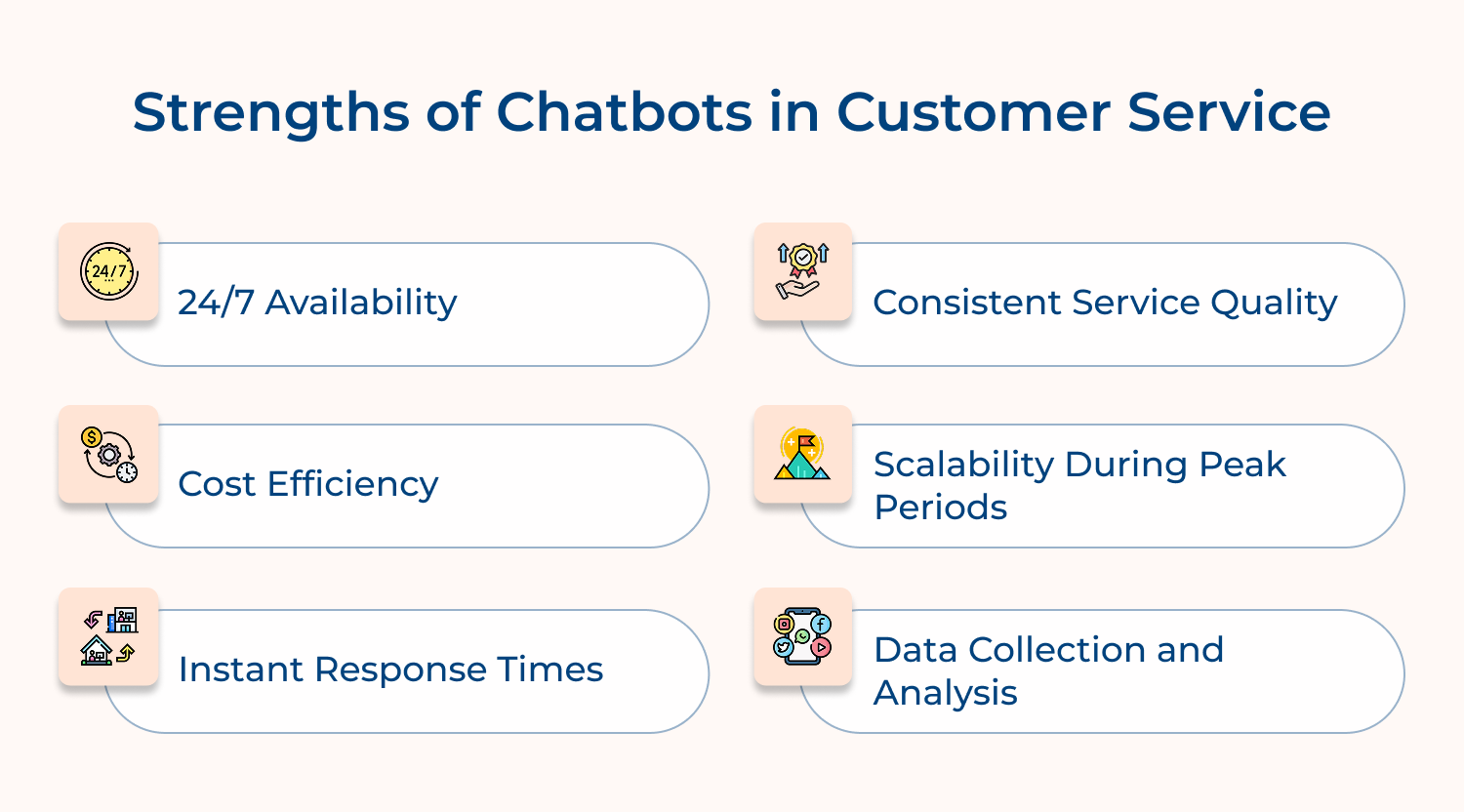
24/7 Availability
Chatbots don’t clock out. Whether it’s midnight on a holiday or during your busiest hour, they’re ready to help. Customers love knowing they can get answers anytime—no more waiting or feeling ignored.
Cost Efficiency
Hiring and training large support teams is expensive. Chatbots handle thousands of chats at once without any overtime pay. That means you save money and let your human agents focus on the trickier stuff.
Instant Response Times
Nobody likes waiting. With chatbots, customers get replies in seconds, keeping them happy and engaged. Quick answers mean fewer abandoned carts and more completed purchases.
Consistent Service Quality
People have off days—chatbots don’t. They stick to scripts, follow protocols and deliver reliable answers every time. That means no miscommunication, no mood swings—just solid, consistent support.
Scalability During Peak Times
Flash sales? Holiday rush? No problem. Chatbots can scale instantly to handle any spike in traffic, keeping things running smoothly when it matters most.
Smart Data Collection
Every chatbot interaction is a goldmine of customer insight. They track common questions and spot trends early, helping you make smarter products as well as support decisions.
Human-based customer service involves real people assisting customers with their inquiries and problems through various communication channels. It relies on trained staff who use their empathy and judgment to provide personalized solutions to customer needs. This traditional approach to customer support emphasizes genuine human connection while drawing on representatives’ ability to understand complex emotions.
Representatives receive customer inquiries through phone calls, emails, or chat platforms. They identify the customer’s needs through active listening and access relevant information systems. Representatives then apply their knowledge and problem-solving skills to resolve issues while maintaining a personal connection throughout the interaction.
Key Components:
While chatbots are great for speed, human interactions still play a vital role in customer support. Here’s where a customer service representative truly shines:
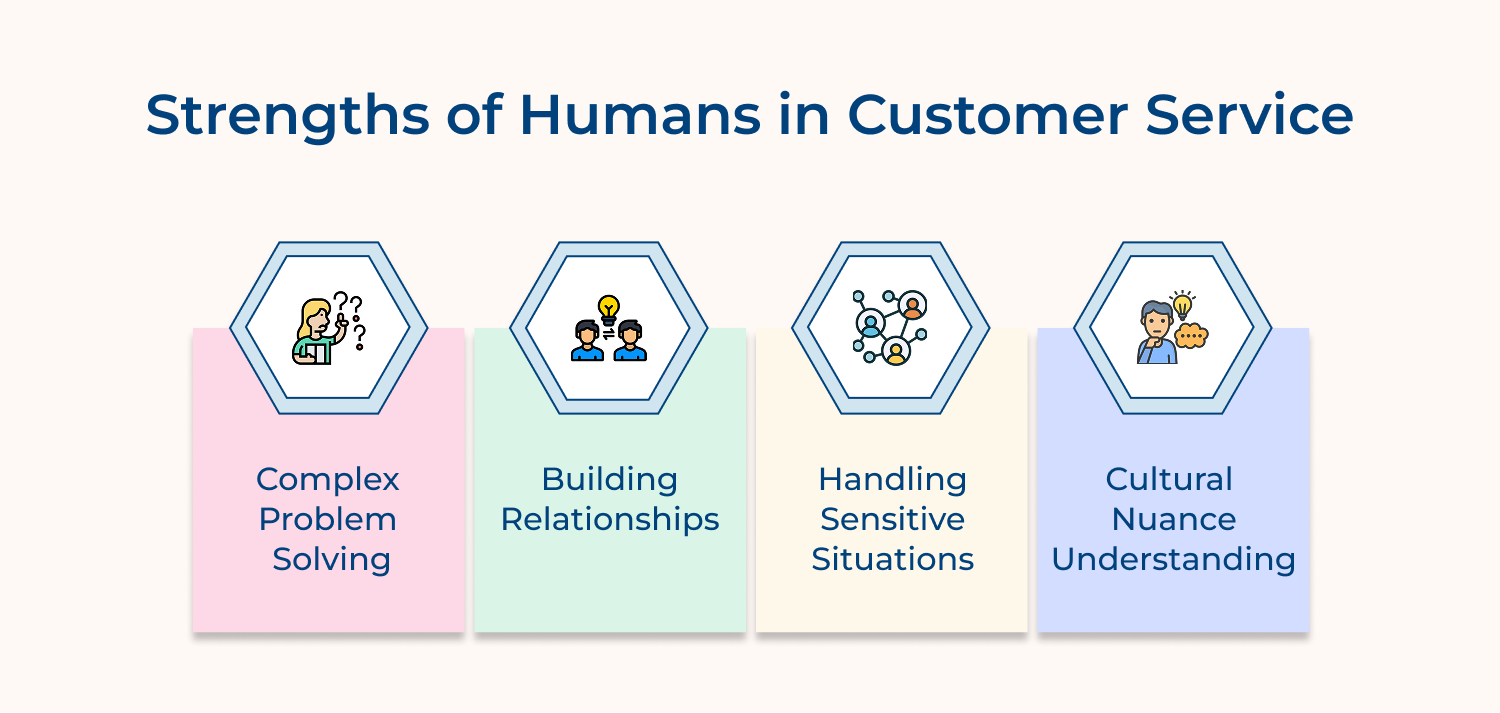
Humans think creatively and connect the dots in ways automation can’t. They’re great at resolving unique issues that require flexible thinking.
A real conversation, a bit of humor and remembering a customer’s name—these small touches build trust as well as loyalty over time.
When things go wrong, human emotions matter. Empathy, patience and a calming voice can turn a bad experience into a positive memory.
Humans easily adapt their tone, language and humor to match the customer’s style, something bots often miss.
Blending human empathy with automation creates a stronger user experience, ensuring customers feel heard, valued and cared for.
The debate between chatbot and human customer service continues to evolve as technology advances. Each approach offers different business needs and customer expectations.
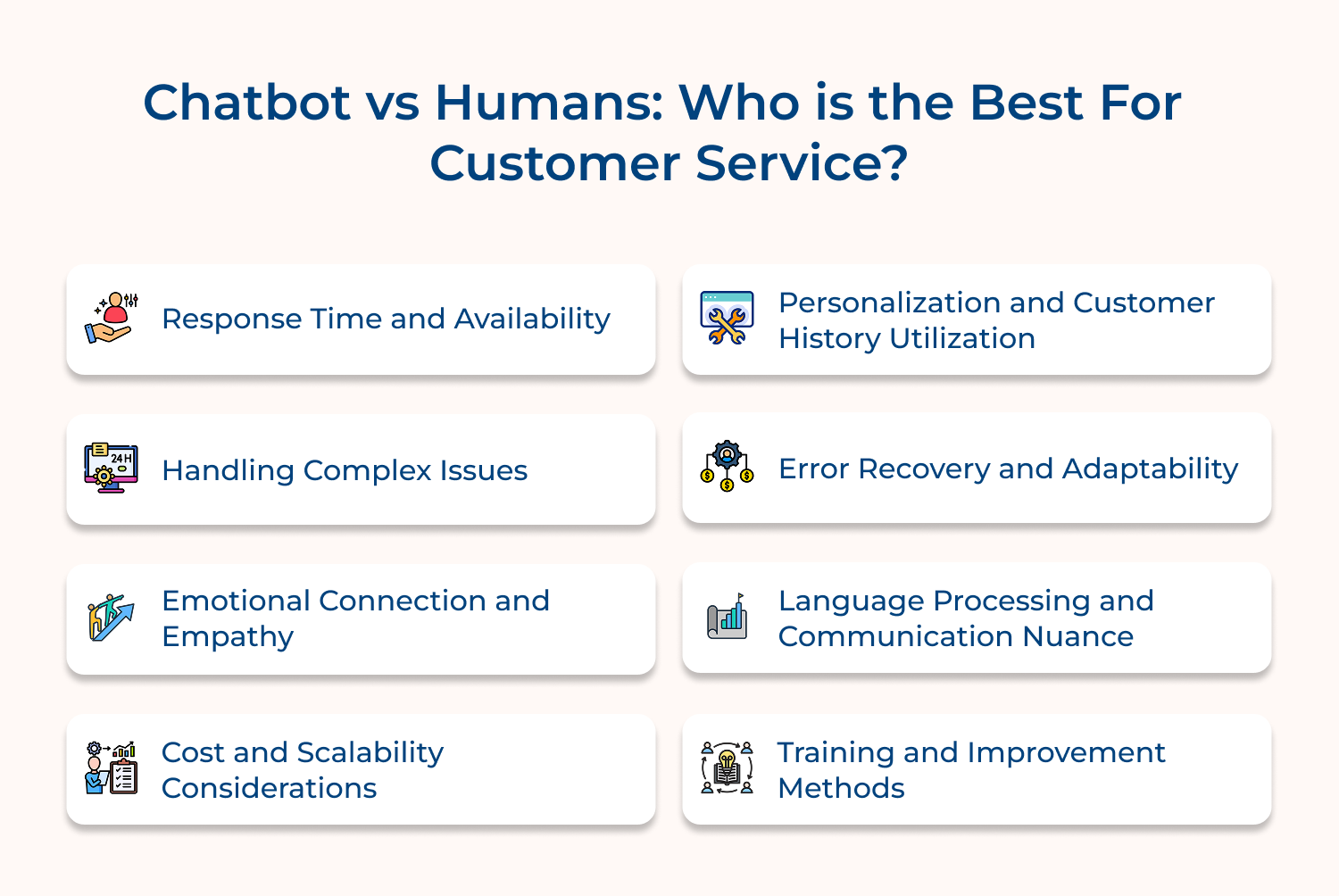
Chatbots are always on, literally! Whether it’s 2 AM, a weekend, or a holiday, they respond within seconds and never take breaks. That means customers can get instant help anytime without waiting in a queue. Perfect for quick tasks like checking an order status or answering common questions.
On the flip side, human agents work in shifts, need time to process queries and understandably take breaks. That can lead to slower response times or delays during off-hours.
So, what’s the takeaway?
Chatbots are great for quick questions, but they often stumble when faced with complex queries that don’t fit a script. If a customer has multiple issues at once (say, a billing error, shipping damage and a product compatibility problem) a chatbot might treat each separately as well as miss how they’re connected.
That’s where customer support agents shine. They can think holistically, ask the right questions and piece everything together to offer a tailored solution. Their experience and intuition help them resolve unique problems that would leave a bot confused.
Key takeaway:
Chatbots are great at delivering real-time customer service, but they fall short when it comes to understanding emotions. They might pick up on words like “frustrated” or “angry,” but they can’t genuinely empathize or adjust their tone with real feeling. That emotional disconnect can be frustrating during sensitive situations.
Customer support agents read emotional cues as well as respond with warmth, empathy and flexibility. If a wedding gift arrives damaged just days before the event, a human can not only rush a replacement but also express sincere concern, something a chatbot simply can’t replicate.
Bottom line:
Chatbots need a solid upfront investment, but they scale beautifully. Once set up, they handle thousands of chats at once, no extra costs, no added staff. That makes them ideal for businesses growing fast or dealing with unpredictable spikes in demand.
For example, during a flash sale with 10,000 customer inquiries, chatbots manage it all instantly – no hiring rush, no long wait times.
Customer support agents, however, scale with cost. More customers mean more reps, more training and more overhead. It works well for businesses with steady volumes, where the personal touch justifies the extra cost.
Bottom line:
Chatbots are great at pulling up customer data fast (order history, preferences and account info) in real time. But their personalization feels a bit robotic since it follows pre-set scripts focused on transactions.
Customer support agents personalize naturally. They remember things customers mentioned before, connect past conversations with current needs and tailor responses in a way that feels human as well as thoughtful.
It’s like the difference between a GPS suggesting your usual route versus a friend saying, “Hey, didn’t you want to try that new café? Let’s swing by.”
Bottom line:
Chatbots can get tripped up when customers ask something unexpected or word things differently. If they misinterpret a message, they often repeat the same mistake, leading to frustrating loops. While they might eventually transfer you to a human, the back-and-forth can feel anything but helpful.
Human customer service representatives pick up on confusion quickly. They ask follow-up questions, shift their approach and offer solutions tailored to your unique situation. That kind of flexibility turns a confusing moment into a personalized experience that builds trust.
Think of it like talking to a rigid script versus someone who says, “Let me rephrase that and find a better solution.”
Bottom line: Human customer service representatives shine when things go off-script. Chatbots work best with straightforward tasks and clear paths to handoff.
Chatbots take language at face value. They often miss the meaning behind slang, sarcasm, or regional phrases. If you don’t speak in a way they expect, you might end up repeating yourself or rewording things just to be understood – frustrating, right?
Human customer service representatives naturally pick up on context, tone and cultural references. They understand when you’re joking, being subtle or simply speaking the way you normally do. This creates a smoother, more personalized experience where you can just talk like yourself.
Think of the difference between texting a friend and typing a command into a machine. One feels natural. The other feels robotic.
Which is better? Humans offer flexibility. Chatbots work best when communication sticks to the script.
Chatbots improve through updates and data training. Their knowledge grows when developers add info or tweak algorithms, but that learning happens in batches, not during real-time conversations. It’s like a system upgrade that makes them smarter every so often.
Customer service agents, however, grow with every interaction. They pick up on patterns, learn from mistakes and share experiences with teammates. Their growth is constant, intuitive and grounded in human connection.
Think of it like this: a chatbot gets better after a software update. A human rep improves every day just by doing the job.
Bottom line: Humans adapt naturally to each customer over time. Chatbots deliver predictable, compliant responses but lack the flexibility and learning agility of human support.
Chatbots can streamline customer service and knowing when to use them ensures a smoother support experience. Here are five key situations where chatbots offer optimal value.
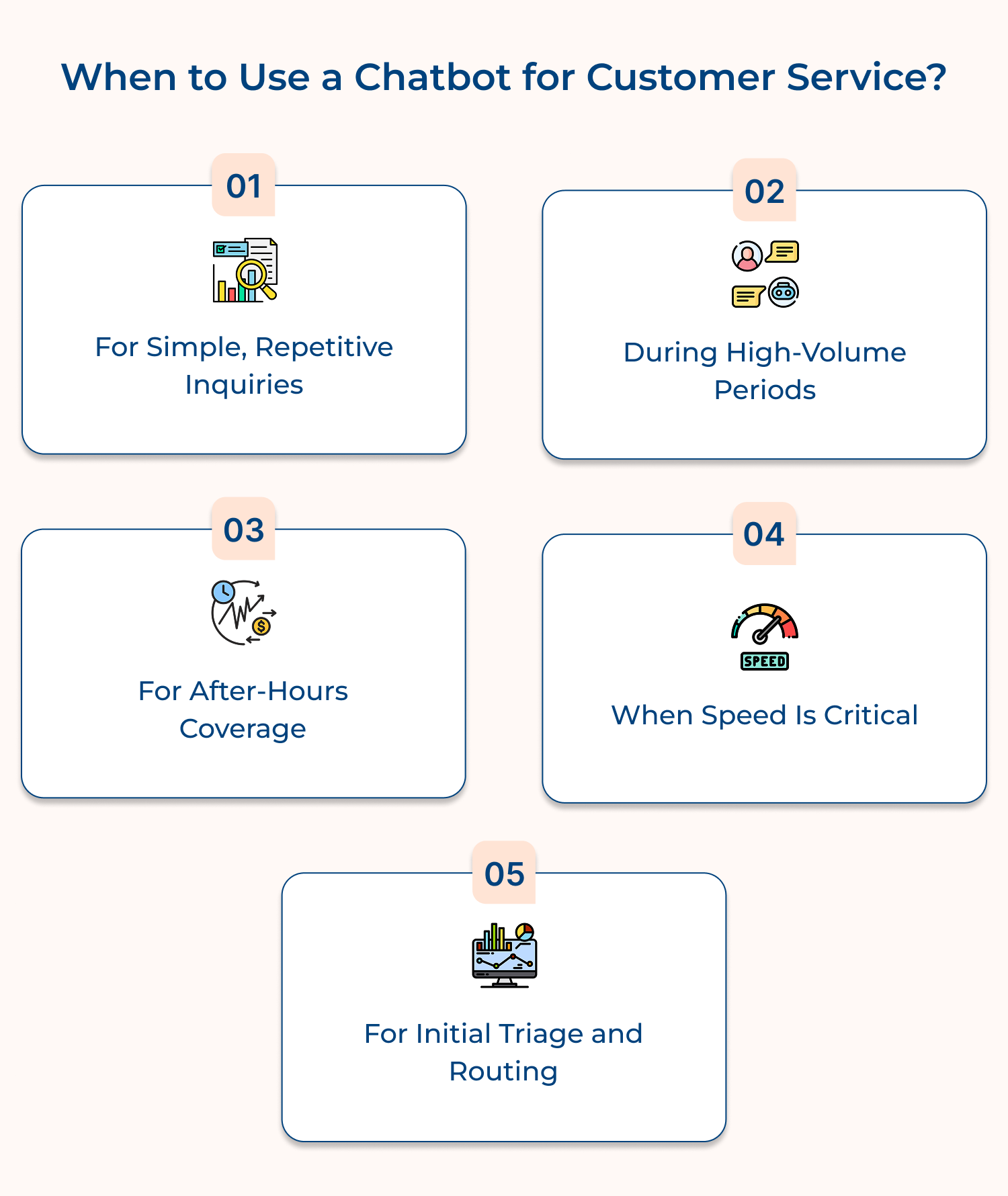
For Simple, Repetitive Inquiries
Chatbots excel at handling straightforward questions that come up frequently. They can efficiently process requests like password resets, account balance checks, or basic product information inquiries without human intervention. This consistent handling of routine questions frees up your human agents for more complex customer needs.
During High-Volume Periods
When customer inquiries spike during sales events, product launches, or seasonal rushes, chatbots prevent bottlenecks in your service queue. They can simultaneously handle thousands of conversations without degradation in response time, ensuring customers receive immediate attention even when human teams would be overwhelmed by the sheer volume of requests.
For After-Hours Coverage
Chatbots provide continuous service when your human team isn’t available. They bridge the gap during evenings, weekends and holidays when staffing a full customer service team isn’t feasible. This 24/7 availability ensures customers receive assistance at their moment of need rather than waiting hours for your office to reopen.
When Speed is Critical
In situations where customers need immediate information to continue their journey, chatbots deliver without delay. They provide instant responses for time-sensitive matters like checking order status, confirming appointment times, or verifying account details. This immediacy keeps customers engaged in their purchasing process rather than abandoning due to wait times.
For Initial Triage and Routing
Chatbots serve as effective first points of contact to understand customer needs and direct them appropriately. They gather preliminary information, identify the nature of inquiries and either resolve simple issues directly or connect customers to the right specialized human agent. This intelligent sorting optimizes the entire customer service workflow.
While chatbots offer efficiency, certain situations demand the nuanced touch. Understanding when to deploy your human talent ensures customers receive the right experience.
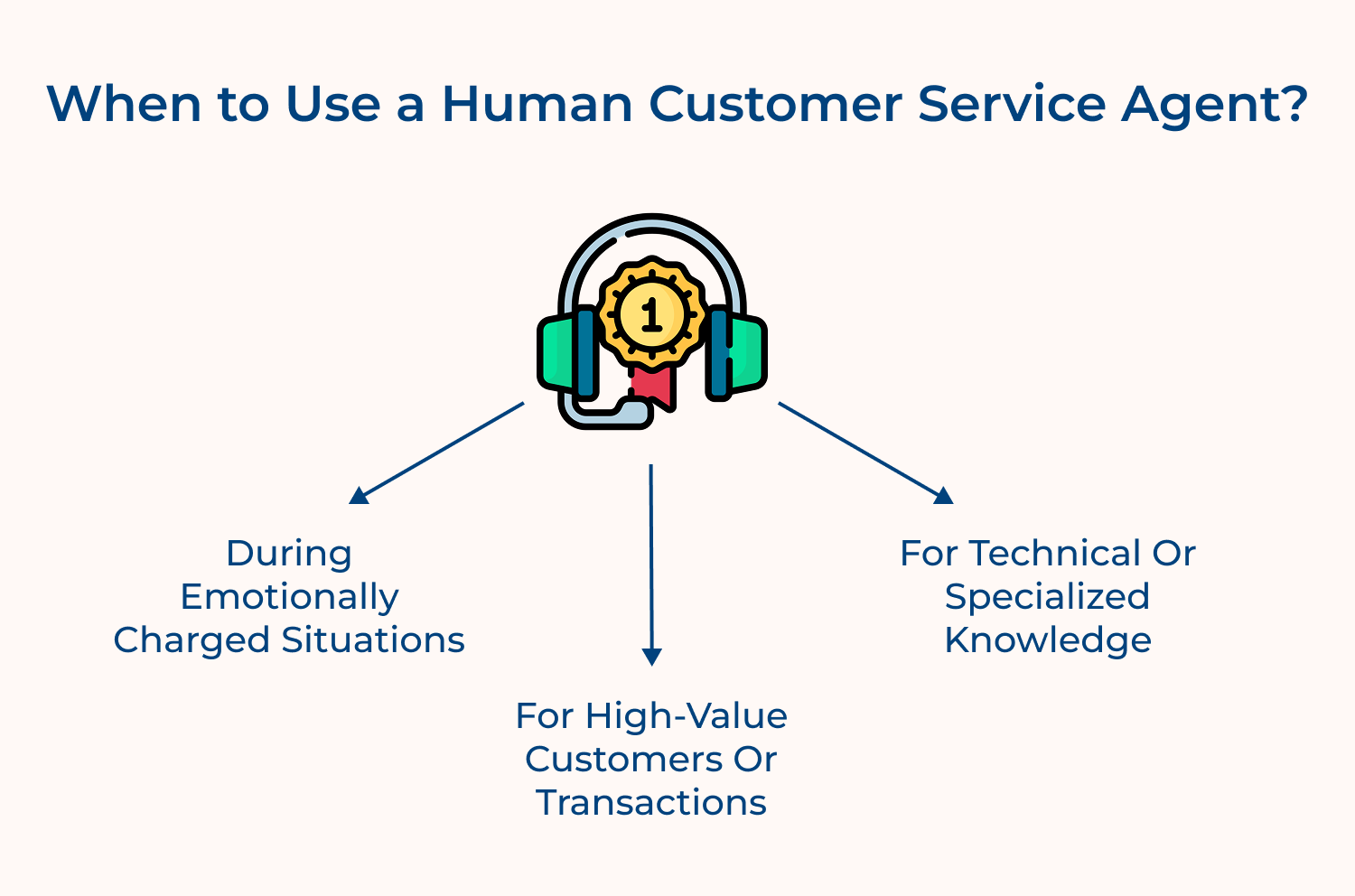
During Emotionally Charged Situations
Human agents bring essential emotional intelligence to sensitive interactions where customers feel upset, disappointed, or anxious. They can recognize subtle emotional cues, adjust their tone accordingly and provide genuine empathy.
When a customer experiences a significant service failure or product disappointment, human connection becomes invaluable for rebuilding trust and turning the situation around.
For High-Value Customers or Transactions
Human representatives provide the personalized attention that premium customers expect and major transactions deserve. Would you trust an automated system with your most significant purchase decisions? Probably not.
Human agents can offer tailored recommendations, address specific concerns and create the white-glove experience that builds confidence during important purchasing decisions or when serving your most valuable customer relationships.
For Technical or Specialized Knowledge
Human experts bring specialized knowledge to complex product questions, technical troubleshooting, or industry-specific inquiries. They can understand nuanced terminology and provide expert-level advice that goes beyond automated responses.
Doesn’t it feel reassuring when you’re speaking to someone who truly understands your specific issue and can guide you through a solution with confidence as well as expertise?
Let’s delve into how businesses can leverage the strengths of both humans and chatbots to create a seamless customer service experience that speaks to the needs of today’s consumer.
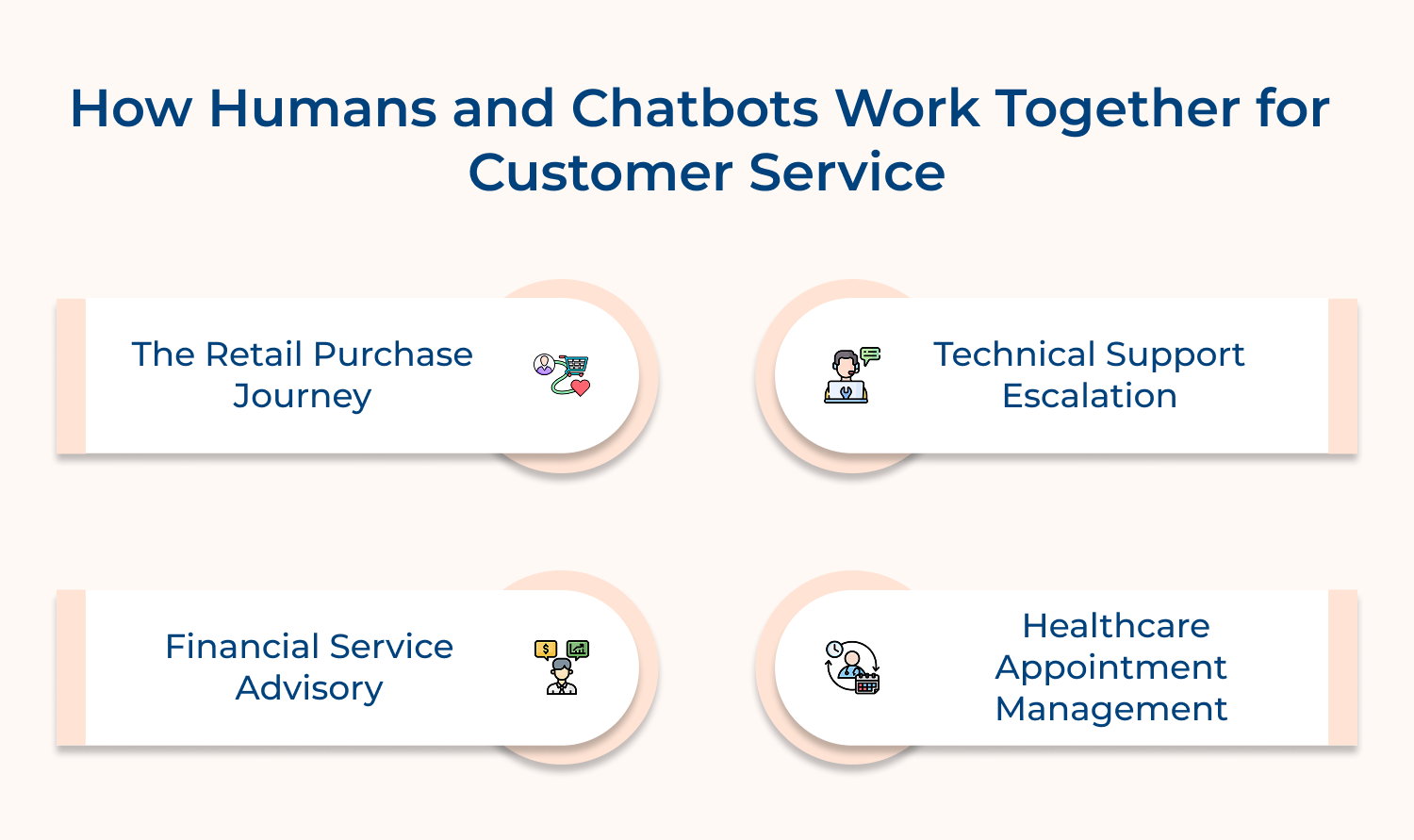
A customer browsing an online clothing store chats with a bot to filter by size, style and budget. It easily handles:
But when the customer asks about fabric feel or fit, the chatbot hands things off to a human style consultant. The human offers tailored advice based on body type and fashion goals.
A customer reports a smart home device issue. The chatbot collects key info—model, error messages and basic fixes tried.
Once the problem proves tricky, the bot hands it over to a technician, who picks it up with full context and dives straight into advanced troubleshooting.
A banking chatbot helps a customer check balances and recent transactions. When the customer asks about investment options, it suggests speaking with a human advisor.
The advisor takes over with full chat history and offers personalized guidance based on goals as well as risk tolerance.
A patient uses a chatbot to book a check-up. It matches dates and confirms the appointment quickly.
But if the patient mentions new symptoms, medication concerns, or emotional distress, the bot alerts a human. A medical staff member reviews and adjusts the care plan if needed.
The optimal customer service strategy isn’t choosing between chatbots or humans but leveraging each for their strengths. Chatbots provide instant, consistent support for routine inquiries while humans deliver emotional intelligence and creative problem-solving for complex situations. This complementary approach ensures efficiency without sacrificing the personal touch.
The future belongs to businesses that create seamless handoffs between digital and human touchpoints. By mapping customer journeys and identifying ideal intervention points for each channel, companies can create experiences that feel both efficient as well as deeply human. The result? Higher satisfaction, increased loyalty and more meaningful customer relationships.

Where do chatbots make a difference?
Chatbots make the most difference in scenarios requiring 24/7 availability and immediate response. They excel at handling high volumes of repetitive inquiries such as order tracking, account balance checks and basic troubleshooting. Their consistent performance during traffic spikes prevents bottlenecks that would overwhelm human teams and significantly reduces operational costs for routine customer service functions.
How do chatbots vs. human agents affect anticipated communication quality?
Chatbots provide consistent, predictable communication quality that doesn’t vary with mood or fatigue, but they lack emotional intelligence and may sound formulaic. Human agents deliver nuanced communication with natural empathy and can adapt their tone to match the customer’s emotional state. Customers generally anticipate more personalized as well as flexible communication from humans but expect faster responses from chatbots.
How to choose between a chatbot and a human?
Evaluate your customer needs, query complexity and business objectives. Choose chatbots for high-volume, simple inquiries that require immediate responses regardless of time. Select humans for complex problem-solving, emotionally sensitive situations, high-value transactions, and scenarios requiring judgment calls. Consider implementing both with intelligent routing to direct queries to the appropriate channel based on their nature.
What are the cost implications of chatbots versus human agents?
Chatbots require significant upfront investment but offer substantially lower per-interaction costs, especially at scale. Their expenses remain relatively fixed regardless of conversation volume. Human agents incur ongoing salary, training, management and workspace costs that increase linearly with customer demand. The long-term ROI for chatbots is typically higher for handling routine inquiries, while humans provide better value for complex interactions.
How can businesses integrate both chatbots and humans effectively?
Successful integration begins with careful journey mapping to identify appropriate intervention points for each. Program chatbots to handle routine inquiries and collect initial information before seamlessly transferring complex cases to humans with complete context. Ensure consistent voice across both channels, provide clear escalation paths from automated to human assistance and continuously refine the handoff process based on customer feedback as well as interaction analytics.
 https://omni24.io/wp-content/uploads/2026/08/conversational-ai-ecommerce.png
1256
2400
Webvision Solution
https://omni24.io/wp-content/uploads/2023/04/Omni-Logo-1.svg
Webvision Solution2026-09-08 04:06:222026-09-08 04:06:22How Conversational AI for Ecommerce Boosts Sales in 2026
https://omni24.io/wp-content/uploads/2026/08/conversational-ai-ecommerce.png
1256
2400
Webvision Solution
https://omni24.io/wp-content/uploads/2023/04/Omni-Logo-1.svg
Webvision Solution2026-09-08 04:06:222026-09-08 04:06:22How Conversational AI for Ecommerce Boosts Sales in 2026 https://omni24.io/wp-content/uploads/2026/08/Ecommerce-Customer-Segmentation.png
1256
2400
Tushar Joshi
https://omni24.io/wp-content/uploads/2023/04/Omni-Logo-1.svg
Tushar Joshi2026-09-07 04:53:302026-09-07 04:53:30How Ecommerce Customer Segmentation Drives Higher Conversions
https://omni24.io/wp-content/uploads/2026/08/Ecommerce-Customer-Segmentation.png
1256
2400
Tushar Joshi
https://omni24.io/wp-content/uploads/2023/04/Omni-Logo-1.svg
Tushar Joshi2026-09-07 04:53:302026-09-07 04:53:30How Ecommerce Customer Segmentation Drives Higher Conversions https://omni24.io/wp-content/uploads/2026/08/Enterprise-Customer-Engagement.png
1256
2400
Tushar Joshi
https://omni24.io/wp-content/uploads/2023/04/Omni-Logo-1.svg
Tushar Joshi2026-09-02 05:29:412026-09-02 05:29:41How to Scale Enterprise Customer Engagement Strategies
https://omni24.io/wp-content/uploads/2026/08/Enterprise-Customer-Engagement.png
1256
2400
Tushar Joshi
https://omni24.io/wp-content/uploads/2023/04/Omni-Logo-1.svg
Tushar Joshi2026-09-02 05:29:412026-09-02 05:29:41How to Scale Enterprise Customer Engagement Strategies
Whether it’s about acquire, engage or support – Omni24 covers all your customer engagement needs in one complete platform.

Copyright ©2026 Veemo All rights reserved.
CA, Los Angeles, Hall Ave, 19011