What is Customer Sentiment & How to Measure It Effectively
Customer sentiment measures how customers feel about your brand. Learn analysis methods, benefits and strategies to improve satisfaction.

Customer sentiment measures how customers feel about your brand. Learn analysis methods, benefits and strategies to improve satisfaction.
Every purchase decision, support ticket, and social review carries a hidden signal—one most businesses are still learning to read. Customer sentiment is the measurable attitude your customers hold toward your brand, expressed through reviews, surveys and social conversations using AI and NLP tools. It goes beyond satisfaction scores to reveal the why behind buying behavior.
PwC’s research shows 32% of customers will leave a brand they love after just one bad experience, while others stopped due to poor product/service experiences. This guide walks you through how to measure, analyze and act on customer sentiment—covering key methodologies like machine learning-based approaches, the right tools and strategies to turn insight into retention, such as reducing churn by up to 30% with AI sentiment analysis.
Customer sentiment refers to the emotions and opinions that customers hold toward a brand, product or service. It encompasses the full spectrum of feelings (from highly positive to intensely negative) that shape how customers perceive and interact with a business.
These sentiments are typically expressed through various channels including social media posts, reviews, customer service interactions, customer satisfaction surveys and direct feedback.
Organizations can identify emerging issues before they become widespread problems, recognize opportunities for improvement and build stronger relationships with their customer base through effective sentiment monitoring.
Key objectives:
Customer sentiment analysis is the systematic process of identifying, extracting and studying subjective information from customer feedback to understand attitudes as well as opinions toward a brand. It employs various methodologies to transform unstructured qualitative data into quantifiable insights about customer perceptions.
The importance of customer sentiment analysis extends far beyond simple feedback collection. It serves as an early warning system for emerging issues before they affect business metrics, providing intelligence that traditional KPIs might miss. Sentiment analysis connects emotional responses to business outcomes, revealing how feelings drive behaviors like purchases, renewals and referrals.
Key objectives:
Understanding what your customers feel directly shapes revenue and brand reputation. Recent research shows that businesses that listen to customer feedback see a 25% profitability increase.
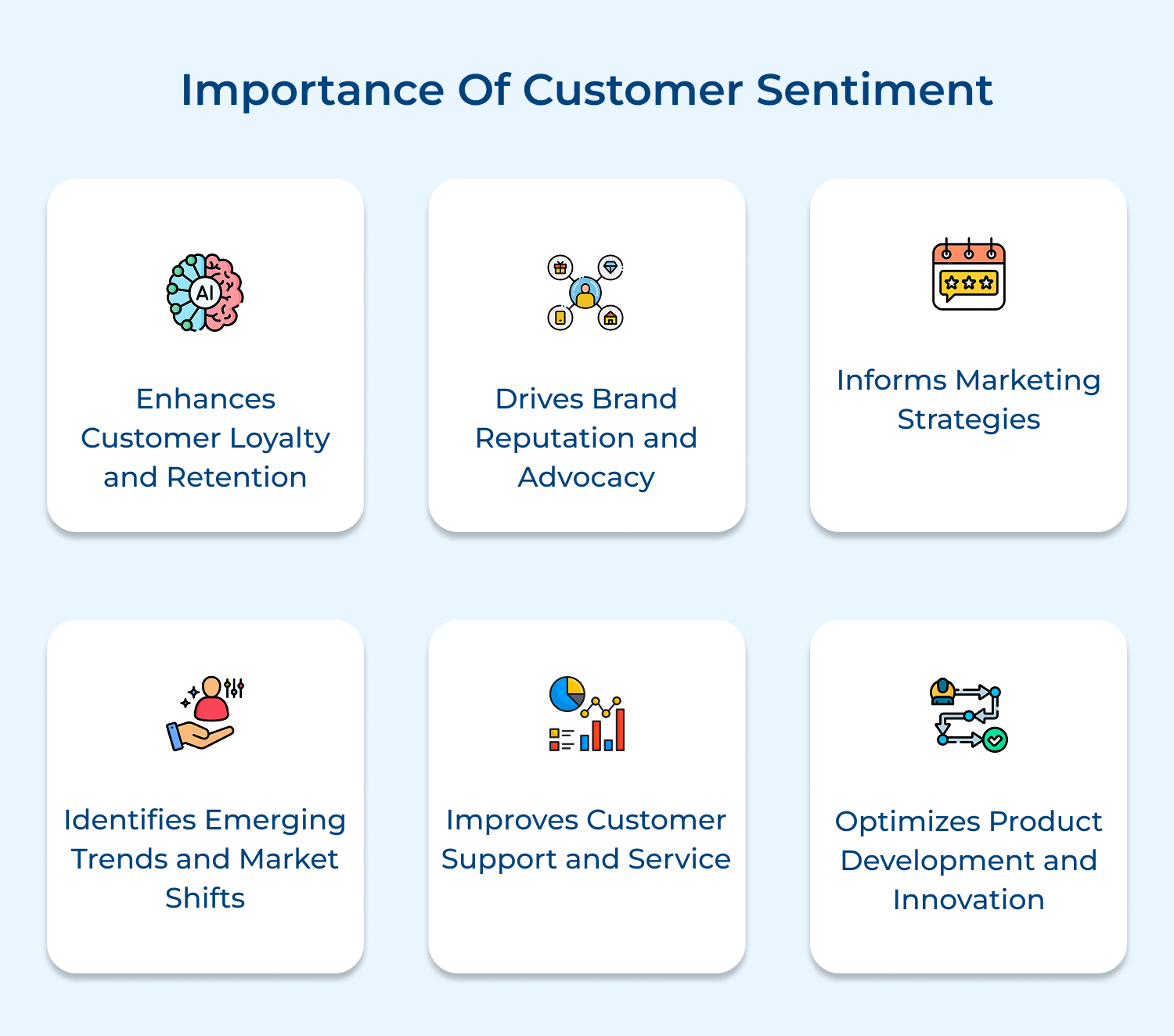
Enhances Customer Loyalty and Retention
When businesses understand and act on customer sentiment, they build stronger relationships. Responding to all feedback increases repeat business and helps keep customers for the long term.
Drives Brand Reputation and Advocacy
Positive customer sentiment improves a brand’s image. Happy customers often recommend the brand, leading to word-of-mouth marketing, more visibility and new customers.
Informs Marketing Strategies
Tracking customer sentiment helps businesses improve their marketing. These insights make it easier to create targeted and engaging campaigns that connect with the audience.
Identifies Emerging Trends and Market Shifts
Changes in customer sentiment reveal new trends and market shifts. This helps companies adapt quickly and stay competitive.
Improves Customer Support and Service
Understanding sentiment highlights common problems. Businesses can fix these issues early, improve support and create a better customer experience.
Optimizes Product Development and Innovation
Customer sentiment gives direct feedback on products and services. Businesses can use it to improve existing offerings or create new ones customers want.
Real-time customer sentiment tracking is a game-changer – 91% of companies achieving high ROI monitor sentiment continuously to catch issues early and retain trust.
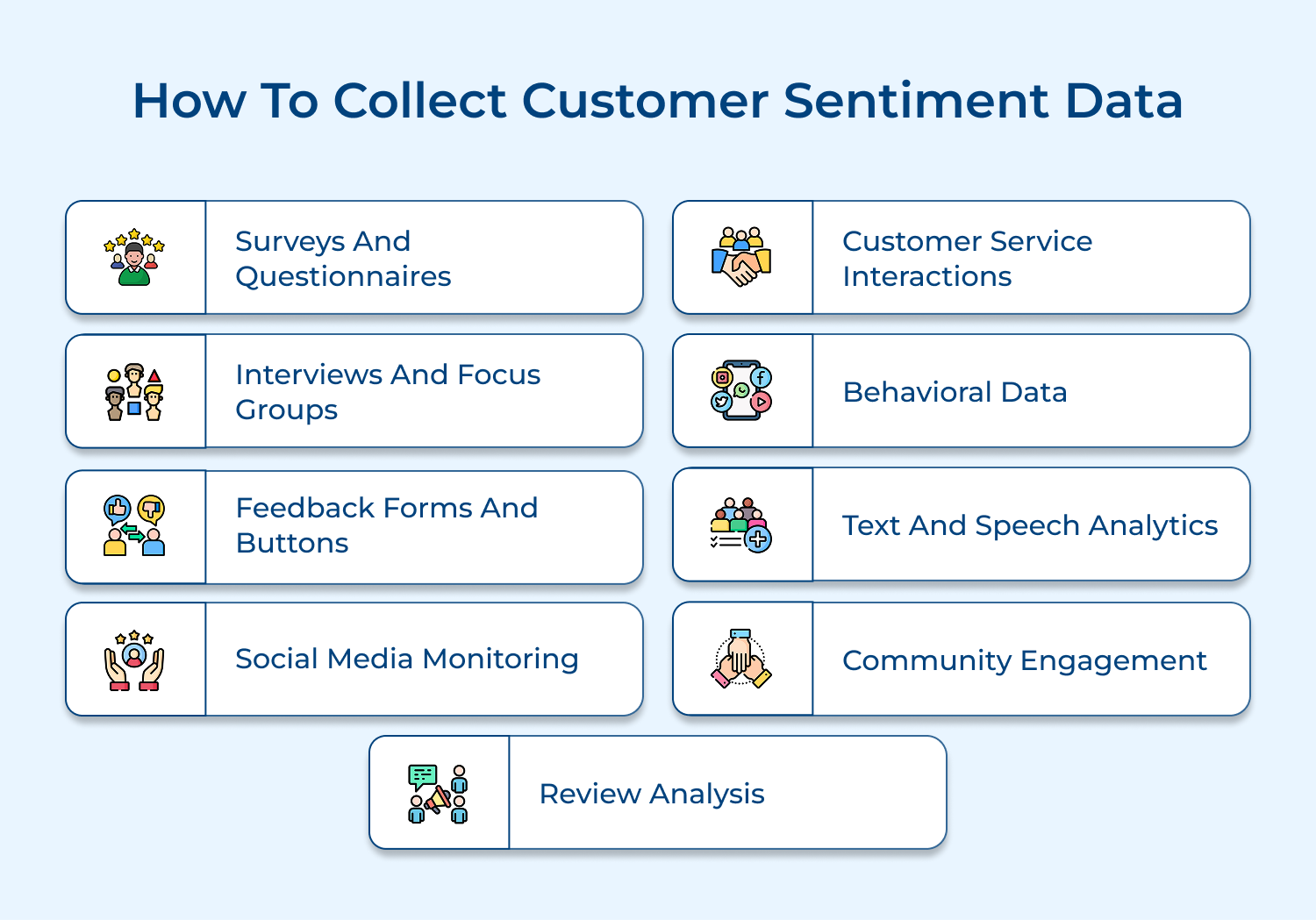
Structured sets of questions delivered to customers through various channels to measure satisfaction, loyalty and experience quality using standardized metrics as well as scales.
Surveys provide quantifiable data that can be tracked over time, enabling businesses to measure sentiment trends, benchmark performance and identify specific improvement areas with statistical validity. They offer direct insights into customer perceptions.
Survey results can identify satisfaction drivers, prioritize improvements based on impact scores, segment customers by sentiment and create dashboards for tracking experience metrics across touchpoints.
Tips:
In-depth conversations with customers, either one-on-one or in small groups, to explore experiences, perceptions and expectations through guided discussion.
Interviews and focus groups provide rich, qualitative insights that surveys can’t capture, revealing the “why” behind the numbers. They allow for follow-up questions and observation of emotional responses as well as non-verbal cues.
Use findings to develop customer personas, identify emerging trends, generate new product ideas, and add context to quantitative data through powerful customer stories as well as direct quotes.
Pro tips:
Simple, accessible mechanisms embedded in digital experiences or physical locations that make it easy for customers to provide immediate reactions.
Feedback forms capture in-the-moment sentiment when experiences are fresh in customers’ minds. They lower the barrier to providing feedback, increasing response rates and capturing insights from customers who wouldn’t complete longer surveys.
Analyze feedback to quickly identify and fix usability issues while tracking sentiment across specific interaction points. Demonstrate responsiveness by acknowledging all feedback received.
Tips:
Tracking and analyzing customer comments, mentions as well as conversations on social media can be done manually or with automated tools.
Social media shows unfiltered, honest opinions shared publicly. It reveals how customers talk about your brand with others, often showing different priorities and concerns.
It helps you spot problems before they spread, find brand advocates, understand your position against competitors while measuring reactions to new products, features or policies.
Actionable Tips:
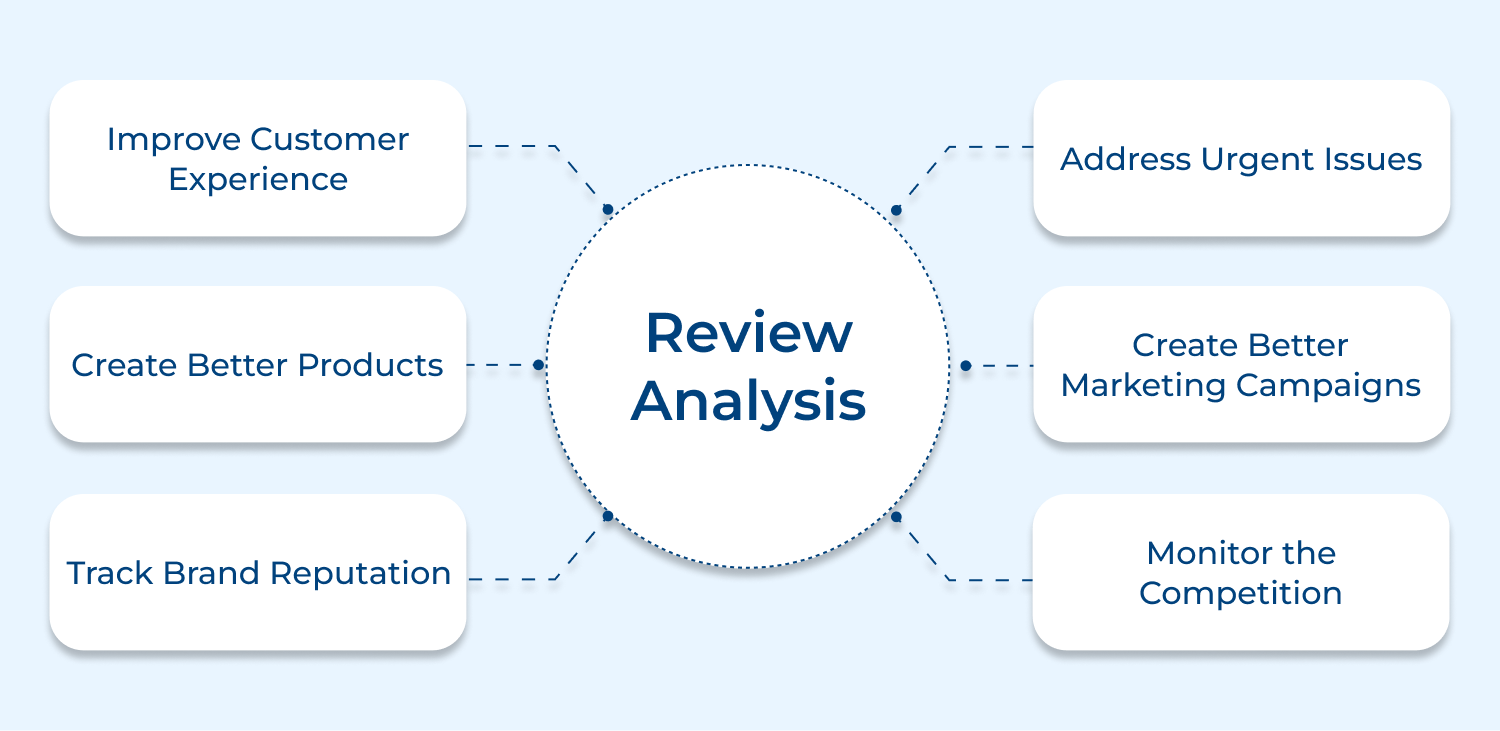
Collect and review customer feedback from product pages, app stores along with third-party review sites to spot sentiment patterns.
Reviews play a big role in influencing potential buyers. They give detailed feedback on product features and service quality, often with comparisons to competitors as well as ideas for improvement.
Use this feedback to fix common issues, adjust marketing messages to address concerns early, and highlight your competitive strengths.
Pro tips:
Analyze support tickets, call transcripts, chat logs and other service interactions to find sentiment patterns as well as common themes.
These interactions often happen when customers face problems or have important questions, making them valuable for spotting pain points. They provide detailed accounts of issues that affect customer sentiment.
Use this information to find knowledge gaps in support teams, detect recurring product problems, and address common concerns before they grow.
Tips:
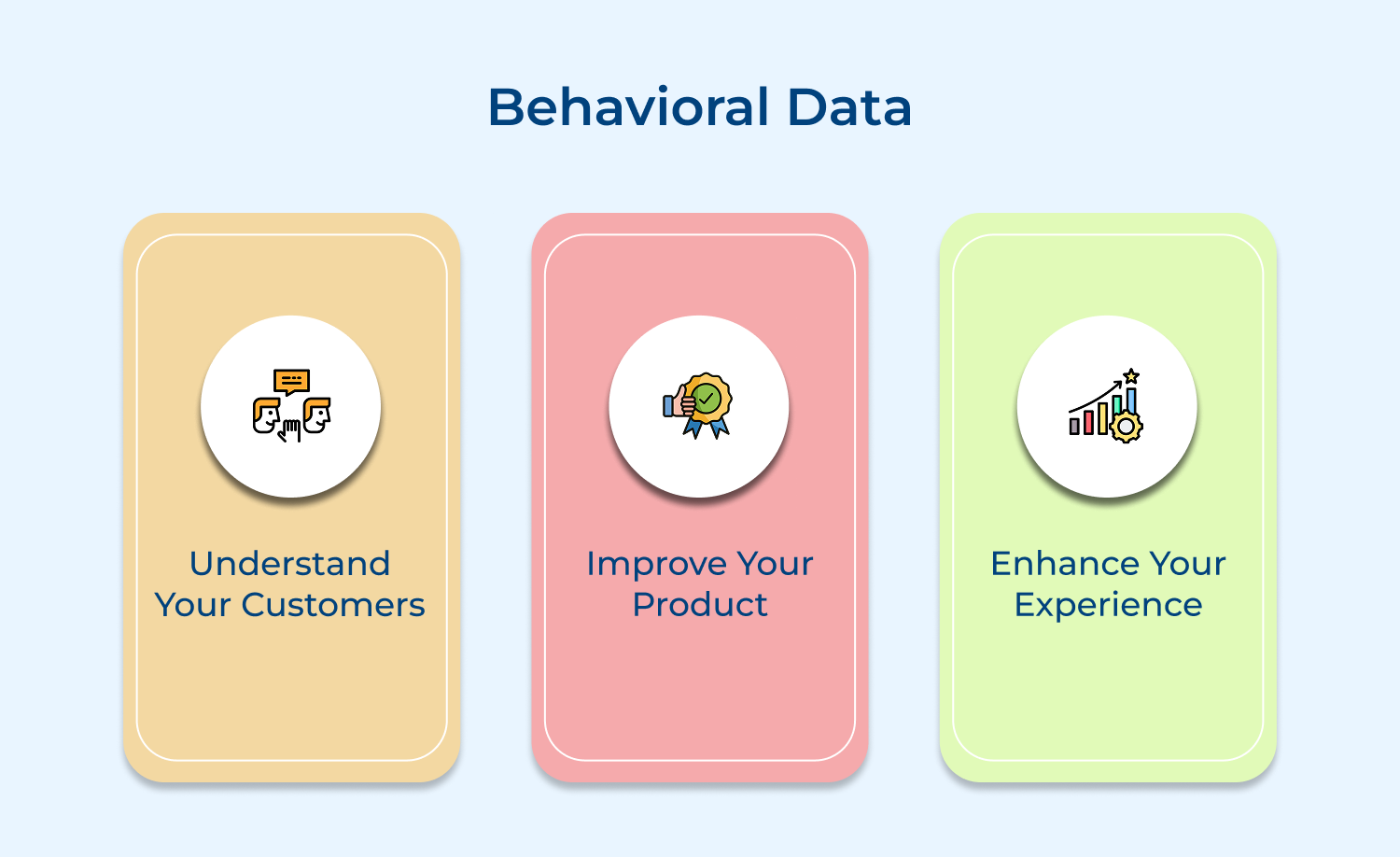
Collecting as well as analyzing patterns in customer actions, including website/app usage, purchase behavior, retention rates, and engagement metrics.
Behavior often reveals sentiment that customers don’t explicitly express. Actions like abandoned carts, reduced usage, or feature avoidance can signal dissatisfaction before customers articulate it in feedback.
Identify friction points in the customer journey, detect early warning signs of churn, understand feature adoption challenges and measure the impact of experience improvements.
Actionable Tips:
AI-powered tools can analyze written feedback and voice recordings to detect sentiment, emotions, topics as well as patterns across large volumes of customer communications.
Manually reviewing all customer messages isn’t possible at scale. These tools can process thousands of interactions, find patterns people might miss, and measure tone or emotion.
They help track sentiment trends over time, spot words or phrases that trigger negative reactions, find new topics early and predict customer behavior.
Pro tips:
Create and monitor spaces where customers can connect with each other as well as your brand, such as forums, user groups, online communities, etc.
These spaces give continuous, natural feedback without the limits of surveys or interviews. They show how customers help each other, reveal new use cases and highlight which product features spark discussion.
Use them to find power users, collect genuine testimonials, get ideas for new features while learning how customers describe your brand in their own words.
Tips:
Leveraging customer sentiment can unlock new growth opportunities and boost loyalty. In fact, 86% of buyers will pay more for a great customer experience.
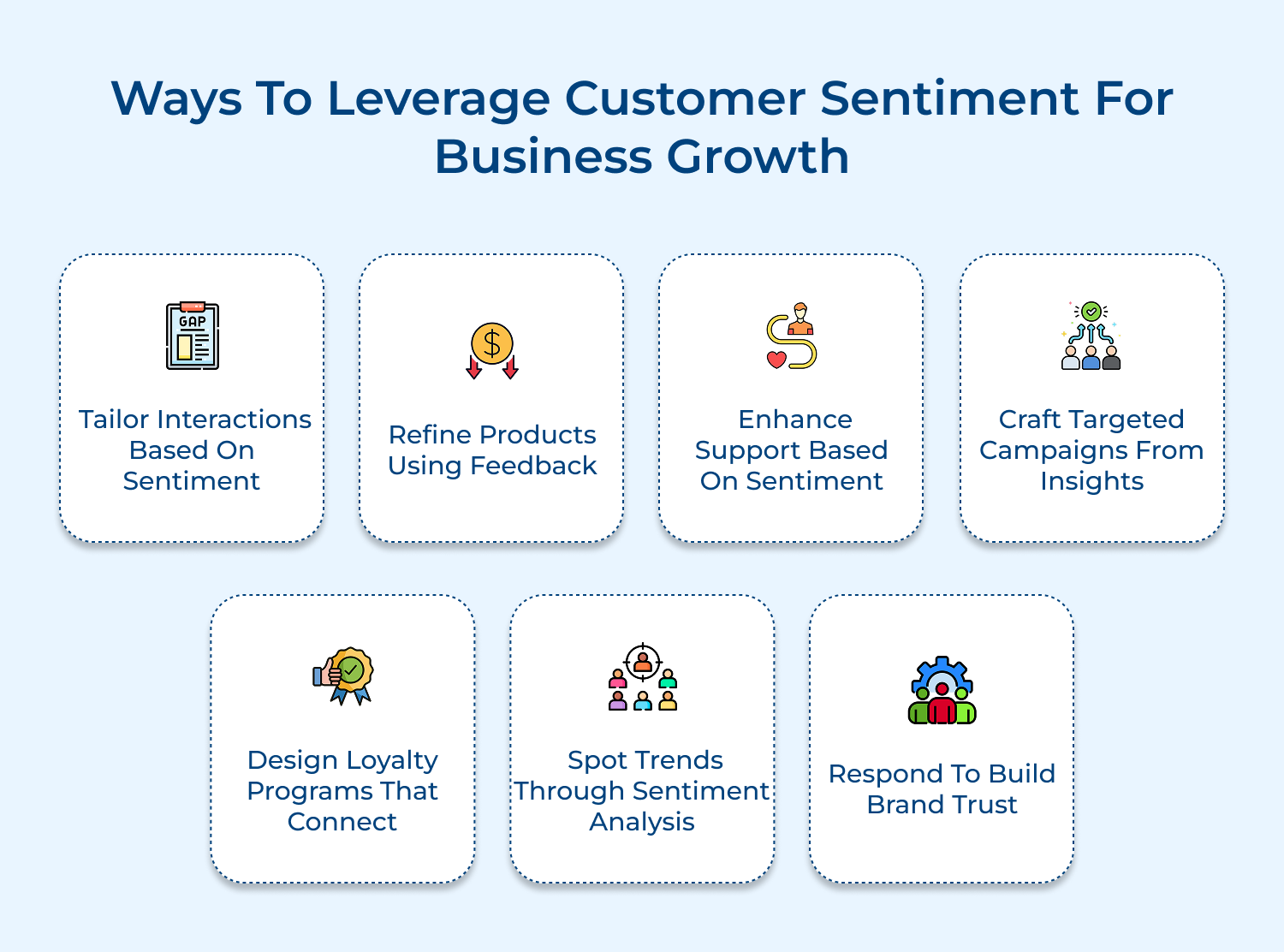
1. Tailor Interactions Based on Sentiment
Use customer sentiment to personalize interactions so they feel genuine and relevant. Understanding the emotions behind feedback helps you respond with empathy, build stronger connections, and increase loyalty.
2. Refine Products Using Feedback
Sentiment shows how well your product meets expectations. Negative feedback points to areas to improve, while positive feedback highlights features to promote. Tracking this regularly helps you make products that better meet customer needs.
3. Enhance Support Based on Sentiment
Sentiment analysis can reveal weak points in your support process, such as slow responses or poor solutions. Fixing these issues makes support faster and more effective, which builds stronger customer relationships.
4. Craft Targeted Campaigns from Insights
Sentiment data helps you understand customer preferences and emotions. Use these insights to create marketing campaigns that connect with your audience and increase engagement as well as conversions.
5. Design Loyalty Programs That Connect
Use sentiment to learn what customers value most. Create rewards and offers that reflect those values, encouraging repeat purchases as well as long-term loyalty.
6. Spot Trends Through Sentiment Analysis
Tracking sentiment over time reveals new trends and changes in customer behavior. Acting on these insights early helps you stay competitive and relevant.
7. Respond to Build Brand Trust
Reply to both positive and negative feedback to show you value customer opinions. This builds trust, improves your brand image, and encourages word-of-mouth referrals.
Measuring customer sentiment isn’t always straightforward. Variations in language, tone and context can make it difficult to capture accurate insights. Here’s how you overcome challenges:
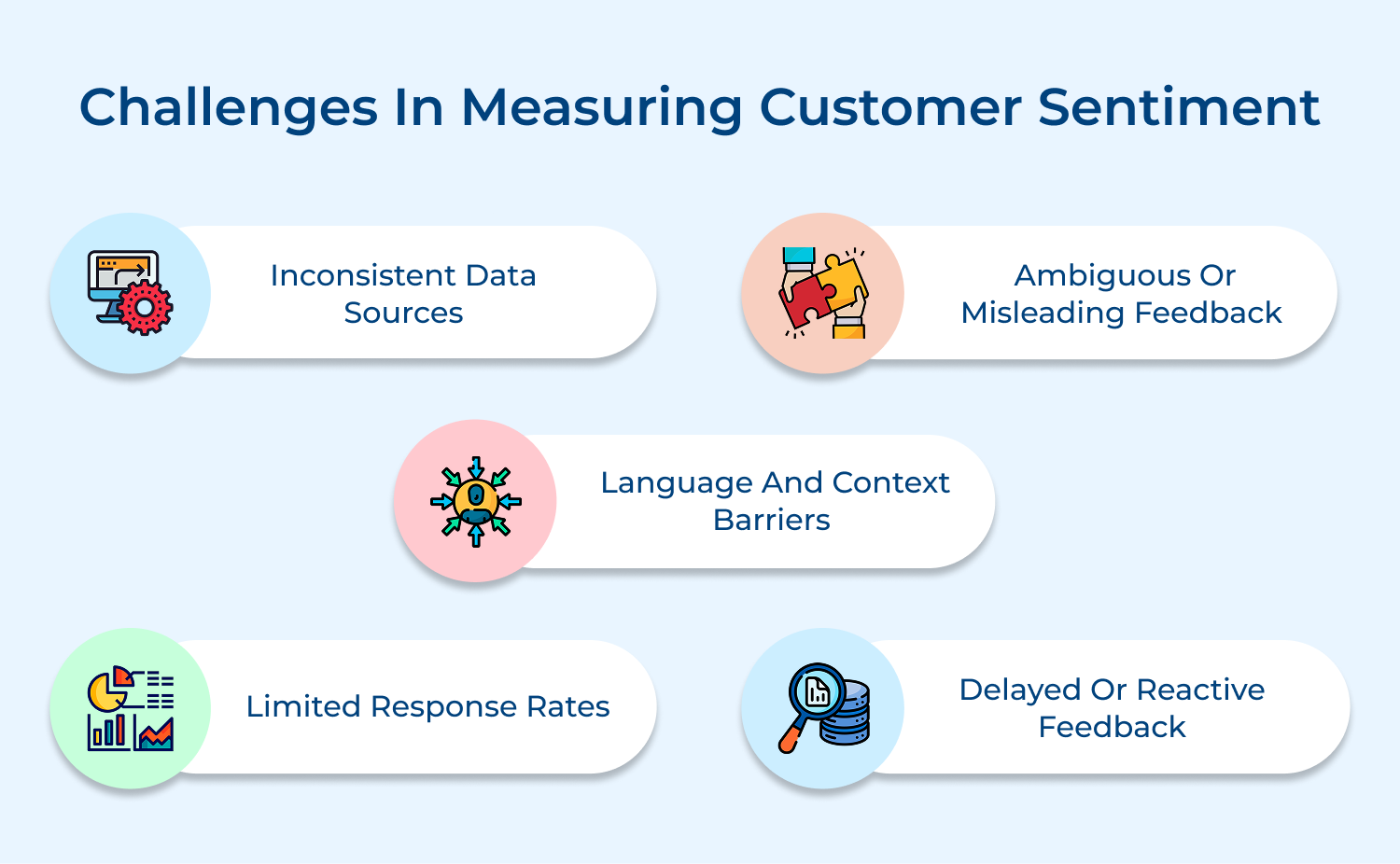
1. Inconsistent Data Sources
Measuring customer sentiment often involves data from multiple channels such as social media, reviews, and surveys, which can lead to inconsistent or conflicting information.
Solution: Centralize data collection by integrating various platforms into one system. Use sentiment analysis tools that aggregate and standardize data across channels, providing a clearer, more cohesive view of customer sentiment.
2. Ambiguous or Misleading Feedback
Customer feedback can sometimes be vague, contradictory, or difficult to interpret, leading to confusion about the true sentiment.
Solution: Use advanced sentiment analysis tools that employ natural language processing (NLP) to detect nuances and emotions in feedback. Encourage more specific feedback through targeted surveys and follow-up questions that clarify customer sentiments.
3. Language and Context Barriers
Different customers may express sentiments using varying language, slang, or cultural references, making it challenging to accurately assess their emotions.
Solution: Employ sentiment analysis tools with multilingual support and contextual understanding. Regularly update these systems to accommodate evolving language trends and cultural differences for more accurate insights.
4. Limited Response Rates
Surveys and feedback mechanisms may suffer from low response rates, skewing the data as well as making it less representative of the entire customer base.
Solution: Incentivize participation by offering rewards or discounts in exchange for feedback. Utilize multiple feedback channels (e.g., email, in-app surveys, social media) to increase engagement and gather a broader sample of customer sentiment.
5. Delayed or Reactive Feedback
Customer sentiment often comes after an event or interaction, making it challenging to act on real-time issues or identify problems quickly.
Solution: Implement real-time sentiment tracking systems that analyze ongoing interactions with customers. Utilize AI-powered tools to detect sentiment in real-time across customer touchpoints, enabling quick responses to emerging concerns and opportunities.
Customer sentiment is crucial for influencing business decisions and fueling growth. Monitoring and responding to emotions expressed by customers allows companies to improve products, refine customer service as well as build strong relationships. Insights from sentiment analysis help businesses stay adaptable, competitive and responsive to market changes.
Acting on feedback builds trust and loyalty, ensuring long-term success. Companies that prioritize customer sentiment create better experiences, encourage repeat business, and ultimately achieve sustainable growth. Embracing sentiment analysis is essential for organizations looking to thrive in an ever-evolving landscape.

How is customer sentiment different from customer satisfaction?
Customer satisfaction measures how well expectations are met at specific touchpoints, while sentiment captures broader emotional attitudes toward the entire brand relationship. Satisfaction is typically measured through structured metrics like CSAT, whereas sentiment can be detected across numerous channels and often reveals deeper loyalty drivers that satisfaction scores might miss.
How can we measure sentiment for customers who don’t respond to surveys?
For non-responders, look at behavioral signs like usage patterns and renewal history. Use passive listening during service interactions and on social media. Offer simple, in-context ways to give feedback. Use predictive models based on similar customer profiles. Run targeted research with incentives aimed at customers who rarely respond.
How do we handle conflicting sentiment signals from different sources?
Focus on behavioral indicators when they conflict with stated opinions. Give more weight to sources with stronger methods. Segment analysis to see differences between customer types. Look for patterns at different stages of the customer journey. Do targeted research to resolve contradictions. Remember that contradictions can reveal important complexities in the customer experience.
How do we account for cultural differences in expressing sentiment?
Create region-specific sentiment baselines. Adjust scoring algorithms for local communication styles. Use local analysts for more accurate interpretation. Remember some cultures avoid extreme responses. Add cultural context to reports to avoid misinterpretation. Test analysis tools across languages and regions to keep results consistent worldwide.
What are the most accurate methods for measuring customer sentiment?
The most accurate approach uses multiple methods. Combine surveys and interviews with passive monitoring of unsolicited feedback. Analyze behavior patterns and study customer communications using text and speech analytics. Include contextual data to understand the situations behind emotions and opinions.
 https://omni24.io/wp-content/uploads/2026/09/Social-commerce-scaled.png
1340
2560
Webvision Solution
https://omni24.io/wp-content/uploads/2023/04/Omni-Logo-1.svg
Webvision Solution2026-10-23 12:18:272026-10-23 12:18:27What is Social Commerce and Why Does It Matter?
https://omni24.io/wp-content/uploads/2026/09/Social-commerce-scaled.png
1340
2560
Webvision Solution
https://omni24.io/wp-content/uploads/2023/04/Omni-Logo-1.svg
Webvision Solution2026-10-23 12:18:272026-10-23 12:18:27What is Social Commerce and Why Does It Matter? https://omni24.io/wp-content/uploads/2026/08/AI-Customer-Service-Agents.png
1256
2400
Webvision Solution
https://omni24.io/wp-content/uploads/2023/04/Omni-Logo-1.svg
Webvision Solution2026-09-21 04:48:512026-09-21 04:48:51How to Build an AI Customer Service Agents: 8 Key Steps
https://omni24.io/wp-content/uploads/2026/08/AI-Customer-Service-Agents.png
1256
2400
Webvision Solution
https://omni24.io/wp-content/uploads/2023/04/Omni-Logo-1.svg
Webvision Solution2026-09-21 04:48:512026-09-21 04:48:51How to Build an AI Customer Service Agents: 8 Key Steps https://omni24.io/wp-content/uploads/2026/08/Omnichannel-Conversational-AI.png
1256
2400
Tushar Joshi
https://omni24.io/wp-content/uploads/2023/04/Omni-Logo-1.svg
Tushar Joshi2026-09-16 03:51:072026-09-16 03:51:07How to Build Omnichannel Conversational AI Strategy
https://omni24.io/wp-content/uploads/2026/08/Omnichannel-Conversational-AI.png
1256
2400
Tushar Joshi
https://omni24.io/wp-content/uploads/2023/04/Omni-Logo-1.svg
Tushar Joshi2026-09-16 03:51:072026-09-16 03:51:07How to Build Omnichannel Conversational AI Strategy
Whether it’s about acquire, engage or support – Omni24 covers all your customer engagement needs in one complete platform.

Copyright ©2026 Veemo All rights reserved.
CA, Los Angeles, Hall Ave, 19011