How Enterprise Chatbots Revolutionize Business Operations
Enterprise chatbots boost efficiency by automating routine tasks, increasing employee productivity and ensuring consistent experience across the organization.
Enterprise chatbots boost efficiency by automating routine tasks, increasing employee productivity and ensuring consistent experience across the organization.
Enterprise chatbots are revolutionizing the way businesses interact with customers and streamline internal processes. These AI-powered digital assistants are becoming an integral part of modern business operations.
The global enterprise/AI chatbot market is projected to reach $46 billion by 2029. Leveraging natural language processing and machine learning, these intelligent bots understand complex queries and provide personalized experiences at scale.
Let us dive deeper into the world of enterprise chatbots we will explore their diverse applications, benefits, and the best practices for successful implementation.
Enterprise chatbots are automated conversational agents designed to assist organizations in managing customer interactions, internal communications and operational processes. These advanced AI-driven tools can engage with users, offering instant responses and enhancing efficiency while improving user experiences.
Enterprise chatbots streamline communication and automate repetitive tasks, freeing up human resources for more complex issues. They handle multiple inquiries simultaneously, ensuring timely responses, which is crucial for maintaining customer satisfaction in a fast-paced business environment.
Key objectives:
Enterprise chatbots offer numerous advantages, including improved efficiency, enhanced customer support and streamlined communication, ultimately driving business success.
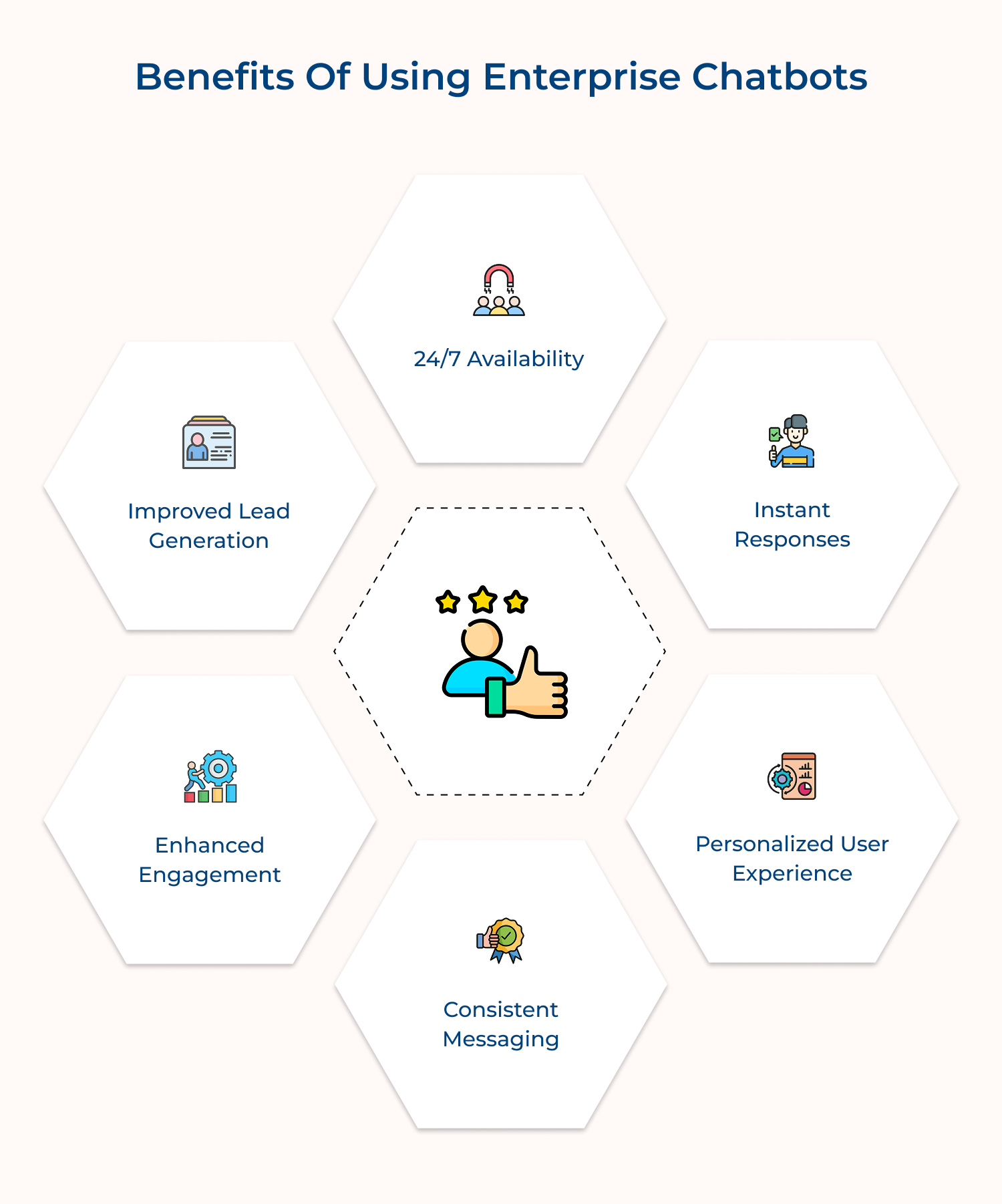
1. 24/7 Availability
Enterprise chatbots provide round-the-clock service, ensuring that customers and employees can access information or assistance at any time. The constant availability eliminates wait times, improves customer satisfaction and supports global operations across different time zones.
2. Provide Instant Responses
Chatbots deliver immediate answers to queries, dramatically reducing response times. The instant gratification meets modern expectations for quick service, enhancing user satisfaction and efficiency. Handling routine inquiries instantly allows chatbots to free up human agents for more complex issues and improve overall service quality.
3. Deliver Personalized User Experience
Enterprise chatbots can leverage user data and interaction history to provide tailored responses or recommendations. Such personalization enhances user engagement, improves the relevance of information provided and creates a more satisfying experience. Remembering preferences and past interactions enables chatbots to offer a continuity of service.
4. Consistent Messaging
Chatbots ensure uniform responses across all customer interactions, maintaining brand voice and messaging consistency. This standardization reduces errors, ensures compliance with company policies and creates a cohesive brand experience. Consistent messaging also helps in building trust, as users receive accurate and up-to-date information.
5. Enhanced Engagement
Interactive chatbots create engaging user experiences, encouraging more frequent and meaningful interactions with the brand. They can use conversational interfaces, rich media and interactive elements to keep users involved. The increased engagement leads to higher customer satisfaction and more opportunities for upselling or cross-selling products/ services.
6. Improved Lead Generation
Chatbots can qualify leads by gathering initial information, assessing needs and guiding potential customers through the sales funnel. They engage visitors 24/7, capture contact details, and provide relevant information to nurture leads. The automated lead generation process increases efficiency and allows sales teams to focus on high-potential prospects.
Enterprise chatbots can be applied in various business functions, enhancing efficiency and customer interactions.
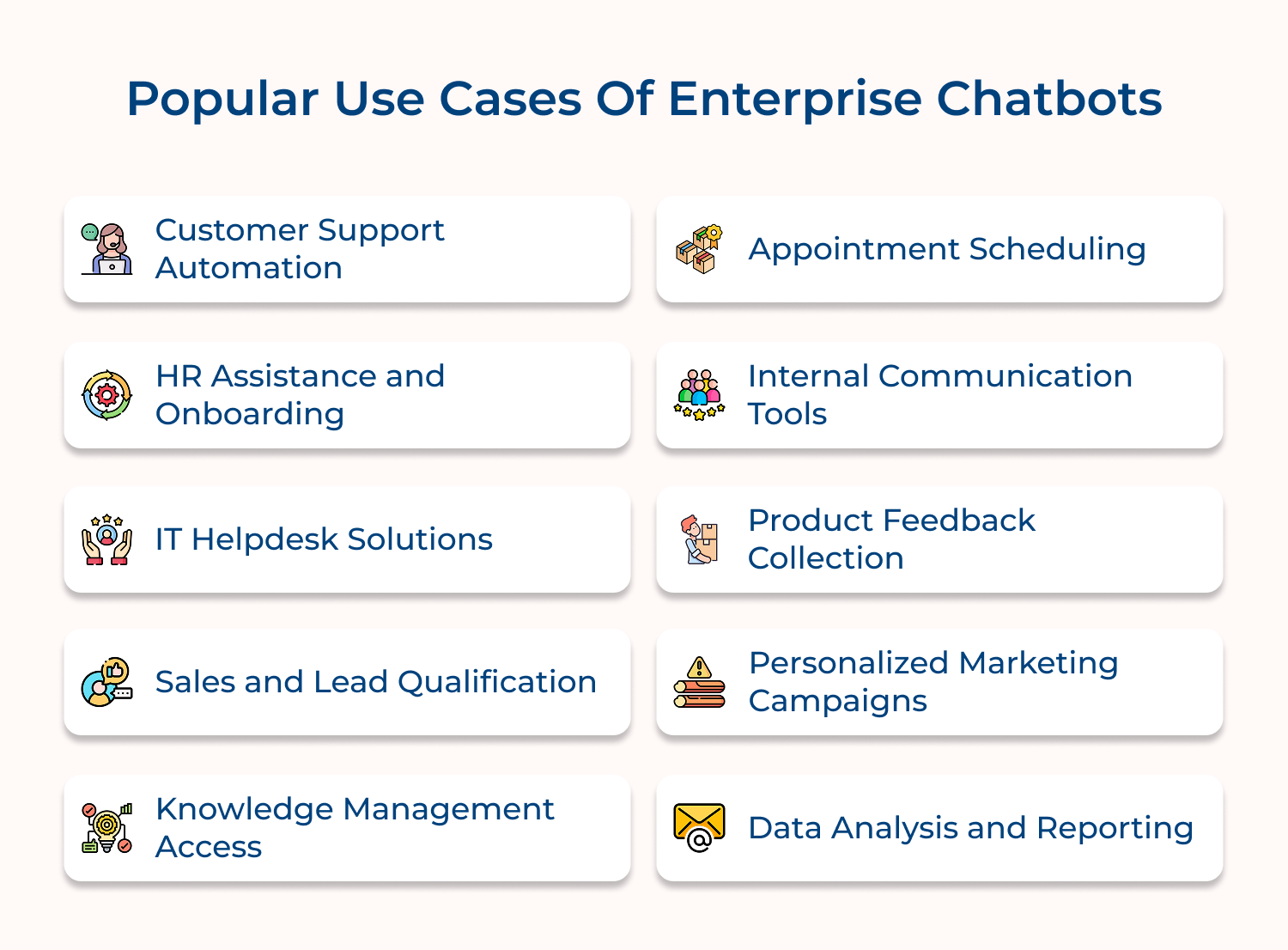
Customer support automation is essential for handling high volumes of inquiries efficiently, reducing response times and improving customer satisfaction. It allows businesses to provide 24/7 support, freeing up human agents to focus on complex issues while ensuring consistent and accurate responses to common questions.
Implement chatbots to answer FAQs, troubleshoot common issues and guide customers through basic processes. Use natural language processing to understand customer queries and provide relevant responses. Integrate with backend systems to access customer data, order information and knowledge bases for comprehensive support.
Pro tips:
1. Use customer interaction data to continuously improve the chatbot’s responses and expand its knowledge base.
2. Implement a seamless handoff to human agents for complex issues the chatbot can’t resolve.
3. Personalize responses based on customer history and preferences to enhance the support experience.
HR assistance and onboarding chatbots streamline human resources processes, reducing administrative burden and improving employee experience. They provide instant access to HR information, automate routine tasks and ensure consistent onboarding experiences.
Deploy chatbots to answer employee questions about policies, benefits and procedures. Automate onboarding tasks like document collection and training schedule creation. Use chatbots to guide new hires through orientation processes, provide company information and collect feedback on the onboarding experience.
Pro tips:
1. Integrate the chatbot with HR management systems for real-time access to employee data and policy updates.
2. Design conversation flows that mimic human HR interactions to create a welcoming onboarding experience.
3. Use analytics to identify common HR queries and continuously improve the chatbot’s knowledge base.
IT helpdesk chatbots are crucial for managing the high volume of tech support requests efficiently. They reduce wait times, provide instant solutions for common issues and allow IT staff to focus on complex problems, ultimately improving productivity and user satisfaction.
Implement chatbots to handle password resets, software installation guides and basic troubleshooting. Use decision trees to diagnose issues and provide step-by-step solutions. Integrate with IT ticketing systems to create and track support tickets for problems that require human intervention.
Pro tips:
1. Implement machine learning to improve issue diagnosis and solution recommendations over time.
2. Create a knowledge base of common IT issues and solutions to power the chatbot’s responses.
3. Use chatbot analytics to identify recurring IT problems and proactively address them.
Sales and lead qualification chatbots are essential for efficiently managing high volumes of potential customers. They help businesses quickly identify promising leads, provide instant responses to sales inquiries and gather valuable customer information, ultimately accelerating the sales process.
Deploy chatbots on websites and social media to engage visitors, answer product questions, and collect contact information. Use conversation flows to qualify leads based on predefined criteria. Integrate with CRM systems to store lead information and trigger follow-ups by human sales representatives for qualified prospects.
Pro tips:
1. Personalize chatbot interactions based on user behavior and preferences to increase engagement.
2. Implement A/B testing on conversation flows to optimize lead qualification and conversion rates.
3. Use natural language processing to understand customer intent and provide relevant product recommendations.
Knowledge management chatbots are crucial for organizing and disseminating vast amounts of corporate information efficiently. They provide quick access to company knowledge, ensuring consistency in information delivery, reducing time spent searching for data and enabling employees to make informed decisions faster.
Implement chatbots that can search and retrieve information from various knowledge bases, documents. Use natural language processing to understand user queries and provide relevant answers. Integrate with internal systems to access up-to-date information on policies, procedures and best practices.
Pro tips:
1. Implement a feedback mechanism to continuously improve the accuracy and relevance of information provided.
2. Use analytics to identify knowledge gaps and prioritize content creation or updates.
3. Design the chatbot to guide users through complex processes or decision trees when simple answers aren’t sufficient.
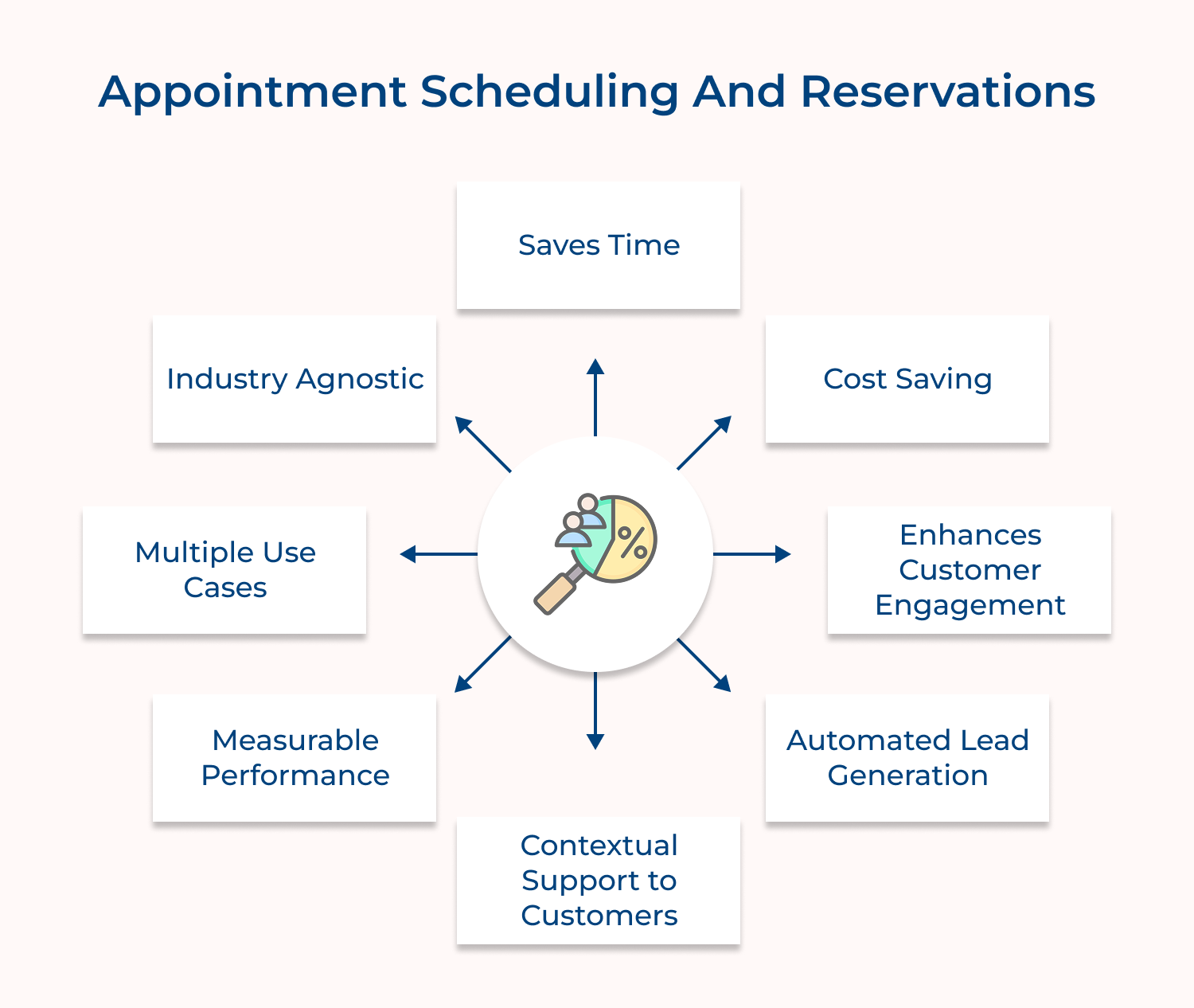
Appointment scheduling and reservation chatbots streamline the booking process, reducing administrative overhead and improving customer convenience. They eliminate the need for manual scheduling, minimize double bookings and allow 24/7 access to appointment services. This leads to improved efficiency, customer satisfaction and resource utilization.
Implement chatbots on websites or messaging platforms to handle appointment requests. They can check availability, suggest suitable time slots, confirm bookings and send reminders. Integrate with calendar systems and databases to manage real-time availability. Use chatbots to handle rescheduling, cancellations and provide booking-related information.
Pro tips:
Internal communication chatbots improve information flow within organizations, ensuring employees have quick access to important updates, policies and resources. They reduce email overload, streamline communication processes and help maintain consistent messaging across departments. It leads to better-informed employees and improved organizational efficiency.
Deploy chatbots on internal messaging platforms or intranets to disseminate company news, policy updates and event information. Use them to answer frequently asked questions about company procedures or benefits. Implement chatbots for employee surveys, feedback collection and to facilitate cross-departmental communication.
Pro tips:
Product feedback collection chatbots streamline the process of gathering user opinions and experiences. They provide a convenient, always-available channel for customers to share feedback, increasing response rates. The continuous flow of insights helps businesses quickly identify product issues, understand customer needs and drive improvements.
Implement chatbots on product pages, in mobile apps, or via messaging platforms to proactively seek customer feedback. Use conversational flows to ask specific questions about product features, user experience, or overall satisfaction. Integrate with analytics tools to categorize and analyze feedback, generating actionable insights for product teams.
Pro tips:
Personalized marketing chatbots enhance customer engagement by delivering tailored content and offers. They leverage user data and preferences to create more relevant marketing messages. The personalization increases conversion rates, improves customer satisfaction and helps businesses build stronger, more meaningful relationships with their audience.
Deploy chatbots across various channels (websites, social media, messaging apps) to interact with customers. Use AI to analyze user behavior and preferences, then deliver personalized product recommendations, offers, or content. Implement chatbots for interactive campaigns, quizzes or product discovery experiences tailored to individual user profiles.
Pro tips:
Data analysis & reporting chatbots democratize access to business intelligence, allowing employees to quickly retrieve and understand key metrics and trends. They reduce the burden on data teams, enable faster decision-making and ensure consistent interpretation of data across the organization. It leads to more data-driven operations and strategies.
Implement chatbots that can query databases and analytics platforms to generate reports on demand. Use natural language processing to understand user requests for specific metrics or trends. Integrate with visualization tools to present data in easily digestible formats. Deploy chatbots that can explain data insights and answer follow-up questions.
Pro tips:
Building an enterprise chatbot can significantly enhance customer experience, streamline operations and improve efficiency within your organization. Here’s a step-by-step guide to help you develop an effective enterprise chatbot.
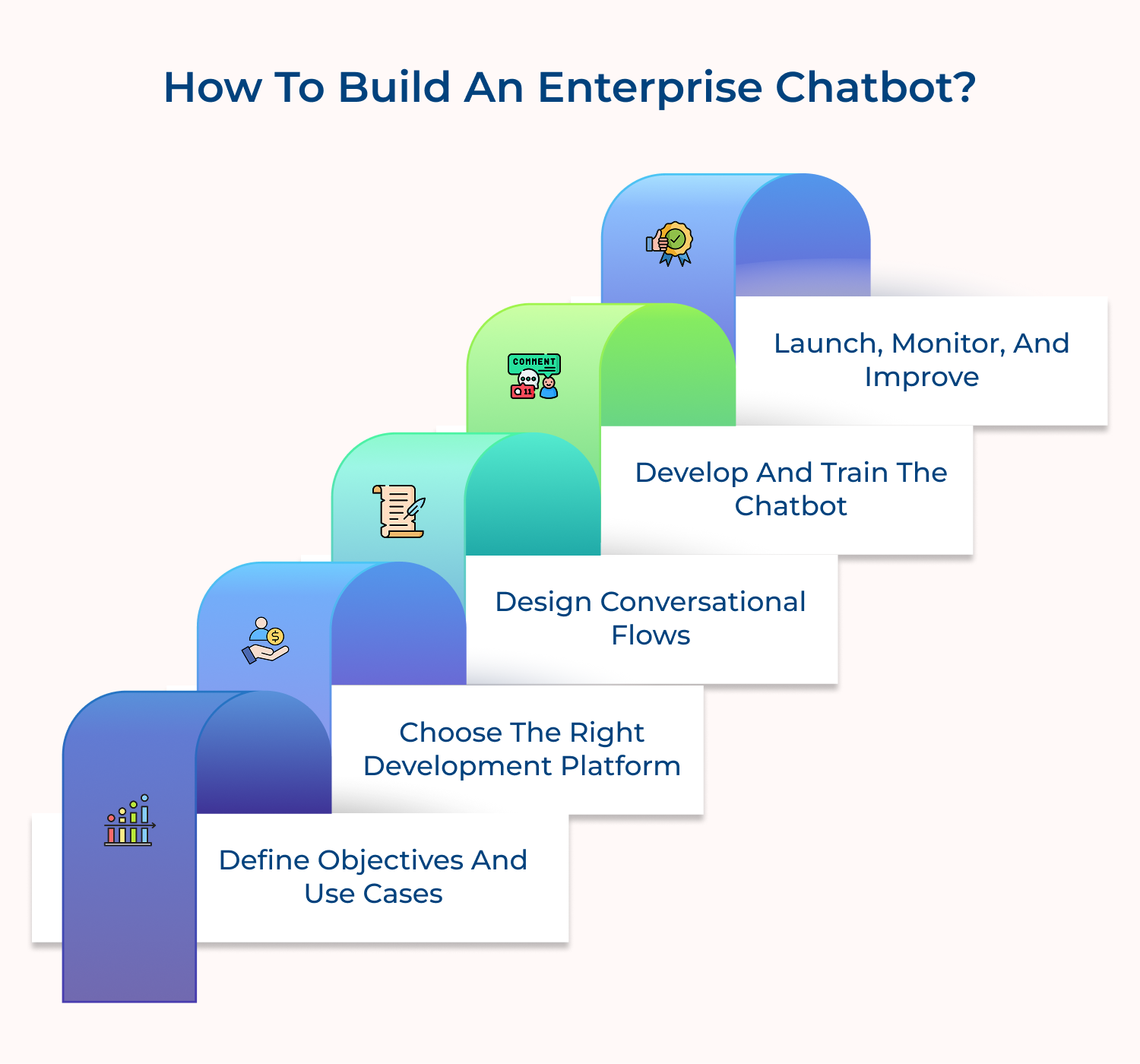
Before diving into development, it’s essential to define the objectives of your chatbot. Consider the specific problems you want the chatbot to solve and how it will benefit your organization. Common use cases for enterprise chatbots include customer support, lead generation, HR inquiries and IT helpdesk assistance.
Identify the primary functions of your chatbot. For instance, to improve customer support, focus on frequently asked questions and issue resolution. Setting clear goals will help you measure the success of your chatbot after deployment.
Selecting the right development platform is crucial for the success of your chatbot. Numerous frameworks and tools are available, each with its own strengths. Evaluate your existing technology stack and determine how the chosen platform can integrate with your current systems (like CRM, databases and internal tools). It ensures seamless operations & data flow between your chatbot and other systems.
Creating an intuitive conversational flow is critical for a positive user experience. Begin by mapping out the user journey, considering how users will interact with the chatbot. Use flowcharts to visualize potential conversation paths.
Define intents (what users want to achieve) and entities (specific data points the chatbot needs to understand). For example, in a customer support scenario, intents may include “reset password” or “check order status,” while entities could be user account details or order numbers.
It’s also essential to design fallback options for unrecognized queries, ensuring users still receive assistance even when their requests are unclear.
With the design in place, developing and training your chatbot is time. Depending on your chosen platform, you may have access to various development tools that facilitate this process. Testing is crucial during this stage. Conduct internal tests to identify and fix issues before rolling out the chatbot to a broader audience.
After thorough testing, it’s time to launch your chatbot. Start with a pilot program to gather initial feedback from users. Monitor the chatbot’s performance using analytics to track key metrics such as user engagement, response accuracy and customer satisfaction.
Collect feedback regularly to identify areas for improvement. An enterprise chatbot should evolve continuously; updating its knowledge base and refining its conversational capabilities will enhance user experience.
Effective enterprise chatbots should include essential features that improve functionality and user experience. Here are the must-have features:
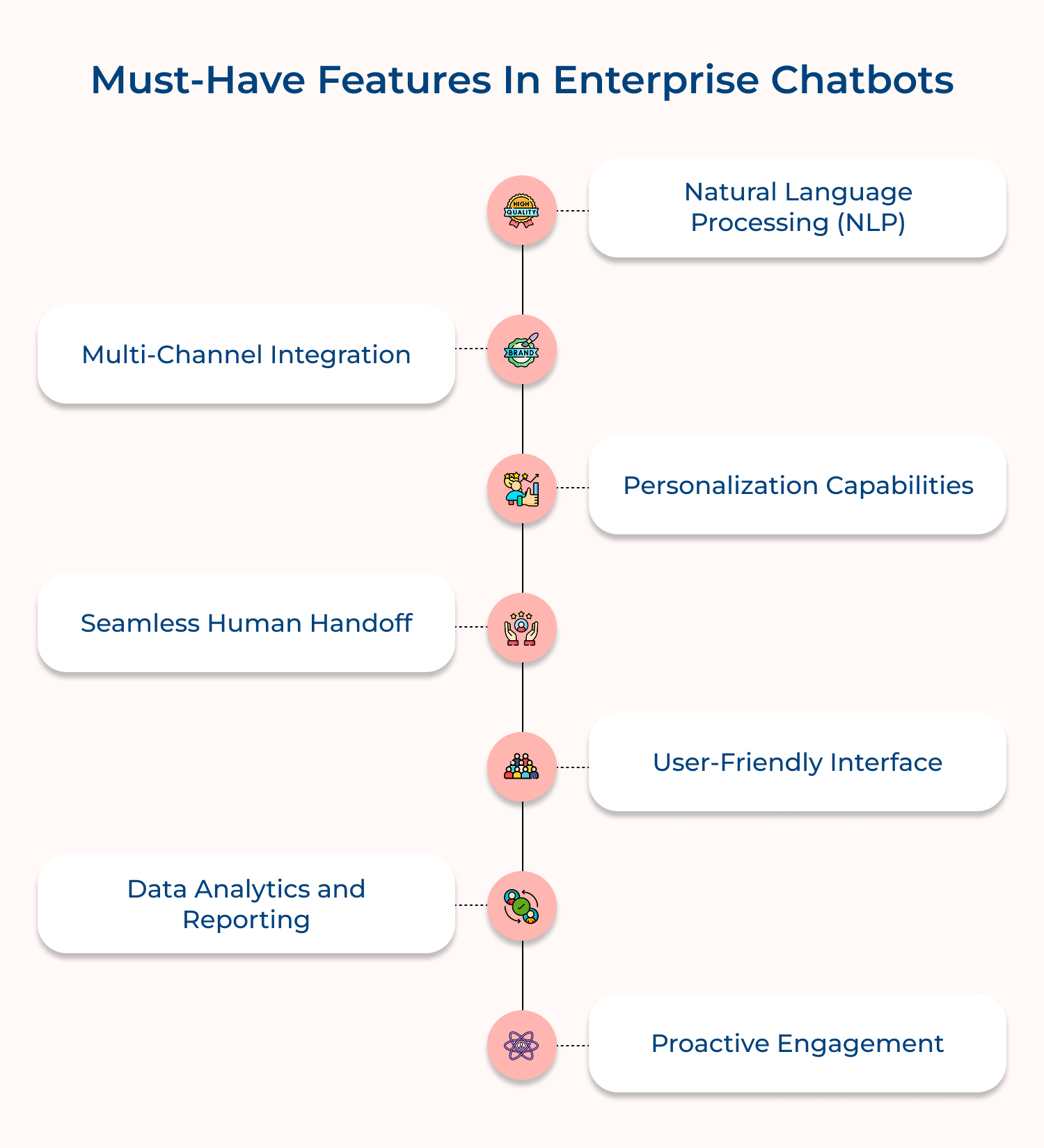
Natural Language Processing (NLP)
Advanced chatbots rely on robust NLP capabilities as their core functionality. This feature allows chatbots to understand human language in its natural form, including colloquialisms, idioms and context-specific phrases. NLP enables chatbots to grasp the intent behind user queries, even when they’re not perfectly structured or contain errors. The result is more accurate responses and a smoother conversation flow, mimicking human-like interactions.
Multi-Channel Integration
Modern customers expect seamless communication across various platforms. Enterprise chatbots should be capable of integrating with multiple channels such as websites, mobile apps, social media platforms and messaging services. The integration ensures a consistent user experience regardless of the chosen communication channel.
Personalization Capabilities
Delivering a truly engaging experience requires chatbots to offer personalized interactions. This feature involves leveraging user data, past interactions and preferences to tailor responses. Personalization can range from addressing users by name to offering product suggestions based on browsing history.
Seamless Human Handoff
While chatbots can handle a wide range of queries, complex situations will always arise that require human intervention. A well-designed enterprise chatbot should recognize when a conversation exceeds its capabilities and smoothly transfer the interaction to a human agent.
User-Friendly Interface
The chatbot’s interface should be intuitive and easy to navigate. This includes clear menu options, easily accessible help functions and the ability to understand to a variety of input types (text, voice, buttons, etc.). A user-friendly interface reduces frustration, increases engagement and improves the overall user experience.
Proactive Engagement
Advanced chatbots should not just wait for user inquiries but also initiate conversations when appropriate. This proactive approach can involve reaching out to users based on their behavior on a website, offering assistance during the checkout process, or sending personalized notifications about relevant products or services.
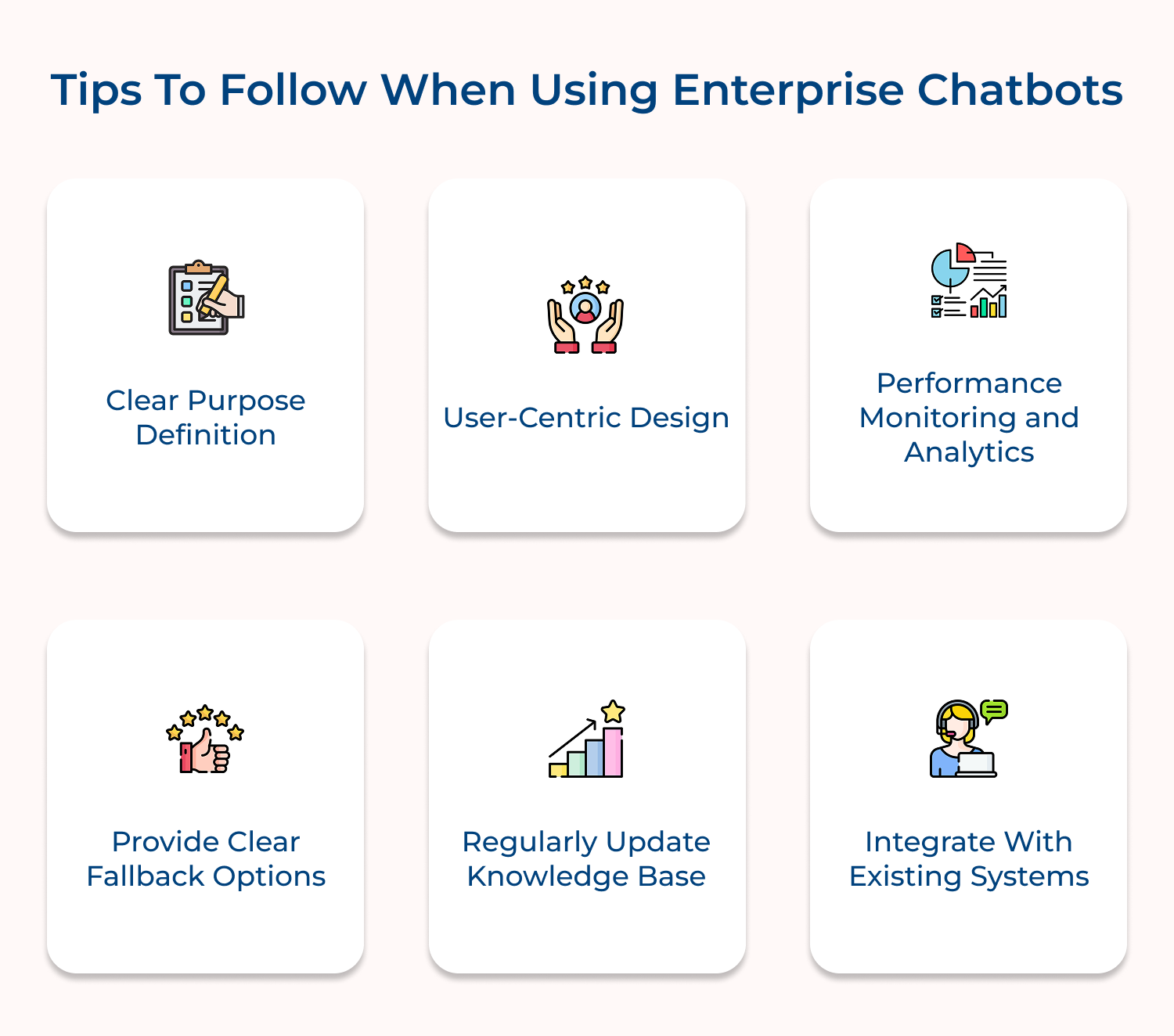
Implementing best practices in chatbot deployment ensures optimal performance, user satisfaction and ongoing improvement within business operations. Here are the practices:
In summary, enterprise chatbots significantly impact business operations and sales. Automating routine tasks and providing instant customer support enhance efficiency as well as free up valuable resources for higher-level strategic initiatives. Their capability to engage customers through personalized interactions fosters stronger relationships and drives conversion rates. With real-time data access, different types of chatbots assist in lead qualification and provide tailored recommendations, streamlining the sales process.
Integrating chatbots into operations not only improves customer satisfaction but also facilitates substantial growth, making them an essential asset in today’s competitive landscape. Their role in optimizing efficiency and driving sales is crucial for modern businesses.

How does conversational AI work for enterprises?
Conversational AI in enterprises uses natural language processing and machine learning to understand and respond to user queries. It integrates with company databases and systems to provide accurate, context-aware responses. The AI continually learns from interactions, improving its performance over time. It can handle multiple languages and complex queries, streamlining various business processes.
How much does an enterprise chatbot cost?
Enterprise chatbot costs vary widely, ranging from $10,000 to $500,000 or more. Factors influencing price include complexity, customization needs, integration requirements and ongoing maintenance. Basic chatbots are more affordable, while advanced AI-powered solutions with extensive features and integrations command higher prices. Many vendors offer subscription-based pricing models, which can help spread costs over time.
What is the future of enterprise chatbots?
The future of enterprise chatbots lies in advanced AI, improved natural language understanding, and deeper integration with business systems. We’ll see more personalized, context-aware interactions, predictive capabilities and emotional intelligence. Chatbots will likely handle increasingly complex tasks, potentially replacing certain human roles. Multi-modal interactions combining text, voice and visual elements will become more common.
How can chatbots help enterprises?
Chatbots help enterprises by automating customer service, streamlining internal processes and providing 24/7 support. They can handle routine queries, freeing up human resources for complex tasks. Chatbots improve efficiency in areas like HR, IT support and sales lead qualification. They provide consistent information, reduce response times and can scale to handle large volumes of interactions simultaneously.
How is an enterprise chatbot different from a normal chatbot?
Enterprise chatbots differ from normal chatbots in their complexity, security features and integration capabilities. They often handle more sophisticated tasks and sensitive information, requiring robust data protection measures. Enterprise chatbots typically integrate with multiple internal systems and databases, offering more comprehensive functionality. They’re designed to scale for large organizations and often include advanced analytics & customization options.
 https://omni24.io/wp-content/uploads/2026/09/Social-commerce-scaled.png
1340
2560
Webvision Solution
https://omni24.io/wp-content/uploads/2023/04/Omni-Logo-1.svg
Webvision Solution2026-10-23 12:18:272026-10-23 12:18:27What is Social Commerce and Why Does It Matter?
https://omni24.io/wp-content/uploads/2026/09/Social-commerce-scaled.png
1340
2560
Webvision Solution
https://omni24.io/wp-content/uploads/2023/04/Omni-Logo-1.svg
Webvision Solution2026-10-23 12:18:272026-10-23 12:18:27What is Social Commerce and Why Does It Matter? https://omni24.io/wp-content/uploads/2026/08/AI-Customer-Service-Agents.png
1256
2400
Webvision Solution
https://omni24.io/wp-content/uploads/2023/04/Omni-Logo-1.svg
Webvision Solution2026-09-21 04:48:512026-09-21 04:48:51How to Build an AI Customer Service Agents: 8 Key Steps
https://omni24.io/wp-content/uploads/2026/08/AI-Customer-Service-Agents.png
1256
2400
Webvision Solution
https://omni24.io/wp-content/uploads/2023/04/Omni-Logo-1.svg
Webvision Solution2026-09-21 04:48:512026-09-21 04:48:51How to Build an AI Customer Service Agents: 8 Key Steps https://omni24.io/wp-content/uploads/2026/08/Omnichannel-Conversational-AI.png
1256
2400
Tushar Joshi
https://omni24.io/wp-content/uploads/2023/04/Omni-Logo-1.svg
Tushar Joshi2026-09-16 03:51:072026-09-16 03:51:07How to Build Omnichannel Conversational AI Strategy
https://omni24.io/wp-content/uploads/2026/08/Omnichannel-Conversational-AI.png
1256
2400
Tushar Joshi
https://omni24.io/wp-content/uploads/2023/04/Omni-Logo-1.svg
Tushar Joshi2026-09-16 03:51:072026-09-16 03:51:07How to Build Omnichannel Conversational AI Strategy
Whether it’s about acquire, engage or support – Omni24 covers all your customer engagement needs in one complete platform.

Copyright ©2026 Veemo All rights reserved.
CA, Los Angeles, Hall Ave, 19011