How to Implement a Knowledge Management Process: 9 Key Steps
A practical breakdown of the knowledge management process and essential steps to help organizations work smarter while collaborating effectively.

A practical breakdown of the knowledge management process and essential steps to help organizations work smarter while collaborating effectively.
In a fast-paced business world, organizations struggle to manage vast amounts of information. This often leads to inefficiencies and missed opportunities. Knowledge gaps can impact innovation, decision-making as well as overall performance.
75% of surveyed organizations in a Global Human Capital Trends study stated that creating and preserving knowledge is important or very important for their success.
A well-structured Knowledge Management (KM) process can solve these issues. It helps companies capture, share and apply valuable insights. We will explore how a KM process ensures the right knowledge reaches the right people at the right time. This leads to improved productivity, better collaboration and overall organizational growth.
Knowledge Management Process (KMP) is a systematic approach to creating, storing, sharing and utilizing organizational knowledge effectively. It encompasses the methods, tools and practices that organizations employ to identify, capture, organize as well as distribute knowledge assets across their workforce.
The importance of the knowledge management process lies in its ability to transform individual and collective knowledge into actionable organizational assets. In a knowledge-driven economy, a comprehensive guide to knowledge management can help organizations maintain their competitive edge by preventing knowledge loss, building innovation and improving decision-making capabilities. It reduces redundancy in work efforts, speeds up employee onboarding while ensuring consistency in organizational practices.
Key objectives:
Knowledge management systems play a crucial role in helping teams capture, organize and access information effortlessly. Let’s explore how it helps your business in the long run:
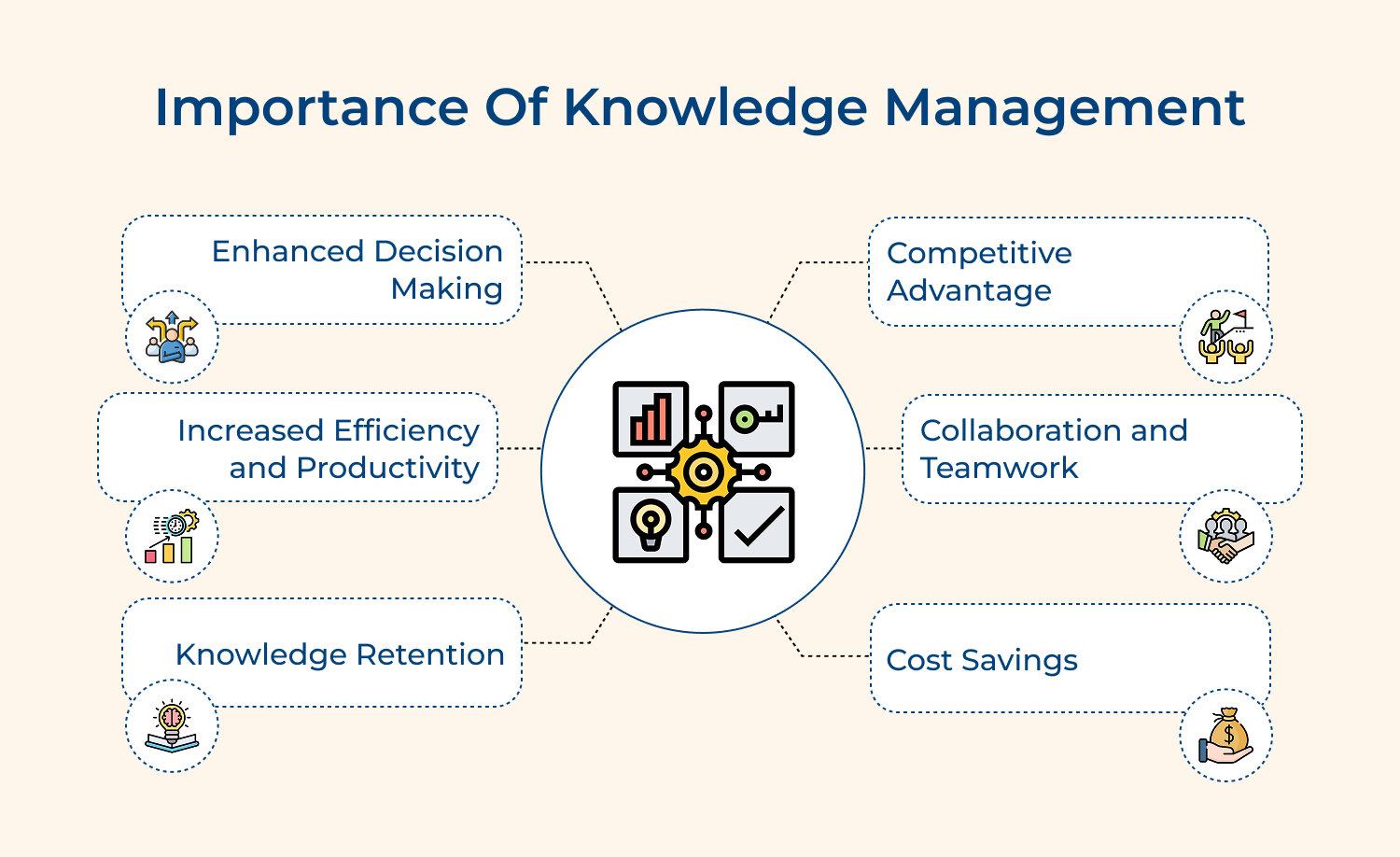
Enhanced Decision Making
A solid KM approach gives teams quick access to accurate information – whether it’s tacit knowledge from experienced employees, explicit knowledge stored in documents, or implicit knowledge gained through daily work. With the right insights on hand, decisions become clearer, faster as well as far less risky.
Increased Efficiency and Productivity
When knowledge is well-organized, employees spend less time digging for answers and more time doing meaningful work. Whether it’s explicit knowledge in a system or tacit know-how shared during collaboration, streamlined access boosts productivity across the board.
Knowledge Retention
KM ensures that valuable expertise doesn’t walk out the door when someone leaves. By capturing tacit, explicit and implicit knowledge, organizations preserve their intellectual capital while maintaining continuity. Hence, keeping operations running smoothly.
Competitive Advantage
Companies that tap into all forms of knowledge make smarter moves, adapt quickly and innovate faster. This mix of explicit insights and tacit experience gives them a real edge in responding to market shifts as well as meeting customer needs ahead of competitors.
Collaboration and Teamwork
Sharing knowledge (whether it’s implicit learning from daily tasks or explicit documents and processes) helps teams collaborate more naturally. It strengthens relationships, sparks new ideas and creates a culture where everyone learns from each other.
Cost Savings
When teams have access to existing knowledge, they avoid repeating work, reduce mistakes and make better decisions. This smart use of tacit, implicit and explicit knowledge leads to fewer errors, less rework and significant long-term cost savings.
A strong KM strategy relies on a set of structured processes that help organizations capture and share information. Learn how the right knowledge management tools can help your team:
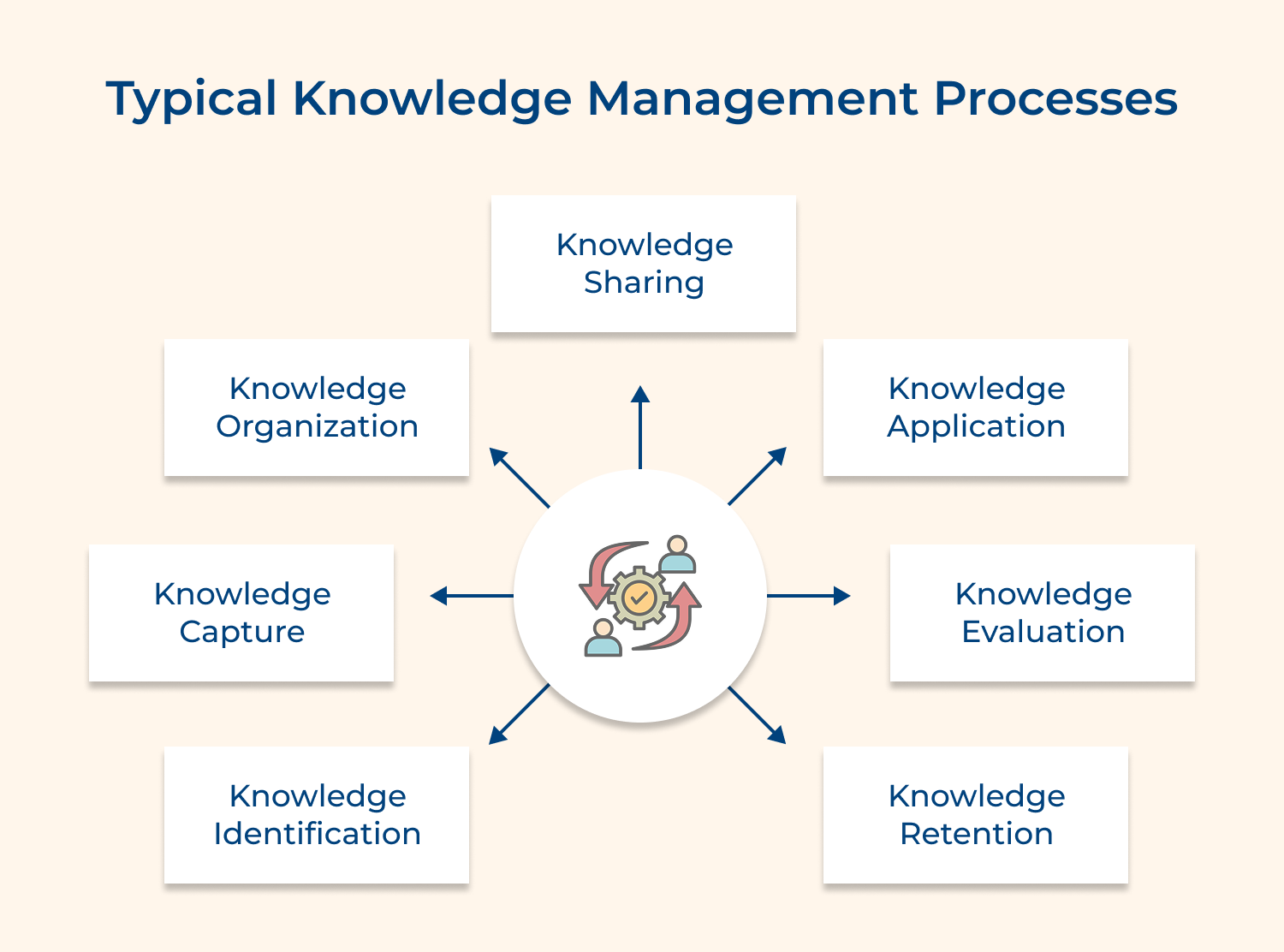
Knowledge Identification
Identifying knowledge involves recognizing what information, skills, or expertise exists within an organization. This includes assessing both explicit knowledge, such as documents and tacit knowledge, like personal experiences as well as insights that employees hold.
Knowledge Capture
Capturing knowledge refers to gathering valuable insights, experiences and information from individuals or external sources. The step ensures that critical knowledge is documented and stored for future use, preventing knowledge loss due to employee turnover or other factors.
Knowledge Organization
Knowledge organization involves structuring and categorizing the captured knowledge in an accessible as well as systematic way. Using taxonomies, keywords and metadata ensures that information is easy to locate, helping employees quickly find relevant resources when needed.
Knowledge Sharing
Knowledge sharing encourages the distribution of information and expertise across the organization. It involves creating a culture of open communication and providing platforms, such as intranets or collaboration tools, that facilitate easy sharing among employees as well as teams.
Knowledge Application
Applying knowledge ensures that relevant information and insights are used in decision-making along with day-to-day operations. It involves integrating knowledge into workflows, processes and systems, enabling employees to leverage existing expertise for more informed as well as effective actions.
Knowledge Evaluation
Evaluating knowledge involves assessing the quality and relevance of the information being shared. This step helps ensure that the knowledge is still accurate, up-to-date and aligned with the organization’s goals. Hence, allowing for continuous improvement and refinement.
Knowledge Retention
Knowledge retention focuses on preserving valuable insights and expertise, especially when employees leave or retire. Organizations implement systems to store and manage knowledge long-term, ensuring it remains available for future generations of employees to access.
A strong Knowledge Management process needs structure, not guesswork. These nine steps help you capture insights and build a system where information flows easily across teams.
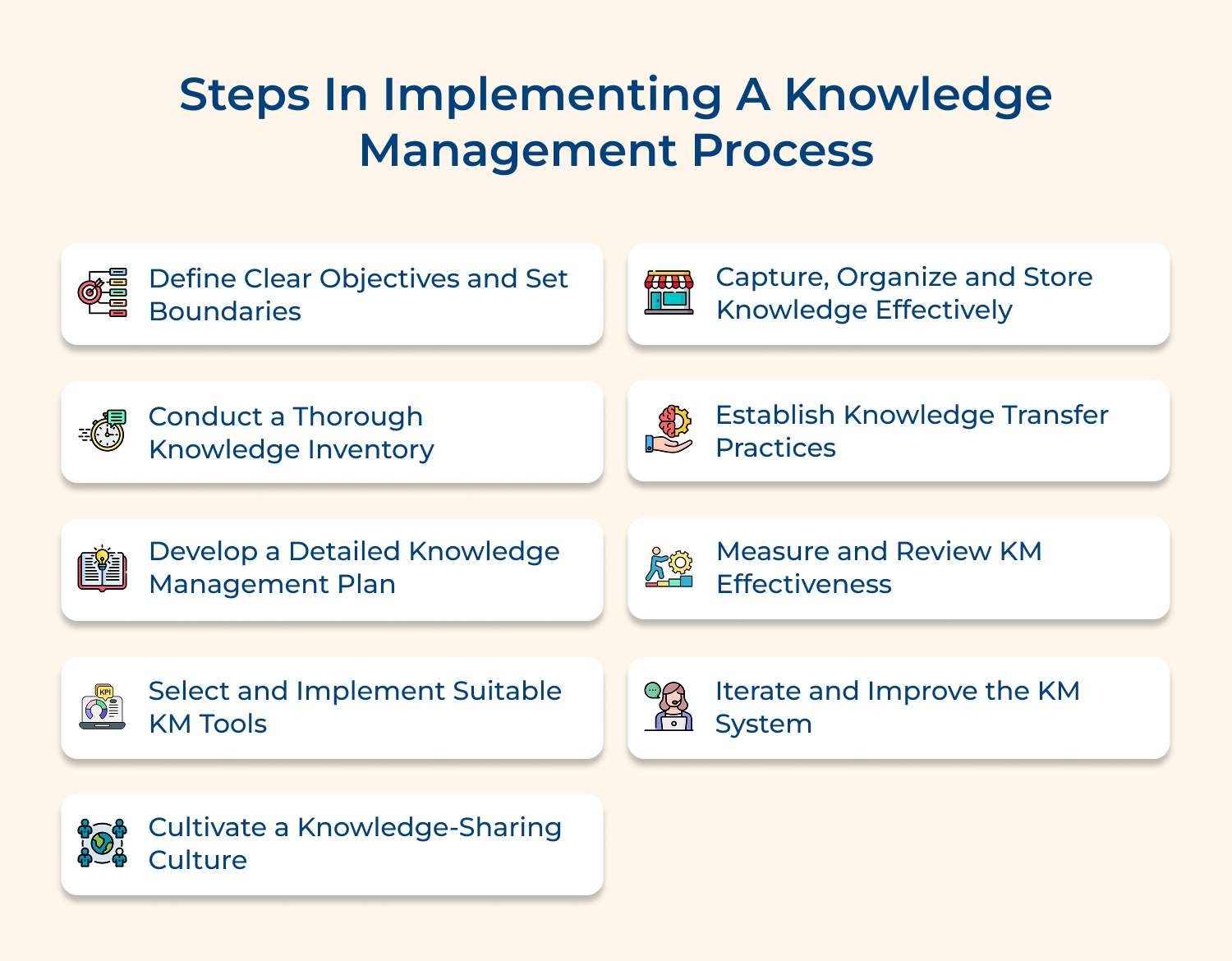
Defining objectives and scope involves setting goals for the knowledge management (KM) system. It identifies what knowledge will be captured and shared, ensuring a focused approach for implementation.
Clear objectives align the KM system with organizational priorities. They help avoid inefficiencies while ensuring resources are used effectively. Specific goals allow for measurable success.
Identify key areas for knowledge sharing, like decision-making or customer service. Determine the departments and tools that will help achieve these goals.
Pro tips:
A knowledge inventory is a review of all existing knowledge within the organization. It helps identify gaps, redundancies and areas for improvement.
A knowledge inventory ensures critical information isn’t lost. It helps organizations leverage existing resources efficiently. The process also highlights areas that need further development.
Document and categorize all valuable knowledge assets. Use the data to prioritize areas that need attention or development to fill knowledge gaps.
Tips:
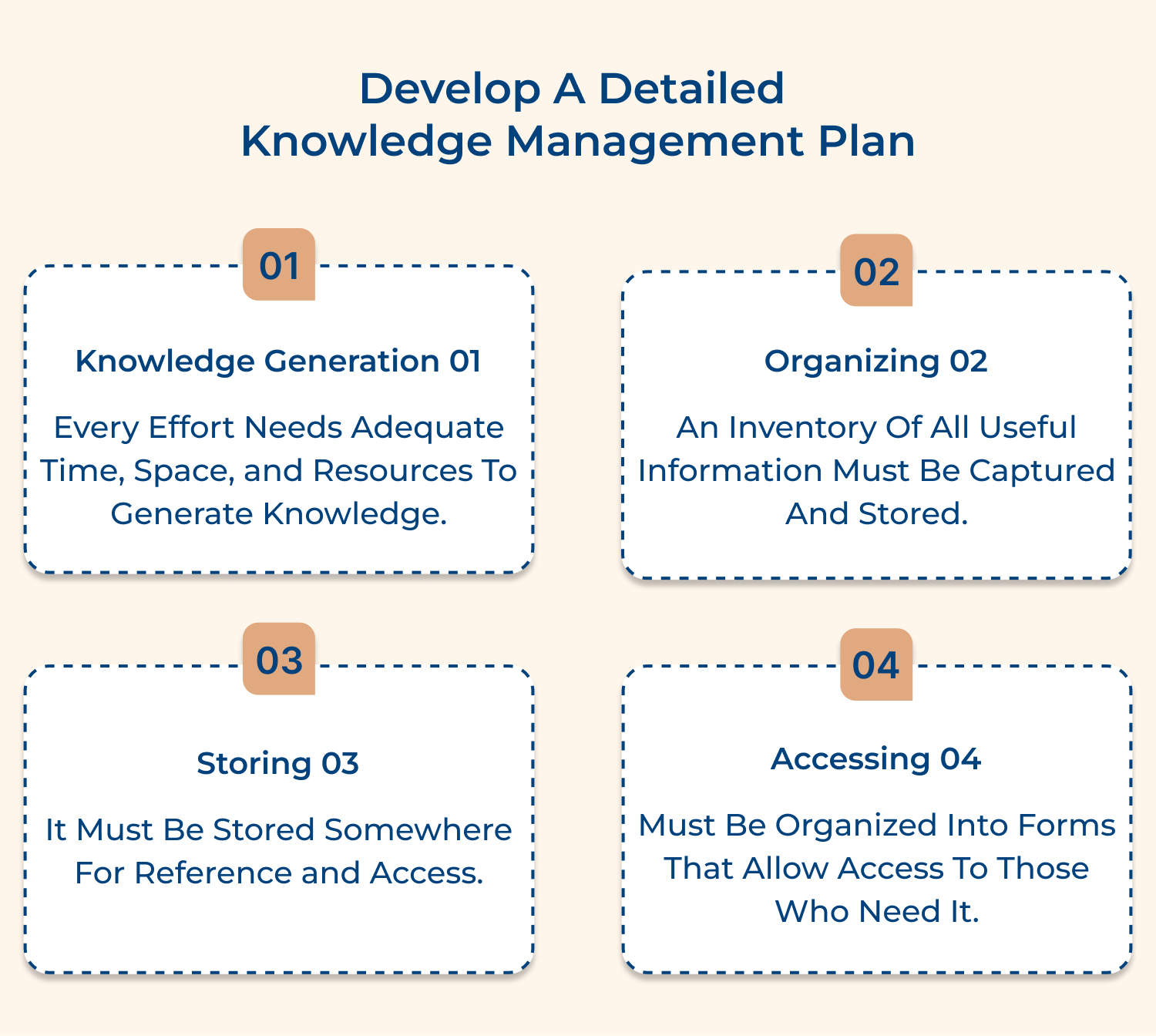
A knowledge management plan outlines how knowledge will be captured, stored and shared. It details the processes as well as policies that will guide the KM system.
A plan ensures a structured and consistent approach. It helps allocate resources effectively and provides clarity on responsibilities. This reduces confusion and optimizes knowledge sharing.
Create a plan that includes timelines, roles and tools for knowledge management. Set clear metrics for success and ensure all stakeholders are aligned.
Pro tips:
KM tools include software and systems that help capture, store, as well as share knowledge. These tools ensure knowledge is accessible and collaboration is seamless.
The right tools streamline the KM process. They make knowledge accessible quickly, improve collaboration and increase efficiency.
Choose tools that match organizational needs, like knowledge repositories or collaboration platforms. Ensure these tools integrate smoothly into existing workflows.
Pro tips:
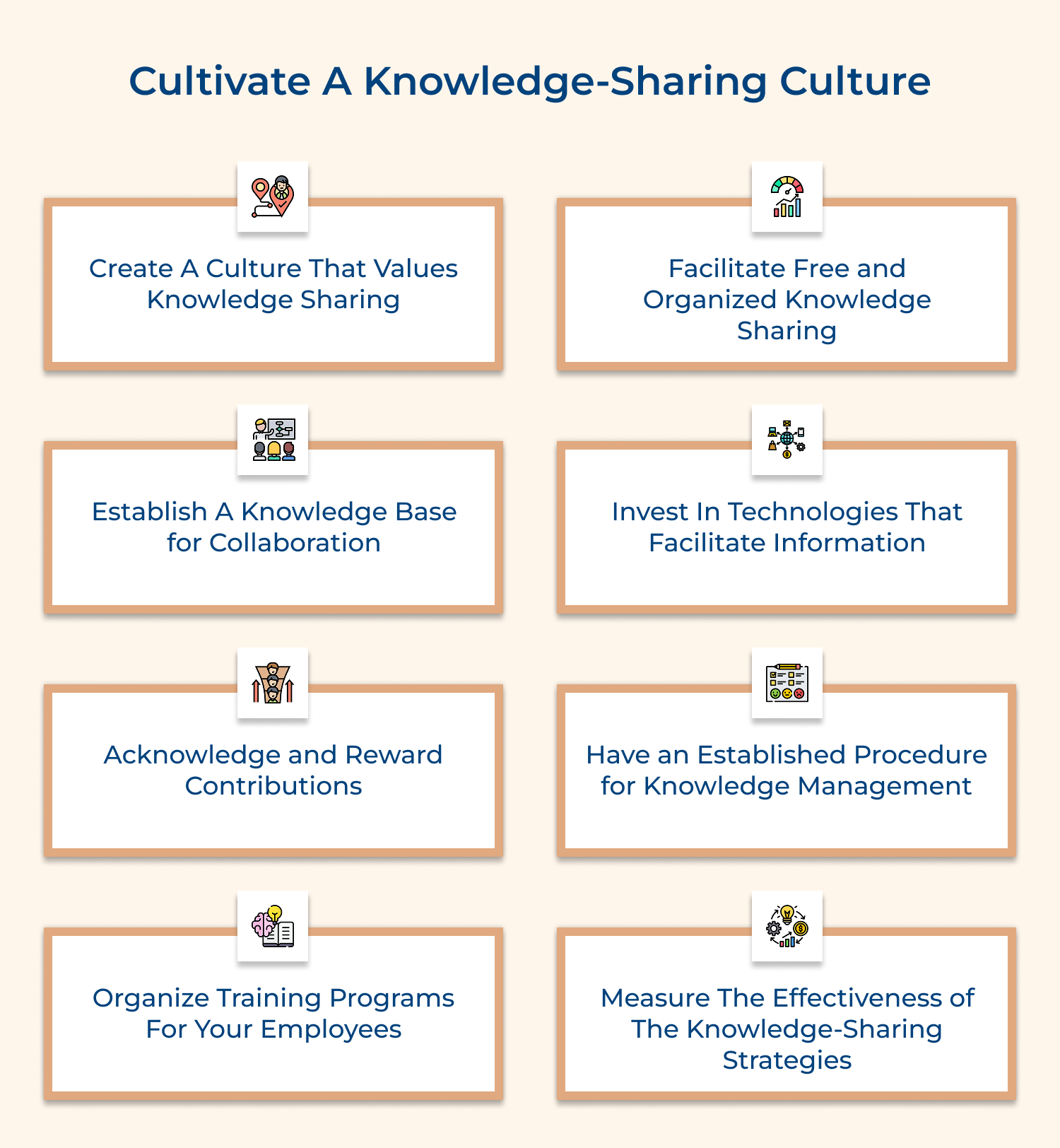
A knowledge-sharing culture encourages employees to openly exchange ideas, insights and experiences. Thus, creating a more collaborative as well as transparent workplace.
When people feel supported as well as rewarded for sharing, innovation grows, decisions improve and teams solve problems faster.
Use platforms like forums or intranets to make sharing easy and regularly recognize employees who contribute meaningful knowledge.
Tips:
Capturing knowledge involves documenting valuable insights and experiences. Organizing it ensures the information is categorized, while storing it securely makes it easily retrievable.
Capturing and organizing knowledge prevents loss while ensuring information is readily available. This supports business continuity and decision-making, especially during transitions.
Use systems to capture both explicit and tacit knowledge. Store it in structured, accessible repositories with clear categorization for easy retrieval.
Pro tips:
Knowledge transfer ensures essential knowledge is shared between employees or teams. It includes mentorship, training, or documentation to pass on valuable insights.
Knowledge transfer reduces the risk of knowledge loss when employees leave. It ensures continuity by sharing expertise and prevents disruptions in workflow or productivity.
Set up formal programs, such as mentoring or cross-training. Document key knowledge areas so that information can be shared across teams seamlessly.
Tips:
Measuring KM effectiveness involves tracking KPIs to assess how well the KM system is working. This includes metrics like knowledge usage, sharing frequency and impact on business results.
Regular measurement provides insights into whether the KM system is achieving its goals. It highlights areas that need improvement and ensures the system remains relevant.
Set KPIs for knowledge sharing, user engagement and business outcomes. Regularly review the data to make adjustments to improve the KM system.
Tips:
Iteration and improvement involve refining the KM system based on feedback as well as performance data. It ensures the system adapts to new challenges or changes within the organization.
Business needs and technologies change over time. Regular improvements keep the KM system relevant and effective, ensuring it continues to meet organizational goals.
Collect feedback from users and assess performance metrics. Use this data to refine tools, processes and strategies, ensuring the KM system remains efficient.
Pro tips:
Knowledge management isn’t always smooth—teams often face obstacles that slow down sharing and access. Here are common challenges and practical solutions:
1. Employee Resistance to Knowledge Sharing
Employees often resist sharing knowledge due to fear of losing job security, power, or competitive advantage within the organization.
Solution:
Organizations struggle with managing vast amounts of information while ensuring its quality, relevance and accuracy.
Solution:
Difficulty in selecting and implementing appropriate technology solutions that integrate well with existing systems as well as meet user needs.
Solution:
Critical knowledge walking out the door when experienced employees leave the organization.
Solution:
Global organizations face challenges in sharing knowledge across different cultures, languages and time zones.
Solution:
Difficulty in quantifying the value and return on investment of knowledge management initiatives.
Solution:
The Knowledge management (KM) process is crucial for ensuring long-term success in organizations. Effectively capturing, organizing and sharing knowledge helps create a competitive advantage. A well-structured KM system improves decision-making, fosters innovation and encourages collaboration.
Regular evaluation and refinement allow the KM process to adapt to changing market conditions as well as organizational needs. A robust KM process supports growth, resilience and continuous improvement, positioning organizations for sustained success in an evolving business environment.

Q: How do you develop a knowledge management process?
Start by assessing your organization’s current knowledge needs and gaps. Create a clear strategy aligned with business objectives. Develop infrastructure and processes for capturing, storing, while sharing knowledge. Implement training programs, establish governance frameworks and measure success through defined KPIs. Regular evaluation as well as refinement ensure continuous improvement.
Q: How do I create a knowledge management process?
Begin with stakeholder interviews to understand requirements. Select appropriate tools and platforms. Create standardized templates for knowledge capture. Establish roles and responsibilities. Implement quality control measures. Train users and gather feedback. Start with a pilot program before full rollout. Monitor adoption while adjusting as needed.
Q: Why do you need a Knowledge Management process flow?
A Knowledge Management process flow ensures systematic handling of organizational knowledge. It prevents knowledge loss, reduces duplication of efforts and maintains consistency in how information is captured or shared. The process flow helps track knowledge from creation to retirement, ensuring quality and accessibility throughout its lifecycle.
Q: What are the stages of the KM cycle?
The Knowledge Management cycle consists of six key stages: Knowledge Creation/Acquisition, Knowledge Storage/Organization, Knowledge Refinement/Processing, Knowledge Distribution/Sharing, Knowledge Application/Use and Knowledge Archival/Retirement. Each stage ensures knowledge flows effectively through the organization while maintaining its value and relevance.
Q: What are the 5 components of knowledge management?
An effective knowledge ecosystem relies on five components: people who create and use knowledge, processes that structure how it’s handled, technology that enables access, content itself, along with a clear strategy that guides and governs all knowledge initiatives.
 https://omni24.io/wp-content/uploads/2026/08/AI-Customer-Service-Agents.png
1256
2400
Webvision Solution
https://omni24.io/wp-content/uploads/2023/04/Omni-Logo-1.svg
Webvision Solution2026-09-21 04:48:512026-09-21 04:48:51How to Build an AI Customer Service Agents: 8 Key Steps
https://omni24.io/wp-content/uploads/2026/08/AI-Customer-Service-Agents.png
1256
2400
Webvision Solution
https://omni24.io/wp-content/uploads/2023/04/Omni-Logo-1.svg
Webvision Solution2026-09-21 04:48:512026-09-21 04:48:51How to Build an AI Customer Service Agents: 8 Key Steps https://omni24.io/wp-content/uploads/2026/08/Omnichannel-Conversational-AI.png
1256
2400
Tushar Joshi
https://omni24.io/wp-content/uploads/2023/04/Omni-Logo-1.svg
Tushar Joshi2026-09-16 03:51:072026-09-16 03:51:07How to Build Omnichannel Conversational AI Strategy
https://omni24.io/wp-content/uploads/2026/08/Omnichannel-Conversational-AI.png
1256
2400
Tushar Joshi
https://omni24.io/wp-content/uploads/2023/04/Omni-Logo-1.svg
Tushar Joshi2026-09-16 03:51:072026-09-16 03:51:07How to Build Omnichannel Conversational AI Strategy https://omni24.io/wp-content/uploads/2026/08/Customer-Service-Teams.png
1256
2400
Tushar Joshi
https://omni24.io/wp-content/uploads/2023/04/Omni-Logo-1.svg
Tushar Joshi2026-09-15 04:01:522026-09-15 04:02:16How to Build Customer Service Teams: 6 Key Steps
https://omni24.io/wp-content/uploads/2026/08/Customer-Service-Teams.png
1256
2400
Tushar Joshi
https://omni24.io/wp-content/uploads/2023/04/Omni-Logo-1.svg
Tushar Joshi2026-09-15 04:01:522026-09-15 04:02:16How to Build Customer Service Teams: 6 Key Steps
Whether it’s about acquire, engage or support – Omni24 covers all your customer engagement needs in one complete platform.

Copyright ©2026 Veemo All rights reserved.
CA, Los Angeles, Hall Ave, 19011