How to Build a Modern Customer Experience (CX): 7 Key Strategies
Learn how modern CX strategies boost satisfaction, simplify interactions and drive growth through personalization and tech.

Learn how modern CX strategies boost satisfaction, simplify interactions and drive growth through personalization and tech.
Customer expectations are constantly shifting, with studies showing 71% of consumers expect personalized interactions during every stage of their buying journey, yet businesses often find it hard to keep up. Many still deliver generic interactions when customers now crave personalized, effortless experiences—this gap not only leads to frustration but also weakens brand loyalty and trust, as evidenced by 86% of buyers willing to pay more for a great customer experience.
The key to turning things around lies in understanding your customers deeply while using data and technology to create experiences that feel truly tailored—leveraging customer data platforms can boost personalization effectiveness by up to 20%.
A modern customer experience isn’t just about service—it’s about building lasting relationships that drive satisfaction, engagement, and long-term business growth, with top performers seeing 1.5x revenue growth from strong CX strategies. This blog explores how to make that transformation happen.
Modern customer experience (CX) refers to the holistic perception a customer has of a brand through all interactions across their journey. It encompasses every touchpoint, from initial awareness to post-purchase support, across various channels including digital platforms, in-person encounters and customer service interactions.
A positive CX can differentiate a company from its competitors, increase customer lifetime value and encourage long-term relationships that withstand market fluctuations as well as economic challenges.
Key objectives:
Delivering an exceptional customer experience is vital for thriving businesses. Here are the compelling reasons it truly matters.
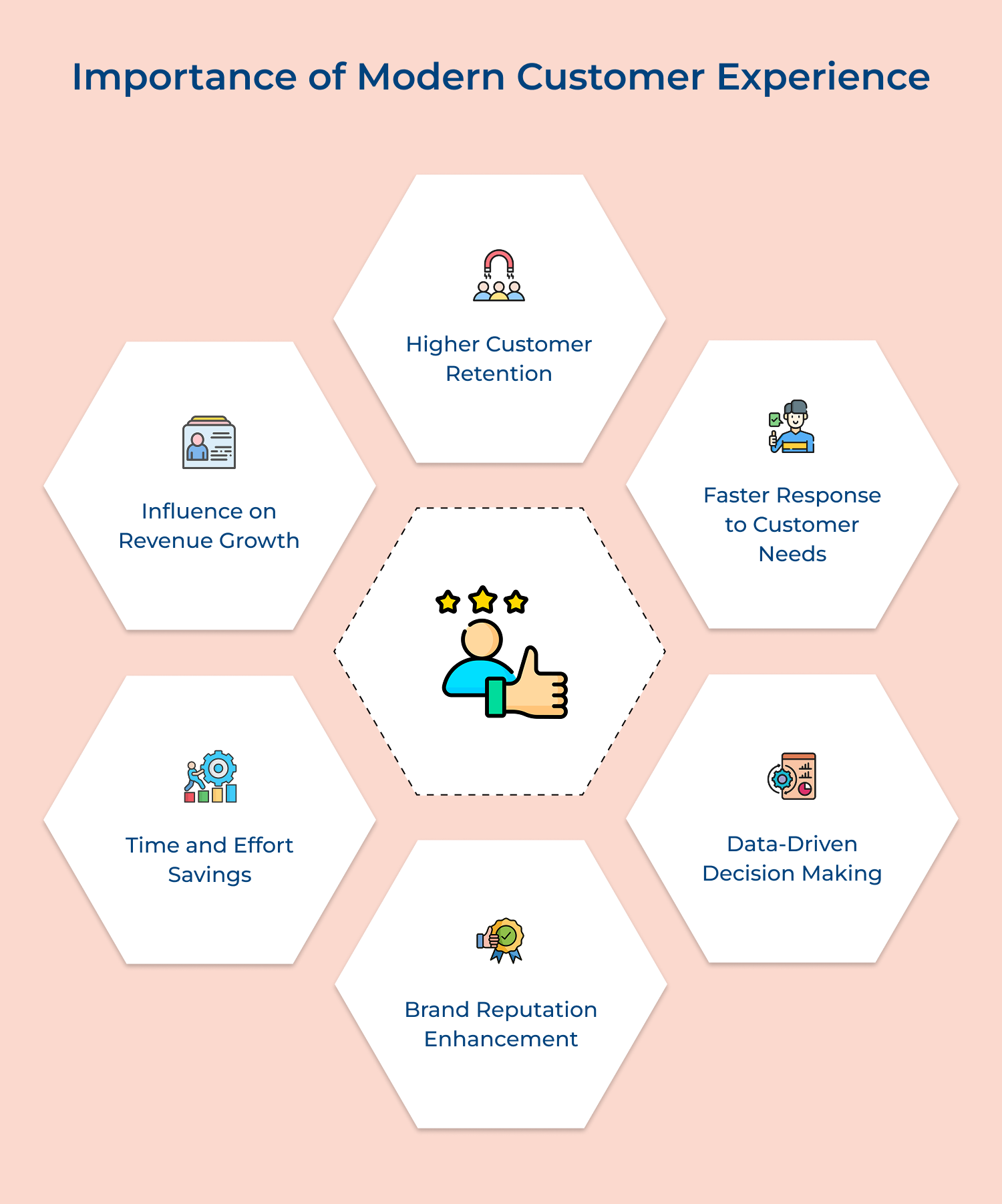
Higher Customer Retention
Strong customer experience efforts can dramatically improve retention. When businesses consistently meet or exceed expectations at every interaction, they build trust and loyalty. Customers who feel valued are more likely to stay, buy again and recommend your brand to others. That’s why customer experience goals should focus on creating meaningful connections that reduce churn and drive sustainable growth.
Faster Response to Customer Needs
Speed matters in the current market. A solid customer experience transformation framework helps businesses respond faster through automation and streamlined support. Quick, thoughtful responses show customers that their time and opinions are respected. Meeting needs proactively not only boosts satisfaction but also gives your brand an edge over slower competitors.
Data-Driven Decision Making
Customer experience efforts thrive on insights. By capturing and analyzing data across multiple touchpoints, businesses can better understand customer behaviors as well as preferences. These insights fuel smarter decisions—from improving products to refining marketing strategies. Aligning your customer experience goals with data ensures every action is targeted, effective and customer-centric.
Brand Reputation Enhancement
A great experience is the best marketing tool. Positive interactions across channels enhance satisfaction and inspire customers to share their stories. This advocacy strengthens your reputation and attracts new audiences. Embedding this mindset into your customer experience transformation framework helps build credibility and long-term brand equity.
Time and Effort Savings
Modern CX strategies streamline operations for both customers and teams. Automating repetitive tasks while simplifying journeys make interactions smoother and faster. These customer experience efforts free up time for employees to focus on innovation and problem-solving—while customers enjoy effortless, friction-free experiences.
Influence on Revenue Growth
Happy customers spend more and stay longer. Consistent, high-quality experiences increase lifetime value while lowering acquisition costs. When customer experience goals are tied to revenue metrics, businesses see clear financial returns from their CX investments. The result: stronger loyalty, higher profits and a resilient brand built for long-term success.
Enhancing customer experience requires thoughtful strategies tailored to evolving expectations. Here are effective approaches to enrich every interaction.
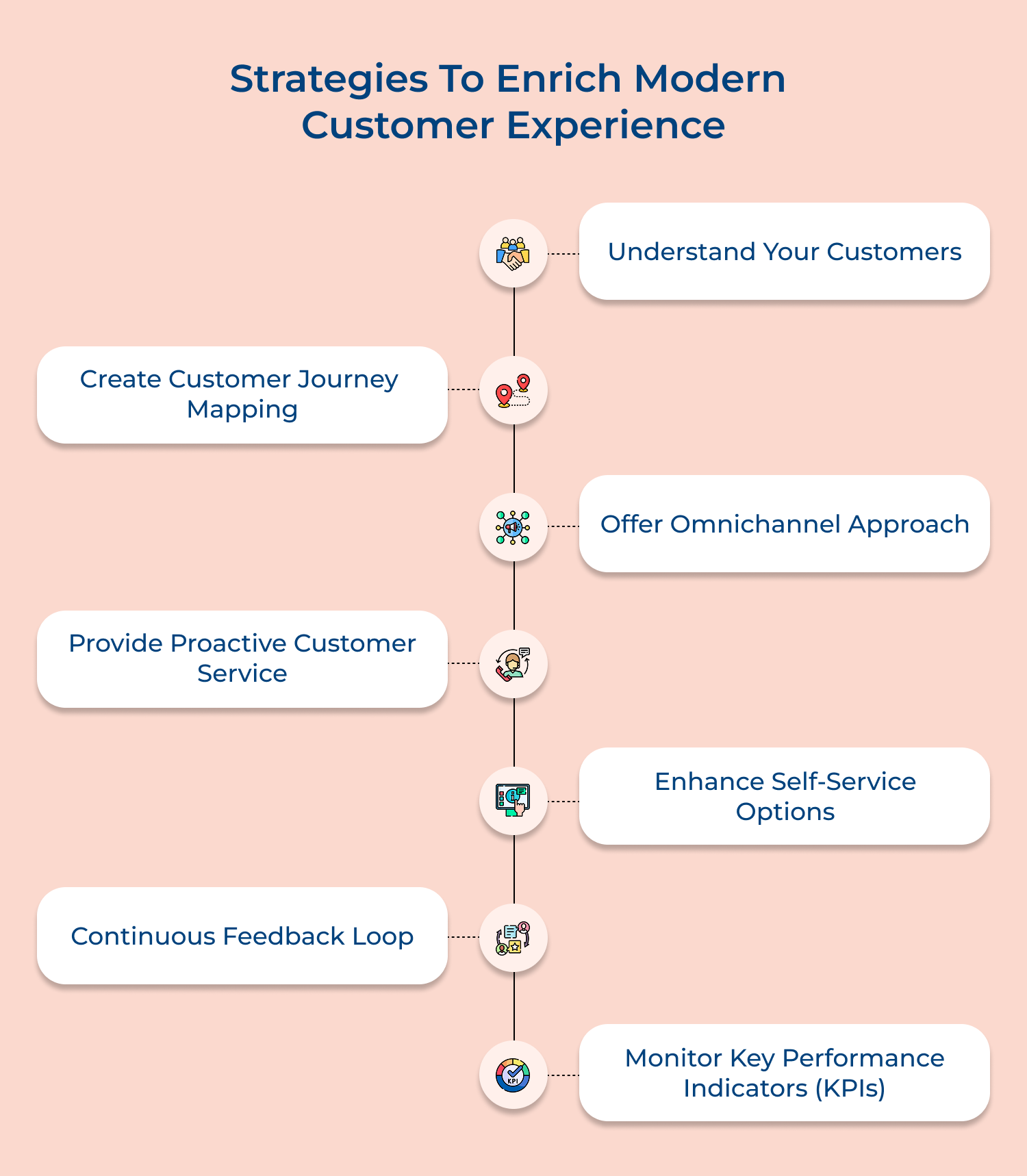
Deep customer understanding is fundamental to delivering exceptional experiences. Without it, businesses risk offering irrelevant products, services, or interactions, leading to customer dissatisfaction and churn. Knowing your customers’ needs, preferences and pain points enables tailored experiences that drive loyalty as well as growth.
Utilize various data sources such as surveys, customer interactions, purchase history and social media to build comprehensive customer profiles. Analyze this data to identify trends, preferences and behaviors. Use these insights to personalize offerings, improve products, while enhancing customer service strategies.
Actionable tips:
1. Implement regular customer surveys and focus groups to gather qualitative insights directly from your target audience.
2. Leverage AI-powered analytics tools to process large volumes of customer data and extract actionable insights automatically.
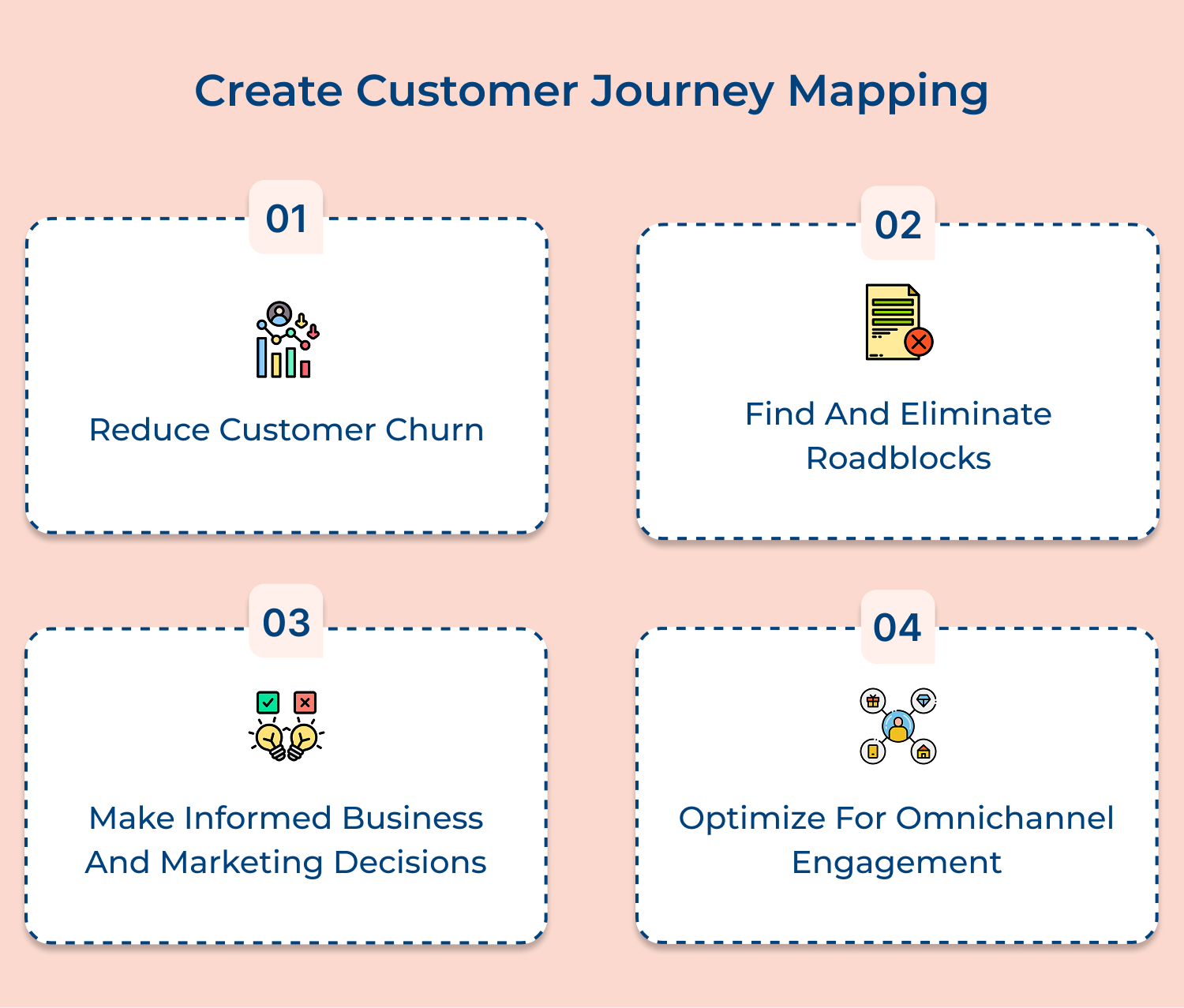
Customer journey mapping gives you a clear, visual story of how customers interact with your brand at every stage. It helps you spot pain points, improvement opportunities and any gaps that might affect satisfaction or loyalty. Without this big-picture view, it’s easy to overlook key moments that shape how customers feel about your business.
To make it work, build detailed journey maps for each customer segment or persona. Capture every touchpoint—online, offline and everything in between. Then, use these insights to simplify processes and deliver smoother, more connected experiences. Keep your maps updated as customer behaviors and expectations evolve.
Actionable tips:
1. Involve cross-functional teams in the journey mapping process to ensure all perspectives are considered and to encourage organization-wide customer-centricity.
2. Use data analytics and customer feedback to validate while refining your journey maps continuously.
Customers today want smooth, consistent experiences no matter how they connect – online, in-store or on mobile. An omnichannel approach makes that possible by unifying all customer interactions.
When data and history are shared across touchpoints, customers enjoy seamless transitions, like starting a purchase on one channel as well as finishing it on another. Integrating systems and technologies behind the scenes ensures every interaction feels connected, personalized, as well as effortless. Thus, building stronger relationships and lasting brand loyalty.
Actionable tips:
1. Invest in a robust Customer Relationship Management (CRM) system to centralize customer data and make it accessible across all channels.
2. Train staff across all departments to provide consistent service and messaging, regardless of the channel they’re operating in.
Proactive service anticipates customer needs and addresses issues before they become problems. This approach enhances customer satisfaction, reduces support costs and demonstrates that the company values its customers’ time as well as experience.
Utilize predictive analytics to identify potential issues or needs based on customer behavior and historical data. Reach out to customers with relevant information, updates or assistance before they need to contact support. Implement systems to monitor product usage or service status and proactively communicate with customers about maintenance, upgrades, or potential issues.
Actionable tips:
1. Set up automated alerts based on customer behavior triggers to prompt timely, personalized outreach from your service team.
2. Develop a knowledge base of common issues and their solutions, using this to create proactive communication strategies.
Today’s customers love solving problems on their own and self-service options make that easy. Offering tools like FAQs, knowledge bases and how-to guides creates a consistent customer experience while reducing support costs.
Adding AI-powered chatbots or virtual assistants helps deliver instant answers to common questions. Simple, intuitive interfaces for tasks like order tracking or account updates keep things effortless. It results in empowered customers, faster resolutions and a smoother, more consistent customer experience across every interaction.
Actionable tips:
1. Regularly analyze customer support data to identify common issues and queries, using this information to update and expand your self-service resources.
2. Implement a feedback mechanism within self-service tools to continuously improve their effectiveness based on user input.
Customer preferences and expectations are constantly evolving. A continuous feedback loop ensures that businesses stay aligned with customer needs, enabling them to adapt quickly while maintaining high levels of customer satisfaction.
Implement various feedback collection methods such as surveys, social media monitoring and direct customer outreach. Analyze feedback data to identify trends and areas for improvement. Create processes to act on feedback promptly as well as communicate changes back to customers.
Actionable tips:
1. Implement real-time feedback collection at key touchpoints in the customer journey to capture immediate impressions and experiences.
2. Create a cross-functional team responsible for reviewing feedback and implementing improvements across the organization.
KPIs provide quantifiable measures of customer experience performance. They help businesses track progress, identify areas for improvement and make data-driven decisions to enhance customer satisfaction as well as loyalty.
Define relevant KPIs such as Customer Satisfaction Score (CSAT), Net Promoter Score (NPS), Customer Effort Score (CES) and customer retention rate. Regularly track and analyze these metrics to gauge the effectiveness of customer experience initiatives. Use KPI data to set goals, measure success and guide strategy adjustments.
Actionable tips:
1. Develop a dashboard that provides real-time visibility into key customer satisfaction metrics across all departments.
2. Set specific, measurable goals for each KPI and establish a regular review process to assess progress while adjusting strategies as needed.
AI and automation are transforming customer engagement, delivering personalized support as well as boosting efficiency. Here are the exciting benefits they bring to the table.
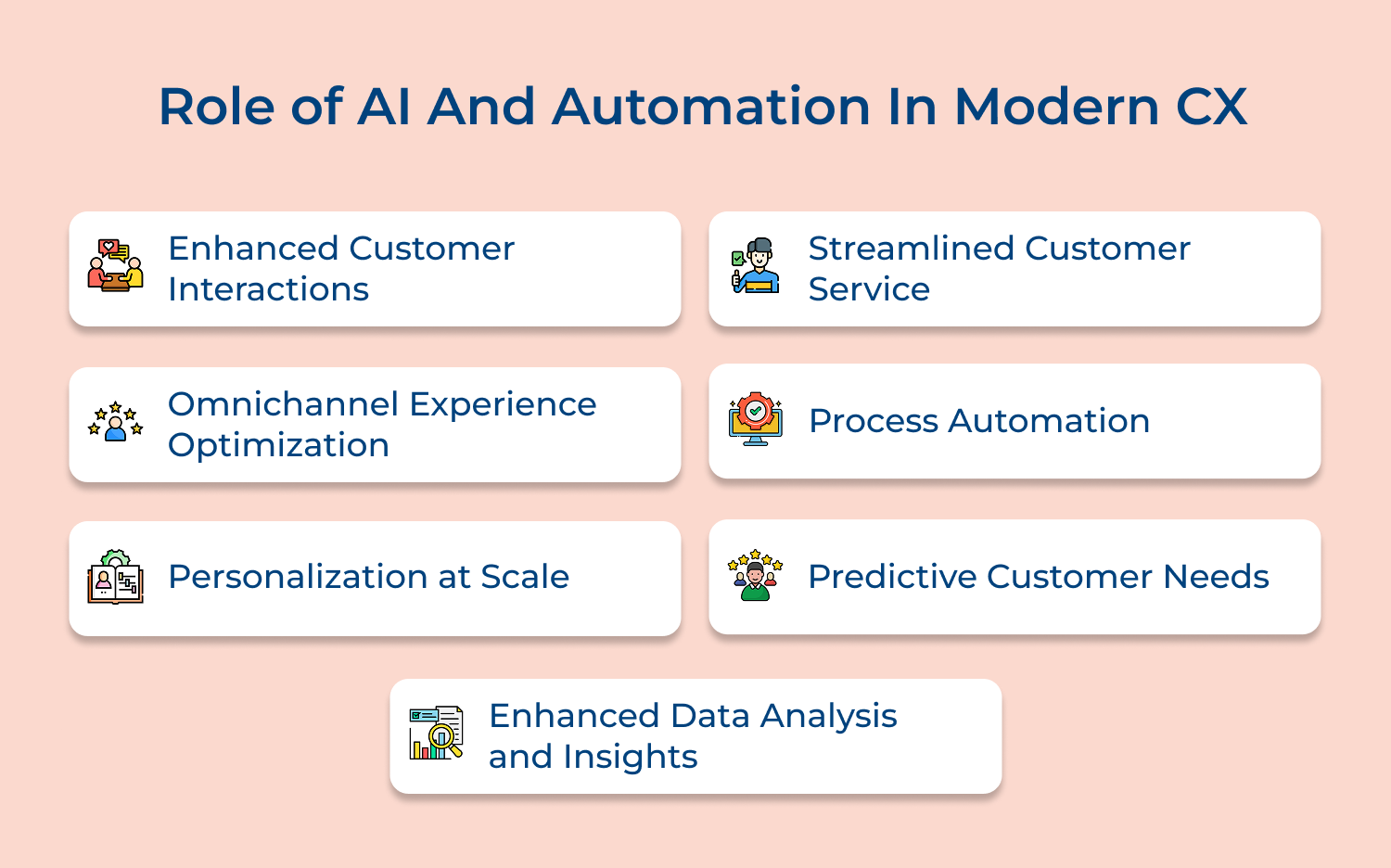
Customers now expect faster, more accurate and personalized support. AI makes that possible with round-the-clock assistance as well as consistent quality. AI chatbots and virtual assistants can handle common questions instantly, while Natural Language Processing ensures human-like responses. Complex queries are seamlessly routed to human agents with all the context they need. Hence, reducing wait times and improving satisfaction.
Customers switch between channels effortlessly and expect the same from brands. AI connects every touchpoint, ensuring a consistent experience everywhere. By tracking and analyzing customer interactions, AI identifies gaps, optimizes performance, as well as predicts each customer’s preferred channel. The result is smooth, connected journeys across all platforms.
Delivering personalized experiences to every customer is easier with AI. It analyzes purchase history, browsing patterns and preferences to tailor recommendations, offers as well as content. This level of personalization boosts engagement, conversion and loyalty – all without increasing manual effort.
AI simplifies customer service by automating routine inquiries through chatbots and voice assistants. It supports agents with real-time insights, helping resolve complex issues faster. Intelligent routing also ensures customers connect with the right expert, improving response times and satisfaction.
AI and RPA eliminate repetitive, error-prone tasks in areas like order processing, returns as well as feedback collection. Automation speeds up service delivery, reduces costs and frees up teams to focus on strategic, value-driven work that enhances the overall experience.
AI-driven predictive analytics helps businesses stay one step ahead. By analyzing patterns and behavior, AI can anticipate customer needs, recommend relevant products or resolve issues before they escalate. Hence, creating proactive and loyalty-building experiences.
AI turns complex customer data into actionable insights. It processes information from multiple sources to identify trends, segment audiences and predict behavior. These insights empower teams to make smarter, data-driven decisions that continually improve the customer experience.
Navigating modern customer experience comes with obstacles that can hinder success. Here are the common customer experience challenges businesses face today with solutions to consider.
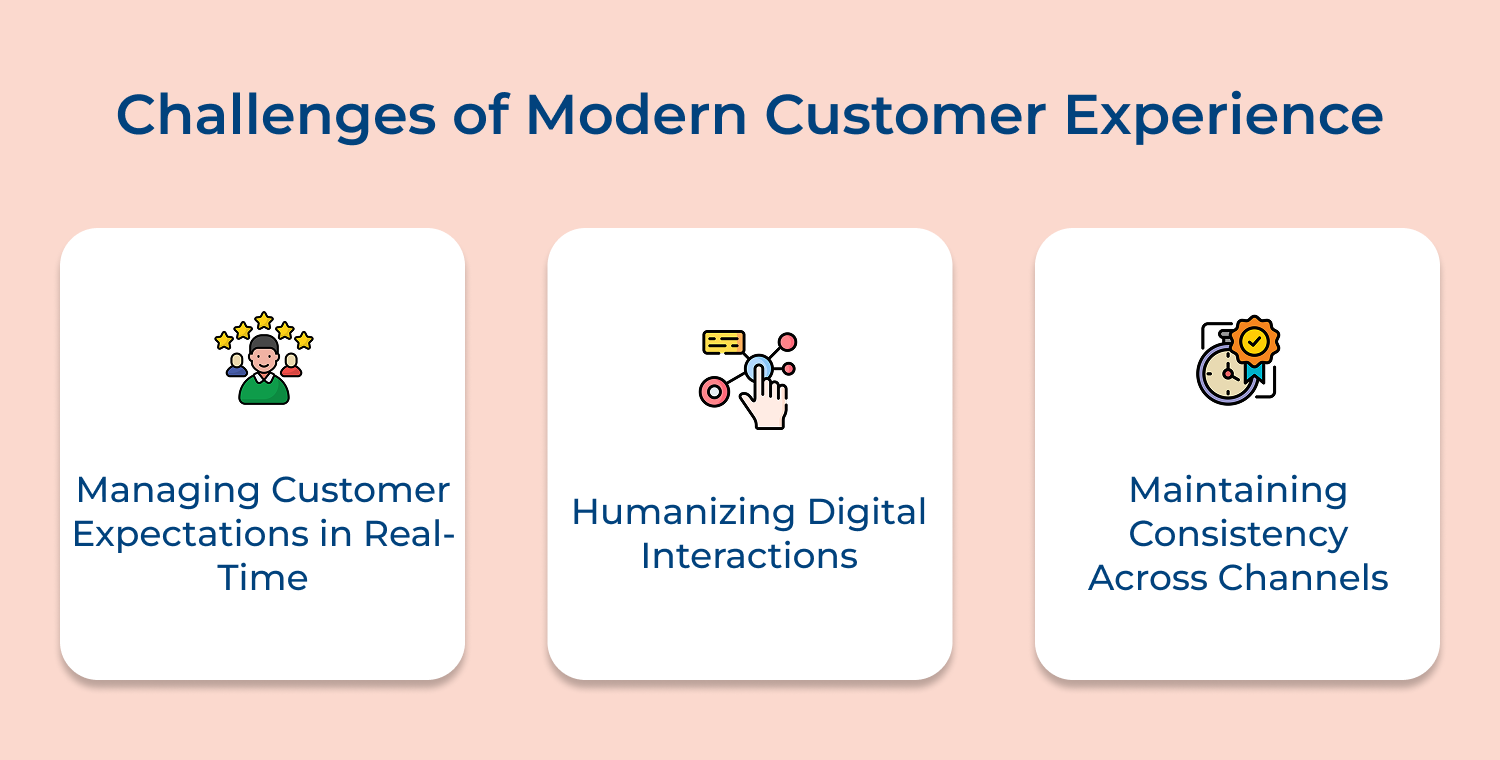
Managing Customer Expectations in Real-Time
Customers expect immediate responses and solutions. Managing these high expectations while maintaining quality service can be overwhelming.
Implement AI-powered chatbots and virtual assistants to provide instant responses 24/7. Use predictive analytics to anticipate customer needs and proactively address issues. Develop a robust knowledge base for quick problem resolution.
Train staff in efficient communication techniques and empower them to make decisions. Set realistic expectations with customers about response times and keep them informed of progress. Utilize automated updates and notifications to keep customers in the loop without increasing workload on staff.
Humanizing Digital Interactions
As businesses increasingly rely on digital channels, maintaining a human touch in customer interactions becomes more difficult, potentially leading to a perceived lack of empathy and personal connection.
Use sentiment analysis to gauge customer emotions in digital interactions and respond appropriately. Train AI systems to use more natural, conversational language. Implement video chat options for more personal interactions when needed.
Use personalization techniques to make digital communications feel more human. Ensure that handoffs from automated systems to human agents are smooth and context-aware. Encourage employees to inject personality into digital interactions while maintaining professionalism.
Maintaining Consistency Across Channels
The proliferation of touchpoints ensure a consistent and seamless experience across all channels can be challenging.
Develop a comprehensive omnichannel strategy that aligns all customer-facing channels. Implement a centralized content management system to ensure consistent messaging across platforms.
Use customer journey mapping to identify and eliminate friction points between channels. Invest in technologies that enable real-time data synchronization across touchpoints. Train employees across all departments to deliver consistent service and messaging. Regularly audit your channels to ensure brand consistency and user experience alignment.
Modern customer experience is crucial for businesses seeking to excel in today’s competitive environment. Emphasizing personalization, utilizing technology and implementing an omnichannel approach can significantly boost customer satisfaction as well as loyalty.
Gaining insights from customer feedback and analytics empowers companies to adapt while innovating continually. Investing in employee training cultivates a culture of outstanding service, enhancing the overall experience.
As customer expectations continue to rise, adopting these strategies not only strengthens relationships but also drives long-term profitability. Ultimately, prioritizing modern customer experience is key to achieving sustained business success.

Why do brands need a modern customer experience strategy?
Brands need a modern customer experience strategy to stay competitive in today’s rapidly evolving market. It helps them meet rising customer expectations, differentiate themselves from competitors and build long-lasting customer relationships. A well-crafted CX strategy can increase customer satisfaction, loyalty and lifetime value. Hence, driving business growth and profitability. It also enables brands to adapt quickly to changing customer needs and technological advancements.
What defines a modern customer experience in today’s digital landscape?
A modern customer experience is characterized by seamless, personalized interactions across multiple channels. It’s defined by speed, convenience and consistency, regardless of how customers choose to engage with the brand. Modern CX leverages data and technology to anticipate customer needs, provide proactive support, while delivering tailored experiences. It emphasizes transparency, accessibility and empowerment. Therefore, giving customers control over their journey as well as easy access to self-service options.
How does technology influence the modern customer experience?
Technology profoundly influences modern customer experience by enabling personalization, automation and real-time interactions. AI and machine learning power predictive analytics as well as chatbots, enhancing service efficiency. Data analytics tools provide deep customer insights for tailored experiences. Mobile technologies and IoT devices create new touchpoints. Cloud computing enables seamless data integration across channels. AR/VR technologies offer immersive experiences. Overall, technology empowers brands to deliver more responsive, efficient and personalized customer experiences at scale.
How can businesses deliver a personalized modern customer experience?
Businesses can deliver personalized modern customer experiences by leveraging data and technology. Use AI and machine learning to predict customer needs. Implement personalization engines to customize content, product recommendations, offers, etc. Utilize CRM systems for a unified customer view across touchpoints. Train employees to use customer insights effectively. Implement preference centers for customers to control their experience.
What role does omnichannel integration play in the modern customer experience?
Omnichannel integration plays a crucial role in modern customer experience by providing a seamless, consistent journey across all touchpoints. It ensures that customers can start an interaction on one channel and continue it on another without losing context. Omnichannel integration enables real-time data synchronization, allowing for up-to-date customer information across all platforms. It facilitates a unified brand voice and consistent service quality, regardless of the channel.
 https://omni24.io/wp-content/uploads/2026/09/Social-commerce-scaled.png
1340
2560
Webvision Solution
https://omni24.io/wp-content/uploads/2023/04/Omni-Logo-1.svg
Webvision Solution2026-10-23 12:18:272026-10-23 12:18:27What is Social Commerce and Why Does It Matter?
https://omni24.io/wp-content/uploads/2026/09/Social-commerce-scaled.png
1340
2560
Webvision Solution
https://omni24.io/wp-content/uploads/2023/04/Omni-Logo-1.svg
Webvision Solution2026-10-23 12:18:272026-10-23 12:18:27What is Social Commerce and Why Does It Matter? https://omni24.io/wp-content/uploads/2026/08/AI-Customer-Service-Agents.png
1256
2400
Webvision Solution
https://omni24.io/wp-content/uploads/2023/04/Omni-Logo-1.svg
Webvision Solution2026-09-21 04:48:512026-09-21 04:48:51How to Build an AI Customer Service Agents: 8 Key Steps
https://omni24.io/wp-content/uploads/2026/08/AI-Customer-Service-Agents.png
1256
2400
Webvision Solution
https://omni24.io/wp-content/uploads/2023/04/Omni-Logo-1.svg
Webvision Solution2026-09-21 04:48:512026-09-21 04:48:51How to Build an AI Customer Service Agents: 8 Key Steps https://omni24.io/wp-content/uploads/2026/08/Omnichannel-Conversational-AI.png
1256
2400
Tushar Joshi
https://omni24.io/wp-content/uploads/2023/04/Omni-Logo-1.svg
Tushar Joshi2026-09-16 03:51:072026-09-16 03:51:07How to Build Omnichannel Conversational AI Strategy
https://omni24.io/wp-content/uploads/2026/08/Omnichannel-Conversational-AI.png
1256
2400
Tushar Joshi
https://omni24.io/wp-content/uploads/2023/04/Omni-Logo-1.svg
Tushar Joshi2026-09-16 03:51:072026-09-16 03:51:07How to Build Omnichannel Conversational AI Strategy
Whether it’s about acquire, engage or support – Omni24 covers all your customer engagement needs in one complete platform.

Copyright ©2026 Veemo All rights reserved.
CA, Los Angeles, Hall Ave, 19011