What is Customer Conversations & How to Do it Effectively?
Customer conversations reveal real-time needs, expectations and experiences, helping businesses build stronger relationships and more meaningful interactions.

Customer conversations reveal real-time needs, expectations and experiences, helping businesses build stronger relationships and more meaningful interactions.
Engaging customers in meaningful conversations can be a challenge for businesses. Generic interactions often fail to build lasting relationships or drive customer loyalty.
Without personalized communication, customers feel disconnected and may turn to competitors, leading to missed opportunities & declining sales. 90% of leading CX organizations expect AI/automation to handle interactions without humans and conversational efficiency.
Customer conversations are a powerful tool to build strong relationships and enhance satisfaction. In this blog, we will examine how effective communication strategies can enhance customer engagement, increase retention and ultimately drive business growth.
A customer conversation is any interaction between a company representative and a customer or potential customer. These interactions can take place across multiple channels including face-to-face meetings, phone calls, emails, live chat, social media or through support tickets. Customer conversations form the backbone of the customer-business relationship.
Customer conversations are vital to business success as they provide direct insight into customer needs, preferences and pain points. When handled effectively, these interactions build trust, strengthen relationships and create positive brand perceptions. They offer real-time feedback that can drive product improvements and service innovations.
Key objectives:
Customer conversations reveal unmet needs, validate assumptions, humanize your brand and drive retention plus revenue growth.
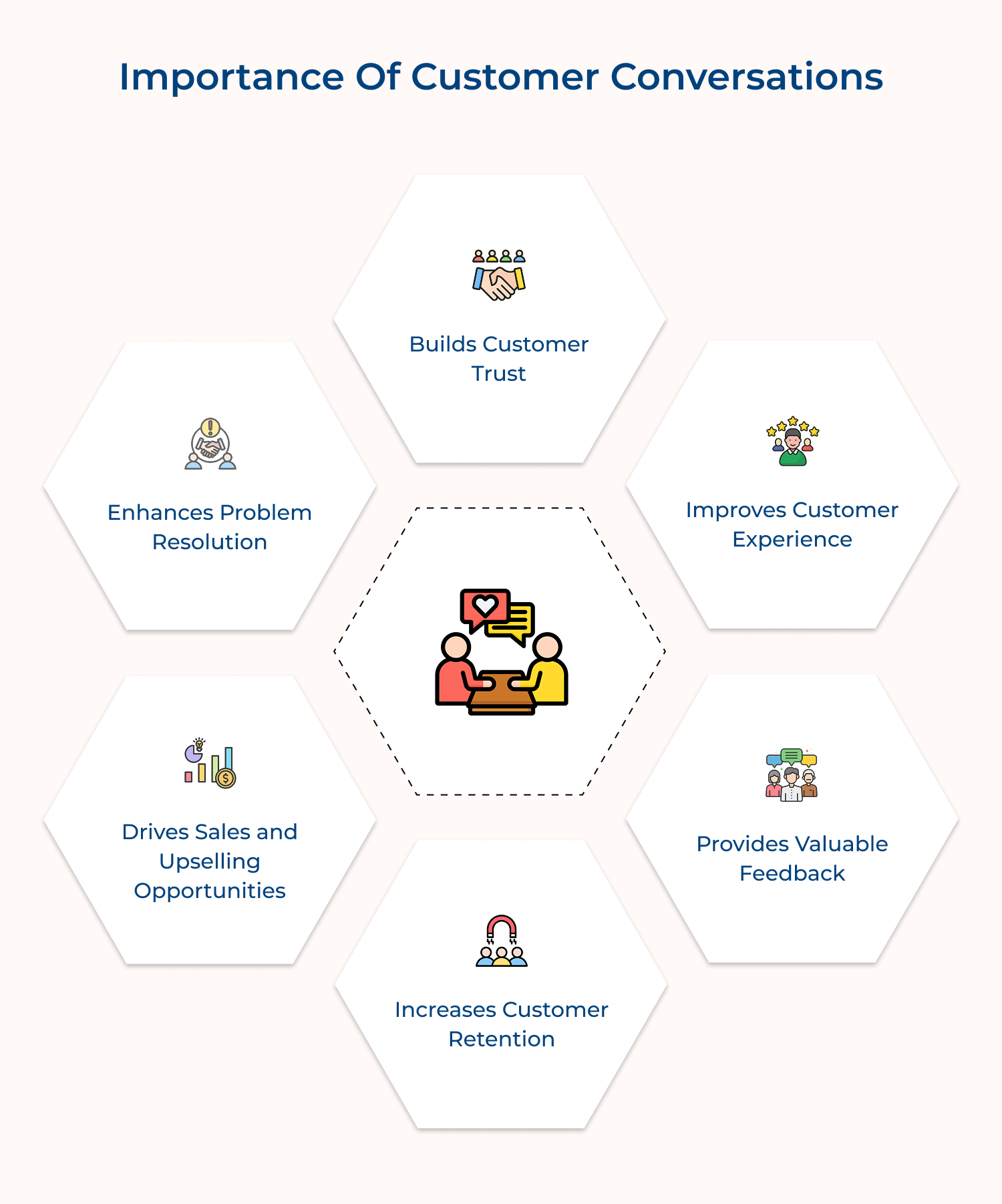
1. Builds Customer Trust
Customer conversations help build trust by creating a personal connection. When customers feel heard and understood, they are more likely to remain loyal to your brand, resulting in long-term relationships and repeat business.
2. Improves Customer Experience
Meaningful conversations allow businesses to tailor their offerings to meet individual needs. This personalized approach enhances the customer experience and increases satisfaction, making customers more likely to recommend your brand to others.
3. Provides Valuable Feedback
Customer conversations serve as a valuable source of direct feedback. By engaging in two-way dialogues, businesses can identify pain points, gather insights, make improvements to products, services and customer support strategies.
4. Increases Customer Retention
Proactively engaging in regular conversations with customers helps build loyalty and reduce churn. By staying connected, understanding their needs and offering solutions, businesses can retain customers for longer periods, ensuring consistent revenue growth.
5. Drives Sales and Upselling Opportunities
Effective conversations create opportunities to guide customers toward additional products or services that enhance their experience. By understanding their preferences and needs, businesses can upsell or cross-sell naturally without being intrusive.
6. Enhances Problem Resolution
When customers face issues, a well-handled conversation can turn a negative experience into a positive one. Addressing concerns in real-time builds goodwill, resolves frustration and strengthens trust in the brand over time.
Customer conversations span acquisition, onboarding, support, feedback, retention and reactivation across channels like chat, email, phone and social.
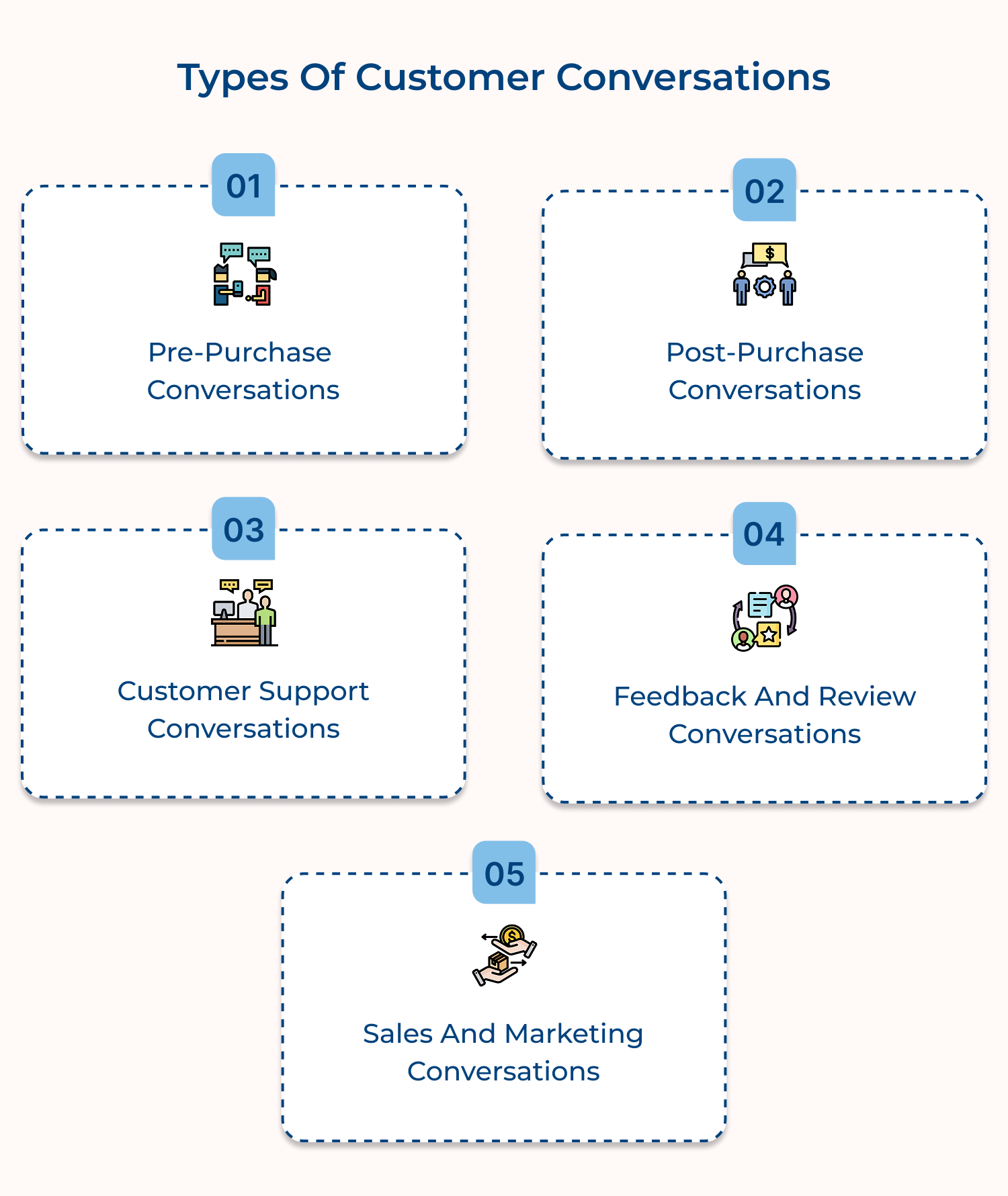
1. Pre-Purchase Conversations
These occur before a customer decides to buy a product or service. Customers might inquire about product features, availability, shipping costs or return policies. Addressing these concerns clearly and promptly can build trust, provide the necessary information for decision-making, guide the customer toward a purchase.
2. Post-Purchase Conversations
Post-purchase conversations focus on ensuring that customers are satisfied after completing their purchase. These interactions often include order confirmations, shipping notifications, delivery updates, or assistance with returns. It’s an essential stage in the customer journey, as it helps businesses maintain engagement, address potential concerns and enhance the customer experience.
3. Customer Support Conversations
Customer support conversations arise when a customer faces issues with their purchase or service experience, such as receiving a damaged product, incorrect orders or experiencing technical difficulties. These interactions are vital in demonstrating the business’s commitment to customer satisfaction. Responding promptly, addressing concerns empathetically and providing timely solutions.
4. Feedback and Review Conversations
Customers often share their experiences through reviews or surveys, providing valuable feedback about products or services. Feedback and review conversations are essential for identifying strengths, weaknesses and potential improvements in the business. Acknowledging and acting upon customer feedback improves product quality, user experience, service offerings.
5. Sales and Marketing Conversations
Sales & marketing conversations aim to attract, engage and persuade potential customers. These interactions happen through live chats, email marketing campaigns, or on social media, where businesses share product information, promotional discounts, or new offers. These conversations are designed to push customers closer to making a purchase by showcasing the benefits of the product or service.
Master customer conversations with proven strategies that build trust, boost satisfaction and drive lasting customer relationships.
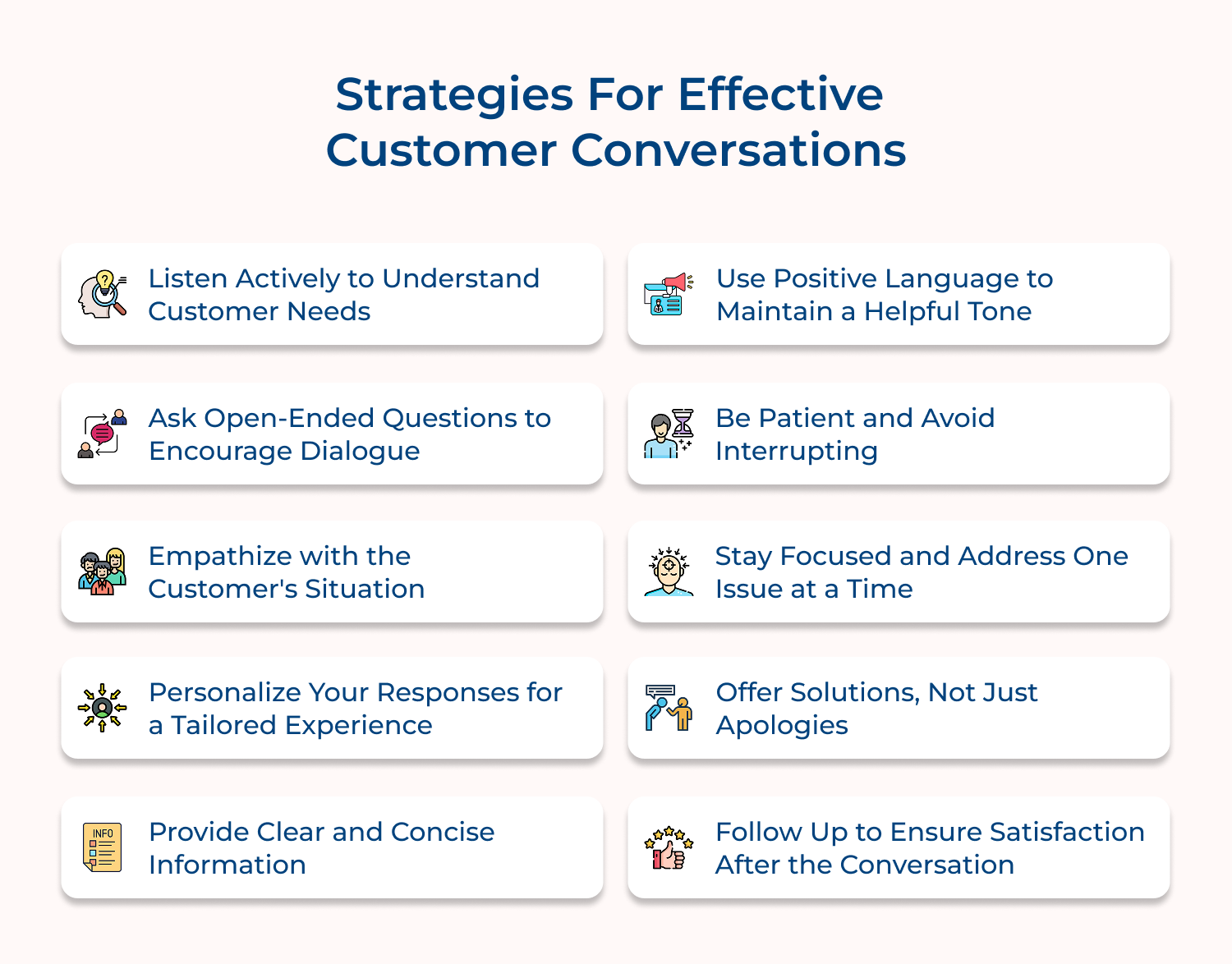
Active listening means giving the customer your full attention. You focus on understanding their concerns and respond thoughtfully without interrupting. It builds trust and prevents misunderstandings. The customers feel heard and respected, leading to stronger relationships.
Make eye contact and avoid distractions. Reflect on what the customer says to confirm your understanding and guide the conversation in the right direction.
Actionable Tips:
Open-ended questions invite the customer to share more details. These questions cannot be answered with a simple “yes” or “no,” which helps promote deeper conversations. These questions uncover valuable insights into the customer’s needs, expectations and frustrations.
Ask questions like, “What would be the ideal solution for you?” or “How has this affected your experience?” These questions encourage customers to share more about their situation.
Actionable Tips:
Empathy is the ability to understand and share the customer’s feelings. It involves acknowledging their frustrations and validating their emotions. It helps build an emotional connection with the customer. It reduces frustration and increases trust, making customers feel heard, valued.
Acknowledge the customer’s concerns by saying, “I can understand why that would be frustrating.” Offer support and express your commitment to resolving the issue.
Actionable Tips:
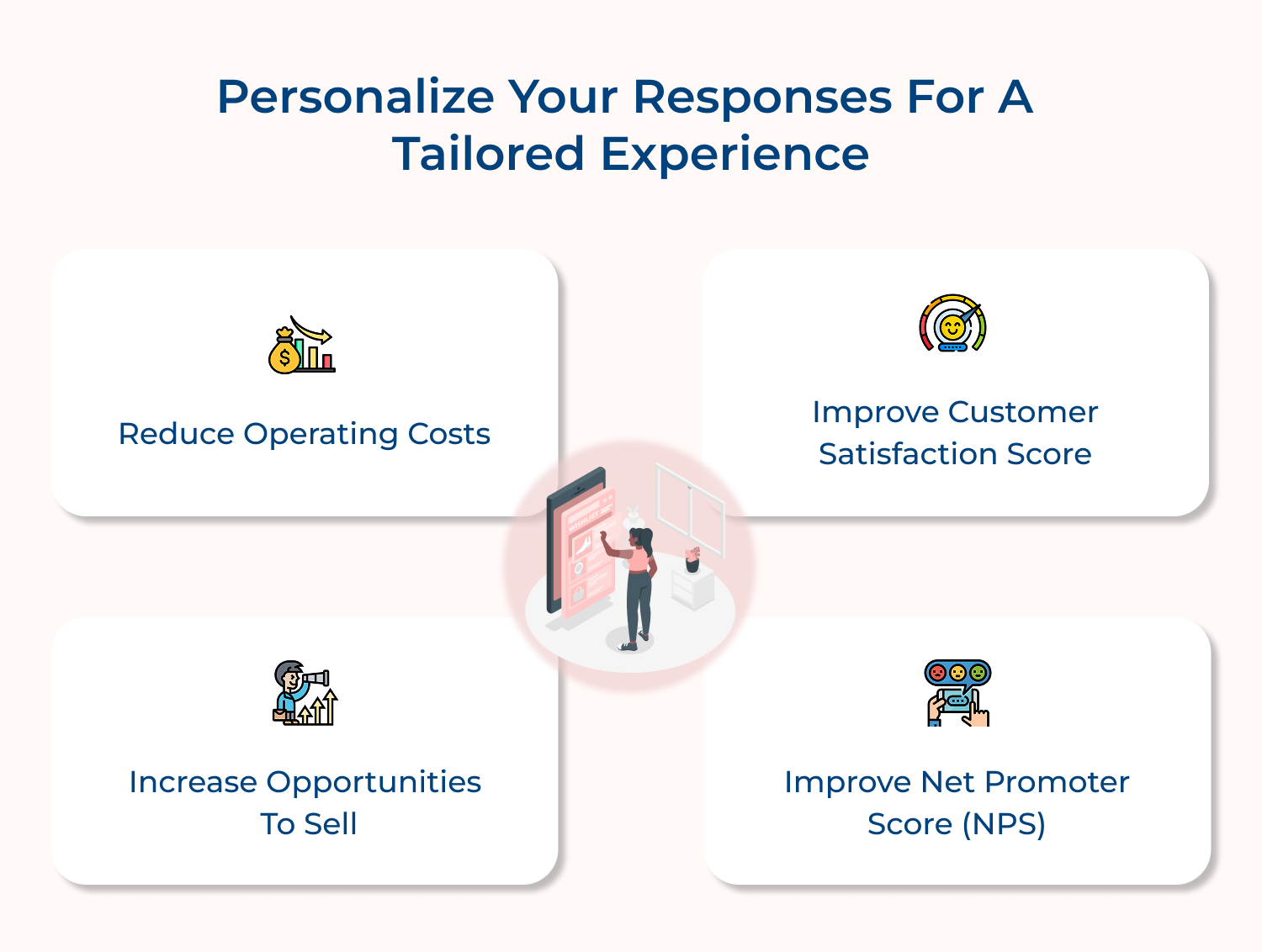
Personalization means adapting your responses to the customer’s unique situation. This approach takes into account their preferences and history with your brand. Customers appreciate personalized attention.
Refer to the customer by name and acknowledge any past interactions or purchases. Tailor your solution based on what you know about the customer’s preferences.
Actionable Tips:
Clear communication means providing information that is easy to understand and straight to the point. Avoid unnecessary details that could confuse the customer. Customers value clarity. When information is clear and concise, it saves time, helps customers make decisions quickly, leading to higher satisfaction.
Focus on key points and explain them simply. If the information is complex, break it down into manageable parts and avoid jargon.
Actionable Tips:
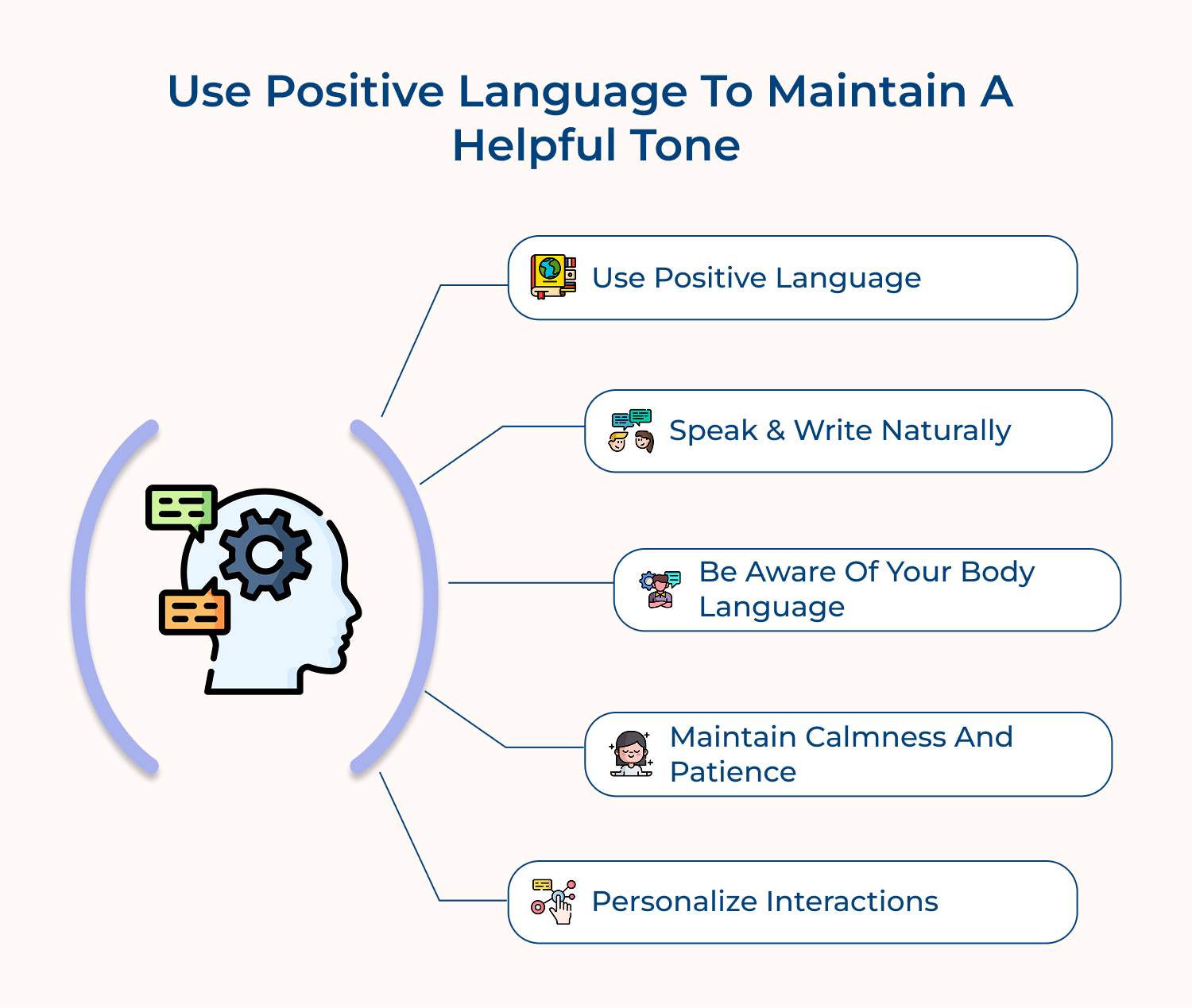
Positive language focuses on solutions rather than problems. It encourages a helpful, optimistic tone, even when dealing with challenges. It creates a more collaborative environment and reduces the chance of customer frustration.
Instead of saying, “I can’t help you with that,” say, “Here’s what I can do.” This keeps the conversation solution-focused and encourages a positive atmosphere.
Actionable Tips:
Patience means giving the customer time to explain their concerns without rushing or interrupting them. Interrupting can make customers feel unheard or disrespected. Being patient shows that you value their perspective and are dedicated to fully understanding their needs.
Allow the customer to finish their thoughts before responding. Wait until they’ve fully expressed themselves before you offer a solution.
Actionable Tips:
Staying focused means addressing one issue at a time instead of trying to resolve multiple concerns simultaneously. Trying to solve too many problems at once can confuse the customer and dilute the effectiveness of your solutions. Focusing on one issue ensures clarity and better results.
Prioritize the customer’s most urgent issue first and resolve it before moving to the next one. Address each concern separately for a structured and effective conversation.
Actionable Tips:
Offering solutions means taking actionable steps to resolve the customer’s issue, rather than simply apologizing for the inconvenience. Customers expect resolution, not just apologies. Offering concrete solutions demonstrates responsibility and a commitment to solving the problem, which boosts customer trust.
Rather than just saying, “I’m sorry for the inconvenience,” propose clear actions that will fix the problem. Let the customer know what steps you’ll take to resolve the issue.
Actionable Tips:
Following up involves reaching out to the customer after a solution has been implemented to ensure they are satisfied and that no further issues remain. It shows the customer you care about their experience and ensures that their problem is completely resolved. It builds loyalty and helps prevent future issues.
Send a follow-up email or make a call to check in after the issue is resolved. Ask if they are happy with the solution and if there’s anything else you can assist with.
Actionable Tips:
Track the right metrics to understand what’s working and turn every conversation into measurable business growth.
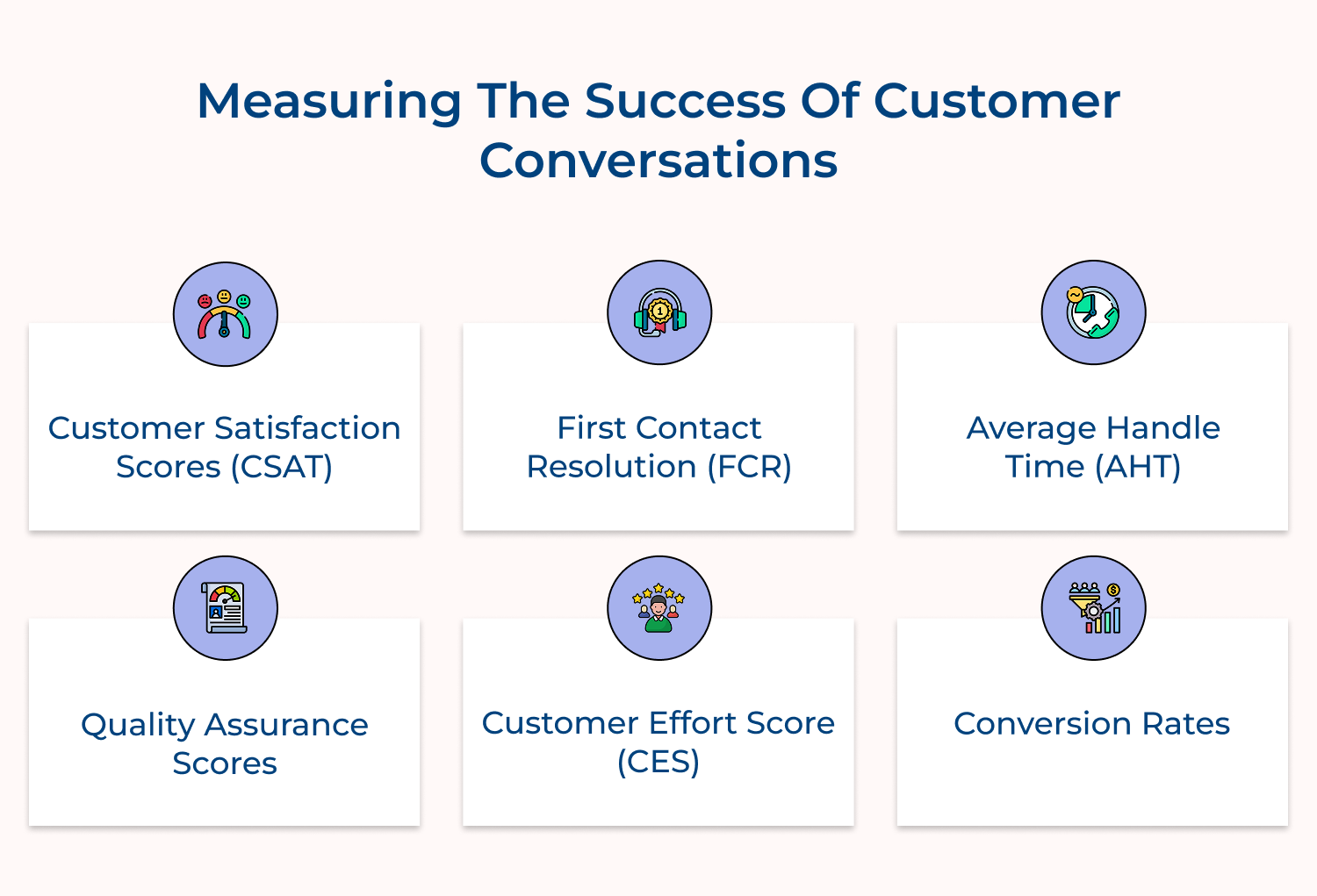
1. Customer Satisfaction Scores (CSAT)
Collect direct feedback through post-interaction surveys using metrics like CSAT, NPS, or CES. These quantitative measures provide clear indicators of conversation quality from the customer’s perspective. Regular tracking reveals trends over time, identifies agents who consistently deliver exceptional experiences, creating benchmarks for training and development.
2. First Contact Resolution (FCR)
Track the percentage of customer issues resolved during the initial interaction. Higher FCR rates indicate more effective conversations and greater efficiency. This metric strongly correlates with customer satisfaction while reducing operational costs. Regular analysis helps identify complex issues that might require process improvements or additional agent training.
3. Average Handle Time (AHT)
Measure the total duration of customer interactions, including talk time, hold time, and after-call work. While shorter isn’t always better, tracking handle time identifies efficiency opportunities and potential process bottlenecks. Balance this metric against quality measures to ensure conversations aren’t rushed at the expense of resolution.
4. Quality Assurance Scores
Evaluate conversations against standardized criteria including accuracy, compliance, professionalism and problem-solving effectiveness. Regular QA reviews provide detailed insights into conversation strengths and weaknesses. Implement a consistent scoring system that aligns with company values and customer expectations to ensure fair assessment.
5. Customer Effort Score (CES)
Assess how easy the company makes it for customers to resolve their issues. Lower effort correlates strongly with loyalty and repeat business. This metric highlights friction points in the conversation process that might frustrate customers despite technically resolving their issues, revealing opportunities for streamlining procedures.
6. Conversion Rates
For sales-oriented conversations, track the percentage resulting in desired outcomes such as purchases, upgrades or appointments. This direct performance indicator connects conversation quality to business results. Analyze successful conversions to identify effective techniques and language patterns that can be shared across the team.
Customer conversations are crucial for creating lasting relationships and driving business success. Personalizing interactions, actively listening to feedback and addressing customer needs can significantly improve engagement & satisfaction. When businesses prioritize meaningful communication, they not only enhance loyalty but also gain valuable insights to refine their offerings.
Consistently investing in these conversations builds trust, increases retention and sets the foundation for long-term growth. Start making customer conversations a priority to elevate your business and achieve sustainable success.

How do you handle angry customers?
Let them vent without interruption, acknowledge their frustration sincerely and avoid taking it personally. Stay calm, use empathetic language and focus on solutions rather than defending company policies. Demonstrate commitment to resolving their issue through concrete next steps.
What’s the best way to say "no" to a customer?
Acknowledge their request, explain the limitation clearly without jargon, then immediately offer alternative solutions. Focus on what can be done rather than what cannot. When possible, provide context for the limitation to help them understand the situation.
How do you balance efficiency with personalization?
Prepare templates for common scenarios but customize them for each interaction. Focus on high-impact personalization moments—using names, referencing history and tailoring solutions. Efficient systems and processes create space for meaningful personalized moments where they matter most.
How can conversation skills be improved?
Regularly review recordings or transcripts of conversations. Seek feedback from colleagues and customers. Practice active listening daily. Study successful conversations. Develop emotional intelligence. Remember that improvement comes from consistent reflection and deliberate practice.
How do you effectively transition between topics?
Summarize the current topic’s resolution, confirm the customer’s satisfaction, then introduce the new topic with a clear transition phrase. For example: “Now that we’ve addressed your billing concern, let’s discuss your question about upgrading your service.”
 https://omni24.io/wp-content/uploads/2026/08/AI-Customer-Service-Agents.png
1256
2400
Webvision Solution
https://omni24.io/wp-content/uploads/2023/04/Omni-Logo-1.svg
Webvision Solution2026-09-21 04:48:512026-09-21 04:48:51How to Build an AI Customer Service Agents: 8 Key Steps
https://omni24.io/wp-content/uploads/2026/08/AI-Customer-Service-Agents.png
1256
2400
Webvision Solution
https://omni24.io/wp-content/uploads/2023/04/Omni-Logo-1.svg
Webvision Solution2026-09-21 04:48:512026-09-21 04:48:51How to Build an AI Customer Service Agents: 8 Key Steps https://omni24.io/wp-content/uploads/2026/08/Omnichannel-Conversational-AI.png
1256
2400
Tushar Joshi
https://omni24.io/wp-content/uploads/2023/04/Omni-Logo-1.svg
Tushar Joshi2026-09-16 03:51:072026-09-16 03:51:07How to Build Omnichannel Conversational AI Strategy
https://omni24.io/wp-content/uploads/2026/08/Omnichannel-Conversational-AI.png
1256
2400
Tushar Joshi
https://omni24.io/wp-content/uploads/2023/04/Omni-Logo-1.svg
Tushar Joshi2026-09-16 03:51:072026-09-16 03:51:07How to Build Omnichannel Conversational AI Strategy https://omni24.io/wp-content/uploads/2026/08/Customer-Service-Teams.png
1256
2400
Tushar Joshi
https://omni24.io/wp-content/uploads/2023/04/Omni-Logo-1.svg
Tushar Joshi2026-09-15 04:01:522026-09-15 04:02:16How to Build Customer Service Teams: 6 Key Steps
https://omni24.io/wp-content/uploads/2026/08/Customer-Service-Teams.png
1256
2400
Tushar Joshi
https://omni24.io/wp-content/uploads/2023/04/Omni-Logo-1.svg
Tushar Joshi2026-09-15 04:01:522026-09-15 04:02:16How to Build Customer Service Teams: 6 Key Steps
Whether it’s about acquire, engage or support – Omni24 covers all your customer engagement needs in one complete platform.

Copyright ©2026 Veemo All rights reserved.
CA, Los Angeles, Hall Ave, 19011