Why Customer Follow-Up is the Secret to Stronger Relationships?
Customer follow-up is crucial for maintaining relationships and reinforcing trust after an interaction. Timely follow-ups improve satisfaction and long-term engagement.

Customer follow-up is crucial for maintaining relationships and reinforcing trust after an interaction. Timely follow-ups improve satisfaction and long-term engagement.
Many businesses struggle to maintain customer engagement after the initial sale, missing valuable opportunities to build long-term relationships.
Businesses responding within 5 minutes are 100x more likely to connect, and standardized processes lift conversion rates.
When customers don’t receive follow-up communication, they may feel neglected or overlooked, leading to dissatisfaction and churn. Implementing an effective customer follow-up strategy ensures that your customers feel valued, enhances their experience and builds loyalty.
Explore the proven customer follow-up strategies that can strengthen customer relationships and significantly boost retention rates.
Customer follow-up refers to the process of maintaining communication with customers after an initial interaction or transaction. It involves reaching out to customers through various channels such as email, phone calls, or messages to check on their satisfaction, address any concerns, provide additional information or simply maintain the relationship.
Effective customer follow-up is critical for business success in today’s competitive marketplace. It is considered an important aspect of customer service in ecommerce as it demonstrates that a company values its customers beyond just the initial transaction, which helps build trust and loyalty.
Key objectives:
Consistent follow-ups build trust, boost retention and turn one-time buyers into loyal, long-term brand advocates.
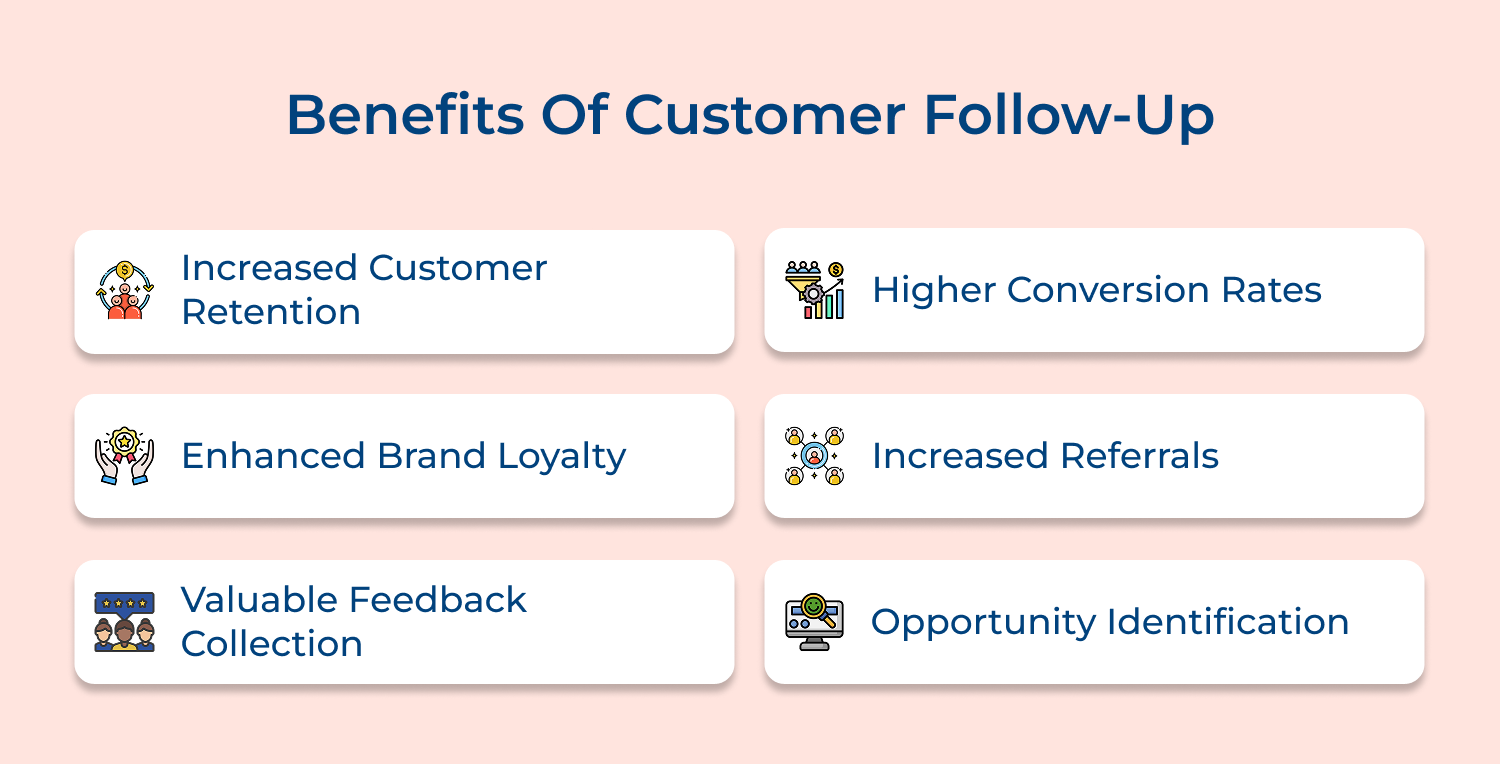
1. Increased customer retention: Consistent follow-up demonstrates to customers that they’re valued beyond their initial purchase. Ongoing attention to customer needs significantly reduces churn rates while establishing foundations for lasting business relationships.
2. Enhanced brand loyalty: Regular follow-ups showcase your commitment to customer satisfaction and success. Meaningful touchpoints reinforce positive experiences, creating emotional connections with your brand that competitors will struggle to disrupt.
3. Valuable feedback collection: Follow-up interactions naturally encourage customers to share critical insights about products, services, and overall experiences. Many important observations might remain undiscovered or unaddressed without dedicated follow-up efforts.
4. Higher conversion rates: Timely follow-ups address lingering questions or concerns potential customers may have. Personalized attention often provides the reassurance hesitant prospects need to finalize their purchase decisions.
5. Increased referrals: Satisfied customers who receive excellent follow-up care frequently become vocal advocates for your business. Customers impressed with thorough follow-up practices recommend your company to friends and colleagues without prompting.
6. Opportunity identification: Follow-up conversations reveal unmet needs, complementary product interests, or service gaps representing new revenue possibilities. Customer discussions during follow-ups often uncover valuable business opportunities.
Stop losing deals to silence. These proven follow-up practices turn cold prospects into loyal, paying customers fast.
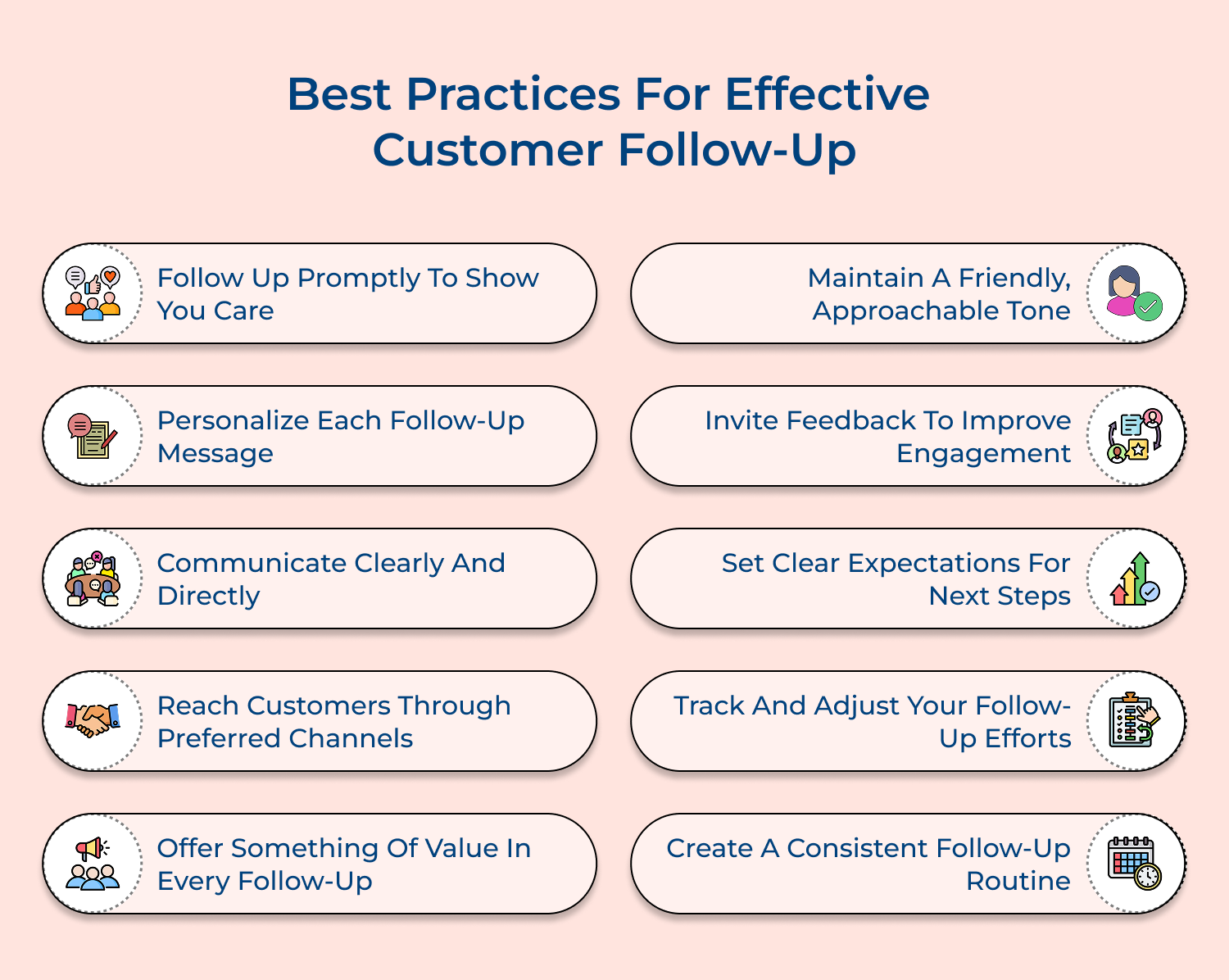
Follow-up promptly means reaching out to the customer within 24-48 hours after an interaction, purchase or service to ensure satisfaction and address any concerns. It could be through an email, phone call or message, depending on the nature of the interaction.
Prompt follow-ups show that you are attentive and care about your customers’ experience. Customers appreciate it when businesses take the initiative to check in soon after a purchase or service. Delays in follow-up can lead to customer dissatisfaction and missed opportunities to address issues before they escalate.
Actionable Tips:
Personalization involves tailoring follow-up messages to each customer based on their specific needs, preferences or past interactions. This includes addressing the customer by name and referencing their previous purchase or issue in the message.
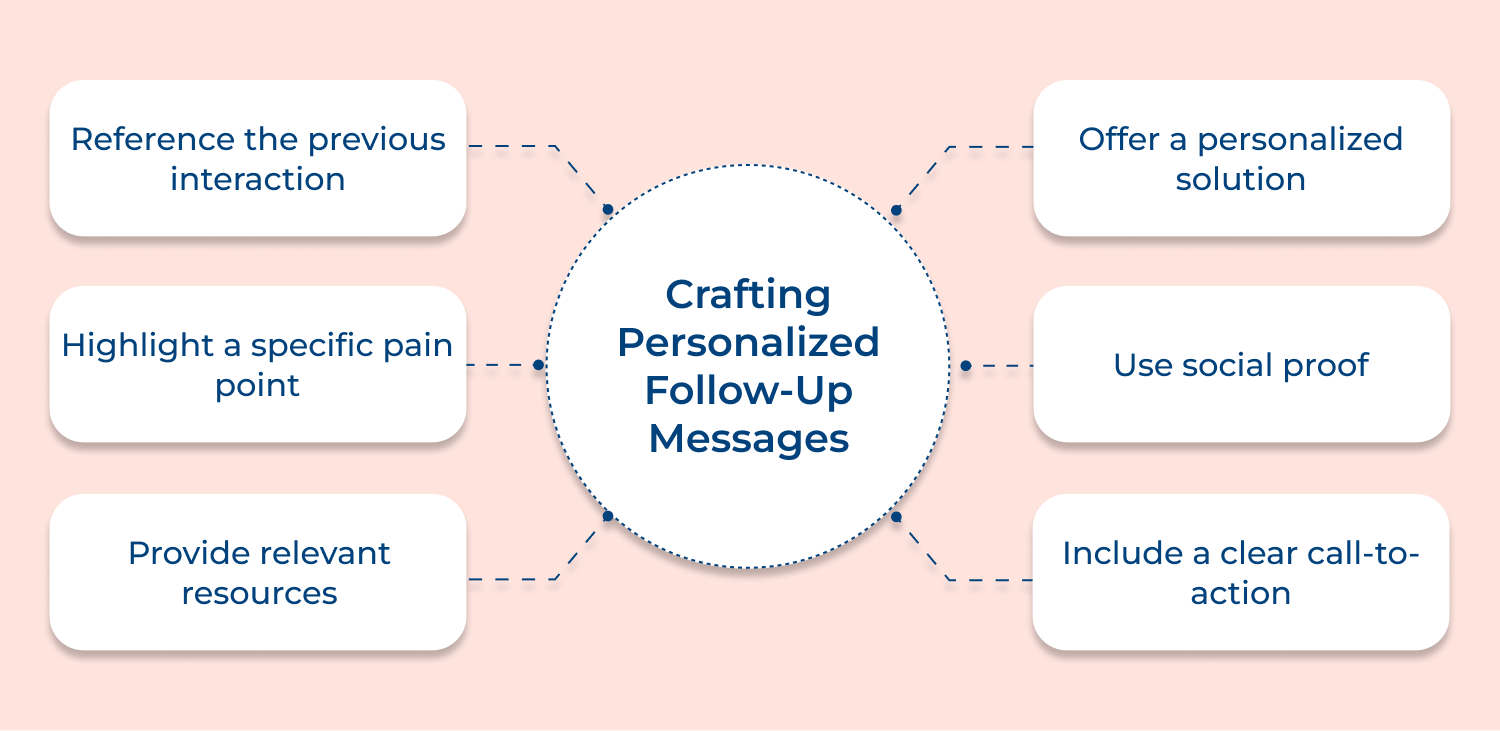
Personalized communication creates a stronger emotional connection with customers, making them feel special and valued. Generic messages can seem insincere and often lead to disengagement. When you reference specific details, customers are more likely to trust your brand and respond positively.
Actionable Tips:
Clear communication involves expressing your message in a simple, direct and understandable manner, ensuring there is no ambiguity or unnecessary complexity. It means providing the information the customer needs without overwhelming them.
Direct communication is crucial for preventing misunderstandings and frustration. Customers appreciate concise, easy-to-understand messages that get straight to the point. Overly complicated or verbose communication can lead to confusion, which might result in lost trust or engagement.
Actionable Tips:
Reaching customers through their preferred communication channels (e.g., email, phone, social media, or SMS) means selecting the medium that best fits their preferences for engagement. It makes follow-ups more effective by ensuring they are received and read.
Not every customer prefers the same form of communication. Some may prefer emails, while others prefer text messages or social media DMs. By respecting their preferences, you improve the chances that they’ll engage with your follow-up, which can strengthen your relationship and ensure that your message doesn’t go unnoticed.
Actionable Tips:
Offering something of value means providing the customer with useful information, discounts, tips, or relevant resources that benefit them in some way, whether it’s related to your product, service, or their experience with your business.
Providing value in follow-up communications fosters goodwill and strengthens the customer relationship. It shows that you’re not just following up to close a deal, but that you care about their ongoing experience. It also gives customers a reason to engage with your brand beyond just making a purchase.
Actionable Tips:
A friendly, approachable tone means communicating in a way that is warm, empathetic, and conversational. This tone helps the customer feel comfortable and valued, ensuring a positive interaction even if the customer has a concern or issue.
A positive and approachable tone helps reduce any tension or frustration the customer might feel, particularly if they are following up on a complaint or issue. When crafting your follow-up messages, avoid overly formal or robotic language. Use words like “I’m happy to help” or “Let me know if you need anything else.”
Actionable Tips:
Inviting feedback means actively asking customers for their thoughts on the product, service, or experience they had with your brand. This can be done through surveys, follow-up emails or during direct communication.
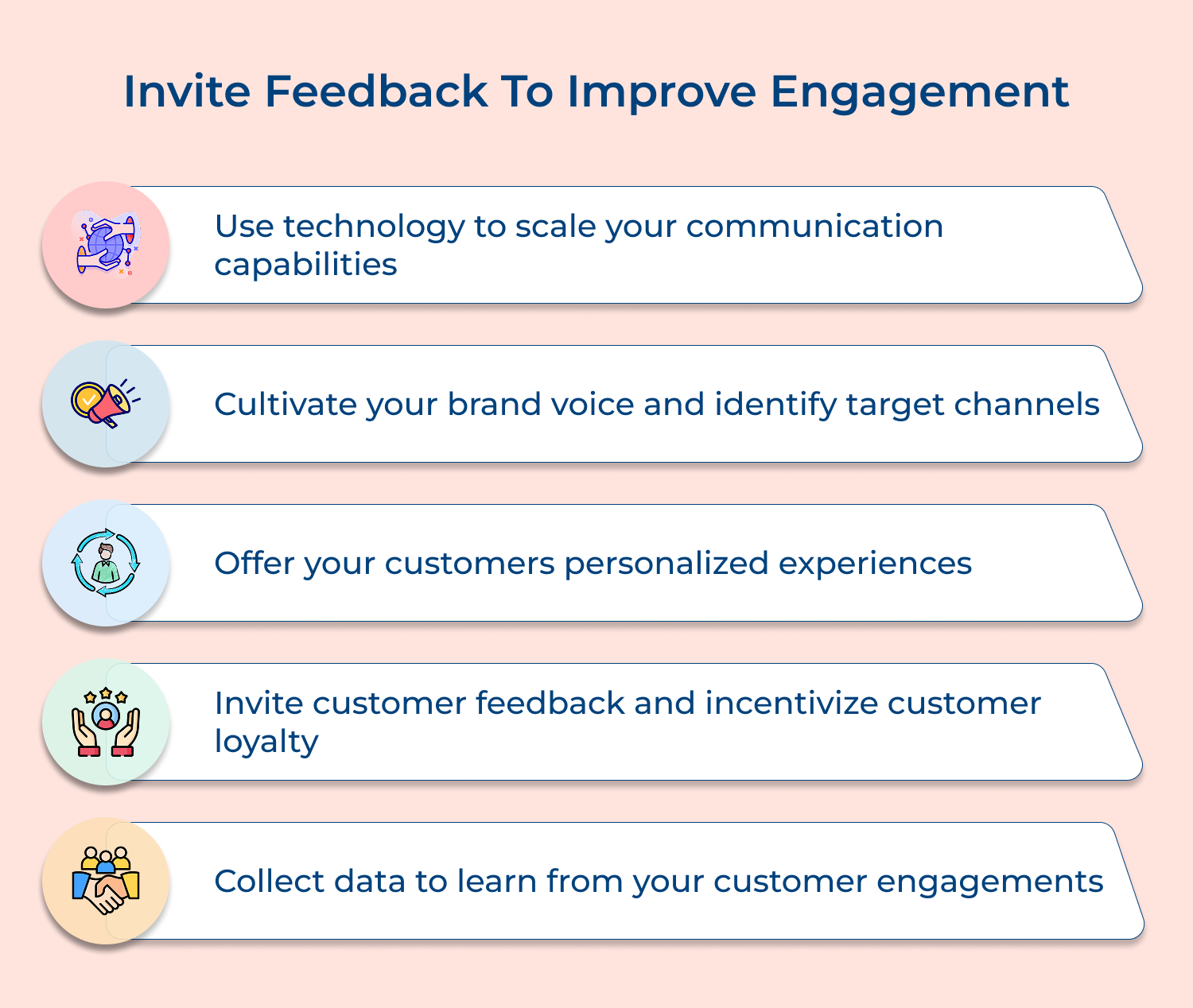
Feedback provides valuable insights that help you improve customer service, products and overall customer satisfaction. It also makes customers feel heard and valued, as they know their opinions matter to your business. Engaged customers are more likely to return and refer others.
Actionable Tips:
Setting clear expectations means informing customers exactly what will happen next, whether that’s further communication, delivery or resolution of an issue. Customers should know what to expect and when.
Clear expectations help manage customer anxiety and reduce frustration. Customers appreciate transparency and will feel more in control of the situation when they know the timeline and steps involved.
Actionable Tips:
Tracking your follow-up efforts means regularly monitoring the effectiveness of your communication strategies, measuring customer responses and making necessary adjustments to improve the process.
By tracking responses, you can evaluate which follow-up methods are working and which need improvement. Adjusting your approach based on these insights ensures better customer engagement and more successful follow-ups in the future.
Actionable Tips:
Creating a consistent follow-up routine means establishing a regular schedule for following up with customers based on their interactions or purchases. It ensures customers are contacted promptly without being neglected.
Consistency builds trust and strengthens relationships. Customers appreciate knowing that they will receive follow-ups and updates on a predictable schedule. A routine ensures that no customer is overlooked and that every interaction is followed up appropriately.
Actionable Tips:
Track the right metrics to know if your follow-ups are converting prospects or quietly killing your pipeline.
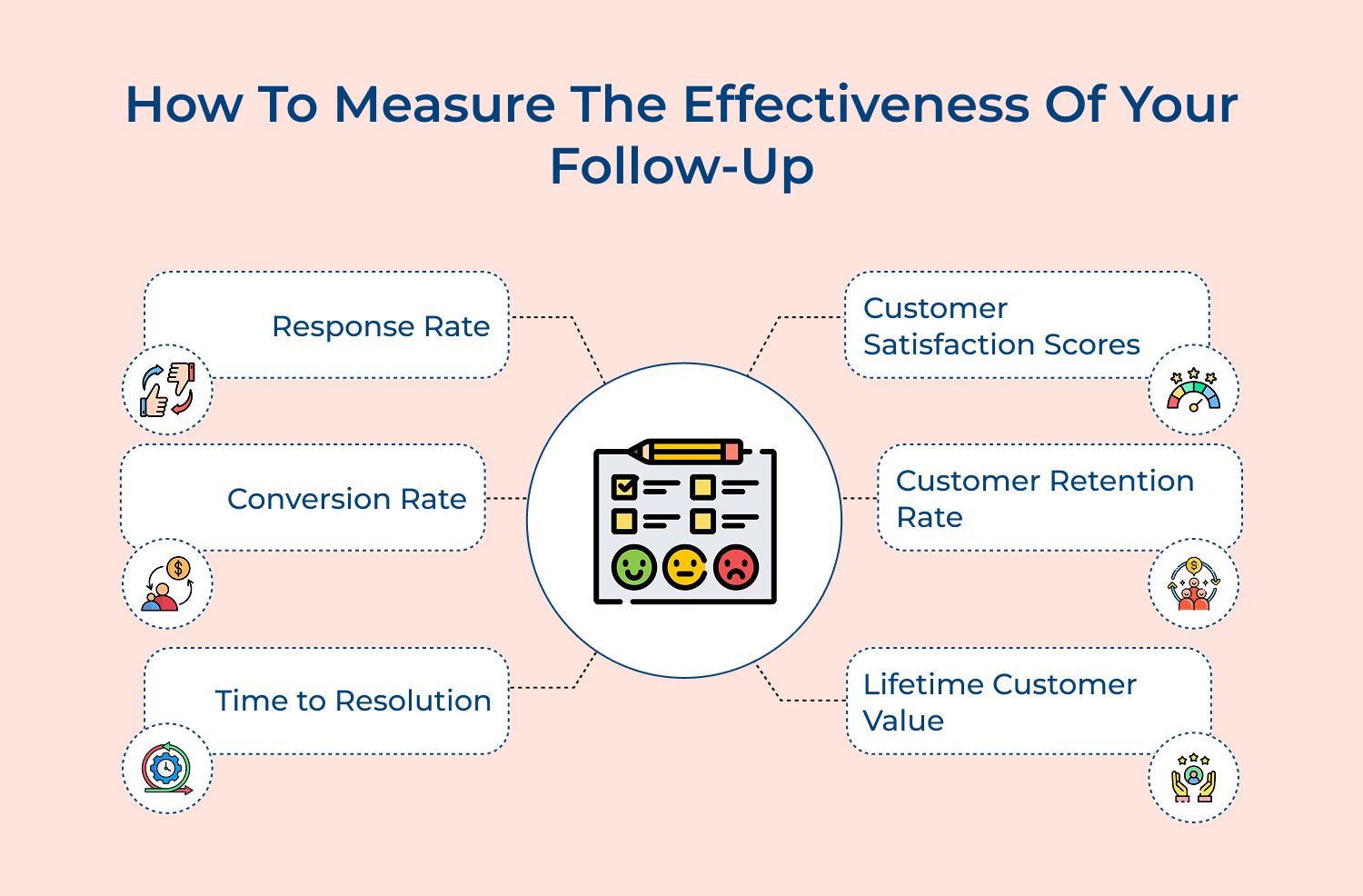
1. Response Rate
Calculate the percentage of follow-ups that receive any form of customer engagement or reply. Track responses across different channels, message types and customer segments to identify which approaches generate the highest engagement levels. Low response rates may indicate poorly timed outreach, irrelevant content or inappropriate communication channels.
2. Conversion Rate
Measure how frequently your follow-ups result in desired actions whether purchases, appointments, renewals or other specific objectives. Compare conversion percentages across different follow-up sequences and timing intervals to determine optimal approaches. Link conversion data to specific follow-up touchpoints to understand which messages most effectively drive customer decisions.
3. Time to Resolution
Monitor how quickly customer issues reach satisfactory conclusions following initial follow-up efforts. Track average resolution time frames across different problem types and complexity levels. Analyze cases with extended resolution periods to identify process bottlenecks or training opportunities that could streamline future customer interactions.
4. Customer Satisfaction Scores
Implement post-follow-up satisfaction surveys using established methodologies like NPS, CSAT or CES. Compare satisfaction metrics before and after implementing follow-up processes to quantify their impact on customer perception. Correlate satisfaction scores with specific follow-up techniques to identify the most effective approaches.
5. Customer Retention Rate
Calculate what percentage of customers remain active after receiving structured follow-up programs compared to those without systematic outreach. Analyze retention patterns across different customer segments and follow-up strategies to optimize approaches for various customer types. Measure the financial impact of improved retention resulting from enhanced follow-up practices.
6. Lifetime Customer Value
Compare the long-term revenue generated by customers receiving comprehensive follow-up versus those with minimal post-purchase contact. Track how effective follow-up influences repeat purchases, account expansions and referral generation over extended customer relationships. Quantify the return on investment for your follow-up resources by measuring incremental value gained against program costs.
Most businesses lose customers not from bad products, but from poor follow-up habits that kill trust silently.
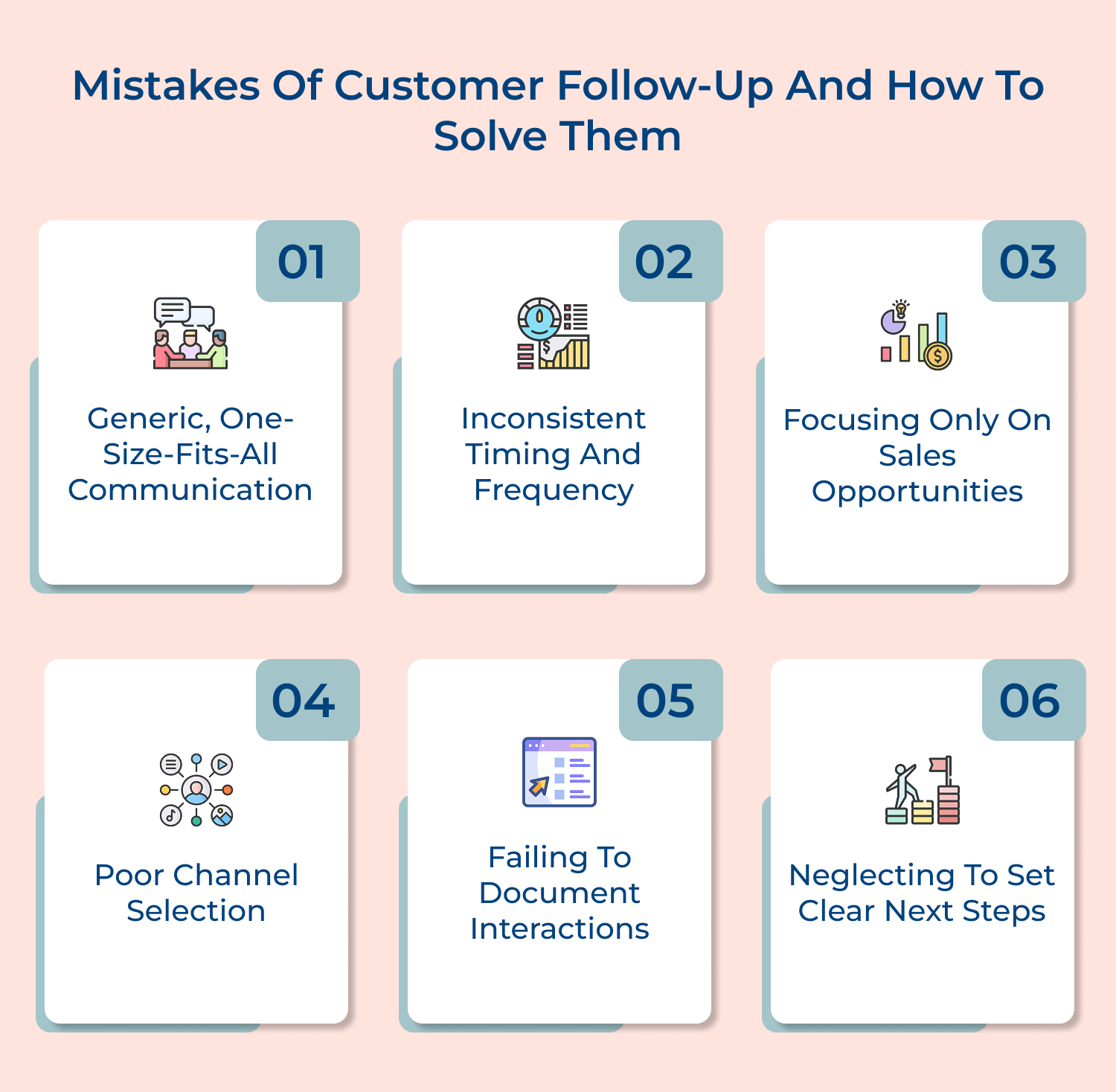
1. Generic, One-Size-Fits-All Communication
Mistake: Sending identical templated messages to all customers regardless of their history, preferences or specific needs.
Solution: Segment your customer base and create tailored follow-up templates for each group. Incorporate specific details from previous interactions, purchase history, or known preferences. Implement a robust CRM system that allows for easy access to customer data during follow-up preparation. Train your team to personalize key elements of each message before sending.
2. Inconsistent Timing and Frequency
Mistake: Following up sporadically without a clear schedule or overwhelming customers with too many contacts in a short timeframe.
Solution: Develop a structured follow-up calendar with optimal timing based on customer journey stages and purchase complexity. Create clear internal guidelines for follow-up frequency across different customer segments. Use automation tools to maintain consistency while respecting customer preferences for contact frequency. Monitor engagement metrics to fine-tune your timing strategy.
3. Focusing Only on Sales Opportunities
Mistake: Using every follow-up as a thinly disguised sales pitch rather than providing genuine value or service.
Solution: Implement a balanced follow-up approach that alternates between educational content, service check-ins, and sales opportunities. Create a content library of valuable, non-promotional information to share during follow-ups. Train your team to identify and prioritize customer needs over immediate sales goals. Measure the effectiveness of value-driven follow-ups on long-term customer retention.
4. Poor Channel Selection
Mistake: Limiting follow-up to a single communication channel or using channels that don’t align with customer preferences.
Solution: Survey customers about their preferred communication channels during onboarding. Develop follow-up capabilities across multiple platforms including email, phone, text, social media, and in-person options. Match channel selection to the complexity and urgency of your follow-up message. Monitor response rates across different channels to optimize your approach for various customer segments.
5. Failing to Document Interactions
Mistake: Not recording follow-up details, leaving team members uninformed about previous conversations and commitments.
Solution: Implement standardized documentation protocols for all customer interactions. Invest in a CRM system that centralizes customer communication history and makes it accessible to all team members. Create follow-up summary templates that capture key discussion points, decisions and next steps. Schedule regular team knowledge-sharing sessions about ongoing customer relationships.
6. Neglecting to Set Clear Next Steps
Mistake: Ending follow-ups without clear resolution or established expectations for what happens next.
Solution: Conclude every follow-up interaction with explicit next steps and timeframes. Train your team to use action-oriented language that clarifies responsibilities and deadlines. Implement a follow-up tracking system that flags incomplete processes. Create standardized closing scripts that ensure proper expectation setting with customers.
Discover real-world follow-up strategies that top brands use to boost retention, build trust and drive repeat revenue.
1. Amazon’s Post-Purchase Email Sequence
Amazon strategically times reviews requests to arrive when customers have adequately experienced their purchases. Their emails feature product-specific images, one-click rating options and direct feedback links.
The company adjusts timing based on product category electronics receiving follow-ups later than consumables. This adaptive approach contributes to Amazon maintaining over 90% customer satisfaction while their personalized product recommendations in follow-ups have increased average order values by 10-30%.
2. Zappos’ Surprise-and-Delight Phone Calls
Zappos revolutionized e-commerce follow-up by implementing random personal phone calls to customers after purchase. These brief, friendly calls focus purely on satisfaction and relationship building without any sales pitch. This unexpected personal touch generates powerful results—customers receiving these calls spend 25% more in subsequent purchases and demonstrate 70% higher retention rates. CEO Tony Hsieh has credited these simple follow-up calls with generating over $6 million in annual sales through positive word-of-mouth.
3. Chewy’s Personalized Handwritten Notes
Online pet retailer Chewy sends physically handwritten thank-you cards after first purchases, creating remarkable differentiation in digital retail. Their customer service team monitors social channels for major customer life events, sending flowers when pets pass away or congratulatory notes for new pets—all without promotional content. These relationship-focused follow-ups generate extensive social media sharing, with customers proudly posting images of their handwritten notes, resulting in 80% higher lifetime value from recipients.
4. Sephora’s Tiered Beauty Insider Follow-Up Program
Sephora’s Beauty Insider program segments customers into three tiers with increasingly personalized follow-up communications. Their approach uniquely combines digital and in-store elements—online purchases trigger emails with usage tips and tutorial videos featuring similar skin tones to the customer’s profile. Higher-tier members receive personalized text messages when favorite products become available. This multi-channel strategy has proven remarkably effective, with loyalty program members spending 15 times more annually than non-members.
5. Slack’s Behavior-Based Engagement Model
Slack’s sophisticated follow-up system responds to actual usage patterns rather than arbitrary timeframes. Their onboarding sequence monitors which features users utilize, then sends targeted emails highlighting complementary unused features. For teams showing decreased engagement, they implement “win-back” sequences showcasing new integrations relevant to previously connected tools. This behavior-based approach ensures highly relevant communications, resulting in 32% higher long-term engagement and 26% lower churn rates compared to standard follow-ups.
Customer follow-up plays a crucial role in building long-lasting relationships and increasing loyalty. Personalizing follow-up messages, ensuring clear communication and offering ongoing value contribute to a positive experience that encourages repeat business.
Consistency and empathy in your approach can lead to improved customer satisfaction and retention. Implementing these strategies will not only deepen customer relationships but also enhance your brand’s reputation, ultimately driving long-term success and maximizing customer lifetime value.

How soon after purchase should I follow up with a customer?
The optimal timing depends on your product or service. For simple products, 24-48 hours is appropriate. For complex products requiring implementation, 3-7 days allows customers time for initial experience. For services, follow up after the first meaningful milestone. Test different timing with small customer segments to determine what generates the highest engagement for your specific business.
What’s the most effective channel for customer follow-up?
The most effective channel aligns with how customers initially engaged with your business and their stated preferences. Email typically performs well for transactional follow-ups, while phone calls create stronger impressions for high-value relationships. Social media works well for younger demographics. The best approach often combines multiple channels in a coordinated sequence based on customer response behavior.
How frequently should follow up without annoying customers?
Follow-up frequency should balance maintaining presence without creating fatigue. Most businesses find success with declining frequency patterns—more frequent initially, then tapering to maintenance levels. Customer actions should adjust this cadence; engagement suggests receptiveness to more communication, while non-responses indicate scaling back. Always provide clear opt-out mechanisms and honor communication preferences.
What information should be included in follow-up communications?
Effective follow-ups include personalized references to specific purchases or interactions, clear value-adding content (usage tips, complementary resources), and an unambiguous call-to-action. Avoid generic messaging or excessive promotional content. The most successful follow-ups focus 80% on providing value to the customer and only 20% on business objectives like additional sales.
Should follow-ups be automated or personalized?
The most effective strategies combine both approaches—using automation for consistency and timing while incorporating personalization elements that make communications relevant. Completely manual follow-ups aren’t scalable, while purely automated messages often feel impersonal. Create a tiered approach where high-value relationships receive more personalized attention while automated systems maintain contact with broader customer segments.
 https://omni24.io/wp-content/uploads/2026/09/Social-commerce-scaled.png
1340
2560
Webvision Solution
https://omni24.io/wp-content/uploads/2023/04/Omni-Logo-1.svg
Webvision Solution2026-10-23 12:18:272026-10-23 12:18:27What is Social Commerce and Why Does It Matter?
https://omni24.io/wp-content/uploads/2026/09/Social-commerce-scaled.png
1340
2560
Webvision Solution
https://omni24.io/wp-content/uploads/2023/04/Omni-Logo-1.svg
Webvision Solution2026-10-23 12:18:272026-10-23 12:18:27What is Social Commerce and Why Does It Matter? https://omni24.io/wp-content/uploads/2026/08/AI-Customer-Service-Agents.png
1256
2400
Webvision Solution
https://omni24.io/wp-content/uploads/2023/04/Omni-Logo-1.svg
Webvision Solution2026-09-21 04:48:512026-09-21 04:48:51How to Build an AI Customer Service Agents: 8 Key Steps
https://omni24.io/wp-content/uploads/2026/08/AI-Customer-Service-Agents.png
1256
2400
Webvision Solution
https://omni24.io/wp-content/uploads/2023/04/Omni-Logo-1.svg
Webvision Solution2026-09-21 04:48:512026-09-21 04:48:51How to Build an AI Customer Service Agents: 8 Key Steps https://omni24.io/wp-content/uploads/2026/08/Omnichannel-Conversational-AI.png
1256
2400
Tushar Joshi
https://omni24.io/wp-content/uploads/2023/04/Omni-Logo-1.svg
Tushar Joshi2026-09-16 03:51:072026-09-16 03:51:07How to Build Omnichannel Conversational AI Strategy
https://omni24.io/wp-content/uploads/2026/08/Omnichannel-Conversational-AI.png
1256
2400
Tushar Joshi
https://omni24.io/wp-content/uploads/2023/04/Omni-Logo-1.svg
Tushar Joshi2026-09-16 03:51:072026-09-16 03:51:07How to Build Omnichannel Conversational AI Strategy
Whether it’s about acquire, engage or support – Omni24 covers all your customer engagement needs in one complete platform.

Copyright ©2026 Veemo All rights reserved.
CA, Los Angeles, Hall Ave, 19011