What is Knowledge Mapping and How to Use It?
Knowledge mapping captures and visualizes information flow, identifies gaps and makes critical insights accessible for better decision‑making.

Knowledge mapping captures and visualizes information flow, identifies gaps and makes critical insights accessible for better decision‑making.
In a knowledge-driven economy, harnessing an organization’s intellectual assets has become a critical factor for success. Knowledge mapping is a powerful tool that illuminates the hidden landscape of information.
Knowledge mapping is reported as a strategic necessity for organizations dealing with large-scale, complex or fast-changing information.
This strategic approach goes beyond simple data management, offering a visual representation of where knowledge resides, how it flows and where it’s needed most. Creating a detailed map of organizational wisdom helps businesses to unlock new efficiencies and make informed decisions.
Explore the transformative potential of knowledge mapping and discover how organizations leverage their most valuable resource – knowledge.
Knowledge mapping is defined as a strategic process that visually represents an organization’s intellectual assets and their interconnections. It identifies, organizes and illustrates the flow of knowledge within a company, highlighting key information sources, expertise.
Creating a clear picture of the knowledge landscape, businesses can optimize resource allocation, improve decision-making processes and encourage effective collaboration. Knowledge mapping serves as a powerful tool for leveraging intellectual capital, enhancing organizational learning and driving innovation across all levels of the enterprise.
Key objectives:
Knowledge mapping techniques are visual tools that organize and represent information. These methods help individuals and organizations structure to communicate complex ideas effectively.

1. Concept mapping: Concept mapping visually represents relationships between different ideas or concepts. It uses nodes to represent concepts and helps in understanding complex systems, identifying knowledge gaps, or communicating intricate ideas effectively. It’s particularly useful for brainstorming sessions and strategic planning.
Example: A marketing team creates a concept map to visualize customer journey touchpoints, showing how different marketing channels interact and influence the customer’s decision-making process.
2. Mind mapping: Mind mapping is a radial diagram that starts with a central idea and branches out into related subtopics. It’s an excellent tool for organizing thoughts, brainstorming and capturing the essence of a subject quickly. Mind maps can help in project planning, note-taking and problem-solving by providing a clear, hierarchical view of information.
Example: A product development team uses a mind map to explore features for a new smartphone, branching out into categories like hardware, software, design and user experience.
3. Process mapping: Process mapping outlines the steps involved in a specific business process or workflow. It uses standardized symbols to represent different activities, decisions and flows. It is crucial for identifying inefficiencies, streamlining operations and ensuring consistency in complex procedures across an organization.
Example: An HR department creates a process map for employee onboarding, detailing each step from job offer acceptance to the completion of the probation period.
4. Social network analysis: Social Network Analysis (SNA) maps out the relationships and interactions between individuals or groups within an organization. It helps identify key influencers, communication patterns and knowledge flow. SNA is valuable for improving collaboration, optimizing team structures and enhancing knowledge sharing across departments.
Example: A large corporation uses SNA to visualize informal communication networks, identifying key knowledge brokers who connect different departments and facilitate information exchange.
5. Knowledge flow mapping: This technique traces the path of knowledge as it moves through an organization. It identifies sources, recipients and barriers to knowledge transfer. Knowledge flow mapping helps in optimizing information sharing, reducing knowledge silos and improving overall organizational learning.
Example: A multinational company maps how best practices are shared between its regional offices, identifying bottlenecks and opportunities for improving global knowledge dissemination.
6. Competency mapping: Competency mapping identifies the skills, knowledge and attributes required for different roles within an organization. It helps in aligning employee capabilities with job requirements, identifying skill gaps and planning training and development initiatives. This technique is crucial for talent management and succession planning.
Example: An IT company creates a competency map for its software developer roles, outlining required technical skills, soft skills and experience levels for each career stage.
Creating an effective knowledge map requires a systematic approach to capture, organize and visualize information.
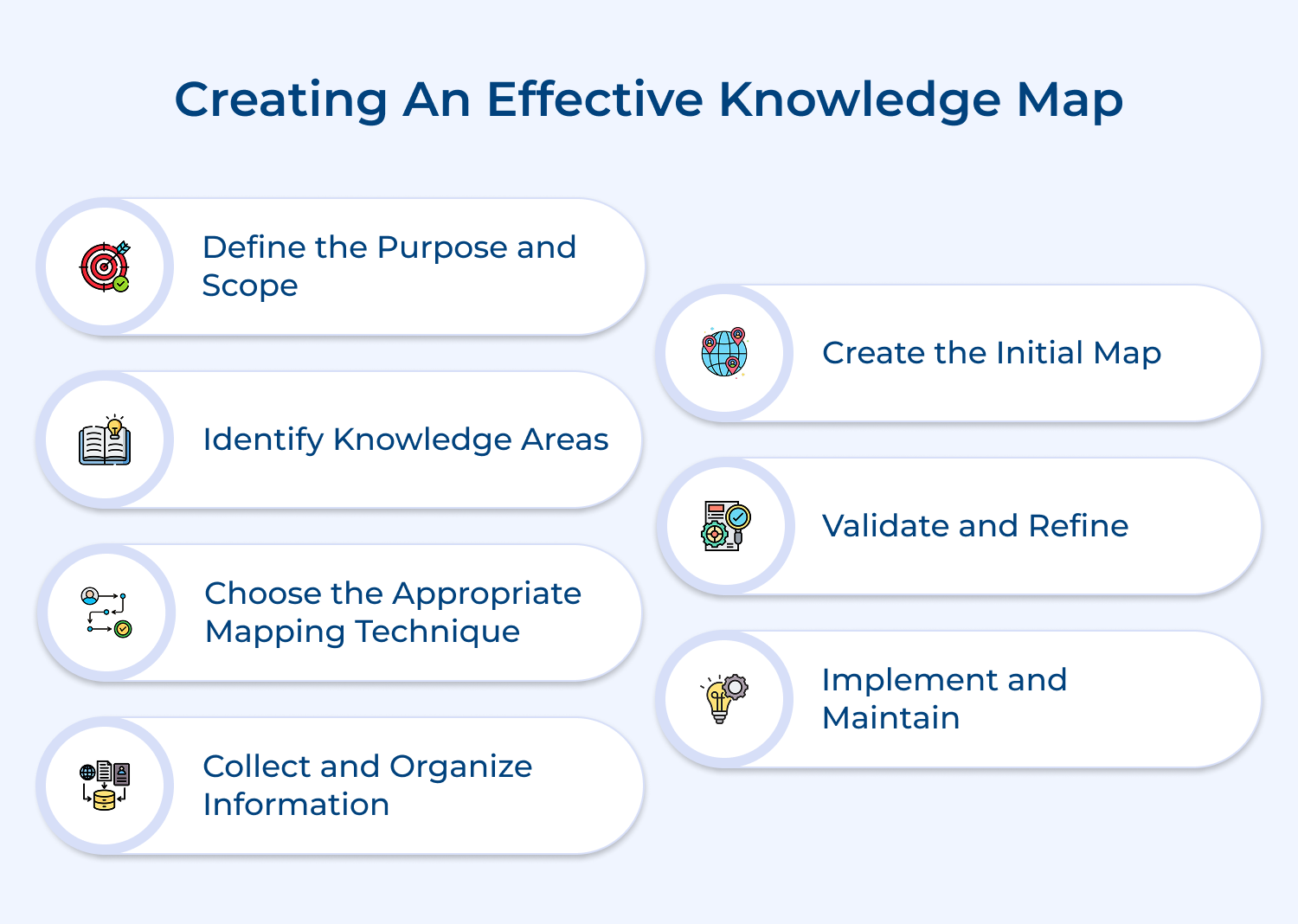
Clearly identify the objective of your knowledge mapping effort. Determine what specific knowledge domain or problem you’re addressing and what outcomes you hope to achieve.
Establish the boundaries of your map to keep it focused and manageable. This step ensures that your knowledge mapping aligns with organizational goals and provides value to stakeholders.
Tips to implement:
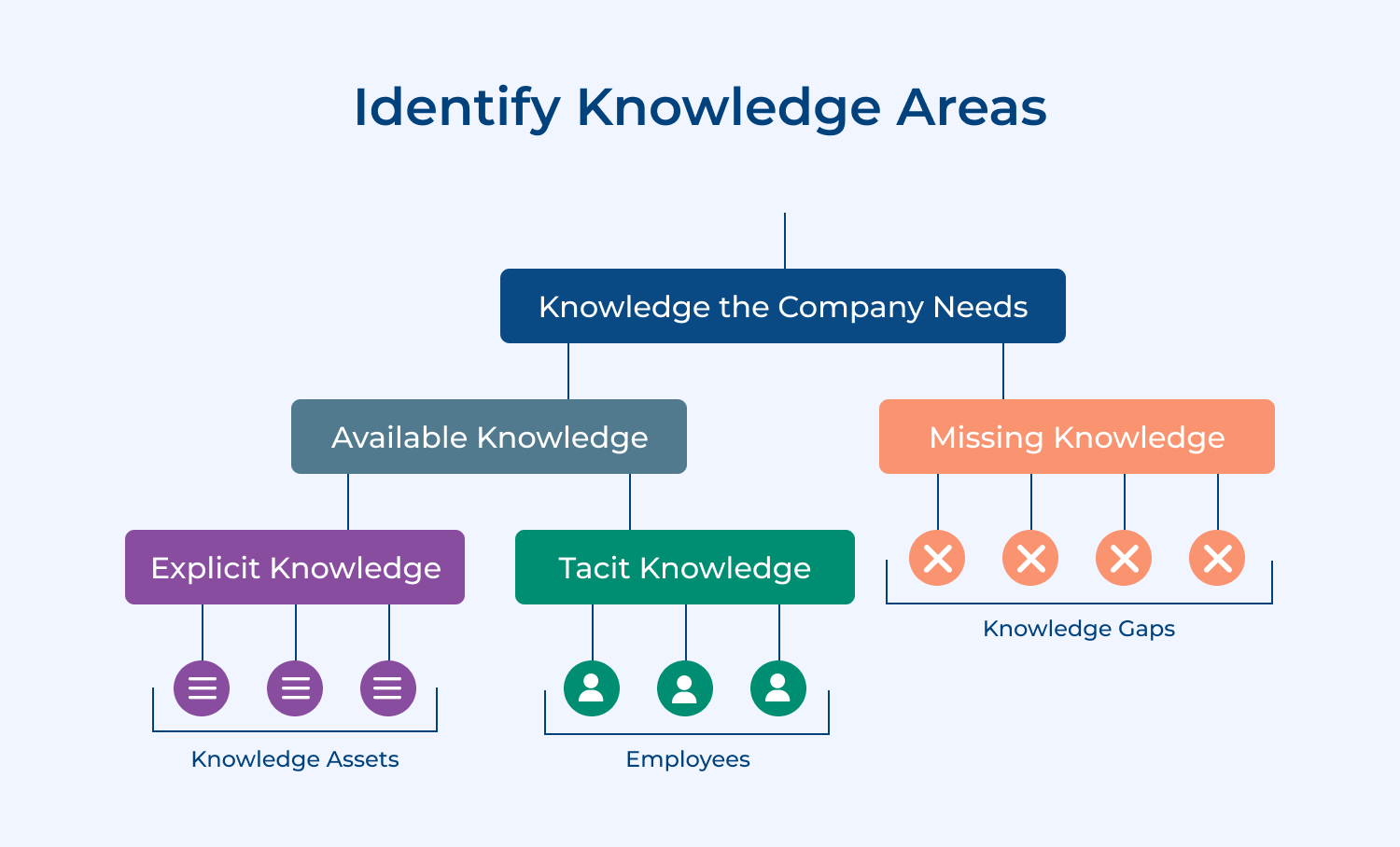
Identify the key areas of knowledge to be mapped. It involves determining the topics, processes, or domains that are critical to your organization.
Cataloging these areas helps in structuring the map and ensures that all relevant knowledge is included. Consider both current and future knowledge needs for comprehensive coverage.
Tips for Implementing:
Select the knowledge mapping technique that best suits your purpose and the type of information you’re working with.
Consider factors such as the complexity of the domain, the relationships between concepts and how the map will be used. Different techniques (e.g., concept maps, mind maps, process maps) serve different purposes.
Tips to implement:
Gather relevant data and knowledge through interviews, document analysis, surveys and observation. Ensure that the collected data is accurate, up-to-date and comprehensive.
Proper data collection forms the foundation of an effective knowledge map and supports informed decision-making. Organize this information into logical categories or themes.
Tips to implement:
Begin constructing your knowledge map using the chosen technique and the organized information. Start with the main concepts or processes, then gradually add details along with connections.
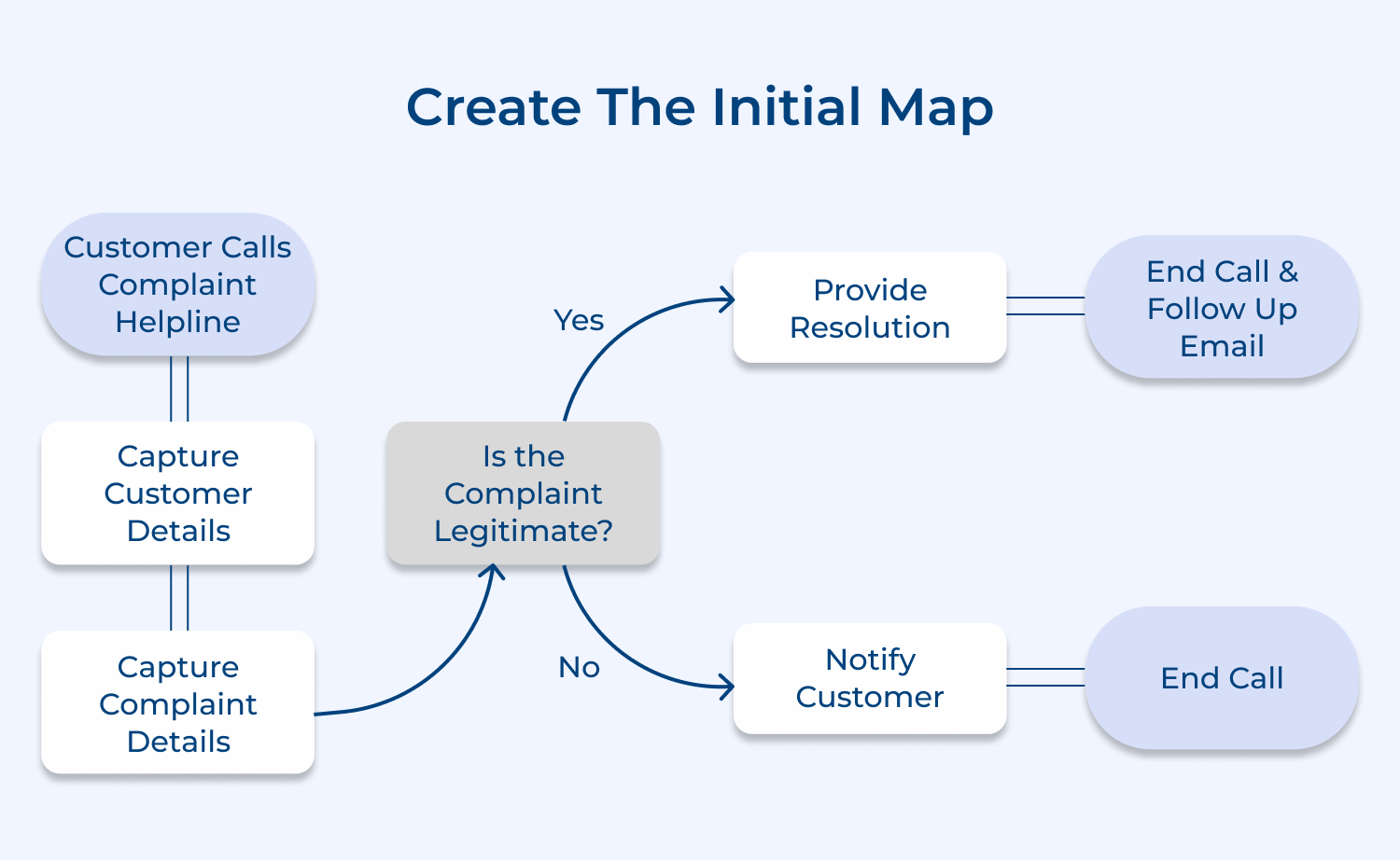
The initial map serves as a foundation that you’ll refine and expand in subsequent steps. Ensure the map is easy to understand and navigate and review it for clarity and completeness. Regularly update the map as new knowledge is acquired.
Tips to implement:
Review the knowledge map for accuracy and completeness. Validate the information with subject matter experts and stakeholders to ensure it meets their needs.
Refine the map based on feedback and make necessary adjustments. It ensures that the map is reliable, relevant and useful for its intended purpose.
Tips for Implementing:
Deploy the knowledge map within your organization and establish processes for its use and ongoing maintenance. Regular updates are crucial to keep the map relevant and valuable over time. Consider how the map will be accessed, used and updated by different stakeholders.
Tips to implement:
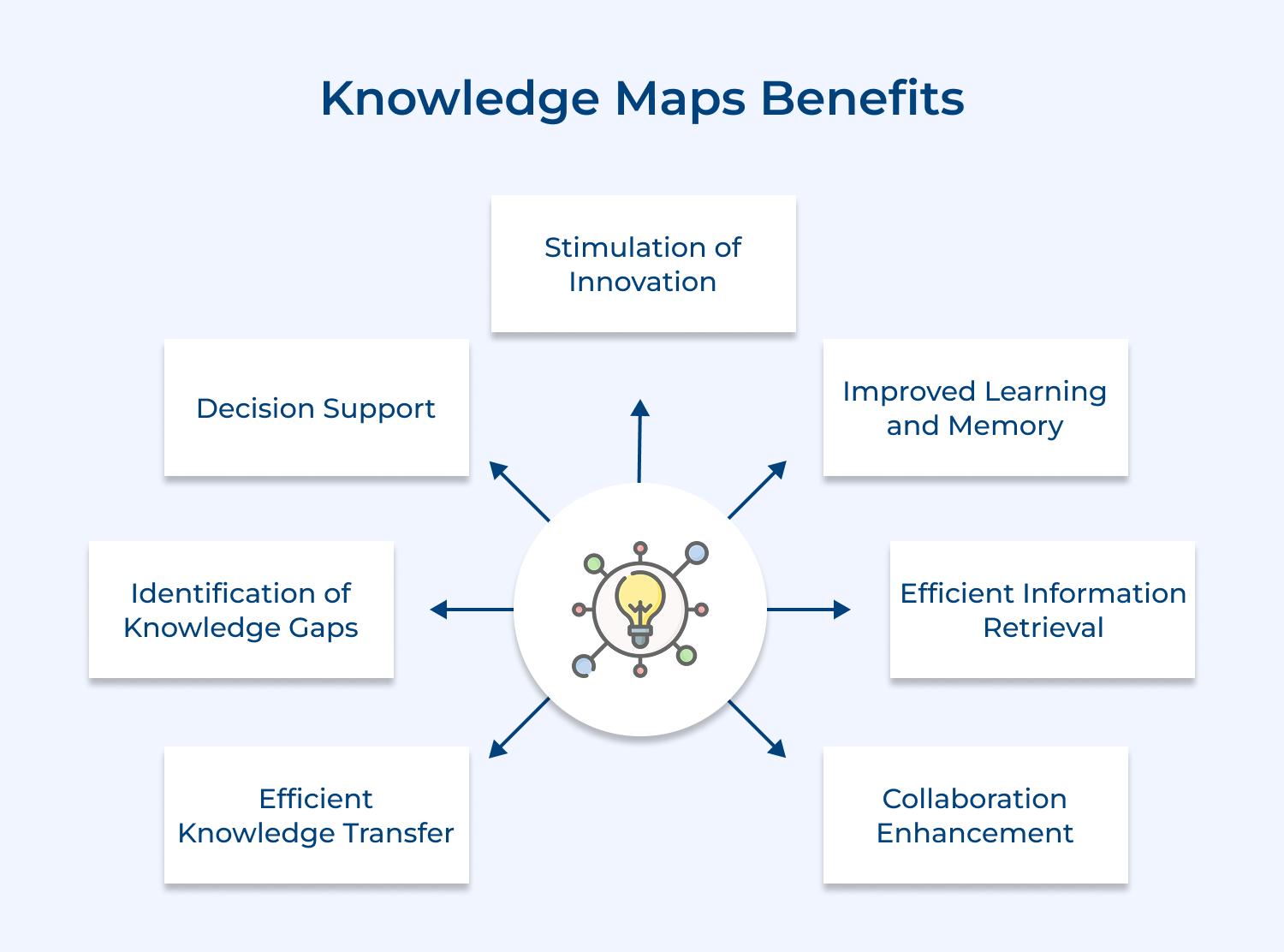
Knowledge maps offer numerous advantages for individuals, teams and organizations. Here are some key advantages of implementing knowledge maps:
Effective knowledge mapping requires careful planning and execution. The best practices ensure maps are accurate, useful and valuable to the organization’s knowledge management efforts.

1. Establish Clear Objectives
Before beginning the mapping process, establish clear goals and boundaries for your knowledge map. Determine what specific knowledge domain you’re addressing, who the intended users are and what outcomes are expected.
The clarity helps focus your efforts, ensures relevance and prevents scope creep. A well-defined purpose guides all subsequent decisions in the mapping process, from choosing the right technique to determining the level of detail required.
2. Involve Subject Matter Experts
Engage key stakeholders and subject matter experts throughout the mapping process. Their input is crucial for identifying important concepts, validating relationships and ensuring the map’s accuracy and completeness.
The collaborative approach not only improves the quality of the map but also increases buy-in and adoption. Regular consultations with experts help capture tacit knowledge and provide insights that might not be evident from documentation alone.
3. Maintain Consistency and Clarity
Establish and adhere to consistent conventions for representing concepts, relationships and hierarchies in your map. Use clear, concise language for labels and descriptions.
Consistency in formatting, color coding and symbol usage enhances readability and understanding. Avoid cluttering the map with excessive detail; instead, focus on key concepts and relationships, providing links to more detailed information when necessary.
4. Iterate and Refine
Approach knowledge mapping as an iterative process. Start with a basic structure and progressively refine and expand it. Regularly review and update the map based on feedback, new information.
The iterative approach allows for continuous improvement and ensures the map remains relevant and accurate over time. Be open to restructuring parts of the map if better ways of representing the knowledge emerge.
5. Provide Training and Support
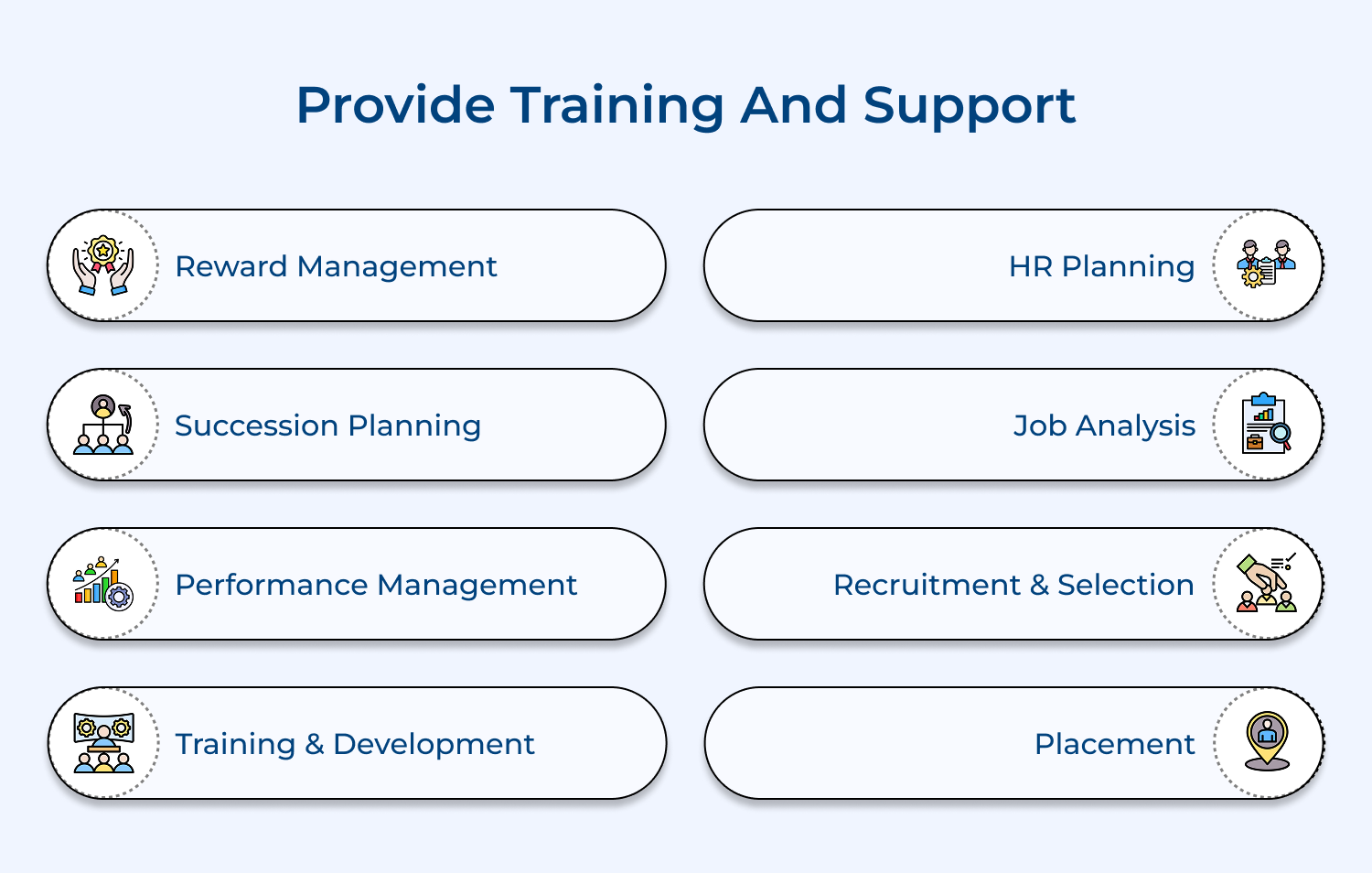
Offer training and support to help users understand and effectively utilize the knowledge map. It may include workshops, user guides or tutorials explaining how to navigate and interpret the map. Educate users on the benefits of the map and how it can support their work.
Ongoing support ensures that the map remains a valuable tool and encourages its regular use and updating by the intended audience.
6. Monitor and Evaluate Effectiveness
Regularly monitor and evaluate the effectiveness of your knowledge mapping efforts. Assess how well the map supports decision-making, knowledge sharing and organizational goals.
Gather feedback from users to identify areas for improvement and make necessary adjustments. Continuous evaluation helps optimize the map’s impact and ensures it remains a valuable tool for knowledge management.
Knowledge mapping has diverse applications across various fields and industries. Here are eight practical use cases demonstrating its versatility and value in different contexts.
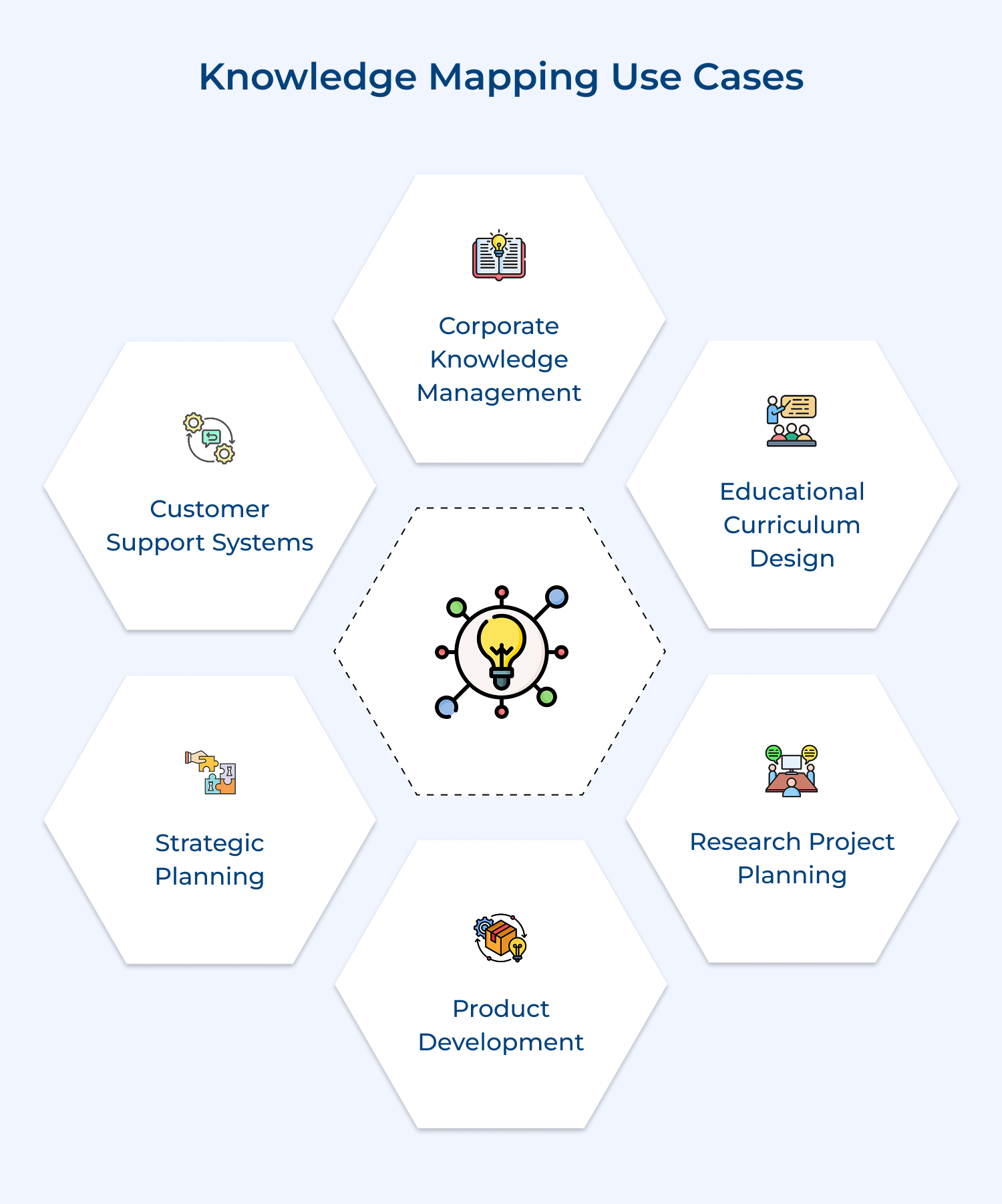
1. Corporate Knowledge Management
Organizations use knowledge maps to capture and organize institutional knowledge. These maps help identify expertise within the company, document processes and facilitate knowledge transfer between departments or generations of employees.
By visualizing the organization’s collective knowledge, companies can better leverage their intellectual assets, improve decision-making and maintain continuity during staff transitions or expansions.
2. Curriculum Design
Educators employ knowledge maps to design and refine curricula. By mapping out subject areas, key concepts and their interrelationships, teachers can create more coherent.
These maps help identify prerequisites, reveal connections between different topics and ensure balanced coverage of essential knowledge. They also aid in aligning course content with learning objectives and standards.
3. Research Project Planning
Researchers use knowledge maps to plan and manage complex projects. These maps help visualize the current state of knowledge in a field, identify research gaps and plan investigative strategies.
Scientists can better coordinate team efforts, allocate resources, and track progress throughout the project lifecycle by mapping out research questions, methodologies, along with potential outcomes.
4. Product Development
During the product development phase, knowledge maps help teams organize information about market needs, technical specifications and design concepts.
These maps facilitate collaboration between different departments, ensuring all aspects of product development are considered. They can also be used to track the evolution of product ideas, manage feature sets and identify potential innovations.
5. Strategic Planning
Organizations use knowledge maps in strategic planning to visualize market landscapes, competitive positions and internal capabilities. These maps help leaders identify opportunities, threats and gaps in their strategic knowledge.
By mapping out different scenarios and their potential outcomes, decision-makers can develop more robust and informed strategies for the future.
6. Customer Support Systems
Customer service departments utilize knowledge maps to organize support information and troubleshooting procedures.
These maps help service representatives quickly navigate complex product information, identify solutions to common problems and provide consistent, accurate support. They can also reveal patterns in customer inquiries, informing product improvements and proactive support strategies.
Go through the real-life examples of knowledge mapping systems to showcase their practical applications across various industries.
1. NASA’s knowledge management system: NASA uses a comprehensive knowledge management system to map and manage technical knowledge and expertise across its projects. By creating detailed knowledge maps, NASA can quickly locate experts, access historical mission data and leverage past learnings. The system enhances collaboration, decision-making and innovation in space exploration.
2. Siemens’ knowledge management portal: Siemens uses a knowledge management portal to map and organize its extensive technical and engineering knowledge. The portal helps employees access best practices, technical documentation and expertise across different divisions. By mapping this knowledge, Siemens enhances collaboration, reduces redundancy and supports global innovation.
3. The World Health Organization (WHO): The WHO employs a knowledge mapping system to manage global health data and research. The WHO can track outbreaks, share information with member countries, and coordinate global health responses by mapping knowledge related to diseases, treatments, as well as health interventions. The system supports evidence-based decision-making and effective public health strategies.
4. McKinsey & company’s knowledge repository: McKinsey & Company utilizes a knowledge repository to map and organize consulting insights, case studies and research. The repository helps consultants quickly access relevant knowledge and best practices from past projects. By mapping this information, McKinsey enhances the efficiency and quality of its consulting services.
5. Oracle’s knowledge management system: Oracle’s knowledge management system includes tools for mapping technical support information as well as managing solutions. It enables users to create and access a structured repository of technical documentation, FAQs and troubleshooting guides. The mapping helps in delivering timely support, improving customer service and facilitating knowledge sharing within the organization.
Knowledge mapping is a powerful tool for organizations seeking to visualize, organize and leverage their intellectual capital. By identifying and connecting key knowledge assets, organizations can improve decision-making, enhance collaboration.
Using techniques such as concept mapping, mind mapping and knowledge graphs enables organizations to gain a deeper understanding of their knowledge landscape, identify gaps, while optimizing their knowledge management practices. As the volume and complexity of knowledge grow, knowledge mapping will continue to be a valuable asset for organizations striving to stay competitive while remaining agile.

How to make a knowledge map?
To create a knowledge map, start by defining objectives, identifying key knowledge areas, collecting relevant data and selecting mapping tools. Organize the information into a visual format, validate the map with stakeholders and regularly update it to maintain accuracy.
What are the advantages of knowledge mapping?
Knowledge mapping enhances organizational efficiency by visualizing knowledge assets, identifying gaps, improving access to information and facilitating better decision-making. It supports knowledge sharing, streamlines processes and helps in strategic planning and problem-solving by providing a clear view of available knowledge resources.
What is the function of a knowledge map?
The function of a knowledge map is to visually organize and represent knowledge, highlighting relationships between concepts, processes or individuals. It helps in identifying knowledge gaps, optimizing information flow and improving access to expertise, thereby supporting better decision-making.
What are the areas of knowledge map?
Knowledge maps typically cover areas such as expertise and skills, processes and workflows, information sources, relationships between concepts and knowledge assets. They can also include organizational knowledge, domain-specific knowledge and the flow of information across departments or teams.
Are some types of knowledge more useful than others?
Yes, some types of knowledge may be more useful depending on organizational needs and goals. Tacit knowledge, such as expertise and experience, often provides deeper insights, while explicit knowledge, such as documented procedures, is essential for standardization. The usefulness varies by context and application.
 https://omni24.io/wp-content/uploads/2026/08/AI-Customer-Service-Agents.png
1256
2400
Webvision Solution
https://omni24.io/wp-content/uploads/2023/04/Omni-Logo-1.svg
Webvision Solution2026-09-21 04:48:512026-09-21 04:48:51How to Build an AI Customer Service Agents: 8 Key Steps
https://omni24.io/wp-content/uploads/2026/08/AI-Customer-Service-Agents.png
1256
2400
Webvision Solution
https://omni24.io/wp-content/uploads/2023/04/Omni-Logo-1.svg
Webvision Solution2026-09-21 04:48:512026-09-21 04:48:51How to Build an AI Customer Service Agents: 8 Key Steps https://omni24.io/wp-content/uploads/2026/08/Omnichannel-Conversational-AI.png
1256
2400
Tushar Joshi
https://omni24.io/wp-content/uploads/2023/04/Omni-Logo-1.svg
Tushar Joshi2026-09-16 03:51:072026-09-16 03:51:07How to Build Omnichannel Conversational AI Strategy
https://omni24.io/wp-content/uploads/2026/08/Omnichannel-Conversational-AI.png
1256
2400
Tushar Joshi
https://omni24.io/wp-content/uploads/2023/04/Omni-Logo-1.svg
Tushar Joshi2026-09-16 03:51:072026-09-16 03:51:07How to Build Omnichannel Conversational AI Strategy https://omni24.io/wp-content/uploads/2026/08/Customer-Service-Teams.png
1256
2400
Tushar Joshi
https://omni24.io/wp-content/uploads/2023/04/Omni-Logo-1.svg
Tushar Joshi2026-09-15 04:01:522026-09-15 04:02:16How to Build Customer Service Teams: 6 Key Steps
https://omni24.io/wp-content/uploads/2026/08/Customer-Service-Teams.png
1256
2400
Tushar Joshi
https://omni24.io/wp-content/uploads/2023/04/Omni-Logo-1.svg
Tushar Joshi2026-09-15 04:01:522026-09-15 04:02:16How to Build Customer Service Teams: 6 Key Steps
Whether it’s about acquire, engage or support – Omni24 covers all your customer engagement needs in one complete platform.

Copyright ©2026 Veemo All rights reserved.
CA, Los Angeles, Hall Ave, 19011