What is AI Workflow Automation & How to Build it?
The advanced capabilities of AI have unlocked novel opportunities for businesses of all sizes either small, medium or enterprise to overcome these challenges by seamless AI workflow automation.
The advanced capabilities of AI have unlocked novel opportunities for businesses of all sizes either small, medium or enterprise to overcome these challenges by seamless AI workflow automation.
Are you tired of repetitive and time-consuming tasks bogging down your business productivity?
What if there was a way to streamline processes and free up your team to focus on more strategic work?
Businesses are constantly looking for ways to improve efficiency and stay ahead of the competition. One way to achieve this is by implementing AI-automated workflows.
36% of organizations are using business process management software to automate workflows. 50% of business leaders plan to automate more repetitive tasks within their organizations.
Leveraging the power of artificial intelligence helps businesses to revolutionize the way they operate, leading to increased productivity and cost savings.
We will explore the benefits of AI-automated workflows and how they can help your organization thrive.
AI workflow automation is a process that uses AI technology to streamline business processes, reducing the need for manual intervention and increasing efficiency. The workflow process refers to the sequential steps or activities executed within an organization to achieve a specific objective or goal.
AI workflow automation involves the use of AI-powered algorithms to automate repetitive tasks, analyze data, make decisions and interact with other systems. It can include tasks such as data entry, document processing, customer service inquiries and more.
Workflow automation with AI has become a game-changer for businesses looking to streamline their operations and increase efficiency. Implementing AI in workflow automation can offer a wide range of benefits that can positively impact your business.
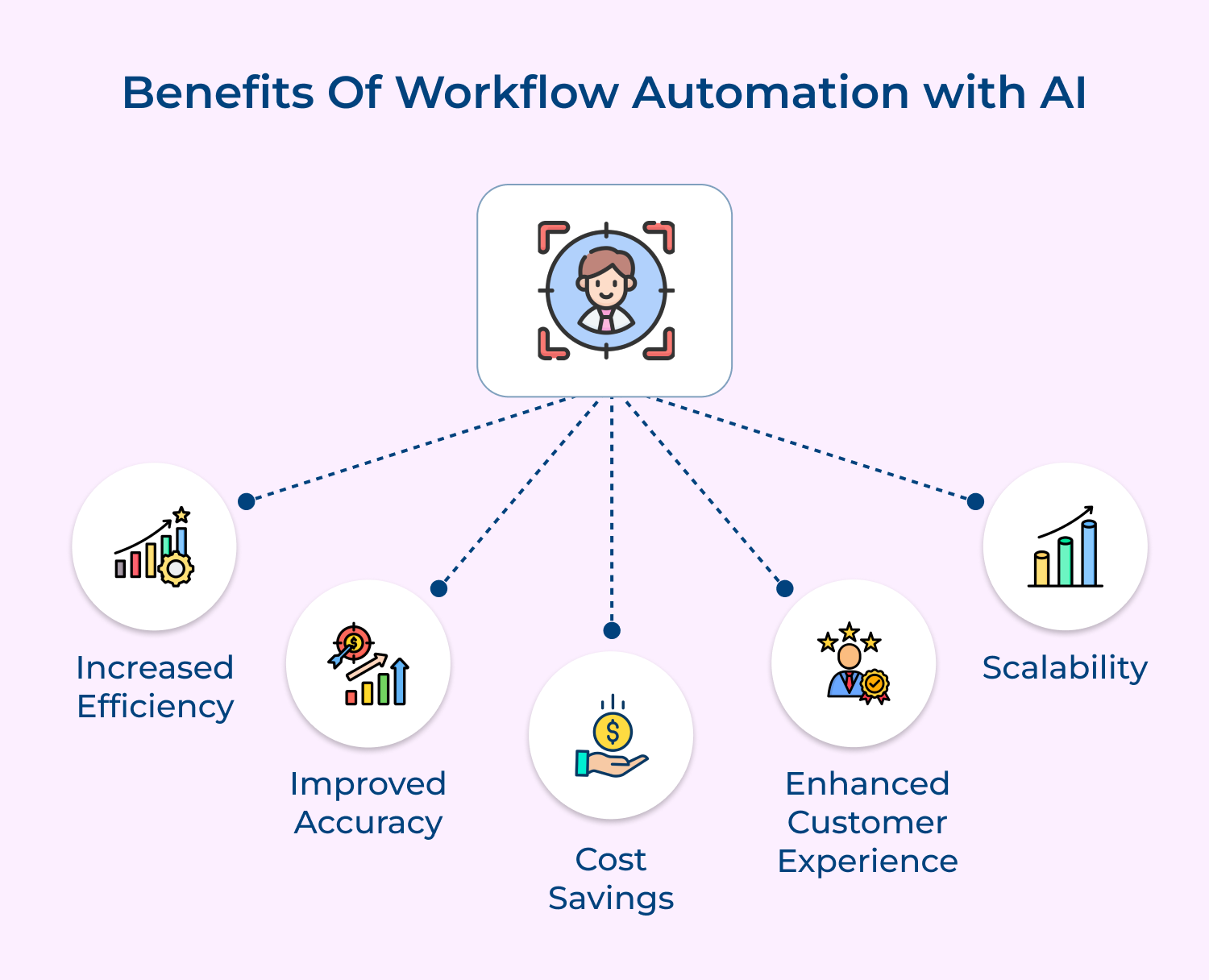
Leveraging AI-enabled workflows helps businesses streamline processes, reduce human error, and free up valuable time for employees to focus on more strategic tasks.
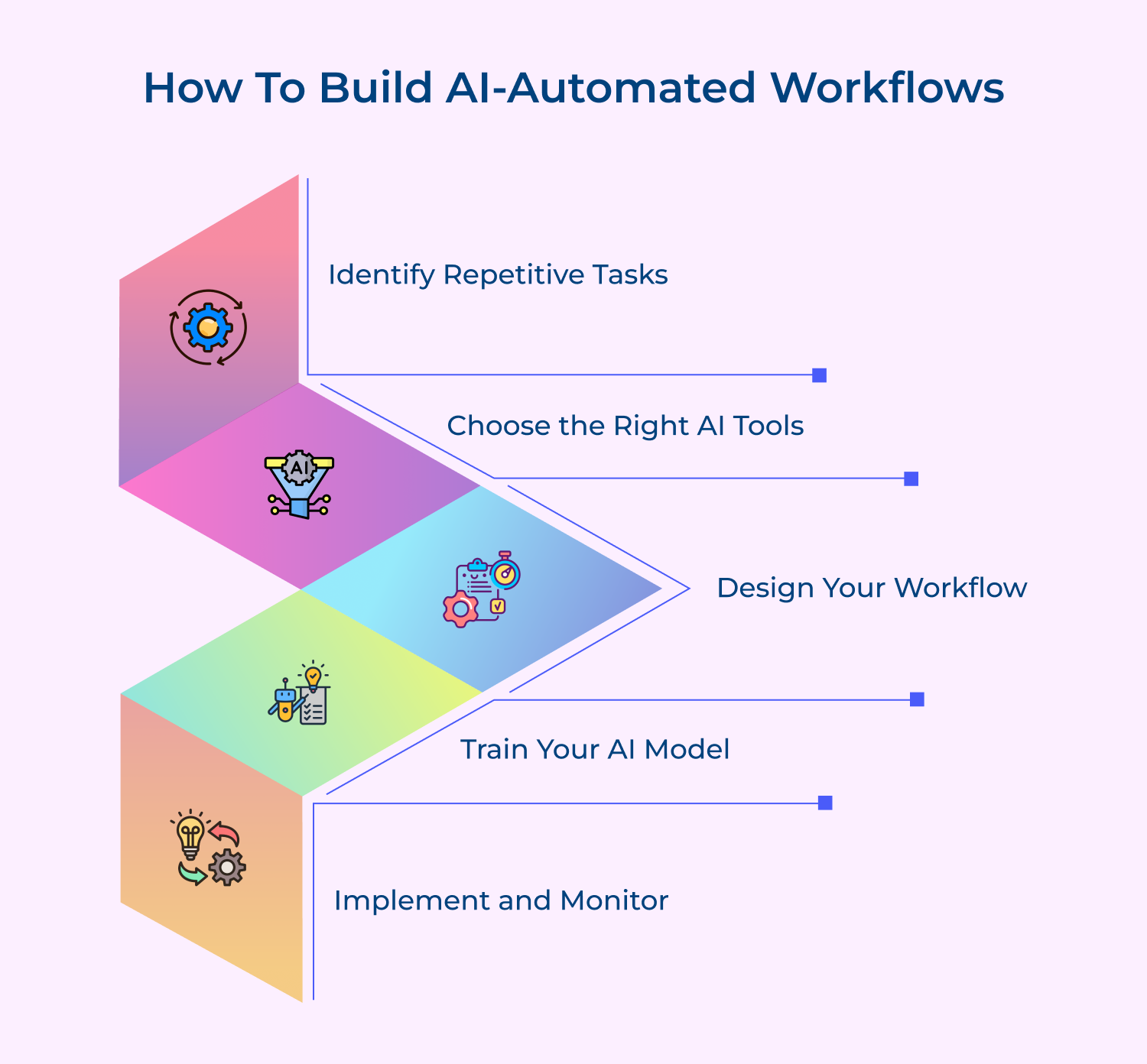
The first step in building AI-automated workflows is to identify the repetitive tasks that need to be automated. It varies from business to business including data entry, report generation, email responses, etc. By identifying the tasks, you can prioritize the processes to automate first, saving time and resources in the long run.
Best Practices:
After identifying the tasks to automate, the next step is to choose the right AI tools for the job. There are many AI-powered workflow automation platforms available, such as Zapier, Microsoft Power Automate, and IBM Watson.
These platforms offer a wide range of features and integrations to help you streamline your workflows effectively.
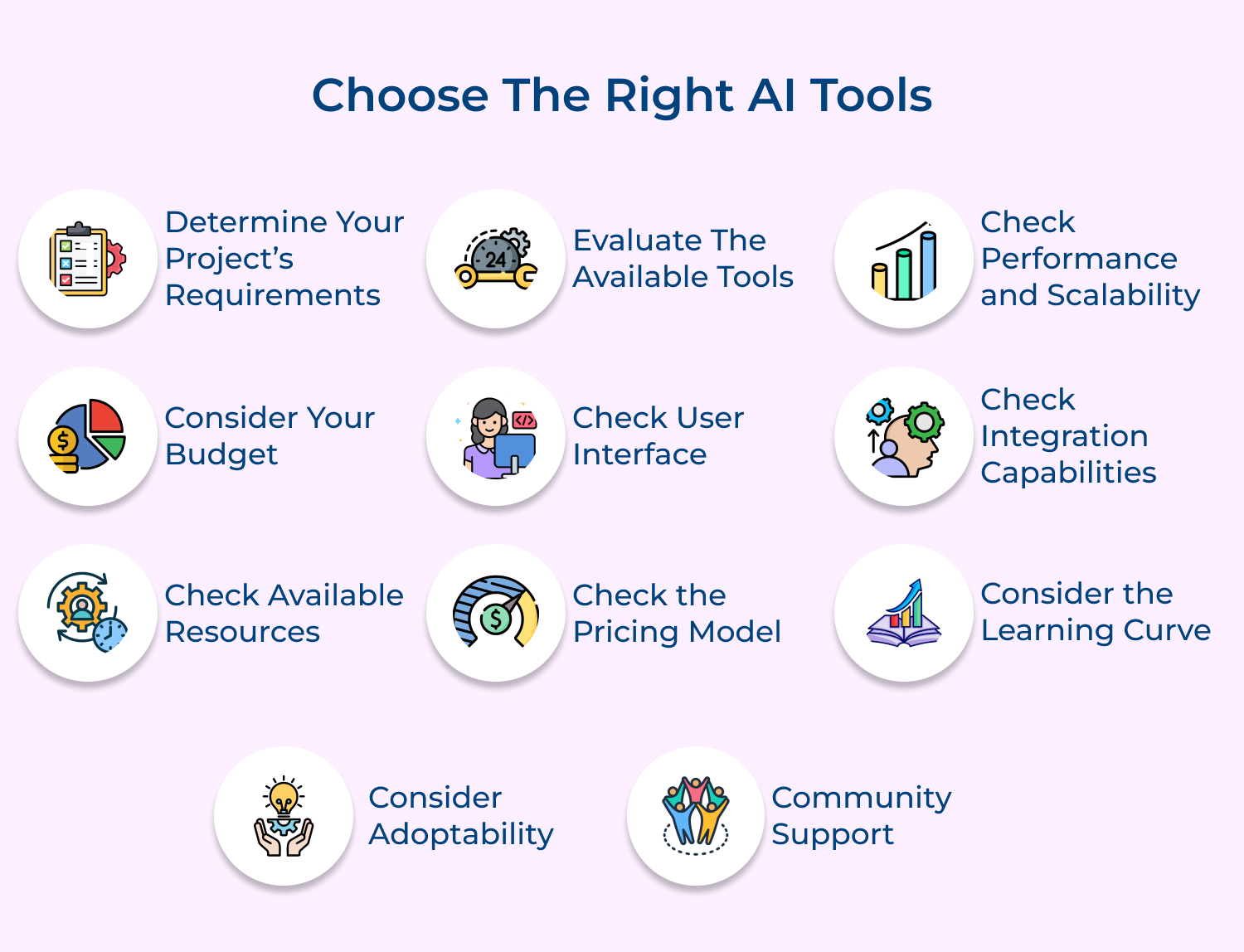
Best Practices:
Once you are done with selecting the AI tools, it’s time to design your automated workflow. Define the steps involved in the process, determine the triggers that will initiate each step, and set up the rules for how the workflow should operate.
Ensure to test the workflow thoroughly to ensure that it functions as intended before deploying it in a live environment.
Best Practices :
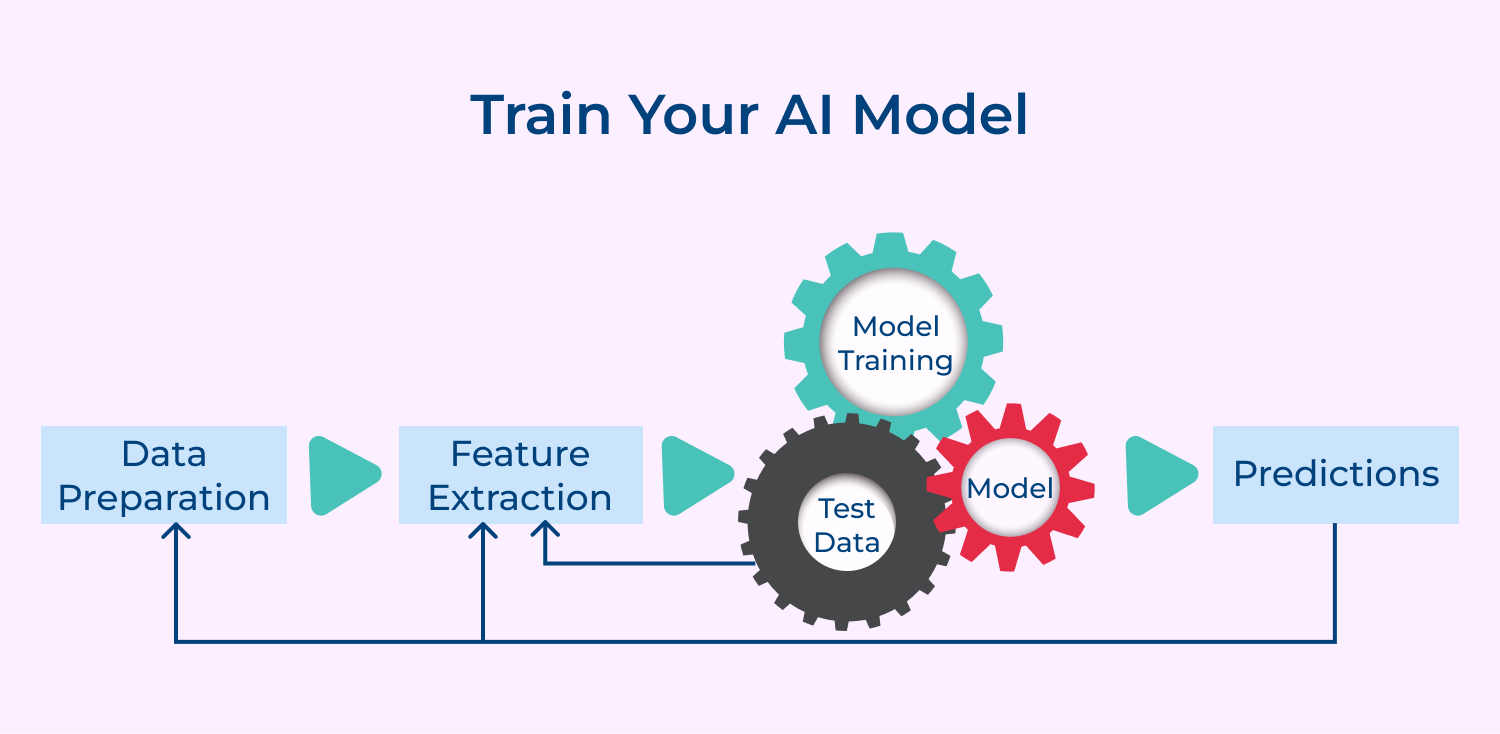
In case you require to create a custom AI model for your workflows, you will need to train it on relevant data to improve its accuracy and performance. It involves feeding the AI model with historical data, conducting tests, and making adjustments as needed.
Continuous monitoring and feedback will help optimize the AI model over time.
Best Practices:
Once your AI-automated workflow is up and running, it is essential to monitor its performance regularly.
Keep track of key metrics such as processing time, error rates, and cost savings to evaluate the effectiveness of the workflow. Make adjustments as needed to optimize efficiency and ensure that the workflow continues to meet your business objectives.
Best Practices:
AI workflow automation is revolutionizing the way businesses operate by streamlining repetitive tasks, reducing human error, and increasing efficiency. From customer service to data analysis, AI workflow automation has a wide range of use cases that can benefit businesses of all sizes.
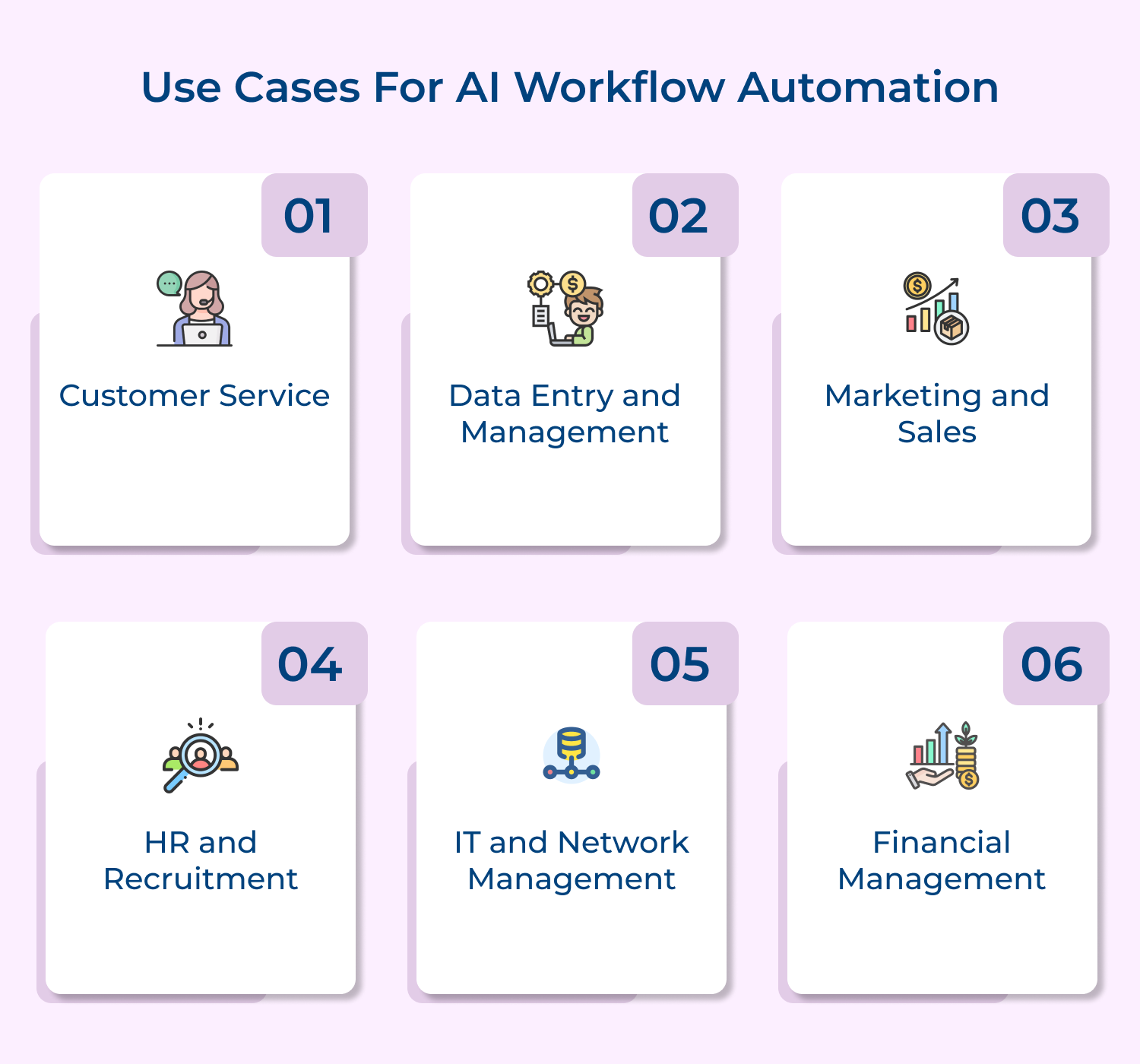
Here are some common use cases for AI workflow automation:
Implementing AI-based workflows can be incredibly beneficial for businesses looking to streamline their processes and improve efficiency. However, there are several challenges that organizations may face when integrating AI into their workflows.
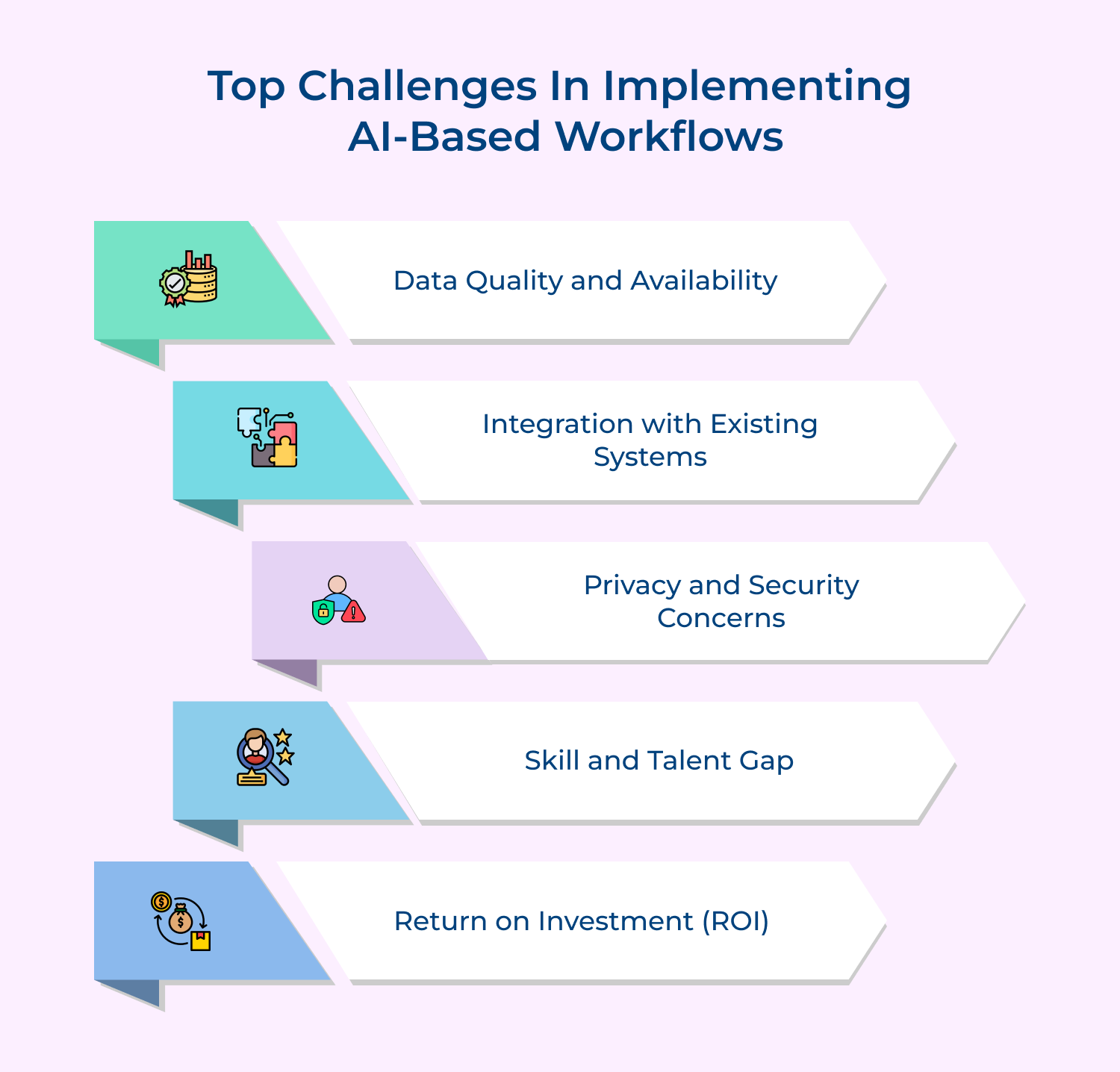
Let us discuss the top challenges in implementing AI-based workflows:
The key requirement for successful AI implementation is having access to high-quality, clean, and relevant data. Without the right data, AI algorithms may not be able to provide accurate results or make informed decisions. Businesses need to ensure that they have access to the right data sources and that the data is updated regularly.
Integrating AI-based workflows with existing systems can be a complex and challenging task. Businesses need to invest in new technology or update their current systems to ensure compatibility with AI algorithms. Training employees on how to use and interact with AI systems may also be necessary.
AI algorithms often require access to large amounts of data, which may raise concerns about privacy and security. Businesses need to ensure that they are complying with relevant data protection regulations and that sensitive information is handled securely when implementing AI-based workflows.
Implementing AI-based workflows requires individuals with the right skills to develop, implement, and manage AI systems. Some businesses may struggle to find employees with the necessary AI skills, leading to a talent gap that can hinder the successful implementation of AI workflows.
While AI can offer significant benefits in terms of efficiency, organizations need to carefully assess the costs and benefits of implementing AI-based workflows. Calculating the ROI of AI projects can be challenging, especially for organizations that are new to AI technology.
Artificial Intelligence (AI) is revolutionizing the way businesses operate by automating processes and workflows. AI workflow automation uses algorithms and machine learning to streamline tasks, increase efficiency, and reduce errors.
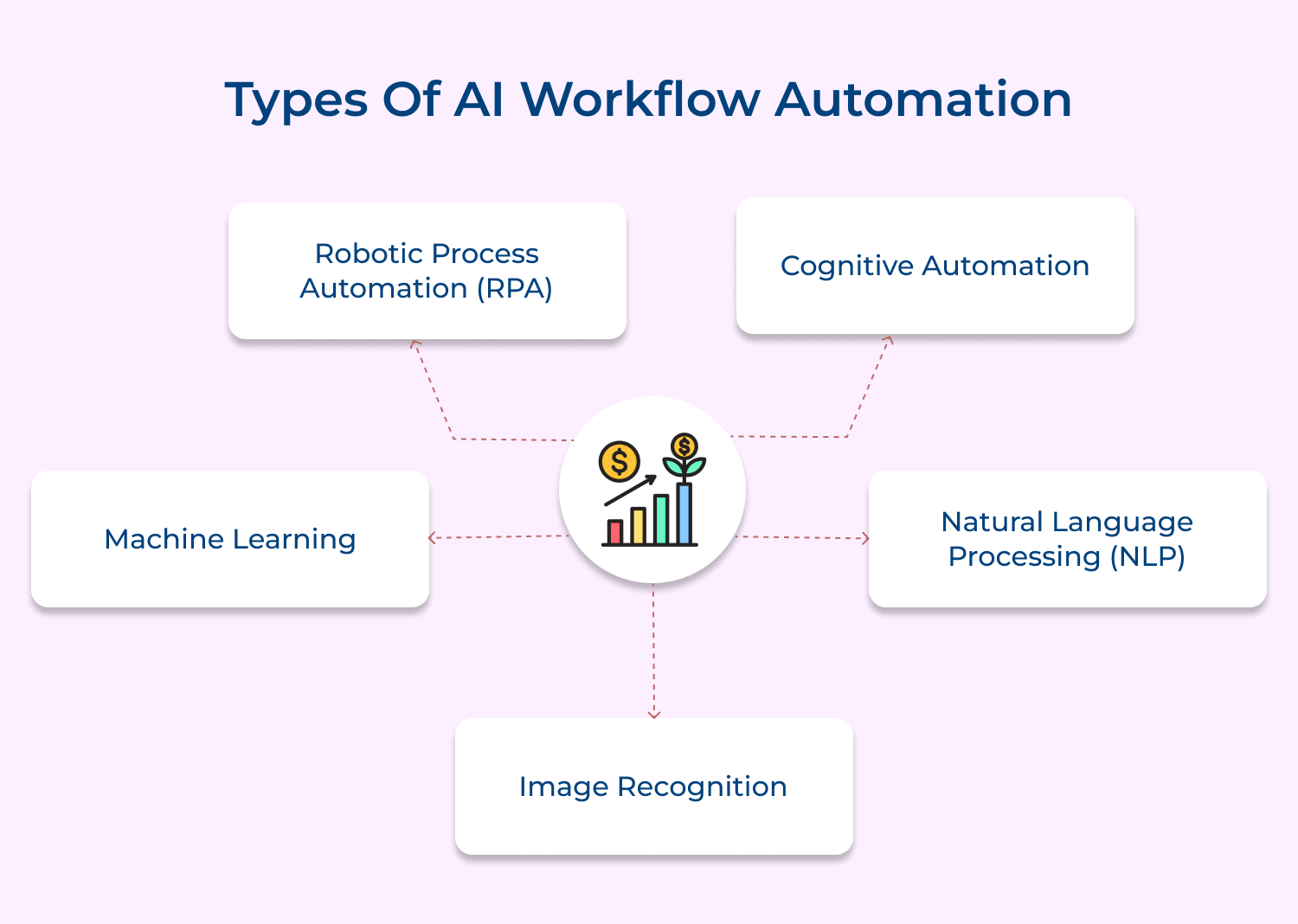
There are several types of AI workflow automation that businesses can implement to optimize their operations.
AI workflow automation is transforming industries and revolutionizing the way businesses operate. With the power of artificial intelligence, repetitive tasks can be automated, freeing up valuable time for employees to focus on more strategic and creative work.
Here are some real-life examples of AI workflow automation in action:
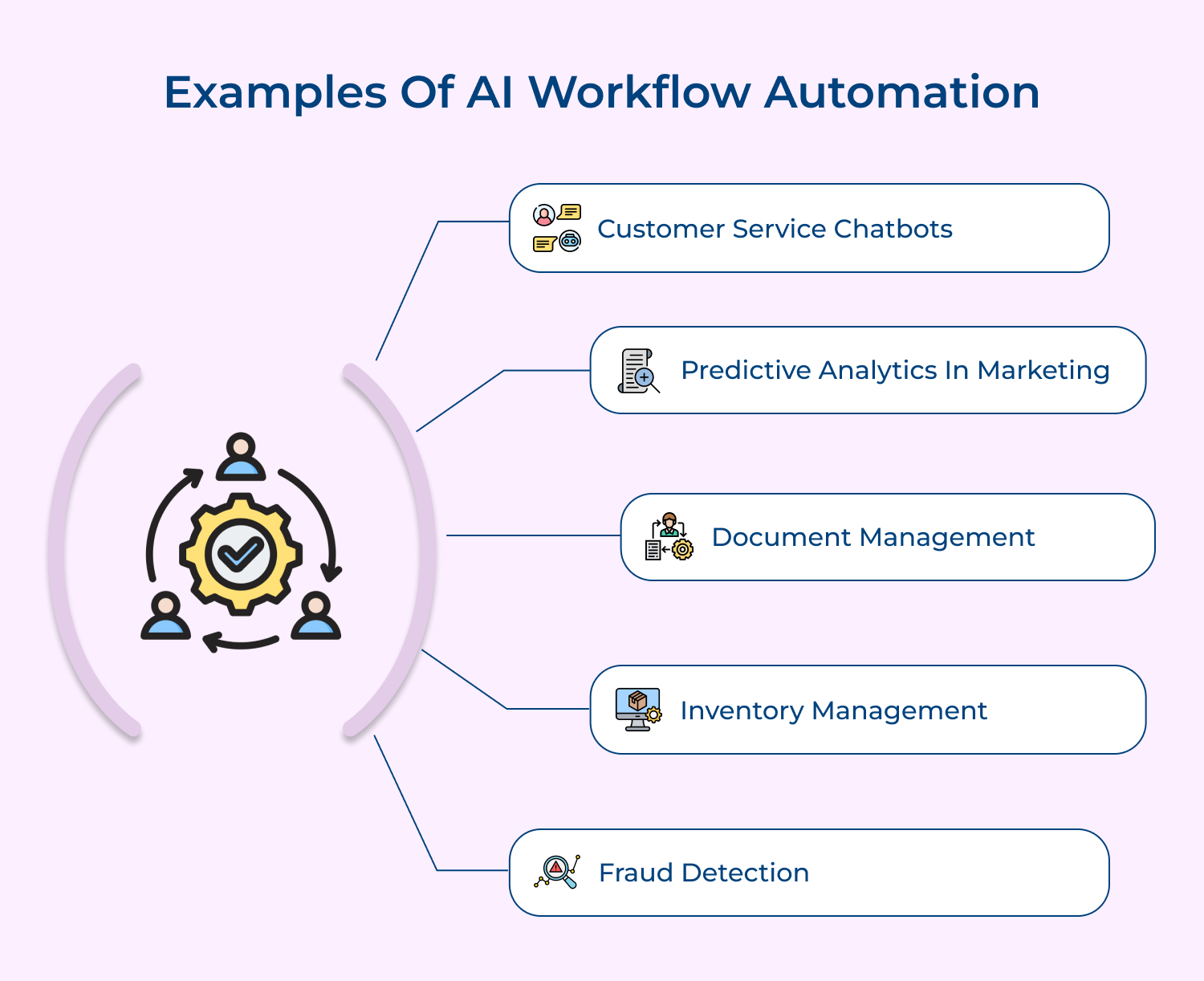
Many companies now utilize AI-powered chatbots to provide instant responses to customer inquiries. These chatbots can answer frequently asked questions, provide product recommendations, and even handle basic troubleshooting. By automating these customer service tasks, businesses can provide round-the-clock support and improve the overall customer experience.
The World Health Organization took the opportunity to utilize customer support chatbots to communicate with people across the globe. The WHO WhatsApp customer service bot included the precautionary measures, treatment options, travel updates, and symptoms. It first deployed the bot in English and eventually built a bot in all six United Nations languages.
Deployment of AI allows the algorithms to analyze vast amounts of data to predict customer behavior and preferences. Marketers can use this information to personalize marketing campaigns, optimize targeting strategies, and improve ROI. By automating the data analysis processes, marketing teams can make data-driven decisions faster and more accurately.
AI-powered document management systems can automatically categorize, organize, and retrieve documents based on keywords and content. This automation streamlines the document retrieval processes, reduces human error, and increases productivity. Businesses can save time and resources by utilizing AI to manage their documents efficiently.
The AI algorithms can forecast demand, optimize inventory levels, and automate replenishment processes. This automation minimizes stockouts, reduces excess inventory, and improves overall inventory efficiency. By implementing AI-powered inventory management systems, businesses can save costs and improve customer satisfaction.
Leveraging AI enables the algorithms to analyze transaction data in real-time to detect suspicious patterns and flag potentially fraudulent activities. By automating the fraud detection process, financial institutions can prevent fraud before it happens and protect their customers’ accounts. AI workflow automation in fraud detection saves time and resources.
Revolutionizing the way your organization operates by building AI-automated workflows can greatly enhance efficiency, productivity and overall success. By leveraging the power of artificial intelligence, workflows can be streamlined, repetitive tasks can be automated and decision-making processes can be optimized.
The innovative approach not only saves time and resources but also empowers employees to focus on more strategic initiatives. Embracing AI-automated workflows is essential for staying competitive in today’s rapidly evolving business landscape. So don’t wait, start transforming your organization today and unlock its full potential with AI automation.

1. What are the 4 stages of an AI workflow?
The four stages of an AI workflow are data collection, data preparation, model training and model deployment. Data collection involves gathering relevant data from various sources. Data preparation includes cleaning, transforming and organizing the data for analysis. Model training involves developing and fine-tuning the AI algorithms to achieve desired outcomes. The final AI system into the workflow for real-time use.
2. Why should businesses consider implementing AI workflow automation?
Businesses should consider implementing AI workflow automation to increase efficiency, reduce errors, and optimize decision-making processes. By automating repetitive tasks and analyzing large amounts of data, AI can help businesses save time & resources, leading to improved productivity.
3. How does AI contribute to streamlining workflow processes?
AI contributes to streamlining workflow processes by automating repetitive tasks, analyzing data to identify patterns, and making predictions or recommendations based on the data. By utilizing AI technologies, businesses can streamline their workflow processes, improve decision-making, and enhance overall performance.
4. What tools are needed for AI workflow automation?
To implement AI workflow automation, businesses may need various tools and technologies. These tools may include machine learning algorithms, natural language processing (NLP) models, predictive analytics software, data visualization tools and cloud computing resources. Businesses may also need to invest in training programs or hire data scientists and AI specialists to develop the AI workflow automation systems effectively.
 https://omni24.io/wp-content/uploads/2026/02/AI-customer-analytics.png
1257
2400
Tushar Joshi
https://omni24.io/wp-content/uploads/2023/04/Omni-Logo-1.svg
Tushar Joshi2026-03-31 05:17:522026-03-31 05:17:52How to Use AI Customer Analytics in Your Business: 10 Key Steps
https://omni24.io/wp-content/uploads/2026/02/AI-customer-analytics.png
1257
2400
Tushar Joshi
https://omni24.io/wp-content/uploads/2023/04/Omni-Logo-1.svg
Tushar Joshi2026-03-31 05:17:522026-03-31 05:17:52How to Use AI Customer Analytics in Your Business: 10 Key Steps https://omni24.io/wp-content/uploads/2026/02/ecommerce-analytics.png
1257
2400
Tushar Joshi
https://omni24.io/wp-content/uploads/2023/04/Omni-Logo-1.svg
Tushar Joshi2026-03-30 04:03:352026-03-30 04:03:35How to Use Ecommerce Analytics for Business Growth
https://omni24.io/wp-content/uploads/2026/02/ecommerce-analytics.png
1257
2400
Tushar Joshi
https://omni24.io/wp-content/uploads/2023/04/Omni-Logo-1.svg
Tushar Joshi2026-03-30 04:03:352026-03-30 04:03:35How to Use Ecommerce Analytics for Business Growth https://omni24.io/wp-content/uploads/2026/02/buying-experience.png
1257
2400
Tushar Joshi
https://omni24.io/wp-content/uploads/2023/04/Omni-Logo-1.svg
Tushar Joshi2026-03-27 04:04:082026-03-27 04:04:08How to Improve Buying Experience: 10 Best Strategies
https://omni24.io/wp-content/uploads/2026/02/buying-experience.png
1257
2400
Tushar Joshi
https://omni24.io/wp-content/uploads/2023/04/Omni-Logo-1.svg
Tushar Joshi2026-03-27 04:04:082026-03-27 04:04:08How to Improve Buying Experience: 10 Best Strategies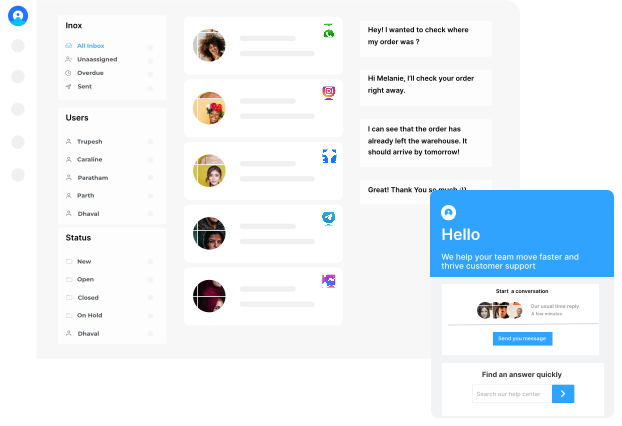
Whether it’s about acquire, engage or support – Omni24 covers all your customer engagement needs in one complete platform.

Copyright ©2026 Veemo All rights reserved.
CA, Los Angeles, Hall Ave, 19011
