Why Most Chatbot Fails and How to Prevent Them?
Chatbot Fails can be hilarious or frustrating—discover memorable misfires and key lessons for businesses to improve customer experiences.
Chatbot Fails can be hilarious or frustrating—discover memorable misfires and key lessons for businesses to improve customer experiences.
Chatbots have become ubiquitous in customer service, but their shortcomings are increasingly apparent.
Microsoft’s Tay, XiaoBing, Tencent’s BabyQ and KLM’s Twitter bot were all withdrawn after high-profile failures such as hate speech, unpatriotic comments etc.
Despite advances in AI, many users still encounter frustrating experiences with these digital assistants. From misinterpreting queries to providing irrelevant responses, chatbot failures can lead to customer dissatisfaction and lost business opportunities.
Explore common chatbot pitfalls and their impact on user experience. Delve into real-world examples of chatbot fails, analyze the underlying causes, and discuss the ripple effects on brand perception.
Chatbot failure occurs when an AI-powered conversational interface fails to meet user expectations or achieve its intended purpose. It can result in poor user experience, miscommunication, or inability to complete tasks effectively.
A common reason behind chatbot failure is the lack of contextual understanding and adaptability. When a chatbot cannot accurately interpret user intent or provide relevant and timely responses, users often feel frustrated and lose trust in the system.
Key objectives:
Chatbots have become increasingly popular as a customer service and engagement tool, but they often fail to meet user expectations.
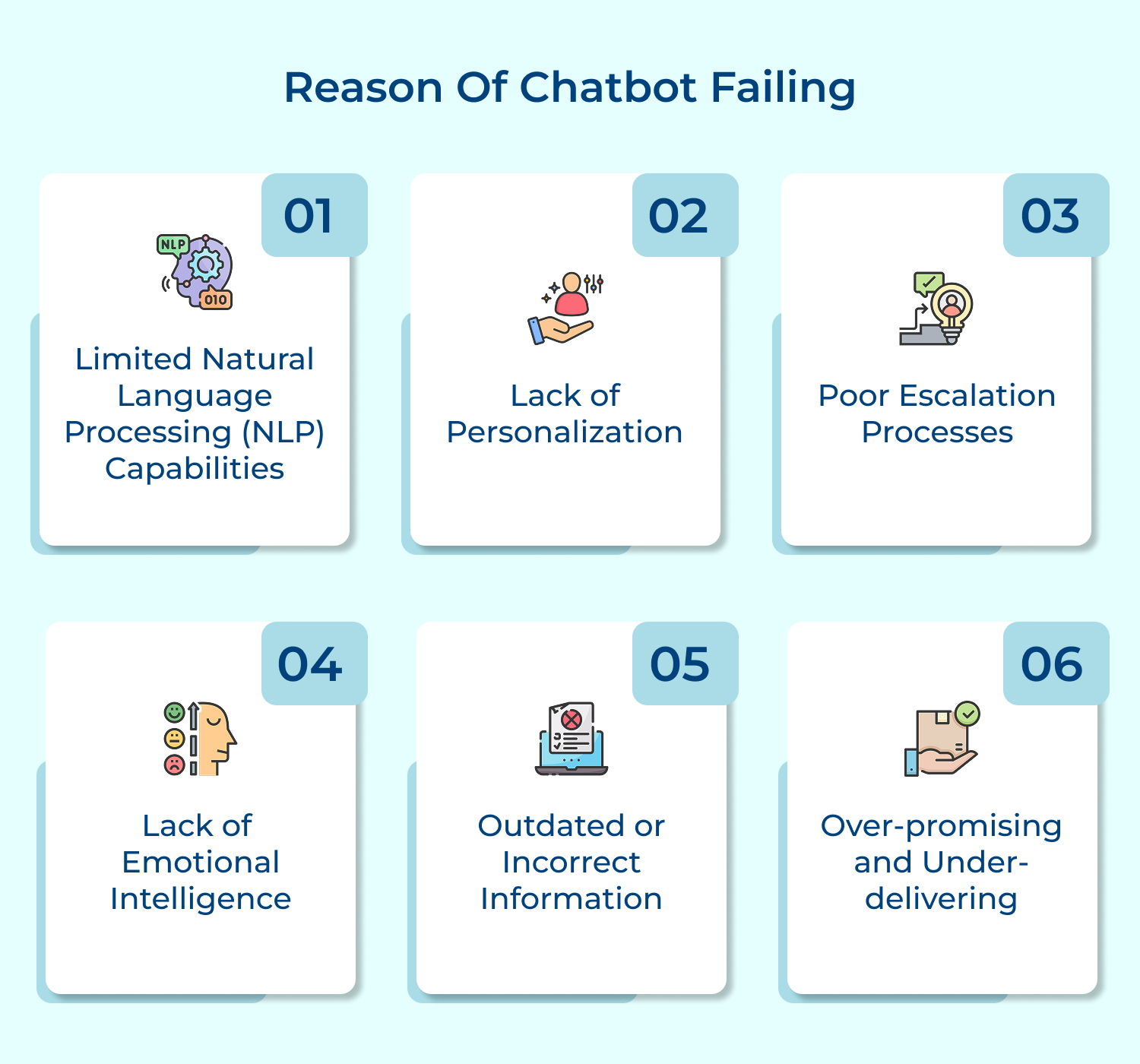
Chatbots have become an essential tool for businesses looking to streamline their customer service operations and improve user experience. Like any technology, chatbots are not immune to issues that can hinder their effectiveness.
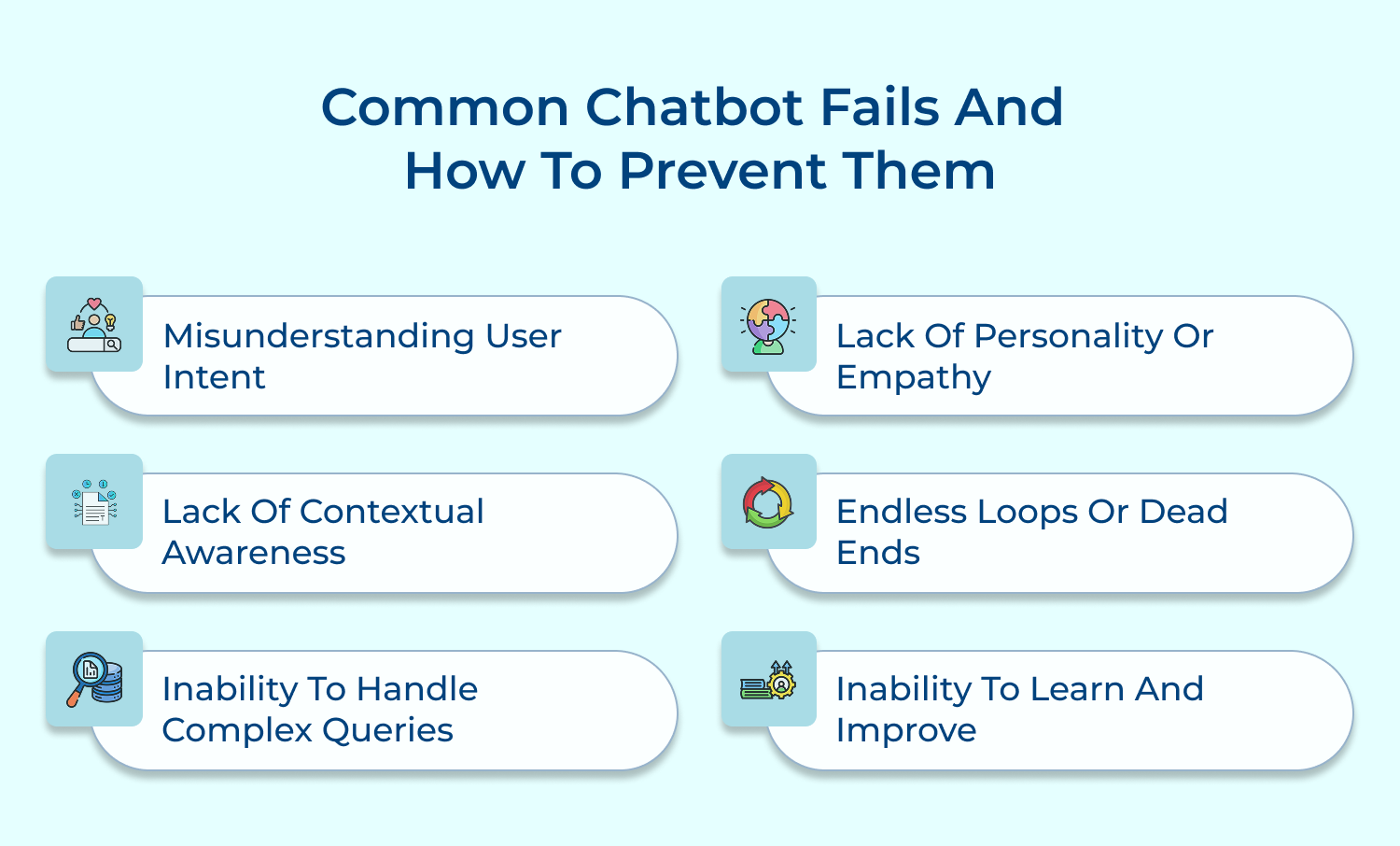
Chatbots sometimes misinterpret user queries, leading to irrelevant or incorrect responses. This can occur due to limited natural language processing capabilities or insufficient training data.
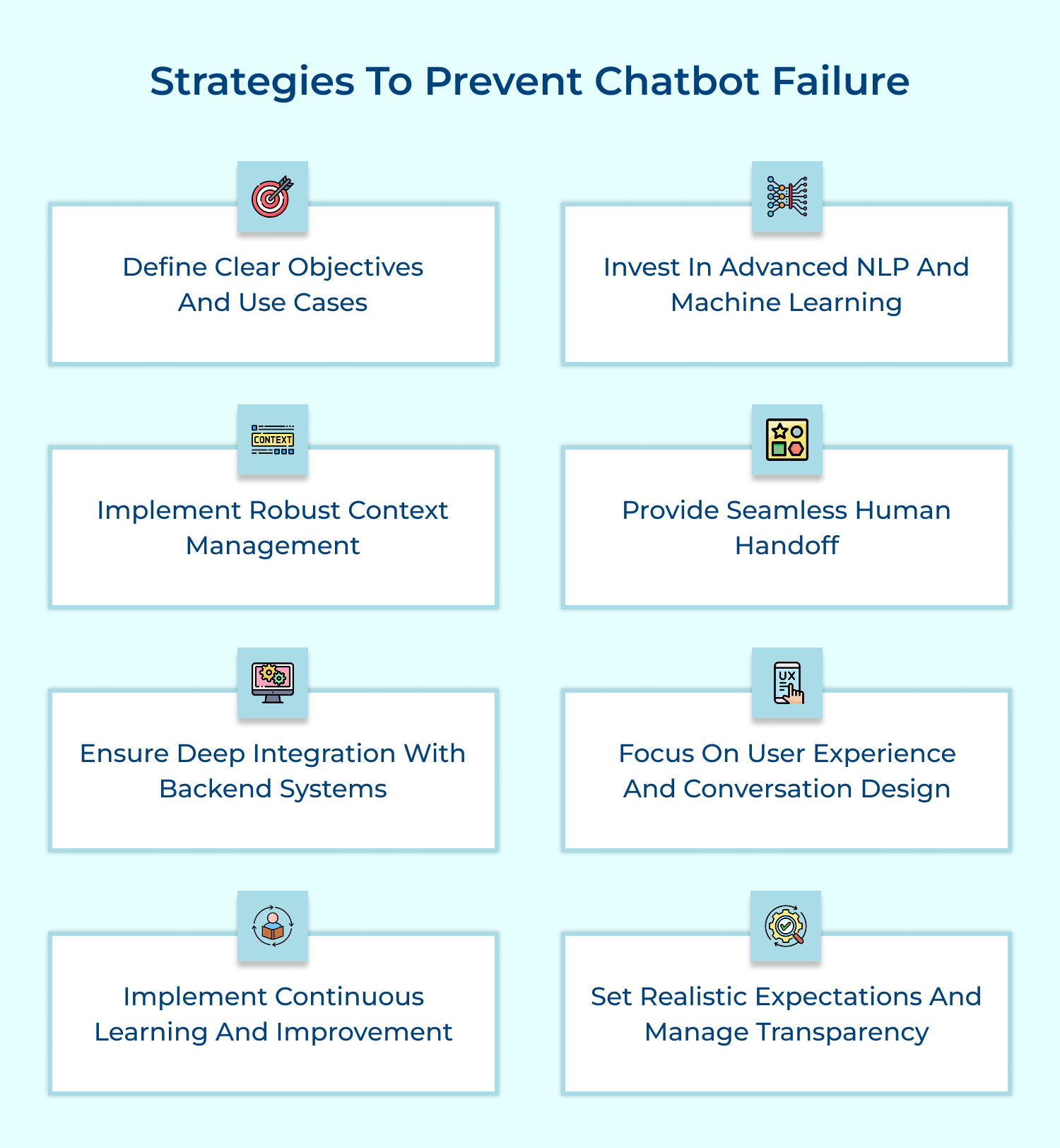
Prevention: Improve the chatbot’s natural language understanding through extensive training with diverse datasets. Implement intent recognition algorithms and continuously update the chatbot’s knowledge base based on user interactions.
How to implement :
Chatbots may fail to maintain context throughout a conversation, resulting in disjointed or repetitive responses that frustrate users.
Prevention: Develop the chatbot’s ability to track conversation history and maintain context. Implement state management techniques and design conversation flows that account for various user paths.
Tips to Implement:
When faced with multi-faceted or nuanced questions, chatbots may provide oversimplified or incomplete answers.
Prevention: Design the chatbot to recognize complex queries and either break them down into manageable parts or escalate to human support when necessary. Develop a robust knowledge base to handle a wide range of topics.
Pro tips:
Chatbots that communicate in a robotic or impersonal manner can alienate users and fail to build rapport.
Prevention: Develop a consistent personality for the chatbot that aligns with your brand voice. Incorporate empathy into responses, especially when dealing with customer service issues or sensitive topics.
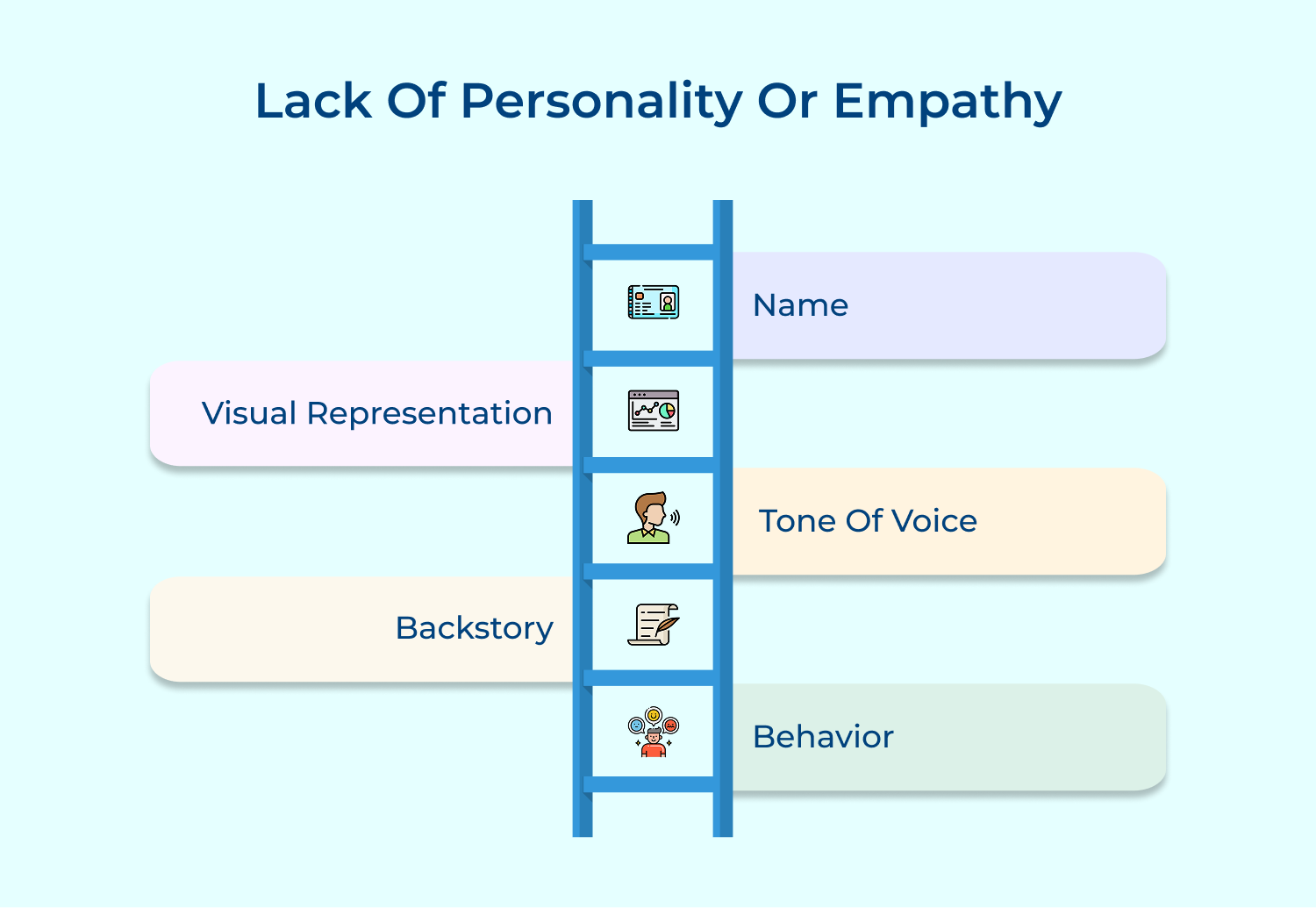
Ways to Implement it:
Users can become trapped in conversation loops or reach dead ends where the chatbot cannot provide further assistance.
Prevention: Design conversation flows with clear exit points and fallback options. Implement mechanisms to detect when a user is stuck and offer alternative solutions or human support.
How to Implement it:
Static chatbots that don’t evolve based on user interactions quickly become outdated and ineffective.
Prevention: Implement machine learning algorithms that allow the chatbot to learn from each interaction. Regularly analyze user feedback and chat logs to identify areas for improvement.
Tips to Implement it:
Chatbots have become an integral tool for businesses looking to improve customer service, automate processes and increase efficiency. But, chatbot failure is a common issue that many businesses face.
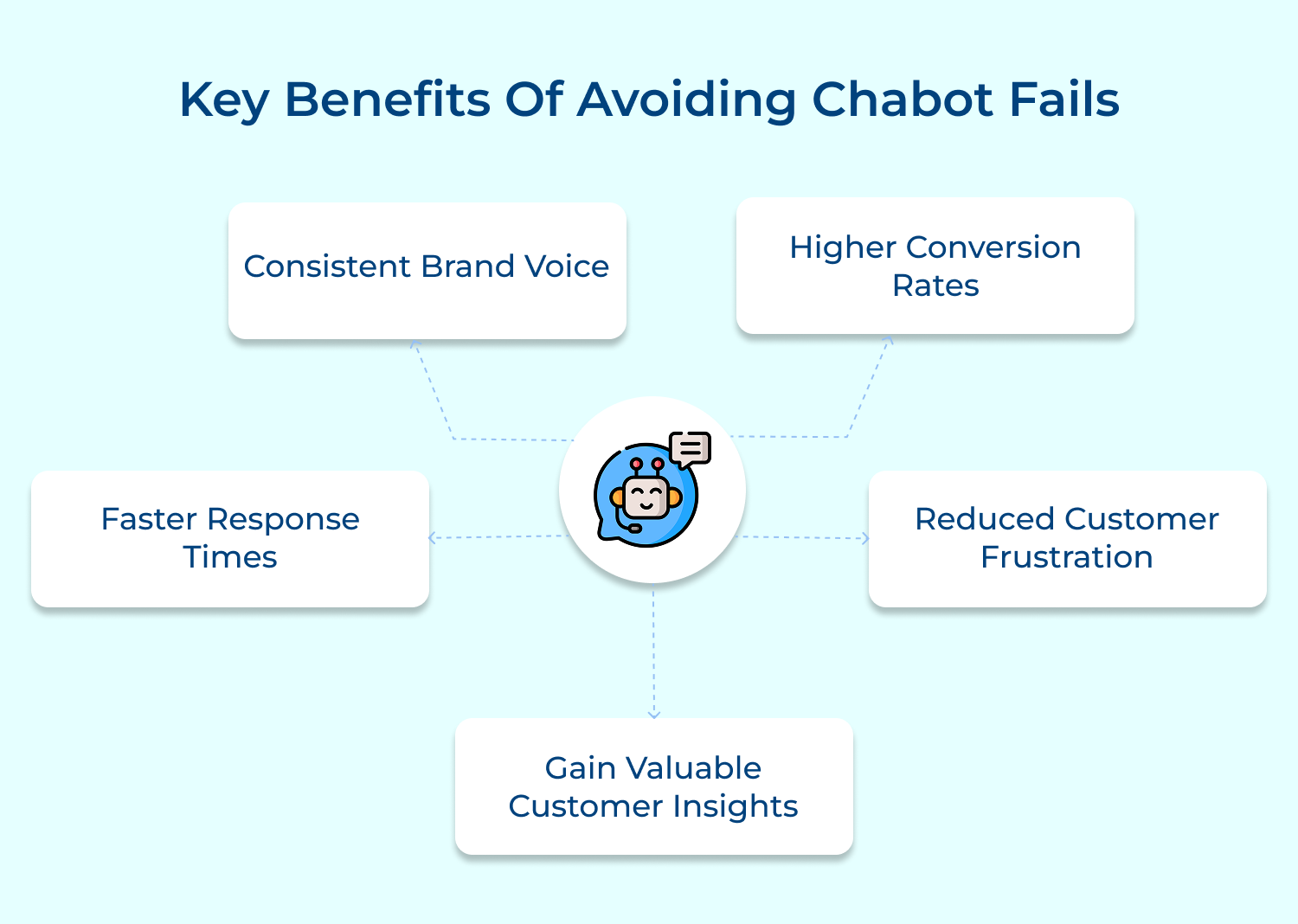
Avoiding chatbot failures yields numerous benefits for businesses, enhancing customer experience and operational efficiency.
Chatbots can interact with users and answer their questions or assist them. But, despite their growing popularity, chatbots are not without their flaws.
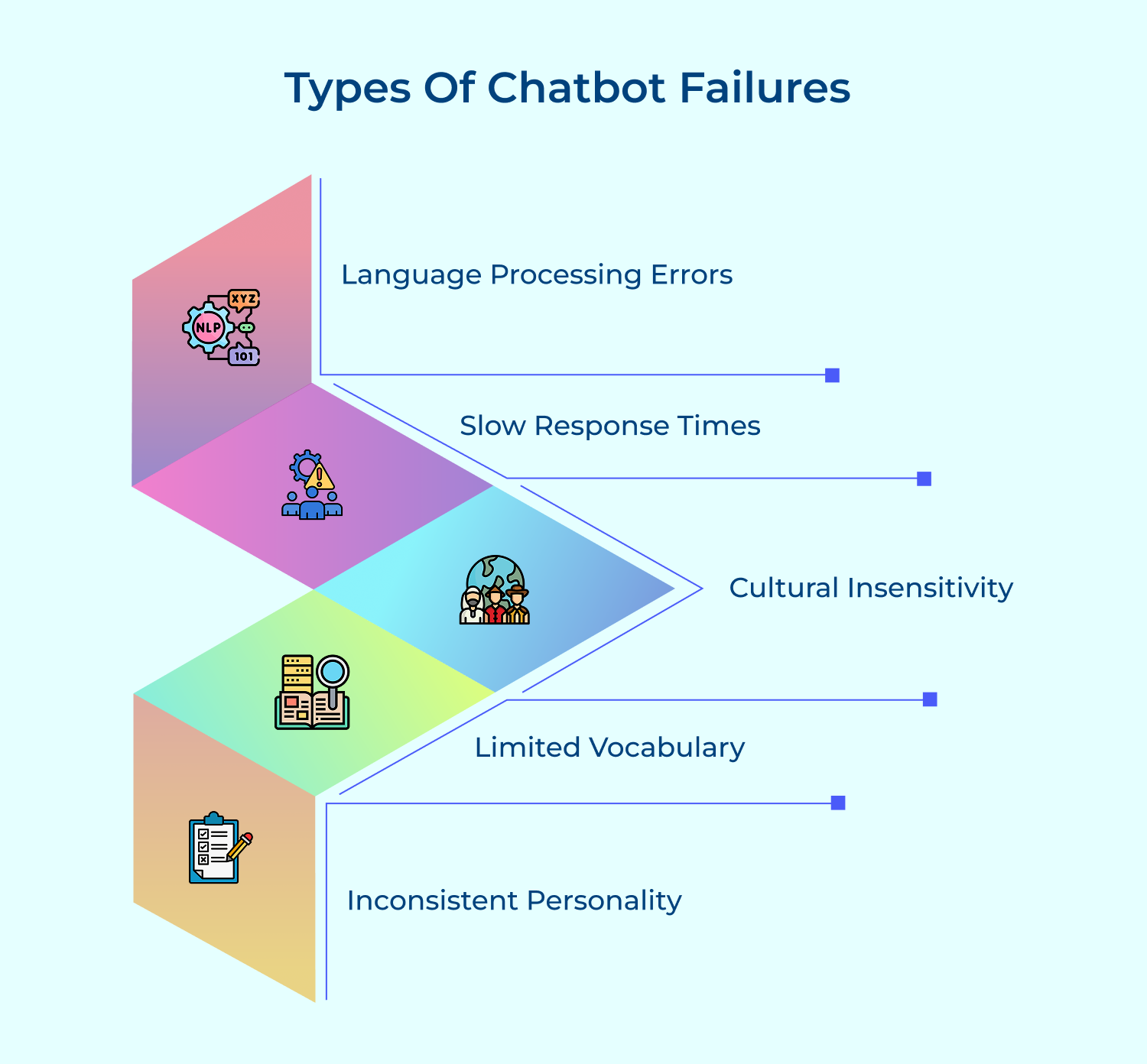
Language processing errors occur when chatbots misinterpret user input, leading to irrelevant or incorrect responses. These errors can stem from limitations in natural language understanding, inability to grasp context or confusion with ambiguous phrases and colloquialisms.
Pro tips to avoid:
Slow response times refer to delays between user input and chatbot replies. This can frustrate users accustomed to instant digital interactions, potentially leading to abandonment of the conversation and negative perception of the service.
Pro tips to avoid:
Cultural insensitivity in chatbots manifests as responses that are inappropriate or offensive to certain cultural groups. This can result from biases in training data, lack of cultural awareness in programming, or failure to account for regional differences in language and customs.
Pro tips to avoid:
A limited vocabulary restricts a chatbot’s ability to understand and respond to a wide range of user inputs. This can lead to repetitive responses, inability to handle nuanced queries and a general feeling of interacting with a simplistic system.
Pro tips to avoid:
Inconsistent personality refers to a chatbot’s failure to maintain a coherent character or tone throughout interactions. This can confuse users and diminish the authenticity of the conversation, potentially reducing trust.
Pro tips to avoid:
Chatbots have the potential to revolutionize customer service and business processes, but their success is not guaranteed. Factors such as poor design, lack of context, and technical limitations can all contribute to chatbot failure.
It is important for businesses to carefully implement their chatbot strategies, ensuring they provide value to users and are continuously monitored or improved. By learning from past failures and taking proactive steps to address potential issues, businesses can increase the chances of chatbot success at the same time enhance the customer experience.

How is a chatbot failure caused?
A chatbot failure can be caused by various factors such as poor design, lack of proper training data, inadequate testing and failure to understand user needs. If a chatbot is not properly programmed or trained, it may give incorrect or irrelevant responses to user queries, leading to frustration and dissatisfaction.
Why is it important to overcome chatbot failure?
It is important to overcome chatbot failure because a poorly functioning chatbot can have negative consequences for your business. Customers may become frustrated with the chatbot and choose to interact with a human representative instead, leading to longer wait times. A chatbot that consistently provides incorrect information can damage your brand reputation and credibility.
How does a chatbot failure affect your business?
A chatbot failure can have a significant impact on your business in terms of customer satisfaction, brand image and overall revenue. If customers have a negative experience with your chatbot, they may be less likely to engage with your business in the future. This can result in lost sales opportunities and lower customer retention rates. If customers share their negative experiences with others, it can harm your brand reputation and deter potential customers.
Which chatbot should you choose?
When choosing a chatbot for your business, it is important to consider your specific needs and goals. There are various types of chatbots available, ranging from rule-based chatbots to AI-powered chatbots. Rule-based chatbots are more limited in their capabilities and can only respond to specific prompts, while AI-powered chatbots use natural language processing to understand to a wider range of queries.
 https://omni24.io/wp-content/uploads/2026/09/Social-commerce-scaled.png
1340
2560
Webvision Solution
https://omni24.io/wp-content/uploads/2023/04/Omni-Logo-1.svg
Webvision Solution2026-10-23 12:18:272026-10-23 12:18:27What is Social Commerce and Why Does It Matter?
https://omni24.io/wp-content/uploads/2026/09/Social-commerce-scaled.png
1340
2560
Webvision Solution
https://omni24.io/wp-content/uploads/2023/04/Omni-Logo-1.svg
Webvision Solution2026-10-23 12:18:272026-10-23 12:18:27What is Social Commerce and Why Does It Matter? https://omni24.io/wp-content/uploads/2026/08/AI-Customer-Service-Agents.png
1256
2400
Webvision Solution
https://omni24.io/wp-content/uploads/2023/04/Omni-Logo-1.svg
Webvision Solution2026-09-21 04:48:512026-09-21 04:48:51How to Build an AI Customer Service Agents: 8 Key Steps
https://omni24.io/wp-content/uploads/2026/08/AI-Customer-Service-Agents.png
1256
2400
Webvision Solution
https://omni24.io/wp-content/uploads/2023/04/Omni-Logo-1.svg
Webvision Solution2026-09-21 04:48:512026-09-21 04:48:51How to Build an AI Customer Service Agents: 8 Key Steps https://omni24.io/wp-content/uploads/2026/08/Omnichannel-Conversational-AI.png
1256
2400
Tushar Joshi
https://omni24.io/wp-content/uploads/2023/04/Omni-Logo-1.svg
Tushar Joshi2026-09-16 03:51:072026-09-16 03:51:07How to Build Omnichannel Conversational AI Strategy
https://omni24.io/wp-content/uploads/2026/08/Omnichannel-Conversational-AI.png
1256
2400
Tushar Joshi
https://omni24.io/wp-content/uploads/2023/04/Omni-Logo-1.svg
Tushar Joshi2026-09-16 03:51:072026-09-16 03:51:07How to Build Omnichannel Conversational AI Strategy
Whether it’s about acquire, engage or support – Omni24 covers all your customer engagement needs in one complete platform.

Copyright ©2026 Veemo All rights reserved.
CA, Los Angeles, Hall Ave, 19011