How to Use Ecommerce Analytics for Business Growth
Ecommerce analytics turns data into actionable insights that boost sales, enhance customer experience and optimize marketing and inventory strategies.

Ecommerce analytics turns data into actionable insights that boost sales, enhance customer experience and optimize marketing and inventory strategies.
Running an ecommerce business without clear analytics is like flying blind — you miss critical opportunities and make costly decisions based on guesswork. Data lets you see real customer behavior, sales patterns and inventory performance so you can act with confidence.
For example, personalization powered by analytics can boost revenue by up to 25% and give a 400% ROI for most retailers. Without this insight, you’re stuck guessing what customers want, leading to lost sales, wasted marketing spend and stock issues.
Ecommerce brands that use data to personalize and optimize see higher conversion rates, better retention as well as smarter operations.
Ecommerce analytics refers to the process of interpreting data from online stores to gain actionable insights about customer behavior, sales performance, marketing effectiveness and overall business operations. It involves tracking various metrics and KPIs across the customer journey to understand patterns and trends that can inform strategic decision-making.
Analytics enables businesses to personalize shopping experiences, which has become an expectation among modern consumers. Companies that effectively utilize ecommerce analytics can respond more quickly to market changes, stay ahead of competitors and ultimately drive higher conversion rates as well as revenue growth.
Key objectives
From understanding customer behavior to improving sales and inventory planning, analytics helps you grow with confidence instead of guesswork. Let’s explore these benefits:
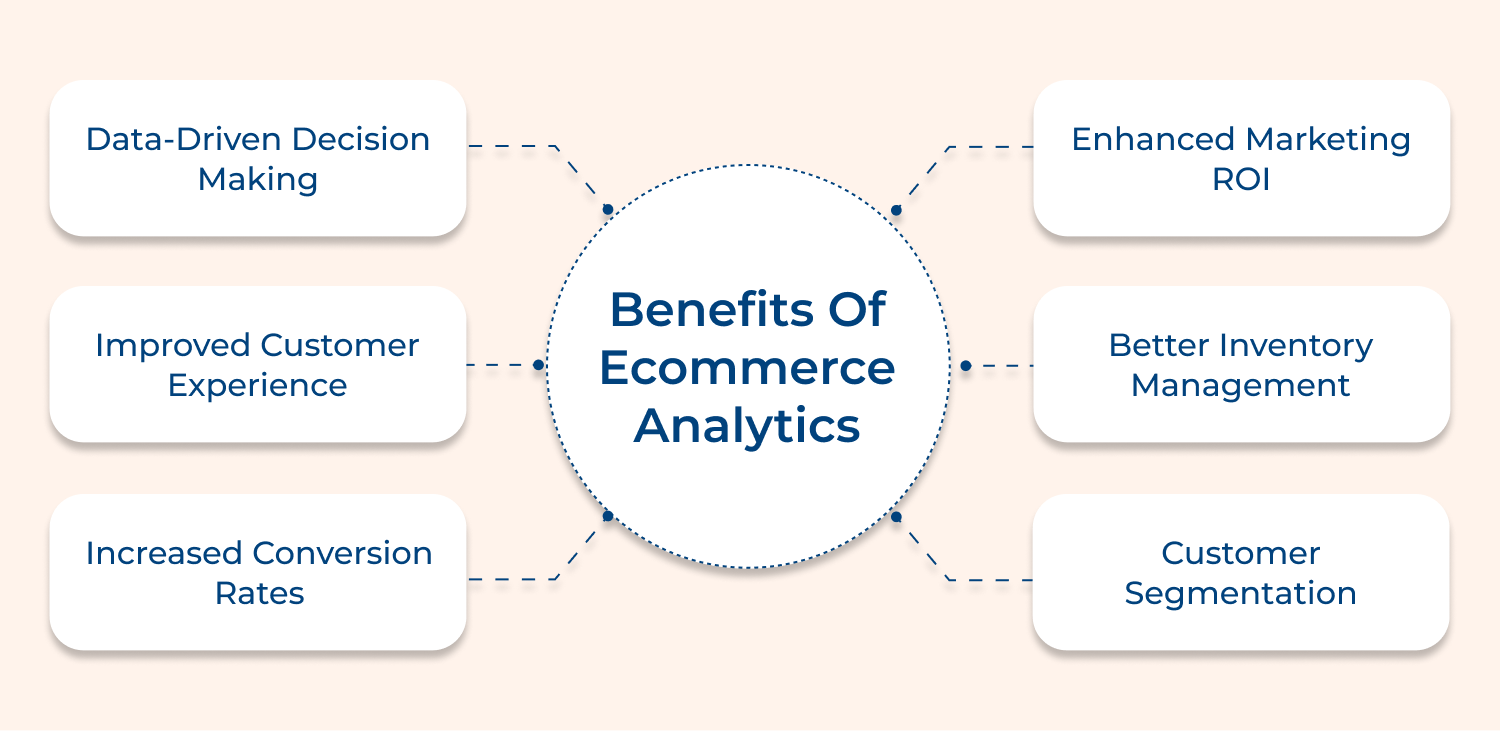
1. Data-Driven Decision Making
Ecommerce analytics provide actionable insights that enable businesses to make informed decisions. Relying on data helps optimize marketing strategies, improve product offerings and enhance overall operations more effectively.
2. Improved Customer Experience
Tracking customer behavior and preferences allows businesses to understand what customers want. Personalizing shopping experiences, offering tailored recommendations and creating smoother journeys all contribute to boosting customer loyalty as well as retention.
3. Increased Conversion Rates
Ecommerce analytics pinpoint areas where customers might abandon the buying process. Identifying these issues helps businesses streamline checkout processes, optimize landing pages and convert more visitors into paying customers.
4. Enhanced Marketing ROI
Ecommerce analytics enables businesses to monitor the performance of various marketing campaigns. Allocating resources effectively ensures focus on high-performing channels, ultimately resulting in a higher return on investment for marketing efforts.
5. Better Inventory Management
Insights into product demand and sales trends enable businesses to forecast more accurately. Optimizing inventory levels helps prevent stockouts, reduce overstocking while ensuring smoother supply chain management.
6. Customer Segmentation
Ecommerce analytics offer the ability to segment customers based on behavior, demographics and purchase history. Segmenting customers enables targeted marketing, personalized offers and better customer service, increasing engagement as well as conversion rates.
Ecommerce analytics can be broken down into different types. Together, they help you understand what’s happening, why it’s happening and how to improve future performance.
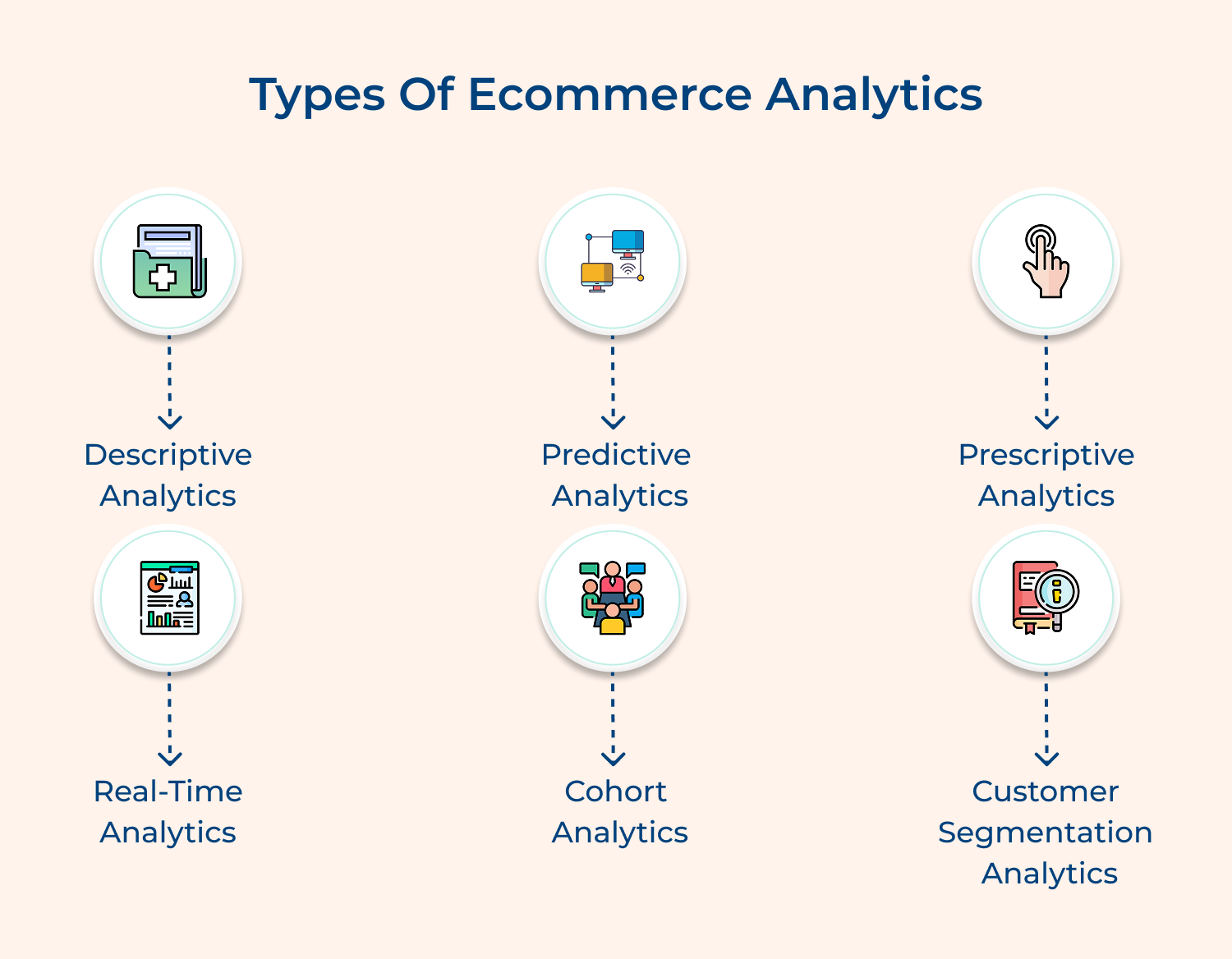
Descriptive analytics looks at historical data to show what has already happened in your ecommerce business. It helps you spot patterns in sales, customer behavior and product performance. This type of analytics gives you clarity on past results and serves as the foundation for planning, reporting as well as smarter decision-making going forward.
Predictive analytics uses past data and statistical models to anticipate future trends as well as customer behavior. It helps you forecast demand, predict sales performance and understand how customers might act next. With these insights, businesses can plan inventory better, fine-tune marketing efforts and make proactive pricing or promotion decisions.
Prescriptive analytics takes things a step further by recommending actions, not just predictions. Using machine learning and optimization techniques, it suggests the best ways to improve outcomes. This can include identifying growth opportunities, optimizing customer journeys, or deciding how to allocate resources for maximum impact.
Real-time analytics analyzes data the moment it’s generated, giving instant visibility into what’s happening right now. This helps businesses react quickly by adjusting campaigns, managing inventory, or responding to customer behavior as it unfolds. It keeps operations agile and customer experiences responsive.
Cohort analytics groups customers based on shared characteristics or actions over a specific time period. This makes it easier to track how different customer groups behave, purchase, or respond to campaigns. These insights help businesses improve retention and tailor strategies for each cohort.
Customer segmentation analytics divides customers into distinct groups based on demographics, behavior, or preferences. This allows businesses to personalize marketing, products and communication for each segment. The result is higher engagement, better conversions and more relevant customer experiences.
Ecommerce analytics helps turn data into practical insights. When used right, it guides everything from marketing and inventory planning to customer experience.
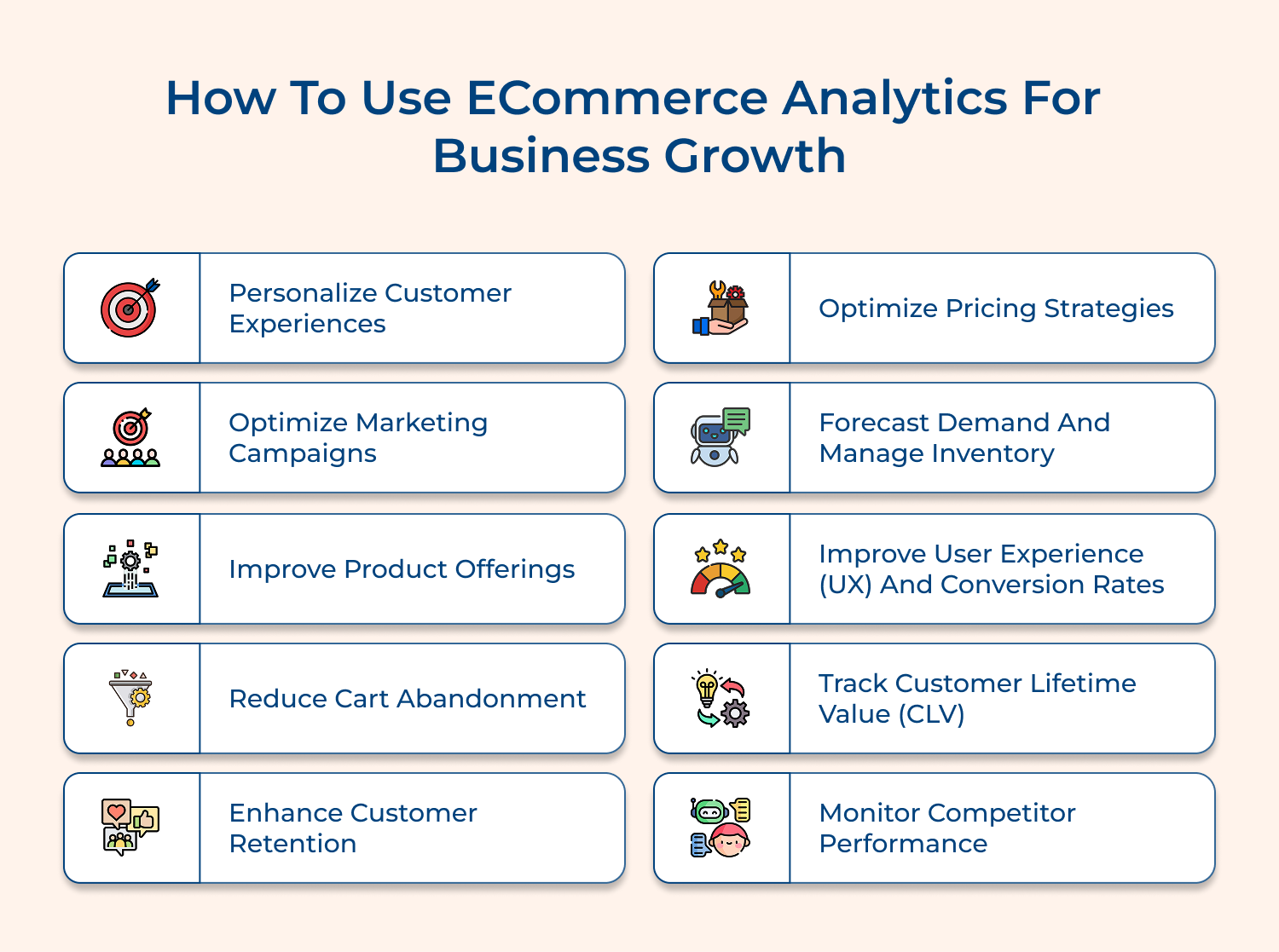
Personalizing customer experiences is all about using data to make every interaction feel relevant and thoughtful.
By understanding customer behavior as well as past purchases, you can offer tailored product recommendations, targeted emails and personalized promotions.
When customers feel seen and understood, they’re more likely to return, engage with your brand while building long-term loyalty—boosting both retention as well as lifetime value.
Actionable tips:
Optimizing marketing campaigns involves analyzing the performance of various marketing strategies. This helps identify the most effective channels and adjust tactics to improve results.
It’s essential to avoid wasting marketing resources. By understanding which campaigns are working, businesses can allocate their budget more effectively, maximizing the return on investment while improving overall campaign results.
Track key metrics like click-through rates, conversions and customer engagement across all marketing channels. Use this data to focus resources on the best-performing platforms and refine strategies for underperforming campaigns.
Tips:
Improving product offerings means using real data to understand what customers actually want. By analyzing sales trends, customer feedback, as well as market insights, you can identify which products perform well and which don’t.
This helps you refine your catalog by promoting top sellers, removing underperforming items and introducing products in demand. Regular updates keep your offerings relevant, boost sales and ensure customers always find value in your store.
Tips:
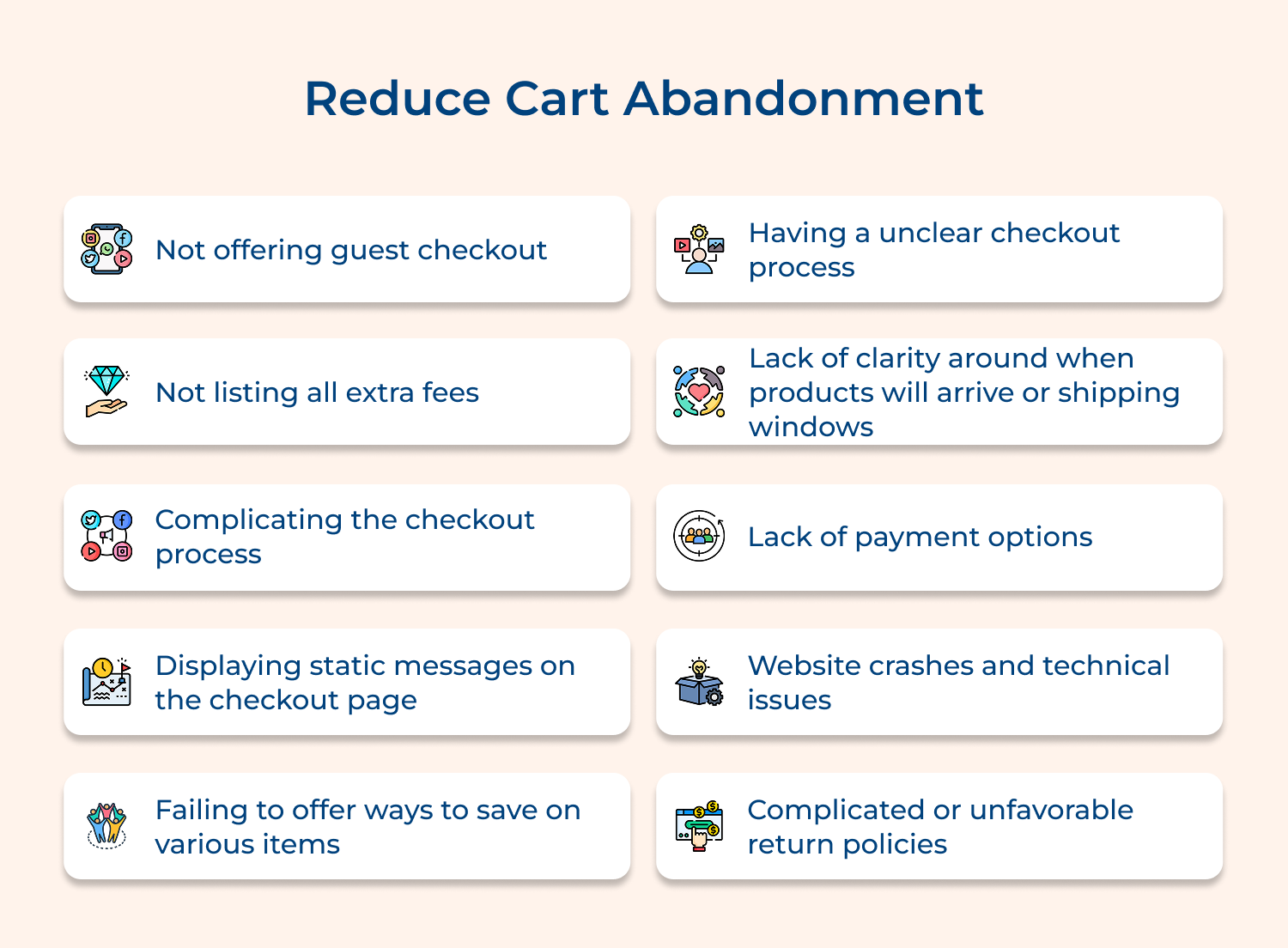
Reducing cart abandonment starts with understanding exactly where shoppers drop off during checkout. By analyzing this data, you can spot friction points and fix them quickly.
Simplifying the checkout process, offering timely incentives and sending reminder emails or retargeted ads helps bring customers back. These small, data-driven improvements can recover lost sales and significantly boost overall conversion rates.
Actionable tips:
Enhancing customer retention starts with understanding what keeps customers coming back—and what makes them leave. By analyzing purchase behavior and engagement data, you can identify loyal shoppers as well as spot drop-off risks early.
Using these insights, offer personalized content, exclusive deals and loyalty programs that make customers feel valued. Strong retention not only boosts repeat purchases but also drives long-term growth through trust, advocacy and referrals.
Tips:
Optimizing pricing strategies means using data to find the sweet spot that balances demand, competition and customer behavior. Pricing products too high can push customers away, while pricing too low hurts margins.
Data-driven insights help businesses make smarter pricing decisions in real time. By analyzing sales trends, tracking competitor prices and running A/B tests, you can adjust prices dynamically to boost conversions while maximizing profitability.
Actionable tips:
Forecasting demand and managing inventory is about using data to anticipate what customers will buy as well as when. By analyzing past sales and market trends, businesses can stock the right products at the right time.
Accurate forecasting helps avoid stockouts, reduce overstocking and lower storage costs. With automated inventory tracking and demand-based restocking, you can meet customer demand efficiently without tying up capital in excess inventory.
Actionable tips:
Improving user experience and conversion rates starts with making your website easy, fast as well as enjoyable to use. When shoppers face slow load times or confusing navigation, they’re more likely to leave without buying.
Analytics helps pinpoint these friction points so you can fix them quickly. By improving site speed, simplifying navigation and optimizing for mobile, you create a smoother shopping journey that keeps users engaged as well as increases conversions.
Tips:
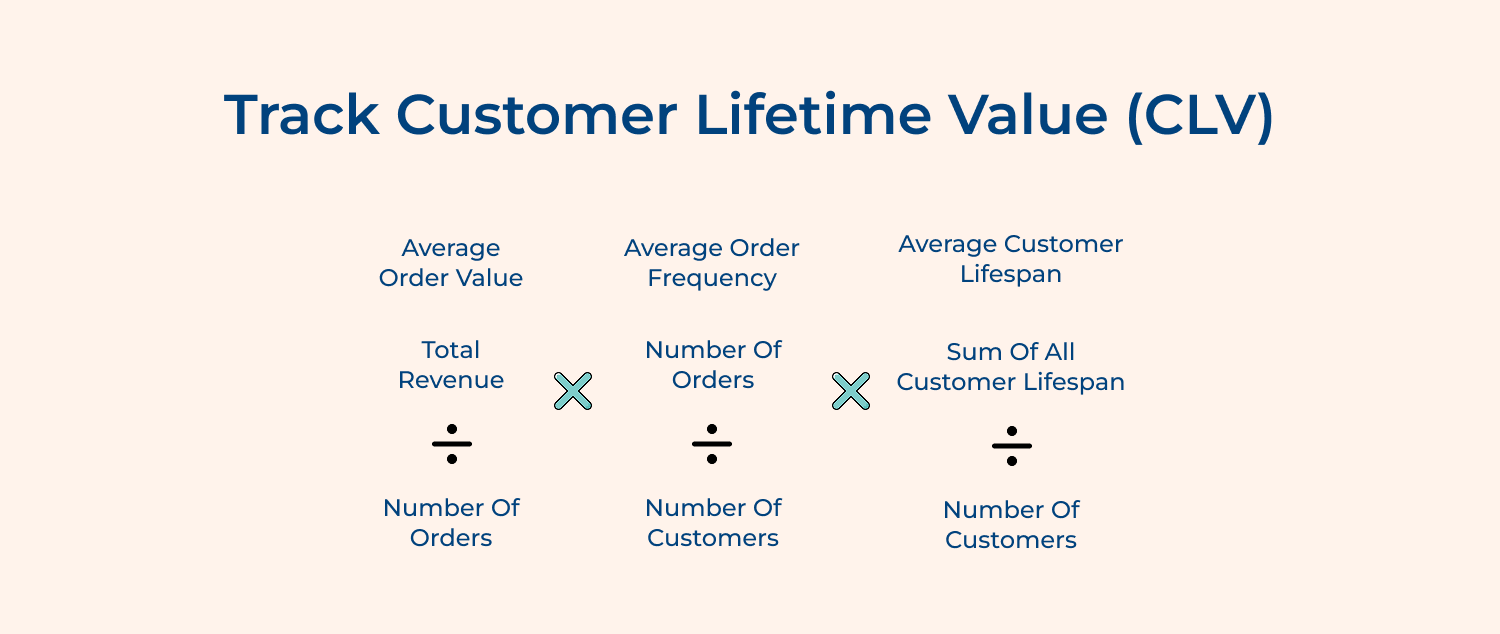
Tracking customer lifetime value (CLV) helps you understand how much revenue a customer brings in over time. This insight makes it easier to focus on the customers who matter most.
By analyzing purchase frequency, order value and buying patterns, you can segment high-value customers as well as create targeted campaigns. Nurturing these relationships with personalized offers and experiences boosts loyalty while driving long-term profitability.
Tips:
Monitoring competitor performance helps you understand how your business stacks up in the market. By tracking competitors’ pricing, product offerings and marketing strategies, you can spot gaps as well as opportunities faster.
Regular analysis allows you to adjust your own strategies, respond quickly to market changes and stay competitive. Using competitive analysis tools ensures your pricing, promotions and product mix remain relevant as well as ahead of the curve.
Actionable tips:
Implementing ecommerce analytics effectively requires following best practices that turn data into actionable insights. By doing so, businesses can make informed decisions. Let’s explore:
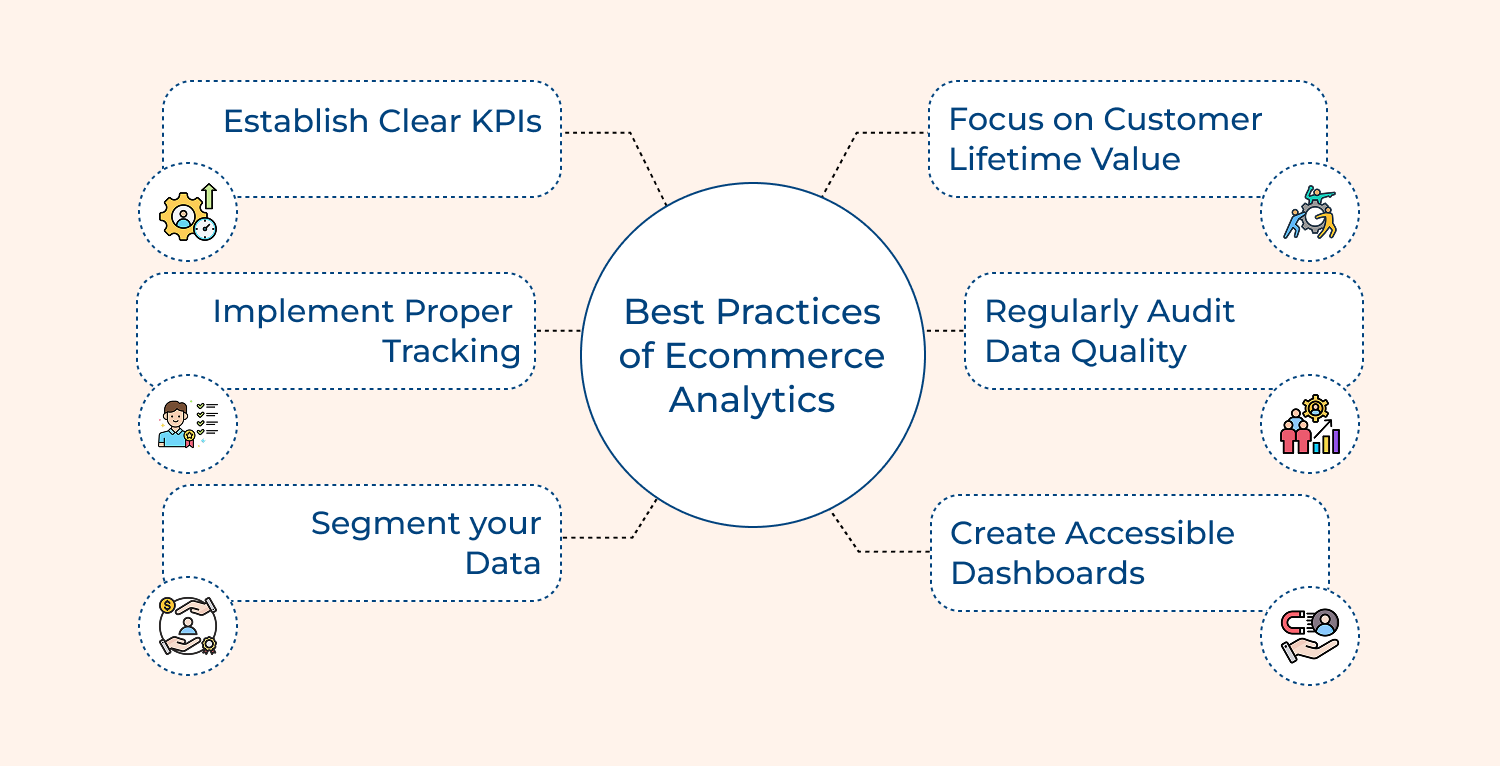
Establish clear KPIs: Define specific metrics that align with your business objectives before collecting data. Focus on actionable metrics like conversion rate, average order value and customer acquisition cost rather than vanity metrics that don’t drive decisions.
Implement proper tracking: Set up comprehensive tracking across all customer touchpoints using tools like Google Analytics 4 and your ecommerce platform’s native analytics. Ensure proper UTM parameter usage to accurately attribute traffic sources and campaign performance.
Segment your data: Break down analytics by customer demographics, acquisition channels, device types and product categories. Segmentation reveals insights that aggregate data might miss and helps identify specific opportunities for optimization within customer subgroups.
Focus on customer lifetime value: Look beyond single transactions to understand the long-term value of different customer segments. This perspective helps justify acquisition costs and informs retention strategies for your most valuable customer groups.
Regularly audit data quality: Schedule periodic reviews of your analytics implementation to check for tracking errors or data gaps. Clean data is essential for confident decision-making. Fix broken tracking promptly to maintain historical data integrity.
Create accessible dashboards: Design intuitive dashboards that present key metrics to stakeholders in digestible formats. Customize views for different departments to focus on relevant KPIs without overwhelming users with excessive data points.
Ecommerce analytics offers powerful insights, but it comes with its challenges. Here’s how you can navigate data complexity and ensure accurate interpretation to make informed decisions.
1. Data Overload
Handling large volumes of data from multiple sources can be overwhelming. With so much information, it’s easy to become distracted by insignificant data points or miss important trends.
How to Overcome:
Implement effective data management systems to clean and organize the data. Use automated analytics platforms to consolidate all data sources as well as present it in an easily digestible format. This will allow you to focus on actionable insights and eliminate data noise, improving decision-making.
2. Data Quality Issues
Inaccurate or incomplete data can mislead decisions and result in ineffective strategies. For instance, incorrect tracking of user activity can create false reports about customer behavior.
How to Overcome:
Regularly audit your data sources to identify any inconsistencies. Use data validation rules during collection and entry to maintain integrity. Utilize tools to cleanse data and remove duplicates, ensuring that the data you use is accurate as well as reliable for making informed decisions.
3. Integrating Multiple Data Sources
Combining data from different platforms such as CRM systems, eCommerce platforms, marketing tools and analytics software can be challenging. This often results in fragmented insights that are difficult to analyze.
How to Overcome:
Invest in integration tools that can connect disparate data sources, such as data connectors or unified analytics platforms. Establish data integration protocols and standard formats across platforms to ensure smooth data sharing along with a consolidated view of performance.
4. Lack of Skilled Analysts
While eCommerce analytics tools generate vast amounts of data, it’s the analysis and interpretation that drive valuable insights. Without skilled professionals, businesses may struggle to uncover key trends.
How to Overcome:
Invest in training or certifications for your team members to build their skills in data interpretation and analysis. If in-house resources are insufficient, consider outsourcing to a specialized agency or hiring experienced data analysts who can efficiently extract actionable insights from complex data.
5. Inability to Measure ROI Accurately
Tracking ROI accurately is difficult when businesses are running multiple campaigns across several channels. It can be challenging to understand the true impact of each marketing initiative.
How to Overcome:
Use advanced attribution models to properly distribute credit for conversions across multiple touchpoints in the customer journey. Set up comprehensive tracking systems that allow you to capture all relevant data, from first interaction to final purchase, to get a clearer view of campaign performance and ROI.
Tracking the right ecommerce metrics gives clear insights into sales, customer behavior and overall business performance. These metrics help guide smarter, data-driven decisions for growth.
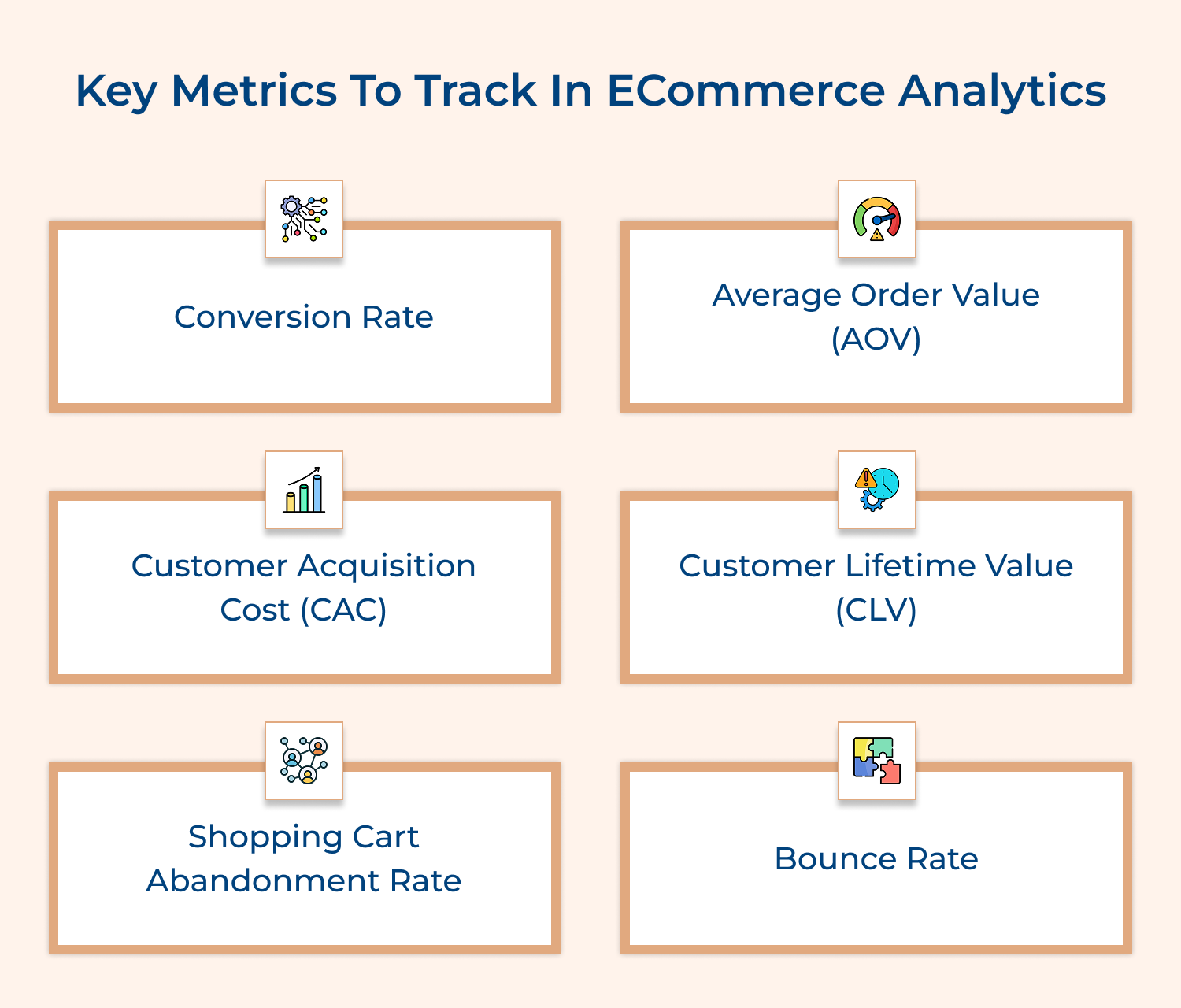
Conversion Rate
Conversion rate measures the percentage of visitors who actually make a purchase on your site. It’s a key indicator of how well your website persuades visitors to become customers. Typical ecommerce rates hover around 2–4%, but breaking it down by traffic source, device, or customer type can reveal where improvements are needed.
Average Order Value (AOV)
AOV shows how much, on average, a customer spends per order. Increasing AOV can boost revenue without needing more traffic. Techniques like cross-selling, upselling, or strategic pricing can encourage customers to spend more each time they shop.
Customer Acquisition Cost (CAC)
CAC tells you how much it costs to bring in a new customer, factoring in marketing and sales expenses. Comparing CAC to customer lifetime value ensures your growth is sustainable. If CAC starts rising, it could signal ineffective campaigns or a saturated market.
Customer Lifetime Value (CLV)
CLV predicts the total revenue a customer will bring over their entire relationship with your business. It helps you decide how much to invest in acquiring and retaining customers. Segmenting CLV by channel, product type, or customer demographics highlights your most valuable audiences.
Shopping Cart Abandonment Rate
This metric tracks how many shoppers leave without completing their purchase after adding items to their cart. With ecommerce averages around 70%, understanding where customers drop off can help you fix friction points and recover potentially lost sales.
Bounce Rate
Bounce rate shows the percentage of visitors who leave after viewing just one page. High bounce rates can signal issues like slow load times, irrelevant content, or confusing navigation. Comparing bounce rates across pages and traffic sources helps pinpoint areas for improvement.
Ecommerce analytics come to life when applied to real-world scenarios. Examples show how businesses use data to boost sales, improve customer experiences and make smarter decisions.
1. Amazon – Personalized Recommendations
How they use eCommerce analytics:
Amazon uses advanced eCommerce analytics to track customer behavior, preferences and previous purchases. This data is then leveraged to create personalized product recommendations for each shopper, which significantly enhances the customer experience and drives higher sales.
Real-life result:
The personalized recommendations account for a significant portion of Amazon’s sales. It’s estimated that about 35% of the company’s total sales come from these recommendations, making it a key strategy for their success.
2. Netflix – Customer Retention via Analytics
How they use eCommerce analytics:
Netflix analyzes user viewing data, including the types of movies and TV shows a user watches, the time spent watching, as well as their ratings. This data helps Netflix recommend content and tailor their platform to increase engagement.
Real-life result:
By analyzing customer preferences and viewing habits, Netflix has been able to reduce churn as well as increase subscriptions, contributing to its impressive global growth. Analytics also helps Netflix produce shows that align with user preferences.
3. Walmart – Optimizing Inventory Management
How they use eCommerce analytics:
Walmart uses real-time eCommerce analytics to track customer demand, inventory levels and sales patterns across different regions. This data helps them optimize inventory and ensure popular products are always in stock, preventing stockouts along with overstock situations.
Real-life result:
This approach has helped Walmart streamline its supply chain, reduce operational costs and improve customer satisfaction by making sure customers can get the products they want, when they want them.
4. Nike – Personalized Email Campaigns
How they use eCommerce analytics:
Nike uses customer data, including past purchases, browsing behavior and app activity, to send personalized email campaigns. This data allows them to offer tailored discounts, product recommendations and promotions based on user interests as well as purchase history.
Real-life result:
Nike’s personalized email campaigns have shown increased customer engagement, improved conversion rates and higher return on investment for their marketing efforts. Their focus on personalized outreach has helped strengthen brand loyalty.
5. Zara – Real-Time Data for Fashion Trends
How they use eCommerce analytics:
Zara collects real-time data on fashion trends, customer preferences and purchasing behavior both online as well as in-store. The company uses this data to quickly adapt its product offerings and create new designs that align with the latest trends.
Real-life result:
Zara’s ability to quickly respond to market trends and customer preferences has helped the brand maintain its competitive edge. Their “fast fashion” model is supported by data-driven insights, allowing them to introduce new products in stores within weeks of identifying a trend.
Ecommerce analytics is a game changer for businesses seeking to optimize operations and boost profitability. Leveraging data helps companies make informed decisions about customer behavior, inventory management and marketing strategies.
Insights derived from analytics empower businesses to streamline processes, enhance customer experiences and drive sustainable growth. Tracking key metrics and identifying trends keeps businesses ahead of the competition. Embracing ecommerce analytics is essential for success in today’s data-driven marketplace, offering the edge needed to thrive in an evolving industry.

Why is ecommerce analytics important for online businesses?
Ecommerce analytics helps businesses make data-driven decisions rather than relying on intuition. It enables identification of growth opportunities, optimization of marketing spend, improvement of customer experience, increase in conversion rates and ultimately maximization of profitability. Without proper analytics, businesses essentially operate blindfolded.
What analytics tools should be used for ecommerce stores?
Popular options include Google Analytics 4, Shopify Analytics (for that platform), Adobe Analytics, Hotjar for user behavior, Klaviyo for email analytics and specialized tools like Glew.io or Metrilo for ecommerce-specific insights. The right combination depends on business size, technical capabilities and specific analytical needs.
How often should ecommerce analytics be reviewed?
Establish a regular cadence – daily for key performance indicators like sales/traffic, weekly for marketing campaign performance and monthly for deeper trend analysis as well as strategic planning. Automated alerts should be set up for significant deviations from expected performance metrics.
How can ROI be tracked for marketing campaigns?
Implement proper UTM parameters for all campaigns, set up conversion tracking in advertising platforms, establish clear attribution models and calculate the revenue generated against costs for each channel. More advanced approaches include incrementality testing to measure true lift from specific marketing activities.
What’s the difference between descriptive, predictive and prescriptive analytics?
Descriptive analytics shows what happened (historical performance data), predictive analytics forecasts what might happen (using historical data to project future outcomes) and prescriptive analytics suggests actions to take (recommending specific strategies based on analyzed patterns and predictions).
How can sales be accurately attributed to marketing channels?
Move beyond last-click attribution by implementing multi-touch attribution models that give appropriate credit to all touchpoints in the customer journey. Consider data-driven attribution methods that use machine learning to determine the actual contribution of each interaction and supplement with controlled experiments to verify channel effectiveness.
 https://omni24.io/wp-content/uploads/2026/08/AI-Customer-Service-Agents.png
1256
2400
Webvision Solution
https://omni24.io/wp-content/uploads/2023/04/Omni-Logo-1.svg
Webvision Solution2026-09-21 04:48:512026-09-21 04:48:51How to Build an AI Customer Service Agents: 8 Key Steps
https://omni24.io/wp-content/uploads/2026/08/AI-Customer-Service-Agents.png
1256
2400
Webvision Solution
https://omni24.io/wp-content/uploads/2023/04/Omni-Logo-1.svg
Webvision Solution2026-09-21 04:48:512026-09-21 04:48:51How to Build an AI Customer Service Agents: 8 Key Steps https://omni24.io/wp-content/uploads/2026/08/Omnichannel-Conversational-AI.png
1256
2400
Tushar Joshi
https://omni24.io/wp-content/uploads/2023/04/Omni-Logo-1.svg
Tushar Joshi2026-09-16 03:51:072026-09-16 03:51:07How to Build Omnichannel Conversational AI Strategy
https://omni24.io/wp-content/uploads/2026/08/Omnichannel-Conversational-AI.png
1256
2400
Tushar Joshi
https://omni24.io/wp-content/uploads/2023/04/Omni-Logo-1.svg
Tushar Joshi2026-09-16 03:51:072026-09-16 03:51:07How to Build Omnichannel Conversational AI Strategy https://omni24.io/wp-content/uploads/2026/08/Customer-Service-Teams.png
1256
2400
Tushar Joshi
https://omni24.io/wp-content/uploads/2023/04/Omni-Logo-1.svg
Tushar Joshi2026-09-15 04:01:522026-09-15 04:02:16How to Build Customer Service Teams: 6 Key Steps
https://omni24.io/wp-content/uploads/2026/08/Customer-Service-Teams.png
1256
2400
Tushar Joshi
https://omni24.io/wp-content/uploads/2023/04/Omni-Logo-1.svg
Tushar Joshi2026-09-15 04:01:522026-09-15 04:02:16How to Build Customer Service Teams: 6 Key Steps
Whether it’s about acquire, engage or support – Omni24 covers all your customer engagement needs in one complete platform.

Copyright ©2026 Veemo All rights reserved.
CA, Los Angeles, Hall Ave, 19011