Top 10 Knowledge Management Best Practices That Drive Growth
Learn top knowledge management best practices to enhance collaboration, streamline processes and build a smarter, more connected organization.

Learn top knowledge management best practices to enhance collaboration, streamline processes and build a smarter, more connected organization.
Knowledge Management (KM) best practices are essential for organizations aiming to optimize their knowledge assets and enhance overall performance. An effective KM enables businesses to capture, share and utilize valuable insights, building innovation as well as collaboration.
In fact, 65% of workers believe knowledge-sharing is essential for innovation. Implementing these best practices not only streamlines processes but also empowers employees to make informed decisions.
This blog will explore key strategies for effective Knowledge Management, including creating a knowledge-sharing culture, leveraging technology and continuously updating knowledge resources. Let’s discover how these practices drive your organizational success and improve employee/customer experience.
Knowledge Management (KM) best practices refer to strategies that organizations employ to effectively capture, distribute and utilize knowledge. These practices aim to enhance organizational learning, improve decision-making and build innovation. Implementing KM best practices is essential for maintaining a competitive edge, as they enable companies to leverage collective expertise and resources efficiently.
The value of KM best practices lies in their ability to transform information into actionable insights, ensuring that knowledge is readily available to employees when needed. This accessibility reduces redundancy, streamlines processes while enhancing collaboration across teams.
Key objectives:
Organizations that implement effective KM practices report up to 20-25% reduction in onboarding time and 20% higher productivity. Let’s explore its importance:
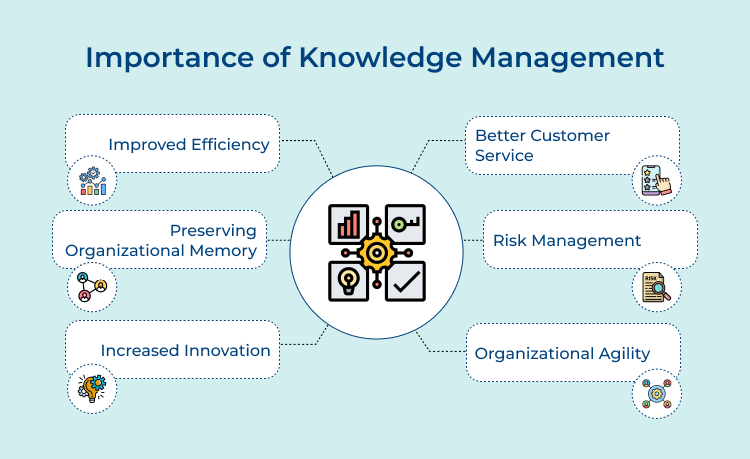
Improved Efficiency
Implementing KM practices streamlines processes by eliminating redundancy while ensuring that employees can easily find necessary information. This efficiency saves time and resources, allowing teams to focus on value-added tasks.
Preserving Organizational Memory
As employees come and go, KM ensures that critical knowledge doesn’t leave with them. It helps in capturing tacit knowledge, reducing the impact of employee turnover while preserving valuable institutional insights.
Increased Innovation
A robust KM framework creates a culture of creativity by encouraging collaboration and idea sharing. When employees have access to diverse insights, they can develop innovative solutions that drive business growth and adaptability.
Better Customer Service
Effective KM equips customer service teams with timely information, enabling them to respond quickly and accurately to inquiries. The responsiveness enhances customer satisfaction and loyalty, ultimately leading to improved business relationships.
Risk Management
KM practices facilitate better risk assessment and management by providing relevant historical data and insights. Organizations can make informed decisions to mitigate potential risks, ensuring more stable operations.
Organizational Agility
Effective Knowledge Management enhances an organization’s ability to adapt to change. With readily accessible information, teams can pivot quickly in response to market shifts, customer needs, or new opportunities, ensuring long-term sustainability.
Implementing best practices in Knowledge Management ensures streamlined processes and maximized value from organizational knowledge assets. Here are essential strategies to follow.
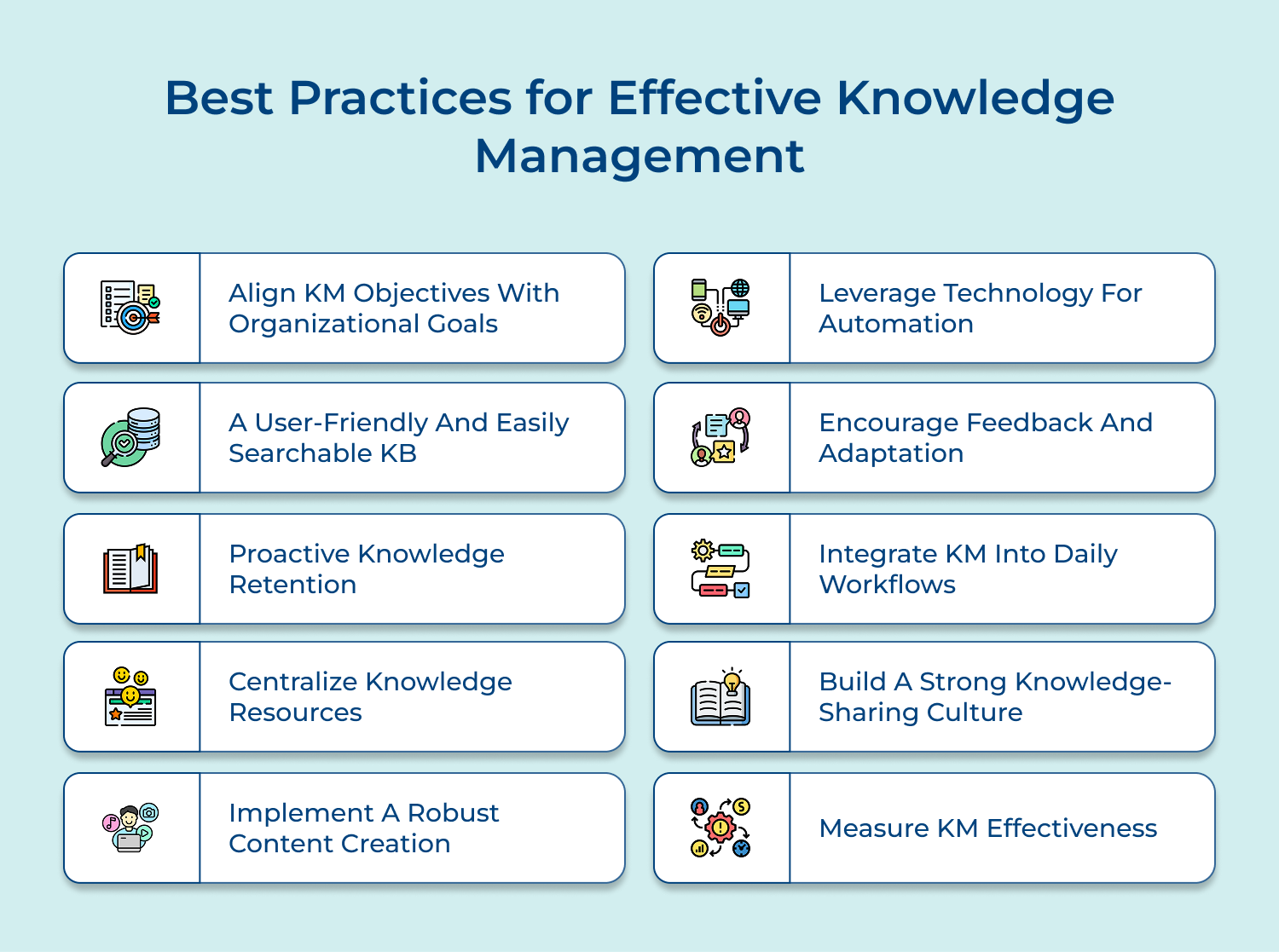
Aligning knowledge management (KM) goals with business objectives ensures every effort drives real results. When KM supports what matters most (like boosting customer satisfaction or improving team performance) it delivers measurable impact instead of scattered initiatives.
For instance, if customer experience is a top priority, focus KM on building better support knowledge bases. This way, every knowledge-sharing activity has a purpose, resources are well-spent and the value of KM is clear in the organization’s success.
Tips:
A user-friendly, searchable knowledge base makes finding information fast and effortless. It saves employees time, boosts productivity as well as encourages active knowledge sharing. When information is easy to access, teams make better decisions and solve problems faster.
Create a centralized knowledge base with simple navigation, strong search features and clear categories. Use tags, metadata and natural language search to improve accuracy. Make it mobile-friendly so employees can access it anywhere and keep it regularly updated to ensure the information stays fresh.
Tips:
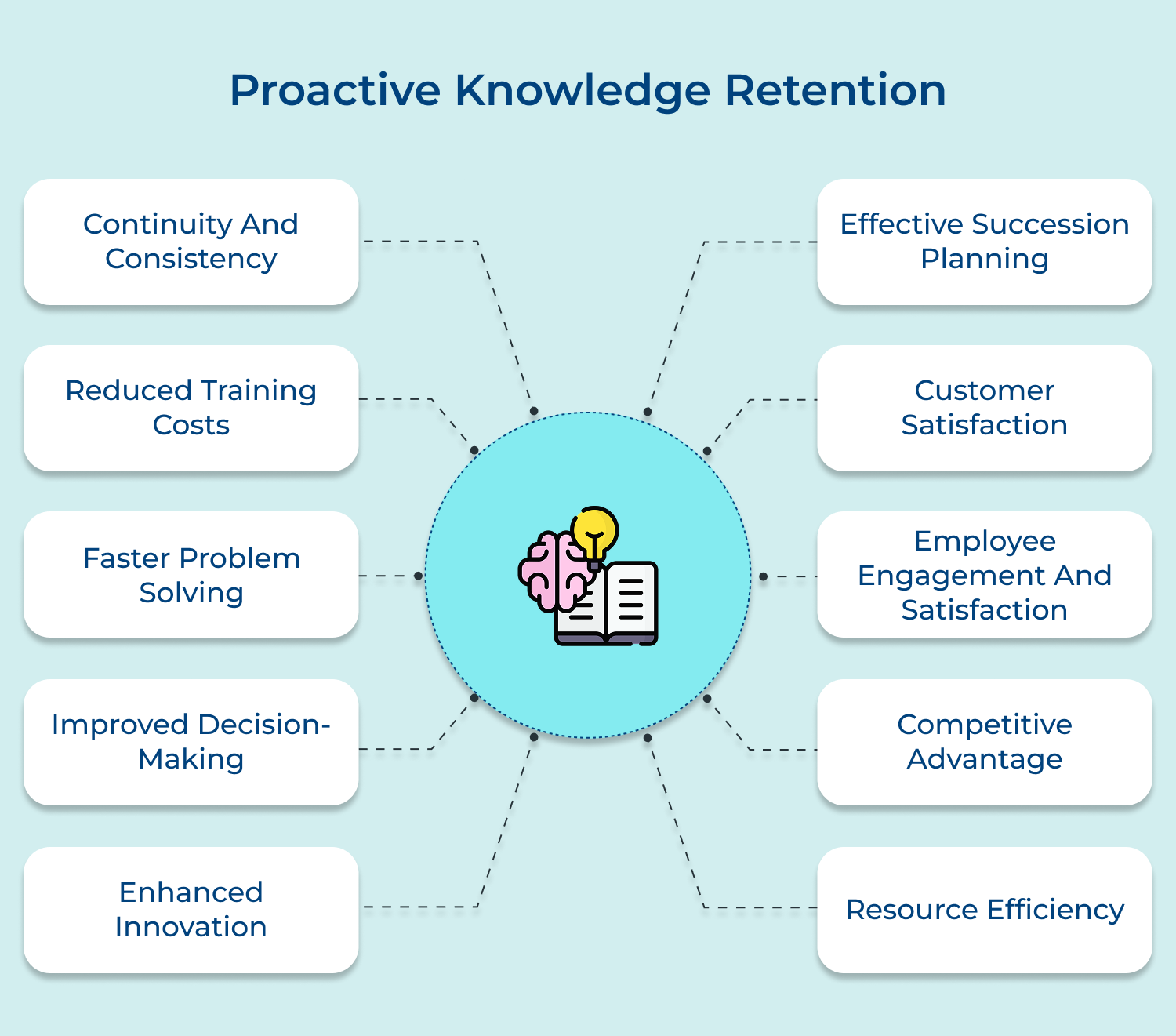
Proactive knowledge retention helps protect valuable insights when employees leave or switch roles. It keeps operations running smoothly, preserves institutional memory and speeds up onboarding for new hires. By capturing and storing expertise, organizations safeguard their competitive edge as well as avoid losing critical know-how.
Set up systems to capture knowledge early – through exit interviews, mentoring programs and documentation of best practices. Use tools like video recordings or AI-powered platforms to capture tacit knowledge. Most importantly, build a culture that values and rewards knowledge sharing to keep information flowing across teams.
Tips:
Centralizing knowledge resources helps break down information silos, reduce duplicate work and maintain consistency across the organization. It creates a single, reliable source of truth that employees can easily access and trust. This approach also ensures better version control and timely updates to knowledge assets.
Set up a central knowledge management system that connects documents, databases and collaboration tools in one place. Make sure it’s secure, easy to access and regularly updated. A well-integrated system streamlines information sharing, strengthens teamwork and supports faster, more informed decision-making.
Tips:
A strong content creation process keeps your knowledge base accurate, relevant and trustworthy. It helps prevent information overload by removing outdated or unnecessary content, ensuring users always find reliable and useful information. This consistency boosts engagement and confidence in your knowledge management system.
Set clear guidelines for creating content—use templates, tone standards and review checkpoints. Regularly audit existing materials to update or remove old information. Track content performance using analytics to understand what’s being used and what’s not. This ongoing refinement keeps your knowledge base fresh, organized and valuable to everyone who relies on it.
Tips:
Automation in knowledge management streamlines processes, reduces manual effort and enhances efficiency. It ensures information stays current and easy to access as organizations grow. Use AI tools for automatic tagging, categorization and summarization.
Chatbots and virtual assistants can help users find information quickly, while automated reviews keep content updated. Machine learning personalizes recommendations based on user roles and behavior. Hence, making the knowledge base smarter, more scalable as well as better aligned with employee needs.
Tips:
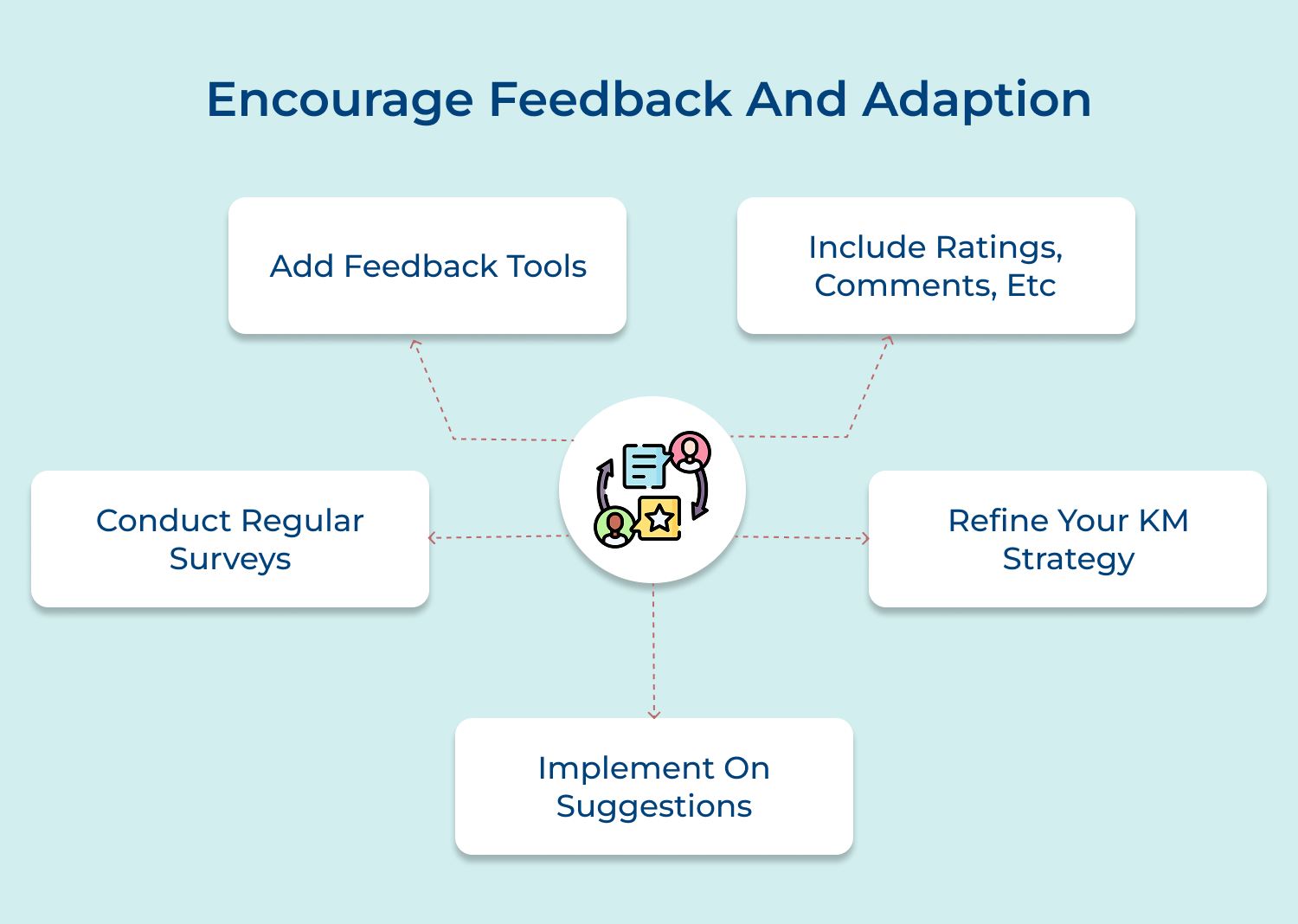
Encouraging feedback keeps your knowledge management system relevant and user-focused. It helps identify gaps, improve usability and boost engagement.
Add feedback tools like ratings, comments and suggestion forms within the KM system. Conduct regular surveys or focus groups to gather insights. Use this input to refine your KM strategy and act quickly on suggestions to show users their feedback truly matters.
Tips:
Integrating KM into daily workflows ensures that knowledge sharing and acquisition become natural parts of employees’ routines rather than separate tasks. This integration increases the likelihood of KM adoption, improves efficiency by reducing context-switching while ensuring that knowledge is captured and utilized at the point of need.
Embed KM tools and processes into existing work applications as well as processes. For example, integrate the knowledge base with the customer support ticketing system or project management software. Create shortcuts or plugins that allow easy access to and contribution of knowledge without leaving the primary work environment.
Tips:
A strong knowledge-sharing culture drives KM success by encouraging employees to share expertise, learn from one another and value collaboration. It fuels innovation as well as problem-solving while building an engaged workforce.
Lead by example – recognize and reward active contributors, include knowledge sharing in performance reviews, while promoting cross-functional learning. Use storytelling to celebrate success stories and show how shared knowledge strengthens the entire organization.
Tips:
Measuring KM effectiveness proves its value and guides continuous improvement. It shows how knowledge initiatives impact engagement, decision-making and overall ROI.
Set clear KPIs aligned with business goals like usage rates, time saved, or faster decisions. Regularly track and analyze results to uncover trends, refine strategies as well as justify ongoing investment in knowledge management.
Tips:
Recognizing the limitations of Knowledge Management is crucial for addressing challenges and ensuring the effectiveness of KM initiatives. Here are the main limitations to consider.
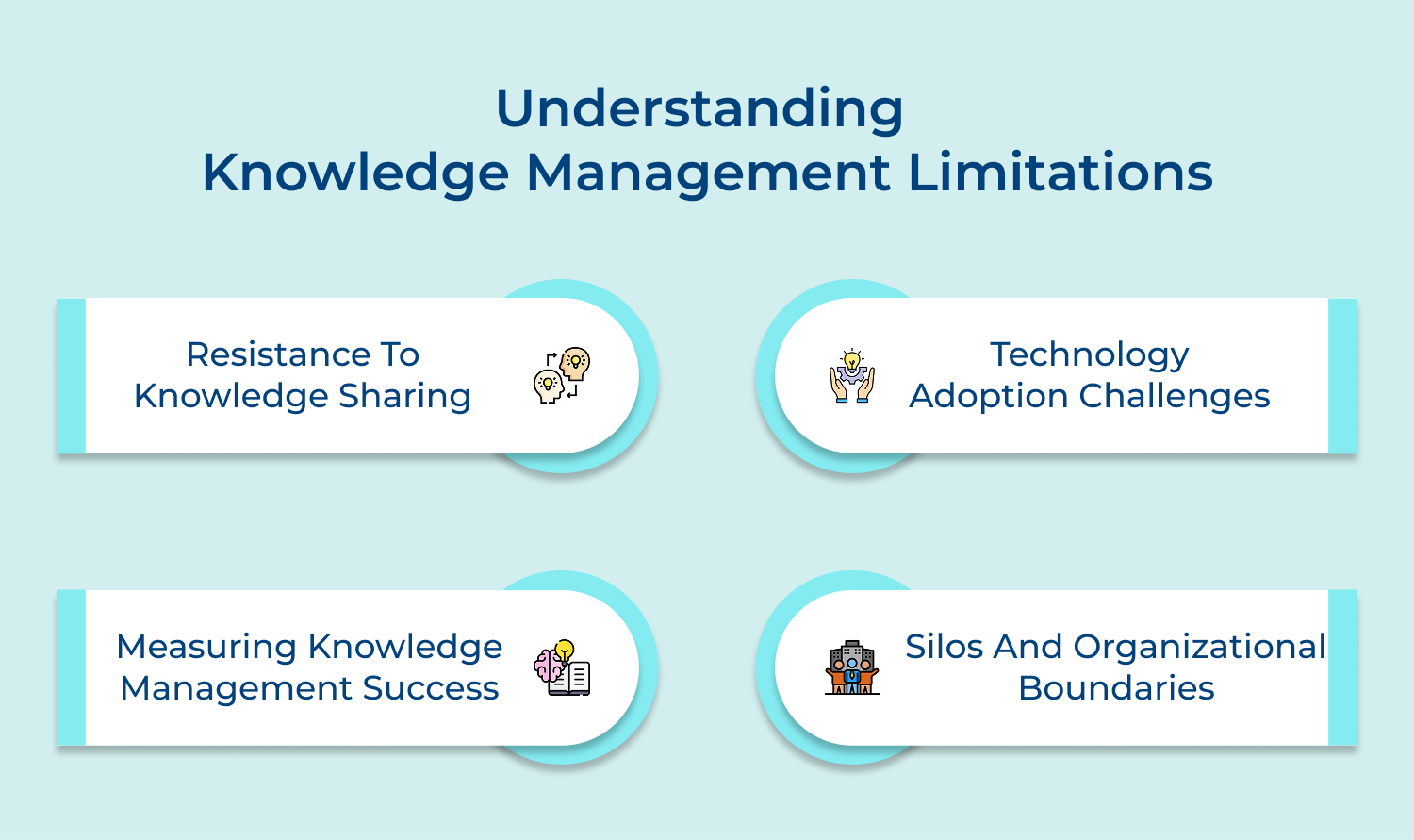
Resistance to Knowledge Sharing
Many employees resist sharing knowledge because they fear losing their unique value or worry it will add to their workload. To change this, build a culture that celebrates collaboration and transparency.
Recognize and reward people who actively share insights. Clearly explain how knowledge sharing benefits both individuals and teams.
Technology Adoption Challenges
Adopting new KM tools can be tough when systems are outdated or not user-friendly. Choose modern, intuitive platforms that fit how your teams work.
Provide hands-on training and support so employees feel confident using the tools. This ensures everyone can easily capture, share and find information when needed.
Measuring Knowledge Management Success
Tracking KM success can be tricky without the right metrics. Set clear, measurable KPIs that align with business goals—like usage rates or time saved.
Regularly review feedback and data to see what’s working. This helps you prove the value of KM as well as make smarter improvements over time.
Silos and Organizational Boundaries
When teams work in silos, valuable knowledge stays locked away. Encourage cross-department collaboration through shared projects and centralized knowledge hubs.
Make teamwork part of your culture, reward collective success over individual wins. Breaking down silos strengthens communication, collaboration as well as overall KM effectiveness.
Knowledge management best practices is essential for organizations seeking to enhance efficiency, foster innovation and improve collaboration. Defining clear objectives, promoting a culture of knowledge sharing and utilizing user-friendly tools enable businesses to effectively capture as well as leverage valuable insights.
Regularly updating knowledge resources and measuring success further ensure that KM initiatives remain impactful. Embracing these best practices not only streamlines operations but also empowers employees, ultimately leading to improved decision-making and a stronger competitive edge. Prioritizing Knowledge Management represents a strategic move toward sustainable growth and organizational success.

What are the 3 main areas of knowledge management?
The three main areas of knowledge management are knowledge creation, knowledge storage and knowledge sharing. Knowledge creation involves generating new insights or information. Knowledge storage focuses on organizing and preserving information for future use. Knowledge sharing facilitates the dissemination of knowledge among employees and stakeholders.
What are the six stages of knowledge management?
The six stages of knowledge management are identification, creation, storage, retrieval, sharing and application. Identification recognizes valuable knowledge. Creation generates new knowledge. Storage organizes information for easy access. Retrieval ensures users can find what they need. Sharing disseminates knowledge, while application focuses on utilizing that knowledge effectively in decision-making.
What are the 4 C’s of knowledge management?
The 4 C’s of knowledge management are Content, Context, Connection and Community. Content refers to the information and knowledge assets. Context provides the framework for understanding that content. Connection emphasizes relationships among people and knowledge sources, while Community fosters collaboration as well as sharing within networks to enhance knowledge utilization.
 https://omni24.io/wp-content/uploads/2026/08/AI-Customer-Service-Agents.png
1256
2400
Webvision Solution
https://omni24.io/wp-content/uploads/2023/04/Omni-Logo-1.svg
Webvision Solution2026-09-21 04:48:512026-09-21 04:48:51How to Build an AI Customer Service Agents: 8 Key Steps
https://omni24.io/wp-content/uploads/2026/08/AI-Customer-Service-Agents.png
1256
2400
Webvision Solution
https://omni24.io/wp-content/uploads/2023/04/Omni-Logo-1.svg
Webvision Solution2026-09-21 04:48:512026-09-21 04:48:51How to Build an AI Customer Service Agents: 8 Key Steps https://omni24.io/wp-content/uploads/2026/08/Omnichannel-Conversational-AI.png
1256
2400
Tushar Joshi
https://omni24.io/wp-content/uploads/2023/04/Omni-Logo-1.svg
Tushar Joshi2026-09-16 03:51:072026-09-16 03:51:07How to Build Omnichannel Conversational AI Strategy
https://omni24.io/wp-content/uploads/2026/08/Omnichannel-Conversational-AI.png
1256
2400
Tushar Joshi
https://omni24.io/wp-content/uploads/2023/04/Omni-Logo-1.svg
Tushar Joshi2026-09-16 03:51:072026-09-16 03:51:07How to Build Omnichannel Conversational AI Strategy https://omni24.io/wp-content/uploads/2026/08/Customer-Service-Teams.png
1256
2400
Tushar Joshi
https://omni24.io/wp-content/uploads/2023/04/Omni-Logo-1.svg
Tushar Joshi2026-09-15 04:01:522026-09-15 04:02:16How to Build Customer Service Teams: 6 Key Steps
https://omni24.io/wp-content/uploads/2026/08/Customer-Service-Teams.png
1256
2400
Tushar Joshi
https://omni24.io/wp-content/uploads/2023/04/Omni-Logo-1.svg
Tushar Joshi2026-09-15 04:01:522026-09-15 04:02:16How to Build Customer Service Teams: 6 Key Steps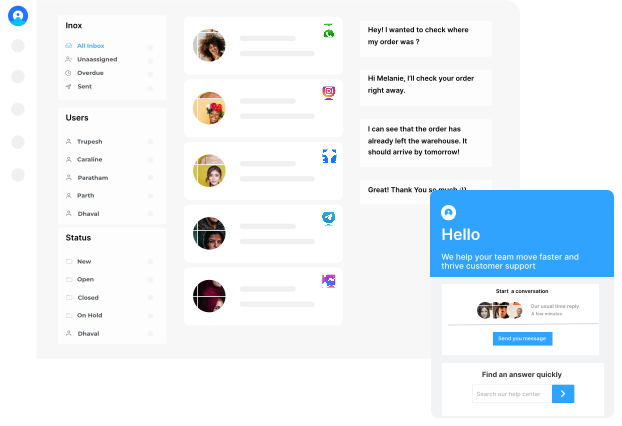
Whether it’s about acquire, engage or support – Omni24 covers all your customer engagement needs in one complete platform.

Copyright ©2026 Veemo All rights reserved.
CA, Los Angeles, Hall Ave, 19011