How to Improve Conversational Customer Engagement: 5 Key Tips
Conversational engagement fosters lasting customer relationships and loyalty using top CX tools and messaging software.

Conversational engagement fosters lasting customer relationships and loyalty using top CX tools and messaging software.
Creating meaningful relationships with your target audience is crucial for the success of your brand. With so much content being pushed out daily, it’s important to stand out and connect with your audience on a deeper level.
One of the best ways to achieve this is through conversational engagement. Brands with a customer-centric approach are 60% more profitable, and conversational platforms make it easy for businesses to put customers first.
Conversational customer engagement involves deploying advanced tools as they allow human-like conversations powered by their Natural Language Processing (NLP) capabilities. Empowering conversations with your audience can help you build trust and drive better business ROI.
Let us explore the power of conversational engagement and how you can leverage it to create meaningful relationships with your target audience.
Conversational customer engagement is a marketing strategy that creates personalized and engaging customer conversations. It involves using conversational platforms or tools like chatbots, messaging apps, and social media to interact with individuals more conversationally, as opposed to traditional marketing methods that are more one-way.
Conversational engagement helps build and nurture customer relationships. By engaging them in real-time conversations, businesses can better understand their customer’s needs and tailor their marketing efforts accordingly. It can lead to increased customer loyalty and retention.
Customer engagement is more important than ever for businesses looking to build strong client relationships. Leveraging chatbots, messaging apps & real-time tools for conversational customer engagement.
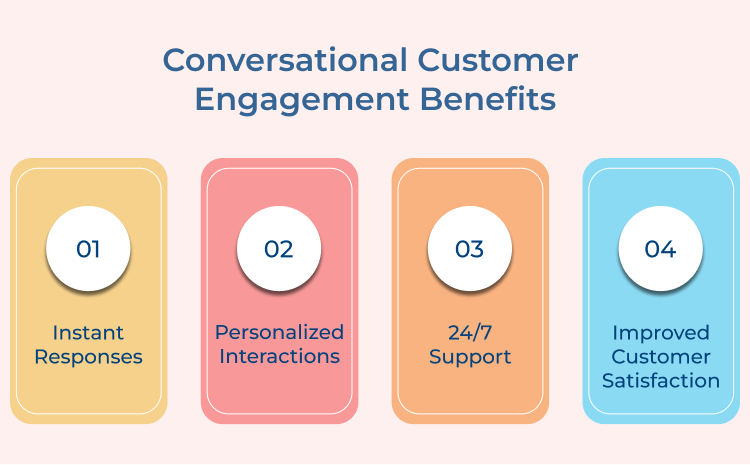
Here are a few key advantages:
Conversational engagement strategies are becoming increasingly important in the digital marketing landscape.
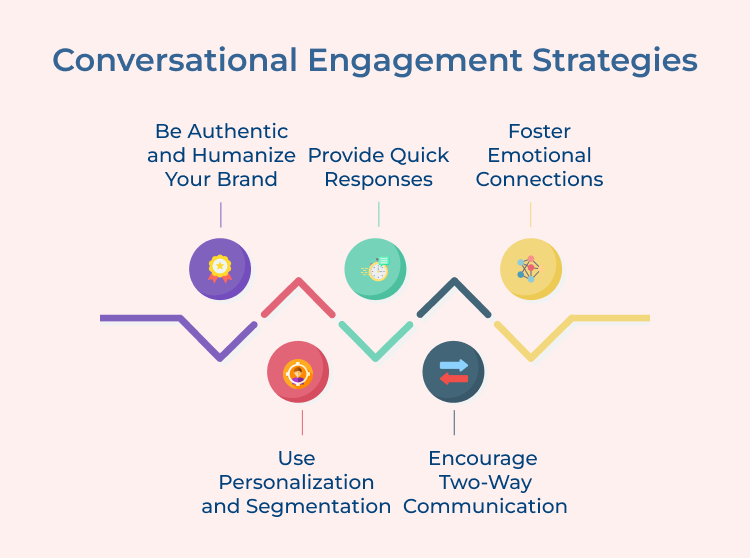
Conversational engagement focuses on a key aspect of creating a genuine connection with your target audience. It means humanizing your brand and being authentic in your communication.
Avoid using robotic language or canned responses. Speak in a friendly and conversational tone. Show your audience that there are real people behind your brand who care about their needs and interests.
Pro tips:
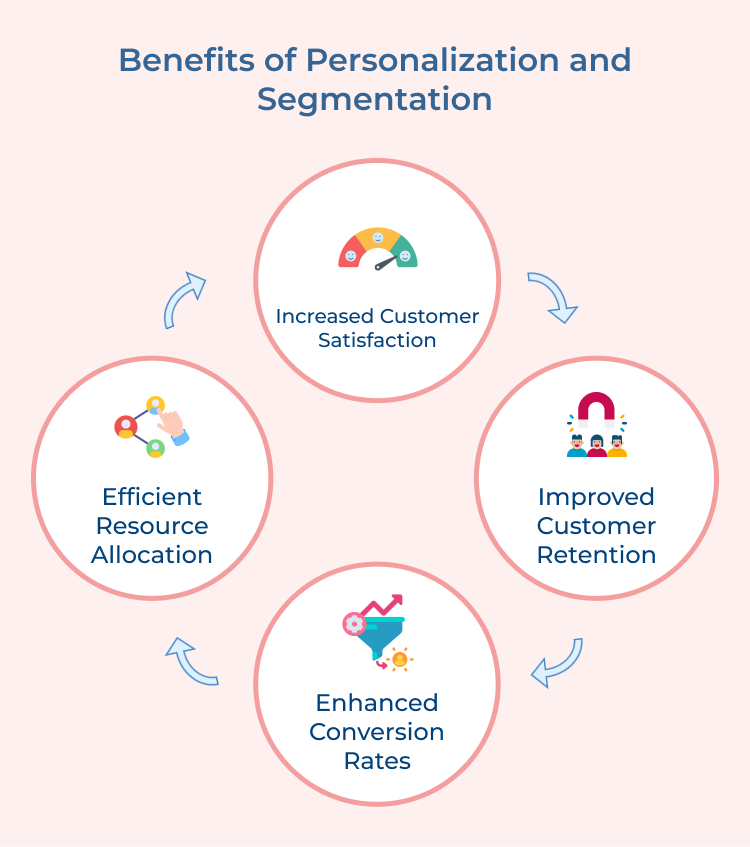
Personalization is key to effective conversational engagement. Use data and analytics to segment your audience based on their interests, preferences, and behavior.
Tailor your messaging to each segment to ensure that your audience feels understood and valued. Personalized messages are more likely to resonate with your audience and drive engagement.
Pro tips:
One of the top customer expectations is to receive real time responses to their queries or problems. Ensure to respond promptly to messages to show your audience that you value their time and are committed to providing excellent customer service.
Leverage AI-enabled chatbots or automated messaging systems to provide immediate responses, even outside of business hours.
Pro tips:
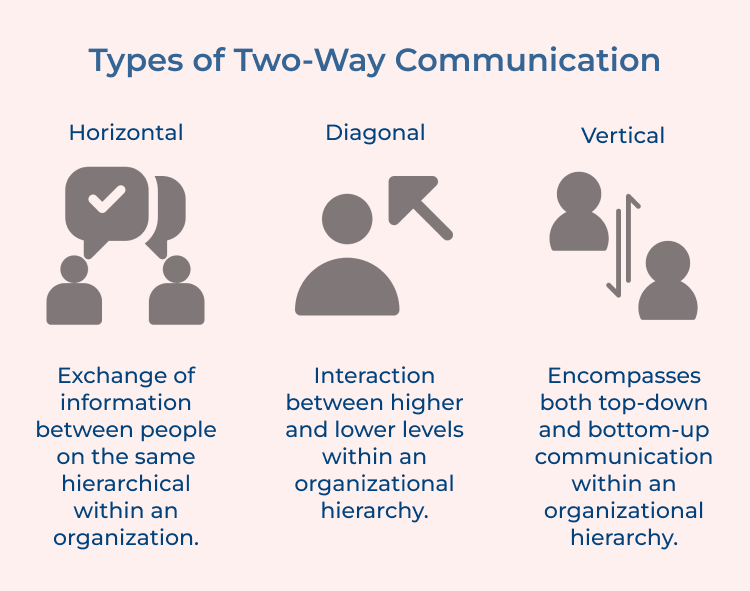
Conversational engagement is a two-way street.
Encourage your audience to actively participate in the conversation by asking questions, soliciting feedback, and inviting them to share their experiences. Listen to their responses and be responsive to their concerns.
Engaging with your audience in a meaningful way can help build a loyal and engaged community around your brand.
Pro tips:
Emotions play a significant role in driving consumer behavior.
Use conversational engagement to evoke positive emotions such as joy, excitement, or empathy. Share compelling stories, use humor, and create memorable experiences that resonate with your audience on an emotional level.
Brands that can forge emotional connections with their audience are more likely to build long-term relationships and loyalty.
Pro tips:
The strategies that involve leveraging conversations with customers are conversational customer engagement and conversational marketing.
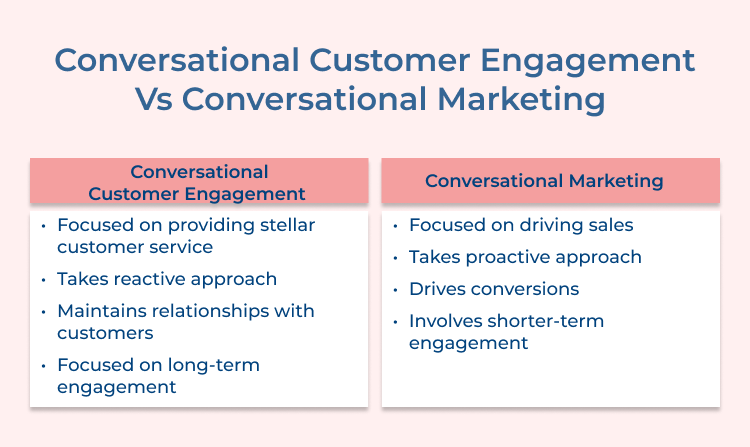
Conversational customer engagement is primarily focused on providing stellar customer service and support. It means using conversations to address customer inquiries, resolve issues, and build strong customer relationships.
Conversational marketing is more focused on driving sales and lead generation. It involves using conversations to guide potential customers through the buyer journey and ultimately convert them into paying customers.
Conversational customer engagement typically involves a more reactive approach, where businesses respond to customer inquiries and engage in conversations initiated by customers.
Conversational marketing takes a more proactive approach by initiating conversations with potential customers and guiding them toward a specific action, such as making a purchase or signing up for a newsletter.
Conversational customer engagement is all about building and maintaining relationships with customers. It means taking the time to engage in meaningful conversations, address customer needs, and personalize the customer experience.
Conversational marketing is more focused on driving conversions and achieving specific marketing goals. It involves using conversations as a tool to move customers down the sales funnel and drive them to purchase.
Conversational customer engagement is focused on long-term engagement and building customer loyalty. By providing excellent customer service and support, businesses can create loyal customers who keep coming back for more.
Conversational marketing often involves shorter-term engagement aimed at achieving specific marketing goals, such as generating leads or sales.
Customers are bombarded with advertisements and marketing messages at every turn. Traditional marketing loses steam as businesses pivot to personalized engagement for deeper customer connections.
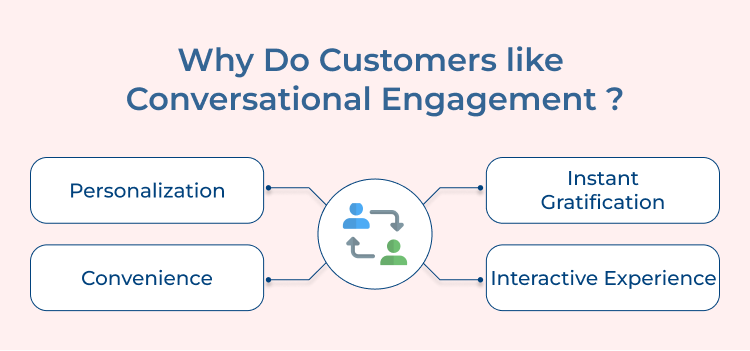
There are several reasons why customers prefer conversational engagement:
Conversational customer engagement is a key element in building relationships with your customers and creating a positive experience for them.
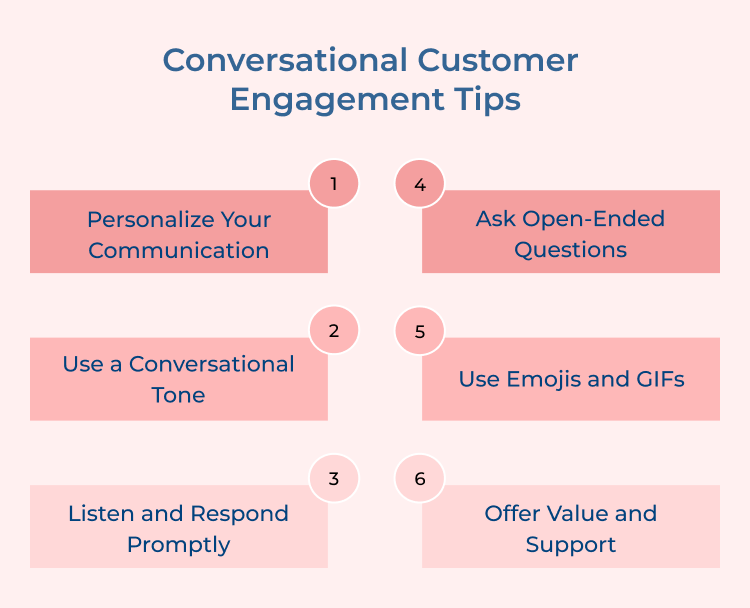
1. Personalize Your Communication
The best way to engage customers in a conversation is to personalize your communication. Use their name, refer to previous interactions or purchases, and tailor your messages to their preferences. It shows customers that you value them as individuals and are interested in building a relationship with them.
2. Use a Conversational Tone
Avoid using formal language or jargon when communicating with customers. Instead, use a conversational tone that is friendly and approachable. It will make customers feel more comfortable and engaged in the conversation.
3. Listen and Respond Promptly
Listening to customers is crucial in conversational customer engagement. Pay attention to their questions, comments or feedback, and respond promptly. It shows customers that you are attentive and care about their needs.
3. Ask Open-Ended Questions
Engage customers in a conversation by asking open-ended questions that encourage them to share more information. It not only helps you understand their needs and preferences better but also makes the conversation more engaging.
4. Use Emojis and GIFs
Adding emojis or GIFs to your messages can help convey emotions tone/ more effectively, making the conversation more engaging and fun. However, use them judiciously and make sure they are appropriate for the context.
5. Offer Value Support
Provide customers with valuable information, tips, or resources that can help them solve a problem or make a decision. It shows them that you care about their needs and also establishes you as a trusted resource.
Conversational engagement is a powerful marketing strategy because it allows businesses to connect with their audience on a personal level. By engaging in meaningful conversations with customers, companies can build trust, loyalty and brand awareness. This strategy also helps businesses gather valuable insights and feedback to improve their products or services.
Overall, conversational engagement humanizes the brand and creates an engaging relationship with customers. To succeed in a competitive market, businesses should prioritize conversational marketing as a key component of their overall marketing strategy.

1. Why is conversational engagement important for your business?
Conversational engagement is important for businesses because it helps build trust and relationships with customers. By engaging in conversations with customers, businesses can better understand their needs, leading to better products and services. It also helps in providing personalized experiences which can lead to increased customer satisfaction.
2. How does conversational engagement work?
A conversational customer engagement strategy works by creating opportunities for two-way communication between businesses and customers. It can be done through various channels such as social media, live chat on websites, email, and messaging apps. By engaging in conversations, businesses can provide support, answer questions, and gather client’s feedback.
3. How can I automate conversational engagement?
Automating conversational engagement can be done using chatbots or automated messaging systems. These tools can be programmed to respond to customer inquiries, provide information, and even initiate conversations based on certain triggers. By automating conversational engagement, businesses can provide instant responses and support to customers 24/7.
4. How do you engage customers in a conversation?
Engaging customers in a conversation can be done by asking questions, listening to their responses, providing relevant information, and showing genuine interest in their needs. By having proactive conversations with customers, businesses can create opportunities for meaningful interactions and build lasting relationships.
5. What are the 4 steps that will help you engage with customers?
The 4 steps that will help you engage with customers are:
6. How is AI used for customer engagement?
AI is used for customer engagement in various ways, such as chatbots, personalized recommendations, and predictive analytics. Chatbots powered by AI can interact with customers in real-time, providing instant responses and support. AI can also analyze customer data to predict their behavior and preferences, allowing businesses to tailor their marketing strategies.
 https://omni24.io/wp-content/uploads/2026/09/Social-commerce-scaled.png
1340
2560
Webvision Solution
https://omni24.io/wp-content/uploads/2023/04/Omni-Logo-1.svg
Webvision Solution2026-10-23 12:18:272026-10-23 12:18:27What is Social Commerce and Why Does It Matter?
https://omni24.io/wp-content/uploads/2026/09/Social-commerce-scaled.png
1340
2560
Webvision Solution
https://omni24.io/wp-content/uploads/2023/04/Omni-Logo-1.svg
Webvision Solution2026-10-23 12:18:272026-10-23 12:18:27What is Social Commerce and Why Does It Matter? https://omni24.io/wp-content/uploads/2026/08/AI-Customer-Service-Agents.png
1256
2400
Webvision Solution
https://omni24.io/wp-content/uploads/2023/04/Omni-Logo-1.svg
Webvision Solution2026-09-21 04:48:512026-09-21 04:48:51How to Build an AI Customer Service Agents: 8 Key Steps
https://omni24.io/wp-content/uploads/2026/08/AI-Customer-Service-Agents.png
1256
2400
Webvision Solution
https://omni24.io/wp-content/uploads/2023/04/Omni-Logo-1.svg
Webvision Solution2026-09-21 04:48:512026-09-21 04:48:51How to Build an AI Customer Service Agents: 8 Key Steps https://omni24.io/wp-content/uploads/2026/08/Omnichannel-Conversational-AI.png
1256
2400
Tushar Joshi
https://omni24.io/wp-content/uploads/2023/04/Omni-Logo-1.svg
Tushar Joshi2026-09-16 03:51:072026-09-16 03:51:07How to Build Omnichannel Conversational AI Strategy
https://omni24.io/wp-content/uploads/2026/08/Omnichannel-Conversational-AI.png
1256
2400
Tushar Joshi
https://omni24.io/wp-content/uploads/2023/04/Omni-Logo-1.svg
Tushar Joshi2026-09-16 03:51:072026-09-16 03:51:07How to Build Omnichannel Conversational AI Strategy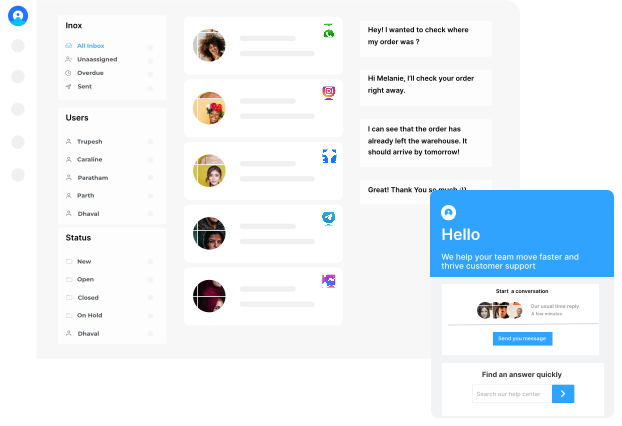
Whether it’s about acquire, engage or support – Omni24 covers all your customer engagement needs in one complete platform.

Copyright ©2026 Veemo All rights reserved.
CA, Los Angeles, Hall Ave, 19011