What is B2B Buyer Journey & How to Create it?
Understanding the B2B buyer journey helps craft targeted strategies that engage businesses through every stage of their purchase decision.

Understanding the B2B buyer journey helps craft targeted strategies that engage businesses through every stage of their purchase decision.
Many organizations struggle to effectively engage potential buyers in the complex world of B2B sales, which leads to missed opportunities and inefficient marketing efforts.
A lack of clarity around the buyer journey can result in losing leads to competitors who better understand their customers’ needs. Prospects may feel neglected or overwhelmed by information, causing frustration and indecision.
77% of B2B buyers consult user reviews during their purchasing journey and more than half (54%) speak directly with current users before making a buying decision. Knowing the stages of the buyer journey enables businesses to develop cohesive marketing strategies.
Let us explore how a well-defined buyer journey enhances customer relationships and contributes to sustained business growth in a competitive landscape.
B2B buyer journey refers to the process businesses go through when making purchasing decisions for products or services from other companies. It includes all stages from initial awareness of a need to post-purchase evaluation.
Understanding the B2B buyer journey enables sellers to align their marketing or sales strategies with buyers’ needs at each stage, improving lead generation, conversion rates and customer retention. Effectively mapping the buyer journey can lead to shorter sales cycles, increased customer satisfaction and higher revenue.
Key objectives:
The buyer’s journey plays a significant role in B2B success. Here are several key reasons highlighting its importance:
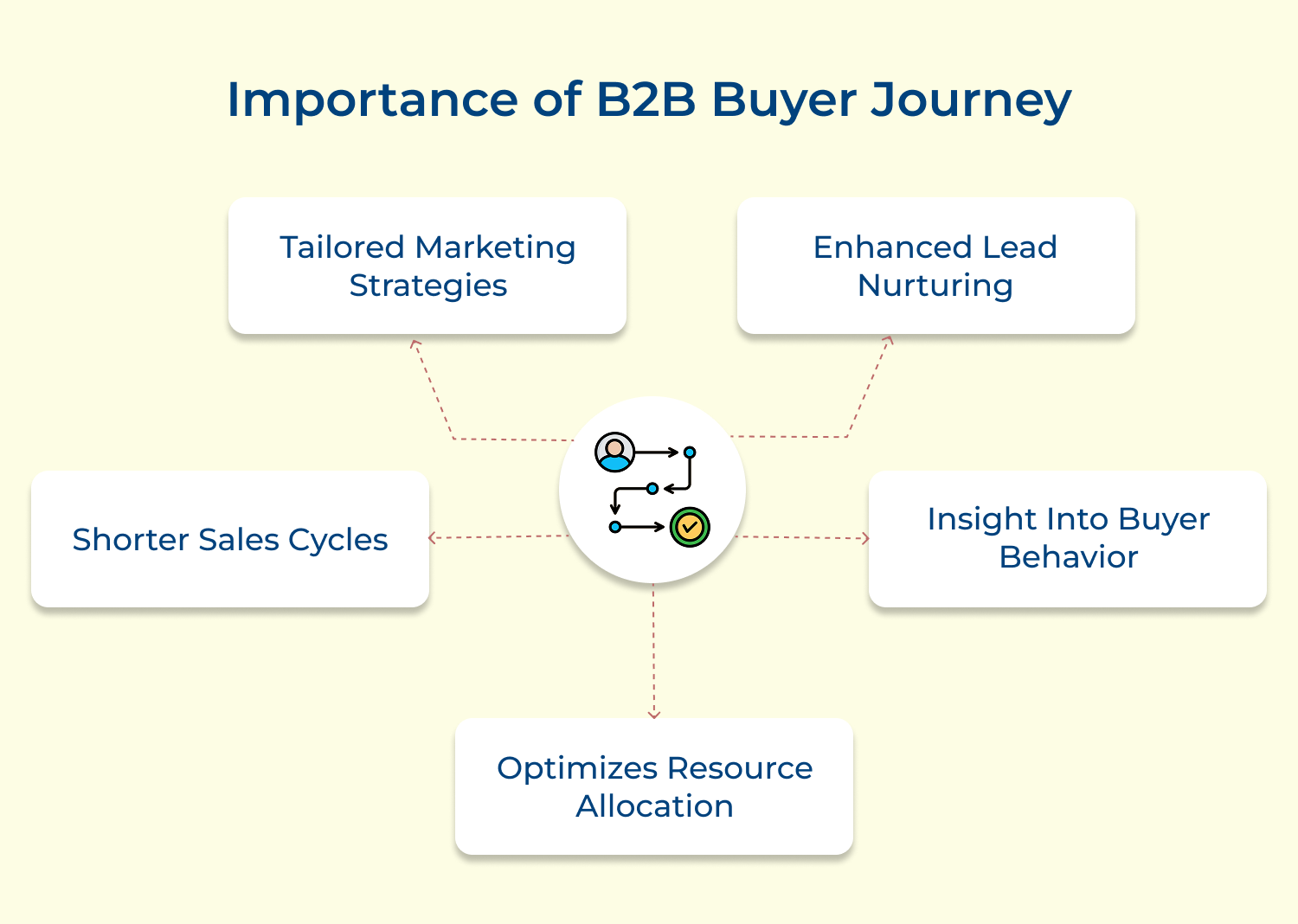
Understanding the buyer’s journey allows companies to create targeted content and messaging for each stage. The personalized approach resonates effectively with potential customers, addressing their specific pain points. Tailoring strategies to different journey stages ensures that marketing efforts are more relevant, increasing the likelihood of engagement and conversion.
Companies can develop stage-specific nurturing campaigns that guide prospects through the decision-making process. The strategic approach helps maintain engagement and build trust. Consistent communication throughout the journey keeps the brand top-of-mind and increases the chances of converting leads into customers.
Mapping the buyer’s journey helps identify potential bottlenecks or pain points in the decision-making process. Companies can proactively address these issues, streamlining the path to purchase. Providing the right information at the right time reduces hesitation and accelerates decision-making.
Analyzing the buyer’s journey offers valuable insights into customer preferences, motivations and decision-making patterns. The deep understanding allows companies to anticipate needs and tailor their offerings accordingly. Insights gained from journey analysis can inform product development, pricing strategies and customer service improvements.
The buyer’s journey helps companies allocate their resources more effectively across different stages. Understanding where prospects are in their journey allows for targeted investment in the most impactful touchpoints. The strategic allocation ensures that marketing budgets, sales efforts and customer support resources are used where they can generate the highest return.
Crafting a B2B buyer persona is key to unlocking targeted marketing success. Here are the essential steps to create an effective persona.
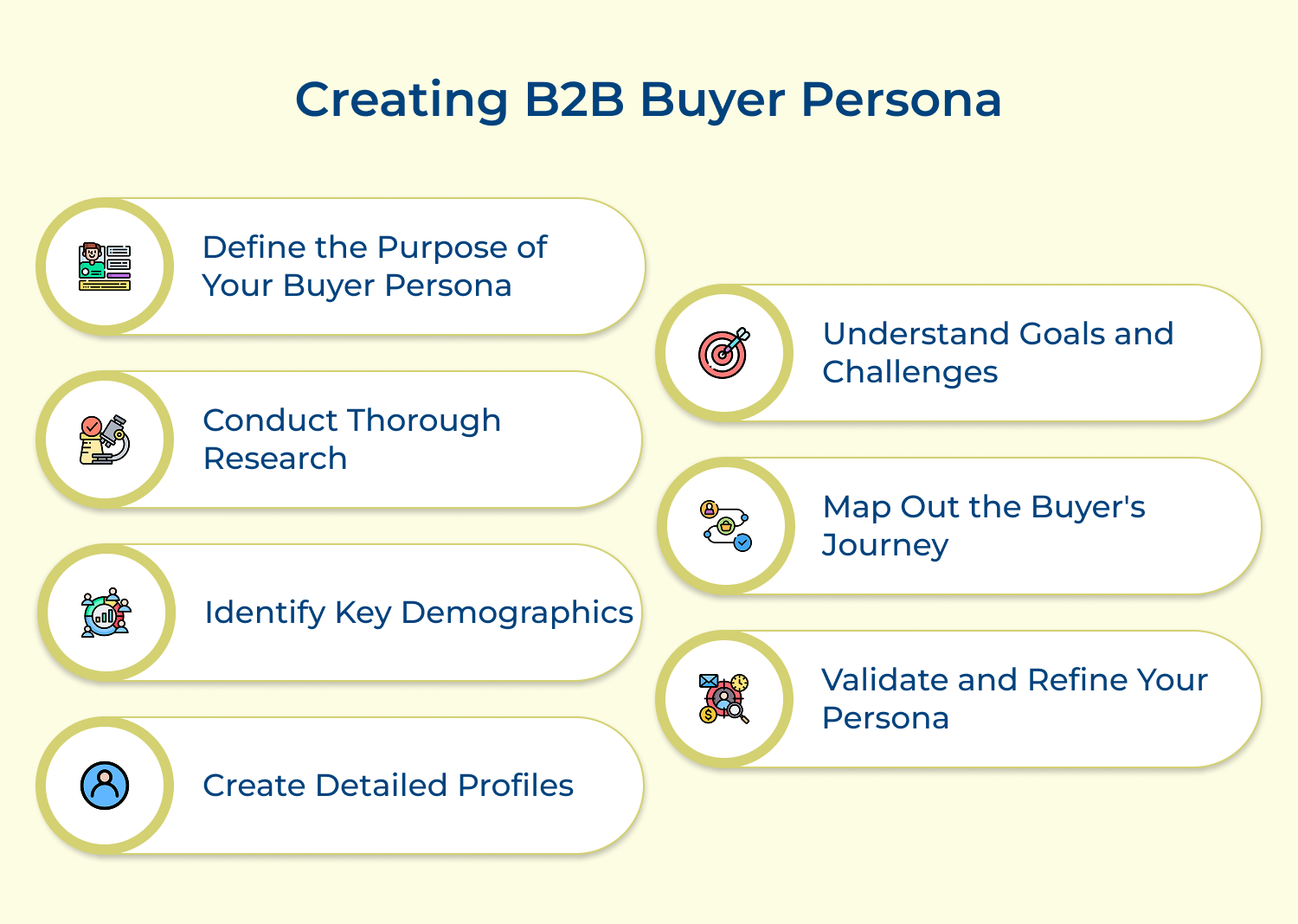
Clearly defining the purpose of your buyer persona ensures you gather the right information and create personas. Without a specific purpose, you risk creating generic personas that don’t provide actionable insights for marketing, sales, product development and other key functions.
A purposeful buyer persona can guide content creation, product positioning, lead generation and sales outreach.
For example, understanding the personas’ key challenges allows you to develop targeted content that addresses their pain points. Knowing their role and influence helps optimize lead qualification and sales engagement.
Pro Tips:
Thorough research is the foundation of accurate and useful buyer personas. Relying on assumptions or anecdotal evidence leads to misaligned personas that don’t reflect your real buyers. Robust qualitative and quantitative research is essential to understand your target audience’s demographics, behavior, motivations and challenges.
Research-based personas provide a reliable reference for marketing, sales and product decisions.
For instance, knowing the trusted information sources of your personas guides marketing channel selection. Understanding behavioral trends like technology usage helps in crafting relevant sales plays. Insights into buyer motivations shape compelling value propositions.
Pro Tips:
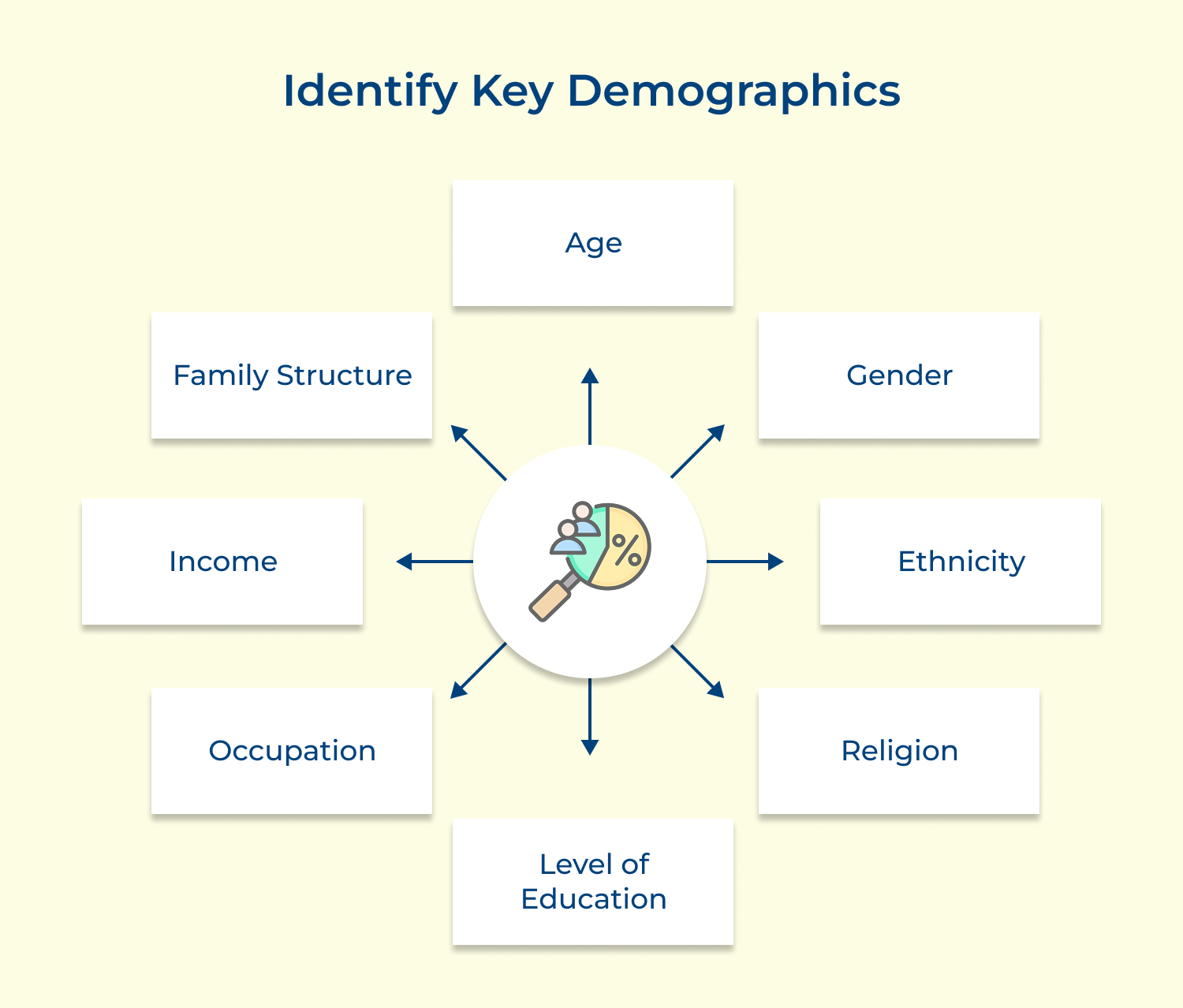
Demographic information like job title, seniority, company size and industry form the basic structure of your buyer persona. These attributes help you filter and segment your target audience.
Without demographic specificity, your personas will be too broad to enable targeted marketing and sales efforts. Demographic attributes are used to identify and reach your target buyers.
For example, job title and seniority help determine the likely decision-making authority. Company size and industry guide account segmentation and outreach prioritization. Demographic filters also enable targeted advertising, list purchasing and event selection.
Pro Tips:
Detailed buyer profiles turn generic demographics into relatable archetypes. Vivid descriptions of your personas’ typical day, key skills, career path, interests and communication preferences humanize the data.
Comprehensive persona profiles guide the tone, style and messaging of your marketing and sales assets.
For example, knowing communication preferences informs the format and length of your content. Understanding career path and skills helps in crafting relatable use cases and stories. Typical day insights uncover engagement opportunities.
Pro Tips:
Knowing your buyer personas’ goals and challenges is key to positioning your solution as uniquely valuable to them. If you don’t understand what motivates their decisions and what obstacles they face, your messaging and offerings will miss the mark.
Goals and challenges insights shape highly resonant value propositions. For example, understanding a person’s desire for recognition guides thought leadership programs. Knowing their fear of vendor lock-in emphasizes your flexible terms. Identifying competing priorities informs multi-stakeholder plays. Typical obstacles determine the proof points needed.
Pro Tips:
Mapping your persona’s path from awareness to purchase uncovers key inflection points to influence and enable their decisions. Without this journey view, you lack insight into evolving perceptions and needs at each stage.
You’ll miss critical opportunities to engage buyers and remove obstacles to purchase. The buyer’s journey map aligns marketing and sales plays to each decision stage.
For example, early stage priorities guide thought leadership topics. Mid-stage concerns inform battlecards and evaluation assets. Late-stage obstacles determine trial structure and negotiation levers. Post-purchase goals steer onboarding, adoption and expansion plays.
Pro Tips:
Regular validation and refinement of your buyer personas is essential to maintain accuracy as markets, offerings and buyers evolve. Without this hygiene, personas become stale and less actionable over time.
Validation also pressure-tests critical assumptions and identifies blind spots, ensuring high personal fidelity and usability. Refreshed buyer personas sharpen the relevance and impact of go-to-market motions.
For example, identifying new business priorities informs revised messaging. Noting changing technology preferences optimizes demand generation mix. Shifts in buying committee composition redirect sales plays. Evolved learning behaviors update enablement approaches.
Pro Tips:
The B2B buyer journey unfolds in three essential stages: Awareness, Consideration and Decision. Understanding these stages is vital for effective engagement and driving conversions.
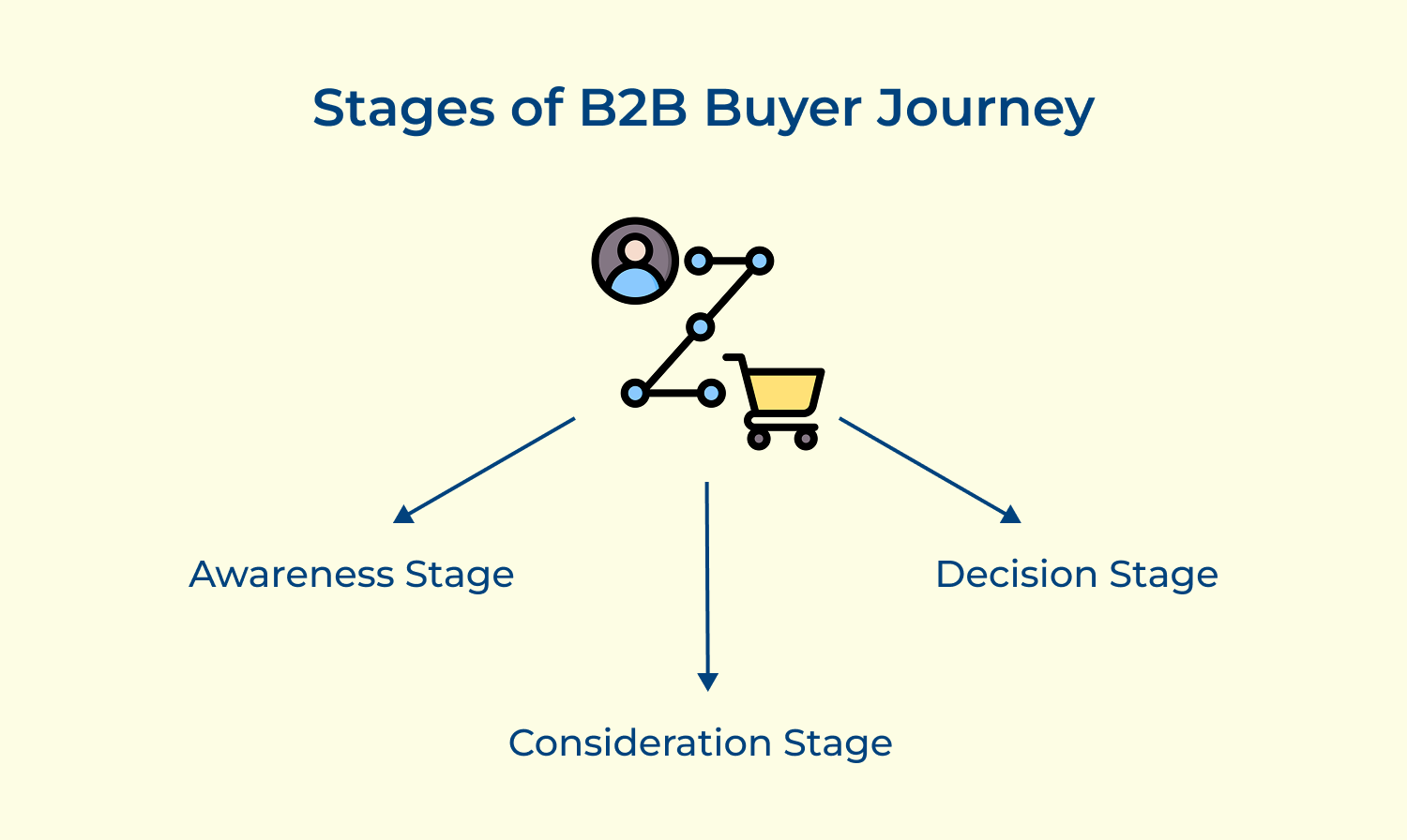
The awareness stage marks the beginning of the buyer journey, where potential customers recognize a problem or opportunity that requires attention. At this point, they may not fully understand the intricacies of their situation or the solutions available. Instead, they are focused on gathering information to better understand their challenges.
Key Characteristics:
Marketing Strategies: To effectively engage buyers in the awareness stage, businesses should create educational content that addresses common challenges within their industry. This could include informative blog posts, introductory guides and downloadable resources that provide valuable insights. Implementing strong SEO strategies ensures that this content ranks well in search engines, making it easier for potential customers to find it.
Once buyers have identified their problem, they transition into the consideration stage, where they actively explore various solutions. Here, they have a clearer understanding of their needs and begin evaluating different products, services, or vendors that could address their challenges.
Key Characteristics:
Marketing Strategies: During the consideration stage, businesses should focus on providing comprehensive content that showcases their solutions’ unique benefits. Case studies highlighting successful implementations and testimonials from satisfied customers can be particularly persuasive. Offering free trials, product demos or interactive tools like calculators can also help potential buyers visualize how a solution can meet their specific needs.
The decision stage is the final phase of the B2B buyer journey, where potential customers are ready to make a purchase decision. At this point, they have evaluated their options and are narrowing down their choices to select a vendor.
Key Characteristics:
Marketing Strategies: To facilitate conversions at this stage, businesses should provide clear and compelling information that addresses any remaining concerns. Offering detailed product specifications, transparent pricing and strong calls to action can help guide buyers toward a decision. Personalizing communication and demonstrating how the solution aligns with the buyer’s specific needs can further enhance the likelihood of closing the deal.
Navigating the B2B buyer journey effectively can significantly enhance customer relationships and drive sales. Here are some best practices to guide your strategy:
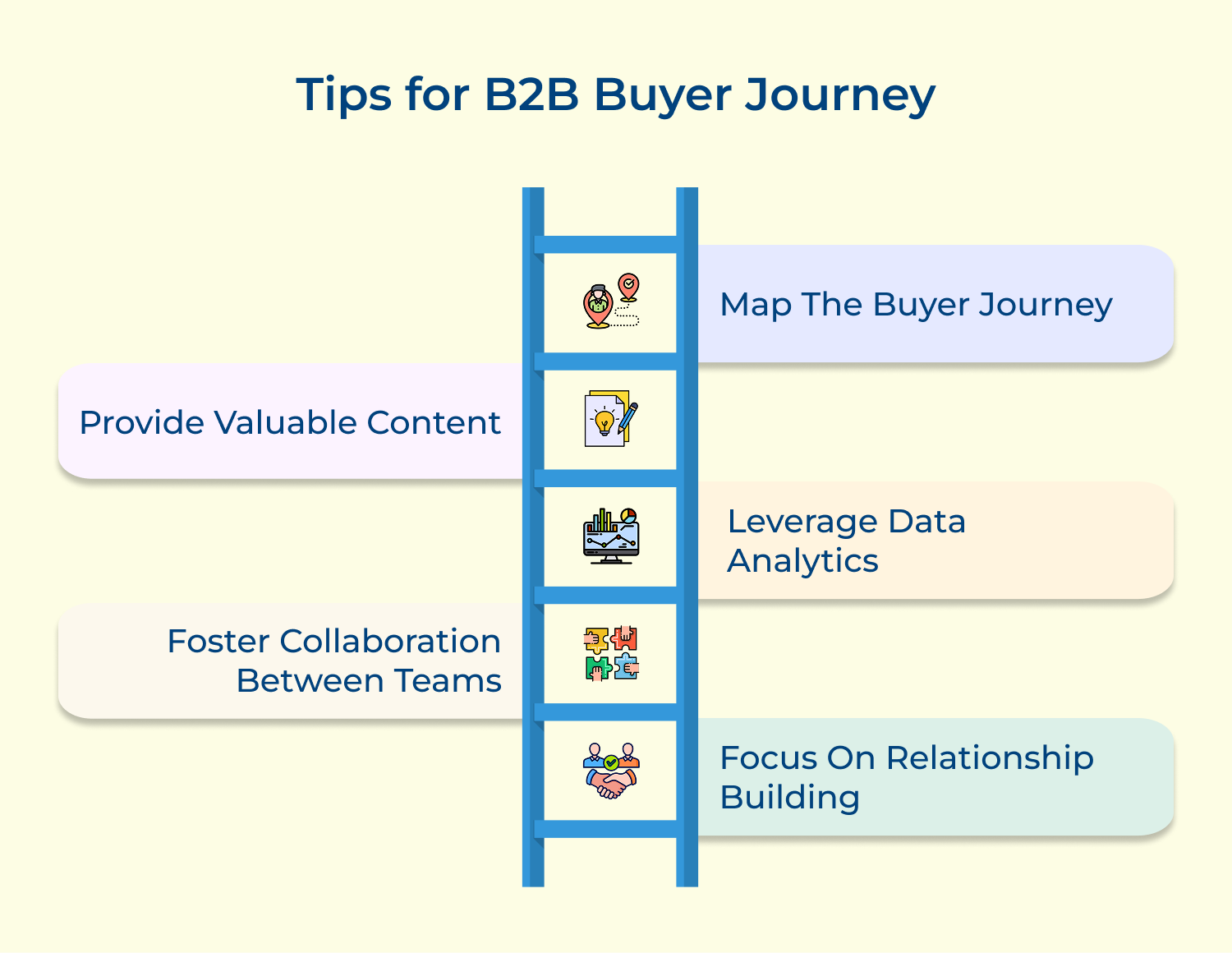
Visualizing the buyer journey allows businesses to identify key touchpoints and interactions that potential customers have with the brand. The mapping process helps in understanding the stages a buyer goes through, from awareness to consideration and ultimately decision-making.
By pinpointing these touchpoints, companies can optimize engagement strategies, ensuring they provide the right information and support at the right moments, ultimately enhancing the overall customer experience.
Offering high-quality, informative content at each stage of the buyer journey is crucial for building trust and establishing your brand as a thought leader. It includes creating a variety of content types such as blogs, whitepapers, case studies and webinars that address common industry challenges and solutions.
By delivering valuable insights and information, businesses can guide potential buyers toward informed decisions, positioning themselves as reliable partners in the buying process.
Utilizing data analytics provides deeper insights into buyer behavior, preferences and engagement patterns. By analyzing this data, businesses can tailor their marketing efforts to meet specific needs at critical moments in the journey.
Implementing tools that track website visits, content engagement and customer interactions allows companies to refine their messaging and outreach strategies, ensuring that they are reaching potential buyers with the right information at the right time.
Encouraging collaboration between marketing, sales and customer service teams ensures a cohesive approach to the buyer journey. Regular meetings and shared goals help align strategies and facilitate seamless transitions between teams as potential customers move through the journey. The collaboration fosters better communication and a unified customer experience, which is crucial for addressing buyer concerns promptly and effectively.
Investing in relationship-building activities is vital for nurturing connections with prospects and increasing the likelihood of conversion. Personalized follow-ups, regular check-ins and tailored communications demonstrate that you value their business.
Consider implementing a customer relationship management (CRM) system to track interactions and ensure timely follow-ups, creating a personalized experience that fosters long-term loyalty and trust.
Understanding the B2B buyer journey significantly impacts business success. Recognizing the distinct stages allows companies to tailor their marketing strategies effectively. The alignment with buyer needs not only enhances customer engagement but also increases conversion rates.
As businesses provide relevant content and support throughout the journey, they build stronger relationships with potential clients. Adapting to evolving buyer behaviors fosters a competitive edge, ensuring that companies remain relevant in a dynamic marketplace. A well-optimized buyer journey contributes to sustained growth and profitability, making it an essential focus for any B2B organization.

What are some challenges of the B2B buying journey?
The B2B buying journey faces challenges like complex decision-making processes involving multiple stakeholders, longer sales cycles and the need for extensive research and comparison. Buyers often struggle with information overload, difficulty in assessing the true value of solutions and aligning various departmental needs. Budget constraints and the pressure to justify ROI can complicate the journey.
How does the B2B buyer’s journey differ from B2C?
The B2B buyer’s journey is typically longer and more complex than B2C. It involves multiple decision-makers, requires more in-depth research and often has higher stakes. B2B purchases are usually driven by logic and ROI rather than emotion. The sales process is more relationship-focused, with a greater emphasis on customization, technical specifications and long-term partnerships.
How is website design changing with the shift in B2B buying journey?
B2B website design is evolving to accommodate self-service research and decision-making. Sites now feature more comprehensive product information, interactive tools, case studies and comparison features. There’s an increased focus on personalization with content tailored to different personas and buying stages. User experience is prioritized with intuitive navigation and mobile optimization becoming standard to support the non-linear buying journey.
How much does building trust matter in the new B2B Buying Journey?
Building trust is crucial in the new B2B buying journey. With buyers conducting more independent research, companies must establish credibility through transparent information, authentic customer testimonials and thought leadership content. Trust influences every stage of the journey, from initial awareness to final decision. It’s essential for nurturing long-term relationships, facilitating smoother negotiations and increasing customer loyalty in an increasingly competitive market.
 https://omni24.io/wp-content/uploads/2026/09/Social-commerce-scaled.png
1340
2560
Webvision Solution
https://omni24.io/wp-content/uploads/2023/04/Omni-Logo-1.svg
Webvision Solution2026-10-23 12:18:272026-10-23 12:18:27What is Social Commerce and Why Does It Matter?
https://omni24.io/wp-content/uploads/2026/09/Social-commerce-scaled.png
1340
2560
Webvision Solution
https://omni24.io/wp-content/uploads/2023/04/Omni-Logo-1.svg
Webvision Solution2026-10-23 12:18:272026-10-23 12:18:27What is Social Commerce and Why Does It Matter? https://omni24.io/wp-content/uploads/2026/08/AI-Customer-Service-Agents.png
1256
2400
Webvision Solution
https://omni24.io/wp-content/uploads/2023/04/Omni-Logo-1.svg
Webvision Solution2026-09-21 04:48:512026-09-21 04:48:51How to Build an AI Customer Service Agents: 8 Key Steps
https://omni24.io/wp-content/uploads/2026/08/AI-Customer-Service-Agents.png
1256
2400
Webvision Solution
https://omni24.io/wp-content/uploads/2023/04/Omni-Logo-1.svg
Webvision Solution2026-09-21 04:48:512026-09-21 04:48:51How to Build an AI Customer Service Agents: 8 Key Steps https://omni24.io/wp-content/uploads/2026/08/Omnichannel-Conversational-AI.png
1256
2400
Tushar Joshi
https://omni24.io/wp-content/uploads/2023/04/Omni-Logo-1.svg
Tushar Joshi2026-09-16 03:51:072026-09-16 03:51:07How to Build Omnichannel Conversational AI Strategy
https://omni24.io/wp-content/uploads/2026/08/Omnichannel-Conversational-AI.png
1256
2400
Tushar Joshi
https://omni24.io/wp-content/uploads/2023/04/Omni-Logo-1.svg
Tushar Joshi2026-09-16 03:51:072026-09-16 03:51:07How to Build Omnichannel Conversational AI Strategy
Whether it’s about acquire, engage or support – Omni24 covers all your customer engagement needs in one complete platform.

Copyright ©2026 Veemo All rights reserved.
CA, Los Angeles, Hall Ave, 19011