How to Build an Effective Knowledge Management System
Learn how modern knowledge management platforms boost collaboration, streamline workflows and help teams share insights efficiently across organizations.

Learn how modern knowledge management platforms boost collaboration, streamline workflows and help teams share insights efficiently across organizations.
A knowledge management system (KMS) isn’t just nice to have, it’s a game changer. Organizations that use KMSs see up to a 25% boost in productivity and often reduce onboarding time by 20-25% thanks to centralized, easy-to-access information.
Companies like Siemens and P&G have used KMSs to break down silos, speed up innovation, as well as improve collaboration. This blog will explore the key features, real-world examples and best practices for building an effective knowledge management system that can drive growth as well as competitive advantage.
A knowledge management system (KMS) is a technology-based platform designed to facilitate the collection, organization, sharing and analysis of knowledge within an organization. It enables employees to access information and expertise efficiently. Thus, building collaboration and innovation across teams.
Implementing a KMS is crucial for enhancing organizational efficiency and productivity. By centralizing knowledge resources, businesses can reduce redundancies, streamline processes and ensure that critical information is readily available. This leads to better decision-making, improved problem-solving capabilities and a culture of continuous learning.
Key objectives of a knowledge management system include:
Using knowledge management tools helps organizations turn scattered information into actionable insights. Here’s how it benefits your organization in the long run:
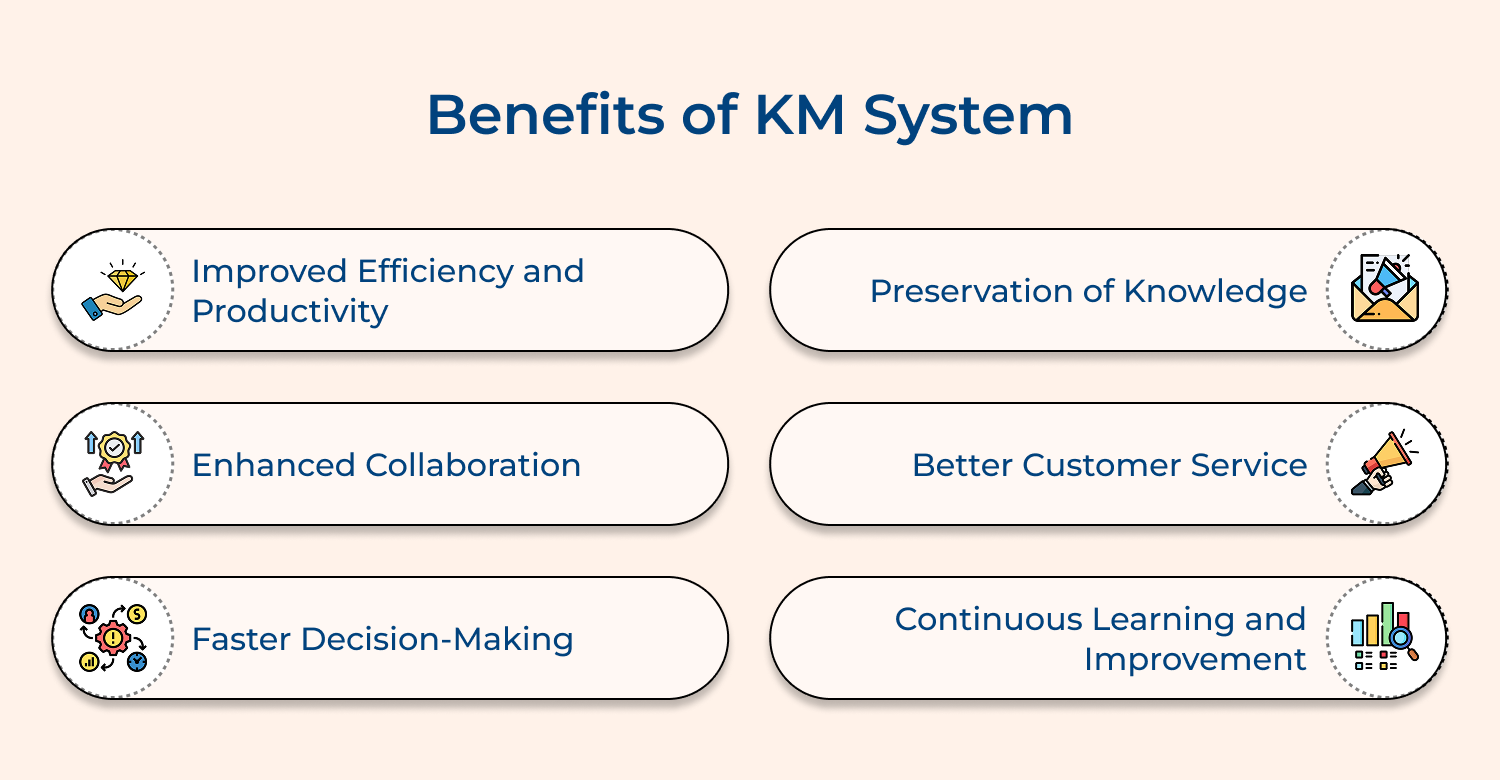
1. Improved Efficiency and Productivity
A KMS centralizes information, making it easily accessible to employees. It eliminates the time spent searching for documents or expertise scattered across various platforms. When employees can quickly find the information they need, they can focus more on their core tasks, leading to increased productivity. Streamlined processes enable teams to work smarter, not harder, resulting in better use of resources.
2. Enhanced Collaboration
Knowledge management systems facilitate collaboration by providing a shared platform for employees to contribute, access and discuss knowledge. Features such as discussion forums, wikis and shared document repositories promote teamwork. Hence, allowing employees to share insights as well as best practices easily. This collaborative environment builds innovation, as diverse perspectives can lead to creative problem-solving and more effective decision-making.
3. Faster Decision-Making
With a KMS, decision-makers can access relevant data and insights quickly. By having key information at their fingertips, they can make informed decisions faster, reducing delays in projects or initiatives. This speed is crucial, where timely decisions can significantly impact market positioning and customer satisfaction.
4. Preservation of Knowledge
Organizations often face the challenge of knowledge loss when employees leave or retire. A KMS helps mitigate this risk by capturing and preserving valuable knowledge as well as expertise within the system. By documenting processes, insights and lessons learned, organizations can ensure continuity while maintaining institutional knowledge, reducing the impact of turnover on operations.
5. Better Customer Service
A robust KMS can enhance customer service by providing support teams with quick access to product information, troubleshooting guides and customer histories. This enables representatives to address customer inquiries more efficiently and effectively, leading to improved customer satisfaction. A well-informed support team can resolve issues faster, which in turn creates customer loyalty.
6. Continuous Learning and Improvement
A KMS promotes a culture of continuous learning by encouraging employees to share experiences and insights. By analyzing feedback and lessons learned from past projects, organizations can identify areas for improvement while adapting strategies accordingly. This iterative learning process not only enhances individual performance but also drives organizational growth and innovation.
Creating a successful Knowledge Management process requires careful planning and execution. Here are essential steps to guide the process:
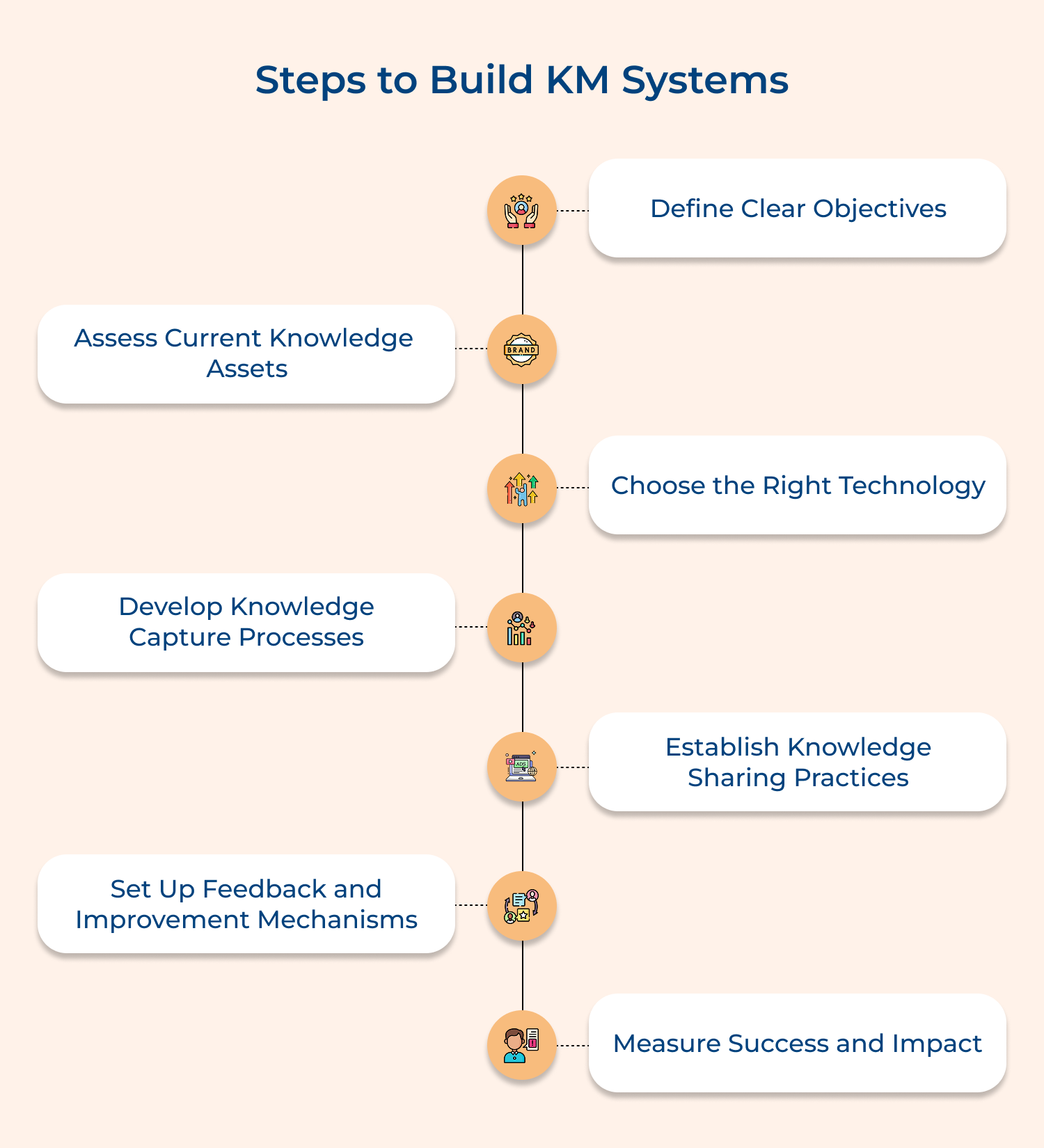
Defining clear objectives provides direction and purpose for your knowledge management system. It ensures alignment with overall business goals, helps prioritize efforts and sets measurable targets. Clear objectives guide decision-making throughout the implementation process while helping stakeholders understand the system’s value and expected outcomes.
Use objectives to guide the selection of technology, design of processes and allocation of resources. They help in creating relevant metrics for measuring success. Clear objectives also aid in communicating the importance of the KMS to employees, encouraging adoption and engagement. They provide a framework for evaluating and refining the system over time.
Best practices:
1. Conduct workshops with key stakeholders to identify and prioritize KMS objectives aligned to business goals.
2. Create SMART (Specific, Measurable, Achievable, Relevant, Time-bound) objectives for your KMS implementation.
3. Regularly review and update objectives to ensure they remain relevant as business needs evolve.
Before building a Knowledge Management System (KMS), it’s smart to start by assessing your current knowledge assets. This means figuring out what information your organization already has, where it’s stored and what’s missing. Doing so helps avoid duplicate work, uncover underused resources and spot areas where new knowledge needs to be developed.
Once you’ve done the assessment, create a clear inventory of your assets—like documents, databases and even the know-how your employees carry. This inventory becomes the foundation for your KMS structure, guiding what to migrate first and identifying key experts as well as critical knowledge to protect.
Best practices:
1. Conduct a comprehensive audit of all digital and physical knowledge repositories across the organization.
2. Use surveys and interviews to identify tacit knowledge held by employees, especially long-term staff as well as subject matter experts.
3. Create a knowledge map that visualizes the types, locations and relationships of different knowledge assets.
Choosing the right technology is the foundation of a successful Knowledge Management System (KMS). It shapes how smoothly knowledge is captured, organized and shared across the organization. The right tools not only boost user adoption and scalability but also ensure security as well as seamless integration with your existing systems.
Use technology to build a centralized, searchable knowledge hub where information is easy to find and update. Include features like document management, collaboration spaces and powerful search options. Make sure the platform supports different content formats and offers analytics to track engagement as well as highlight what’s being used or overlooked.
Best practices:
1. Conduct a thorough needs assessment to identify required features before evaluating KMS technologies.
2. Prioritize user-friendly interfaces and mobile accessibility to encourage widespread adoption.
3. Ensure the chosen technology offers robust security features and complies with relevant data protection regulations.
Strong knowledge capture processes make sure valuable information doesn’t get lost, especially the unwritten insights held by experienced employees. When knowledge is captured consistently and accurately, it becomes easier to organize, find, as well as reuse later. It also builds a culture where sharing ideas and lessons learned feels natural.
Set up clear templates and guidelines for documenting different types of knowledge. Design workflows that capture insights from project reviews, customer feedback and employee expertise. Automate where possible to make capturing easier and regularly prompt teams to contribute their experiences so the KMS stays current.
Best practices:
1. Develop easy-to-use templates for different types of knowledge (e.g., best practices, project lessons, product information).
2. Implement a process for capturing knowledge during key events like project completions or employee departures.
3. Use gamification or recognition programs to incentivize regular knowledge contributions from employees.
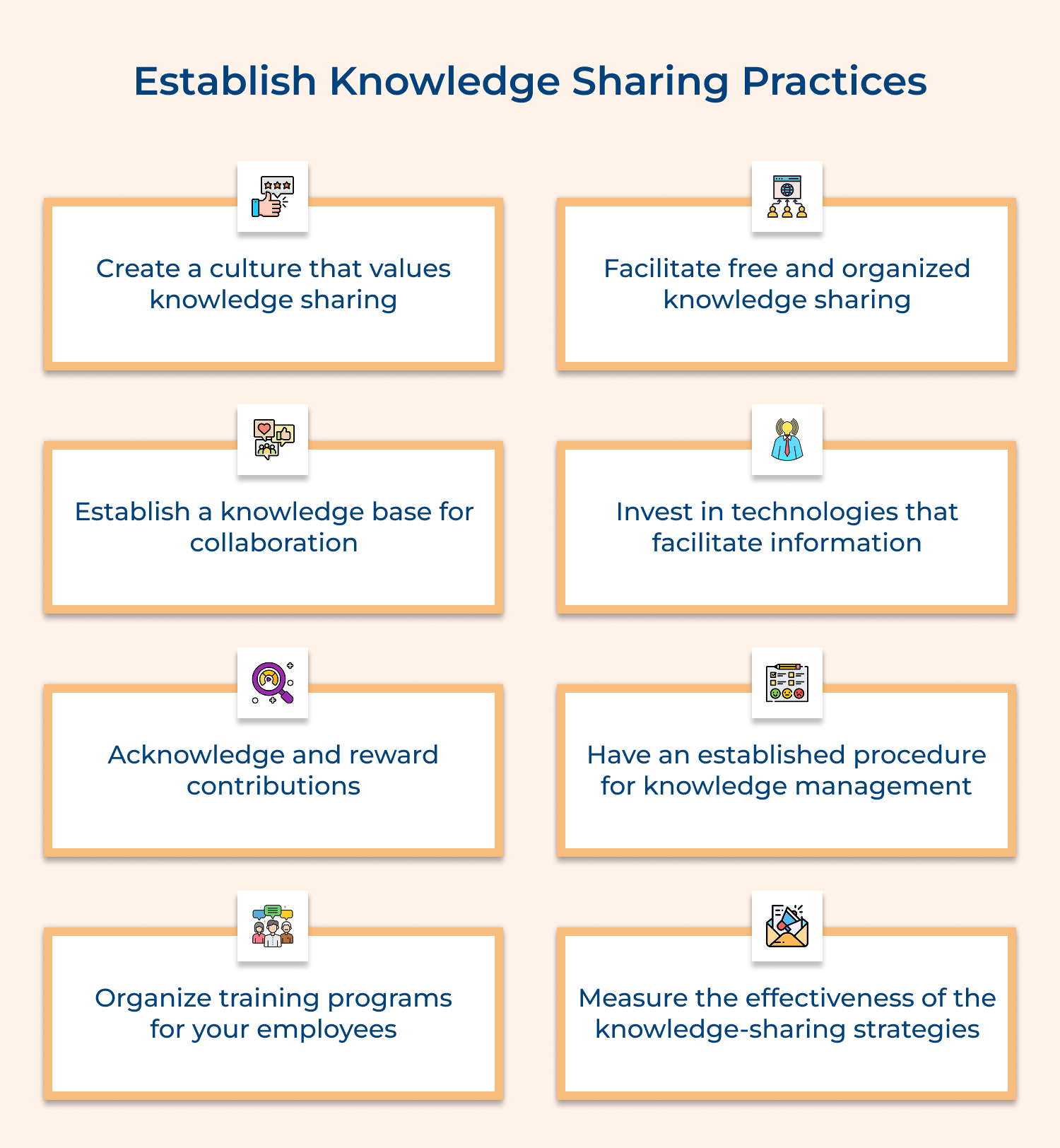
Knowledge sharing practices ensure that the valuable information captured within your organization actually reaches the people who need it. They break down silos, spark collaboration and help teams apply insights more effectively across departments. When done right, sharing knowledge boosts the overall ROI of your KMS by making the most of what’s already known.
Encourage regular sharing through sessions like lunch-and-learns or expert talks. Use collaboration platforms for open discussions as well as Q&As. Build communities of practice around core skills or topics and promote cross-team learning through rotations or joint projects. Highlight new insights using internal newsletters or dashboards.
Best practices:
1. Implement a mentoring program to facilitate knowledge transfer between experienced and newer employees.
2. Create a regular schedule of knowledge-sharing events, mixing formats to cater to different learning preferences.
3. Use social features in your KMS to allow employees to follow topics, ask questions and share insights.
Feedback mechanisms ensure the KMS remains relevant, accurate and useful over time. They help identify areas for improvement, outdated information and new knowledge needs. Regular feedback keeps the system dynamic and responsive to changing organizational needs. It also encourages user engagement as well as ownership of the KMS.
Implement rating systems for knowledge resources. Create easy ways for users to suggest updates or flag inaccuracies. Conduct regular surveys to assess user satisfaction and gather improvement ideas. Use analytics to identify underperforming areas. Establish a process for regular content reviews and updates. Create a governance team to oversee continuous improvement.
Best practices:
1. Implement a simple rating and comment system for all knowledge resources in the KMS.
2. Establish a regular schedule (e.g., quarterly) for reviewing and updating key knowledge assets.
3. Create a cross-functional governance team to oversee KMS improvements and address user feedback.
Measuring the success and impact of your Knowledge Management System (KMS) is key to proving its value while ensuring continuous improvement. It shows stakeholders how the system supports business goals as well as helps identify what’s working – and what needs tweaking. Regular tracking also ensures your KMS evolves with your organization’s changing needs.
Start by defining clear KPIs tied to your KMS objectives. Monitor metrics like active users, contribution rates and frequently accessed content. Track time saved in finding information or solving problems. Evaluate business outcomes and share these insights regularly to guide ongoing improvements.
Best practices:
1. Develop a balanced scorecard of KPIs that measure both system usage and business impact.
2. Conduct regular user surveys to gather qualitative feedback on the KMS’s value.
3. Use data visualization tools to create compelling dashboards that clearly communicate KMS performance and impact to stakeholders.
An effective KMS can transform how information is shared, accessed and utilized. Here are some essential features to look for when implementing a knowledge management software:
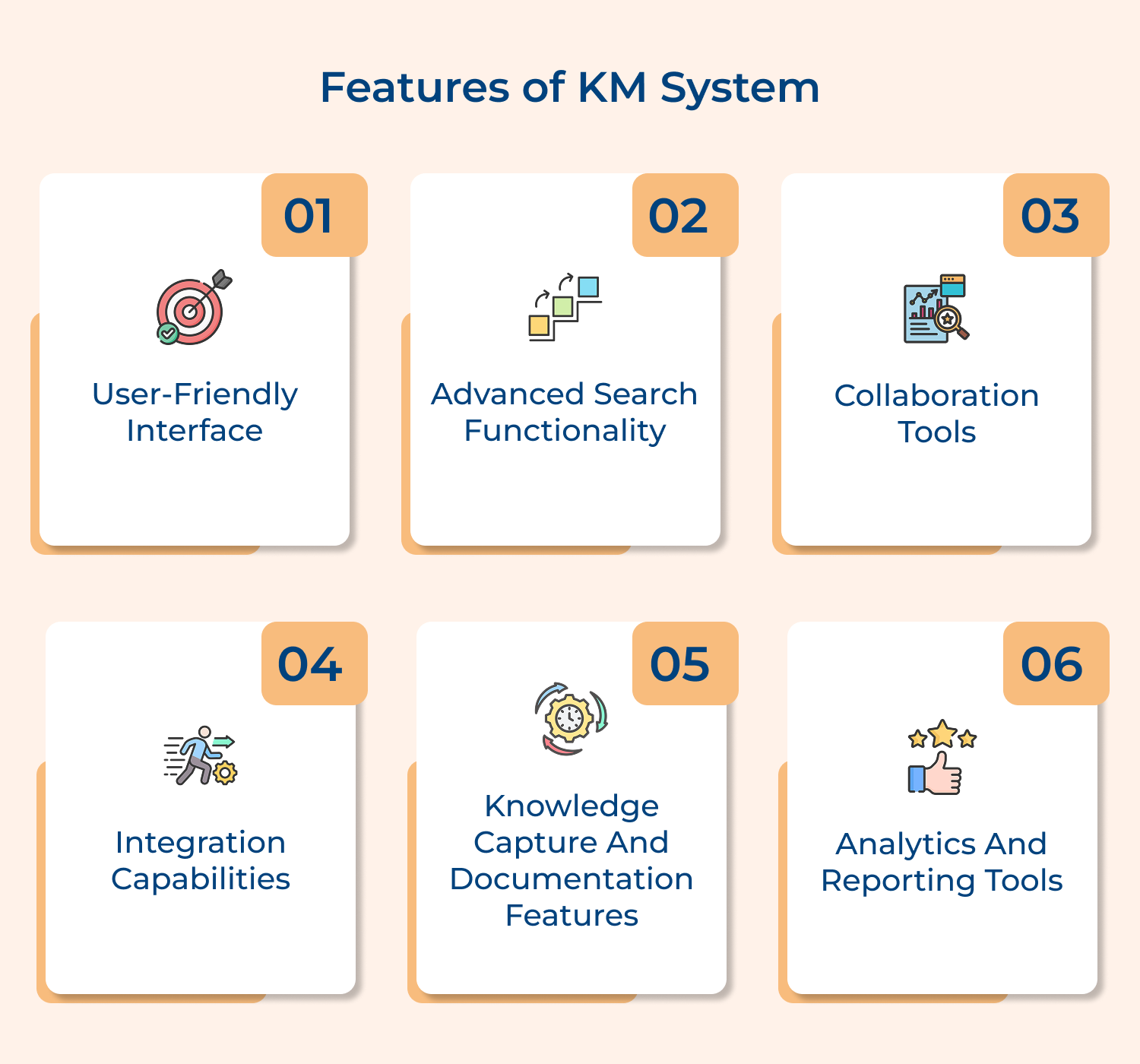
1. User-Friendly Interface
A user-friendly interface is essential for encouraging employees to actually use the system. The design should be intuitive, making it easy to navigate and find information quickly. Features like customizable dashboards and simple layouts help users access what they need without extra training, ensuring smooth adoption across teams.
2. Advanced Search Functionality
An efficient search function is one of the most critical features of a KMS. Advanced options like filters, keyword suggestions and Boolean operators help refine results. Users should be able to search by document type, date, or tags—saving time and boosting productivity by quickly locating relevant information.
3. Collaboration Tools
Collaboration lies at the core of effective knowledge sharing. A KMS should offer tools like discussion forums, shared workspaces and real-time document editing. These features make it easy for employees to share ideas, work together and co-create solutions – building innovation as well as a stronger knowledge-sharing culture.
4. Integration Capabilities
For a KMS to deliver maximum value, it must integrate smoothly with existing organizational tools such as project management software, CRM systems and communication apps like Slack or Microsoft Teams. Seamless integration minimizes workflow disruptions and allows employees to access as well as share knowledge effortlessly.
5. Knowledge Capture and Documentation Features
An effective KMS should make it easy to capture and document critical knowledge. Templates, wikis and guided forms help employees record processes, best practices, as well as lessons learned. This not only preserves institutional knowledge but also prevents teams from repeating the same mistakes.
6. Analytics and Reporting Tools
Robust analytics and reporting tools are vital for tracking the effectiveness of your KMS. They reveal which content is most popular, how users engage and where knowledge gaps exist. These insights help organizations make data-driven improvements and continuously enhance their knowledge management strategy.
Implementing a Knowledge Management System (KMS) can profoundly impact businesses by enhancing efficiency, collaboration and innovation. By centralizing information and facilitating knowledge sharing, organizations can make informed decisions faster, leading to improved productivity as well as customer satisfaction.
A KMS also helps preserve institutional knowledge, reducing the risks associated with employee turnover. As businesses navigate a rapidly changing industry, a well-structured KMS enables them to adapt and thrive by harnessing their collective expertise. Ultimately, investing in knowledge management is about driving sustainable growth and gaining a competitive edge in the marketplace.

What types of knowledge should be included in a knowledge management system?
A comprehensive KMS should include explicit knowledge (documented information like procedures, reports and best practices), tacit knowledge (expertise as well as insights from employees), customer knowledge (feedback, preferences), market intelligence, product information, operational data, etc. It should also encompass lessons learned, case studies, training materials and any other information that adds value to the organization’s decision-making as well as operations.
Who uses a knowledge management system?
KMS is used by employees at all levels of an organization. This includes executives for strategic decision-making, managers for operational planning, frontline staff for day-to-day tasks and customer service representatives for addressing client needs. IT teams use it for troubleshooting, HR for training and R&D for innovation. Essentially, anyone who needs to access, share, or contribute to organizational knowledge can benefit from a KMS.
How long does it take to implement a KMS in an organization?
The implementation time for a KMS varies depending on the organization’s size, complexity and readiness. A basic system might be set up in 3-6 months, but a comprehensive, organization-wide KMS typically takes 12-18 months to fully implement. This includes planning, technology selection, content migration, user training and change management. Ongoing refinement as well as optimization continue beyond the initial implementation.
What are the major knowledge management systems?
Major KMS include Omni24, Atlassian Confluence, Zendesk Guide, Salesforce Knowledge and ServiceNow Knowledge Management. Other popular options are Bloomfire, KnowledgeOwl and Guru. Open-source solutions like DokuWiki are also used. The choice depends on factors like organization size, industry, integration needs and specific features required. Many organizations also develop custom KMS tailored to their unique needs.
What is the role of a knowledge management system in business?
A KMS plays a crucial role in capturing, organizing and disseminating organizational knowledge. It improves decision-making, enhances operational efficiency as well as preserves institutional knowledge. KMS supports employee training, ensures consistency in processes, aids in problem-solving and facilitates collaboration. It also helps in maintaining competitive advantage by leveraging the collective intelligence of the organization.
How does Knowledge Management System enhance CX?
A KMS enhances customer experience (CX) by enabling faster, more accurate responses to customer queries. It ensures consistency in customer interactions across different channels and representatives. By providing easy access to product information, troubleshooting guides and customer history, it enables personalized service. KMS also facilitates the capture and analysis of customer feedback, leading to continuous improvement in products as well as services.
 https://omni24.io/wp-content/uploads/2026/08/AI-Customer-Service-Agents.png
1256
2400
Webvision Solution
https://omni24.io/wp-content/uploads/2023/04/Omni-Logo-1.svg
Webvision Solution2026-09-21 04:48:512026-09-21 04:48:51How to Build an AI Customer Service Agents: 8 Key Steps
https://omni24.io/wp-content/uploads/2026/08/AI-Customer-Service-Agents.png
1256
2400
Webvision Solution
https://omni24.io/wp-content/uploads/2023/04/Omni-Logo-1.svg
Webvision Solution2026-09-21 04:48:512026-09-21 04:48:51How to Build an AI Customer Service Agents: 8 Key Steps https://omni24.io/wp-content/uploads/2026/08/Omnichannel-Conversational-AI.png
1256
2400
Tushar Joshi
https://omni24.io/wp-content/uploads/2023/04/Omni-Logo-1.svg
Tushar Joshi2026-09-16 03:51:072026-09-16 03:51:07How to Build Omnichannel Conversational AI Strategy
https://omni24.io/wp-content/uploads/2026/08/Omnichannel-Conversational-AI.png
1256
2400
Tushar Joshi
https://omni24.io/wp-content/uploads/2023/04/Omni-Logo-1.svg
Tushar Joshi2026-09-16 03:51:072026-09-16 03:51:07How to Build Omnichannel Conversational AI Strategy https://omni24.io/wp-content/uploads/2026/08/Customer-Service-Teams.png
1256
2400
Tushar Joshi
https://omni24.io/wp-content/uploads/2023/04/Omni-Logo-1.svg
Tushar Joshi2026-09-15 04:01:522026-09-15 04:02:16How to Build Customer Service Teams: 6 Key Steps
https://omni24.io/wp-content/uploads/2026/08/Customer-Service-Teams.png
1256
2400
Tushar Joshi
https://omni24.io/wp-content/uploads/2023/04/Omni-Logo-1.svg
Tushar Joshi2026-09-15 04:01:522026-09-15 04:02:16How to Build Customer Service Teams: 6 Key Steps
Whether it’s about acquire, engage or support – Omni24 covers all your customer engagement needs in one complete platform.

Copyright ©2026 Veemo All rights reserved.
CA, Los Angeles, Hall Ave, 19011