Buyer Journey vs Customer Journey: What’s the Difference?
Learn the distinct roles of the buyer journey and customer journey to enhance marketing, build loyalty while driving business growth.
Learn the distinct roles of the buyer journey and customer journey to enhance marketing, build loyalty while driving business growth.
You know that frustrating feeling when a potential customer seems interested, but then they just disappear? Or when a one-time buyer never comes back? You’re not alone. Most businesses find it hard to turn leads into lifelong advocates.
This confusion doesn’t just cost a sale—it can lead to clunky customer experiences and lost revenue over time.
However, there’s a way to fix it. It all starts by mapping out two different paths: the buyer’s journey (how they decide to purchase) and the customer’s journey (their entire experience with you after). Nail both and you’ll not only improve their experience – you’ll build a community of loyal fans that fuels your growth.
The buyer journey is the process customers go through from the moment they become aware of a need or problem to the point of making a purchase decision. It typically consists of three main stages: awareness, consideration and decision.
Understanding the buyer journey is crucial for businesses as it allows them to align their marketing and sales strategies with the customer’s needs as well as behavior at each stage.
Companies can create targeted content, optimize touchpoints and provide the right information at the right time by mapping out the buyer journey. This approach helps build trust, establishes credibility and guides potential customers towards making informed decisions.
Key objectives:
Think of the customer journey as the entire story of a customer’s relationship with your brand. It’s everything from how they first hear about you to their experience after they buy.
This is bigger than just the sales process that leads to a purchase. By creating a customer journey map, you can see this story from their perspective. It helps you spot frustrations and create smoother, more personal experiences. The results help with happier customers who stick around and help your business grow.
Key objectives:
Grasping the difference between the buyer and customer journey is key to unlocking effective marketing strategies. Here are the essential distinctions to guide your approach.
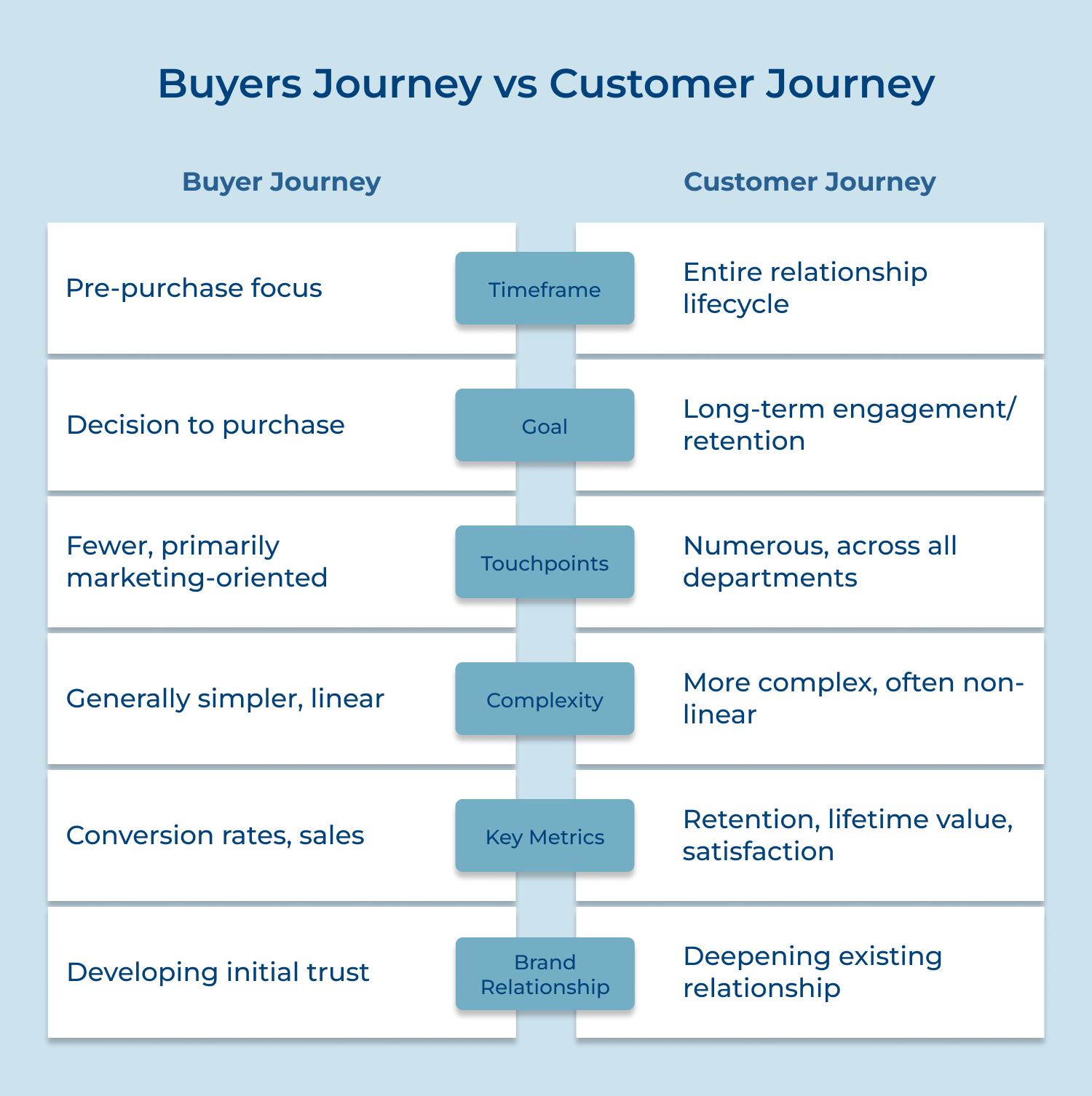
The buyer journey is often shorter in duration, focusing on the period from initial awareness to the purchase decision. The length of the buyer journey varies depending on the complexity of the product or service and the decision-making process of the customer.
In contrast, the customer journey is an ongoing process that extends beyond the initial purchase. It encompasses the entire lifecycle of the customer’s relationship with the brand, which can span months or even years. The customer journey recognizes that building strong, long-lasting relationships requires continuous engagement and support
The buyer journey focuses on the steps a potential customer takes before making a purchase, while the customer journey encompasses the entire experience, from initial awareness to post-purchase interactions. The buyer journey is more narrowly focused on the purchasing process.
The customer journey takes a holistic view of the customer’s relationship with the brand, including their experiences, emotions and interactions across various touchpoints. The customer journey extends beyond the purchase, considering factors such as customer service, loyalty as well as advocacy.
The buyer journey typically consists of four main stages: awareness, consideration, decision and purchase. These stages represent the progression of a potential customer from becoming aware of a problem or need to evaluating options, making a decision and ultimately completing the purchase.
The customer journey includes additional stages, such as onboarding, usage, retention and advocacy. These stages reflect the ongoing relationship between the customer and the brand, focusing on the customer’s experiences as well as interactions after the initial purchase.
The primary goal of the buyer journey is to convert potential customers into paying customers. Marketers and sales teams aim to guide prospects through the buying process, addressing their concerns, providing relevant information, while persuading them to choose their product or service.
In contrast, the customer journey aims to build long-term relationships, enhance customer satisfaction, as well as build loyalty. The objectives of the customer journey include delivering value, meeting customer expectations and encouraging repeat business as well as positive word-of-mouth.
In the buyer journey, marketing plays a crucial role in attracting and nurturing leads, while sales teams focus on converting those leads into customers. Marketing efforts aim to create awareness, generate interest and educate potential customers about the product or service. Sales teams engage with prospects, answer their questions while guiding them towards making a purchase.
In the customer journey, marketing and sales roles expand to include customer service, support, as well as account management. These teams work together to ensure a seamless and satisfying customer experience throughout the entire journey.
The buyer journey is typically measured using metrics such as conversion rates, lead generation and sales revenue. These metrics help organizations assess the effectiveness of their marketing and sales efforts in attracting all while converting potential customers.
The customer journey, on the other hand, is measured using a broader set of metrics, including customer satisfaction scores, retention rates, lifetime value and net promoter score (NPS). These metrics provide insights into the overall health of customer relationships and the success of efforts to build loyalty.
The focus during the buyer journey is on developing initial trust and convincing the prospect of the brand’s value. It’s about creating a positive first impression as well as overcoming skepticism to secure that first purchase.
The customer journey is about deepening an existing relationship. It involves building on that initial trust, consistently delivering value, handling issues effectively and creating emotional connections. The goal is to transform a transactional relationship into a loyal, even passionate, connection with the brand over time.
The buyer journey is crucial for unlocking insights into customer behavior, refining marketing strategies and creating lasting relationships. Here are some key reasons:
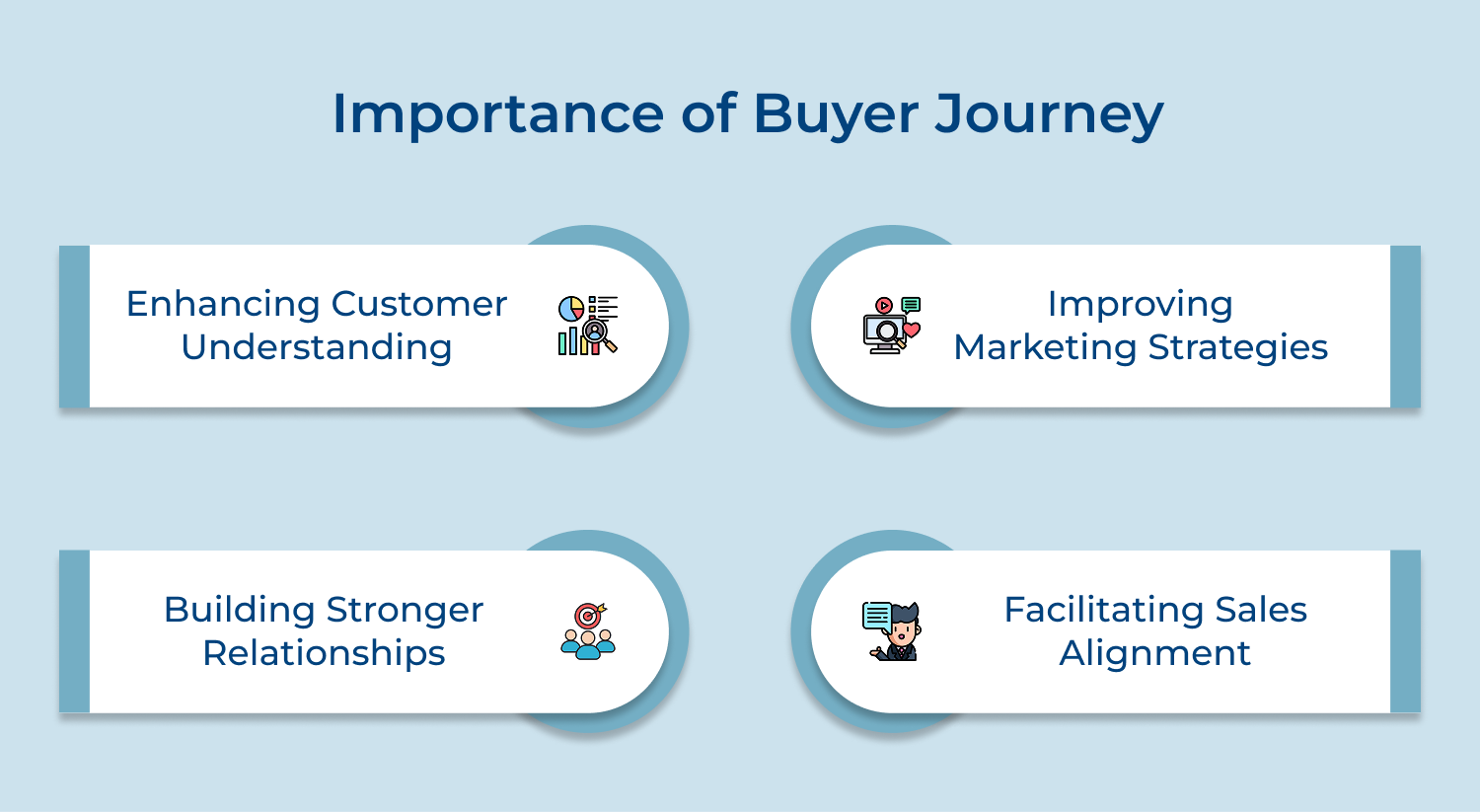
Enhancing Customer Understanding
Mapping the buyer journey is like getting a direct look into your customers’ minds. You learn what they really want, what frustrates them and how they behave. This lets you craft messages and content that truly resonate, helping them see their problem clearly while guiding them to your solution.
Improving Marketing Strategies
When you align your marketing with the buyer journey, you stop guessing and start engaging. By seeing which touchpoints and channels your customers prefer, you can double down on what’s actually working. It means you spend your time and budget more wisely, focusing on the activities that genuinely drive conversions.
Building Stronger Relationships
Understanding this journey builds trust and loyalty. When you provide the right information exactly when a customer needs it, they feel heard and valued. The personal touch doesn’t just secure a one-time sale; it encourages people to come back again and again, turning them into happy, long-term fans.
Facilitating Sales Alignment
A clear buyer journey map is the ultimate collaboration tool for your marketing and sales teams. It helps everyone work from the same playbook, ensuring a smooth experience for the customer. Marketing can arm sales with the insights and materials they need to confidently answer questions as well as close deals faster.
Grasping the customer journey is essential for crafting impactful experiences and fueling business growth. Here are some compelling reasons why it’s important:
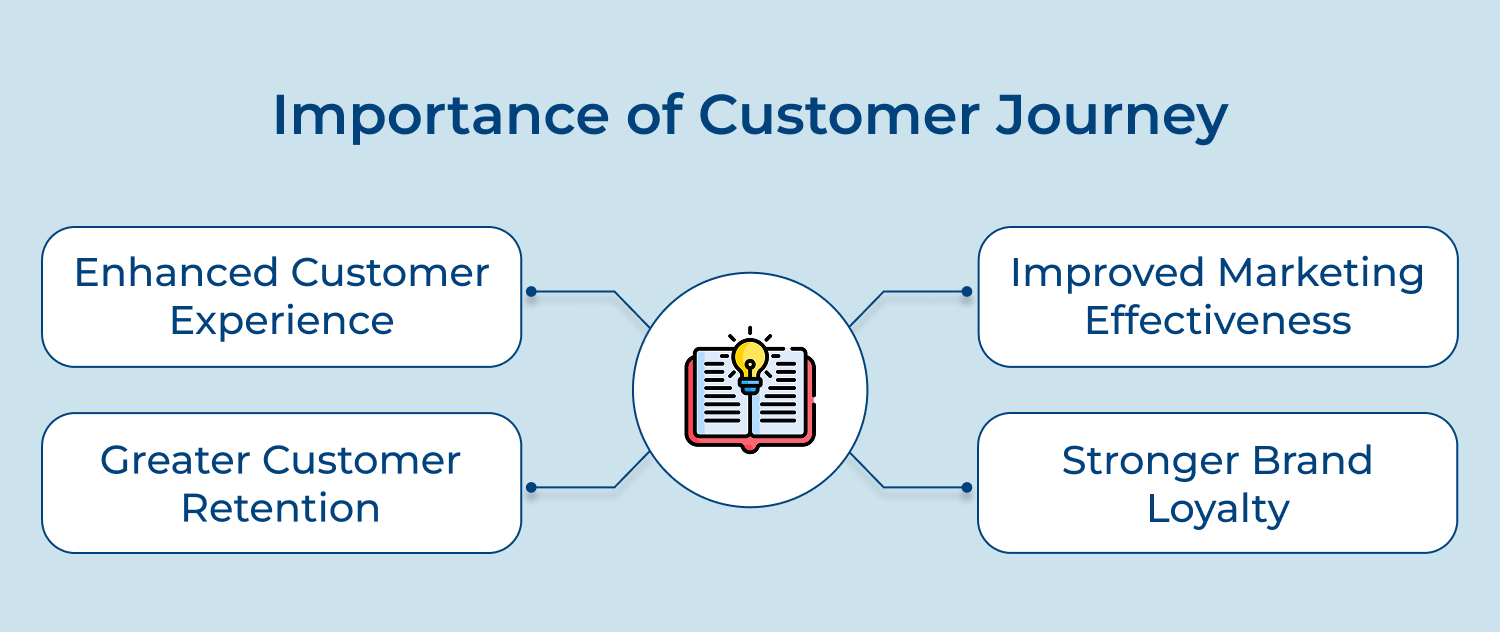
Enhanced Customer Experience
When you understand the customer journey, you can personalize every interaction. By meeting their needs and preferences, you create happier customers. This satisfaction builds fierce loyalty and turns them into fans who happily refer others, naturally driving your growth.
Improved Marketing Effectiveness
Mapping the customer journey shows you which channels and messages actually work. By seeing how customers interact with you, you can fine-tune your strategy to ensure your content hits the mark at every stage. Higher conversion rates and a much better return on your investment.
Greater Customer Retention
A clear customer journey map points out the make-or-break moments for retention. By understanding these key touchpoints, you can solve problems before they escalate and keep customers engaged. It leads to stronger loyalty, making customers more likely to buy again and recommend you.
Stronger Brand Loyalty
When customers feel genuinely understood and valued at every step, they form a real emotional connection with your brand. This loyalty is your secret weapon in a crowded market. A positive overall journey is what transforms one-time buyers into lifelong advocates.
Understanding the distinctions between the buyer and customer journey is essential for effective marketing as well as customer engagement. The buyer journey focuses on the process leading to a purchase decision, while the customer journey encompasses the entire experience post-purchase.
Mapping both journeys allows businesses to tailor their strategies to meet the unique needs of potential buyers and existing customers. This holistic approach builds stronger relationships, enhances customer satisfaction and ultimately drives brand loyalty. As companies adapt to evolving consumer behaviors, prioritizing both journeys will be key to sustained success in an increasingly competitive marketplace.

What is the difference between the customer lifecycle and the buyer journey?
The customer lifecycle encompasses the entire relationship between a customer and a company, from initial awareness through post-purchase interactions as well as loyalty. The buyer journey specifically focuses on the steps a potential customer takes before making a purchase, including awareness, consideration and decision-making stages.
What is the difference between the buyer journey and the funnel?
The buyer journey describes the path a potential customer takes from awareness to purchase, considering various touchpoints and decision-making factors. The funnel is a marketing model that visualizes this journey as a narrowing process, where leads are filtered at each stage, resulting in fewer but more qualified prospects moving towards a purchase.
What is the difference between buyer experience and customer experience?
Buyer experience refers to the interactions and impressions a potential customer has during the pre-purchase stages, such as research, comparison as well as decision-making. Customer experience encompasses the entire relationship with a company, including post-purchase interactions, product usage, customer service and ongoing engagement, extending beyond the initial buying process.
What factors influence the Buyer Journey and Customer Journey?
Factors influencing both journeys include marketing strategies, product quality, pricing, brand reputation, customer service and competitors’ offerings.Personal factors like needs, preferences as well as past experiences play a role. External influences such as economic conditions, technological advancements and social trends also impact these journeys.
How can businesses optimize the Buyer Journey and Customer Journey differently?
To optimize the Buyer Journey, businesses can focus on targeted marketing, educational content and streamlined purchase processes. For the Customer Journey, emphasis should be on post-purchase support, personalized experiences, loyalty programs and ongoing engagement. Both require data analysis and continuous improvement based on customer feedback along with behavior patterns.
 https://omni24.io/wp-content/uploads/2026/08/Omnichannel-Chatbots.png
1256
2400
Tushar Joshi
https://omni24.io/wp-content/uploads/2023/04/Omni-Logo-1.svg
Tushar Joshi2026-08-13 04:43:302026-08-24 09:02:01How Omnichannel Chatbots Improve Your Customer Experience
https://omni24.io/wp-content/uploads/2026/08/Omnichannel-Chatbots.png
1256
2400
Tushar Joshi
https://omni24.io/wp-content/uploads/2023/04/Omni-Logo-1.svg
Tushar Joshi2026-08-13 04:43:302026-08-24 09:02:01How Omnichannel Chatbots Improve Your Customer Experience https://omni24.io/wp-content/uploads/2026/08/Ecommerce-Chatbots-1.png
1256
2400
Tushar Joshi
https://omni24.io/wp-content/uploads/2023/04/Omni-Logo-1.svg
Tushar Joshi2026-08-12 03:57:552026-08-24 09:03:22Ecommerce Chatbots: What are They and Their Use Cases
https://omni24.io/wp-content/uploads/2026/08/Ecommerce-Chatbots-1.png
1256
2400
Tushar Joshi
https://omni24.io/wp-content/uploads/2023/04/Omni-Logo-1.svg
Tushar Joshi2026-08-12 03:57:552026-08-24 09:03:22Ecommerce Chatbots: What are They and Their Use Cases https://omni24.io/wp-content/uploads/2026/08/Omnichannel-Ecommerce.png
1256
2400
Tushar Joshi
https://omni24.io/wp-content/uploads/2023/04/Omni-Logo-1.svg
Tushar Joshi2026-08-11 04:50:362026-08-24 09:00:45How to Create an Omnichannel Ecommerce Strategy: 7 Best Ways
https://omni24.io/wp-content/uploads/2026/08/Omnichannel-Ecommerce.png
1256
2400
Tushar Joshi
https://omni24.io/wp-content/uploads/2023/04/Omni-Logo-1.svg
Tushar Joshi2026-08-11 04:50:362026-08-24 09:00:45How to Create an Omnichannel Ecommerce Strategy: 7 Best Ways
Whether it’s about acquire, engage or support – Omni24 covers all your customer engagement needs in one complete platform.

Copyright ©2026 Veemo All rights reserved.
CA, Los Angeles, Hall Ave, 19011