Live Chat vs Email: Which is Better for Customer Support?
Live chat offers instant help, while email provides detailed support. Use both for optimal customer service.

Live chat offers instant help, while email provides detailed support. Use both for optimal customer service.
Effective communication is the cornerstone of business success. As companies strive to enhance customer experience while streamlining operations, two tools stand out: Live Chat and Email.
51% buy again from a company if they offer live chat support. 88% of customers expect to get a reply within 60 minutes.
These powerhouses of digital communication have transformed how businesses interact with customers and manage internal processes. But which one is right for your needs?
This blog post dives into the Live Chat vs Email debate, exploring their unique strengths, limitations and optimal use cases.
Live chat is a real-time communication tool that allows businesses to interact with website visitors instantly through text-based conversations. It typically appears as a small window on a website, enabling customers to ask questions, seek support, or receive guidance from company representatives without leaving the page they’re browsing.
Live chat bridges the gap between traditional customer service channels and the fast-paced digital world. It offers a convenient and efficient way for customers to engage with businesses. Live chat can significantly improve conversion rates, reduce support costs and gather valuable customer insights.
Key objectives:
Email is a digital communication method that allows individuals and organizations to exchange messages, documents, as well as other files electronically. In professional settings, email serves as a crucial tool for efficient and documented communication.
The importance of email in the workplace cannot be overstated. It facilitates rapid information sharing, enables asynchronous communication across time zones and provides a permanent record of exchanges. Email has become an indispensable part of modern business operations, streamlining workflows and enhancing productivity.
Four key objectives of professional email communication:
While live chat and email serve the purpose of facilitating communication, they have distinct characteristics that make them suitable for different scenarios. Let’s explore their differences:
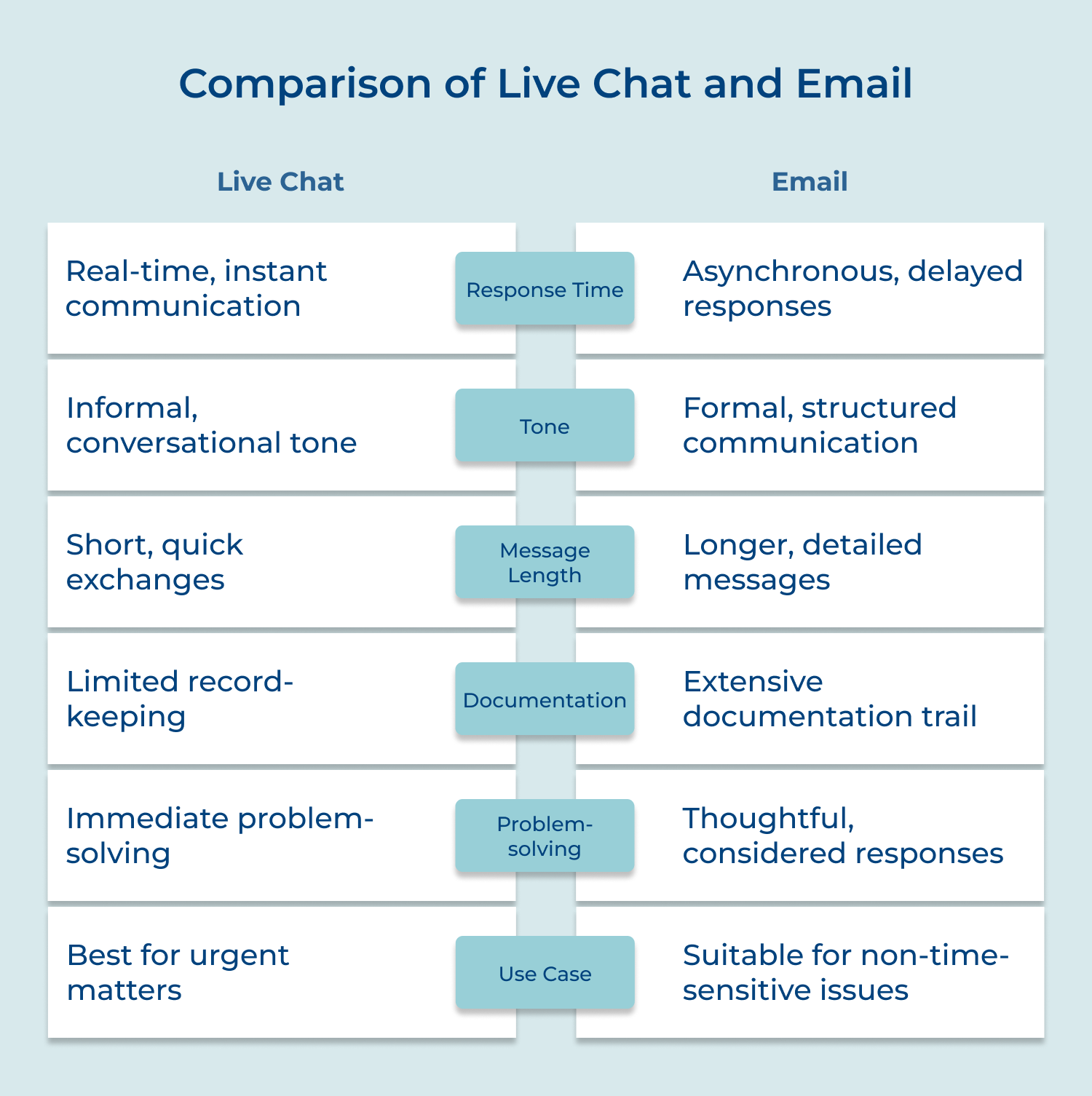
Live Chat: When you start a chat session, you expect a quick answer. It’s all about real-time support. This is perfect for urgent problems where you need help right now. It gives you that instant “someone’s here to help” feeling.
Email: With email assistance, you know you might wait a bit for a reply. It’s not instant and that’s okay. This gives the person on the other end time to think through a full, helpful answer. It’s better for things that aren’t super time-sensitive.
Live Chat: The tone in conversations is usually pretty casual and friendly, like a quick text. It helps build a connection fast. Of course, the agent still needs to be professional.
Email: Email tends to be more formal. You’ll see “Dear” and “Sincerely,” and the messages are more structured. It feels more official, which is great for serious topics or important clients.
Live Chat: During online chats, messages are short and sweet. You get straight to the point. It’s great for simple questions, but not the best for explaining a super complicated issue.
Email: Emails are where you can write a longer, detailed message. You can explain everything fully and even attach files. This makes email assistance the winner for complex stuff.
Live Chat: Live chat usually saves a transcript of your chat session. But because the conversation is so fast and casual, it can sometimes be messy to look back on later
Email: Email is fantastic for record-keeping. Every message is saved with a date and time, creating a perfect paper trail. You can always search your inbox to find what was said.
Live Chat: Live chat can be a bit demanding because of the need for quick replies. An agent might handle a few chat conversations at once, but it’s hard to do deep work while chatting.
Email: This is much easier to fit into your day. You can write replies when you have time, manage your inbox and switch between tasks without the pressure of an immediate response.
Live Chat: You can only get real-time support if you’re both on the live chat tool at the same time. If the company’s chat is offline, you’re out of luck.
Email: You can send an email to anyone, anywhere and they can reply when they’re free. This makes email interaction perfect for talking to people in different time zones.
Live Chat: Online chats are best for simple, straightforward questions that need a fast answer. Think of things like checking an order status or asking a quick “how-to” question.
Email: Email support is your go-to for complicated problems. If you need to include details, talk to several people, or attach documents, email is the way to go.
Live Chat: The immediate back-and-forth of a chat session can make you feel like you’re talking to a real person right away. It’s great for making a quick, friendly connection.
Email: Even though it’s slower, a well-written email can feel very personal. Taking the time to write a thoughtful response shows you care, which can help build a stronger relationship over time.
Live chat and email offers unique advantages that cater to different communication needs and scenarios. Here are the distinct benefits of both live chat as well as email.
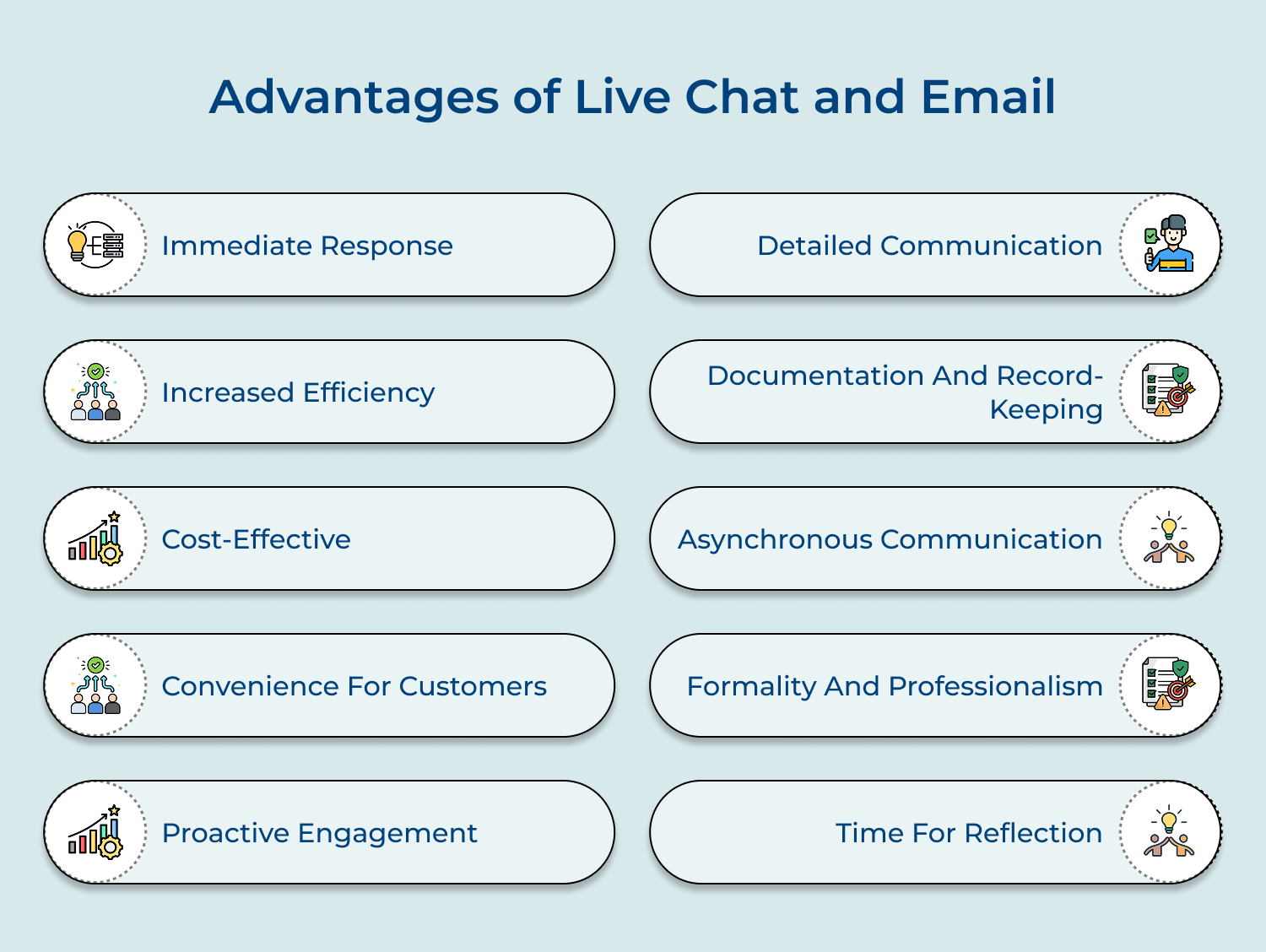
Live chat offers immediate support and engagement, transforming customer service into a real-time experience. Here are the list of its advantages:
Email provides flexible, detailed communication, enabling businesses to connect efficiently across time zones and audiences. Here are the list of its advantages:
Understanding the limitations of live chat and email are crucial for businesses to make informed decisions about when and how to use these communication channels.
While convenient, live chat has limitations, including potential delays and challenges with complex inquiries. Here are the list of its limitations:
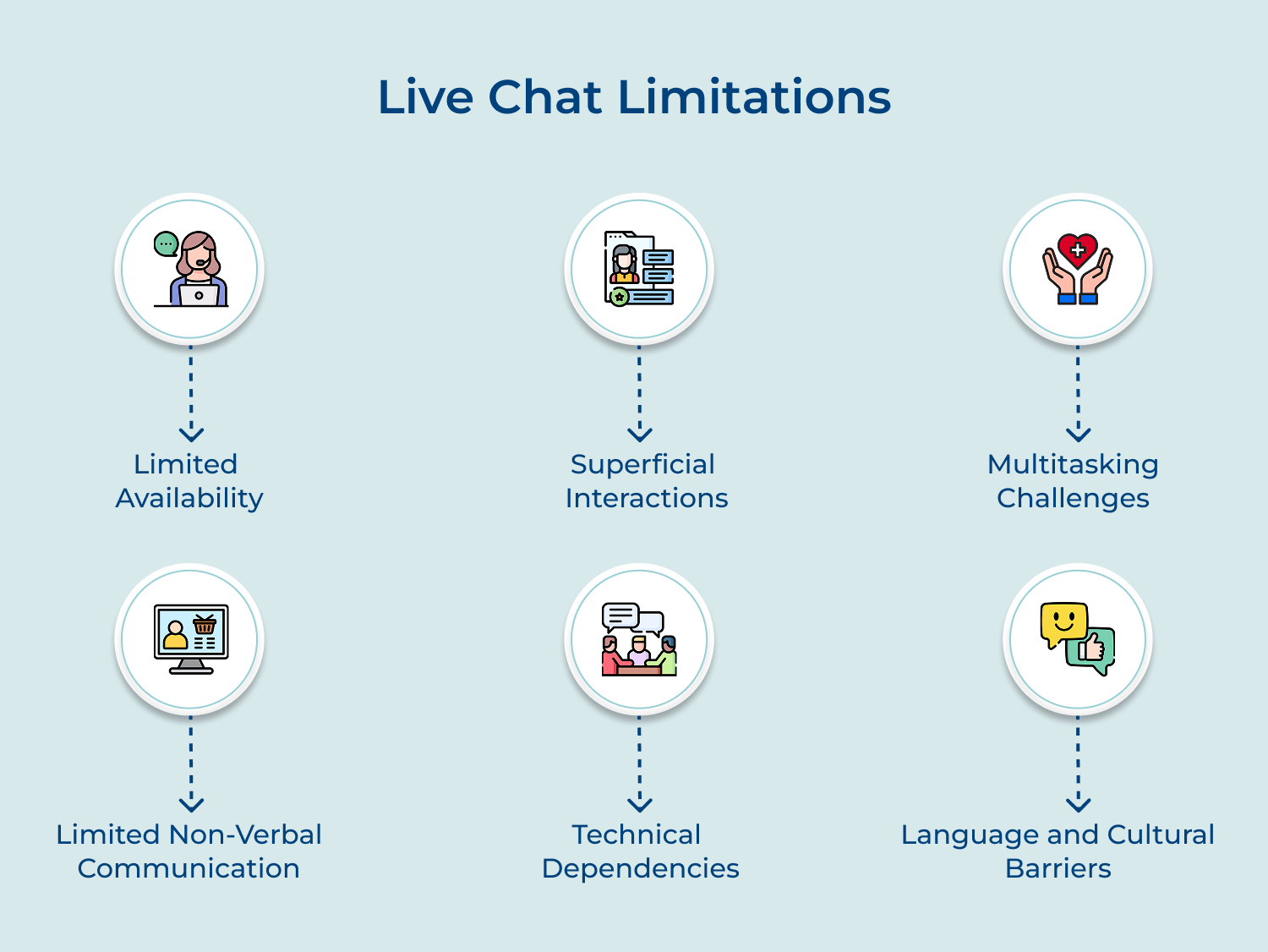
Limited Availability
You can’t always get help when you want it. This service usually only runs during the standard work day. If you have a question late at night or on a weekend, you might be out of luck.
Superficial Interactions
The back-and-forth is so fast that it’s better for simple questions. If your problem is complicated, it’s tough to explain everything properly. You might not get a full solution and could be told to contact someone another way.
Multitasking Challenges
The person you’re talking to is usually having several conversations at the same time. Because they’re split between different people, they might be slower to reply or could miss a detail in your message.
Limited Non-Verbal Communication
Since you’re just typing, it’s impossible to hear if someone is being friendly, sarcastic, or serious. This makes it really easy to misunderstand the other person’s meaning, which can sometimes cause friction.
Technical Dependencies
You need a steady internet connection for it to function. If your connection is bad or the system has a technical glitch, your conversation can be cut off suddenly and you might have to start all over.
Language and Cultural Barriers
The need for speed makes it difficult if you and the helper don’t share a native language. There’s no time to find the perfect word, so small misunderstandings can happen more easily.
Despite its flexibility, email can lead to misunderstandings and slower response times compared to chat. Here are the list of its limitations:
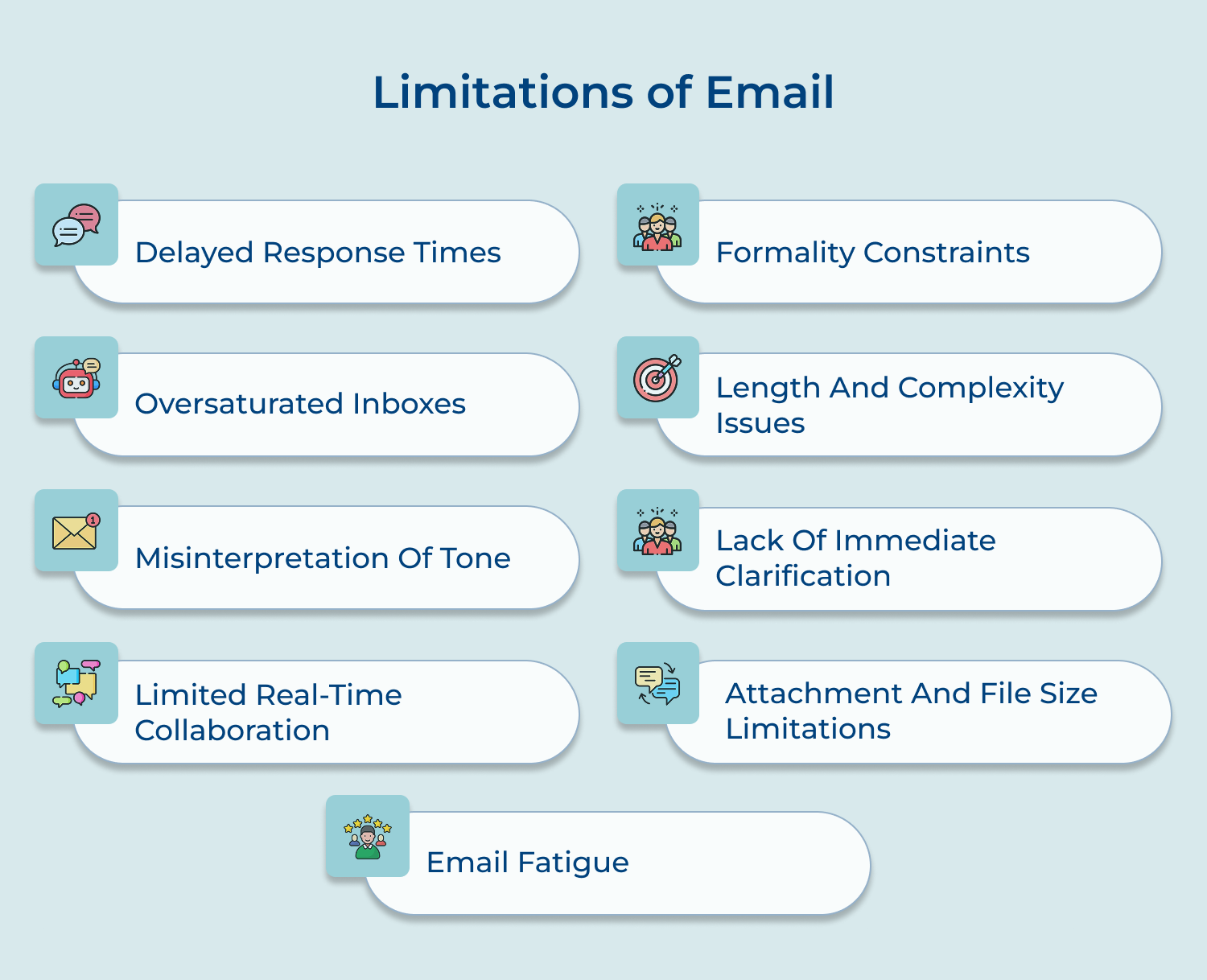
Delayed Response Times
Email isn’t instant. You might send a message and not get a reply for hours or even days. If you need a quick answer to make a decision, this delay can be a real problem.
Oversaturated Inboxes
Everyone gets so many emails. An important message can easily get buried in a crowded inbox and be completely missed. It’s easy for things to get lost in the shuffle.
Misinterpretation of Tone
Since you’re just reading text, you can’t hear someone’s tone of voice. A joke can seem serious, or a simple statement can sound rude. This can lead to unnecessary misunderstandings and hurt feelings.
Limited Real-Time Collaboration
Trying to make a decision over email can be like playing a slow game of tag. The back-and-forth takes forever. For a fast-paced group conversation, other tools are much better.
Formality Constraints
Sometimes, writing a proper email feels like too much work for a simple question. The need for a subject line, a greeting and a sign-off can make a quick check-in feel more formal than it needs to be.
Length and Complexity Issues
When an email is a huge wall of text, it’s overwhelming. People tend to skim long messages, which means they might miss an important detail you buried in the middle.
Lack of Immediate Clarification
In a conversation, if you’re confused, you can just ask “What do you mean?” right away. With email, you have to send a whole new message and wait for another reply, which drags things out.
Attachment and File Size Limitations
Email systems often can’t handle large files like videos or big presentations. You’ll get a “file too large” error, forcing you to use a separate app just to share your work.
Email Fatigue
The constant flood of messages can make people feel burned out on email. When your inbox is always full, it’s easy to feel overwhelmed and put off replying, even to important things.
Both live chat and email have fundamentally improved how businesses operate. Live chat excels by offering instant help and boosting satisfaction, while email remains essential for detailed, formal communication as well as record-keeping.
Together, they create a powerful, balanced system. By strategically using both tools, companies can meet modern customer expectations for both speed and depth. Hence, leading to stronger relationships, smoother internal processes and sustained growth. This dual approach is key to success in the current digital landscape.

Why use chat instead of email?
Chat offers immediate, real-time communication, making it ideal for urgent matters or quick queries. It provides instant gratification for customers seeking immediate assistance and allows for rapid back-&-forth exchanges. Chat is more conversational and can feel more personal, potentially building better rapport with customers or colleagues.
What is the advantage of chatting over emailing?
Chatting allows for instant responses and quick problem-solving. It’s more efficient for handling simple queries or providing immediate clarifications. Chat supports multitasking, as representatives can handle multiple conversations simultaneously. It’s also more convenient for customers who prefer immediate answers without waiting for email responses.
Is email support better than chat support?
Neither is universally better; each has its strengths. Email is better for complex issues requiring detailed explanations or documentation. It’s ideal for formal communications and allows for thoughtful, comprehensive responses. Chat excels at quick problem-solving and immediate assistance. The best choice depends on the specific situation and communication needs.
When does email make sense?
Email makes sense for formal communications, complex issues requiring detailed explanations, or when documentation is crucial. It’s ideal for non-urgent matters, communicating across time zones, or when attachments are necessary. Email is also preferable when multiple stakeholders need to be involved or for maintaining a clear record of communication.
When does live chat make sense?
Live chat makes sense for urgent matters requiring immediate attention or simple queries needing quick resolution. It’s ideal for providing real-time customer support, guiding users through processes, or when immediate back-and-forth communication is necessary. Chat is also effective for proactive engagement with website visitors or potential customers.
 https://omni24.io/wp-content/uploads/2026/09/Social-commerce-scaled.png
1340
2560
Webvision Solution
https://omni24.io/wp-content/uploads/2023/04/Omni-Logo-1.svg
Webvision Solution2026-10-23 12:18:272026-10-23 12:18:27What is Social Commerce and Why Does It Matter?
https://omni24.io/wp-content/uploads/2026/09/Social-commerce-scaled.png
1340
2560
Webvision Solution
https://omni24.io/wp-content/uploads/2023/04/Omni-Logo-1.svg
Webvision Solution2026-10-23 12:18:272026-10-23 12:18:27What is Social Commerce and Why Does It Matter? https://omni24.io/wp-content/uploads/2026/08/AI-Customer-Service-Agents.png
1256
2400
Webvision Solution
https://omni24.io/wp-content/uploads/2023/04/Omni-Logo-1.svg
Webvision Solution2026-09-21 04:48:512026-09-21 04:48:51How to Build an AI Customer Service Agents: 8 Key Steps
https://omni24.io/wp-content/uploads/2026/08/AI-Customer-Service-Agents.png
1256
2400
Webvision Solution
https://omni24.io/wp-content/uploads/2023/04/Omni-Logo-1.svg
Webvision Solution2026-09-21 04:48:512026-09-21 04:48:51How to Build an AI Customer Service Agents: 8 Key Steps https://omni24.io/wp-content/uploads/2026/08/Omnichannel-Conversational-AI.png
1256
2400
Tushar Joshi
https://omni24.io/wp-content/uploads/2023/04/Omni-Logo-1.svg
Tushar Joshi2026-09-16 03:51:072026-09-16 03:51:07How to Build Omnichannel Conversational AI Strategy
https://omni24.io/wp-content/uploads/2026/08/Omnichannel-Conversational-AI.png
1256
2400
Tushar Joshi
https://omni24.io/wp-content/uploads/2023/04/Omni-Logo-1.svg
Tushar Joshi2026-09-16 03:51:072026-09-16 03:51:07How to Build Omnichannel Conversational AI Strategy
Whether it’s about acquire, engage or support – Omni24 covers all your customer engagement needs in one complete platform.

Copyright ©2026 Veemo All rights reserved.
CA, Los Angeles, Hall Ave, 19011