Chatbot vs Virtual Assistant – What’s the Difference?
Chatbots and virtual assistants serve distinct roles in enhancing customer communication, helping businesses deliver smarter and more personalized support.
Chatbots and virtual assistants serve distinct roles in enhancing customer communication, helping businesses deliver smarter and more personalized support.
Modern businesses face the challenge of managing customer interactions effectively while maximizing efficiency. It leads to confusion between two AI solutions: chatbot vs virtual assistant.
The global digital experience platform market is projected to expand to $26.54 billion by 2030.
The problem is that while both can enhance customer service, they serve different functions and may not meet every business need. If you are unsure which solution is right for you, understanding their distinct capabilities is essential.
Learn the differences between virtual assistants vs chatbots, helping you make an informed decision that aligns with your goals and enhances your customer experience. Let’s dive in!
Chatbots are automated software programs designed to simulate human conversation through text or voice interactions. They can be integrated into websites, messaging apps, or support platforms to assist users. They operate 24/7 which makes it a valuable tool for enhancing customer engagement.
Chatbots streamline communication and improve customer service. Handling routine inquiries allows human agents to focus on more complex issues, increasing overall efficiency. Chatbots deliver instant responses, enhancing user satisfaction and reducing wait times.
Key objectives:
A virtual assistant (VA) is a remote professional who provides administrative, technical, or creative support to businesses or individuals. VAs operate from their own locations, leveraging digital tools to complete tasks. The flexible approach allows clients to access specialized skills without the need for in-house staff.
The role of a virtual assistant is crucial in today’s fast-paced work environment. They help businesses streamline operations and focus on core activities, thereby increasing productivity. With the ability to scale support based on demand, VAs offer cost-effective solutions for companies looking to optimize their resources.
Key objectives:
Understanding the distinctions is vital, as here are the key differences between chatbots and virtual assistants that can guide your selection process.
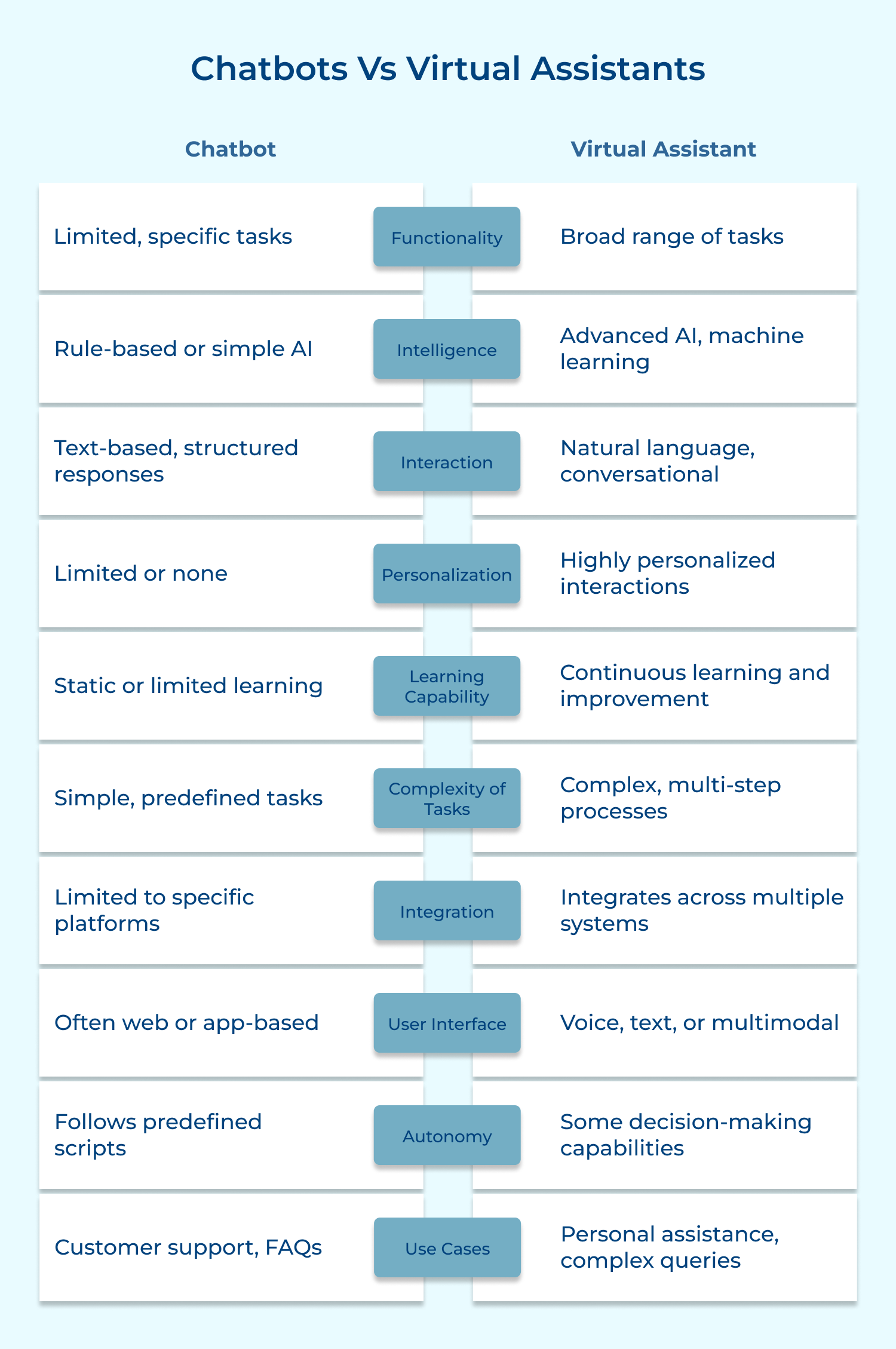
Chatbots typically have a narrow focus, designed to handle specific tasks or answer predefined questions within a limited domain. They excel at providing quick responses to common queries and performing simple actions.
Virtual assistants offer a broader range of capabilities, often integrating with multiple systems and able to perform complex tasks across various domains. It can understand context, learn from interactions, and provide more personalized assistance, making it more versatile in handling diverse user needs.
Most chatbots operate on rule-based systems or simple machine learning algorithms, following predetermined scripts to respond to user inputs. Their learning capabilities are often limited, requiring manual updates to improve performance.
Virtual assistants typically employ more advanced artificial intelligence, including natural language processing and machine learning. They can understand nuanced language, learn from interactions and continuously improve their responses over time.
Chatbots usually interact with users through text-based interfaces, often embedded in websites or messaging platforms. Their conversations tend to be more structured and limited to specific formats or keywords.
Virtual assistants, on the other hand, offer more natural and diverse interaction methods. They can communicate through text, voice, or even visual interfaces, providing a more intuitive and human-like interaction experience.
Chatbots are often standalone applications or integrated into specific platforms for customer service or information retrieval. Their integration capabilities are typically limited to the system they’re designed for.
Virtual assistants boast extensive integration capabilities. They can connect with various devices, applications, and services, allowing for a more seamless and comprehensive user experience. The connectivity enables virtual assistants to perform actions across different platforms and provide a more holistic assistance experience.
Basic chatbots often lack significant personalization capabilities, providing the same responses to similar queries regardless of the user or context. They typically don’t maintain long-term memory of user preferences or past interactions.
Virtual assistants, conversely, excel in personalization and context awareness. They can remember user preferences, understand the context of conversations, and tailor their responses and actions accordingly. The ability to provide personalized assistance makes virtual assistants more effective in building long-term relationships with users and offering truly customized support.
Chatbots are designed to handle simple, repetitive tasks and provide quick answers to straightforward questions. They’re ideal for scenarios like FAQ responses, basic customer support, or simple data retrieval.
Virtual assistants can manage more complex, multi-step tasks that require reasoning and decision-making. They can schedule appointments, make recommendations based on user preferences, perform analysis and even assist with creative tasks.
Chatbots are often easier to deploy and scale, making them suitable for businesses looking for quick implementation of basic customer service solutions. Their customization options may be limited.
Virtual assistants, while potentially more complex to implement initially, offer greater scalability in terms of functionality and customization. They can be tailored to specific business needs, integrate with proprietary systems and evolve to handle an expanding range of tasks, making them a more flexible solution for organizations with diverse needs.
Chatbots typically provide a more transactional and straightforward user experience, focused on quickly resolving specific queries or tasks. While efficient, this can sometimes feel impersonal or limited.
Virtual assistants aim to create a more engaging and interactive experience. They can maintain context across multiple interactions, engage in more natural conversations and even express personality traits. This enhanced engagement can lead to higher user satisfaction, as users feel they’re interacting with a more intelligent system.
Developing and maintaining chatbots is generally less resource-intensive, making them a popular choice for businesses with specific, limited needs. They often require less sophisticated technology and can be updated relatively easily.
Virtual assistants, due to their complexity and broader capabilities, typically require a more significant investment in development or ongoing maintenance. They need regular updates to expand their knowledge base, improve their language understanding and enhance their decision-making capabilities.
Chatbots are widely used in customer service, e-commerce and information dissemination roles across various industries. They’re particularly effective in handling high-volume, repetitive inquiries.
Virtual assistants find applications in more diverse and sophisticated roles. They’re used in personal productivity (like Siri or Alexa), enterprise environments for complex data analysis and decision support, healthcare for patient monitoring and in smart home systems for comprehensive home automation.
Evaluating the advantages is essential; here are the benefits of chatbots and virtual assistants that highlight their role in enhancing efficiency and customer interactions.
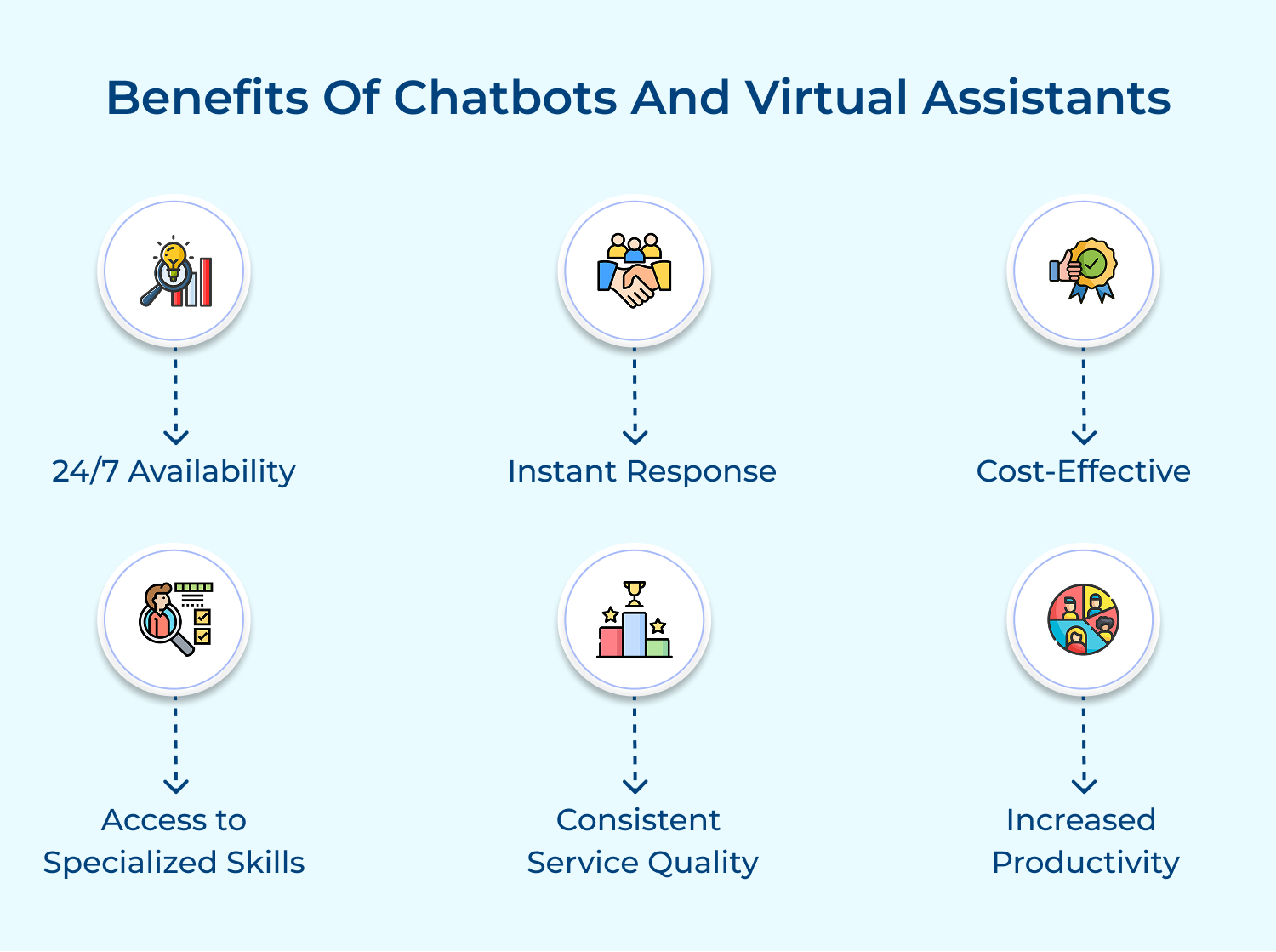
1. 24/7 availability: Chatbots provide round-the-clock customer support, ensuring that customers can get assistance at any time, day or night. This constant availability improves customer satisfaction and can help businesses serve clients across different time zones without increasing staffing costs.
2. Instant response: Virtual assistants offer immediate responses to customer queries, eliminating wait times associated with human agents. This quick turnaround not only enhances customer experience but also allows businesses to handle a higher volume of inquiries simultaneously, improving overall efficiency.
3. Cost-effective: Implementing chatbots can significantly reduce operational costs for businesses. Automation of routine inquiries and tasks minimizes the need for large customer service teams, allowing human agents to focus on more complex issues that require empathy.
4. Access to specialized skills: Virtual assistants offer expertise in various areas, such as social media management, bookkeeping and graphic design. This access to specialized skills enhances the quality of work and helps businesses tackle specific projects effectively.
5. Consistent service quality: Chatbots deliver consistent responses to similar queries, ensuring a uniform customer experience. This consistency helps maintain brand voice and reduces the variability in service quality that can occur with human agents due to factors like mood, fatigue, or personal biases.
6. Increased productivity: Virtual assistants handle time-consuming tasks, allowing clients to focus on core business activities. This delegation boosts overall productivity, enabling professionals to concentrate on strategic initiatives that drive growth.
Businesses are leveraging AI solutions like virtual assistants and chatbots to improve customer interactions. Choosing the right option requires careful consideration of key factors.
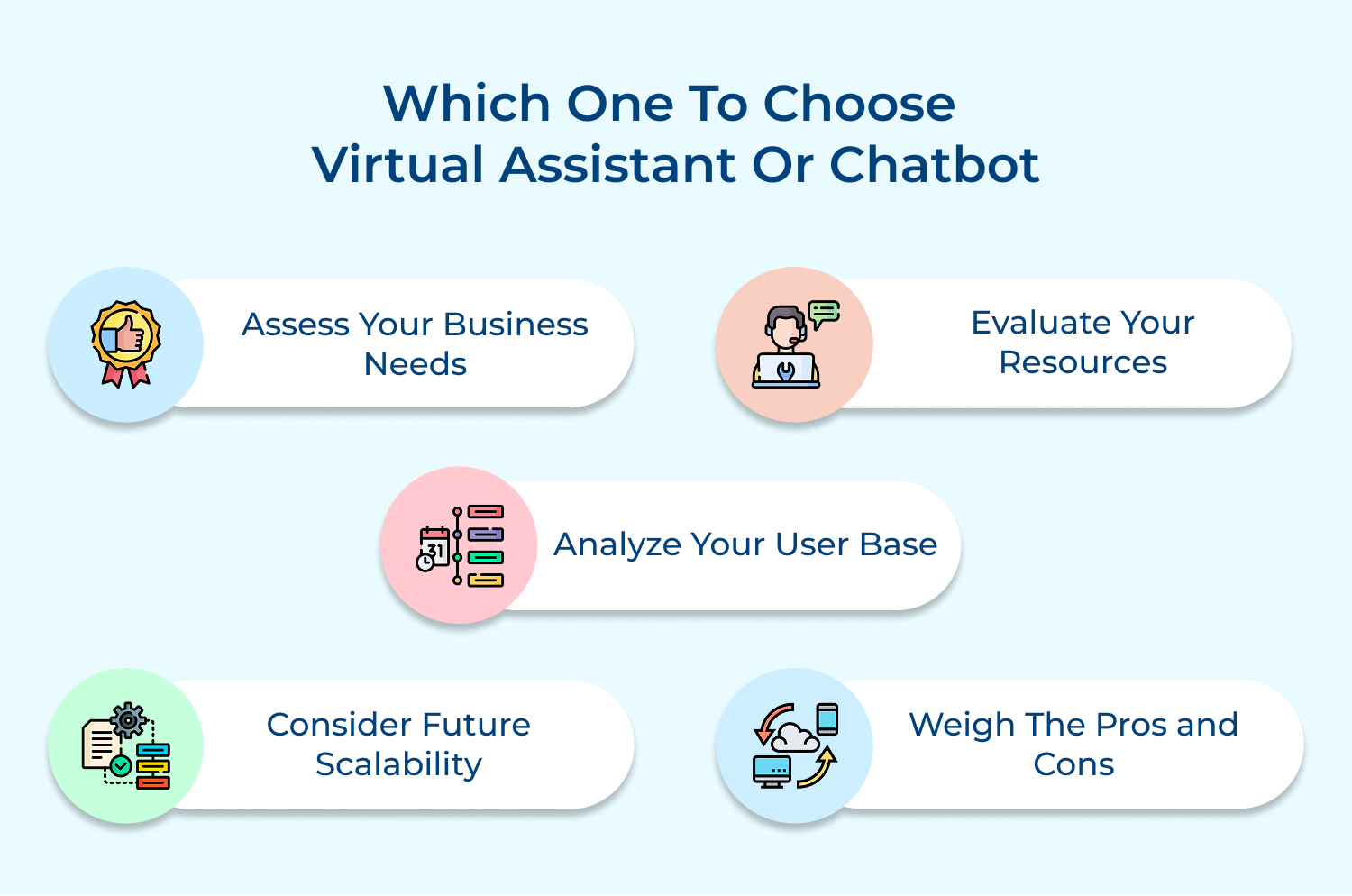
1. Assess Your Business Needs
Begin by identifying the specific tasks and challenges your business faces. Determine whether you require assistance with complex tasks, such as scheduling and data management, or if you primarily need support for straightforward customer inquiries.
2. Evaluate Your Resources
Consider the budget and resources available for implementation and maintenance. Virtual assistants often involve higher costs and require ongoing support, while chatbots can be more cost-effective to deploy. Ensure that your choice aligns with your financial capabilities.
3. Analyze Your User Base
Understand your target audience and their preferences for interaction. If your users prefer quick responses and simple queries, a chatbot may be more effective. For a more personalized experience that involves task management, an AI virtual assistant could be a better fit.
4. Consider Future Scalability
Think about your long-term goals and potential growth. If you anticipate needing more complex functionalities as your business expands, an AI virtual assistant may offer better scalability. Chatbots can also scale but may face limitations in handling intricate queries without advanced capabilities.
5. Weigh the Pros and Cons
Both chatbots and virtual assistants play crucial roles in enhancing customer interactions and streamlining business operations, but they serve distinct purposes. Chatbots excel in handling straightforward queries, making them ideal for customer service. Virtual assistants offer a more comprehensive solution, managing complex tasks and personalizing user experiences.
When choosing between the two, consider your specific business needs, user expectations or long-term goals. Understanding their differences or benefits will help you select the right tool to improve efficiency, enhance customer satisfaction and drive your business forward.

What is an example of a virtual assistant chatbot?
A prominent example of a virtual assistant chatbot is Siri, developed by Apple. Siri combines chatbot functionality with advanced virtual assistant capabilities. It can perform various tasks like setting reminders, answering questions, making recommendations and controlling smart home devices. Siri uses natural language processing and machine learning to understand to user queries effectively.
Which One Fits Your Business Better: Chatbot or Virtual Agent?
The choice between a chatbot and a virtual agent depends on your business needs. Chatbots are ideal for businesses requiring simple, routine customer interactions like answering FAQs or basic order processing. Virtual agents are better suited for companies needing more complex problem-solving, personalized customer service, or integration with multiple systems. Consider your budget, desired functionality and long-term scalability when deciding.
What are the 4 types of chatbots?
The four main types of chatbots are:
What type of AI is a virtual assistant?
Virtual assistants typically use a combination of AI technologies. They primarily rely on Natural Language Processing (NLP) to understand and generate human-like text or speech. Machine Learning algorithms enable them to improve their responses over time. Many also incorporate Deep Learning for complex pattern recognition. They may use Computer Vision for image recognition and Speech Recognition for voice commands.
 https://omni24.io/wp-content/uploads/2026/08/conversational-ai-ecommerce.png
1256
2400
Webvision Solution
https://omni24.io/wp-content/uploads/2023/04/Omni-Logo-1.svg
Webvision Solution2026-09-08 04:06:222026-09-08 04:06:22How Conversational AI for Ecommerce Boosts Sales in 2026
https://omni24.io/wp-content/uploads/2026/08/conversational-ai-ecommerce.png
1256
2400
Webvision Solution
https://omni24.io/wp-content/uploads/2023/04/Omni-Logo-1.svg
Webvision Solution2026-09-08 04:06:222026-09-08 04:06:22How Conversational AI for Ecommerce Boosts Sales in 2026 https://omni24.io/wp-content/uploads/2026/08/Ecommerce-Customer-Segmentation.png
1256
2400
Tushar Joshi
https://omni24.io/wp-content/uploads/2023/04/Omni-Logo-1.svg
Tushar Joshi2026-09-07 04:53:302026-09-07 04:53:30How Ecommerce Customer Segmentation Drives Higher Conversions
https://omni24.io/wp-content/uploads/2026/08/Ecommerce-Customer-Segmentation.png
1256
2400
Tushar Joshi
https://omni24.io/wp-content/uploads/2023/04/Omni-Logo-1.svg
Tushar Joshi2026-09-07 04:53:302026-09-07 04:53:30How Ecommerce Customer Segmentation Drives Higher Conversions https://omni24.io/wp-content/uploads/2026/08/Enterprise-Customer-Engagement.png
1256
2400
Tushar Joshi
https://omni24.io/wp-content/uploads/2023/04/Omni-Logo-1.svg
Tushar Joshi2026-09-02 05:29:412026-09-02 05:29:41How to Scale Enterprise Customer Engagement Strategies
https://omni24.io/wp-content/uploads/2026/08/Enterprise-Customer-Engagement.png
1256
2400
Tushar Joshi
https://omni24.io/wp-content/uploads/2023/04/Omni-Logo-1.svg
Tushar Joshi2026-09-02 05:29:412026-09-02 05:29:41How to Scale Enterprise Customer Engagement Strategies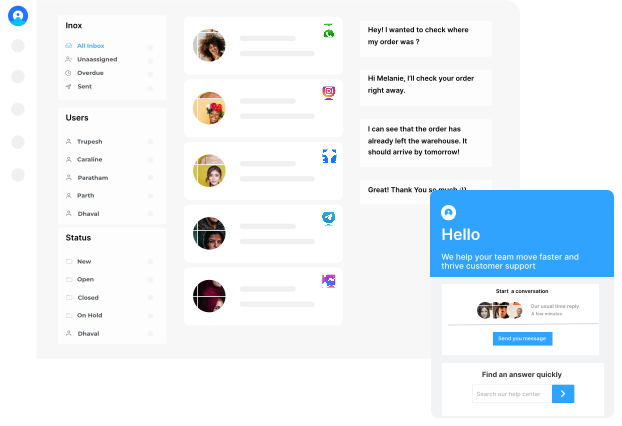
Whether it’s about acquire, engage or support – Omni24 covers all your customer engagement needs in one complete platform.

Copyright ©2026 Veemo All rights reserved.
CA, Los Angeles, Hall Ave, 19011