How to Calculate Net Promoter Score: Step-by-Step Guide
A complete guide explaining how to calculate NPS accurately, interpret results and improve customer loyalty through data-driven insights.

A complete guide explaining how to calculate NPS accurately, interpret results and improve customer loyalty through data-driven insights.
Many business owners find NPS calculations trickier than they should be. What’s meant to be a simple way to measure customer loyalty often turns into a confusing math exercise.
Misunderstanding the formula can lead to misread feedback and poor decisions. Imagine confidently sharing NPS results with your team – only to realize the numbers were off.
This guide on how to calculate net promoter score clears up the confusion with a step-by-step breakdown, real examples and practical tips. You’ll learn exactly how to calculate NPS, interpret results correctly as well as use them to make smarter, data-driven decisions that truly reflect customer loyalty.
Net Promoter Score is a customer loyalty measurement that reveals how likely your customers are to recommend your product or service to others. NPS captures the emotional connection between customers and brands by asking one simple question that predicts future business growth.
Customers answer “How likely are you to recommend us to a friend?” on a 0-10 scale. Responses create three groups: Promoters (9-10) who actively recommend you, Passives (7-8) who stay neutral and Detractors (0-6) who might discourage others. Your NPS equals the percentage of Promoters minus the percentage of Detractors.
Key Objectives:
Understanding NPS transforms how businesses connect with customers and make strategic decisions. Here’s why smart companies track this powerful metric.
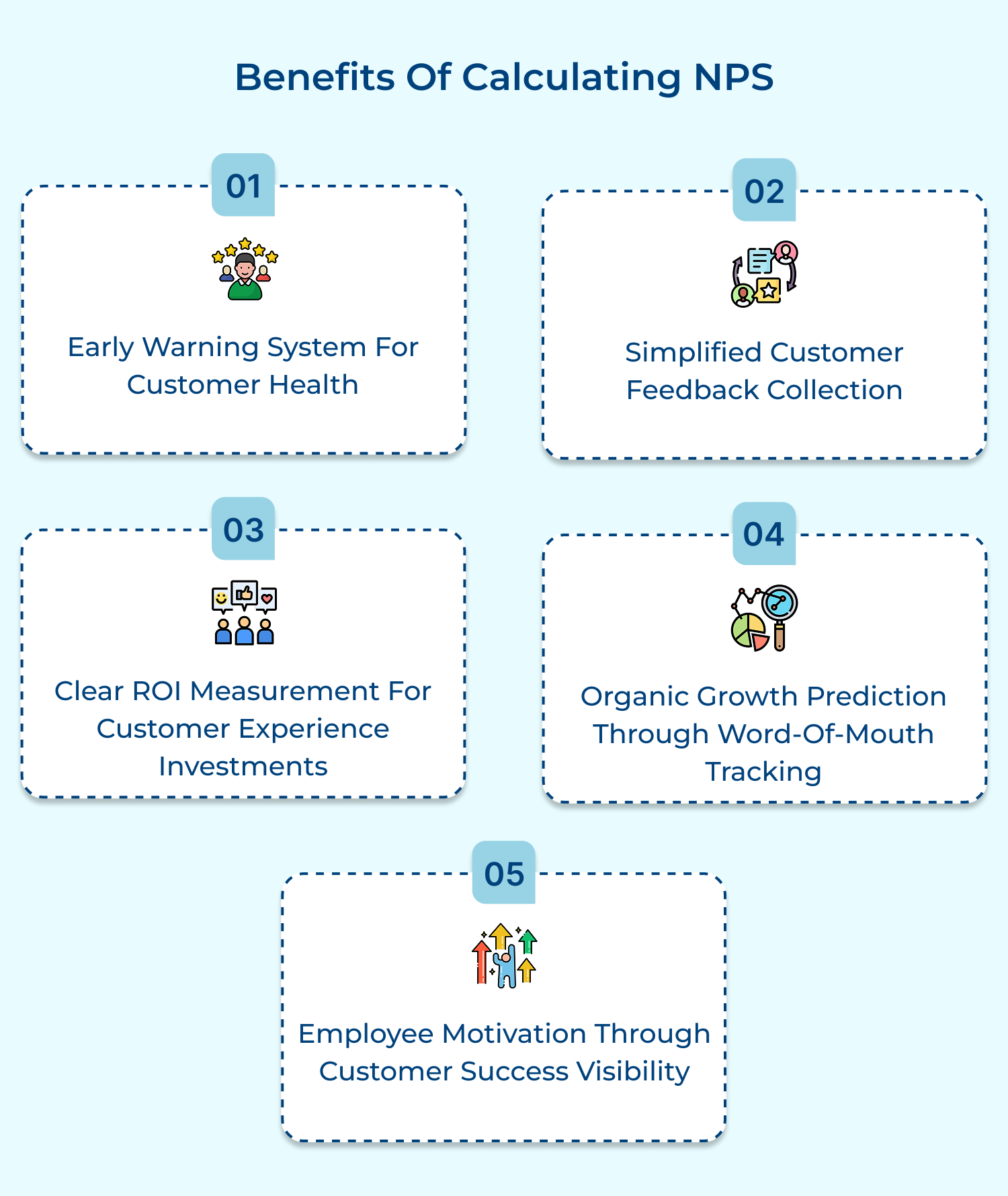
Early Warning System for Customer Health
NPS acts like a business smoke detector that alerts you before customers actually leave. When scores drop suddenly you can investigate root causes and fix problems while there’s still time. This proactive approach prevents costly customer churn and protects your revenue stream from unexpected losses.
Simplified Customer Feedback Collection
NPS makes feedback simple. Instead of long surveys, it asks one quick question—so customers actually respond. That means less survey fatigue, higher response rates and more reliable data to guide smarter business decisions.
Clear ROI Measurement for Customer Experience Investments
NPS turns customer feedback into clear numbers. You can track score changes after new policies or training and see what’s really working. It helps prove ROI, justify budgets and show leaders the real impact of customer experience improvements.
Organic Growth Prediction Through Word-of-Mouth Tracking
Happy customers spread the word. Promoters bring in referrals that cost nothing and drive high-value growth. Since NPS scores align with organic growth, higher scores often signal strong, sustainable business momentum.
Employee Motivation Through Customer Success Visibility
NPS helps teams see how their work affects real customers. When employees connect their efforts to loyalty scores and business results, they feel motivated as well as purpose-driven – fueling a culture focused on customer success.
Think of NPS calculation as a simple math equation that transforms customer opinions into actionable business intelligence. Let’s dive into understanding its calculations and how it helps:
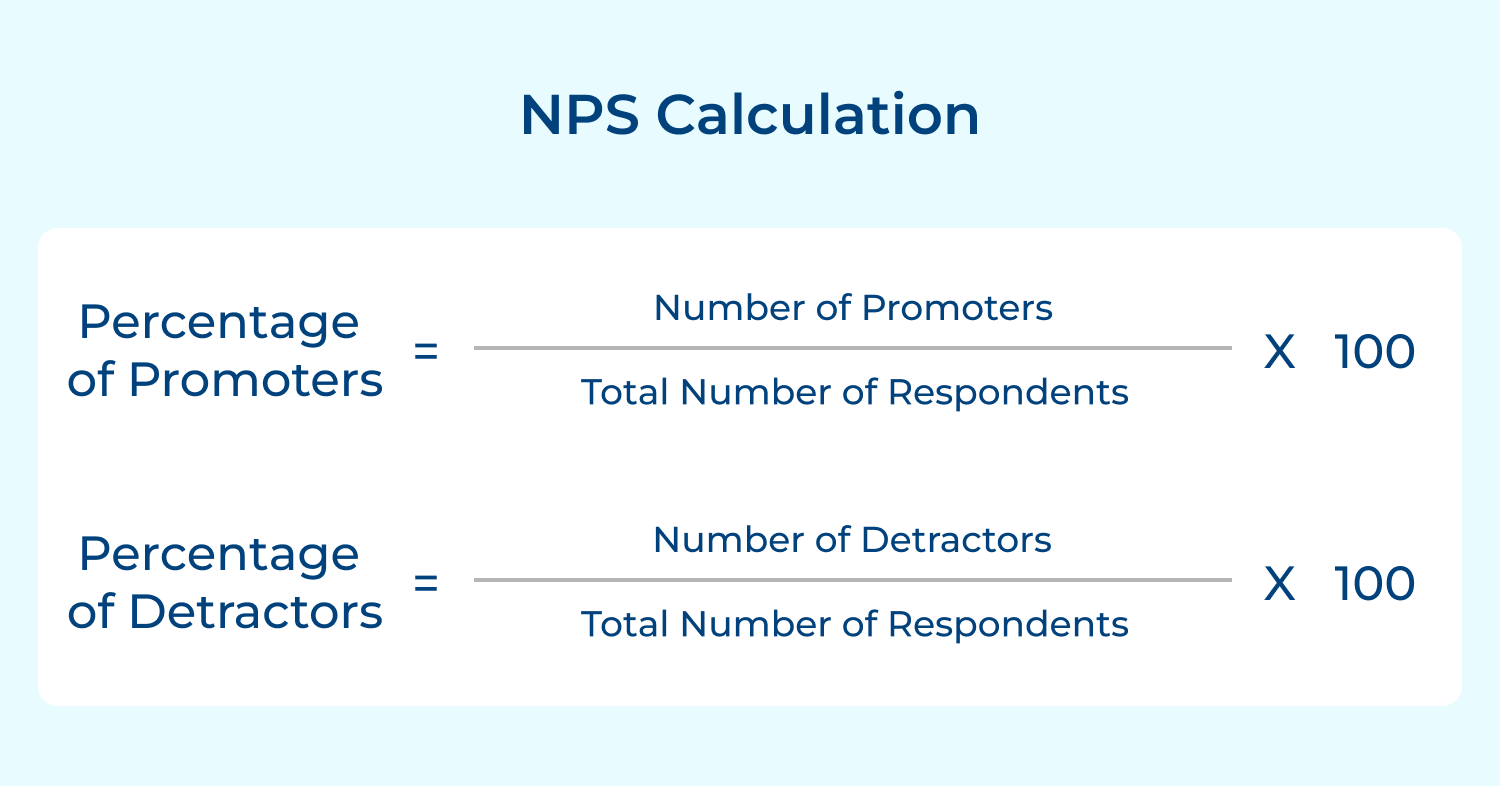
NPS = (Percentage of Promoters – Percentage of Detractors) × 100
Where:
– Percentage of Promoters = (Number of Promoters ÷ Total Number of Respondents) × 100
– Percentage of Detractors = (Number of Detractors ÷ Total Number of Respondents) × 100
Components:
Industry benchmarks vary significantly but scores above 50 indicate excellent customer loyalty while anything above 70 represents world-class performance. Most companies fall between 5-30 depending on their sector and customer expectations within their specific market landscape.
NPS transforms scattered customer opinions into crystal-clear business directions that guides everything from product development to customer service strategy. This single metric cuts through complexity and gives leadership teams the clarity they need for confident decision-making.
Here are 4 step NPS calculations to help you understand how customer opinions are gauged.
Imagine you surveyed 200 customers about their likelihood to recommend your software platform. Here’s how the responses broke down and the resulting calculation:
Survey Results:
– 80 customers gave scores of 9-10 (Promoters)
– 60 customers gave scores of 7-8 (Passives)
– 60 customers gave scores of 0-6 (Detractors)
– Total respondents: 200
Step-by-Step Calculation:
– Promoter percentage = (80 ÷ 200) × 100 = 40%
– Detractor percentage = (60 ÷ 200) × 100 = 30%
– NPS = 40% – 30% = 10
Your final NPS of 10 indicates moderate customer loyalty with room for improvement. While you have more Promoters than Detractors, the significant Passive group suggests many customers could become stronger advocates with enhanced experiences. This score provides a baseline for tracking future improvements and comparing against industry standards.
76% of CX practitioners use NPS as a core metric in 2024. Let’s delve into the best practices and tips to master the art of calculating the NPS score while using it to drive your business forward.
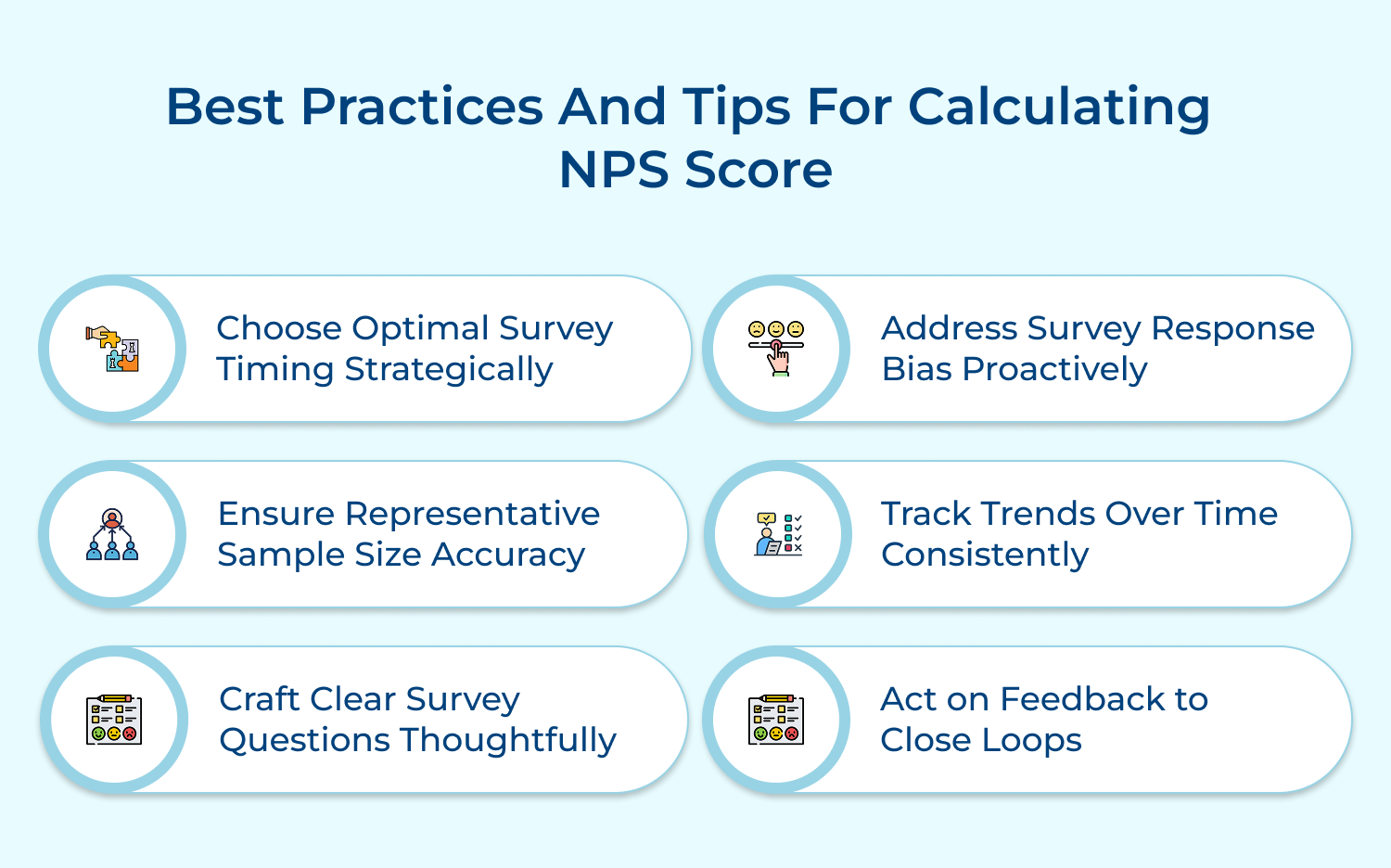
Strategic timing transforms NPS surveys from random interruptions into valuable conversation starters that customers actually want to complete. When you catch customers at the right moment their emotions run fresh and their feedback becomes incredibly authentic as well as actionable.
Here are four prime moments when businesses should deploy NPS surveys to capture genuine customer sentiment:
Think of it like asking someone about a movie right after they leave the theater versus weeks later. Which conversation gives you better insights? The immediate feedback captures raw emotions and specific details that fade quickly from memory. Smart businesses recognize that timing isn’t just about convenience – it’s about data quality and response authenticity that drives meaningful improvements.
Representative sampling ensures your NPS reflects reality rather than just the loudest voices in your customer base. Without proper sampling your score might miss entire customer segments and lead to misguided business decisions.
Here are three proven strategies for building representative samples that deliver reliable NPS insights:
Ever wonder why political polls sometimes get elections wrong? They often miss key voter segments or oversample certain groups. Your NPS faces the same challenge – without representative sampling you might optimize for the wrong customer experiences and miss opportunities to improve satisfaction across your entire customer base.
Clear survey questions eliminate confusion and deliver consistent responses that make your NPS calculations meaningful. Ambiguous wording creates measurement errors that distort your understanding of true customer sentiment and loyalty patterns.
The standard NPS question has been tested across millions of surveys and different industries to ensure reliable results. “How likely are you to recommend [company/product] to a friend or colleague?” uses specific language that triggers consistent interpretation across diverse customer groups and cultural backgrounds.
Smart businesses enhance their NPS surveys with targeted follow-up questions that uncover specific improvement opportunities:
Surveys longer than two minutes face dramatic completion rate drops because modern customers juggle multiple priorities and limited attention spans.
Consider Netflix’s approach – they gather viewing preferences through simple thumbs up/down ratings rather than lengthy questionnaires. This streamlined method captures essential feedback without overwhelming users who might abandon longer surveys halfway through the process.
Response bias skews your NPS results because satisfied customers often respond more readily than unhappy ones who might ignore surveys entirely. Proactive bias management ensures your score reflects genuine customer sentiment rather than just the voices of naturally engaged respondents.
Send Strategic Reminders to Non-Respondents Carefully
Non-respondents frequently represent different satisfaction levels than initial survey participants which means their silence creates data gaps. A gentle follow-up message can capture these missing perspectives without appearing pushy or desperate for feedback.
Deploy Multiple Communication Channels for Maximum Reach
Different customers prefer different communication methods so email-only surveys miss people who respond better to text messages or in-app notifications. Multi-channel deployment increases response diversity and reduces the risk of demographic bias affecting your final NPS calculation.
Offer Incentives Only When Response Rates Drop
Small rewards can boost participation when response rates fall below statistical significance thresholds but overuse creates artificial engagement. Strategic incentive timing maintains data integrity while ensuring you gather enough responses for meaningful analysis and actionable insights.
Consistent trend tracking reveals whether your customer experience improvements actually work rather than relying on single snapshot measurements. Regular monitoring helps you spot patterns and seasonal variations that single surveys miss completely. Here are four essential NPS trends that smart businesses monitor continuously:
Industry benchmarking reveals whether your NPS reflects competitive performance or needs urgent improvement compared to market leaders. Here are three proven methods for establishing meaningful NPS benchmarks that guide strategic decisions:
Feedback loops transform NPS from a measurement exercise into a customer relationship improvement system that drives genuine business growth.
Personal outreach to Detractors demonstrates that you value their opinion and want to rebuild trust through concrete actions. Quick response timing shows urgency and prevents negative experiences from spreading through word-of-mouth or online reviews that damage your reputation permanently.
Here are four essential follow-up questions that turn Detractor conversations into improvement opportunities:
Systematic change implementation prevents the same problems from recurring across different customer touchpoints and creates lasting improvements. Pattern recognition helps you identify root causes rather than treating individual complaint symptoms that keep appearing in future surveys.
Here are three common systematic changes that address frequent NPS feedback themes:
Different NPS survey types help you measure customer loyalty at specific touchpoints and business areas. Each type serves distinct purposes in understanding customer relationships.
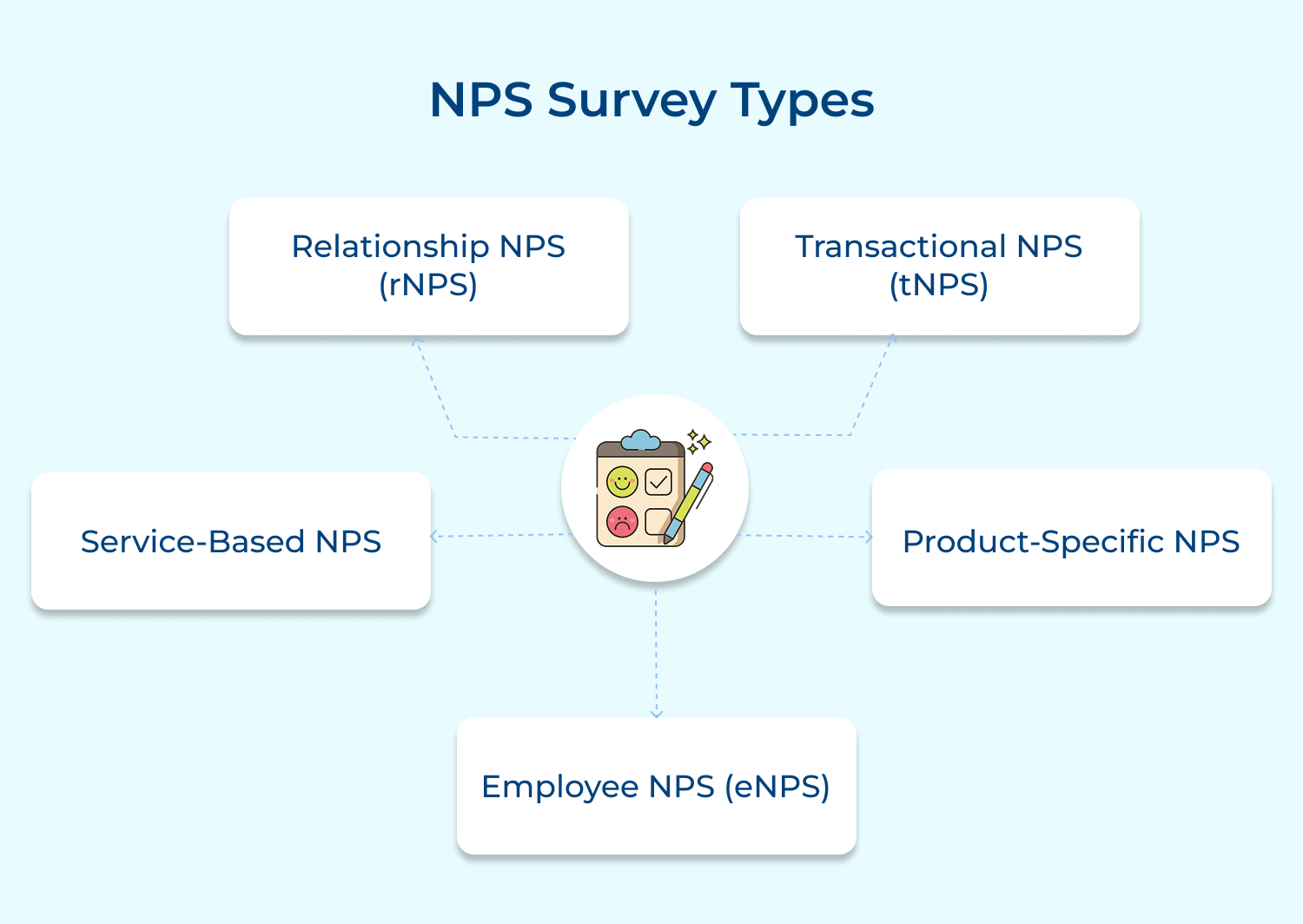
Relationship NPS (rNPS)
Relationship NPS measures how loyal customers are to your brand as a whole, not just after specific interactions. Tracking rNPS helps predict growth through customer advocacy and identifies how your brand is perceived over time.
Transactional NPS (tNPS)
Transactional NPS looks at specific experiences such as a purchase or a customer support call. It tells you exactly where the customer journey succeeds or falls short. This level of detail helps improve key moments that directly impact satisfaction.
Service-Based NPS
Service-based NPS measures loyalty toward individual services like consulting or technical support. It’s essential when you offer multiple services that shape different experiences. The insights show which services drive advocacy and where improvement is needed.
Product-Specific NPS
Product-specific NPS focuses on loyalty toward particular products rather than your entire brand. It’s especially useful for companies with several product lines. The data reveals which products build strong loyalty and how each one affects your overall brand perception.
Employee NPS (eNPS)
Employee NPS measures how likely your team is to recommend your company as a great place to work. Engaged employees often lead to happier customers. Tracking eNPS highlights workplace sentiment while helping strengthen both internal culture and customer experience.
NPS rose in 17 of 22 industries between 2022 – 2023. Let’s learn how it affects across industries and improves overall offerings that business has to offer:
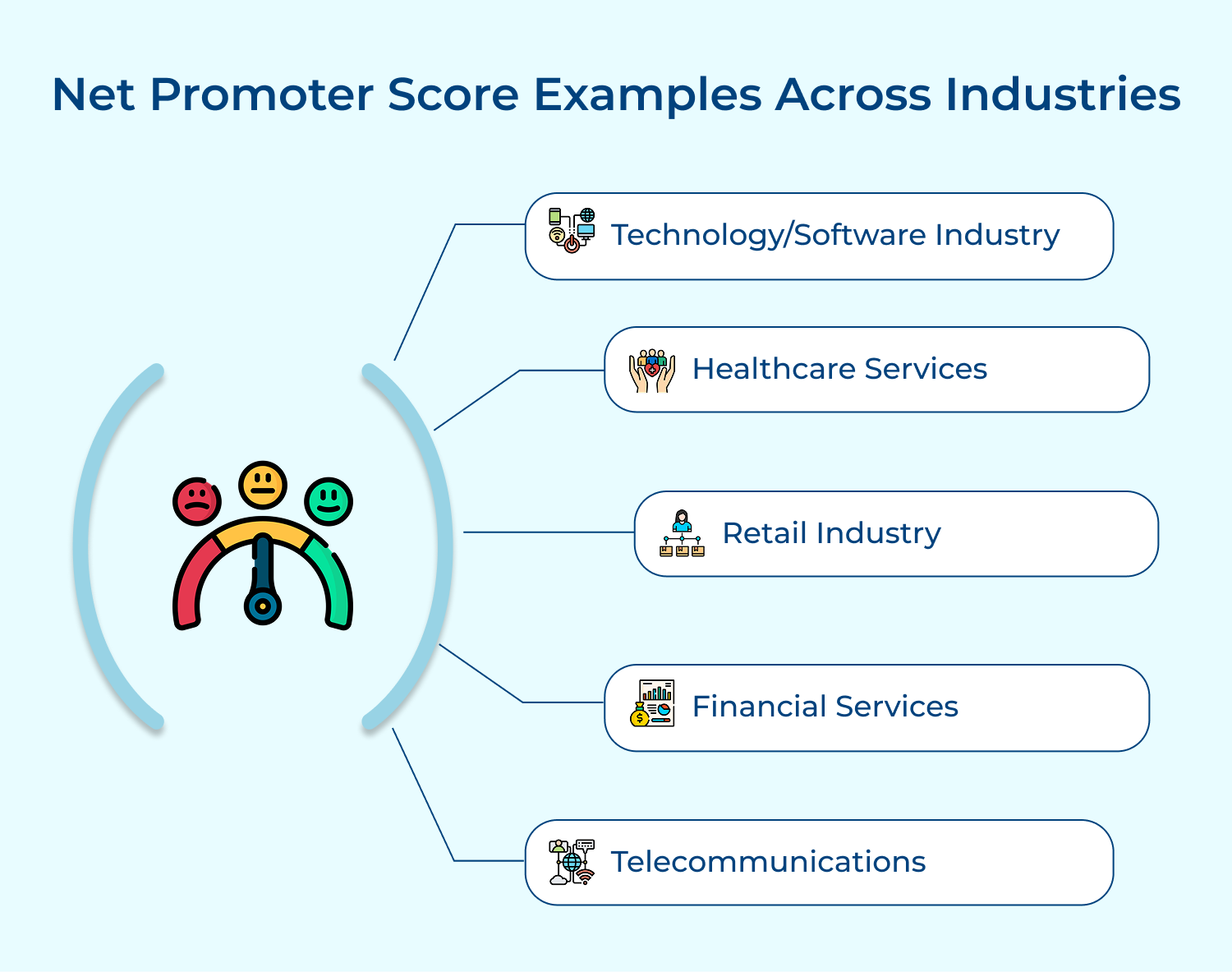
Software companies typically achieve NPS scores between 30-50 due to high customer expectations for seamless digital experiences. Cloud-based NPS platforms often score higher because they deploy updates quickly and respond to user feedback dynamically. The industry benefits from tech-savvy customers who appreciate continuous improvement but demand exceptional performance standards.
Healthcare organizations generally see NPS scores ranging from 10-30 reflecting the complex emotional nature of medical interactions and varying patient outcomes. Primary care practices often outperform hospitals because they build longer patient relationships through regular visits. The industry faces unique challenges where satisfaction intersects with medical necessity rather than pure service preference.
Retail businesses achieve diverse NPS scores from 20-60 depending on their market segment and customer service approach. Luxury retailers typically score higher due to personalized attention while discount retailers focus on value over experience quality. The industry benefits from immediate feedback opportunities but struggles with seasonal variations affecting customer sentiment.
Banks and financial institutions typically score between 20-40 reflecting the necessary but often stressful nature of money management interactions. Credit unions frequently outperform traditional banks due to their community focus and member-centric approach. The industry faces trust challenges where customers need reliable service but view providers as commoditized rather than trusted partners.
Telecom companies often struggle with NPS scores between 0-20 due to service reliability issues and complex billing structures. Mobile carriers typically perform better than cable providers because wireless technology offers more flexibility and competitive options. The industry battles infrastructure limitations while customers expect perfect connectivity and transparent pricing.
NPS is your business compass that always points toward customer truth. When you consistently measure and act on these insights, you transform scattered customer opinions into predictable business growth through genuine relationships.
Start implementing these NPS strategies immediately rather than waiting for perfect conditions to begin measuring customer sentiment. Remember that every customer interaction creates an opportunity to build loyalty and NPS gives you the roadmap to turn those moments into lasting business success.

What is a good NPS score?
A good NPS score depends on your industry but generally anything above 50 indicates excellent customer loyalty while scores above 70 represent world-class performance. Most companies fall between 5-30 depending on their sector. Remember that improvement matters more than absolute numbers since even small NPS increases often translate into significant business growth and customer retention improvements.
What is the Net Promoter Score example?
Imagine surveying 100 customers where 60 rate you 9-10 (Promoters), 20 rate 7-8 (Passives), and 20 rate 0-6 (Detractors). Your NPS calculation becomes 60% minus 20% equals 40. This score of 40 indicates strong customer loyalty with more advocates than critics, suggesting healthy word-of-mouth potential and sustainable business growth through customer recommendations.
What is NPS and how does it relate to customer satisfaction?
NPS measures customer loyalty by asking how likely people are to recommend your business while customer satisfaction typically measures contentment with specific experiences. Satisfaction is like measuring happiness with a meal while NPS predicts whether someone would bring friends to your restaurant. NPS focuses on future behavior and emotional connection rather than just current contentment levels.
Why is NPS considered a crucial metric for businesses?
NPS predicts business growth because Promoters generate referrals that cost nothing but deliver high-value customers who trust recommendations from friends. Unlike other metrics that measure past performance, NPS indicates future customer behavior including retention, spending and word-of-mouth marketing. This forward-looking insight helps businesses invest resources in improvements that actually drive sustainable growth through customer advocacy.
How to calculate NPS for my company or product?
Survey customers asking “How likely are you to recommend us to a friend?” on a 0-10 scale then categorize responses into Promoters (9-10), Passives (7-8) and Detractors (0-6). Calculate the percentage of each group then subtract Detractor percentage from Promoter percentage. Your final NPS ranges from negative 100 to positive 100 with higher scores indicating stronger customer loyalty.
 https://omni24.io/wp-content/uploads/2026/08/Omnichannel-Chatbots.png
1256
2400
Tushar Joshi
https://omni24.io/wp-content/uploads/2023/04/Omni-Logo-1.svg
Tushar Joshi2026-08-13 04:43:302026-08-24 09:02:01How Omnichannel Chatbots Improve Your Customer Experience
https://omni24.io/wp-content/uploads/2026/08/Omnichannel-Chatbots.png
1256
2400
Tushar Joshi
https://omni24.io/wp-content/uploads/2023/04/Omni-Logo-1.svg
Tushar Joshi2026-08-13 04:43:302026-08-24 09:02:01How Omnichannel Chatbots Improve Your Customer Experience https://omni24.io/wp-content/uploads/2026/08/Ecommerce-Chatbots-1.png
1256
2400
Tushar Joshi
https://omni24.io/wp-content/uploads/2023/04/Omni-Logo-1.svg
Tushar Joshi2026-08-12 03:57:552026-08-24 09:03:22Ecommerce Chatbots: What are They and Their Use Cases
https://omni24.io/wp-content/uploads/2026/08/Ecommerce-Chatbots-1.png
1256
2400
Tushar Joshi
https://omni24.io/wp-content/uploads/2023/04/Omni-Logo-1.svg
Tushar Joshi2026-08-12 03:57:552026-08-24 09:03:22Ecommerce Chatbots: What are They and Their Use Cases https://omni24.io/wp-content/uploads/2026/08/Omnichannel-Ecommerce.png
1256
2400
Tushar Joshi
https://omni24.io/wp-content/uploads/2023/04/Omni-Logo-1.svg
Tushar Joshi2026-08-11 04:50:362026-08-24 09:00:45How to Create an Omnichannel Ecommerce Strategy: 7 Best Ways
https://omni24.io/wp-content/uploads/2026/08/Omnichannel-Ecommerce.png
1256
2400
Tushar Joshi
https://omni24.io/wp-content/uploads/2023/04/Omni-Logo-1.svg
Tushar Joshi2026-08-11 04:50:362026-08-24 09:00:45How to Create an Omnichannel Ecommerce Strategy: 7 Best Ways
Whether it’s about acquire, engage or support – Omni24 covers all your customer engagement needs in one complete platform.

Copyright ©2026 Veemo All rights reserved.
CA, Los Angeles, Hall Ave, 19011