5 Essential Knowledge Management Metrics and How to Use Them
Discover key knowledge management metrics to measure effectiveness, optimize strategy and demonstrate tangible business value for success.

Discover key knowledge management metrics to measure effectiveness, optimize strategy and demonstrate tangible business value for success.
In a world drowning in data, KM metrics help organizations figure out what they know, how well they share it and whether it’s actually driving results. For example, 62% of employees say they don’t have access to the knowledge they need.
Metrics like time spent searching for info, reuse of knowledge assets, % of KM initiatives meeting goals and employee satisfaction with knowledge tools are super useful.
Tracking these can help you spot where your KM strategy shines (and where it needs serious fixing) which helps with boosting innovation, decision-making, as well as even retention.
A knowledge management metric is a quantifiable measurement used to assess the effectiveness of knowledge management practices within an organization. These metrics help evaluate how well knowledge is created, shared and utilized. Hence, providing insights that guide decision-making as well as strategy formulation.
The importance of knowledge management metrics lies in their ability to highlight strengths and weaknesses in an organization’s knowledge practices. By measuring these metrics, businesses can ensure that they are leveraging their intellectual assets effectively.
Key objectives:
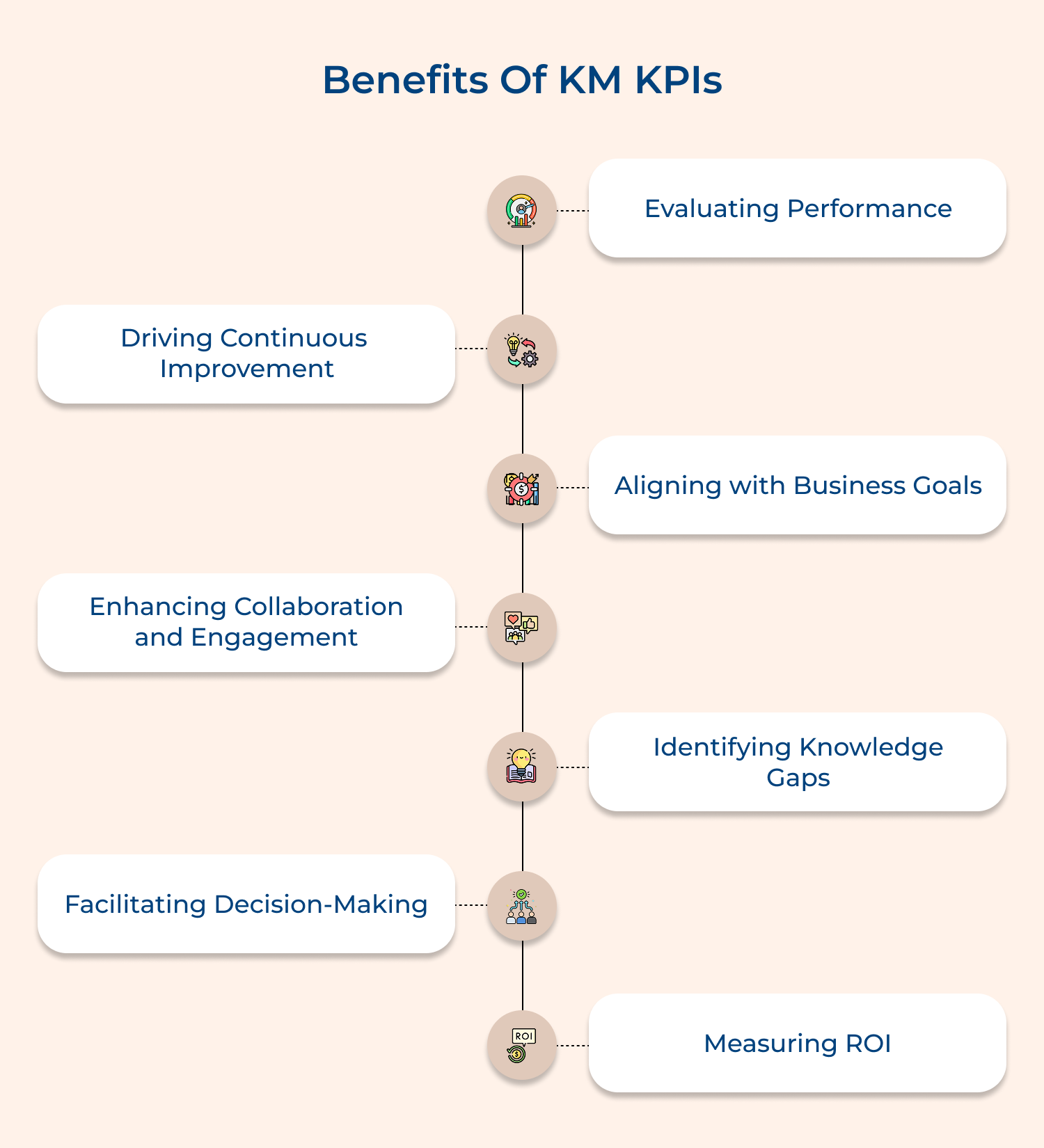
When companies get KM right, they tend to be about 20-25% more productive. The KM KPIs are essential tools to measure the effectiveness of business strategies. Let’s explore its importance:
1. Evaluating Performance
One of the primary reasons for implementing knowledge management KPIs is to evaluate the performance of knowledge management initiatives. These indicators provide insights into how effectively knowledge is being created, shared and used. This evaluation helps identify what is working well and what needs improvement, enabling organizations to optimize their knowledge management processes.
2. Driving Continuous Improvement
Knowledge management KPIs are vital for driving continuous improvement within an organization. Regularly monitoring these metrics help companies identify trends and patterns that inform decision-making. Continuous assessment fosters a culture of learning, where employees feel empowered to share insights and contribute to the organization’s knowledge base.
3. Aligning with Business Goals
Effective knowledge management should align with an organization’s overall business objectives. KPIs help bridge the gap between knowledge management efforts and strategic goals. By establishing KPIs that reflect business priorities, organizations can ensure that their knowledge initiatives directly contribute to achieving broader objectives.
4. Enhancing Collaboration and Engagement
Tracking knowledge management KPIs can significantly enhance collaboration and engagement among employees. When organizations measure and share KPI results, they create transparency as well as accountability. This openness encourages employees to actively participate in knowledge-sharing initiatives, knowing that their contributions are valued and recognized.
5. Identifying Knowledge Gaps
Knowledge management KPIs play a crucial role in identifying gaps in knowledge within an organization. This understanding allows companies to address these gaps proactively, whether through targeted training, mentorship programs or by enhancing knowledge repositories. Filling these gaps not only improves overall knowledge quality but also boosts employee confidence and competence.
6. Facilitating Decision-Making
In a data-driven environment, effective decision-making relies on accurate and timely information. Knowledge management KPIs provide the data necessary for informed decisions, helping leaders understand how knowledge is leveraged across the organization. Having clear metrics to refer to enables decision-makers to assess the impact of knowledge management on performance and make strategic adjustments as needed.
Effective knowledge management relies on measurable metrics. Let’s explore essential KM metrics and how to utilize them for organizational success.
1. Quantitative metrics
Quantitative metrics provide numerical data that can be easily measured and compared over time. These metrics often focus on volume, frequency as well as efficiency aspects of knowledge management.
2. Qualitative metrics
Qualitative metrics assess the quality, relevance and impact of knowledge management initiatives. These metrics often involve subjective assessments and provide context to the quantitative data.
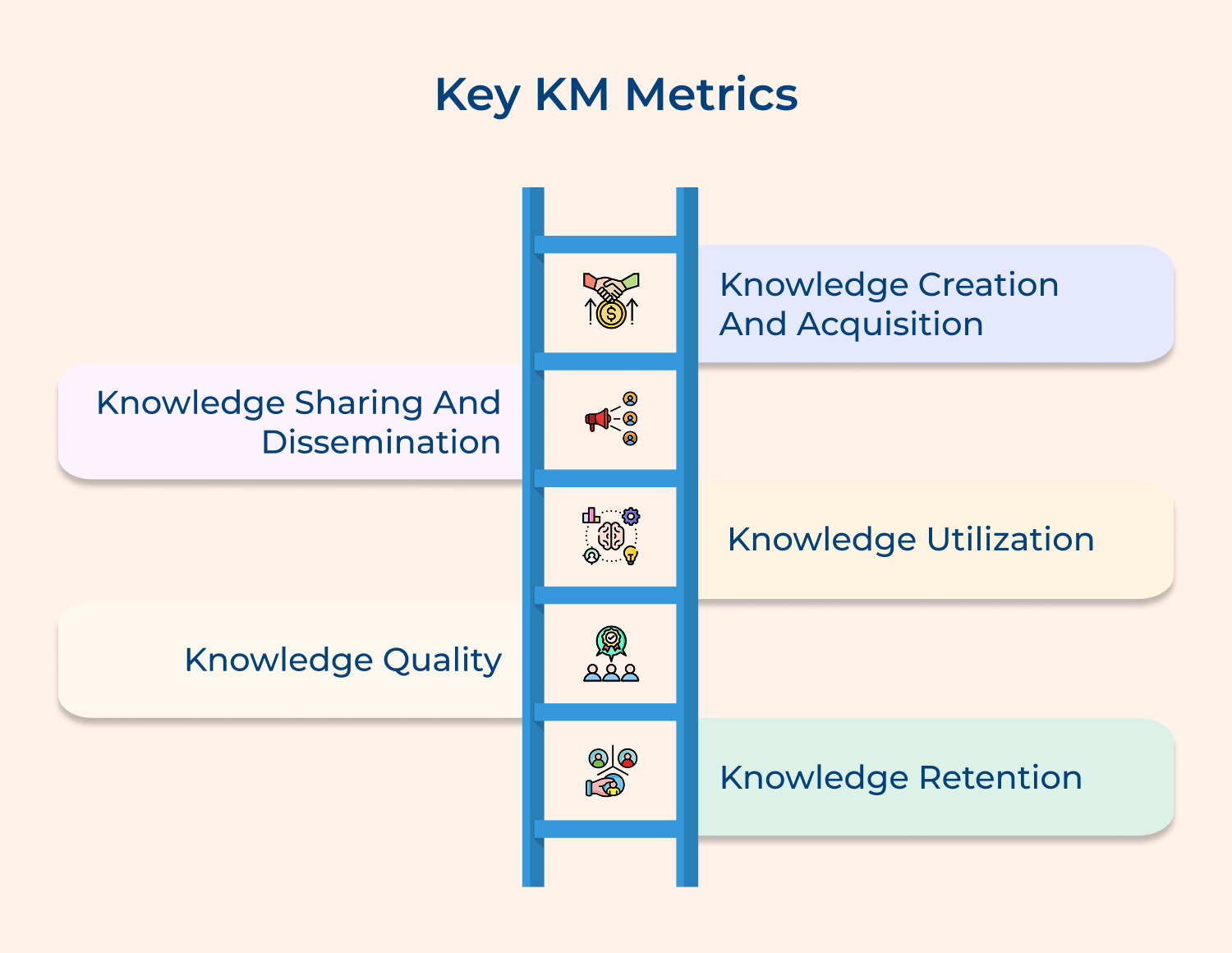
Tracks new knowledge generation and integration, building innovation as well as continuous improvement within the organization.
1. Number of new knowledge assets created
This metric tracks how quickly new knowledge is added to the knowledge base, reflecting innovation and learning. It helps organizations set creation targets, spot high-performing teams and ensure their repository stays valuable. All while assessing the overall health of their knowledge ecosystem.
Pro tips:
2. Rate of knowledge base growth
This measures the growth of an organization’s knowledge base over time, ensuring it aligns with evolving needs. It helps spot stagnation, set healthy growth targets and link repository expansion with business performance. It helps assess the impact of knowledge management on organizational success.
Pro tips:
Evaluates the effectiveness of knowledge transfer methods, promoting collaboration and communication among employees.
1. Frequency of knowledge base access
The frequency is all about how often employees use the knowledge base. It reflects relevance, accessibility and engagement. Organizations can track popular resources, study user behavior, while improving usability. By doing so, they ensure the knowledge base stays useful, easy to access and aligned with employee needs.
Pro tips:
2. Participation rates in knowledge-sharing activities
The metric tracks employee participation in knowledge-sharing initiatives like forums, workshops, or mentoring. It helps assess collaboration culture, highlight successful efforts and spot barriers. Organizations can also use it to recognize active contributors, encourage wider involvement as well as strengthen a culture of continuous knowledge sharing across teams.
Pro tips:
Assesses how frequently knowledge is applied in decision-making processes, impacting productivity and performance outcomes.
1. Time saved through knowledge reuse
It talks about the efficiency gains from reusing knowledge, showing time and resource savings. This metric helps calculate ROI, highlight valuable assets and justify further investment in knowledge management systems. By tracking it, organizations can prove the impact of knowledge management on performance and make smarter resource allocation decisions.
Pro tips:
2. Problem-solving efficiency
How quickly employees solve issues using knowledge resources? This metric reflects KM’s impact on daily operations. It helps spot knowledge gaps, guide new resource development and show how effective knowledge management boosts efficiency. Companies can use it to improve problem-solving and overall organizational performance.
Pro tips:
Analyzes the accuracy, relevance and usefulness of knowledge assets. Hence, ensuring they meet organizational standards.
1. User ratings of knowledge resources
This metric captures employees’ perception of knowledge resource value and usefulness. It ensures the knowledge base stays relevant and helpful. Organizations can use it to highlight top-rated resources, review or remove low-rated ones and create new content aligned with user preferences.
Pro tips:
2. Expert review scores
It uses expert reviews to assess knowledge resources for accuracy, completeness and relevance. This helps companies validate content quality, spot improvement areas as well as maintain a reliable knowledge base that employees can trust for informed decision-making.
Pro tips:
Measures strategies to preserve critical knowledge within the organization, reducing the impact of employee turnover and loss.
1. Employee turnover rate in key knowledge areas
The metric helps organizations track the potential loss of critical knowledge due to employee departures. It highlights areas where knowledge retention efforts may need to be intensified. Organizations can use this data to prioritize knowledge capture and transfer initiatives, develop succession plans while implementing strategies to retain key knowledge holders.
Pro tips:
2. Knowledge preservation index
The index evaluates how effectively an organization captures and preserves critical knowledge over time. It prevents loss of insights when employees leave or projects end. Companies can track retention trends, assess preservation efforts and refine strategies to maintain a strong, reliable knowledge base that supports long-term success.
Pro tips:
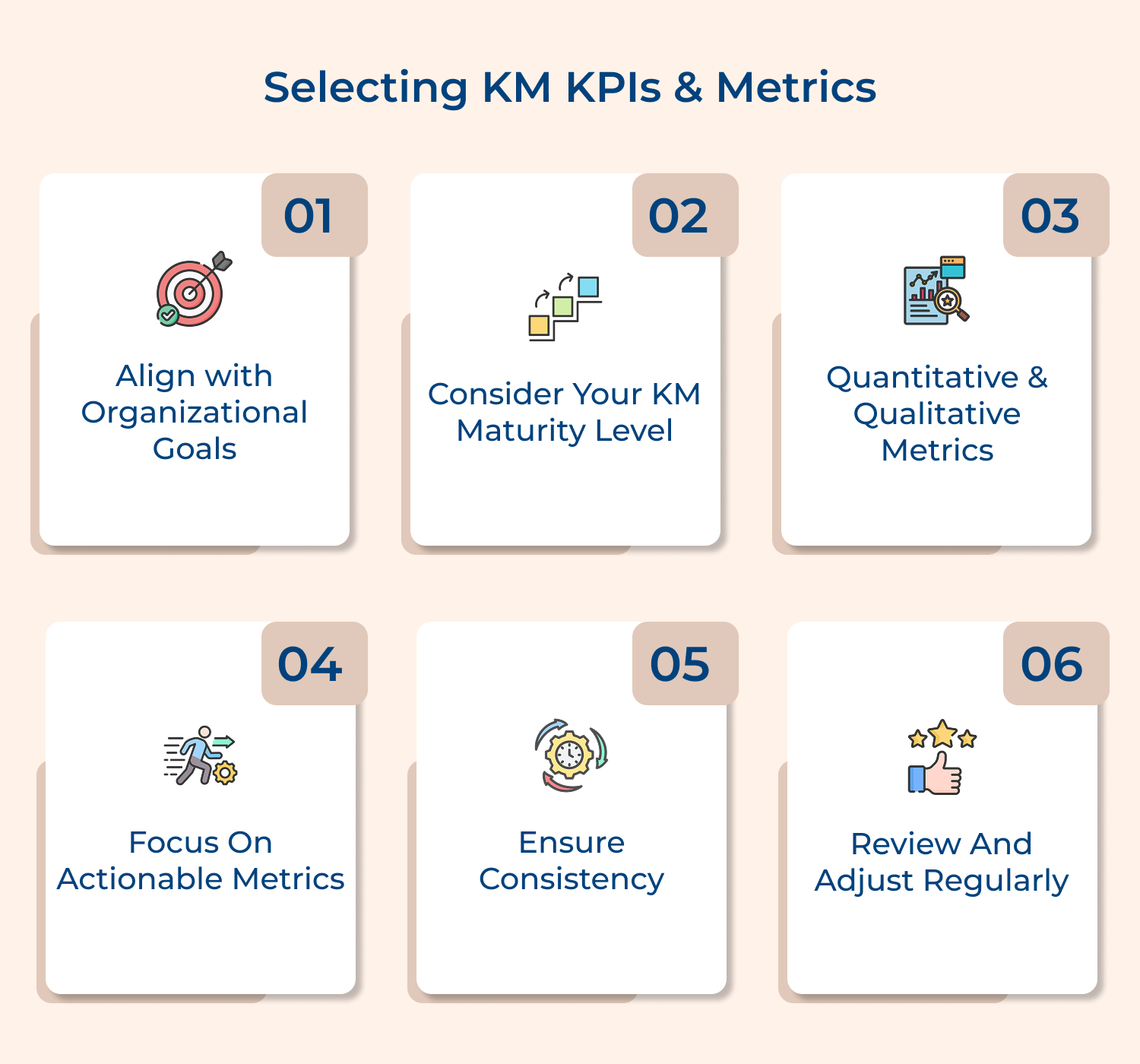
The process of selecting appropriate metrics should be strategic, aligning with organizational goals. Here’s a guide to help you select effective KM metrics:
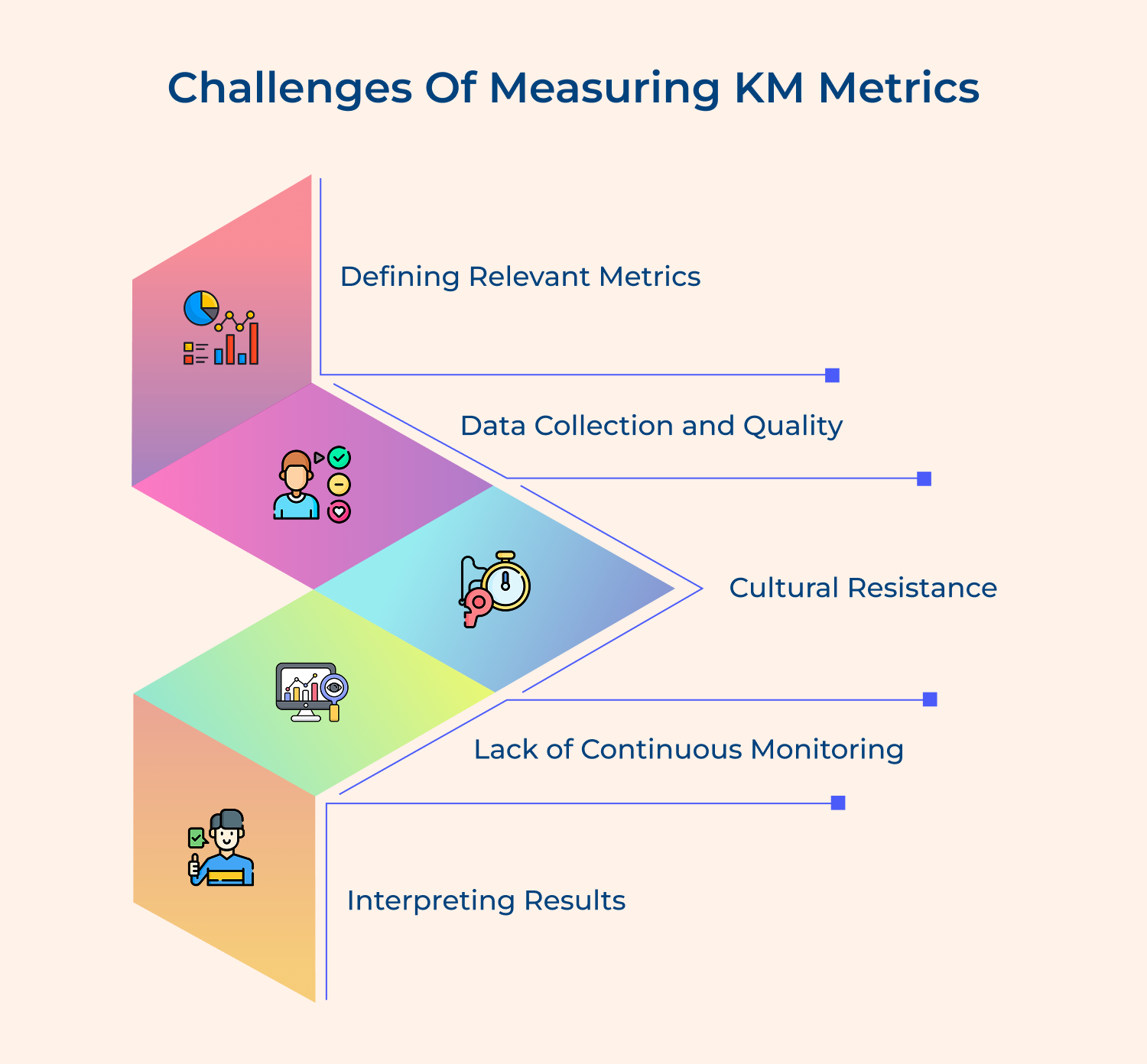
Measuring KM metrics effectively comes with its own set of challenges. Here are five common challenges and strategies to overcome them.
1. Defining Relevant Metrics
One of the foremost challenges in measuring KM metrics is defining which metrics are relevant and meaningful. Organizations may struggle to identify the specific indicators that accurately reflect their knowledge management goals.
Solution:
Organizations should align KM metrics with business goals by involving stakeholders to identify relevant KPIs. Focus on actionable metrics like knowledge-sharing sessions, user engagement with repositories and their impact on decision-making. This ensures KM efforts directly support desired outcomes and drive measurable improvements across the organization.
2. Data Collection and Quality
Accurate measurement of KM metrics relies heavily on data collection. Many organizations face difficulties in gathering relevant data, especially if existing systems are not integrated or if data is siloed across departments. Furthermore, the quality of the data collected can vary, leading to unreliable insights.
Solution:
Invest in robust knowledge management systems that facilitate seamless data collection and integration across platforms. Implement standardized procedures for data entry and encourage a culture of accountability among employees to ensure data accuracy. Regular audits can help maintain data quality and using automated tools can streamline the collection process, minimizing human error.
3. Cultural Resistance
Cultural resistance within an organization can hinder the effective measurement of KM metrics. Employees may be reluctant to share knowledge or engage in knowledge management initiatives, fearing that it could impact their job security or visibility.
Solution:
To overcome this challenge, foster a culture of trust and collaboration by promoting the benefits of knowledge sharing. Leadership should actively support and participate in KM initiatives, demonstrating their importance to the organization. Recognize as well as reward employees who contribute to knowledge management efforts, showcasing how shared knowledge leads to collective success.
4. Lack of Continuous Monitoring
Many organizations measure KM metrics at a single point in time rather than continuously. This lack of ongoing monitoring can lead to missed opportunities for improvement and may prevent timely adjustments to KM strategies.
Solution:
Establish a routine for regular assessment of KM metrics. Set up dashboards that provide real-time insights into key indicators, allowing stakeholders to track progress continuously. Schedule periodic reviews and discussions to analyze the data collectively, enabling teams to identify trends while making informed decisions for optimizing knowledge management practices.
5. Interpreting Results
Challenge:
Even when organizations successfully collect data and measure KM metrics, interpreting the results can be challenging. Metrics can be misleading if not understood in context, leading to incorrect conclusions and decisions.
Solution:
Provide training for teams involved in data analysis to ensure they can interpret the results accurately. Encourage a holistic approach to understanding KM metrics by considering qualitative data alongside quantitative insights. Regularly communicate findings across the organization, facilitating discussions on how the results impact knowledge management strategies and decision-making.
Knowledge management metrics are vital for organizations seeking to enhance their operational efficiency and build a culture of continuous improvement. By systematically measuring and analyzing these metrics, businesses can identify gaps in their knowledge management practices while making informed decisions to address them.
Implementing the right metrics not only boosts knowledge sharing and collaboration but also drives innovation as well as competitive advantage. As organizations continue to evolve in a data-centric landscape, prioritizing knowledge management metrics will be key to unlocking their full potential while ensuring sustained success.
Embracing this approach will ultimately lead to more effective decision-making and a thriving organizational culture.

What are the next steps after picking knowledge management metrics?
After selecting metrics, implement systems to collect data consistently. Establish baselines and set realistic targets. Regularly analyze the data to identify trends and areas for improvement. Use insights to refine knowledge management strategies and processes. Communicate results to stakeholders and adjust metrics as needed to align with evolving business goals.
Why are knowledge management KPIs important?
Knowledge management KPIs are crucial for measuring the effectiveness of an organization’s knowledge-related initiatives. They provide quantifiable data to assess progress, identify areas for improvement and demonstrate the value of knowledge management efforts. KPIs help align knowledge activities with business objectives, facilitate decision-making and drive continuous improvement in knowledge sharing as well as utilization across the organization.
How do we measure knowledge management success?
Measure knowledge management success through a combination of quantitative and qualitative metrics. Track usage statistics of knowledge bases, document repositories and collaboration tools. Assess the quality and relevance of shared knowledge through user feedback along with expert reviews. Measure time saved in problem-solving and decision-making. Evaluate the impact on employee productivity, innovation rates and overall business performance.
What are engagement metrics for knowledge management?
Engagement metrics for knowledge management include: frequency of knowledge base access, number of contributions to shared repositories, participation rates in knowledge-sharing activities, time spent on collaborative platforms, user ratings of knowledge resources, number of knowledge-related queries and the percentage of employees actively using knowledge management tools. These metrics help gauge how effectively the workforce is engaging with knowledge resources.
What tools can you use to measure knowledge management in an organization?
Tools for measuring knowledge management include several options. Analytics software can track how knowledge bases and intranets are used. Survey platforms help gather feedback from users. Project management systems monitor knowledge-related initiatives. Collaboration platforms often have built-in analytics. Learning management systems track training and skill development. Business intelligence tools can integrate and analyze data from multiple sources.
What knowledge management KPIs should you track?
Key KM KPIs to track include knowledge base usage, time saved through knowledge reuse, employee participation in knowledge sharing, quality and relevance of knowledge, problem-solving efficiency, reduction in duplicate work, knowledge retention, innovation tied to knowledge use, as well as overall KM ROI.
 https://omni24.io/wp-content/uploads/2026/08/Omnichannel-Chatbots.png
1256
2400
Tushar Joshi
https://omni24.io/wp-content/uploads/2023/04/Omni-Logo-1.svg
Tushar Joshi2026-08-13 04:43:302026-08-13 04:43:30How Omnichannel Chatbots Improve Your Customer Experience
https://omni24.io/wp-content/uploads/2026/08/Omnichannel-Chatbots.png
1256
2400
Tushar Joshi
https://omni24.io/wp-content/uploads/2023/04/Omni-Logo-1.svg
Tushar Joshi2026-08-13 04:43:302026-08-13 04:43:30How Omnichannel Chatbots Improve Your Customer Experience https://omni24.io/wp-content/uploads/2026/08/Ecommerce-Chatbots-1.png
1256
2400
Tushar Joshi
https://omni24.io/wp-content/uploads/2023/04/Omni-Logo-1.svg
Tushar Joshi2026-08-12 03:57:552026-08-13 04:37:30Ecommerce Chatbots: What are They and Their Use Cases
https://omni24.io/wp-content/uploads/2026/08/Ecommerce-Chatbots-1.png
1256
2400
Tushar Joshi
https://omni24.io/wp-content/uploads/2023/04/Omni-Logo-1.svg
Tushar Joshi2026-08-12 03:57:552026-08-13 04:37:30Ecommerce Chatbots: What are They and Their Use Cases https://omni24.io/wp-content/uploads/2026/08/Omnichannel-Ecommerce.png
1256
2400
Tushar Joshi
https://omni24.io/wp-content/uploads/2023/04/Omni-Logo-1.svg
Tushar Joshi2026-08-11 04:50:362026-08-11 04:50:36How to Create an Omnichannel Ecommerce Strategy: 7 Best Ways
https://omni24.io/wp-content/uploads/2026/08/Omnichannel-Ecommerce.png
1256
2400
Tushar Joshi
https://omni24.io/wp-content/uploads/2023/04/Omni-Logo-1.svg
Tushar Joshi2026-08-11 04:50:362026-08-11 04:50:36How to Create an Omnichannel Ecommerce Strategy: 7 Best Ways
Whether it’s about acquire, engage or support – Omni24 covers all your customer engagement needs in one complete platform.

Copyright ©2026 Veemo All rights reserved.
CA, Los Angeles, Hall Ave, 19011