How to Design a Customer Experience (CX) Survey: 7 Key Steps
A customer experience survey collects feedback on customer interactions to identify strengths and areas for improvement. It helps enhance satisfaction and build stronger relationships.

A customer experience survey collects feedback on customer interactions to identify strengths and areas for improvement. It helps enhance satisfaction and build stronger relationships.
Do you know what your customers really think about your business? Customer experience (CX) survey data can provide valuable insights that can help you make informed business decisions.
57% of customers are willing to switch to a competitor after a single bad experience, emphasizing the critical need for businesses to gather feedback through surveys and improve service quality.
Analyzing customer experience survey data helps businesses gain a better understanding of how they are performing in the eyes of their customers. Businesses can identify areas for improvement and make data-driven decisions with the help of CX survey data.
Let us discuss the importance of customer experience (CX) survey data and how it can be used to drive business growth.
A customer experience survey is defined as a tool used by businesses to gather feedback from customers about their overall experience with the company. These surveys are typically sent out after a customer has interacted with a company, whether it be through a purchase, a customer service inquiry, or any other touchpoint.
The purpose of a customer experience (CX) survey is to measure customer satisfaction, identify areas for improvement and enhance the overall customer experience. By collecting feedback directly from customers, companies can gain valuable insights into what is working well and what can be done better.
Key objectives:
CX surveys help in gathering feedback directly from their customers. Understanding and improving customer experience is key to building a successful business.

Designing a customer experience survey helps businesses gather valuable feedback and gauge customer satisfaction. These insights enable informed decisions to enhance products/services.
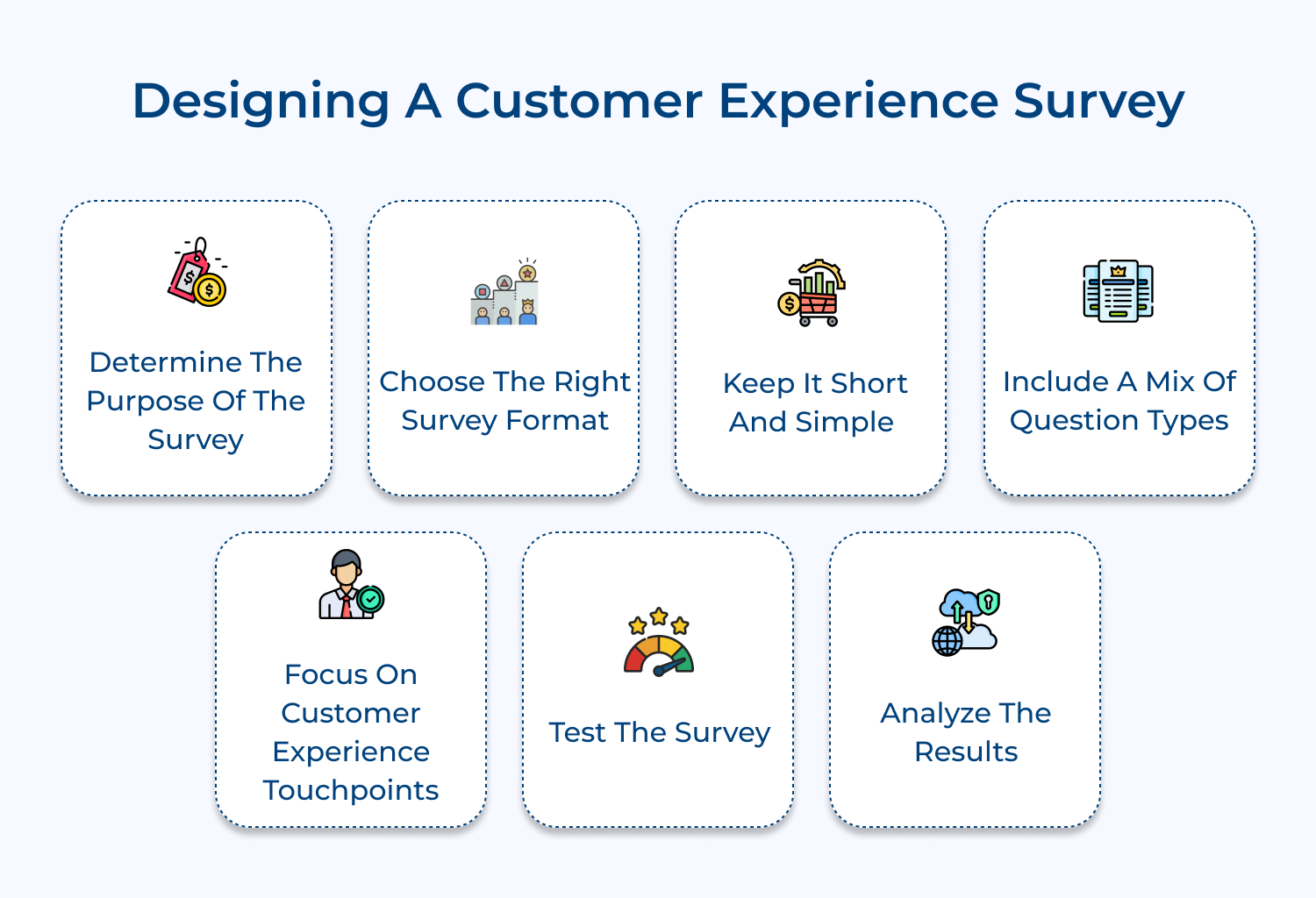
Before creating a customer experience survey, it is important to determine the purpose of the survey. Are you looking to gather feedback on a recent purchase, measure customer satisfaction, or identify areas for improvement? Having a clear objective will help guide the questions you include in the survey.
Here are few tips to follow:
There are various formats for customer experience surveys, including multiple-choice questions, open-ended questions, rating scales and Likert scales. Consider the type of information you want to gather and choose the format that best suits your objectives.
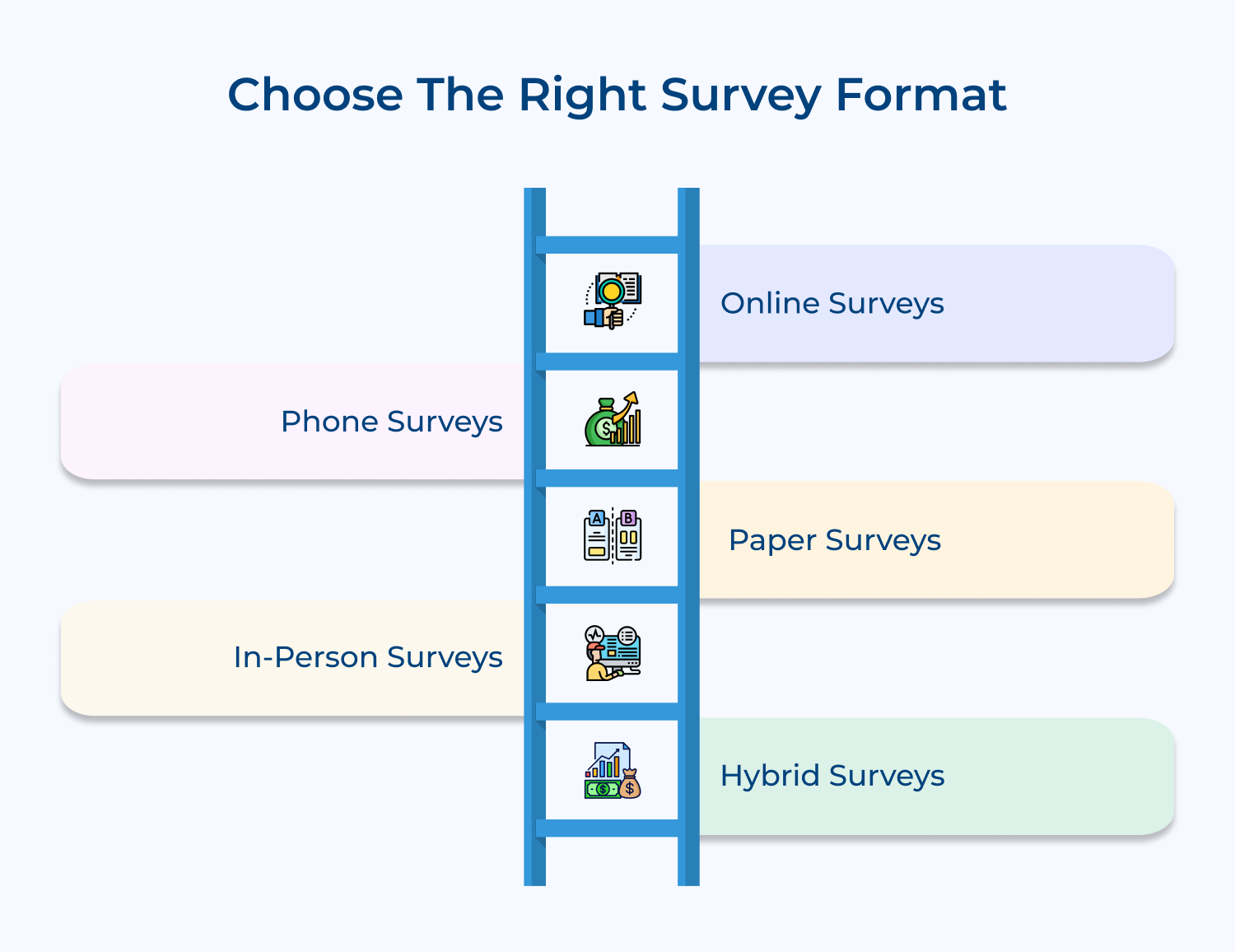
Here are few tips to follow:
To increase the response rate of your survey, it is important to keep it short and simple. Customers are more likely to complete a survey if it is concise and does not require a significant time commitment. Limit the number of questions and be mindful of the language used to ensure clarity.
Here are few tips to follow:
To gather comprehensive feedback from customers, include a mix of question types in your survey. It can include yes/no questions, multiple-choice questions, rating scales and open-ended questions. By incorporating a variety of question types, you can obtain a more holistic view of customer opinions.
Here are few tips to follow:
When designing a customer experience survey, consider focusing on specific touchpoints in the customer journey. It could include the purchasing process, customer service interactions, product usage, or website experience. By targeting key touchpoints, you can gather detailed feedback on areas that are most important to customers.
Here are few tips to follow:
Before launching the customer experience survey to a wider audience, it is important to test the survey with a small group of customers. It can help identify any issues with question clarity, survey flow, or technical glitches. Make any necessary revisions based on feedback from the test group before deploying the survey to a larger audience.
Here are few tips to follow:
Once the customer experience survey has been completed, take the time to analyze the results. Look for trends, patterns and key insights that can help inform decision-making within the business.
Segment survey results based on customer demographics, purchase behavior, or other criteria to gain deeper insights into specific customer groups. Analyzing data by segments can reveal differences in customer perceptions and preferences.
Here are few tips to follow:
CX surveys are a powerful way to gather feedback and understand customer needs, leading to improved satisfaction. Asking the right questions is key to gaining meaningful insights.
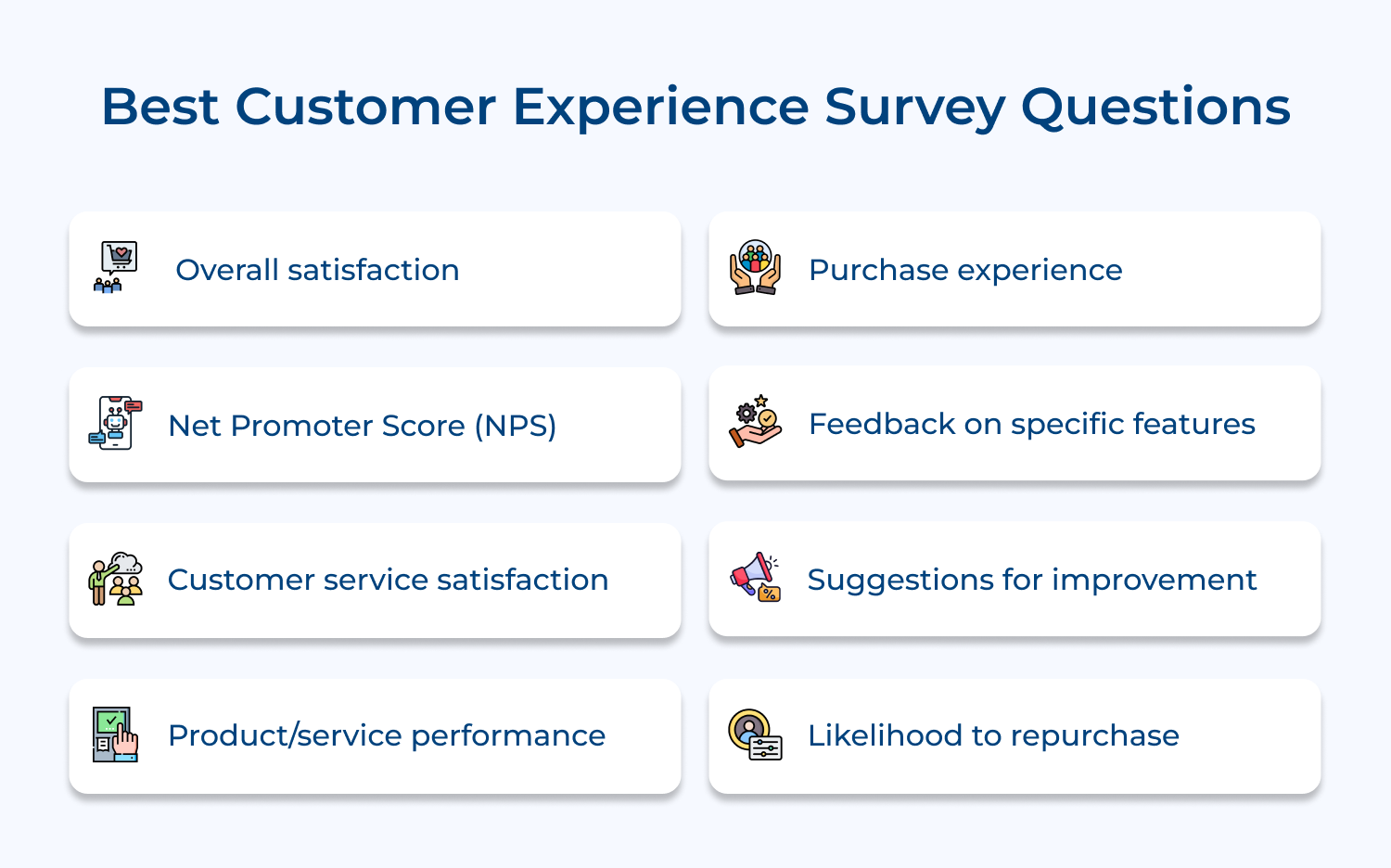
1. Overall satisfaction: Start by asking customers to rate their overall satisfaction with your product or service. This will give you a general idea of how happy your customers are with your offerings.
2. Net Promoter Score (NPS): The NPS question asks customers how likely they are to recommend your business to a friend or colleague. This question helps you gauge how loyal your customers are and how likely they are to spread positive word-of-mouth about your business.
3. Customer service satisfaction: Ask customers about their experience with your customer service team. This will help you understand if your support team is meeting customers’ expectations and provide insights on areas for improvement.
4. Product/service performance: Ask customers about their experience using your product or service. This could include questions about functionality, ease of use and overall performance.
5. Purchase experience: Inquire about customers’ experience while making a purchase from your business. This could include questions about the checkout process, shipping times and any issues they may have encountered.
6. Feedback on specific features: If you’re looking to improve a specific feature or aspect of your product or service, ask customers for feedback on that particular area. This will provide you with targeted insights to help you make improvements.
7. Suggestions for improvement: Give customers the opportunity to provide suggestions for how you can improve your product or service. This feedback can be invaluable for identifying areas of improvement and making changes that will benefit your customers.
8. Likelihood to repurchase: Ask customers how likely they are to repurchase from your business in the future. This question can help you gauge customer loyalty and identify opportunities to increase repeat business.
Customer experience surveys offer valuable insights into your products or services. To make the most of them, it’s crucial to focus on measuring the right metrics.

1. Net Promoter Score (NPS)
NPS is a measure of customer loyalty and satisfaction. It asks one simple question: “On a scale of 0-10, how likely are you to recommend our product/service to a friend or colleague?” Customers are then segmented into Promoters (score of 9-10), Passives (score of 7-8) and Detractors (score of 0-6). Calculating the NPS score can help gauge overall customer satisfaction and loyalty.
2. Customer Satisfaction Score (CSAT)
CSAT measures how satisfied customers are with a specific interaction, product, or service. Customers are typically asked to rate their satisfaction on a scale of 1-5 or 1-10. This metric can help identify areas of improvement and gauge overall customer satisfaction levels.
3. Customer Effort Score (CES)
CES measures how easy or difficult it was for customers to complete a specific task or interaction. Customers are asked to rate the effort required on a scale of 1-5 or 1-10. A lower CES score indicates a smoother and more seamless experience for customers.
4. Customer Churn Rate
Customer churn rate measures the percentage of customers who stop using your products or services over a specific period. Tracking churn rate can help identify reasons why customers are leaving and take proactive measures to prevent customer attrition.
5. Customer Lifetime Value (CLV)
CLV predicts the total revenue a customer will generate throughout their relationship with your company. Understanding CLV can help prioritize efforts to retain high-value customers and maximize revenue potential.
6. Customer Retention Rate
Customer retention rate measures the percentage of customers who continue to engage with your brand over time. Increasing customer retention can lead to long-term profitability and sustainable growth.
7. Customer Loyalty
Customer loyalty metrics such as repeat purchase rate, frequency of engagement and referral rates can provide valuable insights into customer behavior.
Customer experience surveys help companies to better understand their customers’ needs and overall satisfaction with their products or services.
The Ritz-Carlton’s guest experience survey covers various aspects of the hotel stay, such as check-in & check-out processes, room quality and cleanliness, staff attentiveness and courtesy, quality of dining experiences, and overall value for money.
Trader Joe’s surveys customers on their overall shopping experience, product quality as well as selection, store cleanliness, staff friendliness or helpfulness and likelihood of recommending the store to others.
The survey covers various aspects of the ride-sharing experience, including the driver’s behavior, the cleanliness of the vehicle, the navigation and the overall satisfaction with the ride.
Covers various aspects of USAA’s services, including banking, insurance and customer support. Uses rating scales, multiple-choice questions and open-ended feedback.
Gathering valuable insights from customer experience surveys is crucial for making better strategic decisions in your business. By listening to the customer feedback, you can identify areas for improvement, develop a deeper understanding of your target market, and drive growth.
Implementing changes based on this feedback can lead to increased customer satisfaction, loyalty and retention. So, be proactive in analyzing data from your CX surveys to stay ahead of the competition and continuously improve your products/services.

What is a customer experience survey?
A customer experience survey is a questionnaire designed to collect feedback from customers about their interactions with a business. These surveys typically consist of a series of questions that ask customers to rate their overall satisfaction, provide feedback on specific aspects of their experience, and offer suggestions for improvement.
How to choose the right CX survey questions?
When creating a customer experience survey, it’s important to consider the specific goals of the survey and tailor the questions accordingly. Some common types of questions to include in a CX survey are:
– Rating scales: Ask customers to rate their satisfaction on a scale from 1 to 5.
– Open-ended questions: Allow customers to provide detailed feedback in their own words.
– Net Promoter Score (NPS) questions: Measure customer loyalty and likelihood to recommend the business to others.
When should you conduct customer experience surveys?
Customer experience surveys should be conducted regularly to gather feedback from customers at different touch points throughout their journey with the business. It’s important to conduct surveys after key interactions, such as after a purchase, customer service interaction, or website visit. By collecting feedback at these specific moments, businesses can gain valuable insights into the customer experience.
Which tool should I use for customer experience surveys?
There are many tools available for conducting customer experience surveys, ranging from simple survey platforms like SurveyMonkey to more advanced customer experience management software like Qualtrics or Medallia. The best tool for your business will depend on your specific needs, budget and desired features. It’s important to choose a tool that allows for easy survey creation, data analysis and reporting capabilities to make the most out of your customer feedback.
 https://omni24.io/wp-content/uploads/2026/08/Customer-Service-Teams.png
1256
2400
Tushar Joshi
https://omni24.io/wp-content/uploads/2023/04/Omni-Logo-1.svg
Tushar Joshi2026-09-15 04:01:522026-09-15 04:02:16How to Build Customer Service Teams: 6 Key Steps
https://omni24.io/wp-content/uploads/2026/08/Customer-Service-Teams.png
1256
2400
Tushar Joshi
https://omni24.io/wp-content/uploads/2023/04/Omni-Logo-1.svg
Tushar Joshi2026-09-15 04:01:522026-09-15 04:02:16How to Build Customer Service Teams: 6 Key Steps https://omni24.io/wp-content/uploads/2026/08/conversational-ai-ecommerce.png
1256
2400
Webvision Solution
https://omni24.io/wp-content/uploads/2023/04/Omni-Logo-1.svg
Webvision Solution2026-09-08 04:06:222026-09-08 04:06:22How Conversational AI for Ecommerce Boosts Sales in 2026
https://omni24.io/wp-content/uploads/2026/08/conversational-ai-ecommerce.png
1256
2400
Webvision Solution
https://omni24.io/wp-content/uploads/2023/04/Omni-Logo-1.svg
Webvision Solution2026-09-08 04:06:222026-09-08 04:06:22How Conversational AI for Ecommerce Boosts Sales in 2026 https://omni24.io/wp-content/uploads/2026/08/Ecommerce-Customer-Segmentation.png
1256
2400
Tushar Joshi
https://omni24.io/wp-content/uploads/2023/04/Omni-Logo-1.svg
Tushar Joshi2026-09-07 04:53:302026-09-07 04:53:30How Ecommerce Customer Segmentation Drives Higher Conversions
https://omni24.io/wp-content/uploads/2026/08/Ecommerce-Customer-Segmentation.png
1256
2400
Tushar Joshi
https://omni24.io/wp-content/uploads/2023/04/Omni-Logo-1.svg
Tushar Joshi2026-09-07 04:53:302026-09-07 04:53:30How Ecommerce Customer Segmentation Drives Higher Conversions
Whether it’s about acquire, engage or support – Omni24 covers all your customer engagement needs in one complete platform.

Copyright ©2026 Veemo All rights reserved.
CA, Los Angeles, Hall Ave, 19011